The Relationship Between Positive,
Coaching and Clinical/Counseling
Psychology
Dr Patrick G Gwyer
PhD., DClinPsych CSci, AFBPsS, Cpsychol.
29th World Summit on Positive Psychology, Mindfulness &
Psychotherapy May 21-22, 2018 New York City, New York, USA
www.MyDots.life
The emergence of Coaching Psychology (CP) and Positive Psychology (PP) as
ways to improve wellbeing and reduce distress have grown rapidly over the
last few years.
This has traditionally been the domain of Counseling or Clinical Psychology
(C/CP).
The aim of this research was to explore;
1) How CP and PP sit along side their therapeutically orientated sister
disciplines of C/CP
2) Under what circumstances should one approach be used over another so
as to ensure maximum efficacy and client safety?
3) How can they be combined?
Overview
Methodology
Over 100 hours of clinical and coaching session notes, were thematically
reviewed.
The thematic analysis led to the identification of a number of common and
different themes between the approaches.
By adopting the notion of “conceptual maps” of phenomena, with different
“Ranges” and “Focuses” of convenience, the overlap and difference could be
coherently integrated.
From this an integrated transdiagnostic approach was created.
The SMARTER-life-GROWTH approach and accompanying SCOPE*
questionnaire was created.
* Severity & Complexity of Presentation Evaluation
The following themes were found to be linked to wellbeing in both coaching & therapy
Sense of meaning and purpose Ability to overcoming setbacks (resilience)
Ability to set and achieve goals Contentment with who they are
Sense of engagement and connection to
the world (the present)
Subjective rating of physical and
psychological health
Sleep, diet, exercise and daily routine
habits
Ability to manage thoughts, emotions, &
body sensations and to act wisely and with
planning (insight and awareness)
Satisfaction with their occupational or
educational situation
Satisfaction with the amount of enjoyable
and pleasurable activities they engage in
Interpersonal relationships Ability to manage daily living tasks
Acceptance of past experience Anticipation of the future
What differed was the complexity (number of problem
areas) and severity (the impact upon functioning): The more
complex and sever the lower wellbeing was found to be
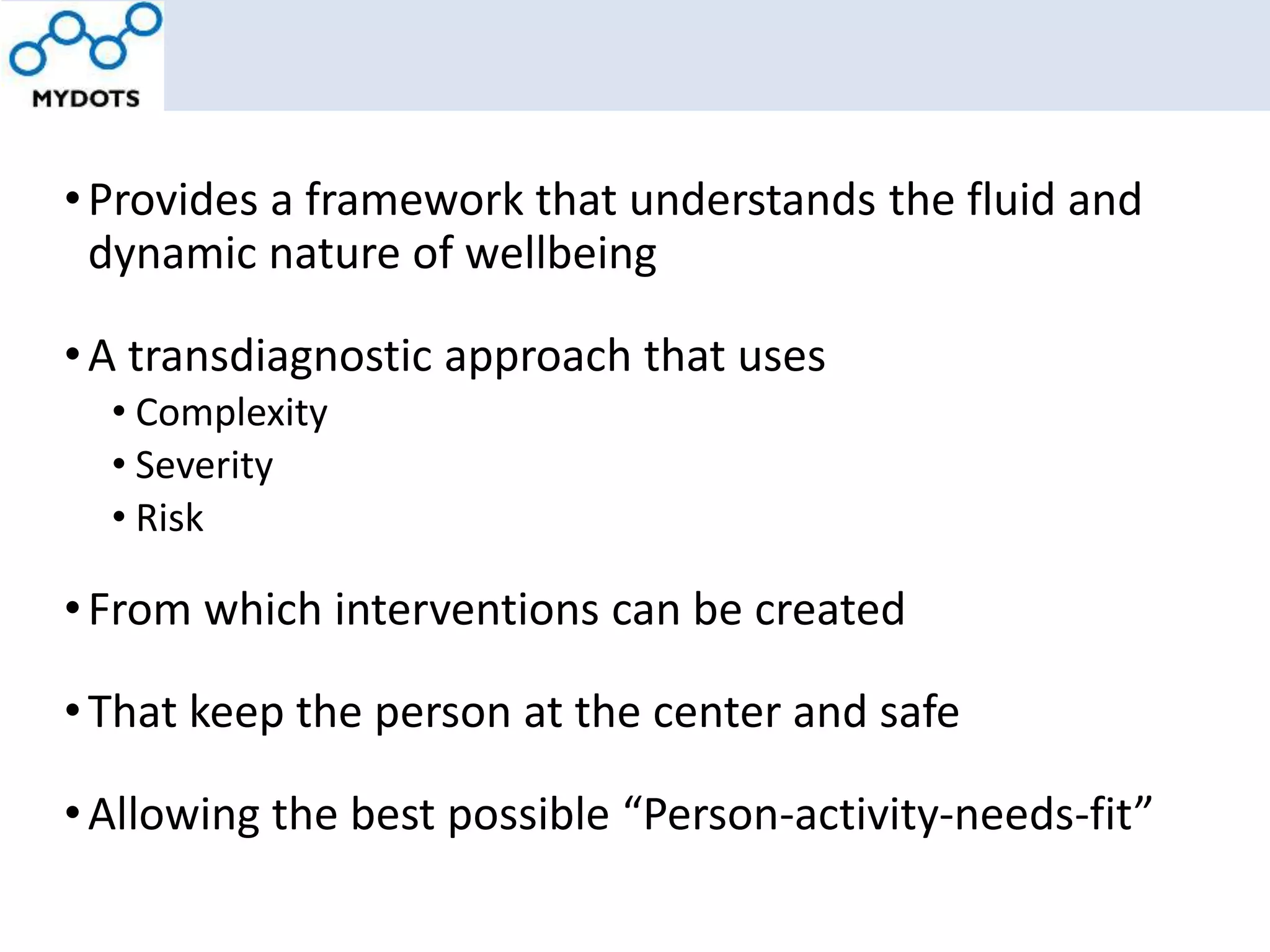
What does this mean?
•Provides a framework that understands the fluid and
dynamic nature of wellbeing
•A transdiagnostic approach that uses
• Complexity
• Severity
• Risk
•From which interventions can be created
•That keep the person at the center and safe
•Allowing the best possible “Person-activity-needs-fit”
How?
• Creating a skills based, evidence based approach that combines Clinical,
Counselling, Positive and Coaching Psychology interventions
• SMARTER – wellbeing goals and interventions (e.g., coaching & CBT)
• LIFE – (e.g., Positive Psychology and coaching)
• GROWTH – (e.g., Coaching)
• Mindfulness – (e.g., Clinical, Counselling, Positive and Coaching, MBCT)
• Key Psychological theories and approaches
• Acceptance & Commitment Therapy
• Dialectical Behavioral Therapy
• Gestalt
• Logo Therapy
• Person Centered / Humanistic
• Personal Construct Psychology
• Schema Therapy
• Solution Focused Therapy
SMARTER-life-GROWTH Interventions
• SMARTER
• Specific
• Measurable
• Achievable
• Relevant
• Time focused
• Evaluate
• Reflect
SMARTER-life-GROWTH Interventions
• Build life into your actions by doing …
• The things you Love and are passionate about
• The things that you are Interested and curious
about
• While being Fair and kind to yourself and others
• And Engaged and connected to your experiences
SMARTER-life-GROWTH Interventions
• GROWTH
• (smarter) Goals
• Realistic
• remove Obstacles form the available options to find you
opportunities
• Find the Way forward to achieve change and growth
• Find Tactics and strategies that work
• Make it a permanent wellbeing Habit
The aim is to achieve your …
• Best
• Realistic
• Achievable
• Ideal
• Self
Best
Possible
Self
Potential
self
Actual
self
Ideal
self
Unaware
Aware
Reflective
& Insightful
Planning
SMARTER-
life-
GROWTH
Action
Implement
goals
Outcome
Evaluation
and
reflection
The action has become a sustainable habit and
new areas are identified
The action has not become a sustainable habit
and so different ways of trying are identified
that build on the learning experience
A simple strategy for sustainable growth facilitating
change of a part within the whole
The separate but connected areas
Gestalts/Holons in a holarchy
Something that is simultaneously a whole and a part
Change in one causes change is the others
Parts of the Whole
•Resource Capital
•Biological
•Psychological
•Social
•Spiritual
•Acceptance of the Past
•Engagement with the present
•Anticipation of the future
Spiritual
Awareness, Insight,
Interconnection to others & the
world. Common humanity
Biological
Treating &/or managing
illness or injury.
Avoidance of substances
Appropriate use of
medication
Maintaining solid back 4
Social
Connection & closeness to
nature & community.
Housing / Employment,
Education, Hobbies &
Sports
Psychological
Personal qualities & interests
Abilities, Talents & Skills,
Aspirations & Desires, Self-
regulation skills
Anticipationoffuture
Acceptance of past
Engagement with present
Mindfulness – an umbrella term
• Four processes
Awareness
Reflection
Insight
Action
• Three types of attention
Bare attention
Zoom Lens (constrictive)
Wide-angle lens (expansive)
• Three types of mind
Intellectual
Wise
Emotional
Anticipationoffuture
Acceptance of past
Resource Capital
Engagementwithpresent
Four
Mindful
Processes
Three types of attention
Constrictive
Zoom lens
Expansive
Wide-angle lens
Bare
attention
Wise insightful
and
compassionate
mind were
wisdom lies.
Intellectual
mind
(hard-hearted
intellect)
Emotional
mind
(kind-hearted
fool)
Three types of mind
Anticipationoffuture
Acceptance of past
Resource Capital
Engagementwithpresent
Engagement,
connection &
openness to
experiences
Constrictive mindful
refection upon
individual
experience
Expansive mindful
reflecting upon the
individual experience
as part of the whole
Better
understanding of
the whole
WHO I AM
Use of bare mindful
attention to manage
distractions, stay focused
and manage distracting
and powerful emotions,
thoughts, body sensations
and urges to act
(especially escape and
avoid)
Steps
Flourishing
& thriving
Languishing
Floundering
Struggling &
Suffering
Step 1: Where is the individual now, and what can be done to stop them slipping down a step?
Step 2: What can be done to help them move up a step and help them remain there?
Achieved by;
Increasing awareness, reflection and insight into the components of wellbeing
Developing the skills to Increase the helpful and Decrease the unhelpful components
Achieved via the SMARTER-life-GROWTH approach
Assessment and outcome evaluation aided by the SCOPE questionnaire
Creation of the SCOPE measure
Severity and Complexity of Presentation Evaluation
• Twenty questions rated on 1 – 10 scale
• Completely agree to completely disagree (some items reversed scored)
Completely
disagree
Neither agree nor
disagree
Completely
agree
10 9 8 7 6 5 4 3 2 1 0
Example questions;
I feel that my life has meaning, and I feel a sense of purpose in my life
I feel that I can achieve the goals I set in life
The relationships I have in my life are supportive
I can manage the setbacks I experience without getting overwhelmed
Completely
disagree
Neither agree nor
disagree
Completely
agree
0 1 2 3 4 5 6 7 8 9 10
Self
trans
-cendence
Self
actualization
Self-esteem & self worth
needs and feeling valued
Being connected to others, nature, and
belonging to social groups
Safety and security needs stability, freedom
from fear
Physiological needs (the solid back four)
Reducing or removing self from harmful or dangerous behaviors &
situations / treating illness
Currently we are developing the SCOPE measure as
a free on line tool and matching interventions with
SCOPE measure outcome score to create a tool for
practitioners and clients
If you are interested in being involved, we would
greatly value any collaborative opportunities to
continue with this exploration and would love to
have you on board and make this a truly
international venture.
Contact details
Dr Patrick G Gwyer
LinkedIn: https://www.linkedin.com/in/drpatgwyerphd/
Skype: live:patgwyer
Twitter: @dr_gwyer
Website: http://drpatrickgwyer.com
MyDots Training and Consultancy
Website: https://www.mydots.life
Thank you for your time and attention

The Relationship Between Positive, Coaching and Clinical/Counseling Psychology

  • 1.
    The Relationship BetweenPositive, Coaching and Clinical/Counseling Psychology Dr Patrick G Gwyer PhD., DClinPsych CSci, AFBPsS, Cpsychol. 29th World Summit on Positive Psychology, Mindfulness & Psychotherapy May 21-22, 2018 New York City, New York, USA www.MyDots.life
  • 2.
    The emergence ofCoaching Psychology (CP) and Positive Psychology (PP) as ways to improve wellbeing and reduce distress have grown rapidly over the last few years. This has traditionally been the domain of Counseling or Clinical Psychology (C/CP). The aim of this research was to explore; 1) How CP and PP sit along side their therapeutically orientated sister disciplines of C/CP 2) Under what circumstances should one approach be used over another so as to ensure maximum efficacy and client safety? 3) How can they be combined? Overview
  • 3.
    Methodology Over 100 hoursof clinical and coaching session notes, were thematically reviewed. The thematic analysis led to the identification of a number of common and different themes between the approaches. By adopting the notion of “conceptual maps” of phenomena, with different “Ranges” and “Focuses” of convenience, the overlap and difference could be coherently integrated. From this an integrated transdiagnostic approach was created. The SMARTER-life-GROWTH approach and accompanying SCOPE* questionnaire was created. * Severity & Complexity of Presentation Evaluation
  • 4.
    The following themeswere found to be linked to wellbeing in both coaching & therapy Sense of meaning and purpose Ability to overcoming setbacks (resilience) Ability to set and achieve goals Contentment with who they are Sense of engagement and connection to the world (the present) Subjective rating of physical and psychological health Sleep, diet, exercise and daily routine habits Ability to manage thoughts, emotions, & body sensations and to act wisely and with planning (insight and awareness) Satisfaction with their occupational or educational situation Satisfaction with the amount of enjoyable and pleasurable activities they engage in Interpersonal relationships Ability to manage daily living tasks Acceptance of past experience Anticipation of the future
  • 5.
    What differed wasthe complexity (number of problem areas) and severity (the impact upon functioning): The more complex and sever the lower wellbeing was found to be
  • 8.
    What does thismean? •Provides a framework that understands the fluid and dynamic nature of wellbeing •A transdiagnostic approach that uses • Complexity • Severity • Risk •From which interventions can be created •That keep the person at the center and safe •Allowing the best possible “Person-activity-needs-fit”
  • 9.
    How? • Creating askills based, evidence based approach that combines Clinical, Counselling, Positive and Coaching Psychology interventions • SMARTER – wellbeing goals and interventions (e.g., coaching & CBT) • LIFE – (e.g., Positive Psychology and coaching) • GROWTH – (e.g., Coaching) • Mindfulness – (e.g., Clinical, Counselling, Positive and Coaching, MBCT) • Key Psychological theories and approaches • Acceptance & Commitment Therapy • Dialectical Behavioral Therapy • Gestalt • Logo Therapy • Person Centered / Humanistic • Personal Construct Psychology • Schema Therapy • Solution Focused Therapy
  • 10.
    SMARTER-life-GROWTH Interventions • SMARTER •Specific • Measurable • Achievable • Relevant • Time focused • Evaluate • Reflect
  • 11.
    SMARTER-life-GROWTH Interventions • Buildlife into your actions by doing … • The things you Love and are passionate about • The things that you are Interested and curious about • While being Fair and kind to yourself and others • And Engaged and connected to your experiences
  • 12.
    SMARTER-life-GROWTH Interventions • GROWTH •(smarter) Goals • Realistic • remove Obstacles form the available options to find you opportunities • Find the Way forward to achieve change and growth • Find Tactics and strategies that work • Make it a permanent wellbeing Habit
  • 13.
    The aim isto achieve your … • Best • Realistic • Achievable • Ideal • Self Best Possible Self Potential self Actual self Ideal self
  • 14.
    Unaware Aware Reflective & Insightful Planning SMARTER- life- GROWTH Action Implement goals Outcome Evaluation and reflection The actionhas become a sustainable habit and new areas are identified The action has not become a sustainable habit and so different ways of trying are identified that build on the learning experience A simple strategy for sustainable growth facilitating change of a part within the whole
  • 15.
    The separate butconnected areas Gestalts/Holons in a holarchy Something that is simultaneously a whole and a part Change in one causes change is the others
  • 17.
    Parts of theWhole •Resource Capital •Biological •Psychological •Social •Spiritual •Acceptance of the Past •Engagement with the present •Anticipation of the future
  • 18.
    Spiritual Awareness, Insight, Interconnection toothers & the world. Common humanity Biological Treating &/or managing illness or injury. Avoidance of substances Appropriate use of medication Maintaining solid back 4 Social Connection & closeness to nature & community. Housing / Employment, Education, Hobbies & Sports Psychological Personal qualities & interests Abilities, Talents & Skills, Aspirations & Desires, Self- regulation skills Anticipationoffuture Acceptance of past Engagement with present
  • 19.
    Mindfulness – anumbrella term • Four processes Awareness Reflection Insight Action • Three types of attention Bare attention Zoom Lens (constrictive) Wide-angle lens (expansive) • Three types of mind Intellectual Wise Emotional
  • 20.
    Anticipationoffuture Acceptance of past ResourceCapital Engagementwithpresent Four Mindful Processes
  • 21.
    Three types ofattention Constrictive Zoom lens Expansive Wide-angle lens Bare attention
  • 22.
    Wise insightful and compassionate mind were wisdomlies. Intellectual mind (hard-hearted intellect) Emotional mind (kind-hearted fool) Three types of mind
  • 23.
    Anticipationoffuture Acceptance of past ResourceCapital Engagementwithpresent Engagement, connection & openness to experiences Constrictive mindful refection upon individual experience Expansive mindful reflecting upon the individual experience as part of the whole Better understanding of the whole WHO I AM Use of bare mindful attention to manage distractions, stay focused and manage distracting and powerful emotions, thoughts, body sensations and urges to act (especially escape and avoid)
  • 24.
    Steps Flourishing & thriving Languishing Floundering Struggling & Suffering Step1: Where is the individual now, and what can be done to stop them slipping down a step? Step 2: What can be done to help them move up a step and help them remain there? Achieved by; Increasing awareness, reflection and insight into the components of wellbeing Developing the skills to Increase the helpful and Decrease the unhelpful components Achieved via the SMARTER-life-GROWTH approach Assessment and outcome evaluation aided by the SCOPE questionnaire
  • 25.
    Creation of theSCOPE measure Severity and Complexity of Presentation Evaluation • Twenty questions rated on 1 – 10 scale • Completely agree to completely disagree (some items reversed scored) Completely disagree Neither agree nor disagree Completely agree 10 9 8 7 6 5 4 3 2 1 0 Example questions; I feel that my life has meaning, and I feel a sense of purpose in my life I feel that I can achieve the goals I set in life The relationships I have in my life are supportive I can manage the setbacks I experience without getting overwhelmed Completely disagree Neither agree nor disagree Completely agree 0 1 2 3 4 5 6 7 8 9 10
  • 27.
    Self trans -cendence Self actualization Self-esteem & selfworth needs and feeling valued Being connected to others, nature, and belonging to social groups Safety and security needs stability, freedom from fear Physiological needs (the solid back four) Reducing or removing self from harmful or dangerous behaviors & situations / treating illness
  • 28.
    Currently we aredeveloping the SCOPE measure as a free on line tool and matching interventions with SCOPE measure outcome score to create a tool for practitioners and clients If you are interested in being involved, we would greatly value any collaborative opportunities to continue with this exploration and would love to have you on board and make this a truly international venture.
  • 29.
    Contact details Dr PatrickG Gwyer LinkedIn: https://www.linkedin.com/in/drpatgwyerphd/ Skype: live:patgwyer Twitter: @dr_gwyer Website: http://drpatrickgwyer.com MyDots Training and Consultancy Website: https://www.mydots.life Thank you for your time and attention