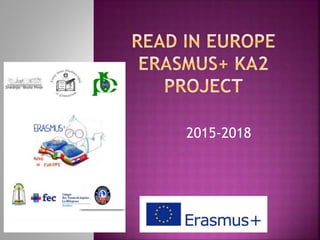
2015-2018
01.09.2015 – 31.08.2018
Grant approved: 120750.00 euro
Total nr of mobilities: 280
- Transnational project meetings: 40
- Joint teacher training: 30
- Short-term student exchange: 150 students +
60 teachers
 Srednja skola Hvar, Croatia
 FEC Santo Tomás de Aquino La MIlagrosa, Tomelloso,
Spain
 BURHAN FELEK COK PROGRAMLI ANADOLU LISESI,
Istambul, Turkey
 LICEO SCIENTIFICO PASTEUR, Roma, Italy
 Pr.Zadeikio gimnazija, Skuodas, Lithuania
 We set up national and international project teams
 We established collaborative and dissemination platforms
(Twinspace, Facebook groups, Project blogs, Project webpage,
Edmodo classroom, Twitter, Slideshare account)
 Introduction of participants, schools, towns and countries
through presentations and films
 We carried out the competition for selecting the project logo
 We administered a questionnaire about students' reading habits
and evaluated the results
 We conducted interviews with local libraries
 Students presented their top 5 favourite books
 We made presentations on classical and contemporary authors
 We got acquainted with each other's national authors
 Students selected their common reader, read it, worked on it and
presented it.
 Students presented their country’s role and history within the EU
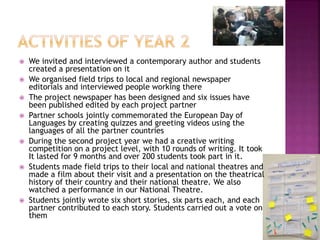
 We invited and interviewed a contemporary author and students
created a presentation on it
 We organised field trips to local and regional newspaper
editorials and interviewed people working there
 The project newspaper has been designed and six issues have
been published edited by each project partner
 Partner schools jointly commemorated the European Day of
Languages by creating quizzes and greeting videos using the
languages of all the partner countries
 During the second project year we had a creative writing
competition on a project level, with 10 rounds of writing. It took
It lasted for 9 months and over 200 students took part in it.
 Students made field trips to their local and national theatres and
made a film about their visit and a presentation on the theatrical
history of their country and their national theatre. We also
watched a performance in our National Theatre.
 Students jointly wrote six short stories, six parts each, and each
partner contributed to each story. Students carried out a vote on
them
 Each partner school organised a translation competition.
We involved over 80 students in it in our school.
 Our school organised a local reading competition involving
the other three primary schools of our town. We invited
colleagues and used techniques and methods we learnt
during the project.
 The script for the common play ’Murder in Istambul’ has
been completed along with description of props, costumes,
sets, sound effects, background music and choreography.
Poster and invitation cards have been designed.
 An international performance of the play took place during
the last student exchange.
 Every partner presents it on national level, too and records
the performance.
 Selection of best actor and actress will be carried out.
 Introduction of students, our schools, our towns and countries in
the form of presentations and films
 E-booklet compiled by students about national classical and
contemporary authors.
 Reading and making various forms of illustrations about our
common reader (The Canterville Ghost by Oscar Wilde)
 Posters about our countries’ role and history within the European
Union
 Presentations on a contemporary author interviewed by students
 Presentations on a local and/or regional newspaper
 Six issues of our project newspaper titled #Erast@gram+.
 Six short stories jointly written by students
 Presentations on national theatrical history and national theatres
and films showing field trips taken by students
 A ready-made play
 Collection of writings submitted by students for the creative
writing competition
 Lesson plans and activities for developing reading
comprehension, speaking, drama and vocabulary (national
literary extracts, Androcles and the Lion, The Selfish
Giant, Midsummer Night’s Dream)
 Activity bank for our common reader
 Activity bank and quizzes about the European Union both
in English and Hungarian
 Collection of useful links for ESL and Reading (Livebinder)
 Collection of drama activities accompanied by a training
video recorded during the 2nd teacher training event
 A guideline for the creative writing competition with
description of the activities and assessment grid
 Materials (interactive exercises, worksheets and activities)
for a reading competition on Shakespeare and MND using
various ICT tools
 Booklet on digital tools used during the project
 Regular appearance in local press and
television
 School webpage
 Project webpage
 Project blog
 Twinspace
 Facebook page
 Onenote – teaching materials, lesson plans
 Slideshare, Twitter, Pinterest
 Regular reports to colleagues during teachers’
meetings
 Informing students with project wall and peer
reports
 Erasmus+ conference: november 2015: our
school’s and local teachers – demonstration of
methods and tools
 Local teachers’ development workshops:
regularly within our department + workshop for
other colleagues on teaching creative writing:
February 2018
 Europe day: informing students + getting to know
partner countries
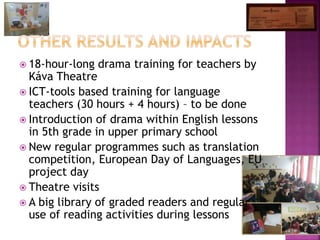
 18-hour-long drama training for teachers by
Káva Theatre
 ICT-tools based training for language
teachers (30 hours + 4 hours) – to be done
 Introduction of drama within English lessons
in 5th grade in upper primary school
 New regular programmes such as translation
competition, European Day of Languages, EU
project day
 Theatre visits
 A big library of graded readers and regular
use of reading activities during lessons
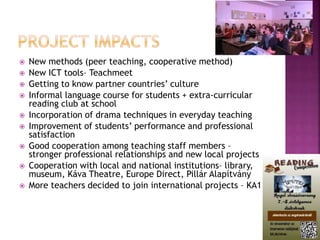
 New methods (peer teaching, cooperative method)
 New ICT tools– Teachmeet
 Getting to know partner countries’ culture
 Informal language course for students + extra-curricular
reading club at school
 Incorporation of drama techniques in everyday teaching
 Improvement of students’ performance and professional
satisfaction
 Good cooperation among teaching staff members –
stronger professional relationships and new local projects
 Cooperation with local and national institutions– library,
museum, Káva Theatre, Europe Direct, Pillár Alapítvány
 More teachers decided to join international projects – KA1
 Great partnership
 Reliable amd hard-working partners
 All tasks are completed
 Strong professional relationship
 A wide range of methods used
 Several new ICT tools and applications
 Huge amount of materials created
 Succesful integration of project activities
into the school curricula
 It was the first time we were project
coordinators
 Making sure everything is recorded and
disseminated
 The lenght of the project: it was difficult to
engage all students throughout the whole
project
 The number of project activities: a strict
timeline
Rea din europe-presentation

Rea din europe-presentation

  • 1.
  • 2.
    01.09.2015 – 31.08.2018 Grantapproved: 120750.00 euro Total nr of mobilities: 280 - Transnational project meetings: 40 - Joint teacher training: 30 - Short-term student exchange: 150 students + 60 teachers
  • 3.
     Srednja skolaHvar, Croatia  FEC Santo Tomás de Aquino La MIlagrosa, Tomelloso, Spain  BURHAN FELEK COK PROGRAMLI ANADOLU LISESI, Istambul, Turkey  LICEO SCIENTIFICO PASTEUR, Roma, Italy  Pr.Zadeikio gimnazija, Skuodas, Lithuania
  • 4.
     We setup national and international project teams  We established collaborative and dissemination platforms (Twinspace, Facebook groups, Project blogs, Project webpage, Edmodo classroom, Twitter, Slideshare account)  Introduction of participants, schools, towns and countries through presentations and films  We carried out the competition for selecting the project logo  We administered a questionnaire about students' reading habits and evaluated the results  We conducted interviews with local libraries  Students presented their top 5 favourite books  We made presentations on classical and contemporary authors  We got acquainted with each other's national authors  Students selected their common reader, read it, worked on it and presented it.  Students presented their country’s role and history within the EU
  • 5.
     We invitedand interviewed a contemporary author and students created a presentation on it  We organised field trips to local and regional newspaper editorials and interviewed people working there  The project newspaper has been designed and six issues have been published edited by each project partner  Partner schools jointly commemorated the European Day of Languages by creating quizzes and greeting videos using the languages of all the partner countries  During the second project year we had a creative writing competition on a project level, with 10 rounds of writing. It took It lasted for 9 months and over 200 students took part in it.  Students made field trips to their local and national theatres and made a film about their visit and a presentation on the theatrical history of their country and their national theatre. We also watched a performance in our National Theatre.  Students jointly wrote six short stories, six parts each, and each partner contributed to each story. Students carried out a vote on them
  • 6.
     Each partnerschool organised a translation competition. We involved over 80 students in it in our school.  Our school organised a local reading competition involving the other three primary schools of our town. We invited colleagues and used techniques and methods we learnt during the project.  The script for the common play ’Murder in Istambul’ has been completed along with description of props, costumes, sets, sound effects, background music and choreography. Poster and invitation cards have been designed.  An international performance of the play took place during the last student exchange.  Every partner presents it on national level, too and records the performance.  Selection of best actor and actress will be carried out.
  • 7.
     Introduction ofstudents, our schools, our towns and countries in the form of presentations and films  E-booklet compiled by students about national classical and contemporary authors.  Reading and making various forms of illustrations about our common reader (The Canterville Ghost by Oscar Wilde)  Posters about our countries’ role and history within the European Union  Presentations on a contemporary author interviewed by students  Presentations on a local and/or regional newspaper  Six issues of our project newspaper titled #Erast@gram+.  Six short stories jointly written by students  Presentations on national theatrical history and national theatres and films showing field trips taken by students  A ready-made play  Collection of writings submitted by students for the creative writing competition
  • 8.
     Lesson plansand activities for developing reading comprehension, speaking, drama and vocabulary (national literary extracts, Androcles and the Lion, The Selfish Giant, Midsummer Night’s Dream)  Activity bank for our common reader  Activity bank and quizzes about the European Union both in English and Hungarian  Collection of useful links for ESL and Reading (Livebinder)  Collection of drama activities accompanied by a training video recorded during the 2nd teacher training event  A guideline for the creative writing competition with description of the activities and assessment grid  Materials (interactive exercises, worksheets and activities) for a reading competition on Shakespeare and MND using various ICT tools  Booklet on digital tools used during the project
  • 9.
     Regular appearancein local press and television  School webpage  Project webpage  Project blog  Twinspace  Facebook page  Onenote – teaching materials, lesson plans  Slideshare, Twitter, Pinterest
  • 10.
     Regular reportsto colleagues during teachers’ meetings  Informing students with project wall and peer reports  Erasmus+ conference: november 2015: our school’s and local teachers – demonstration of methods and tools  Local teachers’ development workshops: regularly within our department + workshop for other colleagues on teaching creative writing: February 2018  Europe day: informing students + getting to know partner countries
  • 11.
     18-hour-long dramatraining for teachers by Káva Theatre  ICT-tools based training for language teachers (30 hours + 4 hours) – to be done  Introduction of drama within English lessons in 5th grade in upper primary school  New regular programmes such as translation competition, European Day of Languages, EU project day  Theatre visits  A big library of graded readers and regular use of reading activities during lessons
  • 12.
     New methods(peer teaching, cooperative method)  New ICT tools– Teachmeet  Getting to know partner countries’ culture  Informal language course for students + extra-curricular reading club at school  Incorporation of drama techniques in everyday teaching  Improvement of students’ performance and professional satisfaction  Good cooperation among teaching staff members – stronger professional relationships and new local projects  Cooperation with local and national institutions– library, museum, Káva Theatre, Europe Direct, Pillár Alapítvány  More teachers decided to join international projects – KA1
  • 13.
     Great partnership Reliable amd hard-working partners  All tasks are completed  Strong professional relationship  A wide range of methods used  Several new ICT tools and applications  Huge amount of materials created  Succesful integration of project activities into the school curricula
  • 14.
     It wasthe first time we were project coordinators  Making sure everything is recorded and disseminated  The lenght of the project: it was difficult to engage all students throughout the whole project  The number of project activities: a strict timeline