RDBMS
RDBMS | Checkpoint RDBMS 1
MySQL
RDBMS | Checkpoint RDBMS 2
MySQL is a relational database management system (RDBMS) based on the SQL (Structured Query
Language) queries. It is one of the most popular languages for accessing and managing the records in the
table.
MySQL is open-source and free software under the GNU license.
Features : Easy to use, it is secure, Client/ Server architecture, free to download, it is scalable, high flexibility,
memory efficiency, high performance, GUI support, ..
PostgreSQL
RDBMS | Checkpoint RDBMS 3
PostgreSQL is an advanced, enterprise-class, and open-source relational database system. PostgreSQL
supports both SQL (relational) and JSON (non-relational) querying.
Features : User-defined types, table inheritance, sophisticated locking mechanism, foreign key referential
integrity,
Nested transactions (savepoints), ..
SQL Server
RDBMS | Checkpoint RDBMS 4
Microsoft SQL Server is a relational database management system developed by Microsoft.
As a database server, it is a software product with the primary function of storing and retrieving data as
requested by other software applications which may run either on the same computer or on another
computer across a network (including the Internet).
Features : User-defined type Intelligent Query Processing Enhancements, , ..
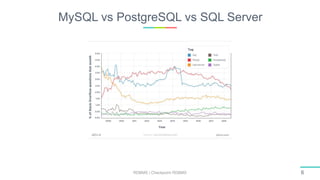
MySQL vs PostgreSQL vs SQL Server
RDBMS | Checkpoint RDBMS 5
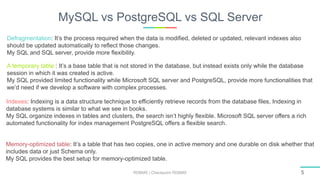
Defragmentation: It’s the process required when the data is modified, deleted or updated, relevant indexes also
should be updated automatically to reflect those changes.
My SQL and SQL server, provide more flexibility.
A temporary table : It’s a base table that is not stored in the database, but instead exists only while the database
session in which it was created is active.
My SQL provided limited functionality while Microsoft SQL server and PostgreSQL, provide more functionalities that
we’d need if we develop a software with complex processes.
Indexes: Indexing is a data structure technique to efficiently retrieve records from the database files, Indexing in
database systems is similar to what we see in books.
My SQL organize indexes in tables and clusters, the search isn’t highly flexible. Microsoft SQL server offers a rich
automated functionality for index management PostgreSQL offers a flexible search.
Memory-optimized table: It’s a table that has two copies, one in active memory and one durable on disk whether that
includes data or just Schema only.
My SQL provides the best setup for memory-optimized table.
MySQL vs PostgreSQL vs SQL Server
RDBMS | Checkpoint RDBMS 6
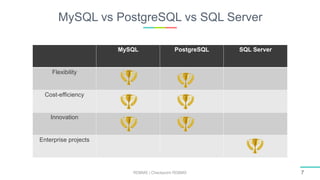
MySQL vs PostgreSQL vs SQL Server
RDBMS | Checkpoint RDBMS 7
MySQL PostgreSQL SQL Server
Flexibility
Cost-efficiency
Innovation
Enterprise projects
See you again!
Hey it’s Waldo!! Did you watch the
episode??

Rdbms

  • 1.
  • 2.
    MySQL RDBMS | CheckpointRDBMS 2 MySQL is a relational database management system (RDBMS) based on the SQL (Structured Query Language) queries. It is one of the most popular languages for accessing and managing the records in the table. MySQL is open-source and free software under the GNU license. Features : Easy to use, it is secure, Client/ Server architecture, free to download, it is scalable, high flexibility, memory efficiency, high performance, GUI support, ..
  • 3.
    PostgreSQL RDBMS | CheckpointRDBMS 3 PostgreSQL is an advanced, enterprise-class, and open-source relational database system. PostgreSQL supports both SQL (relational) and JSON (non-relational) querying. Features : User-defined types, table inheritance, sophisticated locking mechanism, foreign key referential integrity, Nested transactions (savepoints), ..
  • 4.
    SQL Server RDBMS |Checkpoint RDBMS 4 Microsoft SQL Server is a relational database management system developed by Microsoft. As a database server, it is a software product with the primary function of storing and retrieving data as requested by other software applications which may run either on the same computer or on another computer across a network (including the Internet). Features : User-defined type Intelligent Query Processing Enhancements, , ..
  • 5.
    MySQL vs PostgreSQLvs SQL Server RDBMS | Checkpoint RDBMS 5 Defragmentation: It’s the process required when the data is modified, deleted or updated, relevant indexes also should be updated automatically to reflect those changes. My SQL and SQL server, provide more flexibility. A temporary table : It’s a base table that is not stored in the database, but instead exists only while the database session in which it was created is active. My SQL provided limited functionality while Microsoft SQL server and PostgreSQL, provide more functionalities that we’d need if we develop a software with complex processes. Indexes: Indexing is a data structure technique to efficiently retrieve records from the database files, Indexing in database systems is similar to what we see in books. My SQL organize indexes in tables and clusters, the search isn’t highly flexible. Microsoft SQL server offers a rich automated functionality for index management PostgreSQL offers a flexible search. Memory-optimized table: It’s a table that has two copies, one in active memory and one durable on disk whether that includes data or just Schema only. My SQL provides the best setup for memory-optimized table.
  • 6.
    MySQL vs PostgreSQLvs SQL Server RDBMS | Checkpoint RDBMS 6
  • 7.
    MySQL vs PostgreSQLvs SQL Server RDBMS | Checkpoint RDBMS 7 MySQL PostgreSQL SQL Server Flexibility Cost-efficiency Innovation Enterprise projects
  • 8.
    See you again! Heyit’s Waldo!! Did you watch the episode??