Jatropha R&D project
To set up a  mycorrhizal germplasm  reservoir of genetic diversity of mycorrhizal fungi of jatropha-curcas with high oil yielding for biodiesel production and the elimination of the  toxicity of the meal]waste for animal feed Executing organization : BIOVALE ENERGIA – an emerging biodiesel company based in the Minas Gerais in partnership with various stakeholders in the oil production chain Co-executing organizations: Federal University of Viçosa – DMB/BIOAGRO, ranked as the best university of Minas Gerais State and 3rd in Brazil SECTES – Minas Gerais State Science and Technology Secretariat EPAMIG – EMPRESA DE PESQUISA DE AGROPECUÁRIA DE MINAS, national bench-mark in jatropha development CENTRO TECNOLÓGICO DE MINAS GERAIS - CETEC R&D goals and stakeholders
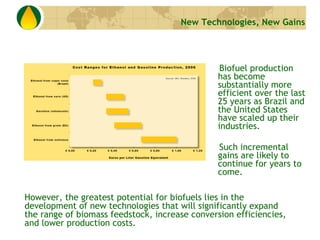
Biofuel production has become substantially more efficient over the last 25 years as Brazil and the United States have scaled up their industries. Such incremental gains are likely to continue for years to come.  New Technologies, New Gains However, the greatest potential for biofuels lies in the development of new technologies that will significantly expand the range of biomass feedstock, increase conversion efficiencies, and lower production costs.
Documentation, preservation and characterization of  J. curcas  and mycorrhizal fungi germplasm Development of micropropagated plants inoculated  of ROC (Root Organ Culture) of arbuscular mycorrhizal (AM) fungi and their  in vitro  mass inoculum production  Selection of jatropha genotypes with high oil yielding, envisaging the biodiesel production  Toxicity elimination of the waste for animal feed Utilization and reclamation of industry created wastelands Expected results The mycorrhizal technology offers biological means of assuring plant health in an economically profitable and ecologically friendly manner. The only known fungal system categorized as a biofertilizer, mycorrhizae provide plant roots with extended arms that help them tap soil nutrients that are otherwise beyond their reach. This means greater availability of other, enriching soil, increasing health, and decreasing dependence on chemical fertilizers.
It exists a wide diversity within the AM fungi which form association with the roots of almost 80% plant species and enhance mineral nutrient acquisition and water uptake, as well as increase tolerance towards different environmental stresses conditions.  To conserve and exploit their diversity, BioVale Project contemplates to build  J. curcas  and  mycorrhizal fungi culture depository houses and maintain cultures from  different agro-ecological zones, in different areas of Brazil. The expected result is to trap isolate a variety of  J. curcas  and  polysporal/monosporal cultures, setting up a  J. curcas  and  mycorrhizal fungi germplasm collection  of genetic diversity of agriculturally and industrially  species for oil production . Documentation, preservation and characterization of  J. curcas  and mycorrhizal fungi germplasm
The ROC (root organ culture) system is the most attractive and advanced cultivation methodology for AM ( arbuscular mycorrhizal  )  fungi: it uses root-inducing transfer-DNA-transformed roots of a host plant to develop the symbiosis on a specific medium  in vitro  which provides pure, viable, contamination-free inoculum using reduced space.  BioVale R&D Project aims at gaining expertise in ROC for  in vitro  culture and utilize mass production of AM fungi under  in vitro. Development of ROC of different AM fungi and their  mass inoculum production under in vitro
Although the facts and figures of potential role of mycorrhizal association in enhanced nutritional and water needs of plants in laboratories, the major bottleneck for its widespread application to reach the end-users is its bulk production to cater the huge requirement. A known fact that culturing mycorrhizal fungi in laboratory conditions like other microbes was not possible due to its strict biotrophic nature of proliferation in the presence of suitable host has been the major reservation of its future contribution in agriculture.  The mass inoculum technology envisages to exploit the genetically modified host roots using the  Agrobacteriumum rhizogenes  carrying Ri T-DNA plasmid. The technology offers the mass production of viable, healthy, genetically pure and high quality fungal propagules, without any pathogenic contamination under  in vitro   environment.  Mass inoculum technology
Jatropha has been  identified as one the best plant alternative to offer clean fuel for achieving energy security. Jatropha seeds inoculated with in vitro-raised mycorrhiza  exhibits early fruition and flowers from the 7th month onwards as against a year with conventional clonal plantations and two years from seed raised plantations.  The mycorrhized  Jatropha  also exhibited 20%–30% higher yields as compared to non-mycorrhizal plantations.  The mycorrhized Jatropha will be widely tested covering several agro-climatic regions in Brazil to prove their adaptation  in diverse soils. More and earlier productivity
Mycorrhized  Jatropha  has been working on the reclamation of environmentally vulnerable and uncultivable lands using mycorrhizal technology for more than a decade in India. The technology has proven its worth and potential in many sites, including fly ash overburdens, and land contaminated with distillery effluents, tannery effluent affected sites and chlor  alkali sludge.  Mycorrhiza benefits both the plants and the environmentally vulnerable sites. Plant benefits include augmentation of the supply of phosphorus and trace elements and protection of plant roots from root diseases, high soil temperatures, and high salt concentrations. The hyphae of mycorrhiza can also bind soil particles, improve their aggregating capabilities, stabilize soil aggregates, and check leaching of important elements and heavy metals . Environmental amelioration using mycorrhizal technology
The seed kernels are rich in crude protein, CP (31–34.5%) and lipid (55–58%). The neutral detergent fibre contents of extracted  J. curcas  meals were between 3.9% and 4.5 % of dry matter (DM). The gross energy of kernels ranged from 31.1 to 31.6 MJ/kg DM. The contents of starch and total soluble sugars were below 6 %. The levels of essential amino acids, except lysine, were higher than that of the FAO/WHO reference protein for a five year old child in all the meal samples on a dry matter basis.  The common use of this residue is as soil organic fertilizer after composting since it possesses a compound known as phorbol, that is toxic to animals. Thus, the R&D aims at studying not only the composting process of  J. curcas  residues but also to evaluate the detoxification potential of micro-organisms for production of mushroom and animal feed. So, the residue can be transformed in other products with high added value.  Incresing aggregated value of the residue  J. curcas   The oil expell
Jatropha R&D project [email_address]

R&D Jatropha

  • 1.
  • 2.
    To set upa mycorrhizal germplasm reservoir of genetic diversity of mycorrhizal fungi of jatropha-curcas with high oil yielding for biodiesel production and the elimination of the toxicity of the meal]waste for animal feed Executing organization : BIOVALE ENERGIA – an emerging biodiesel company based in the Minas Gerais in partnership with various stakeholders in the oil production chain Co-executing organizations: Federal University of Viçosa – DMB/BIOAGRO, ranked as the best university of Minas Gerais State and 3rd in Brazil SECTES – Minas Gerais State Science and Technology Secretariat EPAMIG – EMPRESA DE PESQUISA DE AGROPECUÁRIA DE MINAS, national bench-mark in jatropha development CENTRO TECNOLÓGICO DE MINAS GERAIS - CETEC R&D goals and stakeholders
  • 3.
    Biofuel production hasbecome substantially more efficient over the last 25 years as Brazil and the United States have scaled up their industries. Such incremental gains are likely to continue for years to come. New Technologies, New Gains However, the greatest potential for biofuels lies in the development of new technologies that will significantly expand the range of biomass feedstock, increase conversion efficiencies, and lower production costs.
  • 4.
    Documentation, preservation andcharacterization of J. curcas and mycorrhizal fungi germplasm Development of micropropagated plants inoculated of ROC (Root Organ Culture) of arbuscular mycorrhizal (AM) fungi and their in vitro mass inoculum production Selection of jatropha genotypes with high oil yielding, envisaging the biodiesel production Toxicity elimination of the waste for animal feed Utilization and reclamation of industry created wastelands Expected results The mycorrhizal technology offers biological means of assuring plant health in an economically profitable and ecologically friendly manner. The only known fungal system categorized as a biofertilizer, mycorrhizae provide plant roots with extended arms that help them tap soil nutrients that are otherwise beyond their reach. This means greater availability of other, enriching soil, increasing health, and decreasing dependence on chemical fertilizers.
  • 5.
    It exists awide diversity within the AM fungi which form association with the roots of almost 80% plant species and enhance mineral nutrient acquisition and water uptake, as well as increase tolerance towards different environmental stresses conditions. To conserve and exploit their diversity, BioVale Project contemplates to build J. curcas and mycorrhizal fungi culture depository houses and maintain cultures from different agro-ecological zones, in different areas of Brazil. The expected result is to trap isolate a variety of J. curcas and polysporal/monosporal cultures, setting up a J. curcas and mycorrhizal fungi germplasm collection of genetic diversity of agriculturally and industrially species for oil production . Documentation, preservation and characterization of J. curcas and mycorrhizal fungi germplasm
  • 6.
    The ROC (rootorgan culture) system is the most attractive and advanced cultivation methodology for AM ( arbuscular mycorrhizal ) fungi: it uses root-inducing transfer-DNA-transformed roots of a host plant to develop the symbiosis on a specific medium in vitro which provides pure, viable, contamination-free inoculum using reduced space. BioVale R&D Project aims at gaining expertise in ROC for in vitro culture and utilize mass production of AM fungi under in vitro. Development of ROC of different AM fungi and their mass inoculum production under in vitro
  • 7.
    Although the factsand figures of potential role of mycorrhizal association in enhanced nutritional and water needs of plants in laboratories, the major bottleneck for its widespread application to reach the end-users is its bulk production to cater the huge requirement. A known fact that culturing mycorrhizal fungi in laboratory conditions like other microbes was not possible due to its strict biotrophic nature of proliferation in the presence of suitable host has been the major reservation of its future contribution in agriculture. The mass inoculum technology envisages to exploit the genetically modified host roots using the Agrobacteriumum rhizogenes carrying Ri T-DNA plasmid. The technology offers the mass production of viable, healthy, genetically pure and high quality fungal propagules, without any pathogenic contamination under in vitro environment. Mass inoculum technology
  • 8.
    Jatropha has been identified as one the best plant alternative to offer clean fuel for achieving energy security. Jatropha seeds inoculated with in vitro-raised mycorrhiza exhibits early fruition and flowers from the 7th month onwards as against a year with conventional clonal plantations and two years from seed raised plantations. The mycorrhized Jatropha also exhibited 20%–30% higher yields as compared to non-mycorrhizal plantations. The mycorrhized Jatropha will be widely tested covering several agro-climatic regions in Brazil to prove their adaptation in diverse soils. More and earlier productivity
  • 9.
    Mycorrhized Jatropha has been working on the reclamation of environmentally vulnerable and uncultivable lands using mycorrhizal technology for more than a decade in India. The technology has proven its worth and potential in many sites, including fly ash overburdens, and land contaminated with distillery effluents, tannery effluent affected sites and chlor alkali sludge. Mycorrhiza benefits both the plants and the environmentally vulnerable sites. Plant benefits include augmentation of the supply of phosphorus and trace elements and protection of plant roots from root diseases, high soil temperatures, and high salt concentrations. The hyphae of mycorrhiza can also bind soil particles, improve their aggregating capabilities, stabilize soil aggregates, and check leaching of important elements and heavy metals . Environmental amelioration using mycorrhizal technology
  • 10.
    The seed kernelsare rich in crude protein, CP (31–34.5%) and lipid (55–58%). The neutral detergent fibre contents of extracted J. curcas meals were between 3.9% and 4.5 % of dry matter (DM). The gross energy of kernels ranged from 31.1 to 31.6 MJ/kg DM. The contents of starch and total soluble sugars were below 6 %. The levels of essential amino acids, except lysine, were higher than that of the FAO/WHO reference protein for a five year old child in all the meal samples on a dry matter basis. The common use of this residue is as soil organic fertilizer after composting since it possesses a compound known as phorbol, that is toxic to animals. Thus, the R&D aims at studying not only the composting process of J. curcas residues but also to evaluate the detoxification potential of micro-organisms for production of mushroom and animal feed. So, the residue can be transformed in other products with high added value. Incresing aggregated value of the residue J. curcas The oil expell
  • 11.
    Jatropha R&D project[email_address]