Jatropha curcas
From Potential to Kinetic Energy


              Roy Beckford
       University of Florida, IFAS,
          Lee County, Florida
              239-533-7512
             fbeck@ufl.edu
In the beginning there was
             biodiesel…
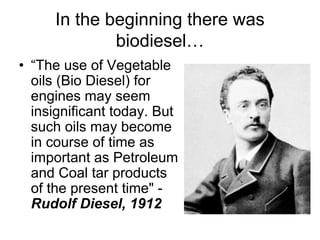
• “The use of Vegetable
  oils (Bio Diesel) for
  engines may seem
  insignificant today. But
  such oils may become
  in course of time as
  important as Petroleum
  and Coal tar products
  of the present time" -
  Rudolf Diesel, 1912
History of Jatropha curcas (Jc)
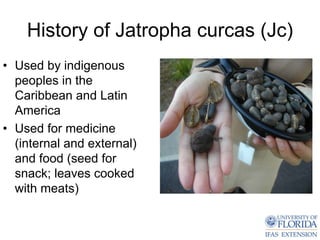
• Used by indigenous
  peoples in the
  Caribbean and Latin
  America
• Used for medicine
  (internal and external)
  and food (seed for
  snack; leaves cooked
  with meats)
History of Jatropha curcas (Jc)
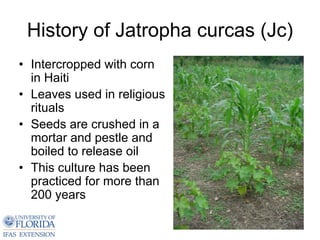
• Intercropped with corn
  in Haiti
• Leaves used in religious
  rituals
• Seeds are crushed in a
  mortar and pestle and
  boiled to release oil
• This culture has been
  practiced for more than
  200 years
Making Connections
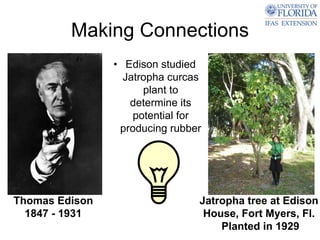
                • Edison studied
                  Jatropha curcas
                      plant to
                   determine its
                    potential for
                 producing rubber


Thomas Edison                   Jatropha tree at Edison
  1847 - 1931                    House, Fort Myers, Fl.
                                    Planted in 1929
• Potential energy is
  energy that is stored
  in an object.
• Kinetic energy is
  energy of motion.
• Potential and
  kinetic energy are
  energy partners.
The State of Jatropha Energy

                                        GEXSI…
                                        Conducted he first
                                        worldwide study
                                        assessing the current
                                        status of Jatropha
                                        projects.

                                        The project was
                                        conducted on behalf
                                        of the WWF, providing
                                        input for the
                                        Roundtable on
Global Exchange for Social Investment
                                        Sustainable Biofuels.
The State of Jatropha Energy
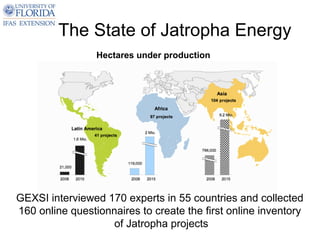
                 Hectares under production


GEXSI interviewed 170 experts in 55 countries and collected
160 online questionnaires to create the first online inventory
                    of Jatropha projects
The State of Jatropha Energy
• The largest Jatropha projects are government
  initiatives that typically work with smallholder
  farmers in Asia and Africa.
• The biggest private companies in the field
  regarding planted acreages are:
- D1-BP Fuel Crops (Asia and Africa)
- Mission Biofuels (Asia)
- Sunbiofuels (Ethiopia, Tanzania, Mozambique)
- GEM Biofuels (Madagascar)
The State of Jatropha Energy
• Major oil companies (e.g. in China) are
  devising their market entry.
• This suggests that the industry structure
  will change dramatically in the next few
  years with large (multi-)national energy
  and oil companies entering the field.
• What are the implications for smaller
  established farmers/investors?
Shifting Gears…Moving from
      ‘Potential’ to ‘Kinetic’

              13,000,000 hectares
2015
       P
       R
       O
       D
       U
       C
       T
       I
       O
       N


2008          900,000 hectares
                PRODUCTIVITY

       2008                         2015
What is Driving ‘Production’
     Production is driven by climbing crude oil
    prices and the quest for larger volumes of
    alternative and sustainable feedstock.
•   We are at the dawn of the bio-dieselization of
    American farms and industry
•   Jatropha shows significant promise, even as it
    remains largely scientifically unexploited, and
    thus a largely undomesticated crop
•   It originated in the Americas, making it suitable
    for regional attention
•   Its on everyone’s top 10 list of biodiesel crops
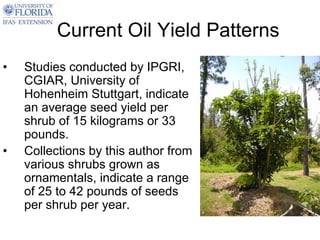
Current Oil Yield Patterns
•   Studies conducted by IPGRI,
    CGIAR, University of
    Hohenheim Stuttgart, indicate
    an average seed yield per
    shrub of 15 kilograms or 33
    pounds.
•   Collections by this author from
    various shrubs grown as
    ornamentals, indicate a range
    of 25 to 42 pounds of seeds
    per shrub per year.
Current Oil Yield Patterns
Known values for ‘undomesticated’ Jatropha:
• 1 gallon of Jatropha oil weighs 7.7 lbs
• Specific gravity of curcas oil = .9186
• Seeds equal 70% of fruit weight
• 35%-38% seed oil content occurs regularly
• In the areas of origin, Jatropha plants reach
  maturity at three years and will continue to yield
  optimally for 30 or more years.
Current Oil Yield Patterns
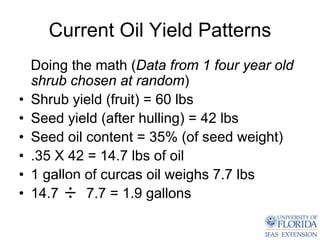
    Doing the math (Data from 1 four year old
    shrub chosen at random)
•   Shrub yield (fruit) = 60 lbs
•   Seed yield (after hulling) = 42 lbs
•   Seed oil content = 35% (of seed weight)
•   .35 X 42 = 14.7 lbs of oil
•   1 gallon of curcas oil weighs 7.7 lbs
•   14.7     7.7 = 1.9 gallons
Jatropha yield projections
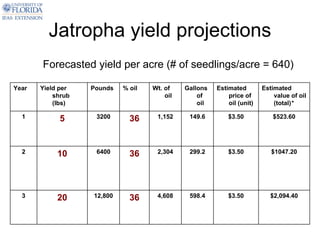
       Forecasted yield per acre (# of seedlings/acre = 640)

Year   Yield per   Pounds   % oil   Wt. of    Gallons   Estimated        Estimated
           shrub                        oil       of        price of         value of oil
           (lbs)                                  oil       oil (unit)       (total)*

  1         5       3200      36     1,152     149.6        $3.50            $523.60


  2         10      6400      36     2,304     299.2        $3.50           $1047.20


  3         20     12,800     36     4,608     598.4        $3.50           $2,094.40
Jatropha yield projections

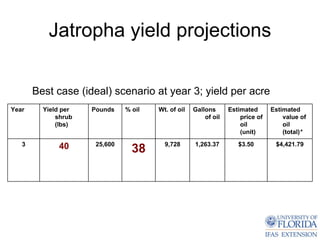
       Best case (ideal) scenario at year 3; yield per acre
Year     Yield per   Pounds    % oil   Wt. of oil   Gallons      Estimated      Estimated
             shrub                                      of oil       price of       value of
             (lbs)                                                   oil            oil
                                                                     (unit)         (total)*
   3         40       25,600             9,728      1,263.37        $3.50        $4,421.79
                                 38
Shifting to Higher Gear…Moving
       into ‘Kinetic’ Phase

              13,000,000 hectares
2015
       P
       R
       O
       D
       U
       C
       T
       I
       O
       N


2008          900,000 hectares
                PRODUCTIVITY

       2008                         2015
Productivity…The Soybean
               Example
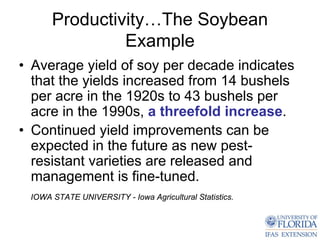
• Average yield of soy per decade indicates
  that the yields increased from 14 bushels
  per acre in the 1920s to 43 bushels per
  acre in the 1990s, a threefold increase.
• Continued yield improvements can be
  expected in the future as new pest-
  resistant varieties are released and
  management is fine-tuned.
 IOWA STATE UNIVERSITY - Iowa Agricultural Statistics.
Making the case for R&D…The
        Soybean Example
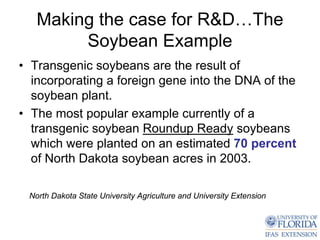
• Transgenic soybeans are the result of
  incorporating a foreign gene into the DNA of the
  soybean plant.
• The most popular example currently of a
  transgenic soybean Roundup Ready soybeans
  which were planted on an estimated 70 percent
  of North Dakota soybean acres in 2003.

 North Dakota State University Agriculture and University Extension
Production to Productivity
             Challenges
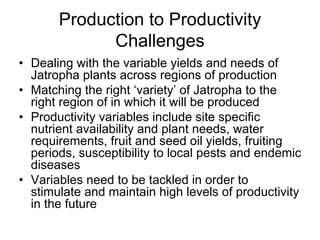
• Dealing with the variable yields and needs of
  Jatropha plants across regions of production
• Matching the right ‘variety’ of Jatropha to the
  right region of in which it will be produced
• Productivity variables include site specific
  nutrient availability and plant needs, water
  requirements, fruit and seed oil yields, fruiting
  periods, susceptibility to local pests and endemic
  diseases
• Variables need to be tackled in order to
  stimulate and maintain high levels of productivity
  in the future
What Will Drive Crop ‘Productivity’
• Provide optimum growing conditions (BMP’s)
• Pruning is essential (Manual or Mechanical)
• Flowering and pollination improvements
• Identification of distinct varieties (existing)
• R&D for high yielding cultivars/hybrids (high fruit
  bearing)
• R&D for increase in seed oil content
• R&D for cold tolerance
• Older fields will benefit from high yield
  genotypes (budding/grafting experiments)
A summary of objectives and findings on
      Jatropha curcas production in Florida.
•   To determine drought tolerance of the species
•   To assess the impact of flooding and frost on the species
    ability to survive in Florida
•   To document the occurrence of non-introduced pests and
    diseases on the plants
•   To evaluate the effect of pruning on flowering, and on fruiting
    yields
•   To estimate preliminary oil yields in South Florida conditions
•   To provide an open and interactive environment of information
    exchange with farmers
•   To provide UF/IFAS scientific disciplines with empirical data
    collected from the project to inform ongoing research and
    development work.
           Roy Beckford/Martha C. Avila and Collaborators
Optimum Growing Conditions
•   Soil pH (6.8 – 8.0 tolerated)
•   24 inches of rain or irrigation equivalent
•   Provision of organic nutrients
•   Spacing (dependent on soil nutrients)
•   Integrated Pest Management (IPM)
•   Avoid extended flooding (> 2 days) at all
    costs!!
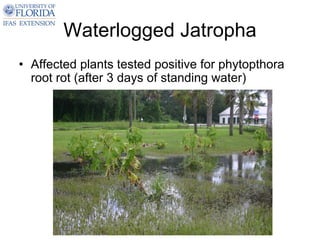
Waterlogged Jatropha
• Affected plants tested positive for phytopthora
  root rot (after 3 days of standing water)
Example of ‘Optimum’ Conditions
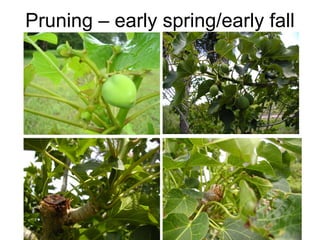
Pruning – early spring/early fall
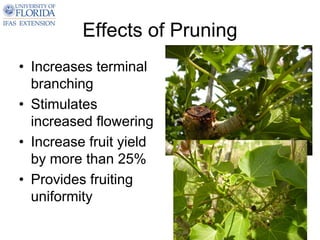
Effects of Pruning
• Increases terminal
  branching
• Stimulates
  increased flowering
• Increase fruit yield
  by more than 25%
• Provides fruiting
  uniformity
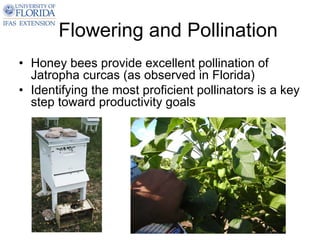
Flowering and Pollination
• Honey bees provide excellent pollination of
  Jatropha curcas (as observed in Florida)
• Identifying the most proficient pollinators is a key
  step toward productivity goals
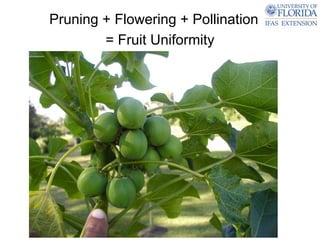
Pruning + Flowering + Pollination +
        = Fruit Uniformity
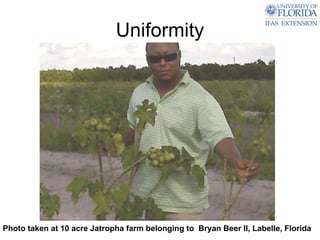
Uniformity


Photo taken at 10 acre Jatropha farm belonging to Bryan Beer II, Labelle, Florida
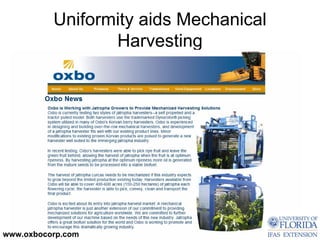
Uniformity aids Mechanical
                 Harvesting


www.oxbocorp.com
R&D for Higher Yielding Plants
• Selection of plants from high yield sources (mother
  trees)
• Selection should aim at pest and disease resistant stock

R&D objectives will include:
• Gene manipulation for higher and improved fruit yields
  on individual shrubs, combined with higher oil content
  increases in seeds.
• Creating resistance to fungal diseases to which
  Jatropha curcas is currently susceptible.
• Improved tolerances or resistance to pests which feed
  on the plant and are disease pathogens.
• Development of plants that bear sterile seeds
  (controversial).
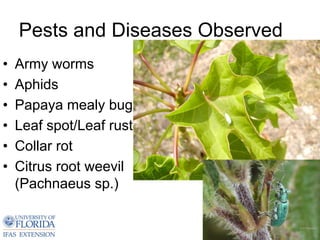
Pests and Diseases Observed
•   Army worms
•   Aphids
•   Papaya mealy bug
•   Leaf spot/Leaf rust
•   Collar rot
•   Citrus root weevil
    (Pachnaeus sp.)
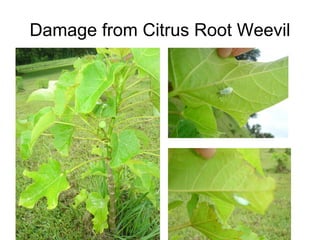
Damage from Citrus Root Weevil
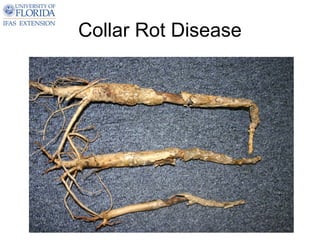
Collar Rot Disease
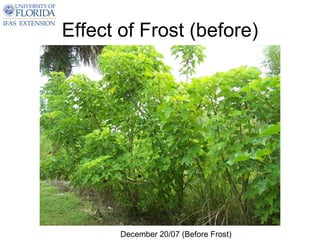
Effect of Frost (before)


       December 20/07 (Before Frost)
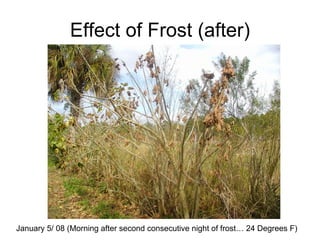
Effect of Frost (after)


January 5/ 08 (Morning after second consecutive night of frost… 24 Degrees F)
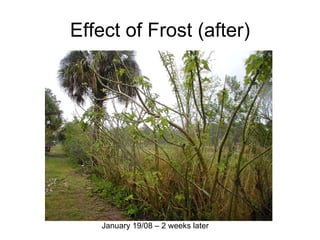
Effect of Frost (after)


    January 19/08 – 2 weeks later
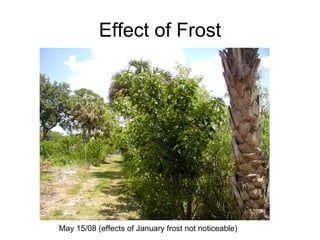
Effect of Frost


May 15/08 (effects of January frost not noticeable)
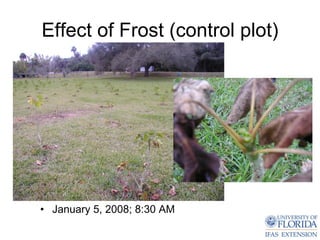
Effect of Frost (control plot)


• January 5, 2008; 8:30 AM
Beginning of Rainy Season; July
      2008 (control plot)
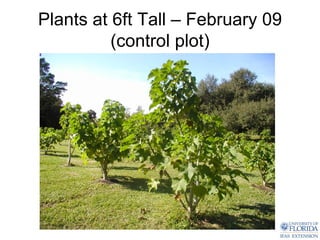
Plants at 6ft Tall – February 09
          (control plot)
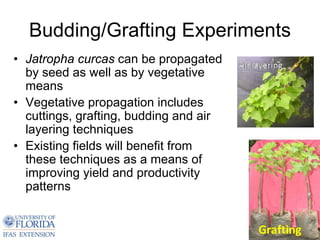
Budding/Grafting Experiments
• Jatropha curcas can be propagated
  by seed as well as by vegetative
  means
• Vegetative propagation includes
  cuttings, grafting, budding and air
  layering techniques
• Existing fields will benefit from
  these techniques as a means of
  improving yield and productivity
  patterns
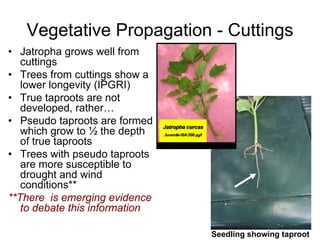
Vegetative Propagation - Cuttings
• Jatropha grows well from
   cuttings
• Trees from cuttings show a
   lower longevity (IPGRI)
• True taproots are not
   developed, rather…
• Pseudo taproots are formed
   which grow to ½ the depth
   of true taproots
• Trees with pseudo taproots
   are more susceptible to
   drought and wind
   conditions**
**There is emerging evidence
   to debate this information

                                Seedling showing taproot
Micro-plants Production
  Various techniques are currently
  been used
• Clonal propagation is the fastest way
  to develop high-yielding varieties
CAVEATS!
• Garbage in, garbage out
• Results in cytoplasmic uniformity
• Cytoplasmic uniformity presents
  major pros and cons
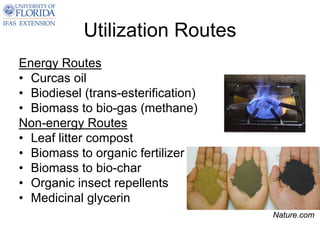
Utilization Routes
Energy Routes
• Curcas oil
• Biodiesel (trans-esterification)
• Biomass to bio-gas (methane)
Non-energy Routes
• Leaf litter compost
• Biomass to organic fertilizer
• Biomass to bio-char
• Organic insect repellents
• Medicinal glycerin
                                     Nature.com
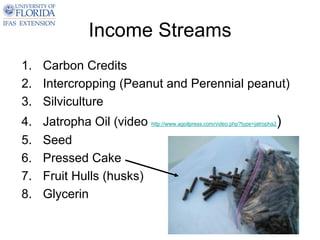
Income Streams
1. Carbon Credits
2. Intercropping (Peanut and Perennial peanut)
3. Silviculture
4.   Jatropha Oil (video http://www.agoilpress.com/video.php?type=jatropha2)
5.   Seed
6.   Pressed Cake
7.   Fruit Hulls (husks)
8.   Glycerin
Global Exchange for Social
        Investment…findings
• Jatropha has not contributed to the destruction of
  primary forest according to GEXSI data sample, only
  0.3% of any cultivated areas were previously primary
  forest, and 5% secondary forests.
• Political support for Jatropha is already strong, and
  developing further. Especially in Asia, governments have
  been the main driver for Jatropha cultivation and
  developed specific Jatropha programs.
• Rising crude oil prices are now creating a strong demand
  for biofuels, therefore, large oil and energy
  conglomerates are beginning to implement large-scale
  Jatropha projects.

        •Global Market Study on Jatropha © GEXSI LLP 2008
Global Exchange for Social
        Investment…findings
• Production is focused on domestic markets
• Production for local markets is more important than
  export, especially in Asia.
• For domestic markets, the use of unrefined Jatropha oil
  is seen as equally important as the trans-esterification
  into biodiesel.
• Jatropha is typically planted using semi-intensive
  methods
• Most Jatropha plantations have nurseries and apply
  cultivation techniques such as pruning or fertilization.
• About half of the projects use some type of irrigation.

        •Global Market Study on Jatropha © GEXSI LLP 2008 15
Thanks


                Roy Beckford
         University of Florida,
                         IFAS,
          Lee County, Florida
                 239-533-7512
               fbeck@ufl.edu

Jatropha Curcas Oil: From Potential to Kinetic EnergyRoy

  • 1.
    Jatropha curcas From Potentialto Kinetic Energy Roy Beckford University of Florida, IFAS, Lee County, Florida 239-533-7512 fbeck@ufl.edu
  • 2.
    In the beginningthere was biodiesel… • “The use of Vegetable oils (Bio Diesel) for engines may seem insignificant today. But such oils may become in course of time as important as Petroleum and Coal tar products of the present time" - Rudolf Diesel, 1912
  • 3.
    History of Jatrophacurcas (Jc) • Used by indigenous peoples in the Caribbean and Latin America • Used for medicine (internal and external) and food (seed for snack; leaves cooked with meats)
  • 4.
    History of Jatrophacurcas (Jc) • Intercropped with corn in Haiti • Leaves used in religious rituals • Seeds are crushed in a mortar and pestle and boiled to release oil • This culture has been practiced for more than 200 years
  • 5.
    Making Connections • Edison studied Jatropha curcas plant to determine its potential for producing rubber Thomas Edison Jatropha tree at Edison 1847 - 1931 House, Fort Myers, Fl. Planted in 1929
  • 6.
    • Potential energyis energy that is stored in an object. • Kinetic energy is energy of motion. • Potential and kinetic energy are energy partners.
  • 7.
    The State ofJatropha Energy GEXSI… Conducted he first worldwide study assessing the current status of Jatropha projects. The project was conducted on behalf of the WWF, providing input for the Roundtable on Global Exchange for Social Investment Sustainable Biofuels.
  • 8.
    The State ofJatropha Energy Hectares under production GEXSI interviewed 170 experts in 55 countries and collected 160 online questionnaires to create the first online inventory of Jatropha projects
  • 9.
    The State ofJatropha Energy • The largest Jatropha projects are government initiatives that typically work with smallholder farmers in Asia and Africa. • The biggest private companies in the field regarding planted acreages are: - D1-BP Fuel Crops (Asia and Africa) - Mission Biofuels (Asia) - Sunbiofuels (Ethiopia, Tanzania, Mozambique) - GEM Biofuels (Madagascar)
  • 10.
    The State ofJatropha Energy • Major oil companies (e.g. in China) are devising their market entry. • This suggests that the industry structure will change dramatically in the next few years with large (multi-)national energy and oil companies entering the field. • What are the implications for smaller established farmers/investors?
  • 11.
    Shifting Gears…Moving from ‘Potential’ to ‘Kinetic’ 13,000,000 hectares 2015 P R O D U C T I O N 2008 900,000 hectares PRODUCTIVITY 2008 2015
  • 12.
    What is Driving‘Production’ Production is driven by climbing crude oil prices and the quest for larger volumes of alternative and sustainable feedstock. • We are at the dawn of the bio-dieselization of American farms and industry • Jatropha shows significant promise, even as it remains largely scientifically unexploited, and thus a largely undomesticated crop • It originated in the Americas, making it suitable for regional attention • Its on everyone’s top 10 list of biodiesel crops
  • 13.
    Current Oil YieldPatterns • Studies conducted by IPGRI, CGIAR, University of Hohenheim Stuttgart, indicate an average seed yield per shrub of 15 kilograms or 33 pounds. • Collections by this author from various shrubs grown as ornamentals, indicate a range of 25 to 42 pounds of seeds per shrub per year.
  • 14.
    Current Oil YieldPatterns Known values for ‘undomesticated’ Jatropha: • 1 gallon of Jatropha oil weighs 7.7 lbs • Specific gravity of curcas oil = .9186 • Seeds equal 70% of fruit weight • 35%-38% seed oil content occurs regularly • In the areas of origin, Jatropha plants reach maturity at three years and will continue to yield optimally for 30 or more years.
  • 15.
    Current Oil YieldPatterns Doing the math (Data from 1 four year old shrub chosen at random) • Shrub yield (fruit) = 60 lbs • Seed yield (after hulling) = 42 lbs • Seed oil content = 35% (of seed weight) • .35 X 42 = 14.7 lbs of oil • 1 gallon of curcas oil weighs 7.7 lbs • 14.7 7.7 = 1.9 gallons
  • 16.
    Jatropha yield projections Forecasted yield per acre (# of seedlings/acre = 640) Year Yield per Pounds % oil Wt. of Gallons Estimated Estimated shrub oil of price of value of oil (lbs) oil oil (unit) (total)* 1 5 3200 36 1,152 149.6 $3.50 $523.60 2 10 6400 36 2,304 299.2 $3.50 $1047.20 3 20 12,800 36 4,608 598.4 $3.50 $2,094.40
  • 17.
    Jatropha yield projections Best case (ideal) scenario at year 3; yield per acre Year Yield per Pounds % oil Wt. of oil Gallons Estimated Estimated shrub of oil price of value of (lbs) oil oil (unit) (total)* 3 40 25,600 9,728 1,263.37 $3.50 $4,421.79 38
  • 18.
    Shifting to HigherGear…Moving into ‘Kinetic’ Phase 13,000,000 hectares 2015 P R O D U C T I O N 2008 900,000 hectares PRODUCTIVITY 2008 2015
  • 19.
    Productivity…The Soybean Example • Average yield of soy per decade indicates that the yields increased from 14 bushels per acre in the 1920s to 43 bushels per acre in the 1990s, a threefold increase. • Continued yield improvements can be expected in the future as new pest- resistant varieties are released and management is fine-tuned. IOWA STATE UNIVERSITY - Iowa Agricultural Statistics.
  • 20.
    Making the casefor R&D…The Soybean Example • Transgenic soybeans are the result of incorporating a foreign gene into the DNA of the soybean plant. • The most popular example currently of a transgenic soybean Roundup Ready soybeans which were planted on an estimated 70 percent of North Dakota soybean acres in 2003. North Dakota State University Agriculture and University Extension
  • 21.
    Production to Productivity Challenges • Dealing with the variable yields and needs of Jatropha plants across regions of production • Matching the right ‘variety’ of Jatropha to the right region of in which it will be produced • Productivity variables include site specific nutrient availability and plant needs, water requirements, fruit and seed oil yields, fruiting periods, susceptibility to local pests and endemic diseases • Variables need to be tackled in order to stimulate and maintain high levels of productivity in the future
  • 22.
    What Will DriveCrop ‘Productivity’ • Provide optimum growing conditions (BMP’s) • Pruning is essential (Manual or Mechanical) • Flowering and pollination improvements • Identification of distinct varieties (existing) • R&D for high yielding cultivars/hybrids (high fruit bearing) • R&D for increase in seed oil content • R&D for cold tolerance • Older fields will benefit from high yield genotypes (budding/grafting experiments)
  • 23.
    A summary ofobjectives and findings on Jatropha curcas production in Florida. • To determine drought tolerance of the species • To assess the impact of flooding and frost on the species ability to survive in Florida • To document the occurrence of non-introduced pests and diseases on the plants • To evaluate the effect of pruning on flowering, and on fruiting yields • To estimate preliminary oil yields in South Florida conditions • To provide an open and interactive environment of information exchange with farmers • To provide UF/IFAS scientific disciplines with empirical data collected from the project to inform ongoing research and development work. Roy Beckford/Martha C. Avila and Collaborators
  • 24.
    Optimum Growing Conditions • Soil pH (6.8 – 8.0 tolerated) • 24 inches of rain or irrigation equivalent • Provision of organic nutrients • Spacing (dependent on soil nutrients) • Integrated Pest Management (IPM) • Avoid extended flooding (> 2 days) at all costs!!
  • 25.
    Waterlogged Jatropha • Affectedplants tested positive for phytopthora root rot (after 3 days of standing water)
  • 26.
  • 27.
    Pruning – earlyspring/early fall
  • 28.
    Effects of Pruning •Increases terminal branching • Stimulates increased flowering • Increase fruit yield by more than 25% • Provides fruiting uniformity
  • 29.
    Flowering and Pollination •Honey bees provide excellent pollination of Jatropha curcas (as observed in Florida) • Identifying the most proficient pollinators is a key step toward productivity goals
  • 30.
    Pruning + Flowering+ Pollination + = Fruit Uniformity
  • 31.
    Uniformity Photo taken at10 acre Jatropha farm belonging to Bryan Beer II, Labelle, Florida
  • 32.
    Uniformity aids Mechanical Harvesting www.oxbocorp.com
  • 33.
    R&D for HigherYielding Plants • Selection of plants from high yield sources (mother trees) • Selection should aim at pest and disease resistant stock R&D objectives will include: • Gene manipulation for higher and improved fruit yields on individual shrubs, combined with higher oil content increases in seeds. • Creating resistance to fungal diseases to which Jatropha curcas is currently susceptible. • Improved tolerances or resistance to pests which feed on the plant and are disease pathogens. • Development of plants that bear sterile seeds (controversial).
  • 34.
    Pests and DiseasesObserved • Army worms • Aphids • Papaya mealy bug • Leaf spot/Leaf rust • Collar rot • Citrus root weevil (Pachnaeus sp.)
  • 35.
    Damage from CitrusRoot Weevil
  • 36.
  • 37.
    Effect of Frost(before) December 20/07 (Before Frost)
  • 38.
    Effect of Frost(after) January 5/ 08 (Morning after second consecutive night of frost… 24 Degrees F)
  • 39.
    Effect of Frost(after) January 19/08 – 2 weeks later
  • 40.
    Effect of Frost May15/08 (effects of January frost not noticeable)
  • 41.
    Effect of Frost(control plot) • January 5, 2008; 8:30 AM
  • 42.
    Beginning of RainySeason; July 2008 (control plot)
  • 43.
    Plants at 6ftTall – February 09 (control plot)
  • 44.
    Budding/Grafting Experiments • Jatrophacurcas can be propagated by seed as well as by vegetative means • Vegetative propagation includes cuttings, grafting, budding and air layering techniques • Existing fields will benefit from these techniques as a means of improving yield and productivity patterns
  • 45.
    Vegetative Propagation -Cuttings • Jatropha grows well from cuttings • Trees from cuttings show a lower longevity (IPGRI) • True taproots are not developed, rather… • Pseudo taproots are formed which grow to ½ the depth of true taproots • Trees with pseudo taproots are more susceptible to drought and wind conditions** **There is emerging evidence to debate this information Seedling showing taproot
  • 46.
    Micro-plants Production Various techniques are currently been used • Clonal propagation is the fastest way to develop high-yielding varieties CAVEATS! • Garbage in, garbage out • Results in cytoplasmic uniformity • Cytoplasmic uniformity presents major pros and cons
  • 47.
    Utilization Routes Energy Routes •Curcas oil • Biodiesel (trans-esterification) • Biomass to bio-gas (methane) Non-energy Routes • Leaf litter compost • Biomass to organic fertilizer • Biomass to bio-char • Organic insect repellents • Medicinal glycerin Nature.com
  • 48.
    Income Streams 1. CarbonCredits 2. Intercropping (Peanut and Perennial peanut) 3. Silviculture 4. Jatropha Oil (video http://www.agoilpress.com/video.php?type=jatropha2) 5. Seed 6. Pressed Cake 7. Fruit Hulls (husks) 8. Glycerin
  • 49.
    Global Exchange forSocial Investment…findings • Jatropha has not contributed to the destruction of primary forest according to GEXSI data sample, only 0.3% of any cultivated areas were previously primary forest, and 5% secondary forests. • Political support for Jatropha is already strong, and developing further. Especially in Asia, governments have been the main driver for Jatropha cultivation and developed specific Jatropha programs. • Rising crude oil prices are now creating a strong demand for biofuels, therefore, large oil and energy conglomerates are beginning to implement large-scale Jatropha projects. •Global Market Study on Jatropha © GEXSI LLP 2008
  • 50.
    Global Exchange forSocial Investment…findings • Production is focused on domestic markets • Production for local markets is more important than export, especially in Asia. • For domestic markets, the use of unrefined Jatropha oil is seen as equally important as the trans-esterification into biodiesel. • Jatropha is typically planted using semi-intensive methods • Most Jatropha plantations have nurseries and apply cultivation techniques such as pruning or fertilization. • About half of the projects use some type of irrigation. •Global Market Study on Jatropha © GEXSI LLP 2008 15
  • 51.
    Thanks Roy Beckford University of Florida, IFAS, Lee County, Florida 239-533-7512 fbeck@ufl.edu