RBI
Reserve Bank Of India
Prathyusha Sampath kumar Priya
VeeraBabu Sameera Vamsi Bhavani
Presentation members
Contents
– Head Quarters
– Introduction
– Roles
– Functions
– Objectives
– Structure of Indian Banking System
– Administration
– Policy rates and their reserve ratios & Limitations of monetary policy
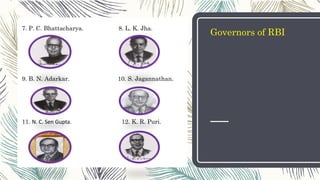
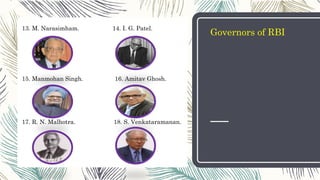
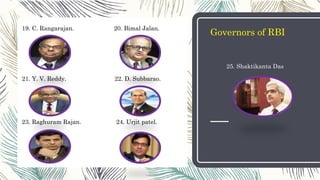
– Governors of RBI
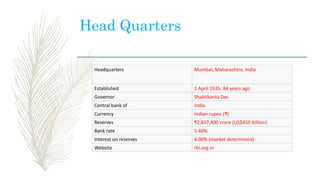
Head Quarters
Headquarters Mumbai, Maharashtra, India
Established 1 April 1935; 84 years ago
Governor Shaktikanta Das
Central bank of India
Currency Indian rupee (₹)
Reserves ₹2,837,400 crore (US$410 billion)
Bank rate 5.40%
Interest on reserves 4.00% (market determined)
Website rbi.org.in
Introduction
RBI - Reserve Bank of India
 Reserve Bank of India (RBI) is the central bank of the
country.
 RBI is a statutory body.
 It is responsible for printing of currency notes and managing
the supply of money in the Indian economy.
 Reserve Bank of India (RBI) is the highest monetary
authority of India.
 RBI was established in 1935 by the RBI Act 1934.
 RBI works as a custodian of foreign reserve, banker’s bank,
banker to the government of India and controller of credit.
Initially the ownership of
almost all the share capital
was in the hands of non-
government share holders.
So in order to prevent the
centralisation of the shares in
few hands, the RBI was
nationalised on January 1,
1949.
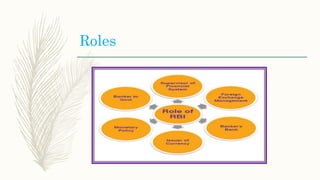
Roles
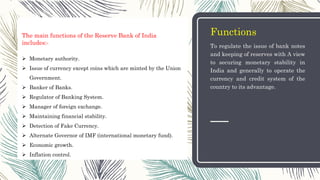
Functions
To regulate the issue of bank notes
and keeping of reserves with A view
to securing monetary stability in
India and generally to operate the
currency and credit system of the
country to its advantage.
The main functions of the Reserve Bank of India
includes:-
 Monetary authority.
 Issue of currency except coins which are minted by the Union
Government.
 Banker of Banks.
 Regulator of Banking System.
 Manager of foreign exchange.
 Maintaining financial stability.
 Detection of Fake Currency.
 Alternate Governor of IMF (international monetary fund).
 Economic growth.
 Inflation control.
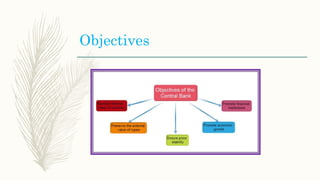
Objectives
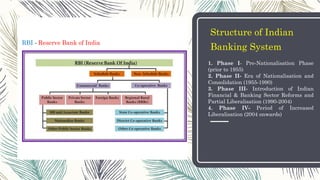
Structure of Indian
Banking System
RBI - Reserve Bank of India
1. Phase I- Pre-Nationalisation Phase
(prior to 1955)
2. Phase II- Era of Nationalisation and
Consolidation (1955-1990)
3. Phase III- Introduction of Indian
Financial & Banking Sector Reforms and
Partial Liberalisation (1990-2004)
4. Phase IV- Period of Increased
Liberalisation (2004 onwards)
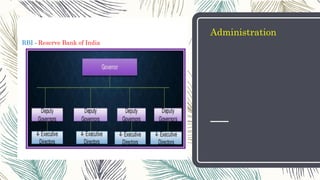
Administration
RBI - Reserve Bank of India
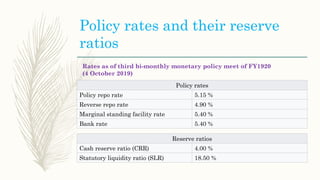
Policy rates and their reserve
ratios
Policy rates
Policy repo rate 5.15 %
Reverse repo rate 4.90 %
Marginal standing facility rate 5.40 %
Bank rate 5.40 %
Reserve ratios
Cash reserve ratio (CRR) 4.00 %
Statutory liquidity ratio (SLR) 18.50 %
Rates as of third bi-monthly monetary policy meet of FY1920
(4 October 2019)
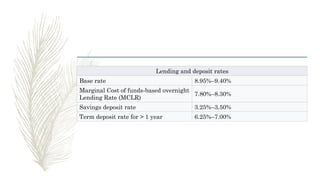
Lending and deposit rates
Base rate 8.95%–9.40%
Marginal Cost of funds-based overnight
Lending Rate (MCLR)
7.80%–8.30%
Savings deposit rate 3.25%–3.50%
Term deposit rate for > 1 year 6.25%–7.00%
Limitations of
monetary policy
In developing countries like India, monetary policy fails to show
immediate or no results because the following factors:
1.People do not employ alternative investment options. A large section of
society still depends on saving accounts, fixed deposits, Public Provident
Fund for investment. Commercial banks have large deposits. RBI is not
the main or even prominent money supplier for these banks. So whatever
monetary action central bank takes has little or late impact on the
economy.
2.Many people in rural areas are out of the banking net and whatever the
RBI does has no impact on their financial activities.
3.Monsoon uncertainty adversely affects food production and thereby
cause food inflation. Monetary policy has no impact on food inflation.
Governors of RBI
1.Osborne Smith. 2. James Braid Taylor.
3. C. D. Deshmukh. 4. Benegal Rama Rau.
5. K. G. Ambegaonkar. 6. H. V. R. Iyengar
Governors of RBI
7. P. C. Bhattacharya. 8. L. K. Jha.
9. B. N. Adarkar. 10. S. Jagannathan.
11. N. C. Sen Gupta. 12. K. R. Puri.
Governors of RBI
13. M. Narasimham. 14. I. G. Patel.
15. Manmohan Singh. 16. Amitav Ghosh.
17. R. N. Malhotra. 18. S. Venkataramanan.
Governors of RBI
19. C. Rangarajan. 20. Bimal Jalan.
21. Y. V. Reddy. 22. D. Subbarao.
23. Raghuram Rajan. 24. Urjit patel.
25. Shaktikanta Das
–THANK YOU

RBI reserve bank of india

  • 1.
    RBI Reserve Bank OfIndia Prathyusha Sampath kumar Priya VeeraBabu Sameera Vamsi Bhavani Presentation members
  • 2.
    Contents – Head Quarters –Introduction – Roles – Functions – Objectives – Structure of Indian Banking System – Administration – Policy rates and their reserve ratios & Limitations of monetary policy – Governors of RBI
  • 3.
    Head Quarters Headquarters Mumbai,Maharashtra, India Established 1 April 1935; 84 years ago Governor Shaktikanta Das Central bank of India Currency Indian rupee (₹) Reserves ₹2,837,400 crore (US$410 billion) Bank rate 5.40% Interest on reserves 4.00% (market determined) Website rbi.org.in
  • 4.
    Introduction RBI - ReserveBank of India  Reserve Bank of India (RBI) is the central bank of the country.  RBI is a statutory body.  It is responsible for printing of currency notes and managing the supply of money in the Indian economy.  Reserve Bank of India (RBI) is the highest monetary authority of India.  RBI was established in 1935 by the RBI Act 1934.  RBI works as a custodian of foreign reserve, banker’s bank, banker to the government of India and controller of credit. Initially the ownership of almost all the share capital was in the hands of non- government share holders. So in order to prevent the centralisation of the shares in few hands, the RBI was nationalised on January 1, 1949.
  • 5.
  • 6.
    Functions To regulate theissue of bank notes and keeping of reserves with A view to securing monetary stability in India and generally to operate the currency and credit system of the country to its advantage. The main functions of the Reserve Bank of India includes:-  Monetary authority.  Issue of currency except coins which are minted by the Union Government.  Banker of Banks.  Regulator of Banking System.  Manager of foreign exchange.  Maintaining financial stability.  Detection of Fake Currency.  Alternate Governor of IMF (international monetary fund).  Economic growth.  Inflation control.
  • 7.
  • 8.
    Structure of Indian BankingSystem RBI - Reserve Bank of India 1. Phase I- Pre-Nationalisation Phase (prior to 1955) 2. Phase II- Era of Nationalisation and Consolidation (1955-1990) 3. Phase III- Introduction of Indian Financial & Banking Sector Reforms and Partial Liberalisation (1990-2004) 4. Phase IV- Period of Increased Liberalisation (2004 onwards)
  • 9.
  • 10.
    Policy rates andtheir reserve ratios Policy rates Policy repo rate 5.15 % Reverse repo rate 4.90 % Marginal standing facility rate 5.40 % Bank rate 5.40 % Reserve ratios Cash reserve ratio (CRR) 4.00 % Statutory liquidity ratio (SLR) 18.50 % Rates as of third bi-monthly monetary policy meet of FY1920 (4 October 2019)
  • 11.
    Lending and depositrates Base rate 8.95%–9.40% Marginal Cost of funds-based overnight Lending Rate (MCLR) 7.80%–8.30% Savings deposit rate 3.25%–3.50% Term deposit rate for > 1 year 6.25%–7.00%
  • 12.
    Limitations of monetary policy Indeveloping countries like India, monetary policy fails to show immediate or no results because the following factors: 1.People do not employ alternative investment options. A large section of society still depends on saving accounts, fixed deposits, Public Provident Fund for investment. Commercial banks have large deposits. RBI is not the main or even prominent money supplier for these banks. So whatever monetary action central bank takes has little or late impact on the economy. 2.Many people in rural areas are out of the banking net and whatever the RBI does has no impact on their financial activities. 3.Monsoon uncertainty adversely affects food production and thereby cause food inflation. Monetary policy has no impact on food inflation.
  • 13.
    Governors of RBI 1.OsborneSmith. 2. James Braid Taylor. 3. C. D. Deshmukh. 4. Benegal Rama Rau. 5. K. G. Ambegaonkar. 6. H. V. R. Iyengar
  • 14.
    Governors of RBI 7.P. C. Bhattacharya. 8. L. K. Jha. 9. B. N. Adarkar. 10. S. Jagannathan. 11. N. C. Sen Gupta. 12. K. R. Puri.
  • 15.
    Governors of RBI 13.M. Narasimham. 14. I. G. Patel. 15. Manmohan Singh. 16. Amitav Ghosh. 17. R. N. Malhotra. 18. S. Venkataramanan.
  • 16.
    Governors of RBI 19.C. Rangarajan. 20. Bimal Jalan. 21. Y. V. Reddy. 22. D. Subbarao. 23. Raghuram Rajan. 24. Urjit patel. 25. Shaktikanta Das
  • 17.