A. Bobbio Reggio Emilia, June 17-18, 2003 1
Dependability & Maintainability
Theory and Methods
3. Reliability Block Diagrams
Andrea Bobbio
Dipartimento di Informatica
Università del Piemonte Orientale, “A. Avogadro”
15100 Alessandria (Italy)
bobbio@unipmn.it - http://www.mfn.unipmn.it/~bobbio/IFOA
IFOA, Reggio Emilia, June 17-18, 2003
A. Bobbio Reggio Emilia, June 17-18, 2003 2
Model Types in Dependability
Combinatorial models assume that components are
statistically independent: poor modeling power
coupled with high analytical tractability.
 Reliability Block Diagrams, FT, ….
State-space models rely on the specification of the
whole set of possible states of the system and of the
possible transitions among them.
 CTMC, Petri nets, ….
A. Bobbio Reggio Emilia, June 17-18, 2003 3
Reliability Block Diagrams
Each component of the system is represented as a
block;
System behavior is represented by connecting the
blocks;
Failures of individual components are assumed to
be independent;
Combinatorial (non-state space) model type.
A. Bobbio Reggio Emilia, June 17-18, 2003 4
Reliability Block Diagrams (RBDs)
Schematic representation or model;
Shows reliability structure (logic) of a system;
Can be used to determine dependability measures;
A block can be viewed as a “switch” that is
“closed” when the block is operating and “open”
when the block is failed;
System is operational if a path of “closed
switches” is found from the input to the output of
the diagram.
A. Bobbio Reggio Emilia, June 17-18, 2003 5
Reliability Block Diagrams (RBDs)
Can be used to calculate:
– Non-repairable system reliability given:
 Individual block reliabilities (or failure rates);
 Assuming mutually independent failures events.
– Repairable system availability given:
Individual block availabilities (or MTTFs and
MTTRs);
Assuming mutually independent failure and
restoration events;
Availability of each block is modeled as 2-state
Markov chain.
A. Bobbio Reggio Emilia, June 17-18, 2003 6
Series system of n components.
Components are statistically independent
Define event Ei = “component i functions properly.”
Series system in RBD
)
(
)...
(
)
(
)
...
(
)
"
"
(
2
1
2
1 n
n E
P
E
P
E
P
E
E
E
P
P






properly
g
functionin
is
system
series
A1 A2 An
P(Ei) is the probability “component i functions properly”
 the reliability R i(t) (non repairable)
 the availability A i(t) (repairable)
A. Bobbio Reggio Emilia, June 17-18, 2003 7
Reliability of Series system
Series system of n components.
Components are statistically independent
Define event Ei = "component i functions properly.”
)
(
)...
(
)
(
)
...
(
)
"
"
(
2
1
2
1 n
n E
P
E
P
E
P
E
E
E
P
P






properly
ng
functioni
is
system
series
A1 A2 An



n
i
i
s t
R
t
R
1
)
(
)
(
Denoting by R i(t) the reliability of component i
Product law of reliabilities:
A. Bobbio Reggio Emilia, June 17-18, 2003 8
Series system with time-independent
failure rate
Let  i be the time-independent failure rate of
component i.
Then:
The system reliability Rs(t) becomes:
Rs(t) = e
-  s t
with s =  i
i=1
n
Ri (t) = e
-  i t
1 1
MTTF = —— = ————
s
 i
i=1
n
A. Bobbio Reggio Emilia, June 17-18, 2003 9
Availability for Series System
Assuming independent repair for each component,
where Ai is the (steady state or transient) availability
of component i










n
i
i
s
n
i i
i
i
n
i
i
s
t
A
t
A
MTTR
MTTF
MTTF
A
A
1
1
1
)
(
)
(
or
,
A. Bobbio Reggio Emilia, June 17-18, 2003 10
Series system:
an example
A. Bobbio Reggio Emilia, June 17-18, 2003 11
Series system:
an example
A. Bobbio Reggio Emilia, June 17-18, 2003 12
Improving the Reliability of a
Series System
Sensitivity analysis:
 R s R s
S i = ———— = ————
 R i R i
The optimal gain in system reliability is obtained by
improving the least reliable component.
A. Bobbio Reggio Emilia, June 17-18, 2003 13
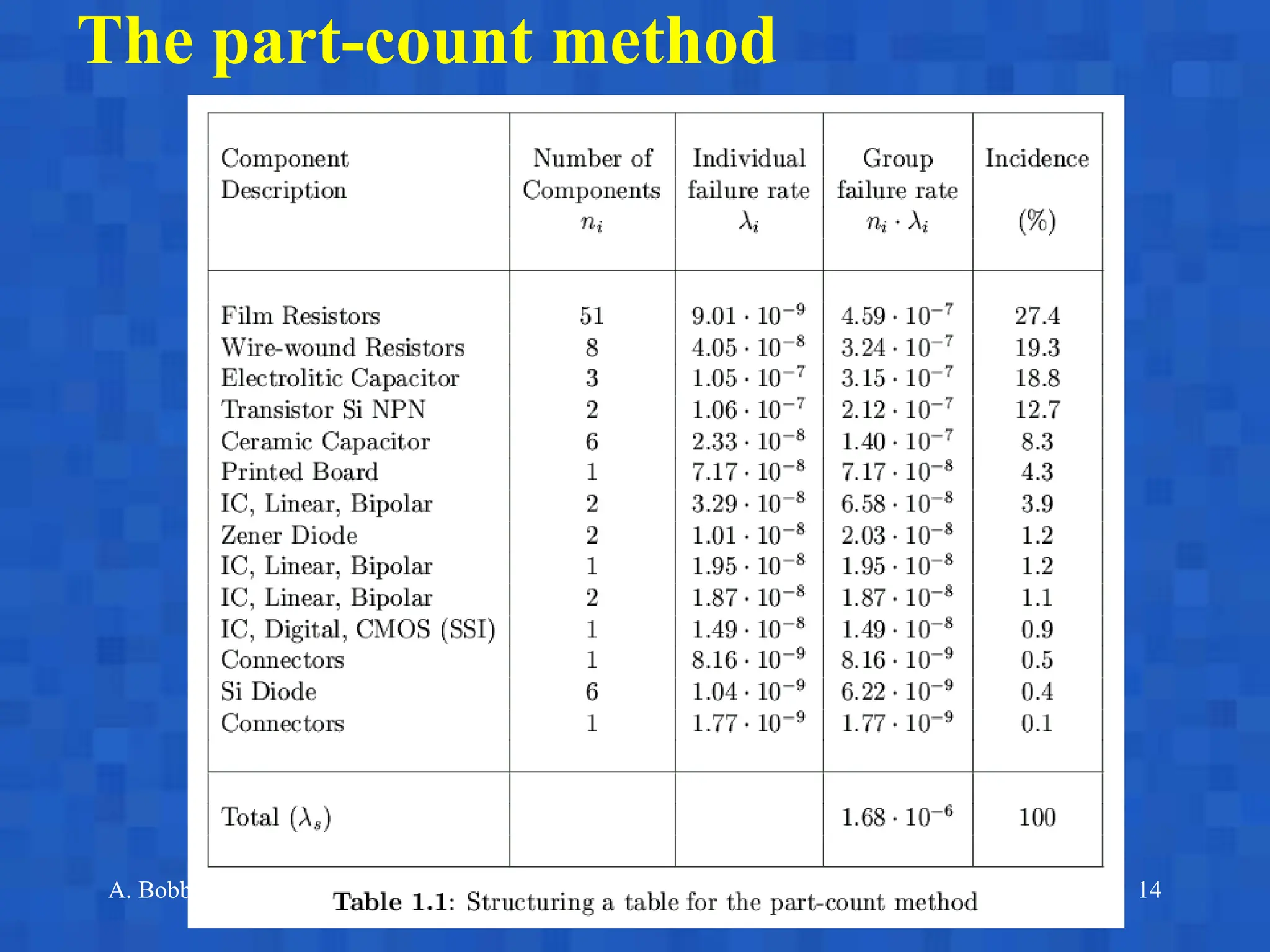
The part-count method
It is usually applied for computing the reliability of
electronic equipment composed of boards with a
large number of components.
Components are connected in series and with time-
independent failure rate.
A. Bobbio Reggio Emilia, June 17-18, 2003 14
The part-count method
A. Bobbio Reggio Emilia, June 17-18, 2003 15
Redundant systems
When the dependability of a system does not reach
the desired (or required) level:
 Improve the individual components;
 Act at the structure level of the system, resorting
to redundant configurations.
A. Bobbio Reggio Emilia, June 17-18, 2003 16
Parallel redundancy
A system consisting of n
independent components in parallel.
It will fail to function only if all n
components have failed.
Ei = “The component i is functioning”
Ep = “the parallel system of n component is
functioning properly.”
A1
An
.
.
.
.
.
.
A. Bobbio Reggio Emilia, June 17-18, 2003 17
Parallel system
"
failed
has
system
parallel
The
"

p
E
"
failed
have
components
n
All
"

__
__
2
__
1 ... n
E
E
E 



)
...
(
)
(
__
__
2
__
1
__
n
p E
E
E
P
E
P 


 )
(
)...
(
)
(
__
__
2
__
1 n
E
P
E
P
E
P

Therefore:
)
(
1
)
( p
p E
P
E
P 

A. Bobbio Reggio Emilia, June 17-18, 2003 18
Parallel redundancy
Fi (t) = P (Ei) Probability component i
is not functioning (unreliability)
Ri (t) = 1 - Fi (t) = P (Ei) Probability
component i is functioning (reliability)
A1
An
.
.
.
.
.
.
—
Fp (t) =  Fi (t)
i=1
n
Rp (t) = 1 - Fp (t) = 1 -  (1 - Ri (t))
i=1
n
A. Bobbio Reggio Emilia, June 17-18, 2003 19
2-component parallel system
For a 2-component parallel system:
Fp (t) = F1 (t) F2 (t)
Rp (t) = 1 – (1 – R1 (t)) (1 – R2 (t)) =
= R1 (t) + R2 (t) – R1 (t) R2 (t)
A1
A2
A. Bobbio Reggio Emilia, June 17-18, 2003 20
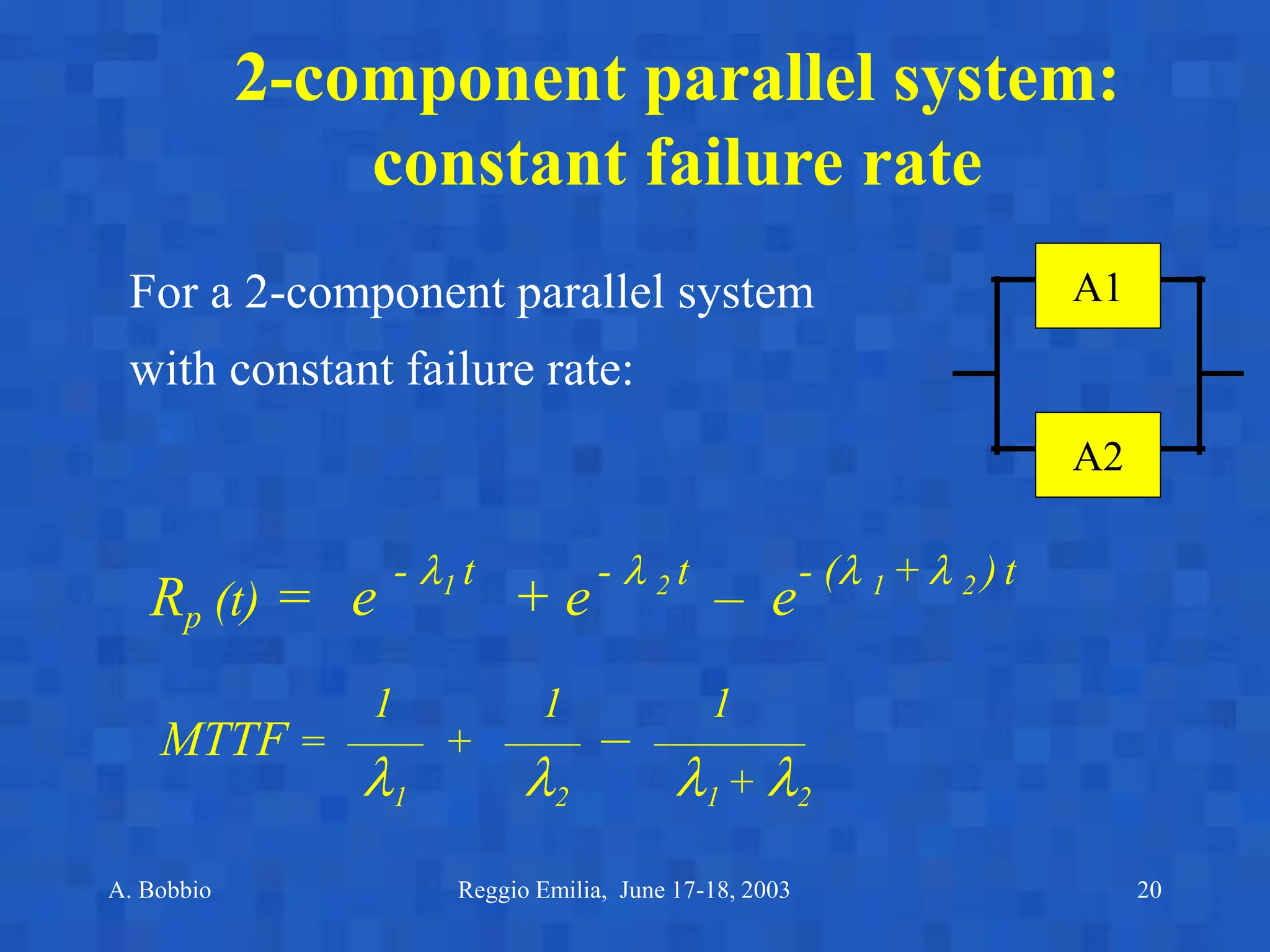
2-component parallel system:
constant failure rate
For a 2-component parallel system
with constant failure rate:
Rp (t) =
A1
A2
e
- 1 t
+ e
-  2 t
– e
- ( 1 +  2 ) t
1 1 1
MTTF = —— + —— – ————
1 2 1 + 2
A. Bobbio Reggio Emilia, June 17-18, 2003 21
Parallel system:
an example
A. Bobbio Reggio Emilia, June 17-18, 2003 22
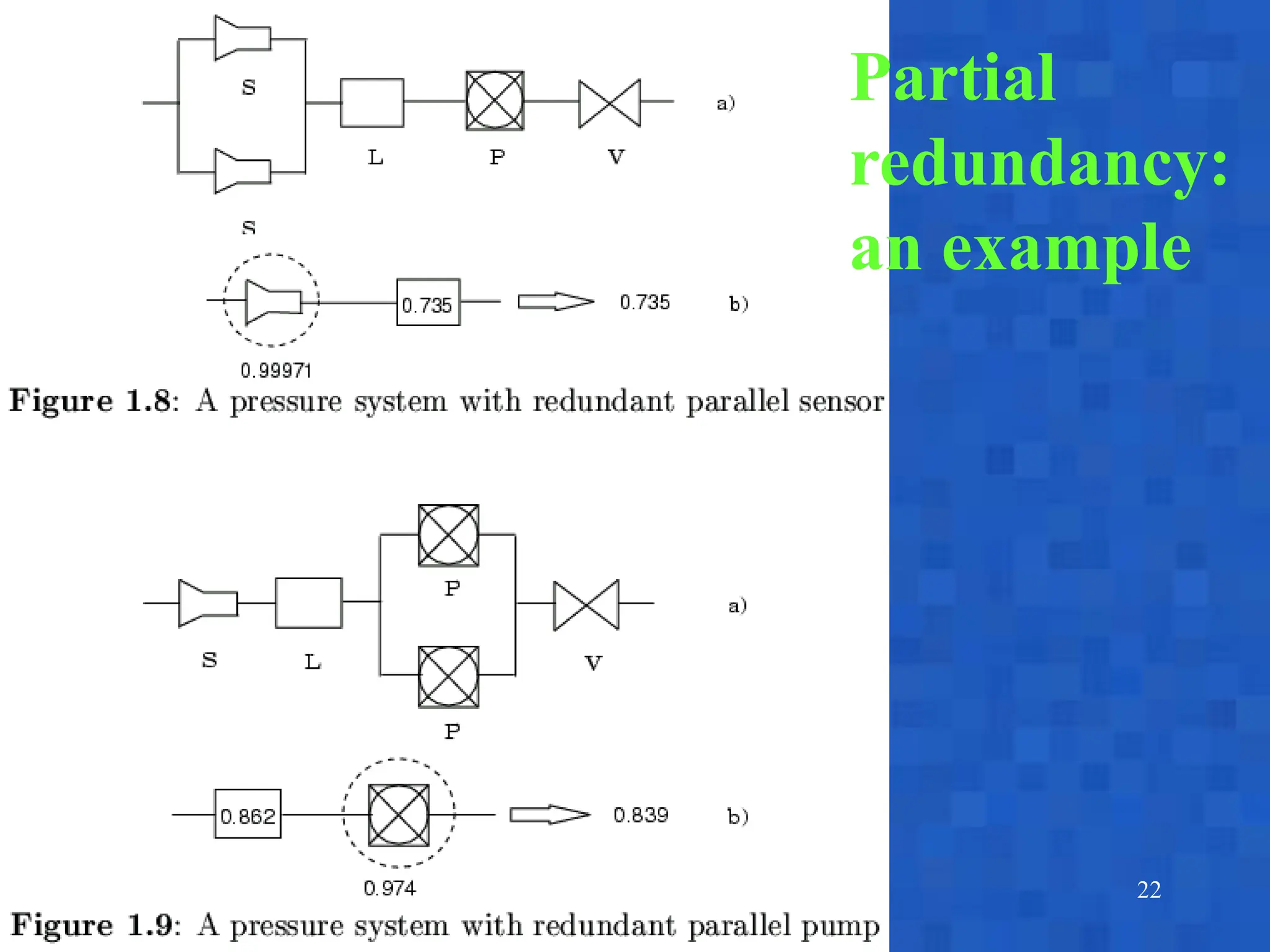
Partial
redundancy:
an example
A. Bobbio Reggio Emilia, June 17-18, 2003 23
Availability for parallel system
Assuming independent repair,
where Ai is the (steady state or transient) availability of
component i.















n
i
i
p
n
i i
i
i
n
i
i
p
t
A
t
A
or
MTTR
MTTF
MTTR
A
A
1
1
1
))
(
1
(
1
)
(
1
)
1
(
1
A. Bobbio Reggio Emilia, June 17-18, 2003 24
Series-parallel
systems
A. Bobbio Reggio Emilia, June 17-18, 2003 25
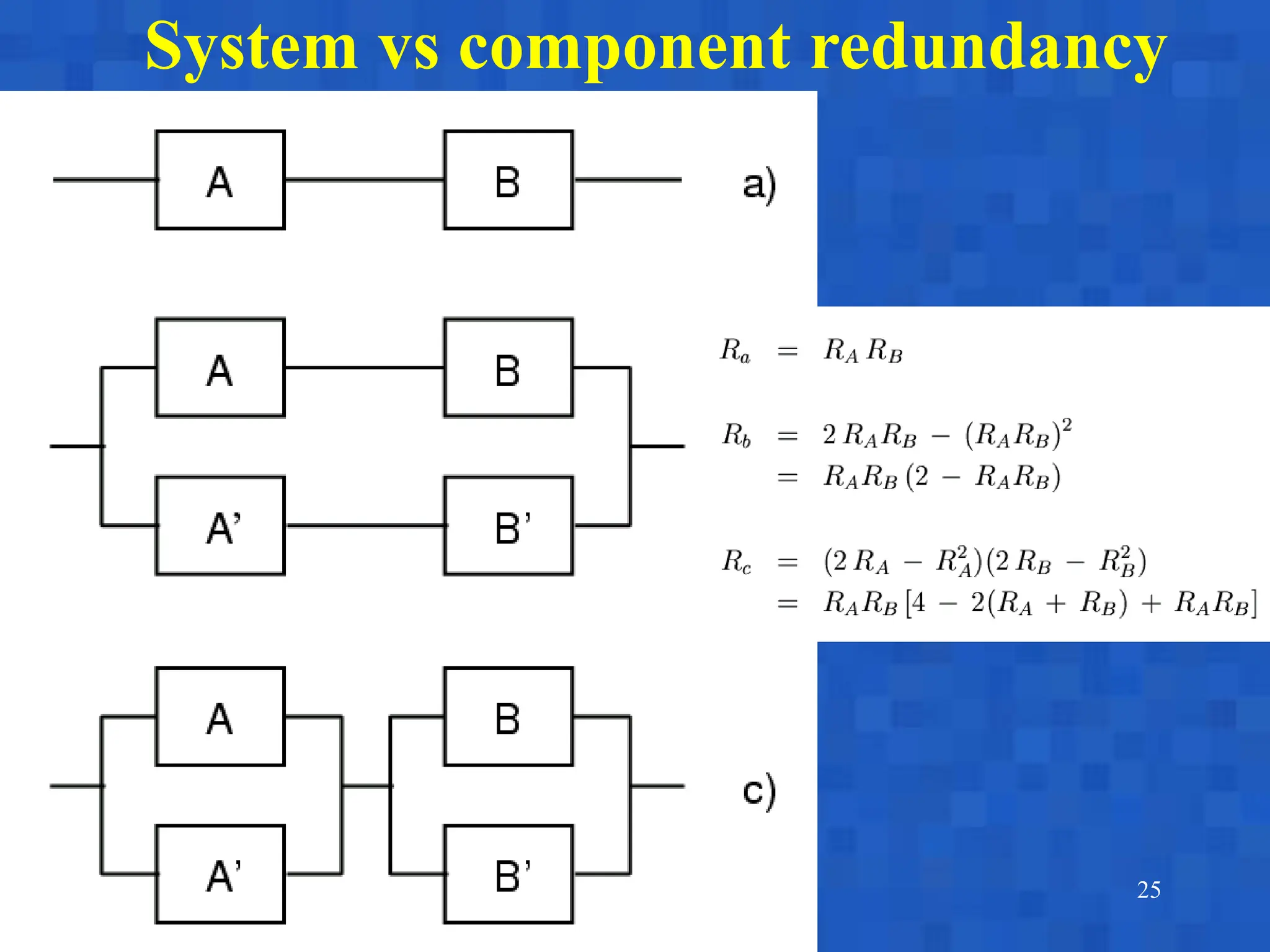
System vs component redundancy
A. Bobbio Reggio Emilia, June 17-18, 2003 26
Component redundant system:
an example
A. Bobbio Reggio Emilia, June 17-18, 2003 27
Is redundancy always useful ?
A. Bobbio Reggio Emilia, June 17-18, 2003 28
Stand-by redundancy
A
B
The system works continuously
during 0 — t if:
a) Component A did not fail between 0 — t
b) Component A failed at x between 0 — t , and
component B survived from x to t .
x
0 t
A B
A. Bobbio Reggio Emilia, June 17-18, 2003 29
Stand-by redundancy
A
B
x
0 t
A B
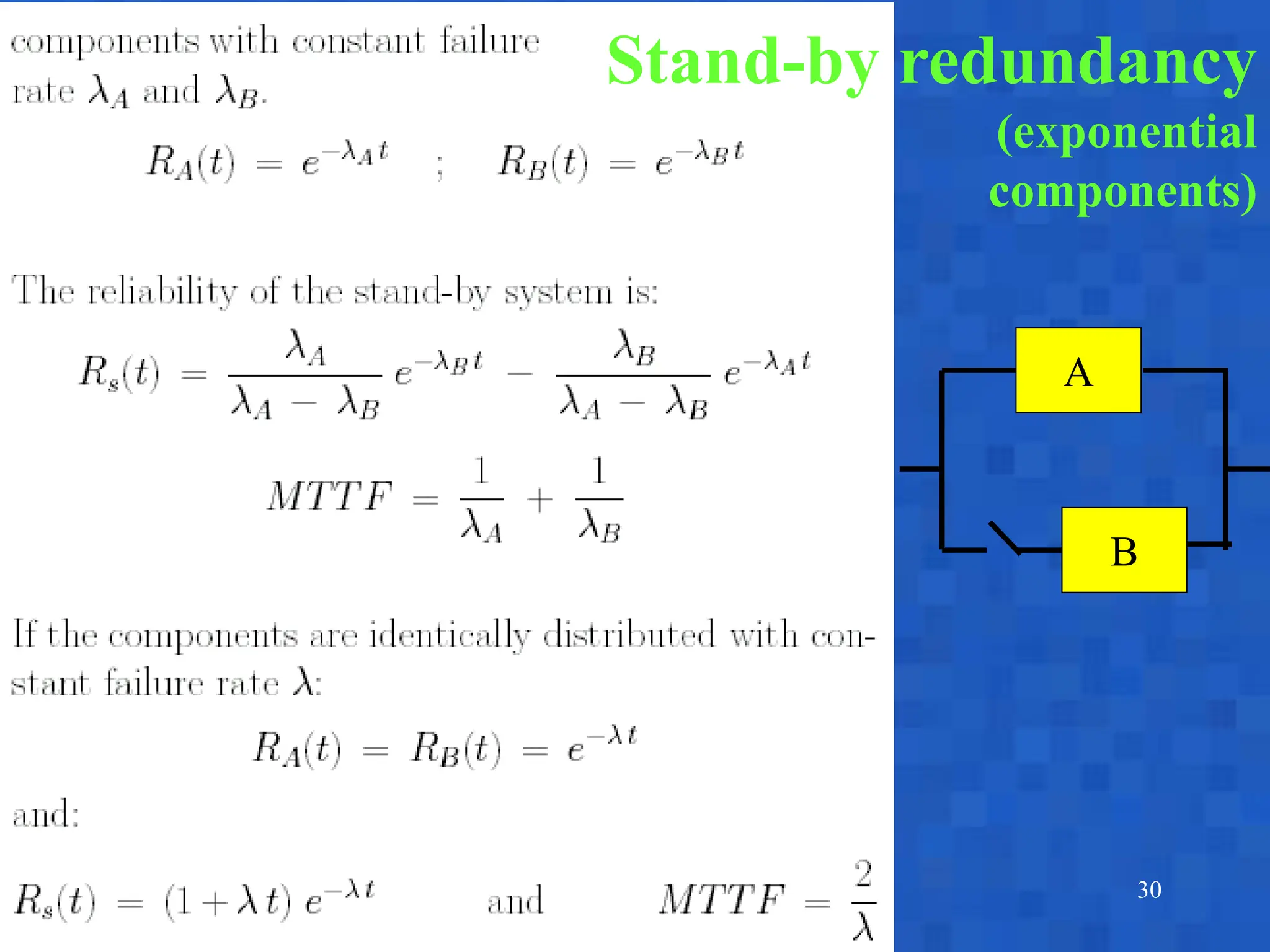
A. Bobbio Reggio Emilia, June 17-18, 2003 30
A
B
Stand-by redundancy
(exponential
components)
A. Bobbio Reggio Emilia, June 17-18, 2003 31
Majority voting
redundancy
A1
A2
A3
Voter
A. Bobbio Reggio Emilia, June 17-18, 2003 32
2:3 majority voting redundancy
A1
A2
A3
Voter

RBDs-Redundancia-Disponibilidad_(slide).ppt

  • 1.
    A. Bobbio ReggioEmilia, June 17-18, 2003 1 Dependability & Maintainability Theory and Methods 3. Reliability Block Diagrams Andrea Bobbio Dipartimento di Informatica Università del Piemonte Orientale, “A. Avogadro” 15100 Alessandria (Italy) bobbio@unipmn.it - http://www.mfn.unipmn.it/~bobbio/IFOA IFOA, Reggio Emilia, June 17-18, 2003
  • 2.
    A. Bobbio ReggioEmilia, June 17-18, 2003 2 Model Types in Dependability Combinatorial models assume that components are statistically independent: poor modeling power coupled with high analytical tractability.  Reliability Block Diagrams, FT, …. State-space models rely on the specification of the whole set of possible states of the system and of the possible transitions among them.  CTMC, Petri nets, ….
  • 3.
    A. Bobbio ReggioEmilia, June 17-18, 2003 3 Reliability Block Diagrams Each component of the system is represented as a block; System behavior is represented by connecting the blocks; Failures of individual components are assumed to be independent; Combinatorial (non-state space) model type.
  • 4.
    A. Bobbio ReggioEmilia, June 17-18, 2003 4 Reliability Block Diagrams (RBDs) Schematic representation or model; Shows reliability structure (logic) of a system; Can be used to determine dependability measures; A block can be viewed as a “switch” that is “closed” when the block is operating and “open” when the block is failed; System is operational if a path of “closed switches” is found from the input to the output of the diagram.
  • 5.
    A. Bobbio ReggioEmilia, June 17-18, 2003 5 Reliability Block Diagrams (RBDs) Can be used to calculate: – Non-repairable system reliability given:  Individual block reliabilities (or failure rates);  Assuming mutually independent failures events. – Repairable system availability given: Individual block availabilities (or MTTFs and MTTRs); Assuming mutually independent failure and restoration events; Availability of each block is modeled as 2-state Markov chain.
  • 6.
    A. Bobbio ReggioEmilia, June 17-18, 2003 6 Series system of n components. Components are statistically independent Define event Ei = “component i functions properly.” Series system in RBD ) ( )... ( ) ( ) ... ( ) " " ( 2 1 2 1 n n E P E P E P E E E P P       properly g functionin is system series A1 A2 An P(Ei) is the probability “component i functions properly”  the reliability R i(t) (non repairable)  the availability A i(t) (repairable)
  • 7.
    A. Bobbio ReggioEmilia, June 17-18, 2003 7 Reliability of Series system Series system of n components. Components are statistically independent Define event Ei = "component i functions properly.” ) ( )... ( ) ( ) ... ( ) " " ( 2 1 2 1 n n E P E P E P E E E P P       properly ng functioni is system series A1 A2 An    n i i s t R t R 1 ) ( ) ( Denoting by R i(t) the reliability of component i Product law of reliabilities:
  • 8.
    A. Bobbio ReggioEmilia, June 17-18, 2003 8 Series system with time-independent failure rate Let  i be the time-independent failure rate of component i. Then: The system reliability Rs(t) becomes: Rs(t) = e -  s t with s =  i i=1 n Ri (t) = e -  i t 1 1 MTTF = —— = ———— s  i i=1 n
  • 9.
    A. Bobbio ReggioEmilia, June 17-18, 2003 9 Availability for Series System Assuming independent repair for each component, where Ai is the (steady state or transient) availability of component i           n i i s n i i i i n i i s t A t A MTTR MTTF MTTF A A 1 1 1 ) ( ) ( or ,
  • 10.
    A. Bobbio ReggioEmilia, June 17-18, 2003 10 Series system: an example
  • 11.
    A. Bobbio ReggioEmilia, June 17-18, 2003 11 Series system: an example
  • 12.
    A. Bobbio ReggioEmilia, June 17-18, 2003 12 Improving the Reliability of a Series System Sensitivity analysis:  R s R s S i = ———— = ————  R i R i The optimal gain in system reliability is obtained by improving the least reliable component.
  • 13.
    A. Bobbio ReggioEmilia, June 17-18, 2003 13 The part-count method It is usually applied for computing the reliability of electronic equipment composed of boards with a large number of components. Components are connected in series and with time- independent failure rate.
  • 14.
    A. Bobbio ReggioEmilia, June 17-18, 2003 14 The part-count method
  • 15.
    A. Bobbio ReggioEmilia, June 17-18, 2003 15 Redundant systems When the dependability of a system does not reach the desired (or required) level:  Improve the individual components;  Act at the structure level of the system, resorting to redundant configurations.
  • 16.
    A. Bobbio ReggioEmilia, June 17-18, 2003 16 Parallel redundancy A system consisting of n independent components in parallel. It will fail to function only if all n components have failed. Ei = “The component i is functioning” Ep = “the parallel system of n component is functioning properly.” A1 An . . . . . .
  • 17.
    A. Bobbio ReggioEmilia, June 17-18, 2003 17 Parallel system " failed has system parallel The "  p E " failed have components n All "  __ __ 2 __ 1 ... n E E E     ) ... ( ) ( __ __ 2 __ 1 __ n p E E E P E P     ) ( )... ( ) ( __ __ 2 __ 1 n E P E P E P  Therefore: ) ( 1 ) ( p p E P E P  
  • 18.
    A. Bobbio ReggioEmilia, June 17-18, 2003 18 Parallel redundancy Fi (t) = P (Ei) Probability component i is not functioning (unreliability) Ri (t) = 1 - Fi (t) = P (Ei) Probability component i is functioning (reliability) A1 An . . . . . . — Fp (t) =  Fi (t) i=1 n Rp (t) = 1 - Fp (t) = 1 -  (1 - Ri (t)) i=1 n
  • 19.
    A. Bobbio ReggioEmilia, June 17-18, 2003 19 2-component parallel system For a 2-component parallel system: Fp (t) = F1 (t) F2 (t) Rp (t) = 1 – (1 – R1 (t)) (1 – R2 (t)) = = R1 (t) + R2 (t) – R1 (t) R2 (t) A1 A2
  • 20.
    A. Bobbio ReggioEmilia, June 17-18, 2003 20 2-component parallel system: constant failure rate For a 2-component parallel system with constant failure rate: Rp (t) = A1 A2 e - 1 t + e -  2 t – e - ( 1 +  2 ) t 1 1 1 MTTF = —— + —— – ———— 1 2 1 + 2
  • 21.
    A. Bobbio ReggioEmilia, June 17-18, 2003 21 Parallel system: an example
  • 22.
    A. Bobbio ReggioEmilia, June 17-18, 2003 22 Partial redundancy: an example
  • 23.
    A. Bobbio ReggioEmilia, June 17-18, 2003 23 Availability for parallel system Assuming independent repair, where Ai is the (steady state or transient) availability of component i.                n i i p n i i i i n i i p t A t A or MTTR MTTF MTTR A A 1 1 1 )) ( 1 ( 1 ) ( 1 ) 1 ( 1
  • 24.
    A. Bobbio ReggioEmilia, June 17-18, 2003 24 Series-parallel systems
  • 25.
    A. Bobbio ReggioEmilia, June 17-18, 2003 25 System vs component redundancy
  • 26.
    A. Bobbio ReggioEmilia, June 17-18, 2003 26 Component redundant system: an example
  • 27.
    A. Bobbio ReggioEmilia, June 17-18, 2003 27 Is redundancy always useful ?
  • 28.
    A. Bobbio ReggioEmilia, June 17-18, 2003 28 Stand-by redundancy A B The system works continuously during 0 — t if: a) Component A did not fail between 0 — t b) Component A failed at x between 0 — t , and component B survived from x to t . x 0 t A B
  • 29.
    A. Bobbio ReggioEmilia, June 17-18, 2003 29 Stand-by redundancy A B x 0 t A B
  • 30.
    A. Bobbio ReggioEmilia, June 17-18, 2003 30 A B Stand-by redundancy (exponential components)
  • 31.
    A. Bobbio ReggioEmilia, June 17-18, 2003 31 Majority voting redundancy A1 A2 A3 Voter
  • 32.
    A. Bobbio ReggioEmilia, June 17-18, 2003 32 2:3 majority voting redundancy A1 A2 A3 Voter