ECE/CS 541: Computer System Analysis, Instructor William H. Sanders. ©2006 William H. Sanders. All rights reserved. Do not duplicate without
permission of the author.
Module 1, Slide 1
Dependability
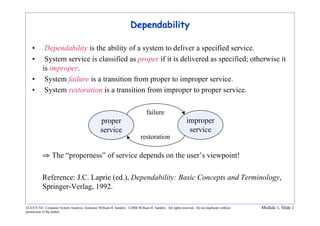
• Dependability is the ability of a system to deliver a specified service.
• System service is classified as proper if it is delivered as specified; otherwise it
is improper.
• System failure is a transition from proper to improper service.
• System restoration is a transition from improper to proper service.
⇒ The “properness” of service depends on the user’s viewpoint!
Reference: J.C. Laprie (ed.), Dependability: Basic Concepts and Terminology,
Springer-Verlag, 1992.
improper
service
failure
restoration
proper
service
ECE/CS 541: Computer System Analysis, Instructor William H. Sanders. ©2006 William H. Sanders. All rights reserved. Do not duplicate without
permission of the author.
Module 1, Slide 2
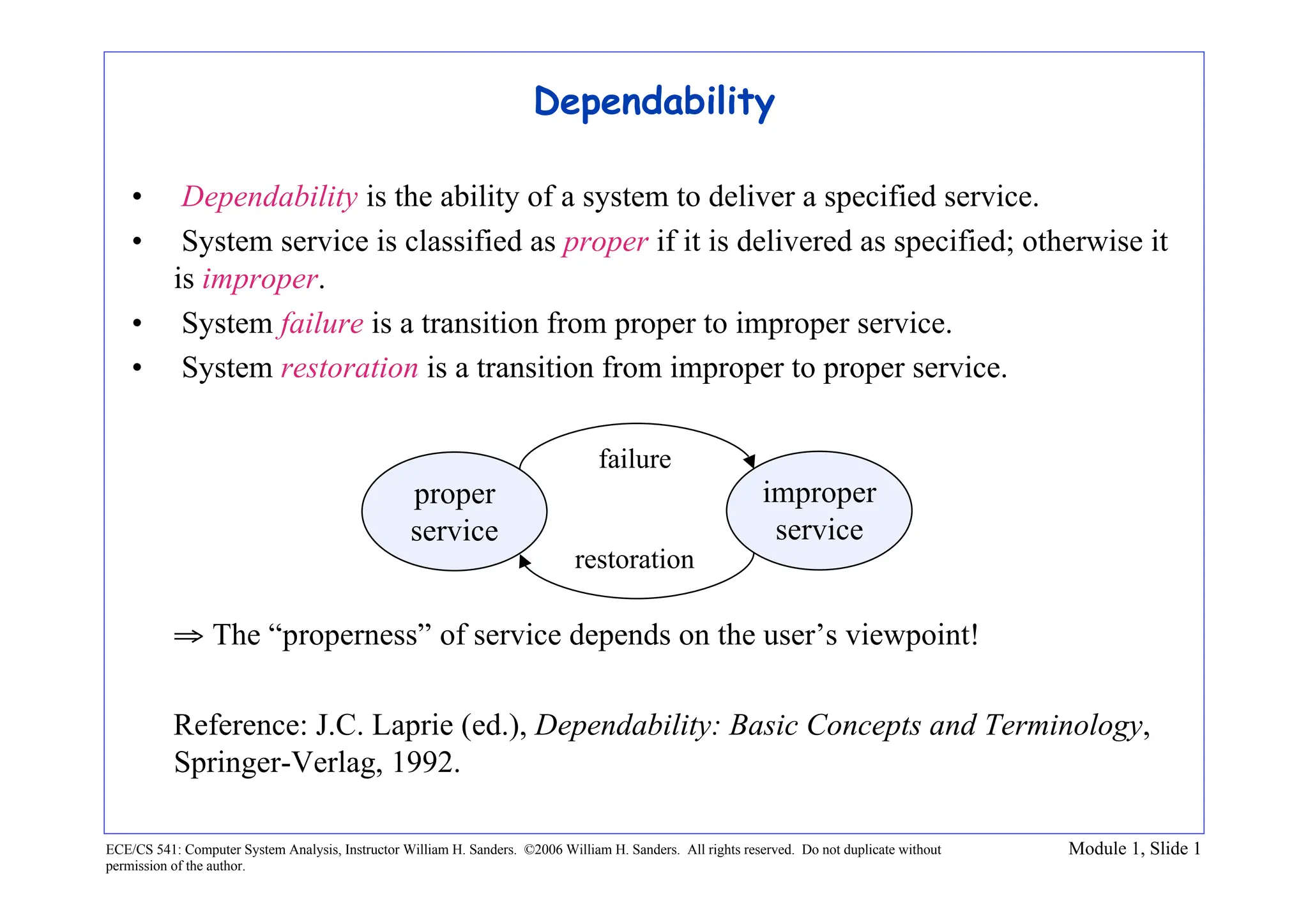
Examples of Specifications of Proper Service
• k out of N components are functioning.
• every working processor can communicate with every other working processor.
• every message is delivered within t milliseconds from the time it is sent.
• all messages are delivered in the same order to all working processors.
• the system does not reach an unsafe state.
• 90% of all remote procedure calls return within x seconds with a correct result.
• 99.999% of all telephone calls are correctly routed.
⇒ Notion of “proper service” provides a specification by which to evaluate a
system’s dependability.
ECE/CS 541: Computer System Analysis, Instructor William H. Sanders. ©2006 William H. Sanders. All rights reserved. Do not duplicate without
permission of the author.
Module 1, Slide 3
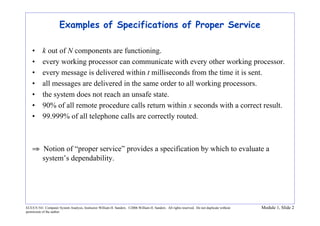
Dependability Concepts
• Measures - properties expected from
a dependable system
– Availability
– Reliability
– Safety
– Confidentiality
– Integrity
– Maintainability
– Coverage
• Means - methods to achieve
dependability
– Fault Avoidance
– Fault Tolerance
– Fault Removal
– Dependability Assessment
• Impairments - causes of
undependable operation
– Faults
– Errors
– Failures
ECE/CS 541: Computer System Analysis, Instructor William H. Sanders. ©2006 William H. Sanders. All rights reserved. Do not duplicate without
permission of the author.
Module 1, Slide 4
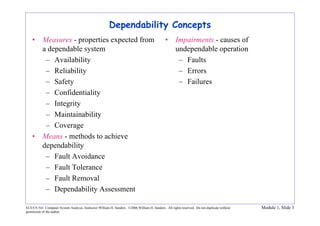
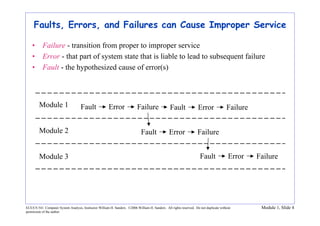
Faults, Errors, and Failures can Cause Improper Service
• Failure - transition from proper to improper service
• Error - that part of system state that is liable to lead to subsequent failure
• Fault - the hypothesized cause of error(s)
Module 1
Module 3
Module 2
Fault Error Failure
Fault Error Failure
Fault Error Failure
Fault Error Failure
ECE/CS 541: Computer System Analysis, Instructor William H. Sanders. ©2006 William H. Sanders. All rights reserved. Do not duplicate without
permission of the author.
Module 1, Slide 5
Dependability Measures: Availability
Availability - quantifies the alternation between deliveries of proper and improper
service.
– A(t) is 1 if service is proper at time t, 0 otherwise.
– E[A(t)] (Expected value of A(t)) is the probability that service is proper at
time t.
– A(0,t) is the fraction of time the system delivers proper service during [0,t].
– E[A(0,t)] is the expected fraction of time service is proper during [0,t].
– P[A(0,t) > t*] (0 ≤ t* ≤ 1) is the probability that service is proper more than
100t*% of the time during [0,t].
– A(0,t)t→∞ is the fraction of time that service is proper in steady state.
– E[A(0,t)t→∞], P[A(0,t)t→∞ > t*] as above.
ECE/CS 541: Computer System Analysis, Instructor William H. Sanders. ©2006 William H. Sanders. All rights reserved. Do not duplicate without
permission of the author.
Module 1, Slide 6
Other Dependability Measures
• Reliability - a measure of the continuous delivery of service
– R(t) is the probability that a system delivers proper service throughout [0,t].
• Safety - a measure of the time to catastrophic failure
– S(t) is the probability that no catastrophic failures occur during [0,t].
– Analogous to reliability, but concerned with catastrophic failures.
• Time to Failure - measure of the time to failure from last restoration. (Expected
value of this measure is referred to as MTTF - Mean time to failure.)
• Maintainability - measure of the time to restoration from last experienced
failure. (Expected value of this measure is referred to as MTTR - Mean time to
repair.)
• Coverage - the probability that, given a fault, the system can tolerate the fault
and continue to deliver proper service.
ECE/CS 541: Computer System Analysis, Instructor William H. Sanders. ©2006 William H. Sanders. All rights reserved. Do not duplicate without
permission of the author.
Module 1, Slide 7
Illustration of the Impact of Coverage on Dependability
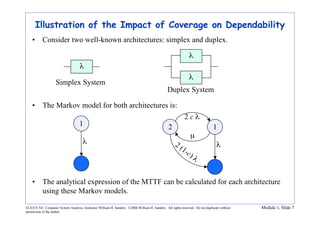
• Consider two well-known architectures: simplex and duplex.
• The Markov model for both architectures is:
• The analytical expression of the MTTF can be calculated for each architecture
using these Markov models.
λ
λ
Duplex System
1
2
2 c λ
µ
2 (1-c) λ
λ
λ
Simplex System
1
λ
ECE/CS 541: Computer System Analysis, Instructor William H. Sanders. ©2006 William H. Sanders. All rights reserved. Do not duplicate without
permission of the author.
Module 1, Slide 8
Illustration of the Impact of Coverage, cont.
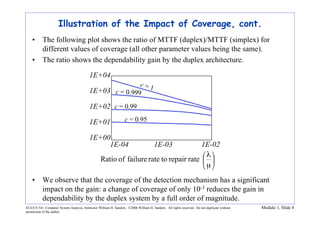
• The following plot shows the ratio of MTTF (duplex)/MTTF (simplex) for
different values of coverage (all other parameter values being the same).
• The ratio shows the dependability gain by the duplex architecture.
• We observe that the coverage of the detection mechanism has a significant
impact on the gain: a change of coverage of only 10-3 reduces the gain in
dependability by the duplex system by a full order of magnitude.
!
"
#
$
%
&
µ
'
rate
repair
to
rate
failure
of
Ratio
1E+04
1E+03
1E+02
1E+01
1E+00
1E-04 1E-03 1E-02
c = 1
c = 0.95
c = 0.999
c = 0.99
ECE/CS 541: Computer System Analysis, Instructor William H. Sanders. ©2006 William H. Sanders. All rights reserved. Do not duplicate without
permission of the author.
Module 1, Slide 9
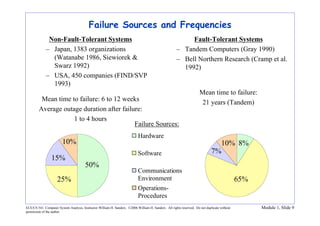
Failure Sources and Frequencies
Non-Fault-Tolerant Systems
– Japan, 1383 organizations
(Watanabe 1986, Siewiorek &
Swarz 1992)
– USA, 450 companies (FIND/SVP
1993)
Mean time to failure: 6 to 12 weeks
Average outage duration after failure:
1 to 4 hours
Fault-Tolerant Systems
– Tandem Computers (Gray 1990)
– Bell Northern Research (Cramp et al.
1992)
Mean time to failure:
21 years (Tandem)
Hardware
Software
Communications
Environment
Operations-
Procedures
50%
25%
15%
10%
65%
10% 8%
7%
Failure Sources:

l4a.pdf

  • 1.
    ECE/CS 541: ComputerSystem Analysis, Instructor William H. Sanders. ©2006 William H. Sanders. All rights reserved. Do not duplicate without permission of the author. Module 1, Slide 1 Dependability • Dependability is the ability of a system to deliver a specified service. • System service is classified as proper if it is delivered as specified; otherwise it is improper. • System failure is a transition from proper to improper service. • System restoration is a transition from improper to proper service. ⇒ The “properness” of service depends on the user’s viewpoint! Reference: J.C. Laprie (ed.), Dependability: Basic Concepts and Terminology, Springer-Verlag, 1992. improper service failure restoration proper service
  • 2.
    ECE/CS 541: ComputerSystem Analysis, Instructor William H. Sanders. ©2006 William H. Sanders. All rights reserved. Do not duplicate without permission of the author. Module 1, Slide 2 Examples of Specifications of Proper Service • k out of N components are functioning. • every working processor can communicate with every other working processor. • every message is delivered within t milliseconds from the time it is sent. • all messages are delivered in the same order to all working processors. • the system does not reach an unsafe state. • 90% of all remote procedure calls return within x seconds with a correct result. • 99.999% of all telephone calls are correctly routed. ⇒ Notion of “proper service” provides a specification by which to evaluate a system’s dependability.
  • 3.
    ECE/CS 541: ComputerSystem Analysis, Instructor William H. Sanders. ©2006 William H. Sanders. All rights reserved. Do not duplicate without permission of the author. Module 1, Slide 3 Dependability Concepts • Measures - properties expected from a dependable system – Availability – Reliability – Safety – Confidentiality – Integrity – Maintainability – Coverage • Means - methods to achieve dependability – Fault Avoidance – Fault Tolerance – Fault Removal – Dependability Assessment • Impairments - causes of undependable operation – Faults – Errors – Failures
  • 4.
    ECE/CS 541: ComputerSystem Analysis, Instructor William H. Sanders. ©2006 William H. Sanders. All rights reserved. Do not duplicate without permission of the author. Module 1, Slide 4 Faults, Errors, and Failures can Cause Improper Service • Failure - transition from proper to improper service • Error - that part of system state that is liable to lead to subsequent failure • Fault - the hypothesized cause of error(s) Module 1 Module 3 Module 2 Fault Error Failure Fault Error Failure Fault Error Failure Fault Error Failure
  • 5.
    ECE/CS 541: ComputerSystem Analysis, Instructor William H. Sanders. ©2006 William H. Sanders. All rights reserved. Do not duplicate without permission of the author. Module 1, Slide 5 Dependability Measures: Availability Availability - quantifies the alternation between deliveries of proper and improper service. – A(t) is 1 if service is proper at time t, 0 otherwise. – E[A(t)] (Expected value of A(t)) is the probability that service is proper at time t. – A(0,t) is the fraction of time the system delivers proper service during [0,t]. – E[A(0,t)] is the expected fraction of time service is proper during [0,t]. – P[A(0,t) > t*] (0 ≤ t* ≤ 1) is the probability that service is proper more than 100t*% of the time during [0,t]. – A(0,t)t→∞ is the fraction of time that service is proper in steady state. – E[A(0,t)t→∞], P[A(0,t)t→∞ > t*] as above.
  • 6.
    ECE/CS 541: ComputerSystem Analysis, Instructor William H. Sanders. ©2006 William H. Sanders. All rights reserved. Do not duplicate without permission of the author. Module 1, Slide 6 Other Dependability Measures • Reliability - a measure of the continuous delivery of service – R(t) is the probability that a system delivers proper service throughout [0,t]. • Safety - a measure of the time to catastrophic failure – S(t) is the probability that no catastrophic failures occur during [0,t]. – Analogous to reliability, but concerned with catastrophic failures. • Time to Failure - measure of the time to failure from last restoration. (Expected value of this measure is referred to as MTTF - Mean time to failure.) • Maintainability - measure of the time to restoration from last experienced failure. (Expected value of this measure is referred to as MTTR - Mean time to repair.) • Coverage - the probability that, given a fault, the system can tolerate the fault and continue to deliver proper service.
  • 7.
    ECE/CS 541: ComputerSystem Analysis, Instructor William H. Sanders. ©2006 William H. Sanders. All rights reserved. Do not duplicate without permission of the author. Module 1, Slide 7 Illustration of the Impact of Coverage on Dependability • Consider two well-known architectures: simplex and duplex. • The Markov model for both architectures is: • The analytical expression of the MTTF can be calculated for each architecture using these Markov models. λ λ Duplex System 1 2 2 c λ µ 2 (1-c) λ λ λ Simplex System 1 λ
  • 8.
    ECE/CS 541: ComputerSystem Analysis, Instructor William H. Sanders. ©2006 William H. Sanders. All rights reserved. Do not duplicate without permission of the author. Module 1, Slide 8 Illustration of the Impact of Coverage, cont. • The following plot shows the ratio of MTTF (duplex)/MTTF (simplex) for different values of coverage (all other parameter values being the same). • The ratio shows the dependability gain by the duplex architecture. • We observe that the coverage of the detection mechanism has a significant impact on the gain: a change of coverage of only 10-3 reduces the gain in dependability by the duplex system by a full order of magnitude. ! " # $ % & µ ' rate repair to rate failure of Ratio 1E+04 1E+03 1E+02 1E+01 1E+00 1E-04 1E-03 1E-02 c = 1 c = 0.95 c = 0.999 c = 0.99
  • 9.
    ECE/CS 541: ComputerSystem Analysis, Instructor William H. Sanders. ©2006 William H. Sanders. All rights reserved. Do not duplicate without permission of the author. Module 1, Slide 9 Failure Sources and Frequencies Non-Fault-Tolerant Systems – Japan, 1383 organizations (Watanabe 1986, Siewiorek & Swarz 1992) – USA, 450 companies (FIND/SVP 1993) Mean time to failure: 6 to 12 weeks Average outage duration after failure: 1 to 4 hours Fault-Tolerant Systems – Tandem Computers (Gray 1990) – Bell Northern Research (Cramp et al. 1992) Mean time to failure: 21 years (Tandem) Hardware Software Communications Environment Operations- Procedures 50% 25% 15% 10% 65% 10% 8% 7% Failure Sources: