CAPICITY BUILDING TRAINING
MODULE ON RADIO DRAMA.
Understanding Drama
A story represented by means of words and action.
In words of Bonamy Dobree “ moving literature”.
Action is pivotal to any drama which is basically meant for
performance.
Words were introduced in plays at much lateral stag e
than other elements e.g. Mime, dance , Music, costume
and stage décor.
• Recreation implies creation of an illusion of a reality, this
phenomenon is called “make believe” or suspension of
disbelief
• Action represents a character at a given time and space
• Action promotes the plot or keeps the story moving
• Drama needs proper characterisation and gripping Plot.
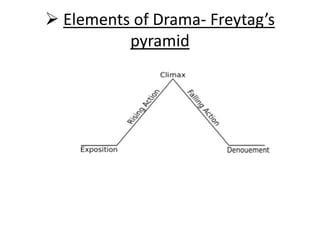
• Plot has four elements ( Freytag’s pyramid )
 Exposition
 Conflict (Rising action )
 Climax
 Resolution , Denouement or anticlimax (Falling action )
Plot
• It’s the series of actions and sequences of
the story
• The plot grows from the conflict that arises
when two forces in a play come into
opposition
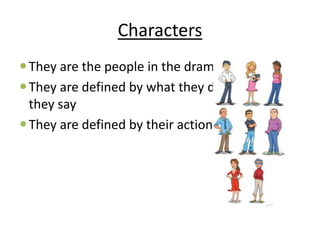
Characters
They are the people in the drama
They are defined by what they do and what
they say
They are defined by their actions
 Brief History
There are records of sacred drama in Egypt (2000
B.C). The Psi (600B.C) in the ancient Greece is the
first known playwright.
Then followed Aeschylus (525-456 B.C),
Sophocles (496-406 B.C ).
In the East, Indian culture was influenced by
Buddhism and under this influence plays were
being written and performed for religious
purposes.
In fact classical drama is conventional and
The plays of Kalidas (4th century A.D ) and
Bhavati are lyrical in tone and refined in
feelings. Kalidas’s delicate romantic tales leep
time and space but there is no conflict and
characters are transformed from human
beings in to gods
Dramaturgy
• Theme
• Story
• Script
• Theme
• Suspense
• Characterisation
antagonist
Protagonist
 Direct ( round or explicit, it uses another character, narrator or the
protagonist himself to tell the audience about the subject)
 Indirect (Flat or implicit, the audience has to deduce for himself the
characteristics of the character by observing his/her own thought process,
behaviour, speech, way of talking, appearance and way of communication
with other characters )
• Plot
• Dialogue(s)
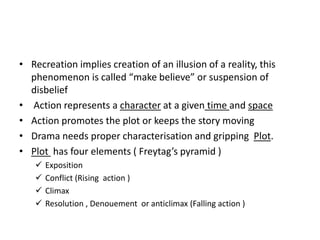
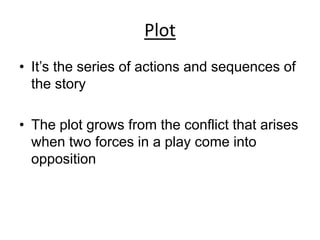
The Radio Play
• The term “ Play “ applied to Drama indicates
that certain action is displayed or reacted for
recreation
• Basically radio play emerged out of Theatre or
stage play
• The recreative quality of drama gets more
imaginative place in Radio
• It has ,sometimes, been called “Blind Theatre
” or “ Aural Half “ of stage play
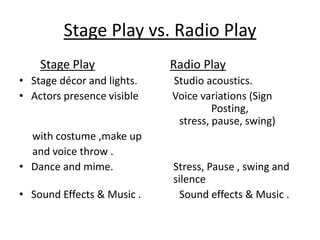
Stage Play vs. Radio Play
Stage Play Radio Play
• Stage décor and lights. Studio acoustics.
• Actors presence visible Voice variations (Sign
Posting,
stress, pause, swing)
with costume ,make up
and voice throw .
• Dance and mime. Stress, Pause , swing and
silence
• Sound Effects & Music . Sound effects & Music .
 Elements of Drama- Freytag’s
pyramid
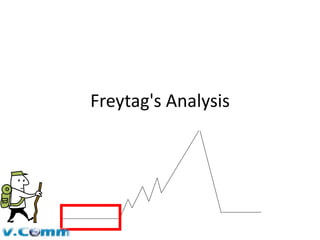
Freytag's Analysis
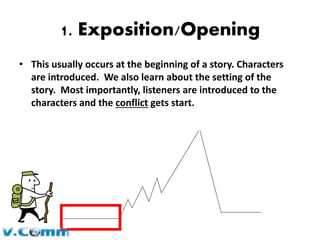
1. Exposition/Opening
• This usually occurs at the beginning of a story. Characters
are introduced. We also learn about the setting of the
story. Most importantly, listeners are introduced to the
characters and the conflict gets start.
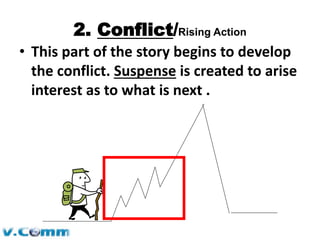
2. Conflict/Rising Action
• This part of the story begins to develop
the conflict. Suspense is created to arise
interest as to what is next .
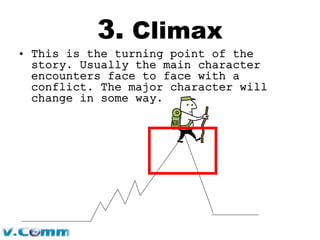
3. Climax
• This is the turning point of the
story. Usually the main character
encounters face to face with a
conflict. The major character will
change in some way.
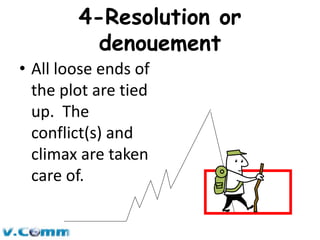
4-Resolution or
denouement
• All loose ends of
the plot are tied
up. The
conflict(s) and
climax are taken
care of.
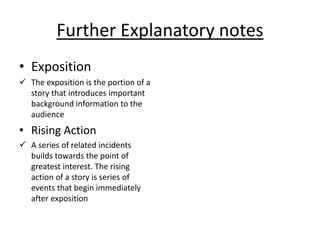
Further Explanatory notes
• Exposition
 The exposition is the portion of a
story that introduces important
background information to the
audience
• Rising Action
 A series of related incidents
builds towards the point of
greatest interest. The rising
action of a story is series of
events that begin immediately
after exposition
• Climax
 the climax is the turning point,
which changes the protagonist’s
fate. If the story is a comedy, things
will have gone badly for the
protagonist up to ths point.
• Falling action
 During the falling action, the
conflict between the protagonist
and antagonist unfolds, with the
protagonist wining or loosing
against the antagonist. The falling
action may contain a moment of
final suspense, in which the final
outcome of the conflict is in doubt
• Resolution or
denouement
 The dénouement comprises
events from the end of the falling
action to the actual ending scene
of the drama or narrative.
Conflicts are resolved, creating
normality for the characters and a
sense of catharsis or release of
tension and anxiety.
Conflict’s meaning
• Conflict’s meaning
 A Struggle between two or
more forces that creates tension
which must be resolved. There
are two conflicts namely External
and internal.
 The traditional breakdown of the
conflict is :
Man vs. man (external)
Man vs. nature (external )
Man vs. society (external )
Man vs. Self ( Internal )
Production and directional modes
• Getting hands on script
 Idea formulation (Research,
personal observations, inspirations,
adaptation of popular novels and
short stories, discussions with
playwrights, translations )
 Script (Vetting, amendments in
consultation with seniors and the
playwright – you have either a
solicited or unsolicited script,
Reader’s Report and final approval
 Casting ,booking proposal
 Preliminary production script
 Copies of final script and selection of
dramatists
REMEMBER:
• Do not perform
the script by your
self in front of the
artists.
why?????
what to do?
Directional mode
• Directional mode
 First Rehearsal ( reading the
script by the dramatists ,cues,
stresses, pauses, swings,
silence, sign posting, tones,
tempo, pace )
 second Rehearsal,
 Final Rehearsal,
 Dress or Mike rehearsal
(Microphone distances for sign
posting, in out cues,
interactive responses among
drama voices and interaction
with the producer through
observation window )
Music blending
 music can capture emotions
and images
 It can swing the listenerts
instantaneously from entirely
one mood to an other mood
 It can, as subtly as a raised
eyebrow-give to a phrase an
extra, and as possibly
contradictory, level of meaning
 There happen different kinds
of music while producing a
radio play e.g.
 Opening/closing music
depending on theme of the
dram, Bridging music, change
over or transitional music for
separating different scenes,
Bangs, BGM as continuity etc.
Music has many
shades :
suggestive
descriptive
indicative
etc.
Sound Effects

Sound Effects help tell the
story in audio. They tell you
where or when the story takes
place. They tell you about the
action, how events are
unfolding.
 Radio drama is usually
recorded in a carefully sound
proofed studio. But voices and
script alone can sound dry and
unreal. It’s the studio
manager’s job to add recorded
sound effects, and to create
live sound effects.
 The addition of sound effects
transforms the clean audio of
voices reading script into a
world that is believable for the
listener. Some of these sound
effects happen at a very
subconscious level. They can
be as simple as a teaspoon
clipping the edge of a cup, or a
door opening – all ordinary
noises that happen in the
background of real life, but
that have to be artificially
created in the world of radio
drama.
Books recommended:
 The Sound Effects Bible - Ric
Viers, Michael Weise Productions,
2008. And excellent book that
covers modern hardware and
software, field recording, sound
design, and how to make specific
sounds.
 Radio Sound Effects - Robert L.
Mott. McFarland, 1993.
 Radio and Television Sound
Effects - by Robert B. Turnbull.
1951. Rinehart & Company Inc.;
New York
www.suondeffectsbible.com
www.sounddogs.com
How to produce a Radio Play in eight
easy steps ?
• Create visual picture. Production of a radio
drama requires you to paint a picture in the
audience’s minds. This means the use of
descriptive words to build up images that
enable the listening audience to identify with
the characters, the world the character lives
in and the atmosphere for each scene. Use of
colour is very important to create the image
in the listener’s mind
• A narrator is very useful in the context of
radio: the narrator play out the scene,
explain action sequences and wrap up the
scene.
 If you are working on a serial, the narrator
can summarise the previous episode’s
action as recap
 The narrator can switch between scenes
REMEMBER
• Create the action
through dialogues,
since all you have to
work with , is
dialogues rather than
props, a setting or
visual cues, dialogues
will need to work hard
on it. It can be used to
describe action as it is
taking place
• Make the most of sound
effects where necessary.
Too many sound effects
can spoil the broth and
can get your listeners
confused. Use
astounding sounds-
things to wake up your
listeners such as an
explosion, a music bang,
a cry, a skidding car, an
angry mob shouting etc.
• You can use effects which are
built in to the mixer desk to
help create actualization.
When it comes to producing
your play, and if you are
producing it, be sure that you
do a sound check with the
effects, to ensure the sound
levels and effects are how you
want them.
 Use reverberation- use it to
set the acoustics of a location.
For example empty room, an
office full of coworkers, a cave,
halls, a court room etc.
• Music in the background can
help to set the mood of your
play. Obviously, you can match
music o feelings such as sad
music for sad occasions
featuring death or loss; happy
music for good news;
suspenseful music for a scary
or worrying moment and fast
music for increased action or a
chase. Music also sets
opening/closing tone of a play,
serving as aural curtain..Sky is
the limit for a creative drama
producer
• Be precise and clear with
spoken words, always use
economy of words without
altering the meaning of a
dialogue. Every thing must be
clear because your listener
cannot view a character using
facial expressions, waving
arms about or throwing
objects etc; Silence must be
used craft fully so as not to
convey an empty space-
meaningful or pregnant pause
is always appreciated
THANK
YOU FOR
YOUR
PATIENCE

Editor's Notes