RAPPORT
A brief Introduction
Define Rapport
Identify ways to build rapport
Use sensory language
Use the 4 A’s
Practice Rapport Behavior
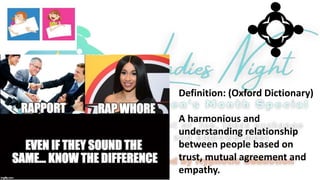
Definition: (Oxford Dictionary)
A harmonious and
understanding relationship
between people based on
trust, mutual agreement and
empathy.
Often times we hear terms like being “in sync”- “in tune”.
Developing a relationship based on trust.
Also defined as providing assurance and acknowledging the victim subject.
Having a “Harmonious relationship” with another person; feeling a
connection! (Read: People you don’t want to stab with a pencil)
RAPPORT
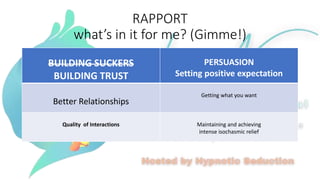
what’s in it for me? (Gimme!)
BUILDING SUCKERS
BUILDING TRUST
PERSUASION
Setting positive expectation
Better Relationships
Getting what you want
Quality of Interactions Maintaining and achieving
intense isochasmic relief
WAYS TO ESTABLISH RAPPORT
Let’s talk tone
“Instant” Rapport:
People often decide right away if they want to interact with you. The first
few seconds of the contact are critical. (Psychic Continuity)
Present yourself as:
Positive (or Dangerous)
Personable
Enthusiastic
Empathetic
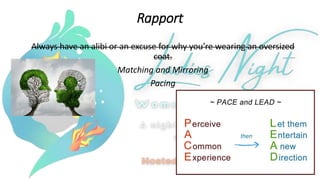
Rapport
Always have an alibi or an excuse for why you’re wearing an oversized
coat.
Matching and Mirroring
Pacing
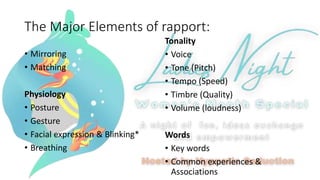
The Major Elements of rapport:
• Mirroring
• Matching
Physiology
• Posture
• Gesture
• Facial expression & Blinking*
• Breathing
Tonality
• Voice
• Tone (Pitch)
• Tempo (Speed)
• Timbre (Quality)
• Volume (loudness)
Words
• Key words
• Common experiences &
Associations
Rapport
Voice or Tone and Tempo
•One way is to match the potential
subject’s rate of speech
Rapport
If the subject is:
Observation
Angry
Friendly
Burdened / Stressed
Frantic in a hurry
Happy
Response
Assuring/Concerned
Cheerful
Sympathetic
Assuring/Concise
Happy
Sensory Language
Cues to observe
• VISUAL: I see what you mean… Bright idea……..: Show me how…… It’s
not clear yet….. I don’t see….
• Auditory: I hear that…….: Sounds good……: Tell me again………
It just clicked………: Yes it rings a bell
= Kinesthetic: It feels right……: I’ve Got a rough idea…… I can handle
that…….. Wonderful News…… : Great………, Fantastic……………..
RAPPORT
shows we are Listening
• When we LISTEN what someone is saying we’re saying, “You
don’t completely suck” and “we are paying attention to you”.
• Spend 80% of the time listening and 20% talking if you don’t want
them to fall asleep on your favorite couch.
Takes interest by listening, (scribble notes on your arm
to let them know you’re well adjusted). Give feedback
to show you’re listening.
RAPPORT
By learning and using the 4 A’s formula.
•Assure
•Acknowledge
•Affirm
•Appreciate
• ASSURE: I assure you that you are safe with me.
People are more trusting when they feel safe.
Subs love fake vampire teeth and capes
ACKNOWLEDGE: I can help you achieve…..(orgasms)
Always acknowledge the subject’s opening statement.
Affirm
• AFFIRM: I like your sense of humor.
• I like your toy collection.
• APPRECIATE: You’re doing brilliantly well my toy
(cue: headpats)

Rapport

  • 1.
    RAPPORT A brief Introduction DefineRapport Identify ways to build rapport Use sensory language Use the 4 A’s Practice Rapport Behavior
  • 2.
    Definition: (Oxford Dictionary) Aharmonious and understanding relationship between people based on trust, mutual agreement and empathy.
  • 3.
    Often times wehear terms like being “in sync”- “in tune”. Developing a relationship based on trust. Also defined as providing assurance and acknowledging the victim subject. Having a “Harmonious relationship” with another person; feeling a connection! (Read: People you don’t want to stab with a pencil)
  • 5.
    RAPPORT what’s in itfor me? (Gimme!) BUILDING SUCKERS BUILDING TRUST PERSUASION Setting positive expectation Better Relationships Getting what you want Quality of Interactions Maintaining and achieving intense isochasmic relief
  • 6.
    WAYS TO ESTABLISHRAPPORT Let’s talk tone “Instant” Rapport: People often decide right away if they want to interact with you. The first few seconds of the contact are critical. (Psychic Continuity) Present yourself as: Positive (or Dangerous) Personable Enthusiastic Empathetic
  • 7.
    Rapport Always have analibi or an excuse for why you’re wearing an oversized coat. Matching and Mirroring Pacing
  • 8.
    The Major Elementsof rapport: • Mirroring • Matching Physiology • Posture • Gesture • Facial expression & Blinking* • Breathing Tonality • Voice • Tone (Pitch) • Tempo (Speed) • Timbre (Quality) • Volume (loudness) Words • Key words • Common experiences & Associations
  • 9.
    Rapport Voice or Toneand Tempo •One way is to match the potential subject’s rate of speech
  • 10.
    Rapport If the subjectis: Observation Angry Friendly Burdened / Stressed Frantic in a hurry Happy Response Assuring/Concerned Cheerful Sympathetic Assuring/Concise Happy
  • 11.
    Sensory Language Cues toobserve • VISUAL: I see what you mean… Bright idea……..: Show me how…… It’s not clear yet….. I don’t see…. • Auditory: I hear that…….: Sounds good……: Tell me again……… It just clicked………: Yes it rings a bell = Kinesthetic: It feels right……: I’ve Got a rough idea…… I can handle that…….. Wonderful News…… : Great………, Fantastic……………..
  • 12.
    RAPPORT shows we areListening • When we LISTEN what someone is saying we’re saying, “You don’t completely suck” and “we are paying attention to you”.
  • 13.
    • Spend 80%of the time listening and 20% talking if you don’t want them to fall asleep on your favorite couch. Takes interest by listening, (scribble notes on your arm to let them know you’re well adjusted). Give feedback to show you’re listening.
  • 14.
    RAPPORT By learning andusing the 4 A’s formula. •Assure •Acknowledge •Affirm •Appreciate
  • 15.
    • ASSURE: Iassure you that you are safe with me. People are more trusting when they feel safe. Subs love fake vampire teeth and capes ACKNOWLEDGE: I can help you achieve…..(orgasms) Always acknowledge the subject’s opening statement.
  • 16.
    Affirm • AFFIRM: Ilike your sense of humor. • I like your toy collection. • APPRECIATE: You’re doing brilliantly well my toy (cue: headpats)