*Corresponding Author: Monalisha Pattnaik, Email: monalisha_1977@yahoo.com
CASE STUDY
Available Online at
A Linear Programming Problem in Fuzzy Space: A Case Study in a Bakery Industry with
Managerial Decision
1
Monalisha Pattnaik*, 2
Padmabati Gahan
1,2
*Dept. of Business Administration Sambalpur University Jyotivihar, Sambalpur India
Received on: 17/02/2017, Revised on: 03/03/2017, Accepted on: 09/03/2017
ABSTRACT
This paper investigates recent techniques that have been developed for optimization of linear
programming problems. In practice, there are many problems in which all decision parameters are fuzzy
numbers, and such problems are usually solved by either probabilistic programming or multi objective
programming methods. Unfortunately all these methods have shortcomings. In this note, using the
concept of comparison of fuzzy numbers, it is introduced a very effective method for solving these
problems. With the problem assumptions, the optimal solution can still be theoretically solved using the
simplex based method. To handle the fuzzy decision variables can be initially generated and then solved
and improved sequentially using the fuzzy decision approach by introducing Robust’s ranking technique.
The model is illustrated with a case study application. The proposed procedure was programmed and
through MATLAB (R2009a) version software, the four dimensional slice diagram is represented to the
application. Finally, real case problem is presented to illustrate the effectiveness of the theoretical results,
and to gain additional managerial insights for decision making.
Keywords: Fuzzy, Trapezoidal number, Linear Programming, Case study.
INTRODUCTION
In recent years, there has been a substantial amount of research related to the fuzzy applied linear
programming problems. Over the last few years, more and more manufacturers had applied the
optimization technique most frequently in linear programming to solve real-world problems and there it
is important to introduce new tools in the approach that allow the model to fit into the real world as much
as possible. Any linear programming model representing real-world situations involves a lot of
parameters whose values are assigned by experts, and in the conventional approach, they are required to
fix an exact value to the aforementioned parameters. However, both experts and the decision maker
frequently do not precisely know the value of those parameters. If exact values are suggested these are
only statistical inference from past data and their stability is doubtful, so the parameters of the problem
are usually defined by the decision maker in a uncertain space. Therefore, it is useful to consider the
knowledge of experts about the parameters as fuzzy data. Two significant questions may be found in
these kinds of problems: how to handle the relationship between the fuzzy parameters, and how to find
the optimal values for the fuzzy multi-objective function. The answer is related to the problem of ranking
fuzzy numbers. This research has been motivated by a suitable example and post optimal analyses.
www.ajms.in
Asian Journal of Mathematical Sciences 2017; 1(2):44-51
In fuzzy decision making problems, the concept of maximizing decision was introduced by Bellman and
Zadeh (1970) [2]. Zimmerman (1978) [17] presented a fuzzy approach to multi-objective linear
programming problems in his classical paper. Lai and Hwang (1992) [7] considered the situations where
all parameters are in fuzzy. Lai and Huang (1992) [5] assume that the parameters have a triangular
possibility distribution. Gani et al. (2009) [4] introduce fuzzy linear programming problem based on L-R
fuzzy number. Jimenez et al. (2005) [5] propose a method for solving linear programming problems
where all coefficients are, in general, fuzzy numbers and using linear ranking technique. Bazaar et al.
Pattnaik Monalisha et al. A Linear Programming Problem in Fuzzy Space: A Case Study in a Bakery Industry with Managerial
Decision
45
© 2017, AJMS. All Rights Reserved
(1990) [1] and Nasseri et al. (2005) [11] define linear programming problems with fuzzy numbers and
simplex method is used for finding the optimal solution of the fuzzy problem. Nagarajan and Solairaju
(2010) [10] compute improved fuzzy optimal Hungarian assignment problems with fuzzy numbers by
applying Robust’s ranking techniques to transform the fuzzy assignment problem to a crisp one. Pattnaik
(2012) [12] presented a fuzzy approach to several linear and nonlinear inventory models. Pattnaik (2012)
[13] explains fuzzy based inventory model with units lost due to deterioration. Swarup et al. (2006) [15]
explain the method to obtain sensitivity analysis or post optimality analysis of the different parameters in
the linear programming problems.
In fact, in order to make linear programming more effective, the uncertainties that happen in the real
world cannot be neglected. Those uncertainties are usually associated with per unit cost of the product,
product supply, customer demand and so on. Looking at the property of representing the preference
relationship in fuzzy terms, ranking methods can be classified into two approaches. One of them
associates, by means of different functions, each fuzzy number to a single of the real line and then a total
crisp order relationship between fuzzy numbers is established. The other approach ranks fuzzy numbers
by means of a fuzzy relationship. It allows decision maker to present his preference in a gradual way,
which in a linear programming problem allows it to be handled with different degrees of satisfaction of
constraints. This paper considers fuzzy multi-objective linear programming problems whose parameters
are fuzzy numbers but whose decision variables are crisp. The aim of this paper is to introduce Robust’s
ranking technique for defuzzifying the fuzzy parameters and then sensitivity analysis for requirement
vector in the constraint function is also performed that permits the interactive participation of decision
maker in all steps of decision process, expressing his opinions in linguistic terms. The major techniques
used in the above research articles are summarized in Table 1.
Table 1 Major Characteristics of Fuzzy Linear Programming Models on Selected Researches
Author(s) and Published
Year
Structure of the
Model
Fuzzy Number Objective Model Model Type Ranking
Function
Case Study
Zimmermann (1978) [17] Fuzzy Triangular Single Cost Linear No
Maleki et al. (2000) [9] Fuzzy Trapezoidal Multi Profit Linear No
Jimenez et al. (2005) [5] Fuzzy Triangular Multi Cost Linear No
Nasseri et al. (2005) [11] Fuzzy Trapezoidal Multi Profit Linear No
Buckly et al. (2000) [3] Fuzzy Triangular Multi Profit Linear No
Present Paper (2017) Fuzzy Trapezoidal Multi Profit Robust Yes
The remainder of this paper is organized as follows. In Section 2, it is introduced fuzzy numbers and
some of the results of applying arithmetic on them. Assumptions, notations and definitions are provided
for the development of the model. In Section 3, it is introduced Robust’ ranking technique for solving
fuzzy number linear programming problems. In Section 4, a linear programming problem with fuzzy
variables is proposed and in Section 5 it is explained a fuzzy version of the simplex algorithm for solving
this problem. A case study is presented to illustrate the development of the model in Section 6. Finally
Section 7 deals with the summary and the concluding remarks.
PRELIMINARIES
It is reviewed that the fundamental notation of fuzzy set theory initiated by Bellman and Zadeh [2].
Below it is given definitions taken from Zimmerman [17].
Definition.1 Fuzzy sets
If X is a collection of objects denoted generally by x, then a fuzzy set in X is defined as a set of ordered
pairs , where is called the membership function for the fuzzy set . The
membership function maps each element of X to a membership value between 0 and 1.
Definition.2 Support of a fuzzy set
The support of a fuzzy set is the set of all points x in X such that . That is
Definition.3 level of fuzzy set
The cut (or) level set of a fuzzy set is a set consisting of those elements of the universe X
whose membership values exceed the threshold level . That is .
Definition.4 Convex fuzzy set
A fuzzy set is convex if, and .
Alternatively, a fuzzy set is convex, if all level sets are convex.
AJMS,
Mar-April,
2017,
Vol.
1,
Issue
2
Pattnaik Monalisha et al. A Linear Programming Problem in Fuzzy Space: A Case Study in a Bakery Industry with Managerial
Decision
46
© 2017, AJMS. All Rights Reserved
Definition.5 Convex normalized fuzzy set
A fuzzy number is a convex normalized fuzzy set on the real line R such that it exists at least one
with and is piecewise continuous.
Definition.6 Trapezoidal fuzzy numbers
Among the various fuzzy numbers, triangular and trapezoidal fuzzy numbers are of the most important.
Note that, in this study only trapezoidal fuzzy numbers are considered. A fuzzy number is a trapezoidal
fuzzy number if the membership function of its be in the following function of it being in the following
form:
Any trapezoidal fuzzy number by , where the support of is and the
modal set of is [ . Let F(R) is the set of trapezoidal fuzzy numbers.
Definition.7 Arithmetic on fuzzy numbers
Let and be two trapezoidal fuzzy numbers and . Then, the
results of applying fuzzy arithmetic on the trapezoidal fuzzy numbers as shown in the following:
Image of :
Addition:
Scalar Multiplication: x and
Ranking Function
A convenient method for comparing of the fuzzy numbers is by use of ranking functions. A ranking
function is a map from F(R) into the real line. The orders on F(R) are:
if and only if ℜ( ℜ(
Where, are in F (R). It is obvious that if and only if . Since there are many ranking
function for comparing fuzzy numbers but robust ranking function is applied. Robust’s ranking technique
satisfies compensation, linearity and additive properties and provides results which are consistent with
human intuition. Give a convex fuzzy number , the Robust’s Ranking index is defined by
ℜ( , where is the - level cut of the fuzzy number .
In this paper this method for ranking the objective values. The Robust’s ranking index ℜ( gives the
representative value of the fuzzy number . It satisfies the linearity and additive property.
Fuzzy Linear Programming Problems
However, when formulating a mathematical programming problem which closely describes and
represents a real-world decision situation, various factors of the real world system should be reflected in
the description of objective functions and constraints involve many parameters whose possible values
may assigned by experts. In the conventional approaches, such parameters are required to be fixed at
some values in an experimental and subjective manner through the experts’ understanding of the nature
of the parameters in the problem-formulation process.
It must be observed that, in most real-world situations, the possible values of these parameters are often
only imprecisely known to the experts. With this observation in mind, it would be certainly more
appropriate to interpret the experts’ understanding of the parameters as fuzzy numerical data which can
be represented by means of fuzzy sets of the real line known as fuzzy numbers.
Definition.1 Linear programming
A linear programming (LP) problem is defined as:
Where, , , and .
In the above problem, all of the parameters are crisp. Now, if some of the parameters be fuzzy numbers
then fuzzy linear programming is obtained which is defined in the next section.
Definition.2 Fuzzy linear programming
Suppose that in the linear programming problem some parameters be fuzzy numbers. Hence, it is possible
that some coefficients of the problem in the objective function, technical coefficients the right hand side
AJMS,
Mar-April,
2017,
Vol.
1,
Issue
2
Pattnaik Monalisha et al. A Linear Programming Problem in Fuzzy Space: A Case Study in a Bakery Industry with Managerial
Decision
47
© 2017, AJMS. All Rights Reserved
coefficients or decision making variables be fuzzy number Maleki (2002) [8], Maleki et al. (2000) [9],
Rommelfanger et al. (1989) [14] and Verdegay (1984) [16]. Here, the linear programming problems with
fuzzy numbers in the objective function.
Definition.3 Fuzzy number linear programming
A fuzzy number linear programming (FNLP) problem is defined as follows:
where, , , , , and ℜ is a Robust ranking function.
Definition.4 Fuzzy feasible solution
The vector is a feasible solution to FNLP if and only if satisfies the constraints of the problem.
Definition.5 Fuzzy optimal solution
A feasible solution is an optimal solution for FNLP, if for all feasible solution for FNLP, then
.
Definition.6 Fuzzy basic feasible solution
The basic feasible solution for FNLP problems is defined as: Consider the system and ,
where is an matrix and is an vector. Now, suppose that .
Partition after possibly rearranging the columns of as where is nonsingular. It is
obvious that . The point where, , is called a basic
solution of the system. If , then is called a basic feasible solution (BFS) of the system. Here B is
called the basic matrix and N is called the non basic matrix.
A Fuzzy Version of Simplex Algorithm
For the solution of any FNLP by Simplex algorithm, the existence of an initial basic feasible fuzzy
solution is always assumed. The steps for the computation of an optimum fuzzy solution are as follows:
Step-1 Check whether the objective function of the given FNLP is to be maximized or minimized. If it is
to be minimized then converting it into a problem of maximizing it by using the result
Step-2 Check whether all are non-negative. If any one is negative then multiply the
corresponding inequation of the constant by -1, so as to get all non-negative.
Step-3 Convert all the inequations of the constraints into equations by introducing slack and/or surplus
variables in the constraints. Put the cost of these variables equal to zero.
Step-4 Obtain an initial basic feasible solution to the problem in the problem in the form of
and put in the first column of the simplex table.
Step-5 Compute the net evaluations by using the relation .
Examine the sign
i) If all then the initial basic feasible fuzzy solution is an optimum basic feasible fuzzy solution.
ii) If at least one , proceed on to the next step.
Step-6 If there are more than one negative , then choose the most negative of them. Let it be for
some j=r.
i) If all then there is an unbounded solution to the given problem.
ii) If at least one then the corresponding vector enter the basis .
Step-7 Compute the and choose minimum of them. Let minimum of these ratios be
. Then the vector will level the basis . The common element , which in the kth
row and rth
column is known as leading number of the table.
Step-8 Convert the leading number to unit number by dividing its row by the leading number itself and
all other number itself and all other elements in its column to zero.
Step-9 Go to step 5 and repeat the computational procedure until either an optimum solution is obtained
or this is an indication of an unbounded solution.
AJMS,
Mar-April,
2017,
Vol.
1,
Issue
2
Pattnaik Monalisha et al. A Linear Programming Problem in Fuzzy Space: A Case Study in a Bakery Industry with Managerial
Decision
48
© 2017, AJMS. All Rights Reserved
A Case Study of Bakery Industry:
In this section we present one case study of our evolutionary algorithm solution to FLPP. In this case the
evolutionary algorithm is used to solve the FLPP in Section 6. The case study is the standard product mix
problem with profit maximization model.
Neelachal Bakery Private Limited: Profit Maximization Fuzzy Linear Programming Model.
History: Santanu Kumar Gadnayak, A. N. Siba Patnaik and Gateswar Mohanty, three partners of the
Neelachal Bakery Private Limited, opened investing Rs. one lakh, the first polythene packaged bread in
Mancheswar industrial estate, Bhubaneswar, Odisha, India in 1989 by rental with three dismals location
area. From the beginning, they sight to build an innovative polythene packaging in bakery market for
their growing bakery business in Odisha. Unlike most contemporary bakery marketers who profited
significantly by making up the breads by using the wax paper packaging, these three partners aligned the
bakery’s interests by profiting from excellent bakery mechanisms. Initially they are doing all types jobs
related to manufacturing, staffing, production and marketing for six to seven years, they focused
exclusively on securing the consistent supply to meet demand, quality and volume pricing that would
facilitate success in the bakery markets. During 1989, they took a rent room and started their business. At
that time, they have no mechanization. They started polythenized package for bakery first time in
Mancheswar area. At that time main competitor was Sajitha bakery.
Success: together with over three partners of Neelachal Packaging Private Limited serves more than 45
people daily in one bakery in own 2.5 acre location area with asset Rs. three crores made it one of the
largest bakery product marketer in Odisha.
Complexities: Previously they purchased polythene packs to pack bakery product but now they are also
manufacturing printed polythene packets for their need and other needs as per order by third party.
Leadership: Initially they have one variety and breakeven point they achieved in 1991.
Present: they have mechanized equipments. Presently 20-22 staffs involved in bakery production. They
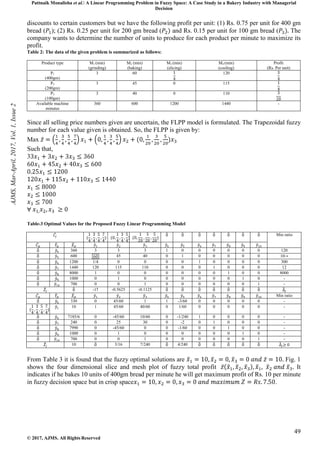
are producing three varieties which are defined clearly in Fig. 1.
Product
100gm 200gm
400gm
Cream Bun Plane Fruit
Special
Premium
Plane
Premium
Fig. 1: Product variety description of Neelachal Bakery Industry.
Strategy: initial days, both three of them was involved in manufacturing, staffing, production and
marketing. Now they have marketing strategy. During 1989-1999 they individually meet retailers and
approach to sell but by this they could not recover their money timely. 2000-2012 and now onwards, they
sell their product through middleman or distribution channel.
Problem:
Neelachal Bakery Private Limited Company produces three products (400gm, 200 gm and 100gm) like
, and each of which must be processed through four different machines (grinding, baking, slicing
and cooling) like respectively. The approximate time, in minutes, each spends in
each is given in Table 3.
Each machine has only so much time available each day. These times can vary slightly from day to day
so the following numbers are estimates of the maximum time available per day, in minutes, for each
machine: (1) for 360min; (2) 600min for (3) 1200min for and (4) 1440 min for . The daily
baking of is sufficient for only 8000 breads, there are only 1000 breads a day available for of and
700 breads a day available of . Finally the selling price for each product can vary a little due to small
AJMS,
Mar-April,
2017,
Vol.
1,
Issue
2
Pattnaik Monalisha et al. A Linear Programming Problem in Fuzzy Space: A Case Study in a Bakery Industry with Managerial
Decision
49
© 2017, AJMS. All Rights Reserved
discounts to certain customers but we have the following profit per unit: (1) Rs. 0.75 per unit for 400 gm
bread ( ); (2) Rs. 0.25 per unit for 200 gm bread ( and Rs. 0.15 per unit for 100 gm bread ( The
company wants to determine the number of units to produce for each product per minute to maximize its
profit.
Table 2: The data of the given problem is summarized as follows:
Product type M1 (min)
(grinding)
M2 (min)
(baking)
M3 (min)
(slicing)
M4 (min)
(cooling)
Profit
(Rs. Per unit)
P1
(400gm)
3 60 120
P2
(200gm)
3 45 0 115
P3
(100gm)
3 40 0 110
Available machine
minutes
360 600 1200 1440 -
Since all selling price numbers given are uncertain, the FLPP model is formulated. The Trapezoidal fuzzy
number for each value given is obtained. So, the FLPP is given by:
Max
Such that,
3
Table-3 Optimal Values for the Proposed Fuzzy Linear Programming Model
Min ratio
360 3 3 3 1 0 0 0 0 0 0 120
600 45 40 0 1 0 0 0 0 0 10
1200 1/4 0 0 0 0 1 0 0 0 0 300
1440 120 115 110 0 0 0 1 0 0 0 12
8000 1 0 0 0 0 0 0 1 0 0 8000
1000 0 1 0 0 0 0 0 0 1 0 -
700 0 0 1 0 0 0 0 0 0 1 -
-1 -0.5625 -0.1125
Min ratio
330 0 45/60 1 1 -3/60 0 0 0 0 0 -
10 1 45/60 40/60 0 1/60 0 0 0 0 0 -
7185/6 0 -45/60 10/60 0 -1/240 1 0 0 0 0 -
240 0 25 30 0 -2 0 1 0 0 0 -
7990 0 -45/60 0 0 -1/60 0 0 1 0 0 -
1000 0 1 0 0 0 0 0 0 1 0 -
700 0 0 1 0 0 0 0 0 0 1 -
10 3/16 7/240 4/240
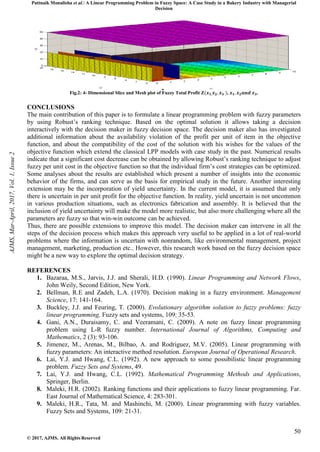
From Table 3 it is found that the fuzzy optimal solutions are Fig. 1
shows the four dimensional slice and mesh plot of fuzzy total profit It
indicates if he bakes 10 units of 400gm bread per minute he will get maximum profit of Rs. 10 per minute
in fuzzy decision space but in crisp space .
AJMS,
Mar-April,
2017,
Vol.
1,
Issue
2
Pattnaik Monalisha et al. A Linear Programming Problem in Fuzzy Space: A Case Study in a Bakery Industry with Managerial
Decision
50
© 2017, AJMS. All Rights Reserved
Fig.2: 4- Dimensional Slice and Mesh plot of Fuzzy Total Profit Z , .
CONCLUSIONS
The main contribution of this paper is to formulate a linear programming problem with fuzzy parameters
by using Robust’s ranking technique. Based on the optimal solution it allows taking a decision
interactively with the decision maker in fuzzy decision space. The decision maker also has investigated
additional information about the availability violation of the profit per unit of item in the objective
function, and about the compatibility of the cost of the solution with his wishes for the values of the
objective function which extend the classical LPP models with case study in the past. Numerical results
indicate that a significant cost decrease can be obtained by allowing Robust’s ranking technique to adjust
fuzzy per unit cost in the objective function so that the individual firm’s cost strategies can be optimized.
Some analyses about the results are established which present a number of insights into the economic
behavior of the firms, and can serve as the basis for empirical study in the future. Another interesting
extension may be the incorporation of yield uncertainty. In the current model, it is assumed that only
there is uncertain in per unit profit for the objective function. In reality, yield uncertain is not uncommon
in various production situations, such as electronics fabrication and assembly. It is believed that the
inclusion of yield uncertainty will make the model more realistic, but also more challenging where all the
parameters are fuzzy so that win-win outcome can be achieved.
Thus, there are possible extensions to improve this model. The decision maker can intervene in all the
steps of the decision process which makes this approach very useful to be applied in a lot of real-world
problems where the information is uncertain with nonrandom, like environmental management, project
management, marketing, production etc.. However, this research work based on the fuzzy decision space
might be a new way to explore the optimal decision strategy.
REFERENCES
1. Bazaraa, M.S., Jarvis, J.J. and Sherali, H.D. (1990). Linear Programming and Network Flows,
John Weily, Second Edition, New York.
2. Bellman, R.E and Zadeh, L.A. (1970). Decision making in a fuzzy environment. Management
Science, 17: 141-164.
3. Buckley, J.J. and Feuring, T. (2000). Evolutionary algorithm solution to fuzzy problems: fuzzy
linear programming, Fuzzy sets and systems, 109: 35-53.
4. Gani, A.N., Duraisamy, C. and Veeramani, C. (2009). A note on fuzzy linear programming
problem using L-R fuzzy number. International Journal of Algorithms, Computing and
Mathematics, 2 (3): 93-106.
5. Jimenez, M., Arenas, M., Bilbao, A. and Rodriguez, M.V. (2005). Linear programming with
fuzzy parameters: An interactive method resolution. European Journal of Operational Research.
6. Lai, Y.J. and Hwang, C.L. (1992). A new approach to some possibilistic linear programming
problem. Fuzzy Sets and Systems, 49.
7. Lai, Y.J. and Hwang, C.L. (1992). Mathematical Programming Methods and Applications,
Springer, Berlin.
8. Maleki, H.R. (2002). Ranking functions and their applications to fuzzy linear programming. Far.
East Journal of Mathematical Science, 4: 283-301.
9. Maleki, H.R., Tata, M. and Mashinchi, M. (2000). Linear programming with fuzzy variables.
Fuzzy Sets and Systems, 109: 21-31.
AJMS,
Mar-April,
2017,
Vol.
1,
Issue
2
Pattnaik Monalisha et al. A Linear Programming Problem in Fuzzy Space: A Case Study in a Bakery Industry with Managerial
Decision
51
© 2017, AJMS. All Rights Reserved
10. Nagarajan, R. and Solairaju, A. (2010). Computing improved fuzzy optimal Hungarian
assignment problems with fuzzy costs under robust ranking techniques. International Journal of
Computer Applications, 6(4): 6-13.
11. Nasseri, S.H., Ardil, E., Yazdani, A., and Zaefarian, R. (2005). Simplex method for solving linear
programming problems with fuzzy numbers. World Academy of Science, Engineering and
Technology, 10: 284-288.
12. Pattnaik, M. (2012). Models of Inventory Control, Lambart Academic, Germany.
13. Pattnaik, M. (2012). The effect of promotion in fuzzy optimal replenishment model with units lost
due to deterioration. International Journal of Management Science and Engineering
Management, 7(4): 303-311.
14. Rommelfanger, H. Hanuscheck, R., and Wolf, J. (1989). Linear programming with fuzzy
objective. Fuzzy Sets and Systems, 29: 31-48.
15. Swarup, K., Gupta, P.K. and Mohan, M. (2006). Operations Research, Sultan Chand and Sons,
New Delhi.
16. Verdegay, J.L. (1984). A dual approach to solve the fuzzy linear programming problem. Fuzzy
Sets and Systems, 14: 131-141.
17. Zimmermann, H.J. (1978). Fuzzy programming and linear programming with several objective
functions. Fuzzy Sets and Systems, 1: 45-55.
AJMS,
Mar-April,
2017,
Vol.
1,
Issue
2

3. Monalisha Pattnaik.pdf

  • 1.
    *Corresponding Author: MonalishaPattnaik, Email: monalisha_1977@yahoo.com CASE STUDY Available Online at A Linear Programming Problem in Fuzzy Space: A Case Study in a Bakery Industry with Managerial Decision 1 Monalisha Pattnaik*, 2 Padmabati Gahan 1,2 *Dept. of Business Administration Sambalpur University Jyotivihar, Sambalpur India Received on: 17/02/2017, Revised on: 03/03/2017, Accepted on: 09/03/2017 ABSTRACT This paper investigates recent techniques that have been developed for optimization of linear programming problems. In practice, there are many problems in which all decision parameters are fuzzy numbers, and such problems are usually solved by either probabilistic programming or multi objective programming methods. Unfortunately all these methods have shortcomings. In this note, using the concept of comparison of fuzzy numbers, it is introduced a very effective method for solving these problems. With the problem assumptions, the optimal solution can still be theoretically solved using the simplex based method. To handle the fuzzy decision variables can be initially generated and then solved and improved sequentially using the fuzzy decision approach by introducing Robust’s ranking technique. The model is illustrated with a case study application. The proposed procedure was programmed and through MATLAB (R2009a) version software, the four dimensional slice diagram is represented to the application. Finally, real case problem is presented to illustrate the effectiveness of the theoretical results, and to gain additional managerial insights for decision making. Keywords: Fuzzy, Trapezoidal number, Linear Programming, Case study. INTRODUCTION In recent years, there has been a substantial amount of research related to the fuzzy applied linear programming problems. Over the last few years, more and more manufacturers had applied the optimization technique most frequently in linear programming to solve real-world problems and there it is important to introduce new tools in the approach that allow the model to fit into the real world as much as possible. Any linear programming model representing real-world situations involves a lot of parameters whose values are assigned by experts, and in the conventional approach, they are required to fix an exact value to the aforementioned parameters. However, both experts and the decision maker frequently do not precisely know the value of those parameters. If exact values are suggested these are only statistical inference from past data and their stability is doubtful, so the parameters of the problem are usually defined by the decision maker in a uncertain space. Therefore, it is useful to consider the knowledge of experts about the parameters as fuzzy data. Two significant questions may be found in these kinds of problems: how to handle the relationship between the fuzzy parameters, and how to find the optimal values for the fuzzy multi-objective function. The answer is related to the problem of ranking fuzzy numbers. This research has been motivated by a suitable example and post optimal analyses. www.ajms.in Asian Journal of Mathematical Sciences 2017; 1(2):44-51 In fuzzy decision making problems, the concept of maximizing decision was introduced by Bellman and Zadeh (1970) [2]. Zimmerman (1978) [17] presented a fuzzy approach to multi-objective linear programming problems in his classical paper. Lai and Hwang (1992) [7] considered the situations where all parameters are in fuzzy. Lai and Huang (1992) [5] assume that the parameters have a triangular possibility distribution. Gani et al. (2009) [4] introduce fuzzy linear programming problem based on L-R fuzzy number. Jimenez et al. (2005) [5] propose a method for solving linear programming problems where all coefficients are, in general, fuzzy numbers and using linear ranking technique. Bazaar et al.
  • 2.
    Pattnaik Monalisha etal. A Linear Programming Problem in Fuzzy Space: A Case Study in a Bakery Industry with Managerial Decision 45 © 2017, AJMS. All Rights Reserved (1990) [1] and Nasseri et al. (2005) [11] define linear programming problems with fuzzy numbers and simplex method is used for finding the optimal solution of the fuzzy problem. Nagarajan and Solairaju (2010) [10] compute improved fuzzy optimal Hungarian assignment problems with fuzzy numbers by applying Robust’s ranking techniques to transform the fuzzy assignment problem to a crisp one. Pattnaik (2012) [12] presented a fuzzy approach to several linear and nonlinear inventory models. Pattnaik (2012) [13] explains fuzzy based inventory model with units lost due to deterioration. Swarup et al. (2006) [15] explain the method to obtain sensitivity analysis or post optimality analysis of the different parameters in the linear programming problems. In fact, in order to make linear programming more effective, the uncertainties that happen in the real world cannot be neglected. Those uncertainties are usually associated with per unit cost of the product, product supply, customer demand and so on. Looking at the property of representing the preference relationship in fuzzy terms, ranking methods can be classified into two approaches. One of them associates, by means of different functions, each fuzzy number to a single of the real line and then a total crisp order relationship between fuzzy numbers is established. The other approach ranks fuzzy numbers by means of a fuzzy relationship. It allows decision maker to present his preference in a gradual way, which in a linear programming problem allows it to be handled with different degrees of satisfaction of constraints. This paper considers fuzzy multi-objective linear programming problems whose parameters are fuzzy numbers but whose decision variables are crisp. The aim of this paper is to introduce Robust’s ranking technique for defuzzifying the fuzzy parameters and then sensitivity analysis for requirement vector in the constraint function is also performed that permits the interactive participation of decision maker in all steps of decision process, expressing his opinions in linguistic terms. The major techniques used in the above research articles are summarized in Table 1. Table 1 Major Characteristics of Fuzzy Linear Programming Models on Selected Researches Author(s) and Published Year Structure of the Model Fuzzy Number Objective Model Model Type Ranking Function Case Study Zimmermann (1978) [17] Fuzzy Triangular Single Cost Linear No Maleki et al. (2000) [9] Fuzzy Trapezoidal Multi Profit Linear No Jimenez et al. (2005) [5] Fuzzy Triangular Multi Cost Linear No Nasseri et al. (2005) [11] Fuzzy Trapezoidal Multi Profit Linear No Buckly et al. (2000) [3] Fuzzy Triangular Multi Profit Linear No Present Paper (2017) Fuzzy Trapezoidal Multi Profit Robust Yes The remainder of this paper is organized as follows. In Section 2, it is introduced fuzzy numbers and some of the results of applying arithmetic on them. Assumptions, notations and definitions are provided for the development of the model. In Section 3, it is introduced Robust’ ranking technique for solving fuzzy number linear programming problems. In Section 4, a linear programming problem with fuzzy variables is proposed and in Section 5 it is explained a fuzzy version of the simplex algorithm for solving this problem. A case study is presented to illustrate the development of the model in Section 6. Finally Section 7 deals with the summary and the concluding remarks. PRELIMINARIES It is reviewed that the fundamental notation of fuzzy set theory initiated by Bellman and Zadeh [2]. Below it is given definitions taken from Zimmerman [17]. Definition.1 Fuzzy sets If X is a collection of objects denoted generally by x, then a fuzzy set in X is defined as a set of ordered pairs , where is called the membership function for the fuzzy set . The membership function maps each element of X to a membership value between 0 and 1. Definition.2 Support of a fuzzy set The support of a fuzzy set is the set of all points x in X such that . That is Definition.3 level of fuzzy set The cut (or) level set of a fuzzy set is a set consisting of those elements of the universe X whose membership values exceed the threshold level . That is . Definition.4 Convex fuzzy set A fuzzy set is convex if, and . Alternatively, a fuzzy set is convex, if all level sets are convex. AJMS, Mar-April, 2017, Vol. 1, Issue 2
  • 3.
    Pattnaik Monalisha etal. A Linear Programming Problem in Fuzzy Space: A Case Study in a Bakery Industry with Managerial Decision 46 © 2017, AJMS. All Rights Reserved Definition.5 Convex normalized fuzzy set A fuzzy number is a convex normalized fuzzy set on the real line R such that it exists at least one with and is piecewise continuous. Definition.6 Trapezoidal fuzzy numbers Among the various fuzzy numbers, triangular and trapezoidal fuzzy numbers are of the most important. Note that, in this study only trapezoidal fuzzy numbers are considered. A fuzzy number is a trapezoidal fuzzy number if the membership function of its be in the following function of it being in the following form: Any trapezoidal fuzzy number by , where the support of is and the modal set of is [ . Let F(R) is the set of trapezoidal fuzzy numbers. Definition.7 Arithmetic on fuzzy numbers Let and be two trapezoidal fuzzy numbers and . Then, the results of applying fuzzy arithmetic on the trapezoidal fuzzy numbers as shown in the following: Image of : Addition: Scalar Multiplication: x and Ranking Function A convenient method for comparing of the fuzzy numbers is by use of ranking functions. A ranking function is a map from F(R) into the real line. The orders on F(R) are: if and only if ℜ( ℜ( if and only if ℜ( ℜ( if and only if ℜ( ℜ( Where, are in F (R). It is obvious that if and only if . Since there are many ranking function for comparing fuzzy numbers but robust ranking function is applied. Robust’s ranking technique satisfies compensation, linearity and additive properties and provides results which are consistent with human intuition. Give a convex fuzzy number , the Robust’s Ranking index is defined by ℜ( , where is the - level cut of the fuzzy number . In this paper this method for ranking the objective values. The Robust’s ranking index ℜ( gives the representative value of the fuzzy number . It satisfies the linearity and additive property. Fuzzy Linear Programming Problems However, when formulating a mathematical programming problem which closely describes and represents a real-world decision situation, various factors of the real world system should be reflected in the description of objective functions and constraints involve many parameters whose possible values may assigned by experts. In the conventional approaches, such parameters are required to be fixed at some values in an experimental and subjective manner through the experts’ understanding of the nature of the parameters in the problem-formulation process. It must be observed that, in most real-world situations, the possible values of these parameters are often only imprecisely known to the experts. With this observation in mind, it would be certainly more appropriate to interpret the experts’ understanding of the parameters as fuzzy numerical data which can be represented by means of fuzzy sets of the real line known as fuzzy numbers. Definition.1 Linear programming A linear programming (LP) problem is defined as: Where, , , and . In the above problem, all of the parameters are crisp. Now, if some of the parameters be fuzzy numbers then fuzzy linear programming is obtained which is defined in the next section. Definition.2 Fuzzy linear programming Suppose that in the linear programming problem some parameters be fuzzy numbers. Hence, it is possible that some coefficients of the problem in the objective function, technical coefficients the right hand side AJMS, Mar-April, 2017, Vol. 1, Issue 2
  • 4.
    Pattnaik Monalisha etal. A Linear Programming Problem in Fuzzy Space: A Case Study in a Bakery Industry with Managerial Decision 47 © 2017, AJMS. All Rights Reserved coefficients or decision making variables be fuzzy number Maleki (2002) [8], Maleki et al. (2000) [9], Rommelfanger et al. (1989) [14] and Verdegay (1984) [16]. Here, the linear programming problems with fuzzy numbers in the objective function. Definition.3 Fuzzy number linear programming A fuzzy number linear programming (FNLP) problem is defined as follows: where, , , , , and ℜ is a Robust ranking function. Definition.4 Fuzzy feasible solution The vector is a feasible solution to FNLP if and only if satisfies the constraints of the problem. Definition.5 Fuzzy optimal solution A feasible solution is an optimal solution for FNLP, if for all feasible solution for FNLP, then . Definition.6 Fuzzy basic feasible solution The basic feasible solution for FNLP problems is defined as: Consider the system and , where is an matrix and is an vector. Now, suppose that . Partition after possibly rearranging the columns of as where is nonsingular. It is obvious that . The point where, , is called a basic solution of the system. If , then is called a basic feasible solution (BFS) of the system. Here B is called the basic matrix and N is called the non basic matrix. A Fuzzy Version of Simplex Algorithm For the solution of any FNLP by Simplex algorithm, the existence of an initial basic feasible fuzzy solution is always assumed. The steps for the computation of an optimum fuzzy solution are as follows: Step-1 Check whether the objective function of the given FNLP is to be maximized or minimized. If it is to be minimized then converting it into a problem of maximizing it by using the result Step-2 Check whether all are non-negative. If any one is negative then multiply the corresponding inequation of the constant by -1, so as to get all non-negative. Step-3 Convert all the inequations of the constraints into equations by introducing slack and/or surplus variables in the constraints. Put the cost of these variables equal to zero. Step-4 Obtain an initial basic feasible solution to the problem in the problem in the form of and put in the first column of the simplex table. Step-5 Compute the net evaluations by using the relation . Examine the sign i) If all then the initial basic feasible fuzzy solution is an optimum basic feasible fuzzy solution. ii) If at least one , proceed on to the next step. Step-6 If there are more than one negative , then choose the most negative of them. Let it be for some j=r. i) If all then there is an unbounded solution to the given problem. ii) If at least one then the corresponding vector enter the basis . Step-7 Compute the and choose minimum of them. Let minimum of these ratios be . Then the vector will level the basis . The common element , which in the kth row and rth column is known as leading number of the table. Step-8 Convert the leading number to unit number by dividing its row by the leading number itself and all other number itself and all other elements in its column to zero. Step-9 Go to step 5 and repeat the computational procedure until either an optimum solution is obtained or this is an indication of an unbounded solution. AJMS, Mar-April, 2017, Vol. 1, Issue 2
  • 5.
    Pattnaik Monalisha etal. A Linear Programming Problem in Fuzzy Space: A Case Study in a Bakery Industry with Managerial Decision 48 © 2017, AJMS. All Rights Reserved A Case Study of Bakery Industry: In this section we present one case study of our evolutionary algorithm solution to FLPP. In this case the evolutionary algorithm is used to solve the FLPP in Section 6. The case study is the standard product mix problem with profit maximization model. Neelachal Bakery Private Limited: Profit Maximization Fuzzy Linear Programming Model. History: Santanu Kumar Gadnayak, A. N. Siba Patnaik and Gateswar Mohanty, three partners of the Neelachal Bakery Private Limited, opened investing Rs. one lakh, the first polythene packaged bread in Mancheswar industrial estate, Bhubaneswar, Odisha, India in 1989 by rental with three dismals location area. From the beginning, they sight to build an innovative polythene packaging in bakery market for their growing bakery business in Odisha. Unlike most contemporary bakery marketers who profited significantly by making up the breads by using the wax paper packaging, these three partners aligned the bakery’s interests by profiting from excellent bakery mechanisms. Initially they are doing all types jobs related to manufacturing, staffing, production and marketing for six to seven years, they focused exclusively on securing the consistent supply to meet demand, quality and volume pricing that would facilitate success in the bakery markets. During 1989, they took a rent room and started their business. At that time, they have no mechanization. They started polythenized package for bakery first time in Mancheswar area. At that time main competitor was Sajitha bakery. Success: together with over three partners of Neelachal Packaging Private Limited serves more than 45 people daily in one bakery in own 2.5 acre location area with asset Rs. three crores made it one of the largest bakery product marketer in Odisha. Complexities: Previously they purchased polythene packs to pack bakery product but now they are also manufacturing printed polythene packets for their need and other needs as per order by third party. Leadership: Initially they have one variety and breakeven point they achieved in 1991. Present: they have mechanized equipments. Presently 20-22 staffs involved in bakery production. They are producing three varieties which are defined clearly in Fig. 1. Product 100gm 200gm 400gm Cream Bun Plane Fruit Special Premium Plane Premium Fig. 1: Product variety description of Neelachal Bakery Industry. Strategy: initial days, both three of them was involved in manufacturing, staffing, production and marketing. Now they have marketing strategy. During 1989-1999 they individually meet retailers and approach to sell but by this they could not recover their money timely. 2000-2012 and now onwards, they sell their product through middleman or distribution channel. Problem: Neelachal Bakery Private Limited Company produces three products (400gm, 200 gm and 100gm) like , and each of which must be processed through four different machines (grinding, baking, slicing and cooling) like respectively. The approximate time, in minutes, each spends in each is given in Table 3. Each machine has only so much time available each day. These times can vary slightly from day to day so the following numbers are estimates of the maximum time available per day, in minutes, for each machine: (1) for 360min; (2) 600min for (3) 1200min for and (4) 1440 min for . The daily baking of is sufficient for only 8000 breads, there are only 1000 breads a day available for of and 700 breads a day available of . Finally the selling price for each product can vary a little due to small AJMS, Mar-April, 2017, Vol. 1, Issue 2
  • 6.
    Pattnaik Monalisha etal. A Linear Programming Problem in Fuzzy Space: A Case Study in a Bakery Industry with Managerial Decision 49 © 2017, AJMS. All Rights Reserved discounts to certain customers but we have the following profit per unit: (1) Rs. 0.75 per unit for 400 gm bread ( ); (2) Rs. 0.25 per unit for 200 gm bread ( and Rs. 0.15 per unit for 100 gm bread ( The company wants to determine the number of units to produce for each product per minute to maximize its profit. Table 2: The data of the given problem is summarized as follows: Product type M1 (min) (grinding) M2 (min) (baking) M3 (min) (slicing) M4 (min) (cooling) Profit (Rs. Per unit) P1 (400gm) 3 60 120 P2 (200gm) 3 45 0 115 P3 (100gm) 3 40 0 110 Available machine minutes 360 600 1200 1440 - Since all selling price numbers given are uncertain, the FLPP model is formulated. The Trapezoidal fuzzy number for each value given is obtained. So, the FLPP is given by: Max Such that, 3 Table-3 Optimal Values for the Proposed Fuzzy Linear Programming Model Min ratio 360 3 3 3 1 0 0 0 0 0 0 120 600 45 40 0 1 0 0 0 0 0 10 1200 1/4 0 0 0 0 1 0 0 0 0 300 1440 120 115 110 0 0 0 1 0 0 0 12 8000 1 0 0 0 0 0 0 1 0 0 8000 1000 0 1 0 0 0 0 0 0 1 0 - 700 0 0 1 0 0 0 0 0 0 1 - -1 -0.5625 -0.1125 Min ratio 330 0 45/60 1 1 -3/60 0 0 0 0 0 - 10 1 45/60 40/60 0 1/60 0 0 0 0 0 - 7185/6 0 -45/60 10/60 0 -1/240 1 0 0 0 0 - 240 0 25 30 0 -2 0 1 0 0 0 - 7990 0 -45/60 0 0 -1/60 0 0 1 0 0 - 1000 0 1 0 0 0 0 0 0 1 0 - 700 0 0 1 0 0 0 0 0 0 1 - 10 3/16 7/240 4/240 From Table 3 it is found that the fuzzy optimal solutions are Fig. 1 shows the four dimensional slice and mesh plot of fuzzy total profit It indicates if he bakes 10 units of 400gm bread per minute he will get maximum profit of Rs. 10 per minute in fuzzy decision space but in crisp space . AJMS, Mar-April, 2017, Vol. 1, Issue 2
  • 7.
    Pattnaik Monalisha etal. A Linear Programming Problem in Fuzzy Space: A Case Study in a Bakery Industry with Managerial Decision 50 © 2017, AJMS. All Rights Reserved Fig.2: 4- Dimensional Slice and Mesh plot of Fuzzy Total Profit Z , . CONCLUSIONS The main contribution of this paper is to formulate a linear programming problem with fuzzy parameters by using Robust’s ranking technique. Based on the optimal solution it allows taking a decision interactively with the decision maker in fuzzy decision space. The decision maker also has investigated additional information about the availability violation of the profit per unit of item in the objective function, and about the compatibility of the cost of the solution with his wishes for the values of the objective function which extend the classical LPP models with case study in the past. Numerical results indicate that a significant cost decrease can be obtained by allowing Robust’s ranking technique to adjust fuzzy per unit cost in the objective function so that the individual firm’s cost strategies can be optimized. Some analyses about the results are established which present a number of insights into the economic behavior of the firms, and can serve as the basis for empirical study in the future. Another interesting extension may be the incorporation of yield uncertainty. In the current model, it is assumed that only there is uncertain in per unit profit for the objective function. In reality, yield uncertain is not uncommon in various production situations, such as electronics fabrication and assembly. It is believed that the inclusion of yield uncertainty will make the model more realistic, but also more challenging where all the parameters are fuzzy so that win-win outcome can be achieved. Thus, there are possible extensions to improve this model. The decision maker can intervene in all the steps of the decision process which makes this approach very useful to be applied in a lot of real-world problems where the information is uncertain with nonrandom, like environmental management, project management, marketing, production etc.. However, this research work based on the fuzzy decision space might be a new way to explore the optimal decision strategy. REFERENCES 1. Bazaraa, M.S., Jarvis, J.J. and Sherali, H.D. (1990). Linear Programming and Network Flows, John Weily, Second Edition, New York. 2. Bellman, R.E and Zadeh, L.A. (1970). Decision making in a fuzzy environment. Management Science, 17: 141-164. 3. Buckley, J.J. and Feuring, T. (2000). Evolutionary algorithm solution to fuzzy problems: fuzzy linear programming, Fuzzy sets and systems, 109: 35-53. 4. Gani, A.N., Duraisamy, C. and Veeramani, C. (2009). A note on fuzzy linear programming problem using L-R fuzzy number. International Journal of Algorithms, Computing and Mathematics, 2 (3): 93-106. 5. Jimenez, M., Arenas, M., Bilbao, A. and Rodriguez, M.V. (2005). Linear programming with fuzzy parameters: An interactive method resolution. European Journal of Operational Research. 6. Lai, Y.J. and Hwang, C.L. (1992). A new approach to some possibilistic linear programming problem. Fuzzy Sets and Systems, 49. 7. Lai, Y.J. and Hwang, C.L. (1992). Mathematical Programming Methods and Applications, Springer, Berlin. 8. Maleki, H.R. (2002). Ranking functions and their applications to fuzzy linear programming. Far. East Journal of Mathematical Science, 4: 283-301. 9. Maleki, H.R., Tata, M. and Mashinchi, M. (2000). Linear programming with fuzzy variables. Fuzzy Sets and Systems, 109: 21-31. AJMS, Mar-April, 2017, Vol. 1, Issue 2
  • 8.
    Pattnaik Monalisha etal. A Linear Programming Problem in Fuzzy Space: A Case Study in a Bakery Industry with Managerial Decision 51 © 2017, AJMS. All Rights Reserved 10. Nagarajan, R. and Solairaju, A. (2010). Computing improved fuzzy optimal Hungarian assignment problems with fuzzy costs under robust ranking techniques. International Journal of Computer Applications, 6(4): 6-13. 11. Nasseri, S.H., Ardil, E., Yazdani, A., and Zaefarian, R. (2005). Simplex method for solving linear programming problems with fuzzy numbers. World Academy of Science, Engineering and Technology, 10: 284-288. 12. Pattnaik, M. (2012). Models of Inventory Control, Lambart Academic, Germany. 13. Pattnaik, M. (2012). The effect of promotion in fuzzy optimal replenishment model with units lost due to deterioration. International Journal of Management Science and Engineering Management, 7(4): 303-311. 14. Rommelfanger, H. Hanuscheck, R., and Wolf, J. (1989). Linear programming with fuzzy objective. Fuzzy Sets and Systems, 29: 31-48. 15. Swarup, K., Gupta, P.K. and Mohan, M. (2006). Operations Research, Sultan Chand and Sons, New Delhi. 16. Verdegay, J.L. (1984). A dual approach to solve the fuzzy linear programming problem. Fuzzy Sets and Systems, 14: 131-141. 17. Zimmermann, H.J. (1978). Fuzzy programming and linear programming with several objective functions. Fuzzy Sets and Systems, 1: 45-55. AJMS, Mar-April, 2017, Vol. 1, Issue 2