Random Forests
Paper presentation for CSI5388
PENGCHENG XI
Mar. 23, 2005
Reference
• Leo Breiman, Random Forests,
Machine Learning, 45, 5-32, 2001
Leo Breiman (Professor Emeritus at UCB) is a
member of the National Academy of Sciences
Abstract
• Random forests (RF) are a combination of tree
predictors such that each tree depends on the
values of a random vector sampled
independently and with the same distribution for
all trees in the forest.
• The generalization error of a forest of tree
classifiers depends on the strength of the
individual trees in the forest and the correlation
between them.
• Using a random selection of features to split
each node yields error rates that compare
favorably to Adaboost, and are more robust with
respect to noise.
Introduction
• Improvements in classification accuracy have
resulted from growing an ensemble of trees
and letting them vote for the most popular
class.
• To grow these ensembles, often random
vectors are generated that govern the growth of
each tree in the ensemble.
• Several examples: bagging (Breiman, 1996),
random split selection (Dietterich, 1998), random
subspace (Ho, 1998), written character
recognition (Amit and Geman, 1997)
Introduction (Cont.)
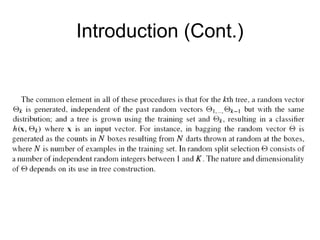
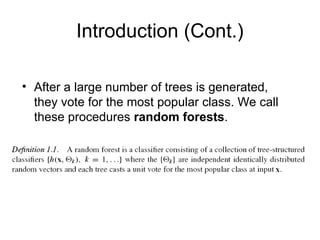
• After a large number of trees is generated,
they vote for the most popular class. We call
these procedures random forests.
Characterizing the accuracy of RF
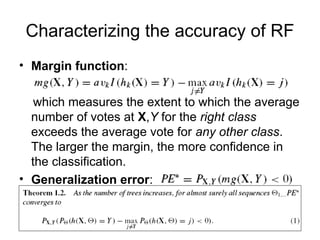
• Margin function:
which measures the extent to which the average
number of votes at X,Y for the right class
exceeds the average vote for any other class.
The larger the margin, the more confidence in
the classification.
• Generalization error:
Characterizing… (Cont.)
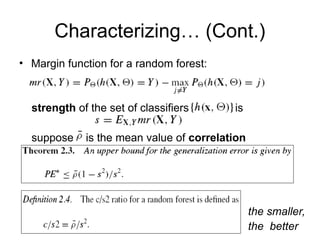
• Margin function for a random forest:
strength of the set of classifiers is
suppose is the mean value of correlation
the smaller,
the better
Using random features
• Random split selection does better than
bagging; introduction of random noise into the
outputs also does better; but none of these do
as well as Adaboost by adaptive reweighting
(arcing) of the training set.
• To improve accuracy, the randomness injected
has to minimize the correlation while
maintaining strength.
• The forests consists of using randomly selected
inputs or combinations inputs at each node to
grow each tree.
Using random features (Cont.)
• Compared with Adaboost, the forests discussed
here have following desirable characteristics:
--- its accuracy is as good as Adaboost and
sometimes better;
--- it’s relatively robust to outliers and noise;
--- it’s faster than bagging or boosting;
--- it gives useful internal estimates of error,
strength, correlation and variable importance;
--- it’s simple and easily parallelized.
Using random features (Cont.)
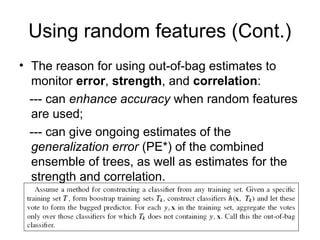
• The reason for using out-of-bag estimates to
monitor error, strength, and correlation:
--- can enhance accuracy when random features
are used;
--- can give ongoing estimates of the
generalization error (PE*) of the combined
ensemble of trees, as well as estimates for the
strength and correlation.
Random forests using random input
selection (Forest-RI)
• The simplest random forest with random
features is formed by selecting a small group of
input variables to split on at random at each
node.
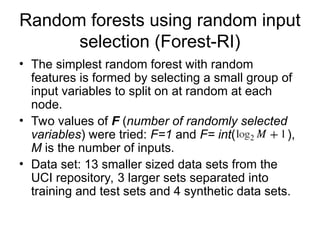
• Two values of F (number of randomly selected
variables) were tried: F=1 and F= int( ),
M is the number of inputs.
• Data set: 13 smaller sized data sets from the
UCI repository, 3 larger sets separated into
training and test sets and 4 synthetic data sets.
Forest-RI (Cont.)
Forest-RI (Cont.)
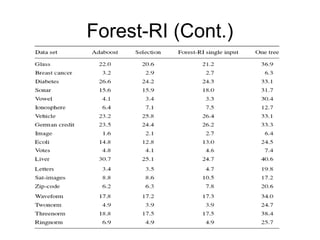
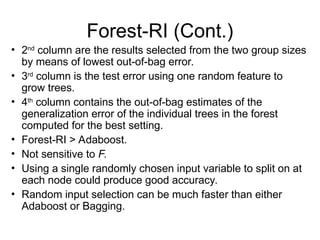
• 2nd
column are the results selected from the two group sizes
by means of lowest out-of-bag error.
• 3rd
column is the test error using one random feature to
grow trees.
• 4th
column contains the out-of-bag estimates of the
generalization error of the individual trees in the forest
computed for the best setting.
• Forest-RI > Adaboost.
• Not sensitive to F.
• Using a single randomly chosen input variable to split on at
each node could produce good accuracy.
• Random input selection can be much faster than either
Adaboost or Bagging.
Random forests using linear
combinations of inputs (Forest-RC)
• Defining more features by taking random linear
combinations of a number of the input variables.
That is, a feature is generated by specifying L, the
number of variables to be combined. At a given
node, L variables are randomly selected and added
together with coefficients that are uniform random
numbers on [-1,1]. F linear combinations are
generated, and then a search is made over these
for the best split. This procedure is called Forest-
RC.
• We use L=3 and F=2,8 with the choice for F being
decided on by the out-of-bag estimate.
Forest-RC (Cont.)
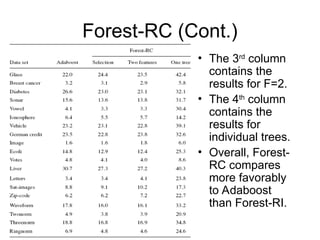
• The 3rd
column
contains the
results for F=2.
• The 4th
column
contains the
results for
individual trees.
• Overall, Forest-
RC compares
more favorably
to Adaboost
than Forest-RI.
Empirical results on strength
and correlation
• To look at the effect of strength and correlation on
the generalization error.
• To get more understanding of the lack of sensitivity
in PE* to group size F.
• Using out-of-bag estimates to monitor the strength
and correlation.
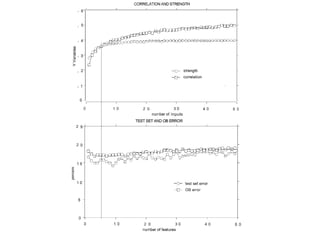
• We begin by running Forest-RI on the sonar data (60
inputs, 208 examples) using from 1 to 50 inputs. In
each iteration, 10% of the data was split off as a test
set. For each value of F, 100 trees were grown to
form a random forest and the terminal values of test
set error, strength, correlation are recorded.
Some conclusions
• More experiments on breast data set
(features consisting of random
combinations of three inputs) and satellite
data set (larger data set).
• Results indicate that better random forests
have lower correlation between classifiers
and higher strength.
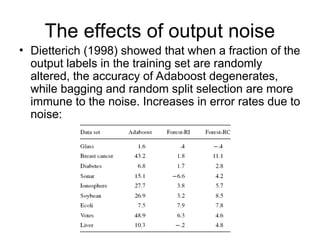
The effects of output noise
• Dietterich (1998) showed that when a fraction of the
output labels in the training set are randomly
altered, the accuracy of Adaboost degenerates,
while bagging and random split selection are more
immune to the noise. Increases in error rates due to
noise:
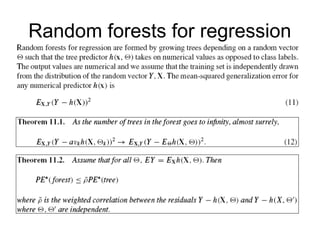
Random forests for regression
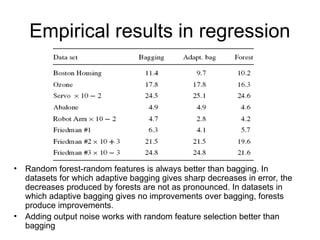
Empirical results in regression
• Random forest-random features is always better than bagging. In
datasets for which adaptive bagging gives sharp decreases in error, the
decreases produced by forests are not as pronounced. In datasets in
which adaptive bagging gives no improvements over bagging, forests
produce improvements.
• Adding output noise works with random feature selection better than
bagging
Conclusions
• Random forests are an effective tool in
prediction.
• Forests give results competitive with boosting
and adaptive bagging, yet do not progressively
change the training set.
• Random inputs and random features produce
good results in classification- less so in
regression.
• For larger data sets, we can gain accuracy by
combining random features with boosting.

RandomForests Bootstrapping BAgging Aggregation

  • 1.
    Random Forests Paper presentationfor CSI5388 PENGCHENG XI Mar. 23, 2005
  • 2.
    Reference • Leo Breiman,Random Forests, Machine Learning, 45, 5-32, 2001 Leo Breiman (Professor Emeritus at UCB) is a member of the National Academy of Sciences
  • 3.
    Abstract • Random forests(RF) are a combination of tree predictors such that each tree depends on the values of a random vector sampled independently and with the same distribution for all trees in the forest. • The generalization error of a forest of tree classifiers depends on the strength of the individual trees in the forest and the correlation between them. • Using a random selection of features to split each node yields error rates that compare favorably to Adaboost, and are more robust with respect to noise.
  • 4.
    Introduction • Improvements inclassification accuracy have resulted from growing an ensemble of trees and letting them vote for the most popular class. • To grow these ensembles, often random vectors are generated that govern the growth of each tree in the ensemble. • Several examples: bagging (Breiman, 1996), random split selection (Dietterich, 1998), random subspace (Ho, 1998), written character recognition (Amit and Geman, 1997)
  • 5.
  • 6.
    Introduction (Cont.) • Aftera large number of trees is generated, they vote for the most popular class. We call these procedures random forests.
  • 7.
    Characterizing the accuracyof RF • Margin function: which measures the extent to which the average number of votes at X,Y for the right class exceeds the average vote for any other class. The larger the margin, the more confidence in the classification. • Generalization error:
  • 8.
    Characterizing… (Cont.) • Marginfunction for a random forest: strength of the set of classifiers is suppose is the mean value of correlation the smaller, the better
  • 9.
    Using random features •Random split selection does better than bagging; introduction of random noise into the outputs also does better; but none of these do as well as Adaboost by adaptive reweighting (arcing) of the training set. • To improve accuracy, the randomness injected has to minimize the correlation while maintaining strength. • The forests consists of using randomly selected inputs or combinations inputs at each node to grow each tree.
  • 10.
    Using random features(Cont.) • Compared with Adaboost, the forests discussed here have following desirable characteristics: --- its accuracy is as good as Adaboost and sometimes better; --- it’s relatively robust to outliers and noise; --- it’s faster than bagging or boosting; --- it gives useful internal estimates of error, strength, correlation and variable importance; --- it’s simple and easily parallelized.
  • 11.
    Using random features(Cont.) • The reason for using out-of-bag estimates to monitor error, strength, and correlation: --- can enhance accuracy when random features are used; --- can give ongoing estimates of the generalization error (PE*) of the combined ensemble of trees, as well as estimates for the strength and correlation.
  • 12.
    Random forests usingrandom input selection (Forest-RI) • The simplest random forest with random features is formed by selecting a small group of input variables to split on at random at each node. • Two values of F (number of randomly selected variables) were tried: F=1 and F= int( ), M is the number of inputs. • Data set: 13 smaller sized data sets from the UCI repository, 3 larger sets separated into training and test sets and 4 synthetic data sets.
  • 13.
  • 14.
    Forest-RI (Cont.) • 2nd columnare the results selected from the two group sizes by means of lowest out-of-bag error. • 3rd column is the test error using one random feature to grow trees. • 4th column contains the out-of-bag estimates of the generalization error of the individual trees in the forest computed for the best setting. • Forest-RI > Adaboost. • Not sensitive to F. • Using a single randomly chosen input variable to split on at each node could produce good accuracy. • Random input selection can be much faster than either Adaboost or Bagging.
  • 15.
    Random forests usinglinear combinations of inputs (Forest-RC) • Defining more features by taking random linear combinations of a number of the input variables. That is, a feature is generated by specifying L, the number of variables to be combined. At a given node, L variables are randomly selected and added together with coefficients that are uniform random numbers on [-1,1]. F linear combinations are generated, and then a search is made over these for the best split. This procedure is called Forest- RC. • We use L=3 and F=2,8 with the choice for F being decided on by the out-of-bag estimate.
  • 16.
    Forest-RC (Cont.) • The3rd column contains the results for F=2. • The 4th column contains the results for individual trees. • Overall, Forest- RC compares more favorably to Adaboost than Forest-RI.
  • 17.
    Empirical results onstrength and correlation • To look at the effect of strength and correlation on the generalization error. • To get more understanding of the lack of sensitivity in PE* to group size F. • Using out-of-bag estimates to monitor the strength and correlation. • We begin by running Forest-RI on the sonar data (60 inputs, 208 examples) using from 1 to 50 inputs. In each iteration, 10% of the data was split off as a test set. For each value of F, 100 trees were grown to form a random forest and the terminal values of test set error, strength, correlation are recorded.
  • 19.
    Some conclusions • Moreexperiments on breast data set (features consisting of random combinations of three inputs) and satellite data set (larger data set). • Results indicate that better random forests have lower correlation between classifiers and higher strength.
  • 20.
    The effects ofoutput noise • Dietterich (1998) showed that when a fraction of the output labels in the training set are randomly altered, the accuracy of Adaboost degenerates, while bagging and random split selection are more immune to the noise. Increases in error rates due to noise:
  • 21.
  • 22.
    Empirical results inregression • Random forest-random features is always better than bagging. In datasets for which adaptive bagging gives sharp decreases in error, the decreases produced by forests are not as pronounced. In datasets in which adaptive bagging gives no improvements over bagging, forests produce improvements. • Adding output noise works with random feature selection better than bagging
  • 23.
    Conclusions • Random forestsare an effective tool in prediction. • Forests give results competitive with boosting and adaptive bagging, yet do not progressively change the training set. • Random inputs and random features produce good results in classification- less so in regression. • For larger data sets, we can gain accuracy by combining random features with boosting.