R&TTE DIRECTIVE
1999/5/EC
RADIO EQUIPMENT DIRECTIVE
2014/53/EU
RADIO & TELECOMMUNICATION TERMINAL EQUIPMENT
CE MARKING REQUIREMENT
KYAW SOE HEIN
hotep.soe@gmail.com
November, 2015
GENERAL KNOWLEDGE
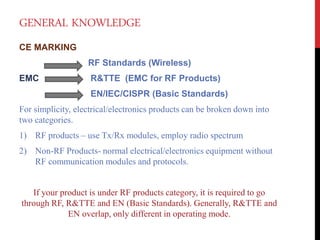
CE MARKING
RF Standards (Wireless)
EMC R&TTE (EMC for RF Products)
EN/IEC/CISPR (Basic Standards)
For simplicity, electrical/electronics products can be broken down into
two categories.
1) RF products – use Tx/Rx modules, employ radio spectrum
2) Non-RF Products- normal electrical/electronics equipment without
RF communication modules and protocols.
If your product is under RF products category, it is required to go
through RF, R&TTE and EN (Basic Standards). Generally, R&TTE and
EN overlap, only different in operating mode.
GENERAL KNOWLEDGE
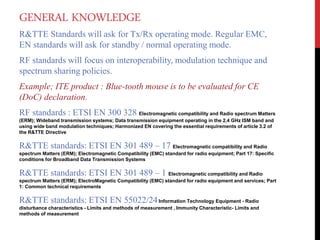
R&TTE Standards will ask for Tx/Rx operating mode. Regular EMC,
EN standards will ask for standby / normal operating mode.
RF standards will focus on interoperability, modulation technique and
spectrum sharing policies.
Example; ITE product : Blue-tooth mouse is to be evaluated for CE
(DoC) declaration.
RF standards : ETSI EN 300 328 Electromagnetic compatibility and Radio spectrum Matters
(ERM); Wideband transmission systems; Data transmission equipment operating in the 2,4 GHz ISM band and
using wide band modulation techniques; Harmonized EN covering the essential requirements of article 3.2 of
the R&TTE Directive
R&TTE standards: ETSI EN 301 489 – 17 Electromagnetic compatibility and Radio
spectrum Matters (ERM); Electromagnetic Compatibility (EMC) standard for radio equipment; Part 17: Specific
conditions for Broadband Data Transmission Systems
R&TTE standards: ETSI EN 301 489 – 1 Electromagnetic compatibility and Radio
spectrum Matters (ERM); ElectroMagnetic Compatibility (EMC) standard for radio equipment and services; Part
1: Common technical requirements
R&TTE standards: ETSI EN 55022/24Information Technology Equipment - Radio
disturbance characteristics - Limits and methods of measurement , Immunity Characteristic- Limits and
methods of measurement
WHAT IS R&TTE DIRECTIVE ABOUT ?
The R&TTE Directive covers all equipment that uses the radio
frequency spectrum, with few exceptions.
The main aspects of the Directive are:
 Conformity of a product with the requirements of the Directive
 Obligation for network operators to publish their interfaces
 Obligation for Member States to publish the rules to access the
radio frequency spectrum
 Obligation for manufacturers to inform the end user of intended
use and limitations of use
NEW RADIO EQUIPMENT DIRECTIVE
The European Parliament and Council Directive on Radio and
Telecommunication Terminal Equipment (1999/5/EC) was revised
in 2014 to become the Radio Equipment Directive 2014/53/EU.
New directive will be effective from 13 June 2016.
This directive aims to ensure safety & health, EMC and the
efficient use of the radio spectrum by setting essentials
requirements. This applies to all products using the radio
frequency spectrum.
EQUIPMENT CLASSES
Equipment classes are defined by Article 4.1 of the Directive.
There are two classes of Equipment :
Class 1 Equipment
Radio equipment which can be placed on the market and be put
into service without restrictions.
Class 2 Equipment
All radio equipment not falling under the Class 1 definition.
http://ec.europa.eu/growth/sectors/electrical-engineering/rtte-
directive/index_en.htm
You can find your equipment fall under which Class in above
link. (Equipment Classes)
HARMONIZED STANDARDS
Directive 1999/5/EC
Directive 2014/53/EU
You may find harmonized Radio Equipment Standards in this link
http://ec.europa.eu/growth/single-market/european-
standards/harmonised-standards/rtte/index_en.htm
Directive 2014/53/EU on radio equipment - references of harmonized
standards have not yet been published in the Official Journal
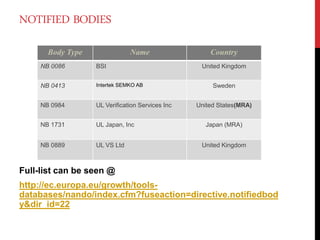
NOTIFIED BODIES
Full-list can be seen @
http://ec.europa.eu/growth/tools-
databases/nando/index.cfm?fuseaction=directive.notifiedbod
y&dir_id=22
Body Type Name Country
NB 0086 BSI United Kingdom
NB 0413 Intertek SEMKO AB Sweden
NB 0984 UL Verification Services Inc United States(MRA)
NB 1731 UL Japan, Inc Japan (MRA)
NB 0889 UL VS Ltd United Kingdom
R&TTE DIRECTIVE
The directive can be downloaded here.
http://eur-lex.europa.eu/legal-
content/EN/TXT/?uri=CELEX:32014L0053
It consists of 7 chapters, and 8 Annex for detailed requirements.
After successfully undergoing a conformity assessment procedure and
having constituted the technical documentation.
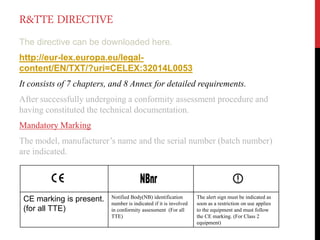
Mandatory Marking
The model, manufacturer’s name and the serial number (batch number)
are indicated.
CE marking is present.
(for all TTE)
Notified Body(NB) identification
number is indicated if it is involved
in conformity assessment (For all
TTE)
The alert sign must be indicated as
soon as a restriction on use applies
to the equipment and must follow
the CE marking. (For Class 2
equipment)

Radio Equipment Directive, CE Marking

  • 1.
    R&TTE DIRECTIVE 1999/5/EC RADIO EQUIPMENTDIRECTIVE 2014/53/EU RADIO & TELECOMMUNICATION TERMINAL EQUIPMENT CE MARKING REQUIREMENT KYAW SOE HEIN hotep.soe@gmail.com November, 2015
  • 2.
    GENERAL KNOWLEDGE CE MARKING RFStandards (Wireless) EMC R&TTE (EMC for RF Products) EN/IEC/CISPR (Basic Standards) For simplicity, electrical/electronics products can be broken down into two categories. 1) RF products – use Tx/Rx modules, employ radio spectrum 2) Non-RF Products- normal electrical/electronics equipment without RF communication modules and protocols. If your product is under RF products category, it is required to go through RF, R&TTE and EN (Basic Standards). Generally, R&TTE and EN overlap, only different in operating mode.
  • 3.
    GENERAL KNOWLEDGE R&TTE Standardswill ask for Tx/Rx operating mode. Regular EMC, EN standards will ask for standby / normal operating mode. RF standards will focus on interoperability, modulation technique and spectrum sharing policies. Example; ITE product : Blue-tooth mouse is to be evaluated for CE (DoC) declaration. RF standards : ETSI EN 300 328 Electromagnetic compatibility and Radio spectrum Matters (ERM); Wideband transmission systems; Data transmission equipment operating in the 2,4 GHz ISM band and using wide band modulation techniques; Harmonized EN covering the essential requirements of article 3.2 of the R&TTE Directive R&TTE standards: ETSI EN 301 489 – 17 Electromagnetic compatibility and Radio spectrum Matters (ERM); Electromagnetic Compatibility (EMC) standard for radio equipment; Part 17: Specific conditions for Broadband Data Transmission Systems R&TTE standards: ETSI EN 301 489 – 1 Electromagnetic compatibility and Radio spectrum Matters (ERM); ElectroMagnetic Compatibility (EMC) standard for radio equipment and services; Part 1: Common technical requirements R&TTE standards: ETSI EN 55022/24Information Technology Equipment - Radio disturbance characteristics - Limits and methods of measurement , Immunity Characteristic- Limits and methods of measurement
  • 4.
    WHAT IS R&TTEDIRECTIVE ABOUT ? The R&TTE Directive covers all equipment that uses the radio frequency spectrum, with few exceptions. The main aspects of the Directive are:  Conformity of a product with the requirements of the Directive  Obligation for network operators to publish their interfaces  Obligation for Member States to publish the rules to access the radio frequency spectrum  Obligation for manufacturers to inform the end user of intended use and limitations of use
  • 5.
    NEW RADIO EQUIPMENTDIRECTIVE The European Parliament and Council Directive on Radio and Telecommunication Terminal Equipment (1999/5/EC) was revised in 2014 to become the Radio Equipment Directive 2014/53/EU. New directive will be effective from 13 June 2016. This directive aims to ensure safety & health, EMC and the efficient use of the radio spectrum by setting essentials requirements. This applies to all products using the radio frequency spectrum.
  • 6.
    EQUIPMENT CLASSES Equipment classesare defined by Article 4.1 of the Directive. There are two classes of Equipment : Class 1 Equipment Radio equipment which can be placed on the market and be put into service without restrictions. Class 2 Equipment All radio equipment not falling under the Class 1 definition. http://ec.europa.eu/growth/sectors/electrical-engineering/rtte- directive/index_en.htm You can find your equipment fall under which Class in above link. (Equipment Classes)
  • 7.
    HARMONIZED STANDARDS Directive 1999/5/EC Directive2014/53/EU You may find harmonized Radio Equipment Standards in this link http://ec.europa.eu/growth/single-market/european- standards/harmonised-standards/rtte/index_en.htm Directive 2014/53/EU on radio equipment - references of harmonized standards have not yet been published in the Official Journal
  • 8.
    NOTIFIED BODIES Full-list canbe seen @ http://ec.europa.eu/growth/tools- databases/nando/index.cfm?fuseaction=directive.notifiedbod y&dir_id=22 Body Type Name Country NB 0086 BSI United Kingdom NB 0413 Intertek SEMKO AB Sweden NB 0984 UL Verification Services Inc United States(MRA) NB 1731 UL Japan, Inc Japan (MRA) NB 0889 UL VS Ltd United Kingdom
  • 9.
    R&TTE DIRECTIVE The directivecan be downloaded here. http://eur-lex.europa.eu/legal- content/EN/TXT/?uri=CELEX:32014L0053 It consists of 7 chapters, and 8 Annex for detailed requirements. After successfully undergoing a conformity assessment procedure and having constituted the technical documentation. Mandatory Marking The model, manufacturer’s name and the serial number (batch number) are indicated. CE marking is present. (for all TTE) Notified Body(NB) identification number is indicated if it is involved in conformity assessment (For all TTE) The alert sign must be indicated as soon as a restriction on use applies to the equipment and must follow the CE marking. (For Class 2 equipment)