Ramadan
Donald W. Reid 2011
Ramadan is the ninth month of the
Islamic lunar calendar. Every day
during this month, Muslims around
the world spend the daylight hours
in a complete fast.
During the month of Ramadan,
Muslims all over the world abstain
from food, drink, and other
physical needs during the daylight
hours. As a time to purify the soul,
refocus attention on God, and
practice self-sacrifice, Ramadan is
much more than just not eating
and drinking.
Donald W. Reid 2011
During the Fast of Ramadan strict restraints are
placed on the daily lives of Muslims. They are
not allowed to eat or drink during the daylight
hours (those that are traveling or ill are not
required to fast). Smoking and sexual relations
are also forbidden during fasting. At the end of
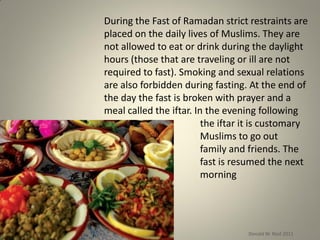
the day the fast is broken with prayer and a
meal called the iftar. In the evening following
the iftar it is customary
for Muslims to go out
visiting family and friends. The
fast is resumed the next
morning
Donald W. Reid 2011
According to the Quran:
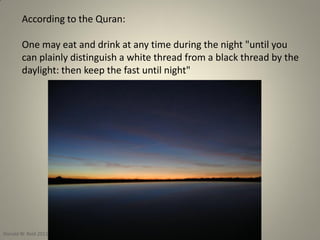
One may eat and drink at any time during the night "until you
can plainly distinguish a white thread from a black thread by the
daylight: then keep the fast until night"
Donald W. Reid 2011
The good that is acquired through
the fast can be destroyed by five
things -
•the telling of a lie
•slander
•denouncing someone behind
his back
•a false oath
•greed or covetousness
These are considered offensive at
all times, but are most offensive
during the Fast of Ramadan.
Donald W. Reid 2011
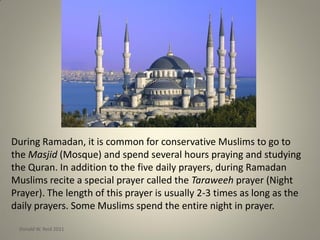
During Ramadan, it is common for conservative Muslims to go to
the Masjid (Mosque) and spend several hours praying and studying
the Quran. In addition to the five daily prayers, during Ramadan
Muslims recite a special prayer called the Taraweeh prayer (Night
Prayer). The length of this prayer is usually 2-3 times as long as the
daily prayers. Some Muslims spend the entire night in prayer.
Donald W. Reid 2011
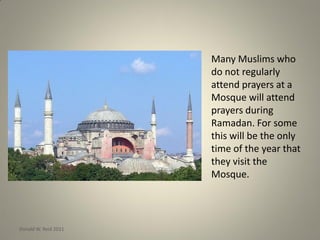
Many Muslims who
do not regularly
attend prayers at a
Mosque will attend
prayers during
Ramadan. For some
this will be the only
time of the year that
they visit the
Mosque.
Donald W. Reid 2011
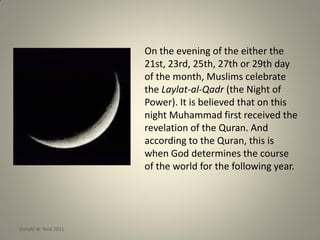
On the evening of the either the
21st, 23rd, 25th, 27th or 29th day
of the month, Muslims celebrate
the Laylat-al-Qadr (the Night of
Power). It is believed that on this
night Muhammad first received the
revelation of the Quran. And
according to the Quran, this is
when God determines the course
of the world for the following year.
Donald W. Reid 2011
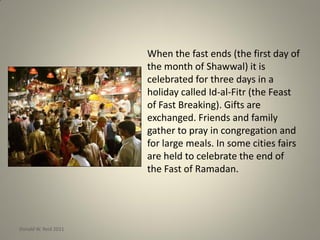
When the fast ends (the first day of
the month of Shawwal) it is
celebrated for three days in a
holiday called Id-al-Fitr (the Feast
of Fast Breaking). Gifts are
exchanged. Friends and family
gather to pray in congregation and
for large meals. In some cities fairs
are held to celebrate the end of
the Fast of Ramadan.
Donald W. Reid 2011
Islamic Holidays
Al Hijra: Islamic New Year’s Day -
First day of the Islamic New Year
celebrated on the first day of
Muharram. Al Hijra is the day when
Mohammed began his migration
from Mecca to Medina in Islamic
Year 1 (1 AH), 622 CE.
November 26, 2011
Donald W. Reid 2011
Ashura - Day of mourning,
observed on the 10th of
Muharram, the first month of the
Islamic year. It is a day of
commemoration of the martyrdom
of Imam Hussain, the grandson of
The Prophet Muhammad.
December 5, 2011
Donald W. Reid 2011
Ramadan - 9th month of the Islamic Calendar -
holy month of fasting Based on a lunar calendar
and therefore varies every year.
The Holy Month of Ramadan is a time when
Muslims fast during daylight hours to celebrate the
time when Allah revealed the first verses of the
Qu'ran, the holy book of Islam.
It is a time for spiritual reflection, prayer, doing
good deeds, charity, spending time with loved
ones. It teaches self-discipline, self-restraint,
generosity and understanding of those less
fortunate.
Begins:
August 1, 2011
Donald W. Reid 2011
Eid ul-Fitr - Marks the end of
Ramadan. It starts the day after
Ramadan ends. It's significance is
to celebrate the achievement of
enhanced piety. A day of
forgiveness, fellowship and unity, a
time of giving and sharing.
Aug 30, 2011
Donald W. Reid 2011
Eid al-Adha - Religious festival
celebrated by Muslims and Druze
worldwide as a commemoration of
Ibrahim's (Abraham's) willingness
to sacrifice his son, as commanded
by Allah. (Muslim tradition names
Ishmael as the son who was to be
sacrificed, whereas the Judeo-
Christian tradition names Isaac.)
Nov 6, 2011
Donald W. Reid 2011
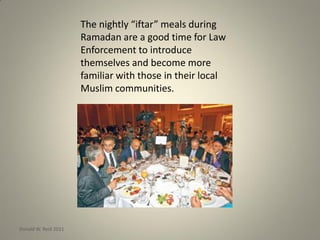
The nightly “iftar” meals during
Ramadan are a good time for Law
Enforcement to introduce
themselves and become more
familiar with those in their local
Muslim communities.
Donald W. Reid 2011

Ramadan

  • 1.
  • 2.
    Ramadan is theninth month of the Islamic lunar calendar. Every day during this month, Muslims around the world spend the daylight hours in a complete fast. During the month of Ramadan, Muslims all over the world abstain from food, drink, and other physical needs during the daylight hours. As a time to purify the soul, refocus attention on God, and practice self-sacrifice, Ramadan is much more than just not eating and drinking. Donald W. Reid 2011
  • 3.
    During the Fastof Ramadan strict restraints are placed on the daily lives of Muslims. They are not allowed to eat or drink during the daylight hours (those that are traveling or ill are not required to fast). Smoking and sexual relations are also forbidden during fasting. At the end of the day the fast is broken with prayer and a meal called the iftar. In the evening following the iftar it is customary for Muslims to go out visiting family and friends. The fast is resumed the next morning Donald W. Reid 2011
  • 4.
    According to theQuran: One may eat and drink at any time during the night "until you can plainly distinguish a white thread from a black thread by the daylight: then keep the fast until night" Donald W. Reid 2011
  • 5.
    The good thatis acquired through the fast can be destroyed by five things - •the telling of a lie •slander •denouncing someone behind his back •a false oath •greed or covetousness These are considered offensive at all times, but are most offensive during the Fast of Ramadan. Donald W. Reid 2011
  • 6.
    During Ramadan, itis common for conservative Muslims to go to the Masjid (Mosque) and spend several hours praying and studying the Quran. In addition to the five daily prayers, during Ramadan Muslims recite a special prayer called the Taraweeh prayer (Night Prayer). The length of this prayer is usually 2-3 times as long as the daily prayers. Some Muslims spend the entire night in prayer. Donald W. Reid 2011
  • 7.
    Many Muslims who donot regularly attend prayers at a Mosque will attend prayers during Ramadan. For some this will be the only time of the year that they visit the Mosque. Donald W. Reid 2011
  • 8.
    On the eveningof the either the 21st, 23rd, 25th, 27th or 29th day of the month, Muslims celebrate the Laylat-al-Qadr (the Night of Power). It is believed that on this night Muhammad first received the revelation of the Quran. And according to the Quran, this is when God determines the course of the world for the following year. Donald W. Reid 2011
  • 9.
    When the fastends (the first day of the month of Shawwal) it is celebrated for three days in a holiday called Id-al-Fitr (the Feast of Fast Breaking). Gifts are exchanged. Friends and family gather to pray in congregation and for large meals. In some cities fairs are held to celebrate the end of the Fast of Ramadan. Donald W. Reid 2011
  • 10.
    Islamic Holidays Al Hijra:Islamic New Year’s Day - First day of the Islamic New Year celebrated on the first day of Muharram. Al Hijra is the day when Mohammed began his migration from Mecca to Medina in Islamic Year 1 (1 AH), 622 CE. November 26, 2011 Donald W. Reid 2011
  • 11.
    Ashura - Dayof mourning, observed on the 10th of Muharram, the first month of the Islamic year. It is a day of commemoration of the martyrdom of Imam Hussain, the grandson of The Prophet Muhammad. December 5, 2011 Donald W. Reid 2011
  • 12.
    Ramadan - 9thmonth of the Islamic Calendar - holy month of fasting Based on a lunar calendar and therefore varies every year. The Holy Month of Ramadan is a time when Muslims fast during daylight hours to celebrate the time when Allah revealed the first verses of the Qu'ran, the holy book of Islam. It is a time for spiritual reflection, prayer, doing good deeds, charity, spending time with loved ones. It teaches self-discipline, self-restraint, generosity and understanding of those less fortunate. Begins: August 1, 2011 Donald W. Reid 2011
  • 13.
    Eid ul-Fitr -Marks the end of Ramadan. It starts the day after Ramadan ends. It's significance is to celebrate the achievement of enhanced piety. A day of forgiveness, fellowship and unity, a time of giving and sharing. Aug 30, 2011 Donald W. Reid 2011
  • 14.
    Eid al-Adha -Religious festival celebrated by Muslims and Druze worldwide as a commemoration of Ibrahim's (Abraham's) willingness to sacrifice his son, as commanded by Allah. (Muslim tradition names Ishmael as the son who was to be sacrificed, whereas the Judeo- Christian tradition names Isaac.) Nov 6, 2011 Donald W. Reid 2011
  • 15.
    The nightly “iftar”meals during Ramadan are a good time for Law Enforcement to introduce themselves and become more familiar with those in their local Muslim communities. Donald W. Reid 2011