Donald W. Reid 2011
A Quick Look at
Wahhabism
(Salafism)
Donald W. Reid 2011
This branch of Islam is often referred to as "Wahhabi," a term that
many adherents to this tradition do not use. Members of this form
of Islam call themselves Muwahhidun ("Unitarians", or "unifiers of
Islamic practice"). They use the Salafi Da'wa or Ahlul Sunna wal
Jama'a. The teachings of the reformer Abd Al-Wahhab are more
often referred to by adherents as Salafi, that is, "following the
forefathers of Islam."
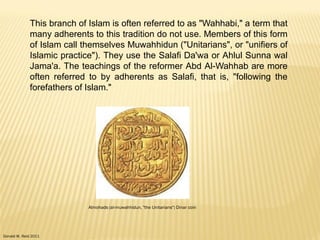
Almohads (al-muwahhidun, "the Unitarians") Dinar coin
Donald W. Reid 2011
Salafi is a word denoting one who ascribes
her/himself to the Salaf of Islam, based on its
meaning in the Arabic language. Amongst
contemporary historians, it denotes a follower of
a Sunni Islamic movement that takes the pious
predecessors, the Salaf of the patristic period of
early Islam, as exemplary models. The word Salaf
is an Arabic noun which may be translated as
"predecessor" or "ancestor". In Islamic
terminology, it is generally used to refer to the first
three generations of Muslims: the Sahaba
("Companions"), the Tabi„un ("Followers") and the
Tabi„ al-Tabi„in ("Those after the Followers").
These three generations are looked upon as
examples of how Islam should be practiced.
Donald W. Reid 2011
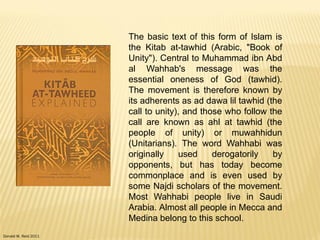
The basic text of this form of Islam is
the Kitab at-tawhid (Arabic, "Book of
Unity"). Central to Muhammad ibn Abd
al Wahhab's message was the
essential oneness of God (tawhid).
The movement is therefore known by
its adherents as ad dawa lil tawhid (the
call to unity), and those who follow the
call are known as ahl at tawhid (the
people of unity) or muwahhidun
(Unitarians). The word Wahhabi was
originally used derogatorily by
opponents, but has today become
commonplace and is even used by
some Najdi scholars of the movement.
Most Wahhabi people live in Saudi
Arabia. Almost all people in Mecca and
Medina belong to this school.
Donald W. Reid 2011
Wahhabism (Salafism) is named after Muhammed Ibin
Abdul Wahhab, an Arabic imam who lived in 18th century in
today‟s Saudi Arabia.
Abdul Wahhab‟s approach to Islam considers many of the
traditions in the religion as infidelity. According to
Wahhabism, only the testimony is not enough for fidelity,
but one has to prove it with his actions and who ever does
not prove it, his life and property are not deserved.
Donald W. Reid 2011
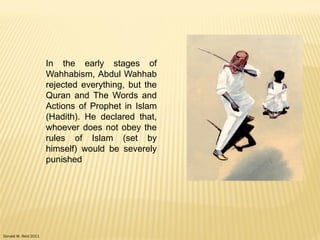
In the early stages of
Wahhabism, Abdul Wahhab
rejected everything, but the
Quran and The Words and
Actions of Prophet in Islam
(Hadith). He declared that,
whoever does not obey the
rules of Islam (set by
himself) would be severely
punished
Donald W. Reid 2011
In 1744 Abdul Wahhab was married to the one of the
daughters of Muhammed bin Saud, who was the leader of
Saud tribe. This made him even more powerful, he wrote
letters to all Muslim leaders inviting them to his version of
Islam.
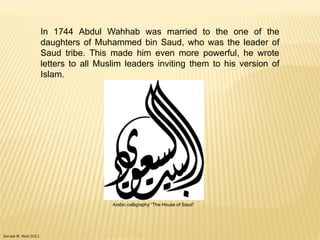
Arabic calligraphy “The House of Saud”
Donald W. Reid 2011
As the Saud family gained more
power among the Arabian
peninsula, Wahhabism spread with
them. In a short time, Wahhabism
spread to the majority of Arab
towns quickly. Things like,
smoking, music, and silk clothes,
were forbidden, worship was
mandatory. The most surprising
actions during this time were
attacks against graves and
mausoleums. Even mosques close
to gravesites were destroyed, this
earned the Wahhabis the label of
“Temple Collapsers”. When they
conquered Mecca and Medina all
the graves were destroyed except
for the prophet Muhammad‟s,
however it was forbidden to visit it.
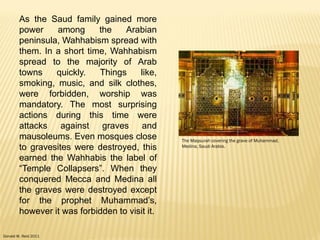
The Maqsurah covering the grave of Muhammad,
Medina, Saudi Arabia.
Donald W. Reid 2011
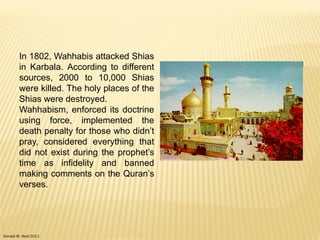
In 1802, Wahhabis attacked Shias
in Karbala. According to different
sources, 2000 to 10,000 Shias
were killed. The holy places of the
Shias were destroyed.
Wahhabism, enforced its doctrine
using force, implemented the
death penalty for those who didn‟t
pray, considered everything that
did not exist during the prophet‟s
time as infidelity and banned
making comments on the Quran‟s
verses.
Donald W. Reid 2011
The Fundamentals of Wahhabism :
1. The Existence, The Role and The
Actions of Allah are all in one, they
cannot be separated.
2. What is mentioned above is Tawhid
(Uniqueness) whoever does not believe
in this does not deserve his/her life and
property.
3. Actions are hidden in fidelity, no fidelity
without supporting actions.
4. Who ever does not obey these actions
should be fought against.
5. Making Comments on verses of the
Quran is infidelity.
6. Pray to Allah without middlemen.
Believing and Obeying Sheikhs, Islamic
Saints, or other mediators is infidelity.
Donald W. Reid 2011
7. The only and eternal proof is the
Quran and Hadith (Words and Actions
of Prophet). All Sects, Sufism etc is
infidelity
8. Making Graves, Mausoleums,
vows, cemetery visits is infidelity.
9. Expecting help from anyone else
but Allah is infidelity.
10. Praying together is mandatory;
who ever doesn‟t pray in a mosque
shall be punished.
11. Whoever smokes, drinks coffee,
takes alcohol shall be punished
physically.
Donald W. Reid 2011
12. Wakfs (Public Foundations) are
forbidden. Who ever establishes
Wakfs are in fact those who hide their
property.
13. Amulets, prayer beads, dhikr,
sunnet are fictional.
14. Entertainment, Kissing One‟s Hand
(as an expression of respect), visiting
the graves or relics of Islamic Saints,
Listening Music is infidelity.
15. Rufai, Kadiri, Naksibendi etc Sects
of Islam are Infidels.
16. Loving the Ehl-i Beyt (Pioneers of
Islam, Friends and Family of the
Prophet) and accepting the innocence
of Ali‟s Sons is infidelity.
Donald W. Reid 2011
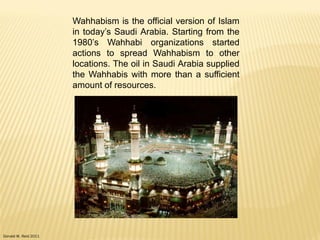
Wahhabism is the official version of Islam
in today‟s Saudi Arabia. Starting from the
1980‟s Wahhabi organizations started
actions to spread Wahhabism to other
locations. The oil in Saudi Arabia supplied
the Wahhabis with more than a sufficient
amount of resources.
Donald W. Reid 2011
The main doctrine of Wahhabism is that
anyone who is not Wahhabi is infidel and
the real Islam is Wahhabism. However,
Wahhabism, as the name of this version
of Islam is not mentioned (it is
considered derogatory), they basically
call themselves Muslims and their
religion as Islam, which can cause
confusion among non Muslims.
Donald W. Reid 2011
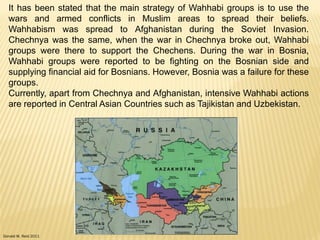
It has been stated that the main strategy of Wahhabi groups is to use the
wars and armed conflicts in Muslim areas to spread their beliefs.
Wahhabism was spread to Afghanistan during the Soviet Invasion.
Chechnya was the same, when the war in Chechnya broke out, Wahhabi
groups were there to support the Chechens. During the war in Bosnia,
Wahhabi groups were reported to be fighting on the Bosnian side and
supplying financial aid for Bosnians. However, Bosnia was a failure for these
groups.
Currently, apart from Chechnya and Afghanistan, intensive Wahhabi actions
are reported in Central Asian Countries such as Tajikistan and Uzbekistan.
Donald W. Reid 2011
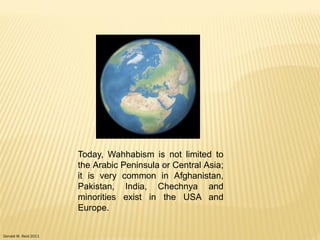
Today, Wahhabism is not limited to
the Arabic Peninsula or Central Asia;
it is very common in Afghanistan,
Pakistan, India, Chechnya and
minorities exist in the USA and
Europe.

Wahhabism

  • 1.
    Donald W. Reid2011 A Quick Look at Wahhabism (Salafism)
  • 2.
    Donald W. Reid2011 This branch of Islam is often referred to as "Wahhabi," a term that many adherents to this tradition do not use. Members of this form of Islam call themselves Muwahhidun ("Unitarians", or "unifiers of Islamic practice"). They use the Salafi Da'wa or Ahlul Sunna wal Jama'a. The teachings of the reformer Abd Al-Wahhab are more often referred to by adherents as Salafi, that is, "following the forefathers of Islam." Almohads (al-muwahhidun, "the Unitarians") Dinar coin
  • 3.
    Donald W. Reid2011 Salafi is a word denoting one who ascribes her/himself to the Salaf of Islam, based on its meaning in the Arabic language. Amongst contemporary historians, it denotes a follower of a Sunni Islamic movement that takes the pious predecessors, the Salaf of the patristic period of early Islam, as exemplary models. The word Salaf is an Arabic noun which may be translated as "predecessor" or "ancestor". In Islamic terminology, it is generally used to refer to the first three generations of Muslims: the Sahaba ("Companions"), the Tabi„un ("Followers") and the Tabi„ al-Tabi„in ("Those after the Followers"). These three generations are looked upon as examples of how Islam should be practiced.
  • 4.
    Donald W. Reid2011 The basic text of this form of Islam is the Kitab at-tawhid (Arabic, "Book of Unity"). Central to Muhammad ibn Abd al Wahhab's message was the essential oneness of God (tawhid). The movement is therefore known by its adherents as ad dawa lil tawhid (the call to unity), and those who follow the call are known as ahl at tawhid (the people of unity) or muwahhidun (Unitarians). The word Wahhabi was originally used derogatorily by opponents, but has today become commonplace and is even used by some Najdi scholars of the movement. Most Wahhabi people live in Saudi Arabia. Almost all people in Mecca and Medina belong to this school.
  • 5.
    Donald W. Reid2011 Wahhabism (Salafism) is named after Muhammed Ibin Abdul Wahhab, an Arabic imam who lived in 18th century in today‟s Saudi Arabia. Abdul Wahhab‟s approach to Islam considers many of the traditions in the religion as infidelity. According to Wahhabism, only the testimony is not enough for fidelity, but one has to prove it with his actions and who ever does not prove it, his life and property are not deserved.
  • 6.
    Donald W. Reid2011 In the early stages of Wahhabism, Abdul Wahhab rejected everything, but the Quran and The Words and Actions of Prophet in Islam (Hadith). He declared that, whoever does not obey the rules of Islam (set by himself) would be severely punished
  • 7.
    Donald W. Reid2011 In 1744 Abdul Wahhab was married to the one of the daughters of Muhammed bin Saud, who was the leader of Saud tribe. This made him even more powerful, he wrote letters to all Muslim leaders inviting them to his version of Islam. Arabic calligraphy “The House of Saud”
  • 8.
    Donald W. Reid2011 As the Saud family gained more power among the Arabian peninsula, Wahhabism spread with them. In a short time, Wahhabism spread to the majority of Arab towns quickly. Things like, smoking, music, and silk clothes, were forbidden, worship was mandatory. The most surprising actions during this time were attacks against graves and mausoleums. Even mosques close to gravesites were destroyed, this earned the Wahhabis the label of “Temple Collapsers”. When they conquered Mecca and Medina all the graves were destroyed except for the prophet Muhammad‟s, however it was forbidden to visit it. The Maqsurah covering the grave of Muhammad, Medina, Saudi Arabia.
  • 9.
    Donald W. Reid2011 In 1802, Wahhabis attacked Shias in Karbala. According to different sources, 2000 to 10,000 Shias were killed. The holy places of the Shias were destroyed. Wahhabism, enforced its doctrine using force, implemented the death penalty for those who didn‟t pray, considered everything that did not exist during the prophet‟s time as infidelity and banned making comments on the Quran‟s verses.
  • 10.
    Donald W. Reid2011 The Fundamentals of Wahhabism : 1. The Existence, The Role and The Actions of Allah are all in one, they cannot be separated. 2. What is mentioned above is Tawhid (Uniqueness) whoever does not believe in this does not deserve his/her life and property. 3. Actions are hidden in fidelity, no fidelity without supporting actions. 4. Who ever does not obey these actions should be fought against. 5. Making Comments on verses of the Quran is infidelity. 6. Pray to Allah without middlemen. Believing and Obeying Sheikhs, Islamic Saints, or other mediators is infidelity.
  • 11.
    Donald W. Reid2011 7. The only and eternal proof is the Quran and Hadith (Words and Actions of Prophet). All Sects, Sufism etc is infidelity 8. Making Graves, Mausoleums, vows, cemetery visits is infidelity. 9. Expecting help from anyone else but Allah is infidelity. 10. Praying together is mandatory; who ever doesn‟t pray in a mosque shall be punished. 11. Whoever smokes, drinks coffee, takes alcohol shall be punished physically.
  • 12.
    Donald W. Reid2011 12. Wakfs (Public Foundations) are forbidden. Who ever establishes Wakfs are in fact those who hide their property. 13. Amulets, prayer beads, dhikr, sunnet are fictional. 14. Entertainment, Kissing One‟s Hand (as an expression of respect), visiting the graves or relics of Islamic Saints, Listening Music is infidelity. 15. Rufai, Kadiri, Naksibendi etc Sects of Islam are Infidels. 16. Loving the Ehl-i Beyt (Pioneers of Islam, Friends and Family of the Prophet) and accepting the innocence of Ali‟s Sons is infidelity.
  • 13.
    Donald W. Reid2011 Wahhabism is the official version of Islam in today‟s Saudi Arabia. Starting from the 1980‟s Wahhabi organizations started actions to spread Wahhabism to other locations. The oil in Saudi Arabia supplied the Wahhabis with more than a sufficient amount of resources.
  • 14.
    Donald W. Reid2011 The main doctrine of Wahhabism is that anyone who is not Wahhabi is infidel and the real Islam is Wahhabism. However, Wahhabism, as the name of this version of Islam is not mentioned (it is considered derogatory), they basically call themselves Muslims and their religion as Islam, which can cause confusion among non Muslims.
  • 15.
    Donald W. Reid2011 It has been stated that the main strategy of Wahhabi groups is to use the wars and armed conflicts in Muslim areas to spread their beliefs. Wahhabism was spread to Afghanistan during the Soviet Invasion. Chechnya was the same, when the war in Chechnya broke out, Wahhabi groups were there to support the Chechens. During the war in Bosnia, Wahhabi groups were reported to be fighting on the Bosnian side and supplying financial aid for Bosnians. However, Bosnia was a failure for these groups. Currently, apart from Chechnya and Afghanistan, intensive Wahhabi actions are reported in Central Asian Countries such as Tajikistan and Uzbekistan.
  • 16.
    Donald W. Reid2011 Today, Wahhabism is not limited to the Arabic Peninsula or Central Asia; it is very common in Afghanistan, Pakistan, India, Chechnya and minorities exist in the USA and Europe.