Islam
Islam today:
•The word Islam means 'submission to the
will of God'.
•Islam is the second largest religion in the
world with over 1 billion followers.
•People who follow the faith of Islam are
called Muslims
•1,591,000 Muslims in the UK, around 2.7% of
the population.
 Muslims believe that there is only one God,
whose name in the Arabic language is Allah.
 God had special messengers or prophets these
were Abraham, Moses, Jesus and Muhammad
(Peace be upon him).
 When Muslims say the names of the prophets
they say ‘peace be upon him’ afterwards.
 Allah created the Earth and everything on it in
seven days.
 On the seventh day he created Adam and Eve
from clay.
Qur’an
 The holy book for Muslims
 The Qur’an was revealed by God to the prophet
Muhammad and that it is the direct word of God
(Allah)
 The Qur’an is originally written in Arabic but is
translated in over 40 languages
 There are 114 Chapters in the Qur’an
 All chapters except one begin with “Bismillahir
rahmanir raheem” which means “In the name of Allah
the most merciful and the most kind”
 Muslims are taught to learn and recite the Qur’an in
Arabic.Anyone who knows the Qur’an off by heart is
referred to as Hafiz
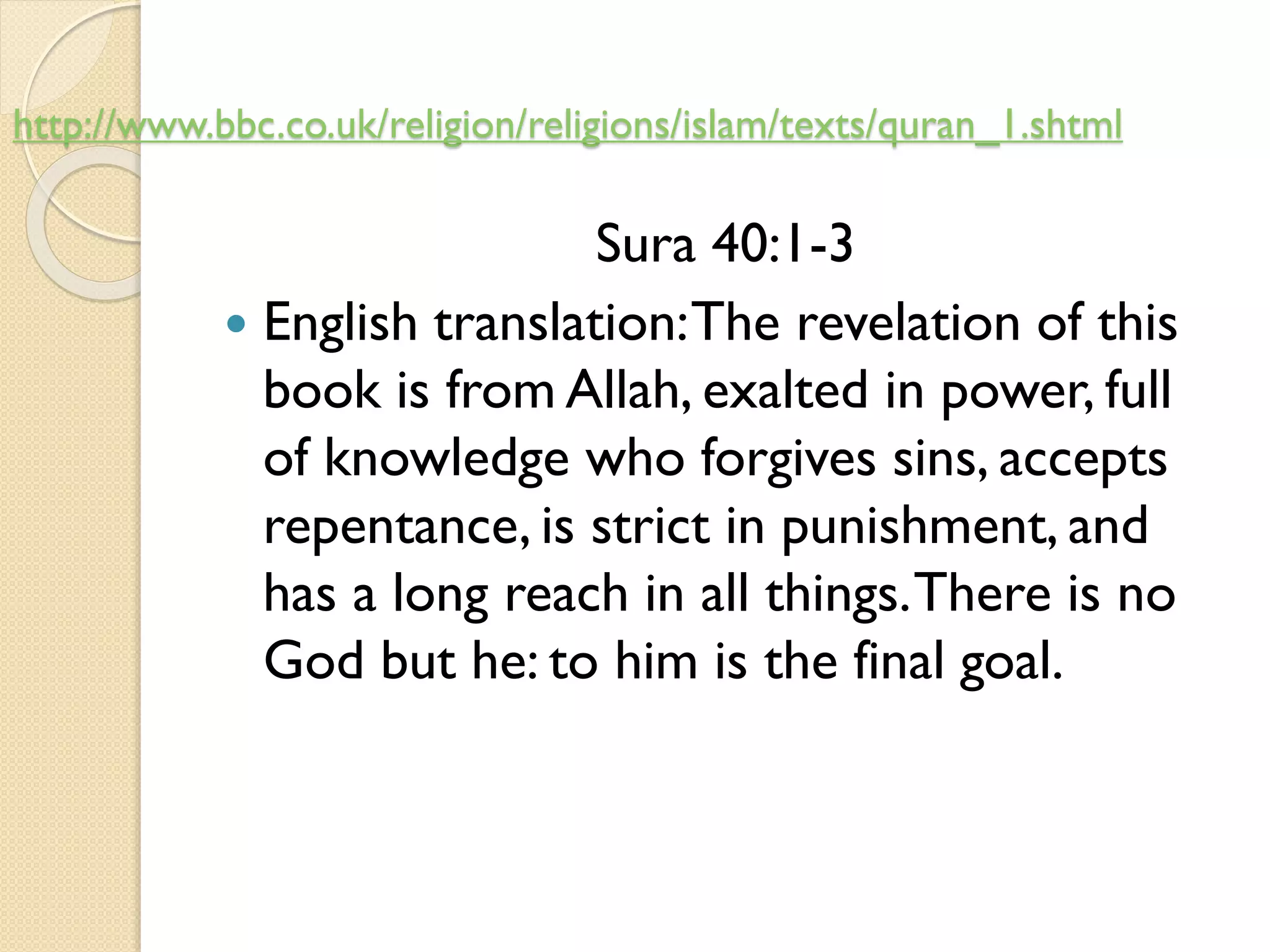
http://www.bbc.co.uk/religion/religions/islam/texts/quran_1.shtml
Sura 40:1-3
 English translation:The revelation of this
book is from Allah, exalted in power, full
of knowledge who forgives sins, accepts
repentance, is strict in punishment, and
has a long reach in all things.There is no
God but he: to him is the final goal.
Rules of the Qur’an
 Before touching the Qur’an you must perform a ritual
washing (washing face then 2 hands all the way up to
the elbows, followed by washing part of the head and
finally washing of the feet up to the ankles).This is
also known as Ablution or Wudu.
 No text is allowed to be place above the Qur’an
 The Book is highly respected and when being read
Muslims have to reframe from talking, eating, drinking
or making distracting noises
 A special stand called the Rihal is used to keep the
Qur’an off the floor in respect for the Holy Book.
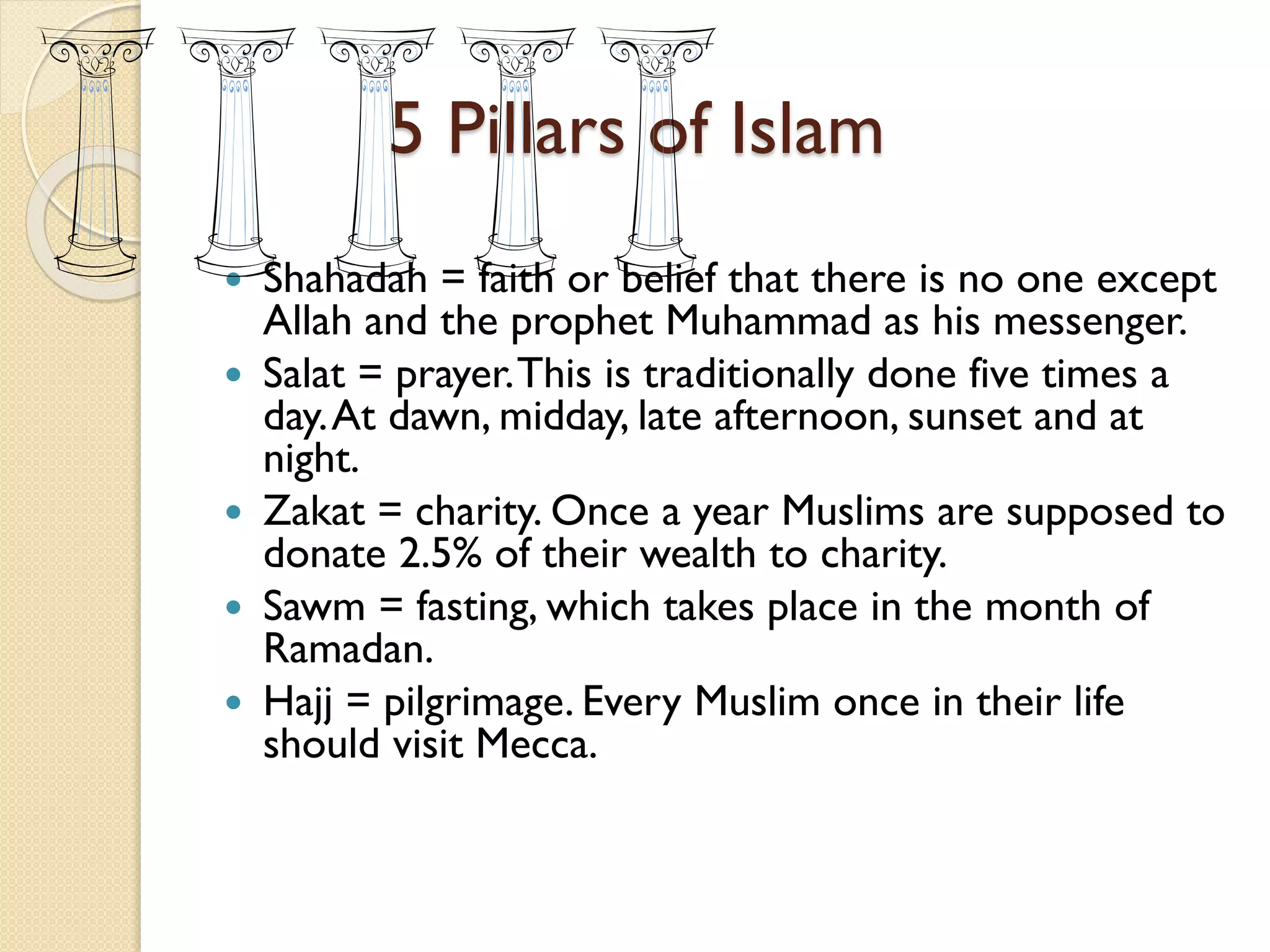
5 Pillars of Islam
 Shahadah = faith or belief that there is no one except
Allah and the prophet Muhammad as his messenger.
 Salat = prayer.This is traditionally done five times a
day.At dawn, midday, late afternoon, sunset and at
night.
 Zakat = charity. Once a year Muslims are supposed to
donate 2.5% of their wealth to charity.
 Sawm = fasting, which takes place in the month of
Ramadan.
 Hajj = pilgrimage. Every Muslim once in their life
should visit Mecca.
By carrying out the Five Pillars it shows
that Muslims don’t try and fit their
religion around their secular lives but put
their faith first.
Everyday Life
 Muslims are expected to live within the Islamic Laws called the Sharia
(God’s Way)
i. They are not allowed to steal, gamble, commit adultery or drink alcohol
 Clothing
i. Men must cover their bodies between the waist and knees
ii. Women must be covered from head to toe with exception of their
hands and face
iii. Clothes for women should not be transparent or show the shape of the
woman’s body
iv. Common to see women and girls wearing head shawls; Hijab that covers
the head or Burka which covers whole body.
 Muslims wash and pray before meals.The eldest person in the room
always eats first
 Any meat that they eat must be prepared in a special way called Halal.
Muslim Festivals
Eid-Ul-Adha, Ramadan and Eid-Ul-Fitr
Eid-Ul-Adha
 http://www.bbc.co.uk/schools/religion/islam/eid_haj.sh
tml
 Is the celebration of sacrifice and marks the end of
Hajj, annual pilgrimage to Mecca. It takes place in the
last month of the Islamic calendar, Zul-Hijjah
 Is a day of happiness, and a day to forgive and forget
differences
 The day usually starts with a visit to the mosque
where a special Eid Namaz (prayer) is read
 Special dishes including lamb and sweet dishes are
consumed during the celebrations
 Presents are often exchanged and some families hang
decorations and have fireworks
Ramadan
 Ramadan is the ninth month of the Islamic calendar, and a time
when many Muslims across the world will fast during the hours of
daylight
 Muslims believe that the gates of Heaven (Jannah) and Hell
(Jahanam) are locked for the duration of Ramadan
 During Ramadan Muslims celebrate the time when the verses of
the Qur’an were revealed to the prophet Muhammad
 Ramadan is a time of worship and contemplation.A time to
strengthen family and community ties
 Muslims are expected to fast from sunrise to sunset. During
Ramadan Muslims get up early before dawn (Fajr) and have a light
meal.This time is known as Suhoor.
 At the end of each day (Maghrib) Muslims traditionally break their
fast with a meal called the iftar. Following the custom of
Muhammad, the fast is often broken with dates, then followed by a
prayer and dinner
 Ramadan concludes with the celebration of Eid-Ul-Fitr
Eid-Ul-Fitr
 Eid-Ul-Fitr or Id-Ul-Fitr is a Muslim
holiday that marks the end of Ramadan.
Eid is the Arabic word for ‘festivity’ while
Fitr means ‘to break the fast’ and so
symbolises the breaking of the fasting
period. Eid is celebrated over a three day
period in Islamic countries.
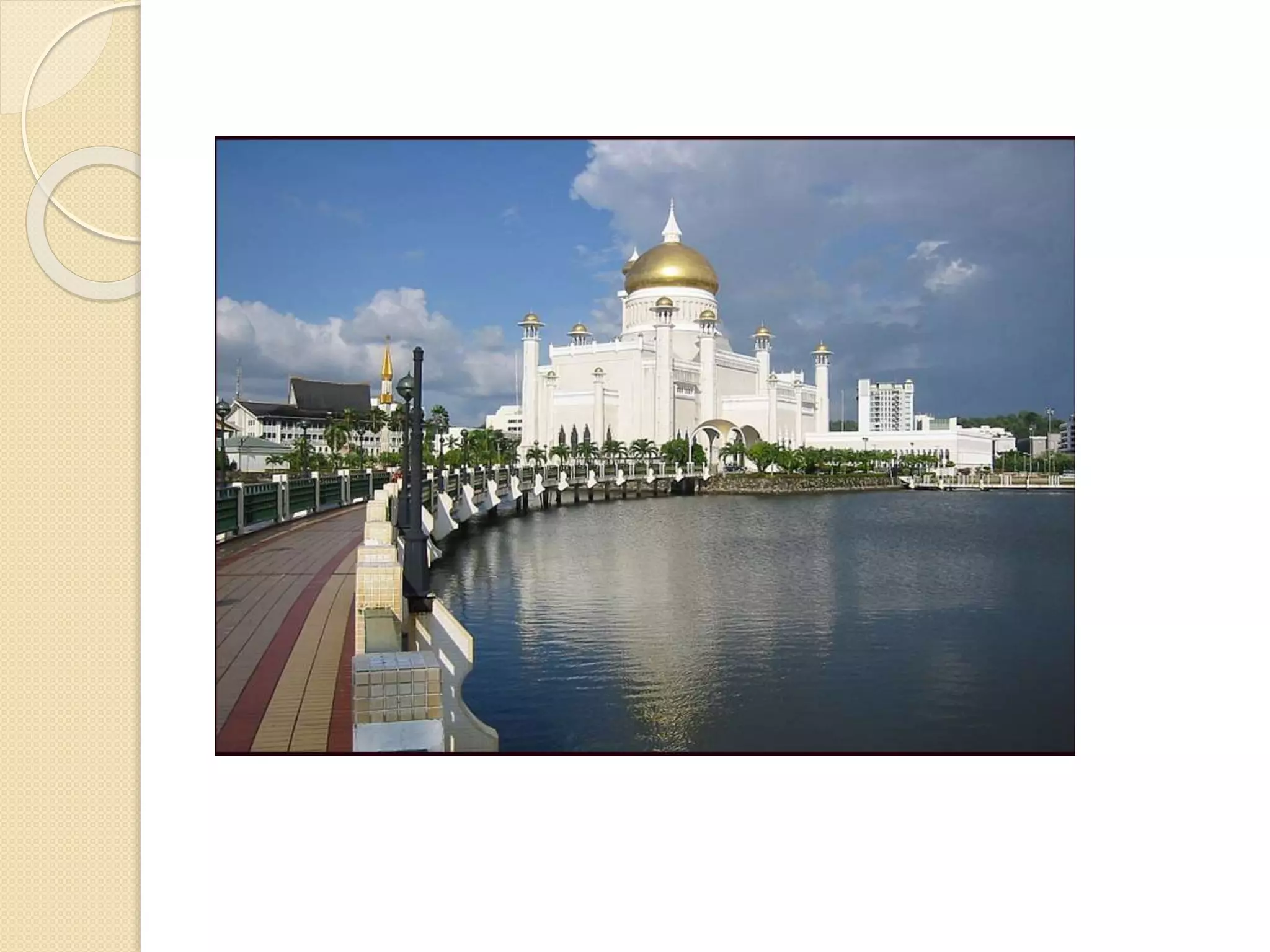
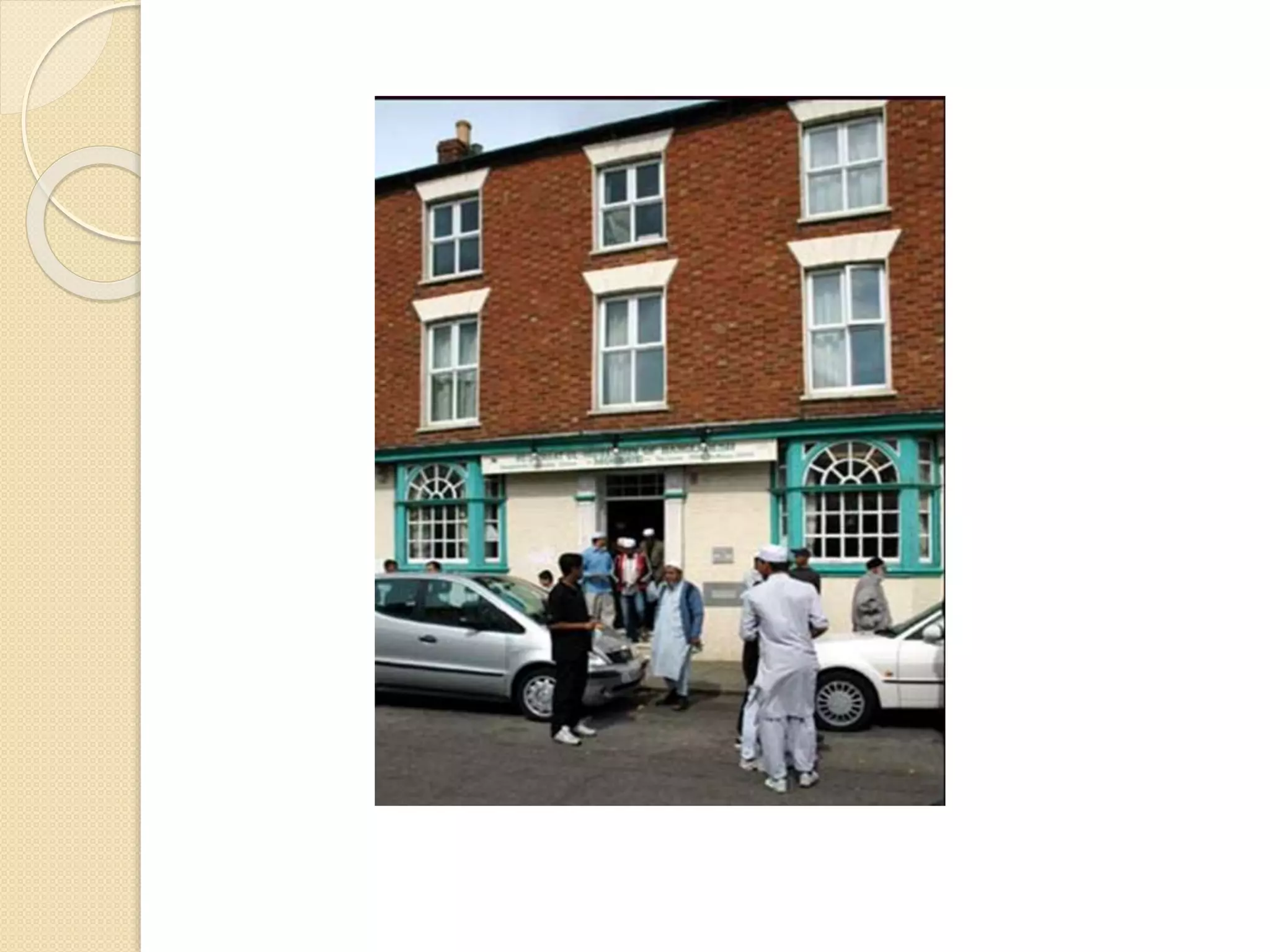
Mosques
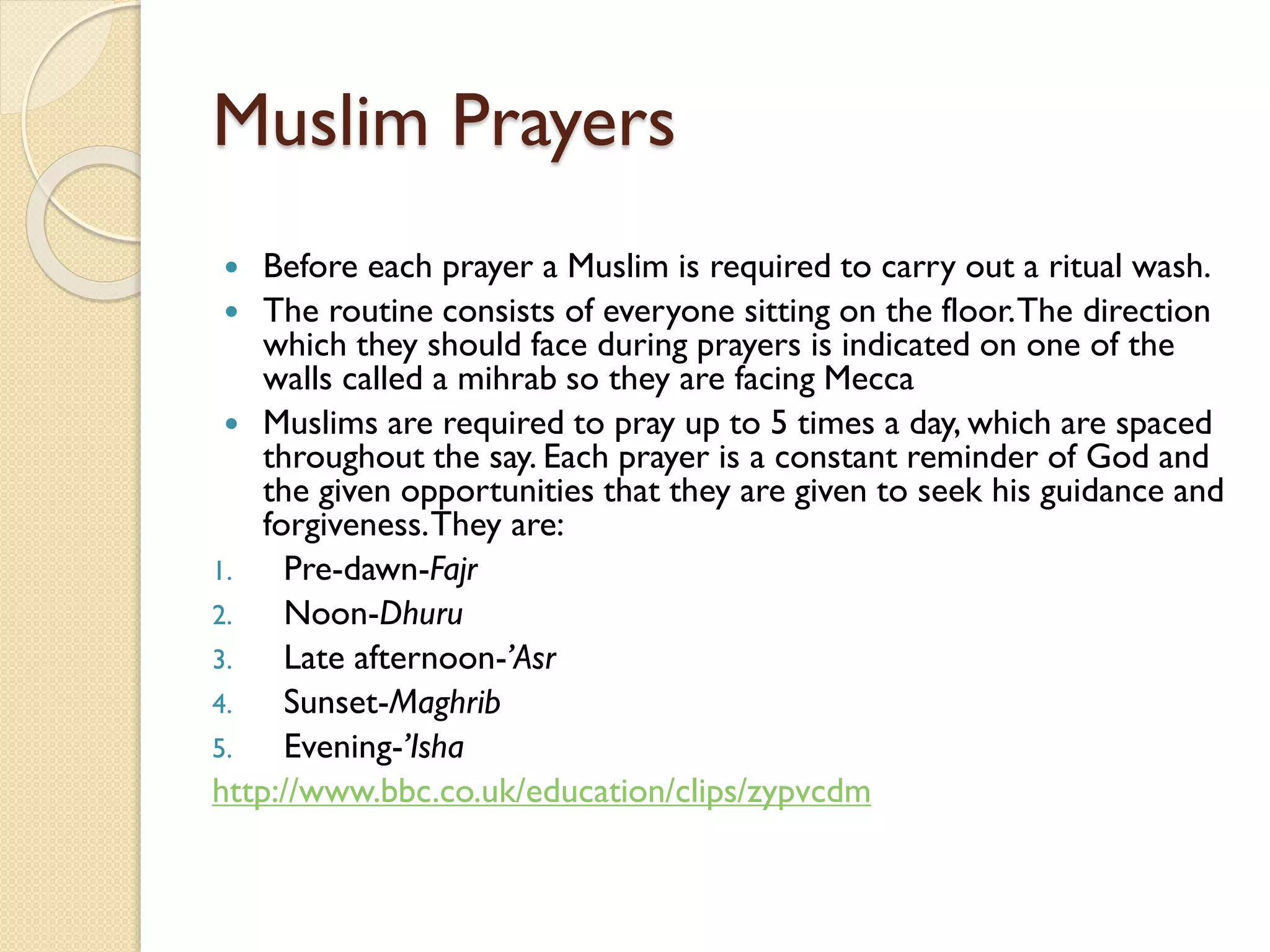
A mosque (masjid in Arabic) is a place for
worship in Islam.Although prayers can be
done privately, either indoors or
outdoors, nearly every community of
Muslims dedicates a space or building for
congregational prayer.
Common Components of Mosques
 Prayer Hall- the central area for prayer
 Prayer Rugs- during Islamic prayers, worshippers bow, kneel
and prostrate on these
 Mihrab- the mihrab is an ornamental indentation on the wall
of a mosque, from which sermons or speeches are given
 Dome- many mosques are decorated withal domed rooftop,
particularly in the Middle East.This architectural element
holds no spiritual or symbolic significance and is purely
aesthetic.The interior of a dome is usually highly decorated
with floral, geometric and other patterns
 Shoe shelf- Muslims remove their shoes before entering a
mosque to preserve the cleanliness of the prayer space
Muslim Prayers
 Before each prayer a Muslim is required to carry out a ritual wash.
 The routine consists of everyone sitting on the floor.The direction
which they should face during prayers is indicated on one of the
walls called a mihrab so they are facing Mecca
 Muslims are required to pray up to 5 times a day, which are spaced
throughout the say. Each prayer is a constant reminder of God and
the given opportunities that they are given to seek his guidance and
forgiveness.They are:
1. Pre-dawn-Fajr
2. Noon-Dhuru
3. Late afternoon-’Asr
4. Sunset-Maghrib
5. Evening-’Isha
http://www.bbc.co.uk/education/clips/zypvcdm
Mecca
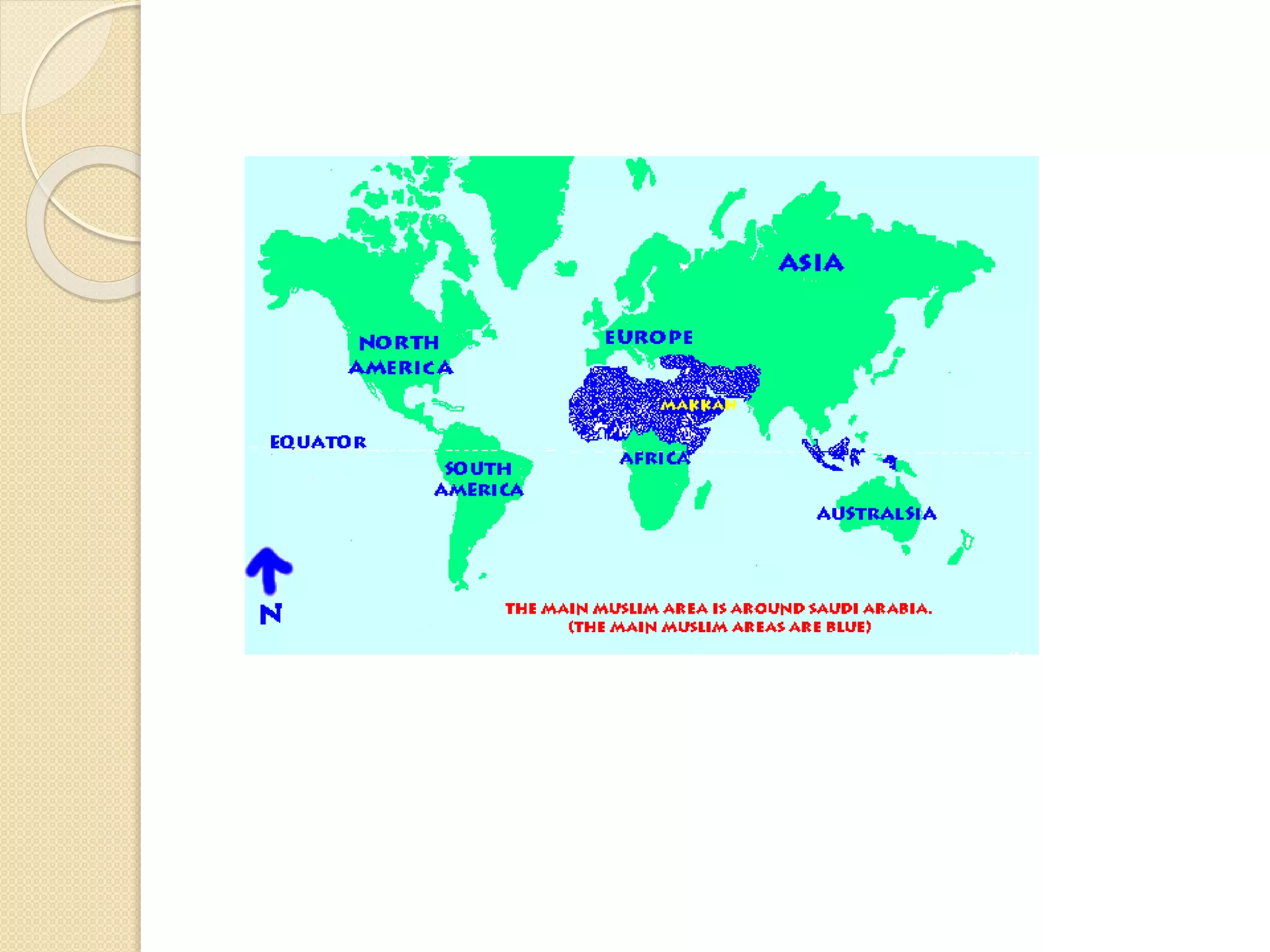
 Mecca translated into Makah is a city in Saudi Arabia which is
considered to be the Holy City of Islam
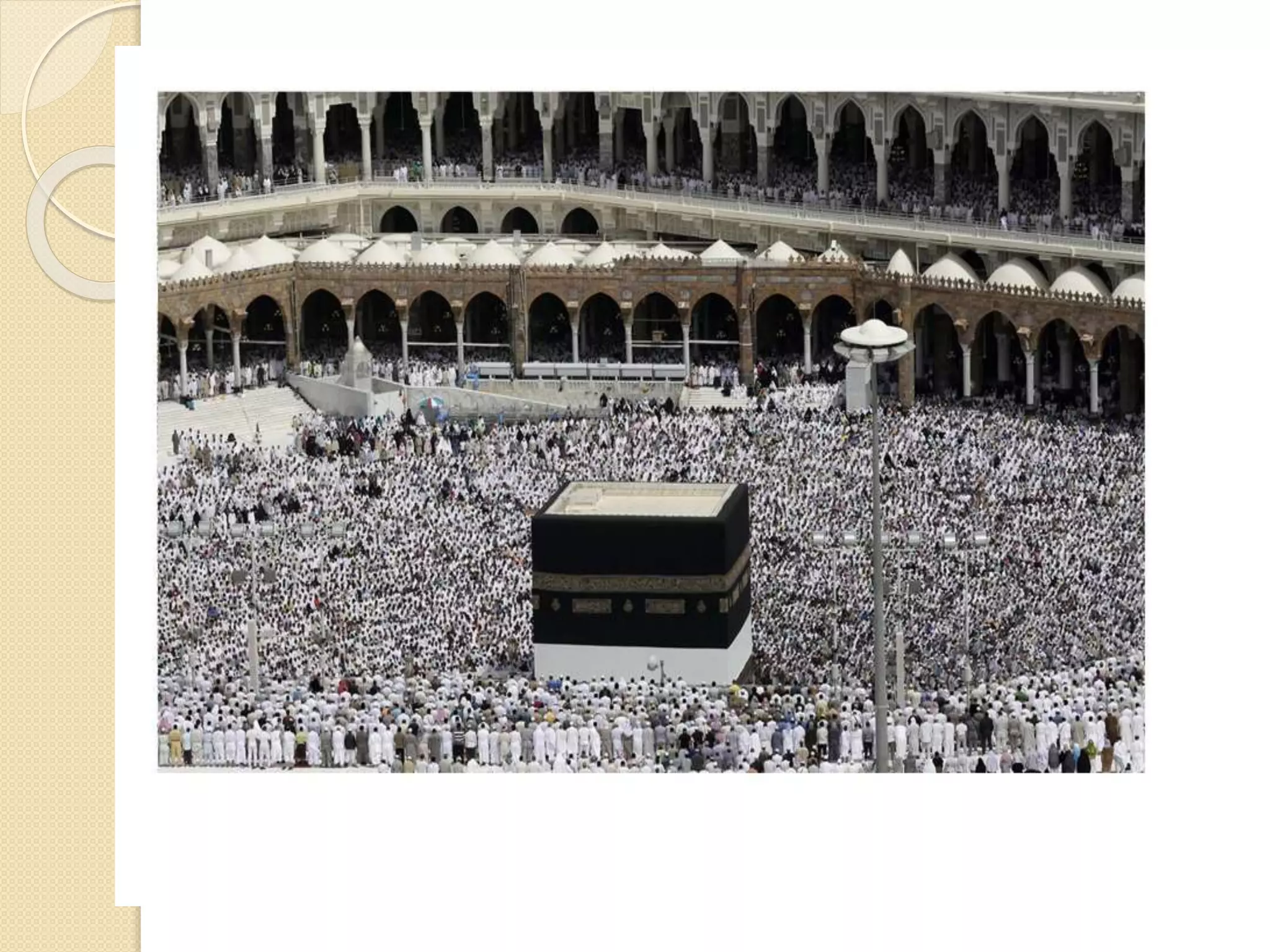
 Mecca is the home to the Kaaba- a cuboid building lying at the
heart of the holy Mosque.The Kaaba is the holiest building in Islam
and is a large stone structure which holds one single room with
marble flooring
 Mecca is massively important this week as it is currently the week
of the annual Hajj pilgrimage. Hundreds and thousands of people
gather in Mecca to participate in one of the five pillars of Islam
 Muslims take part in a pilgrimage to get to Mecca, which they are
required to do at least once in their lifetime. Once in Mecca, the
Muslims perform one of two rituals- the lesser pilgrimage of Urmar,
and the main pilgrimage of Hajj
 After the pilgrimage of the Hajj, the celebration of Eid takes place
Ihram
 Special state of ritual purity
 To perform Ihram Muslims must wear special white clothing and
must not do any of the following:
-engage in marital relations
-shave or cut their nails
-use cologne or scented oils
-kill or hunt anything
-fight or argue
-women must not cover their faces, even if they would do so in their
home country
-men may not wear clothes with stitching
-bathing is allowed but scented soaps are frowned upon
http://www.bbc.co.uk/religion/religions/islam/practices/hajj_1.shtml

An Introduction to Islam

  • 1.
  • 2.
    Islam today: •The wordIslam means 'submission to the will of God'. •Islam is the second largest religion in the world with over 1 billion followers. •People who follow the faith of Islam are called Muslims •1,591,000 Muslims in the UK, around 2.7% of the population.
  • 4.
     Muslims believethat there is only one God, whose name in the Arabic language is Allah.  God had special messengers or prophets these were Abraham, Moses, Jesus and Muhammad (Peace be upon him).  When Muslims say the names of the prophets they say ‘peace be upon him’ afterwards.  Allah created the Earth and everything on it in seven days.  On the seventh day he created Adam and Eve from clay.
  • 5.
    Qur’an  The holybook for Muslims  The Qur’an was revealed by God to the prophet Muhammad and that it is the direct word of God (Allah)  The Qur’an is originally written in Arabic but is translated in over 40 languages  There are 114 Chapters in the Qur’an  All chapters except one begin with “Bismillahir rahmanir raheem” which means “In the name of Allah the most merciful and the most kind”  Muslims are taught to learn and recite the Qur’an in Arabic.Anyone who knows the Qur’an off by heart is referred to as Hafiz
  • 6.
    http://www.bbc.co.uk/religion/religions/islam/texts/quran_1.shtml Sura 40:1-3  Englishtranslation:The revelation of this book is from Allah, exalted in power, full of knowledge who forgives sins, accepts repentance, is strict in punishment, and has a long reach in all things.There is no God but he: to him is the final goal.
  • 7.
    Rules of theQur’an  Before touching the Qur’an you must perform a ritual washing (washing face then 2 hands all the way up to the elbows, followed by washing part of the head and finally washing of the feet up to the ankles).This is also known as Ablution or Wudu.  No text is allowed to be place above the Qur’an  The Book is highly respected and when being read Muslims have to reframe from talking, eating, drinking or making distracting noises  A special stand called the Rihal is used to keep the Qur’an off the floor in respect for the Holy Book.
  • 8.
    5 Pillars ofIslam  Shahadah = faith or belief that there is no one except Allah and the prophet Muhammad as his messenger.  Salat = prayer.This is traditionally done five times a day.At dawn, midday, late afternoon, sunset and at night.  Zakat = charity. Once a year Muslims are supposed to donate 2.5% of their wealth to charity.  Sawm = fasting, which takes place in the month of Ramadan.  Hajj = pilgrimage. Every Muslim once in their life should visit Mecca.
  • 9.
    By carrying outthe Five Pillars it shows that Muslims don’t try and fit their religion around their secular lives but put their faith first.
  • 10.
    Everyday Life  Muslimsare expected to live within the Islamic Laws called the Sharia (God’s Way) i. They are not allowed to steal, gamble, commit adultery or drink alcohol  Clothing i. Men must cover their bodies between the waist and knees ii. Women must be covered from head to toe with exception of their hands and face iii. Clothes for women should not be transparent or show the shape of the woman’s body iv. Common to see women and girls wearing head shawls; Hijab that covers the head or Burka which covers whole body.  Muslims wash and pray before meals.The eldest person in the room always eats first  Any meat that they eat must be prepared in a special way called Halal.
  • 11.
  • 12.
    Eid-Ul-Adha  http://www.bbc.co.uk/schools/religion/islam/eid_haj.sh tml  Isthe celebration of sacrifice and marks the end of Hajj, annual pilgrimage to Mecca. It takes place in the last month of the Islamic calendar, Zul-Hijjah  Is a day of happiness, and a day to forgive and forget differences  The day usually starts with a visit to the mosque where a special Eid Namaz (prayer) is read  Special dishes including lamb and sweet dishes are consumed during the celebrations  Presents are often exchanged and some families hang decorations and have fireworks
  • 13.
    Ramadan  Ramadan isthe ninth month of the Islamic calendar, and a time when many Muslims across the world will fast during the hours of daylight  Muslims believe that the gates of Heaven (Jannah) and Hell (Jahanam) are locked for the duration of Ramadan  During Ramadan Muslims celebrate the time when the verses of the Qur’an were revealed to the prophet Muhammad  Ramadan is a time of worship and contemplation.A time to strengthen family and community ties  Muslims are expected to fast from sunrise to sunset. During Ramadan Muslims get up early before dawn (Fajr) and have a light meal.This time is known as Suhoor.  At the end of each day (Maghrib) Muslims traditionally break their fast with a meal called the iftar. Following the custom of Muhammad, the fast is often broken with dates, then followed by a prayer and dinner  Ramadan concludes with the celebration of Eid-Ul-Fitr
  • 14.
    Eid-Ul-Fitr  Eid-Ul-Fitr orId-Ul-Fitr is a Muslim holiday that marks the end of Ramadan. Eid is the Arabic word for ‘festivity’ while Fitr means ‘to break the fast’ and so symbolises the breaking of the fasting period. Eid is celebrated over a three day period in Islamic countries.
  • 15.
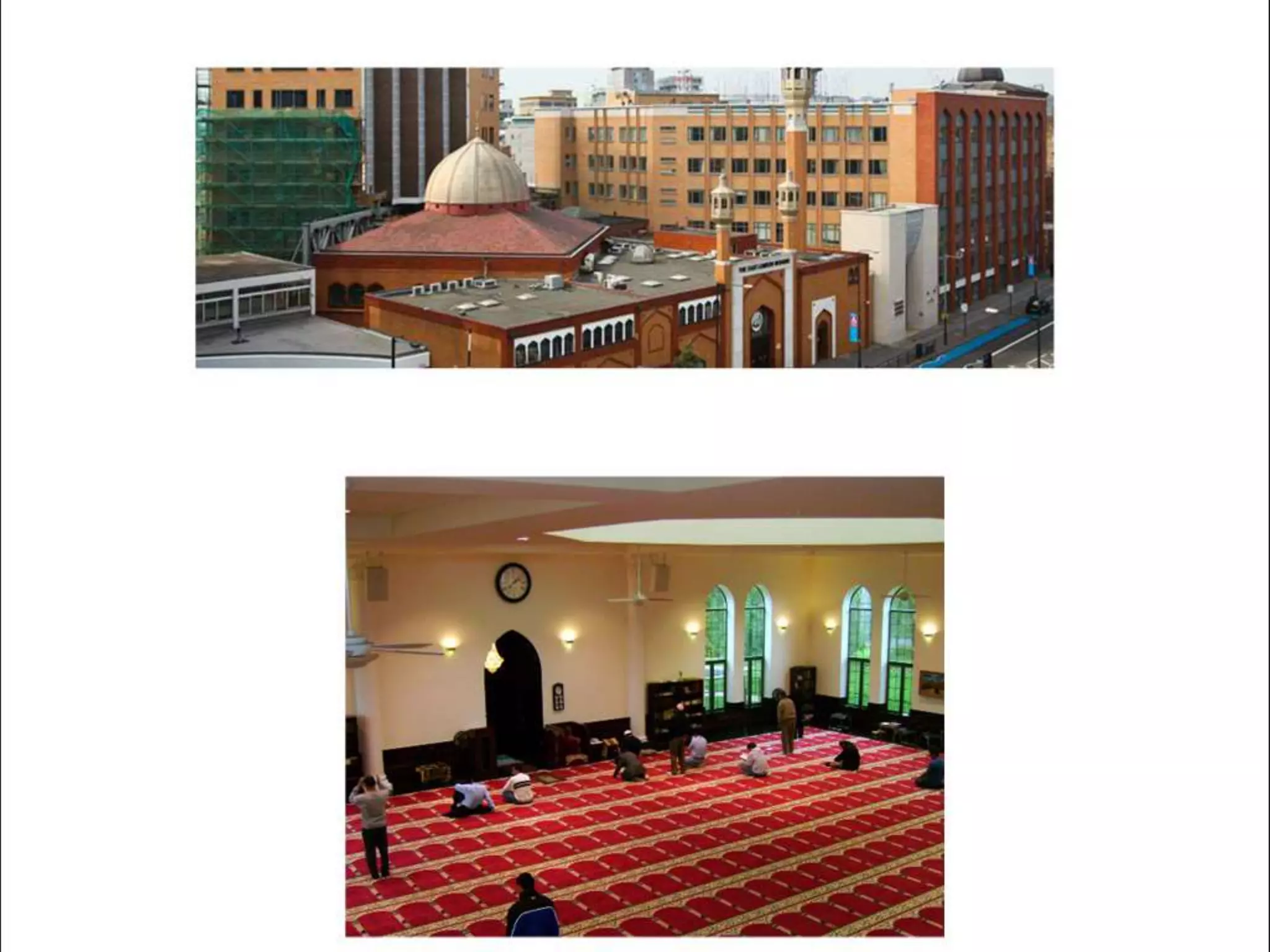
    Mosques A mosque (masjidin Arabic) is a place for worship in Islam.Although prayers can be done privately, either indoors or outdoors, nearly every community of Muslims dedicates a space or building for congregational prayer.
  • 18.
    Common Components ofMosques  Prayer Hall- the central area for prayer  Prayer Rugs- during Islamic prayers, worshippers bow, kneel and prostrate on these  Mihrab- the mihrab is an ornamental indentation on the wall of a mosque, from which sermons or speeches are given  Dome- many mosques are decorated withal domed rooftop, particularly in the Middle East.This architectural element holds no spiritual or symbolic significance and is purely aesthetic.The interior of a dome is usually highly decorated with floral, geometric and other patterns  Shoe shelf- Muslims remove their shoes before entering a mosque to preserve the cleanliness of the prayer space
  • 19.
    Muslim Prayers  Beforeeach prayer a Muslim is required to carry out a ritual wash.  The routine consists of everyone sitting on the floor.The direction which they should face during prayers is indicated on one of the walls called a mihrab so they are facing Mecca  Muslims are required to pray up to 5 times a day, which are spaced throughout the say. Each prayer is a constant reminder of God and the given opportunities that they are given to seek his guidance and forgiveness.They are: 1. Pre-dawn-Fajr 2. Noon-Dhuru 3. Late afternoon-’Asr 4. Sunset-Maghrib 5. Evening-’Isha http://www.bbc.co.uk/education/clips/zypvcdm
  • 21.
    Mecca  Mecca translatedinto Makah is a city in Saudi Arabia which is considered to be the Holy City of Islam  Mecca is the home to the Kaaba- a cuboid building lying at the heart of the holy Mosque.The Kaaba is the holiest building in Islam and is a large stone structure which holds one single room with marble flooring  Mecca is massively important this week as it is currently the week of the annual Hajj pilgrimage. Hundreds and thousands of people gather in Mecca to participate in one of the five pillars of Islam  Muslims take part in a pilgrimage to get to Mecca, which they are required to do at least once in their lifetime. Once in Mecca, the Muslims perform one of two rituals- the lesser pilgrimage of Urmar, and the main pilgrimage of Hajj  After the pilgrimage of the Hajj, the celebration of Eid takes place
  • 23.
    Ihram  Special stateof ritual purity  To perform Ihram Muslims must wear special white clothing and must not do any of the following: -engage in marital relations -shave or cut their nails -use cologne or scented oils -kill or hunt anything -fight or argue -women must not cover their faces, even if they would do so in their home country -men may not wear clothes with stitching -bathing is allowed but scented soaps are frowned upon http://www.bbc.co.uk/religion/religions/islam/practices/hajj_1.shtml