Muslim Festivals
There are two great festivals in
Islam.
• Eid-ul-Fitr (which falls on the first
day of Shawwal, the tenth month
of the Islamic year).
• Eid-ul-Adha (which falls on the
tenth day of Thul-Hijjah).
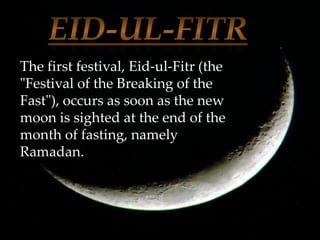
The first festival, Eid-ul-Fitr (the
"Festival of the Breaking of the
Fast"), occurs as soon as the new
moon is sighted at the end of the
month of fasting, namely
Ramadan.
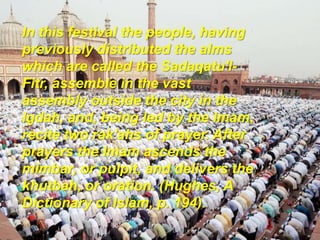
In this festival the people, having
previously distributed the alms
which are called the Sadaqatu'l-
Fitr, assemble in the vast
assembly outside the city in the
Igdah, and, being led by the Imam,
recite two rak'ahs of prayer. After
prayers the Imam ascends the
mimbar, or pulpit, and delivers the
khutbah, or oration. (Hughes, A
Dictionary of Islam, p. 194).
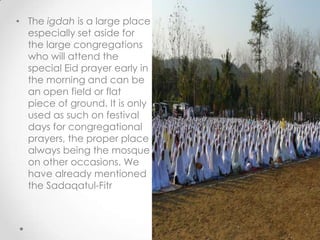
• The igdah is a large place
especially set aside for
the large congregations
who will attend the
special Eid prayer early in
the morning and can be
an open field or flat
piece of ground. It is only
used as such on festival
days for congregational
prayers, the proper place
always being the mosque
on other occasions. We
have already mentioned
the Sadaqatul-Fitr
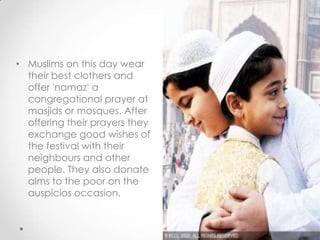
• Muslims on this day wear
their best clothers and
offer 'namaz' a
congregational prayer at
masjids or mosques. After
offering their prayers they
exchange good wishes of
the festival with their
neighbours and other
people. They also donate
alms to the poor on the
auspicios occasion.
Eid-ul-Adha
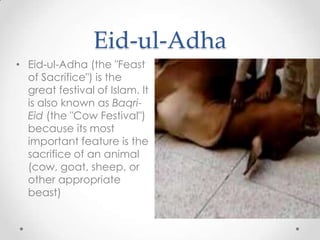
• Eid-ul-Adha (the "Feast
of Sacrifice") is the
great festival of Islam. It
is also known as Baqri-
Eid (the "Cow Festival")
because its most
important feature is the
sacrifice of an animal
(cow, goat, sheep, or
other appropriate
beast)
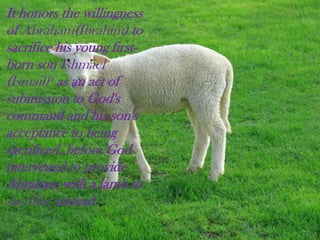
It honors the willingness
of Abraham(Ibrahim) to
sacrifice his young first-
born son Ishmael
(Ismail)a as an act of
submission to God's
command and his son's
acceptance to being
sacrificed, before God
intervened to provide
Abraham with a lamb to
sacrifice instead
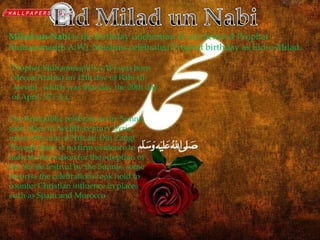
Eid Milad-un-NabiMilad-un-Nabi is the birthday celebration of our beloved Prophet
Muhammad(S.A.W). Muslims celebrated Prophet birthday as Eid-e-Milad.
Prophet Muhammad (S.A.W) was born
Mecca(Arabia) on 12th day of Rabi-ul-
Awwal , which was Monday the 20th day
of April, 571 A.C.
The first public celebrations by Sunnis
took place in twelfth-century Syria,
under the rule of Nur ad-Din Zangi
Though there is no firm evidence to
indicate the reason for the adoption of
the Shi’ite festival by the Sunnis, some
theorise the celebrations took hold to
counter Christian influence in places
such as Spain and Morocco.
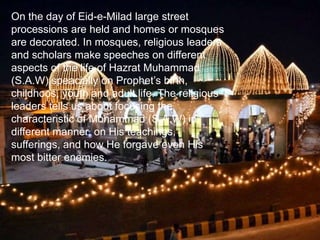
On the day of Eid-e-Milad large street
processions are held and homes or mosques
are decorated. In mosques, religious leaders
and scholars make speeches on different
aspects of the life of Hazrat Muhammad
(S.A.W) speacially on Prophet’s birth,
childhoos, youth and adult life. The religious
leaders tells us about focusing the
characteristic of Mohammad (S.A.W) in
different manner, on His teachings,
sufferings, and how He forgave even His
most bitter enemies.
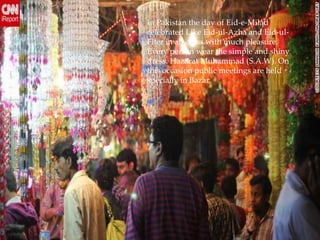
In Pakistan the day of Eid-e-Milad
celebrated Like Eid-ul-Azha and Eid-ul-
Fiter in all cities with much pleasure.
Every person wear the simple and shiny
dress. Hazarat Muhammad (S.A.W). On
this occasion public meetings are held
specially in Bazar.
Thank You
Presentation by
Ebad ur Rehman

Muslim festivels

  • 2.
    Muslim Festivals There aretwo great festivals in Islam. • Eid-ul-Fitr (which falls on the first day of Shawwal, the tenth month of the Islamic year). • Eid-ul-Adha (which falls on the tenth day of Thul-Hijjah).
  • 3.
    The first festival,Eid-ul-Fitr (the "Festival of the Breaking of the Fast"), occurs as soon as the new moon is sighted at the end of the month of fasting, namely Ramadan.
  • 4.
    In this festivalthe people, having previously distributed the alms which are called the Sadaqatu'l- Fitr, assemble in the vast assembly outside the city in the Igdah, and, being led by the Imam, recite two rak'ahs of prayer. After prayers the Imam ascends the mimbar, or pulpit, and delivers the khutbah, or oration. (Hughes, A Dictionary of Islam, p. 194).
  • 5.
    • The igdahis a large place especially set aside for the large congregations who will attend the special Eid prayer early in the morning and can be an open field or flat piece of ground. It is only used as such on festival days for congregational prayers, the proper place always being the mosque on other occasions. We have already mentioned the Sadaqatul-Fitr
  • 6.
    • Muslims onthis day wear their best clothers and offer 'namaz' a congregational prayer at masjids or mosques. After offering their prayers they exchange good wishes of the festival with their neighbours and other people. They also donate alms to the poor on the auspicios occasion.
  • 8.
    Eid-ul-Adha • Eid-ul-Adha (the"Feast of Sacrifice") is the great festival of Islam. It is also known as Baqri- Eid (the "Cow Festival") because its most important feature is the sacrifice of an animal (cow, goat, sheep, or other appropriate beast)
  • 9.
    It honors thewillingness of Abraham(Ibrahim) to sacrifice his young first- born son Ishmael (Ismail)a as an act of submission to God's command and his son's acceptance to being sacrificed, before God intervened to provide Abraham with a lamb to sacrifice instead
  • 10.
    Eid Milad-un-NabiMilad-un-Nabi isthe birthday celebration of our beloved Prophet Muhammad(S.A.W). Muslims celebrated Prophet birthday as Eid-e-Milad. Prophet Muhammad (S.A.W) was born Mecca(Arabia) on 12th day of Rabi-ul- Awwal , which was Monday the 20th day of April, 571 A.C. The first public celebrations by Sunnis took place in twelfth-century Syria, under the rule of Nur ad-Din Zangi Though there is no firm evidence to indicate the reason for the adoption of the Shi’ite festival by the Sunnis, some theorise the celebrations took hold to counter Christian influence in places such as Spain and Morocco.
  • 11.
    On the dayof Eid-e-Milad large street processions are held and homes or mosques are decorated. In mosques, religious leaders and scholars make speeches on different aspects of the life of Hazrat Muhammad (S.A.W) speacially on Prophet’s birth, childhoos, youth and adult life. The religious leaders tells us about focusing the characteristic of Mohammad (S.A.W) in different manner, on His teachings, sufferings, and how He forgave even His most bitter enemies.
  • 12.
    In Pakistan theday of Eid-e-Milad celebrated Like Eid-ul-Azha and Eid-ul- Fiter in all cities with much pleasure. Every person wear the simple and shiny dress. Hazarat Muhammad (S.A.W). On this occasion public meetings are held specially in Bazar.
  • 13.