METHMETH
Donald W. Reid 2011
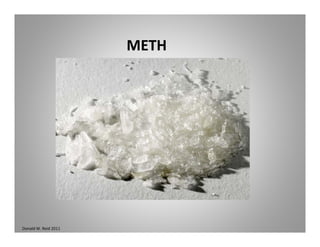
Methamphetamine (meth, ice, crystal, crank, stove‐top) is a synthetic analogue ofMethamphetamine (meth, ice, crystal, crank, stove top) is a synthetic analogue of 
adrenaline. Adrenalin is a naturally produced hormone the body produces in small 
amounts when reacting to an immediate stress. The hormone and the drug that 
mimics it increases energy and alertness when we need a short burst to escape 
i di d Th diff b h i h h ll dimmediate danger. The difference between the two is that the naturally secreted 
adrenalin quickly clears our systems and we recover. Meth can last 6 to 8 hours or 
longer.
Treatment for meth addiction is wide ranging and includes immediate detox and g g
subsequent care. Meth rehab may include a combination of individual counseling and 
group meetings, all aimed at teaching useful life and coping skills.
It may be surprising to some that methamphetamine was once a legitimate drug InIt may be surprising to some that methamphetamine was once a legitimate drug. In 
fact, it is still prescribed and sold in the U.S. (under the trade name Desoxyn) for 
weight loss and attention deficit disorder. This is an oral form of the drug. The 
injectable or smoked form is much more powerful and is illegal. Inhaling or injecting 
meth gives the addict an almost instant high. The drug speeds quickly into the 
bloodstream and the brain. While methamphetamine is addictive in any form, it is the 
immediate rush and sustained high of the inhaled drug that makes it so addictive.
Donald W. Reid 2011
History
Although first synthesized in Japan in 1893 in Japan, it was first introduced for 
sale in the US in 1944. The drug found use in situations where people needed 
to stay awake for extended periods and became popular with truck drivers 
and shift workers. It also found use as an anorexic and used to aid weight loss. 
Soon however the addictive properties and the ‘crash’ associated with methSoon however, the addictive properties and the  crash  associated with meth 
use led to its being banned. Now, the only source is illegal manufacture, 
usually in home or makeshift laboratories. In 2005, as part of the Patriot Act, 
some of the chemicals used to make meth have been restricted in an attempt 
l ll l dto lessen illegal production.
Methamphetamine comes in two forms, a left and a right handed type. Only 
the right handed form (dextro) has the powerful addictive properties. In fact, 
the left handed form (levo) is still sold in over the counter inhaler products to ( ) p
stop runny nose. The "left" and "right" monikers refer to the molecular 
structure of the chemical.
Donald W. Reid 2011
Addiction
Methamphetamine, when inhaled, gives the user an extreme, overwhelming 
sense of euphoria, power, and seemingly boundless energy. Ideas come in a 
flash, conversation quickens, and sexual arousal is heightened; lights and colors 
seem brighter, the heart beat speeds up and the person becomes restless with 
nervous intensity. It is sometimes used to instill confidence in social situations 
and an oral tablet, Yaba (a mix of caffeine and meth) has become popular at 
clubs and ravesclubs and raves.
This wonderful feeling quickly fades and the user crashes. The crash comes 
from the user’s body paying the price for the super‐charged meth state. 
Fatigue and depression are the common elements. Users may sleep for 
extended periods unless they have become dependent on the drug, in which 
case they will awaken and begin a cycle of craving and drug seeking behavior.
Extended periods of use, called ‘tweaking’, will force an addict to keep using 
more and more of the drug. They will stay awake and tweaked for days or evenmore and more of the drug. They will stay awake and tweaked for days or even 
a week at a time. An episode may only end when they are arrested or 
hospitalized for psychotic, violent behavior or when their body simply cannot 
function any longer.
Donald W. Reid 2011
Addiction effects
Beyond the social damage meth addiction causes thereBeyond the social damage meth addiction causes, there 
are well known physiological effects that may take a year 
or more to heal. This includes changes in the dopamine 
pathways in the brain that alter how an addict is able to 
feel pleasure. Without the drug to stimulate these 
damaged areas of the brain, addicts will be unable to feel 
normal pleasures and subsequently fall into depression.
Donald W. Reid 2011
DeathDeath
from methamphetamine abuse can come in a 
variety of forms – severe anorexia, 
hyperthermia, convulsions, or cardiac collapse. 
Unfortunately, it is the loved ones of the addict 
who usually suffer first. Meth addiction is a 
noted cause of family violence because thenoted cause of family violence because the 
aggression and irritability felt by addicts is 
usually directed at a spouse or children.
Donald W. Reid 2011
Meth mouth
an accelerated tooth decay and tooth loss is 
associated with chronic meth use. The drug 
itself doesn’t directly cause the problem,itself doesn t directly cause the problem, 
rather, the dry mouth and teeth grinding from 
meth use, along with poor oral hygiene, lead 
to the condition.
Donald W. Reid 2011
Meth Sores
One of the most striking effects of meth is the 
h i th h i l f thchange in the physical appearance of meth 
users. Because meth causes the blood vessels 
to constrict, it cuts off the steady flow of blood 
to all parts of the body. Heavy usage can 
weaken and destroy these vessels, causing 
tissues to become prone to damage and 
inhibiting the body's ability to repair itself. 
Acne appears sores take longer to heal andAcne appears, sores take longer to heal, and 
the skin loses its luster and elasticity. Some 
users are covered in small sores, the result of 
obsessive skin‐picking brought on by the 
hallucination of having bugs crawling beneath 
the skin, a disorder known as formication.
Donald W. Reid 2011
Meth babies
Because methamphetamine is passed to unborn children 
through the placenta, some babies are born already exposed to 
the drug and have to undergo withdrawal. Meth is also 
excreted in breast milkexcreted in breast milk.
Intravenous use is associated with all the risks that come from 
IV drug abuse. Risks for HIV, Hepatitis and infections are 
elevated, especially because, when tweaking, an injectable user 
doesn’t care about sanitary practices. Because meth is used to 
enhance sex with the same lack of care or concern, there is 
increased risk of sexually transmitted diseases in addict 
populations. Some addicts will even use sex as a way to financepopulations. Some addicts will even use sex as a way to finance 
their addiction.
Donald W. Reid 2011
DEA Drug Seizures
Calendar Year Cocaine kgs Heroin kgs Marijuana kgs Methamphetamine kgs
Hallucinogens dosage 
units
2009 49 339 642 666 120 1 703 2 954 2512009 49,339 642 666,120 1,703 2,954,251
2008 49,823.3  598.6 660,969.2 1,540.4  9,199,693 
2007 96,713 625 356,472 1,086 5,636,305
2006 69,826 805 322,438 1,711 4,606,277
2005 118,311 640 283,344 2,161 8,881,321, , , , ,
2004 117,854 672 265,813 1,659 2,261,706
2003 73,725 795 254,196 1,678 2,878,594
2002 63,640 710 238,024 1,353 11,661,157
2001 59,430 753 271,849 1,634 13,755,390
2000 58,674 546 331,964 1,771 29,307,427
1999 36,165 351 338,247 1,489 1,736,077
1998 34,447 370 262,180 1,203 1,075,457
1997 28,670 399 215,348 1147 1,100,912
1996 44 735 320 192 059 751 1 719 2091996 44,735 320 192,059 751 1,719,209
1995 45,326 876 219,830 876 2,768,165
1994 75,051 491 157,181 768 1,366,817
1993 55,529 616 143,055 560 2,710,063
1992 69,324 722 201,483 352 1,305,177
1991 67,016 1,174 98,592 289 1,297,394
1990 57,031 535 127,792 272 2,826,966
1989 73,587 758 286,371 896 13,125,010
1988 60,951 728 347,306 694 16,706,442
1987 49 666 512 629 839 198 6 556 8911987 49,666 512 629,839 198 6,556,891
1986 29,389 421 491,831 234.5 4,146,329
Source: DEA (STRIDE)
CY 2000 had several large LSD Seizures
Donald W. Reid 2011
Faces of Meth
Donald W. Reid 2011
Donald W. Reid 2011
Donald W. Reid 2011
Donald W. Reid 2011
Donald W. Reid 2011
Donald W. Reid 2011
Donald W. Reid 2011
Donald W. Reid 2011
Donald W. Reid 2011
Donald W. Reid 2011
Donald W. Reid 2011
Donald W. Reid 2011
Donald W. Reid 2011
Donald W. Reid 2011
Donald W. Reid 2011
Donald W. Reid 2011
Donald W. Reid 2011
Donald W. Reid 2011
Donald W. Reid 2011
Donald W. Reid 2011
Donald W. Reid 2011
Donald W. Reid 2011
POLICE: Ind. mother used meth; left children with 
dead bodydead body
TERRE HAUTE, Ind. (AP) ‐‐ A western Indiana woman was arrested 
after police say they believe she left her children at home with 
the dead body of a man with whom she had used 
methamphetamine.
The Vigo County prosecutor's office said Friday that 41‐year‐oldThe Vigo County prosecutor s office said Friday that 41 year old 
Telissa True of Terre Haute was being held on probable cause for 
child neglect and providing false information.
Authorities told the Tribune‐Star that True called police Tuesday 
h ld ' k h f ki h hildto report she couldn't wake up the man after taking her children 
to school. Police later found that neighbors had gone with the 
children.
True then told police that she and the man used meth the night p g
of his death and she left her children to go to a store.
True didn't have an attorney Friday. Her two children were in their 
grandparents' custody.
Donald W. Reid 2011
Meth Charges Filed, Cause of Death in 5‐
M th Old Still U kMonth‐Old Still Unknown
COLUMBIA CITY, Ind. (Indiana’s NewsCenter) ‐
Indiana's NewsCenter has learned 
methamphetamine charges have been filed 
against a Columbia City man and his girlfriendagainst a Columbia City man and his girlfriend 
whose 5‐month‐old baby died mysteriously 
Monday.
Felony counts of manufacturing 
th h t i d i t i imethamphetamine and maintaining a common 
nuisance have been filed against Janel Creech 
and Travis Wonderly. They have not been 
charged in connection with the baby's death.g y
Donald W. Reid 2011
Woman dies in meth lab blast
Explosion 1st recorded in Whitley
Chris Meyers | The Journal Gazette
COLUMBIA CITY – A Whitley County woman died early Friday 
when a methamphetmine lab exploded in her home, police said.
Alecia L. Stine, 24, was killed about 1 a.m. at her home in Miami 
Village Mobile Home Park east of Columbia CityVillage Mobile Home Park, east of Columbia City. 
She was killed when glass from a bottle that was near the lab, or 
involved with it, struck her in the throat, neck and arm, according 
to police.
When sheriff’s Deputy Jason Spencer arrived, he found Stine dead 
on the floor of the master bedroom of the home and a strong 
chemical odor usually related to meth production, the sheriff’s 
department said.department said. 
Spencer was treated at Parkview Whitley Hospital for respiratory 
irritation, police said.
Police said they’re surprised there aren’t more deaths from meth 
l b l i i th b f th l t d tlab explosions given the number of meth‐related arrests.
Donald W. Reid 2011
Chemicals in Meth Manufacture
Properties of Chemicals Used
Most of the chemicals associated with producing meth can be grouped into the following 
distinct categories with similar toxic and physical properties:
1. solvents
2. metals and salts
3. strong acids or bases
Regardless of the production method (there are several methods used to produce meth), 
chemicals in each of these groups are used. The routes of exposure and possible health 
effects of these chemicals and those that have unique hazards are summarized in Tables1‐q
3 below.
Those chemicals classified as solvents or corrosives (strong acids or bases) may exist as 
gases or liquids and thereby produce the greatest risk for inhalation (breathing)gases or liquids and thereby produce the greatest risk for inhalation (breathing) 
exposure. In contrast, chemicals that are solid or relatively non‐volatile (don’t easily 
become gasses) present little inhalation risk unless environmental factors, such as air 
movement, fire, explosion, etc., cause the chemical to be present in the air as dust or 
vapors. Solid substances in the form of fine powders are easily inhaled.
Donald W. Reid 2011
Donald W. Reid 2011
Donald W. Reid 2011
TABLE 1
CHEMICAL TOXICITY AND ROUTES 
OF EXPOSURE
(Skin and Respiratory)
CORROSIVES AND IRRITANTS
Substance Form Exposure
Acetic Acid Liquid Skin, Eyes, Inhalation
Acetic Anhydride Liquid Skin, Eyes, Inhalation
Ammonia Gas, Liquid Skin, Eyes, Inhalation
Benzyl Chloride Liquid Skin, Eyes, Inhalation
Hydroiodic Acid Liquid Skin, Eyes, Inhalation
M th l i G Li id S lid Ski E I h l tiMethylamine Gas, Liquid, Solid Skin, Eyes, Inhalation
Perchloric Acid Liquid Skin, Eyes, Inhalation
Phosphine Gas Eyes, Inhalation
Sodium Metal Solid Skin EyesSodium Metal Solid Skin, Eyes
Sodium Hydroxide Liquid, Solid Skin, Eyes
Donald W. Reid 2011
Health Effect
Vapors of volatile corrosives may cause eye 
irritation, lacrimation (shedding tears), 
redness/inflammation, and corneal 
injury Inhalation may cause mucousinjury. Inhalation may cause mucous 
membranes irritation in the nose and throat, 
and lung irritation resulting in cough, chest 
pain, and shortness of breath. Accumulation 
of fluids and bleeding in the lungs may occur in 
severe cases. High concentrations of vapor 
may cause skin irritation. Additional symptoms 
of vapor inhalation may include headacheof vapor inhalation may include headache, 
nausea, dizziness, and anxiety. Direct contact 
with corrosives may result in severe eye or skin 
burns.
Donald W. Reid 2011
TABLE 2
CHEMICAL TOXICITY AND ROUTES 
OF EXPOSURE
(Skin and Respiratory)(Skin and Respiratory)
SOLVENTS
Substance Form Exposure
Acetone Liquid Skin Eyes InhalationAcetone Liquid Skin, Eyes, Inhalation
Benzene Liquid Skin, Eyes, Inhalation
Benzyl Chloride Liquid Skin, Eyes, Inhalation
Chloroform Liquid Skin, Eyes, InhalationChloroform Liquid Skin, Eyes, Inhalation
Ethanol Liquid Skin, Eyes, Inhalation
Ethyl Ether Liquid Skin, Eyes, Inhalation
Freon Liquid Skin, Eyes, Inhalationq , y ,
Hexane Liquid Skin, Eyes, Inhalation
Isopropanol Liquid Skin, Eyes, Inhalation
Methanol Liquid Skin, Eyes, Inhalation
Petroleum Ether Liquid Skin, Eyes, Inhalation
Pyridine Liquid Skin, Eyes, Inhalation
Donald W. Reid 2011
Health Effects
Inhaling vapors at low concentrations may 
result in mild eye, nose, and throat 
irritation. Symptoms of intoxication 
(drowsiness and lack of coordination) or loss of(drowsiness and lack of coordination) or loss of 
consciousness may occur at high 
concentrations. Liver and kidney impairment 
may also occur at high doses. 
Freon is generally not poisonous, but if spilled 
onto the skin it may result in freezing injury to 
the skin.
Donald W. Reid 2011
TABLE 3
CHEMICAL TOXICITY AND ROUTES OFCHEMICAL TOXICITY AND ROUTES OF 
EXPOSURE
(Skin and Respiratory)
METAL/SALTS
Substance Form Exposure
Aluminum Solid Skin, Eyes
Iodine Solid Skin, Eyes
Lead Acetate Solid Skin, Eyes
Lithium Aluminum  Solid Skin, Eyes
Hydride
Magnesium Solid Skin, Eyes
Mercuric Chloride Solid Skin, Eyes
ll d l d kPalladium Solid Skin, Eyes
Potassium Metal Solid in Kerosene Skin, Eyes
Red Phosphorous Solid Skin, Eyes
S di A t t S lid Ski ESodium Acetate Solid Skin, Eyes
Sodium Hydroxide Solid Skin, Eyes
Sodium Metal Solid in Kerosene Skin, Eyes
Donald W. Reid 2011
Health Effects
Most metals and salts are stable solids with 
minimal potential for exposure unless ingested 
or unless the material is present in the air as 
dust vapor (at normal temperatures) ordust, vapor (at normal temperatures), or 
fumes (if heated). Sodium and potassium 
metal and sodium hydroxide are extremely 
corrosive in the presence of moisture. Lithium 
aluminum hydride is extremely reactive (fire 
and explosion hazard).
Donald W. Reid 2011
Impacts of These Chemicals on Human Health 
Several chemicals involved in methamphetamine production present a danger of injurySeveral chemicals involved in methamphetamine production present a danger of injury 
from fire or explosion. In addition, at a lab site there are possible risks of exposure to 
infectious disease in the event of skin puncture by drug paraphernalia (needles). There 
is a risk of injury or toxicity from chemical exposure depending on the toxic properties 
f th h i l t d th i tit f t ti d th d ti dof the chemicals present and their quantity, form, concentration, and the duration and 
route of exposure. The body may absorb chemicals or local injury may occur by one or 
more of the following routes of exposure:
1. Inhalation (breathing)
2. Skin exposure (direct skin contact)
3. Ingestion (swallowed)
4 Injection (introduced via skin puncture with a needle broken glass etc )4. Injection (introduced via skin puncture with a needle, broken glass, etc.)
Donald W. Reid 2011
Inhalation and/or skin exposure are the most likely routes of exposure for 
people exposed to labs. Ingestion is possible if people eat, drink, or smoke in 
contaminated areas, or fail to wash contamination from skin and clothing. The 
drug user‐chemist has the additional potential of toxicity from all routes of 
exposure; i.e., ingestion and injection of drugs, spilling chemicals onto the 
skin, and inhaling vapors. Others, including children, who enter or live in labs 
may accidentally ingest chemicals, in addition to risking potential skin ormay accidentally ingest chemicals, in addition to risking potential skin or 
inhalation exposure.
Inhalation or skin exposure may result in local injury from corrosive 
substances, and may include symptoms such as shortness of breath, cough, 
h t i ki b M l t ll b b d f th lchest pain, or skin burns. Many solvents are well absorbed from the lungs 
into the body and, if the dose is sufficient, may result in symptoms of 
intoxication ‐ dizziness, lack of coordination, nausea, etc. The skin, to a lesser 
extent, absorbs some solvents if chemicals have direct contact. Ingesting g g
chemicals runs the greatest risk of toxicity, however, except in the event of a 
suicide attempt or a child accidentally ingesting these chemicals, toxicity by 
ingestion is the least likely route of exposure.
Donald W. Reid 2011
List of treatment facilities in Indiana
http://www.alltreatment.com/in/meth‐addiction/all‐facilities‐list
Donald W. Reid 2011
Resources
Indiana News Center
DEA
APAP
Oregon Public Health Agency
Multnomah County Sheriff, Ore.
http://www.myaddiction.com/methamphetamine.html
I di ’ N CIndiana’s News Center
The Journal Gazette
Donald W. Reid 2011

Meth