Topic : Ram & Rom
Lecturer : Dr. Syed Sherjeel Gillani
Presented By:
• Mr. Qasim Ali 22772
• Mr. Zamama Zaman 22699
Topic :
• Main memory.
• Structure of main memory.
• Types of main memory.
• What is Ram & Rom.
• Types of ram & rom.
• Digital logical circuit of ram & rom.
Main Memory :
• Directly attached on CPU and install on mother board .
• Used to store data program and data that are being used.
• Known as working area of computer system.
• Computer cannot work with out main memory.
•
Structure Of Main Memory
• Main memory is built in a form of chip.
• Chip is made of a semi conductor material.
• The chip consist of thousand of million of cells.
• Each cell can store one bit i.e. 0 and 1.
• The cell in the main memory are logically organized as groups of 8 bits.
• Each byte is assigned a unique number.
• This number is known as the address of the byte.
• Main Memory has two types RAM & ROM.
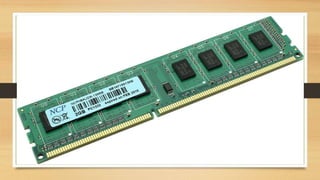
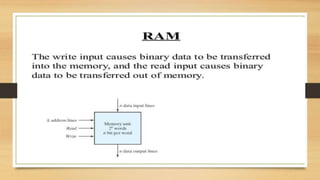
RAM(random access memory)
• Also called direct memory.
• RAM is used to store data and instructions temporarily.
• RAM is volatile memory.
• RAM is read write/memory.
• CPU can read data from RAM and write data to RAM.
• It is used to store data and instruction.
• RAM is also called main memory or primary storage.
Types of RAM:
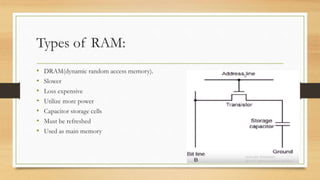
• DRAM(dynamic random access memory).
• Slower
• Loss expensive
• Utilize more power
• Capacitor storage cells
• Must be refreshed
• Used as main memory
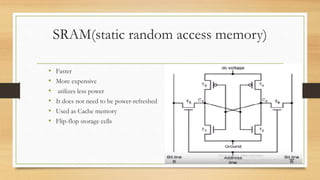
SRAM(static random access memory)
• Faster
• More expensive
• utilizes less power
• It does not need to be power-refreshed
• Used as Cache memory
• Flip-flop storage cells
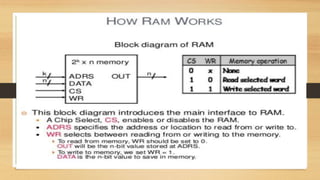
How RAM work
Rom(Read only memory)
• Rom is permanent memory.
• The instructions written in ROM cannot be changed or deleted.
• It is not possible to write new information or instructions in ROM.
• ROM is non-volatile memory.
• The instructions are written into ROM at manufacturing time.
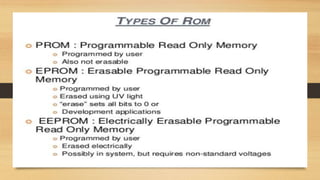
Type of ROM:
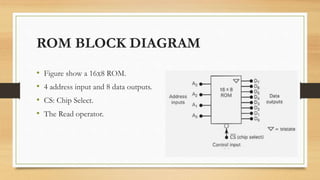
ROM BLOCK DIAGRAM
• Figure show a 16x8 ROM.
• 4 address input and 8 data outputs.
• CS: Chip Select.
• The Read operator.
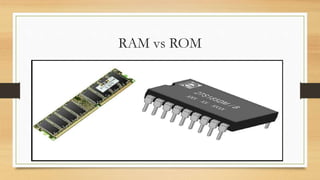
RAM vs ROM
Ram and Rom

Ram and Rom

  • 2.
    Topic : Ram& Rom Lecturer : Dr. Syed Sherjeel Gillani
  • 3.
    Presented By: • Mr.Qasim Ali 22772 • Mr. Zamama Zaman 22699
  • 4.
    Topic : • Mainmemory. • Structure of main memory. • Types of main memory. • What is Ram & Rom. • Types of ram & rom. • Digital logical circuit of ram & rom.
  • 5.
    Main Memory : •Directly attached on CPU and install on mother board . • Used to store data program and data that are being used. • Known as working area of computer system. • Computer cannot work with out main memory. •
  • 6.
    Structure Of MainMemory • Main memory is built in a form of chip. • Chip is made of a semi conductor material. • The chip consist of thousand of million of cells. • Each cell can store one bit i.e. 0 and 1. • The cell in the main memory are logically organized as groups of 8 bits. • Each byte is assigned a unique number. • This number is known as the address of the byte. • Main Memory has two types RAM & ROM.
  • 7.
    RAM(random access memory) •Also called direct memory. • RAM is used to store data and instructions temporarily. • RAM is volatile memory. • RAM is read write/memory. • CPU can read data from RAM and write data to RAM. • It is used to store data and instruction. • RAM is also called main memory or primary storage.
  • 9.
    Types of RAM: •DRAM(dynamic random access memory). • Slower • Loss expensive • Utilize more power • Capacitor storage cells • Must be refreshed • Used as main memory
  • 10.
    SRAM(static random accessmemory) • Faster • More expensive • utilizes less power • It does not need to be power-refreshed • Used as Cache memory • Flip-flop storage cells
  • 11.
  • 13.
    Rom(Read only memory) •Rom is permanent memory. • The instructions written in ROM cannot be changed or deleted. • It is not possible to write new information or instructions in ROM. • ROM is non-volatile memory. • The instructions are written into ROM at manufacturing time.
  • 14.
  • 15.
    ROM BLOCK DIAGRAM •Figure show a 16x8 ROM. • 4 address input and 8 data outputs. • CS: Chip Select. • The Read operator.
  • 18.