

















Rain Gardens  for Healthy Streams and Clean Water Robert Emanuel OSUES Tillamook & Clatsop counties  Oregon Sea Grant Extension Derek Godwin OSUES Marion County Oregon Sea Grant Extension
Workshop Goals What is a rain garden & how does it work? Why build a rain garden?  Assess your site for a rain garden Steps to design and install a rain garden More resources
what is a  rain garden  and why build one?
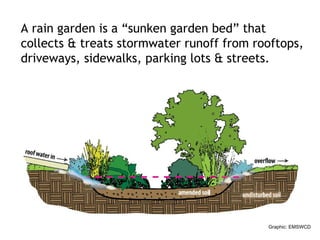
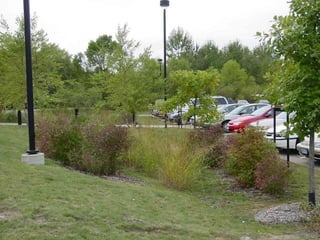
A rain garden is a “sunken garden bed” that collects & treats stormwater runoff from rooftops, driveways, sidewalks, parking lots & streets.  Graphic: EMSWCD
© Good Nature Publishing
How a Rain Garden Works Graphic: EMSWCD
 
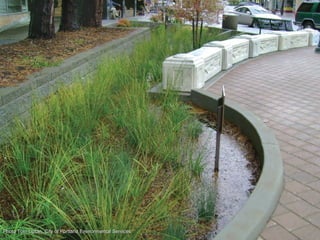
Photo Tom Liptan, City of Portland Environmental Services
 
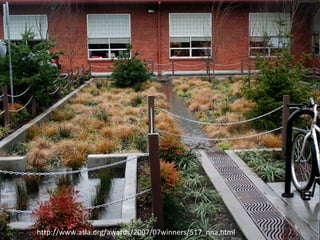
http://www.asla.org/awards/2007/07winners/517_nna.html
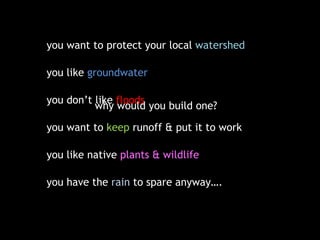
you want to protect your local  watershed you like  groundwater you don’t like  floods you want to  keep  runoff & put it to work you like native  plants & wildlife you have the  rain  to spare anyway…. why would you build one?
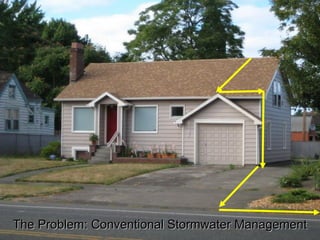
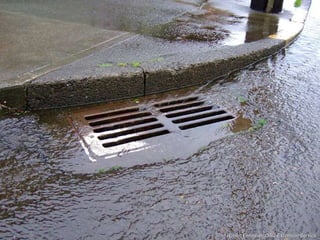
The Problem: Conventional Stormwater Management
Robert Emanuel, OSU Extension Service
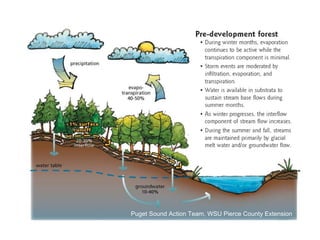
Puget Sound Action Team, WSU Pierce County Extension
 
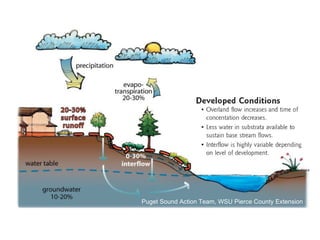
Puget Sound Action Team, WSU Pierce County Extension
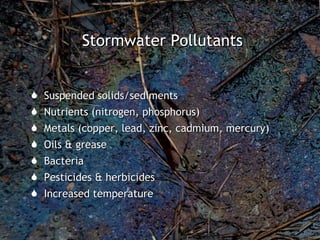
Stormwater Pollutants Suspended solids/sediments Nutrients (nitrogen, phosphorus) Metals (copper, lead, zinc, cadmium, mercury) Oils & grease Bacteria Pesticides & herbicides Increased temperature
Flooding and Urban Development More Runoff Arriving Faster
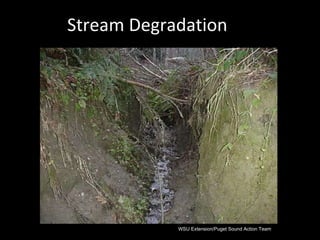
Stream Degradation WSU Extension/Puget Sound Action Team
 
 
what are the  steps  to building a rain garden?
Steps to Assessing a Site Calculate how much water to treat Decide where to put a garden Calculate slope Test soil
 
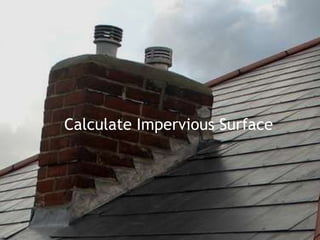
Calculate Impervious Surface
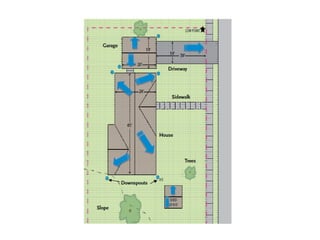
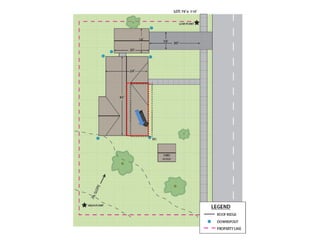
Calculate ft 2  of impervious area(s) Calculate total rain garden area needed Determine dimensions of each garden Sizing a Rain Garden
 
 
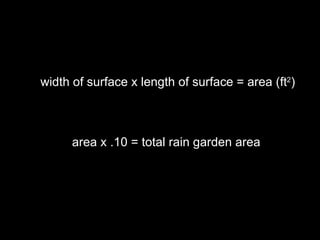
width of surface x length of surface = area (ft 2 ) area x .10 = total rain garden area
Rules of thumb Willamette Valley = 10% of impervious surface Southwest Oregon = 10% of impervious surface Coast = 15-20% of impervious surface Central Oregon = 15-20 % of impervious surface (shallow)
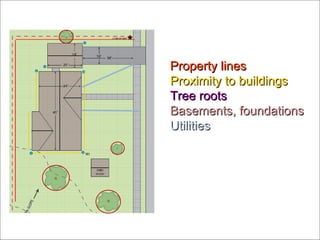
Property lines Proximity to buildings Tree roots Basements, foundations Utilities
slope and soil
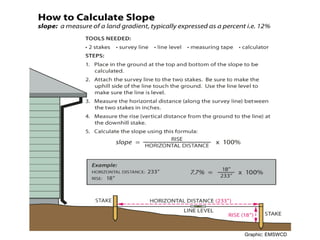
Graphic: EMSWCD
Rule of Thumb: conventional rain gardens are located on slopes <10% and >50 ft. from steep slopes; Seek professional help if needed!
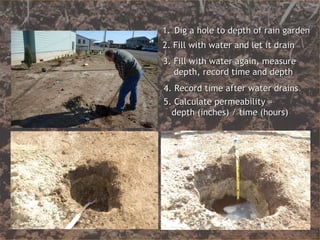
Dig a hole to depth of rain garden 2. Fill with water and let it drain 3. Fill with water again, measure depth, record time and depth 4. Record time after water drains 5. Calculate permeability = depth (inches) / time (hours)
 
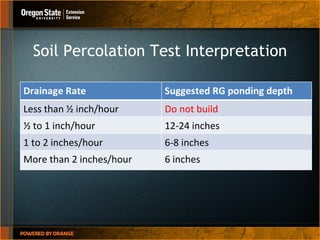
Soil Percolation Test Interpretation Drainage Rate Suggested RG ponding depth Less than ½ inch/hour Do not build ½ to 1 inch/hour 12-24 inches 1 to 2 inches/hour 6-8 inches More than 2 inches/hour 6 inches
Steps to Assessing a Site Calculate how much water to treat Decide where to put a garden Calculate slope Test soil
 
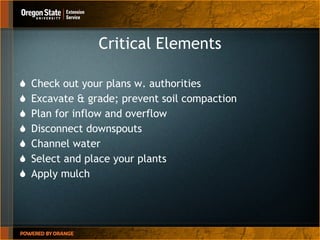
Critical Elements Check out your plans w. authorities Excavate & grade; prevent soil compaction  Plan for inflow and overflow Disconnect downspouts Channel water Select and place your plants Apply mulch
Legal issues Call your local community development office Describe what you’re doing Ask “Do I need a permit?” Digsmart! Call 811
 
 
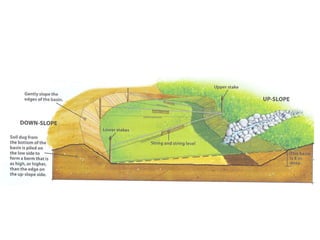
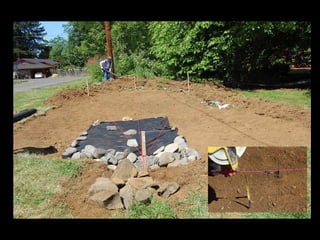
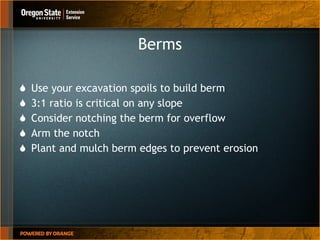
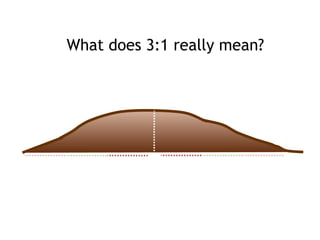
Berms Use your excavation spoils to build berm 3:1 ratio is critical on any slope Consider notching the berm for overflow Arm the notch Plant and mulch berm edges to prevent erosion
What does 3:1 really mean?
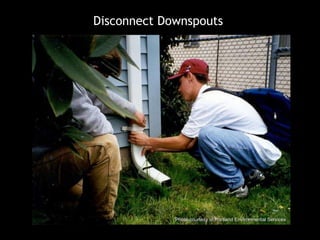
Disconnect Downspouts Photo courtesy of Portland Environmental Services
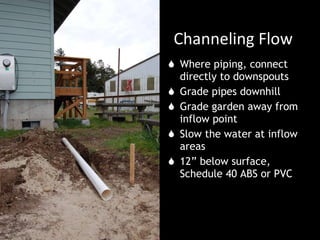
Channeling Flow Where piping, connect directly to downspouts Grade pipes downhill Grade garden away from inflow point Slow the water at inflow areas 12” below surface, Schedule 40 ABS or PVC
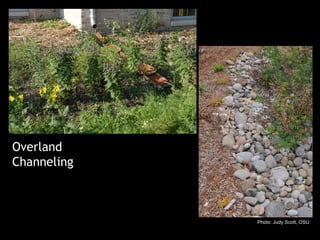
Overland Channeling  Photo: Judy Scott, OSU
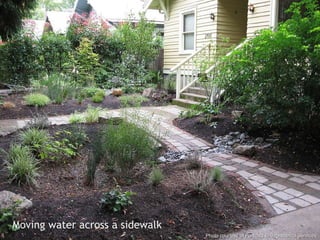
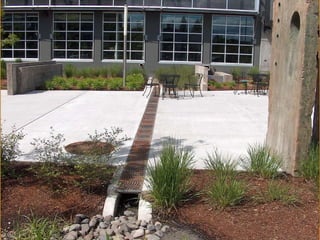
Moving water across a sidewalk   Photo courtesy of Portland Environmental Services
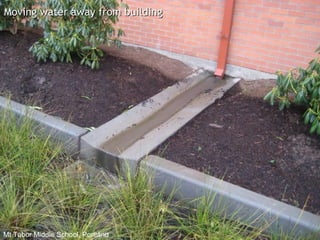
Moving water away from building Mt Tabor Middle School, Portland
Another creative overhead solution!
 
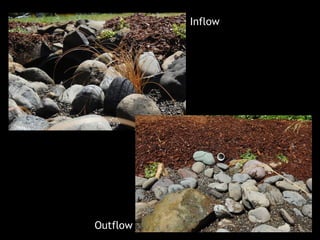
Inflow Outflow
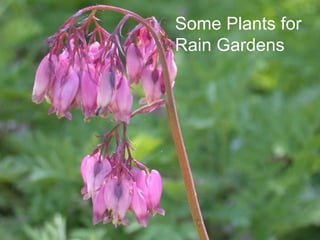
Some Plants for Rain Gardens
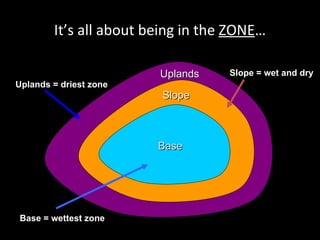
It’s all about being in the  ZONE … Slope Base Uplands = driest zone Base = wettest zone Slope = wet and dry Uplands
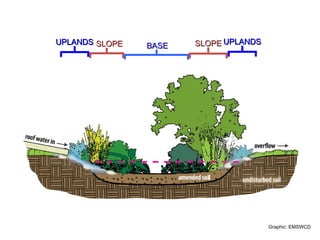
BASE Graphic: EMSWCD SLOPE SLOPE UPLANDS UPLANDS
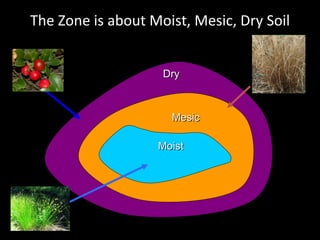
The Zone is about Moist, Mesic, Dry Soil Mesic Moist Dry
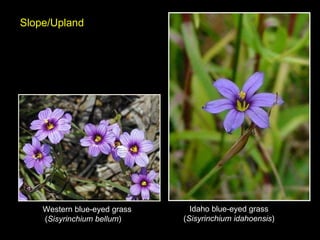
Idaho blue-eyed grass ( Sisyrinchium idahoensis ) Western blue-eyed grass  ( Sisyrinchium bellum )  Slope/Upland
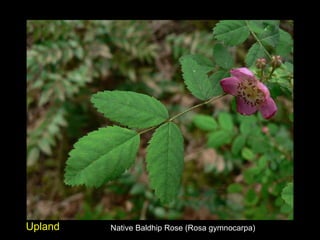
Native Baldhip Rose (Rosa gymnocarpa) Upland
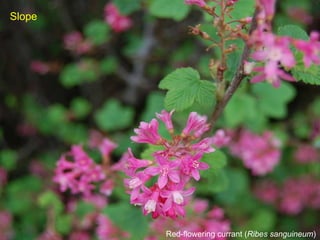
Red-flowering currant ( Ribes sanguineum ) Slope
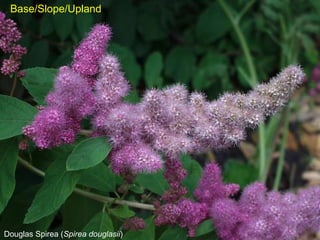
Douglas Spirea ( Spirea douglasii ) Base/Slope/Upland
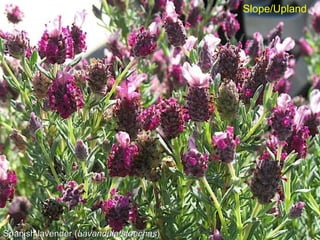
Spanish lavender ( Lavandula stoechas ) Slope/Upland
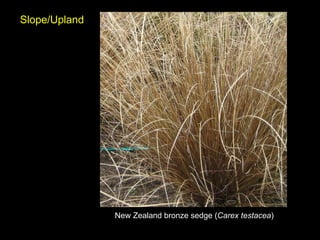
New Zealand bronze sedge ( Carex testacea ) Slope/Upland
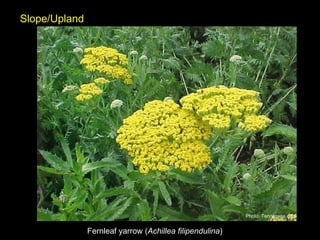
Fernleaf yarrow ( Achillea filipendulina ) Slope/Upland Photo: Tennessee.edu
Kinnickinnik (Arctostaphyllos uva-ursi) Slope/Upland
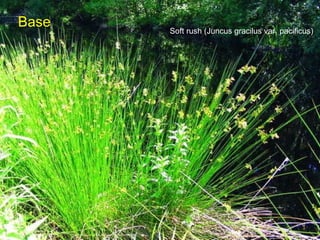
Soft rush (Juncus gracilus var. pacificus) Base
Invasive Species
 
 
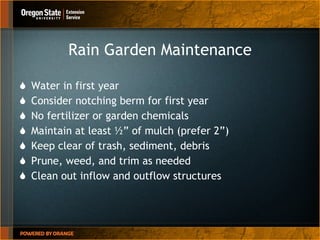
Rain Garden Maintenance Water in first year Consider notching berm for first year No fertilizer or garden chemicals Maintain at least ½” of mulch (prefer 2”) Keep clear of trash, sediment, debris Prune, weed, and trim as needed Clean out inflow and outflow structures
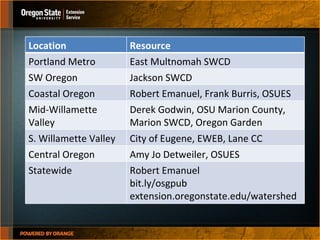
Location Resource Portland Metro East Multnomah SWCD SW Oregon Jackson SWCD Coastal Oregon Robert Emanuel, Frank Burris, OSUES Mid-Willamette Valley Derek Godwin, OSU Marion County, Marion SWCD, Oregon Garden S. Willamette Valley City of Eugene, EWEB, Lane CC Central Oregon Amy Jo Detweiler, OSUES Statewide Robert Emanuel  bit.ly/osgpub extension.oregonstate.edu/watershed
 
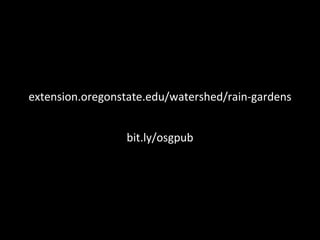
extension.oregonstate.edu/watershed/rain-gardens bit.ly/osgpub
Contact Information Robert Emanuel Water Resources & Community Development Agent OSU Extension Service Tillamook County  (503) 842-5708 x 210 [email_address] Derek Godwin Watershed Management Specialist OSU Extension Service Marion County (503) 566-2909 [email_address] blogs.oregonstate.edu/h2onc

Rain Gardens, an introduction for Oregonians

  • 1.
    Rain Gardens for Healthy Streams and Clean Water Robert Emanuel OSUES Tillamook & Clatsop counties Oregon Sea Grant Extension Derek Godwin OSUES Marion County Oregon Sea Grant Extension
  • 2.
    Workshop Goals Whatis a rain garden & how does it work? Why build a rain garden? Assess your site for a rain garden Steps to design and install a rain garden More resources
  • 3.
    what is a rain garden and why build one?
  • 4.
    A rain gardenis a “sunken garden bed” that collects & treats stormwater runoff from rooftops, driveways, sidewalks, parking lots & streets. Graphic: EMSWCD
  • 5.
    © Good NaturePublishing
  • 6.
    How a RainGarden Works Graphic: EMSWCD
  • 7.
  • 8.
    Photo Tom Liptan,City of Portland Environmental Services
  • 9.
  • 10.
  • 11.
    you want toprotect your local watershed you like groundwater you don’t like floods you want to keep runoff & put it to work you like native plants & wildlife you have the rain to spare anyway…. why would you build one?
  • 12.
    The Problem: ConventionalStormwater Management
  • 13.
    Robert Emanuel, OSUExtension Service
  • 14.
    Puget Sound ActionTeam, WSU Pierce County Extension
  • 15.
  • 16.
    Puget Sound ActionTeam, WSU Pierce County Extension
  • 17.
    Stormwater Pollutants Suspendedsolids/sediments Nutrients (nitrogen, phosphorus) Metals (copper, lead, zinc, cadmium, mercury) Oils & grease Bacteria Pesticides & herbicides Increased temperature
  • 18.
    Flooding and UrbanDevelopment More Runoff Arriving Faster
  • 19.
    Stream Degradation WSUExtension/Puget Sound Action Team
  • 20.
  • 21.
  • 22.
    what are the steps to building a rain garden?
  • 23.
    Steps to Assessinga Site Calculate how much water to treat Decide where to put a garden Calculate slope Test soil
  • 24.
  • 25.
  • 26.
    Calculate ft 2 of impervious area(s) Calculate total rain garden area needed Determine dimensions of each garden Sizing a Rain Garden
  • 27.
  • 28.
  • 29.
    width of surfacex length of surface = area (ft 2 ) area x .10 = total rain garden area
  • 30.
    Rules of thumbWillamette Valley = 10% of impervious surface Southwest Oregon = 10% of impervious surface Coast = 15-20% of impervious surface Central Oregon = 15-20 % of impervious surface (shallow)
  • 31.
    Property lines Proximityto buildings Tree roots Basements, foundations Utilities
  • 32.
  • 33.
  • 34.
    Rule of Thumb:conventional rain gardens are located on slopes <10% and >50 ft. from steep slopes; Seek professional help if needed!
  • 35.
    Dig a holeto depth of rain garden 2. Fill with water and let it drain 3. Fill with water again, measure depth, record time and depth 4. Record time after water drains 5. Calculate permeability = depth (inches) / time (hours)
  • 36.
  • 37.
    Soil Percolation TestInterpretation Drainage Rate Suggested RG ponding depth Less than ½ inch/hour Do not build ½ to 1 inch/hour 12-24 inches 1 to 2 inches/hour 6-8 inches More than 2 inches/hour 6 inches
  • 38.
    Steps to Assessinga Site Calculate how much water to treat Decide where to put a garden Calculate slope Test soil
  • 39.
  • 40.
    Critical Elements Checkout your plans w. authorities Excavate & grade; prevent soil compaction Plan for inflow and overflow Disconnect downspouts Channel water Select and place your plants Apply mulch
  • 41.
    Legal issues Callyour local community development office Describe what you’re doing Ask “Do I need a permit?” Digsmart! Call 811
  • 42.
  • 43.
  • 44.
    Berms Use yourexcavation spoils to build berm 3:1 ratio is critical on any slope Consider notching the berm for overflow Arm the notch Plant and mulch berm edges to prevent erosion
  • 45.
    What does 3:1really mean?
  • 46.
    Disconnect Downspouts Photocourtesy of Portland Environmental Services
  • 47.
    Channeling Flow Wherepiping, connect directly to downspouts Grade pipes downhill Grade garden away from inflow point Slow the water at inflow areas 12” below surface, Schedule 40 ABS or PVC
  • 48.
    Overland Channeling Photo: Judy Scott, OSU
  • 49.
    Moving water acrossa sidewalk Photo courtesy of Portland Environmental Services
  • 50.
    Moving water awayfrom building Mt Tabor Middle School, Portland
  • 51.
  • 52.
  • 53.
  • 54.
    Some Plants forRain Gardens
  • 55.
    It’s all aboutbeing in the ZONE … Slope Base Uplands = driest zone Base = wettest zone Slope = wet and dry Uplands
  • 56.
    BASE Graphic: EMSWCDSLOPE SLOPE UPLANDS UPLANDS
  • 57.
    The Zone isabout Moist, Mesic, Dry Soil Mesic Moist Dry
  • 58.
    Idaho blue-eyed grass( Sisyrinchium idahoensis ) Western blue-eyed grass ( Sisyrinchium bellum ) Slope/Upland
  • 59.
    Native Baldhip Rose(Rosa gymnocarpa) Upland
  • 60.
    Red-flowering currant (Ribes sanguineum ) Slope
  • 61.
    Douglas Spirea (Spirea douglasii ) Base/Slope/Upland
  • 62.
    Spanish lavender (Lavandula stoechas ) Slope/Upland
  • 63.
    New Zealand bronzesedge ( Carex testacea ) Slope/Upland
  • 64.
    Fernleaf yarrow (Achillea filipendulina ) Slope/Upland Photo: Tennessee.edu
  • 65.
  • 66.
    Soft rush (Juncusgracilus var. pacificus) Base
  • 67.
  • 68.
  • 69.
  • 70.
    Rain Garden MaintenanceWater in first year Consider notching berm for first year No fertilizer or garden chemicals Maintain at least ½” of mulch (prefer 2”) Keep clear of trash, sediment, debris Prune, weed, and trim as needed Clean out inflow and outflow structures
  • 71.
    Location Resource PortlandMetro East Multnomah SWCD SW Oregon Jackson SWCD Coastal Oregon Robert Emanuel, Frank Burris, OSUES Mid-Willamette Valley Derek Godwin, OSU Marion County, Marion SWCD, Oregon Garden S. Willamette Valley City of Eugene, EWEB, Lane CC Central Oregon Amy Jo Detweiler, OSUES Statewide Robert Emanuel bit.ly/osgpub extension.oregonstate.edu/watershed
  • 72.
  • 73.
  • 74.
    Contact Information RobertEmanuel Water Resources & Community Development Agent OSU Extension Service Tillamook County (503) 842-5708 x 210 [email_address] Derek Godwin Watershed Management Specialist OSU Extension Service Marion County (503) 566-2909 [email_address] blogs.oregonstate.edu/h2onc

Editor's Notes

  • #4 Current cost estimates for invasives nation wide put the number just over $143 billion!
  • #15 What you see here is the typical way that water moves after it rains or snows on an undeveloped Pacific Northwest landscape. Low Impact Development practices can help protect the natural hydrology of watersheds. Under natural conditions in the Pacific Northwest, about 75 percent of the water from each rainfall event is either intercepted by the forest and returned to the atmosphere through evapo-transpiration or trapped on the forest floor, where it slowly soaks, or infiltrates, into the ground. There is very little surface runoff. The water that infiltrates is critical to maintaining the base flows of streams for fish and other aquatic life. The temperature, volume and quality of this base flow are crucial to maintaining habitat for sensitive and endangered species, such as salmon.
  • #16 That stormdrain will be connected to a pipe or ditch system that drains into a lake, river, stream, bay or ocean—leaving behind a host of impacts for that watershed. It all comes back to the old recycling adage that there is no such thing as “away”.
  • #17 When land is developed, the frequency, volume and rate of flow of surface runoff increases dramatically – from 0.3% before, to 30% after development (100 times more runoff!) This is because of increased impervious areas, such as roads, driveways and buildings. The reduction of vegetation from development also decreases the amount of rainfall returning to the atmosphere through evapo-transpiration and the amount that infiltrates to the ground and recharges aquifers.
  • #18 Anything that touches the land can end up being carried into our rivers by stormwater runoff. Cars, roads, lawns, and rooftops are sources of many storm water pollutants. Even higher pollutant loads can be found in the runoff from some industrial land uses. I call this the stormwater superhighway in that it carries the water quickly and efficiently—along with its load of pollution. While you may not think of it as a pollutant, high temperature is one of the most common problems in Oregon’s rivers and streams, making it tough for our native cold-water fish to survive. Urban runoff is one factor contributing to unnaturally warm waters.
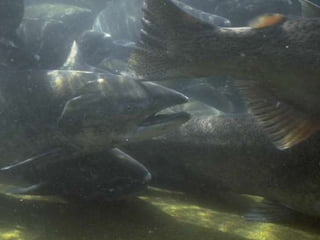
  • #21 Emerging evidence that salmon olfactory is damaged. 63 pesticides were found at the source drinking water intake on the Clackamas River, near Portland, Oregon. Glyphosate and its derivative was one of the most frequent pollutants detected. Once invasives are established in an environment, our responsibility is to remove them where possible, but also we should be focusing efforts on preventing them in the first place.
  • #22 Challenge – Stormwater runoff from impervious surfaces affects water quantity, water quality, and stream health. Solution - Use management practices, like rain gardens, to capture diverted stormwater runoff, treat it naturally with vegetation, soils and microorganisms, and release it safely to groundwater and streams.
  • #23 Current cost estimates for invasives nation wide put the number just over $143 billion!
  • #56 And speaking of zones…here’s the map (of a generic rain garden) we should pay attention to when placing plants into the design. Remember, the base will be the wettest zone—at least on paper. The slope should be drier, but have some wet times too when the rains or snowmelt are heaviest, and lastly a dry uplands zone around the top. Another analogue is to think about base as “moist” soil; slope as “mesic” soil; and uplands as “dry” soil. You will note these in your Rain Garden Guides.
  • #58 Here we see our hypothetical design with the moisture zones a little more realistically drawn. For example, the inflow point to the left of the base is contributing to this area of high moisture, but doesn’t extend evenly across the base. Likewise, the dry zone is probably bigger than the area we called the “uplands” in our earlier diagram. So we must select plants to fill these zones by their ability to tolerate—and even thrive—in these zones. Hopefully once the rain garden is mature and the plants in each zone will do well and not need supplemental irrigation during dry periods of the year. The plants here would be ideally placed by moisture zone, as well as the other form, habit, color, and light tolerance. The juncus gracilus (Pacific Rush), bronze sedge and kinnickinick should tolerate the soil moisture better if confined to the proper zones.
  • #59 S. bellum: photo courtesy of NPS S. Idahoensis: photo courtesy of the NPS
  • #60 Photo courtesy of NRCS
  • #61 Photo by Robert Emanuel, OSU
  • #62 Photo courtesy of Washington Department of Natural Resources
  • #63 Private photographer—trying to contact him to ask for permission—this was such a good photo!
  • #66 Photo--OSU
  • #69 We highly recommend using this guide with plant selection—it has a great list of bad-boys and their less aggressive alternatives.