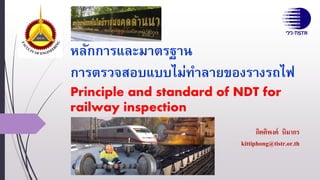
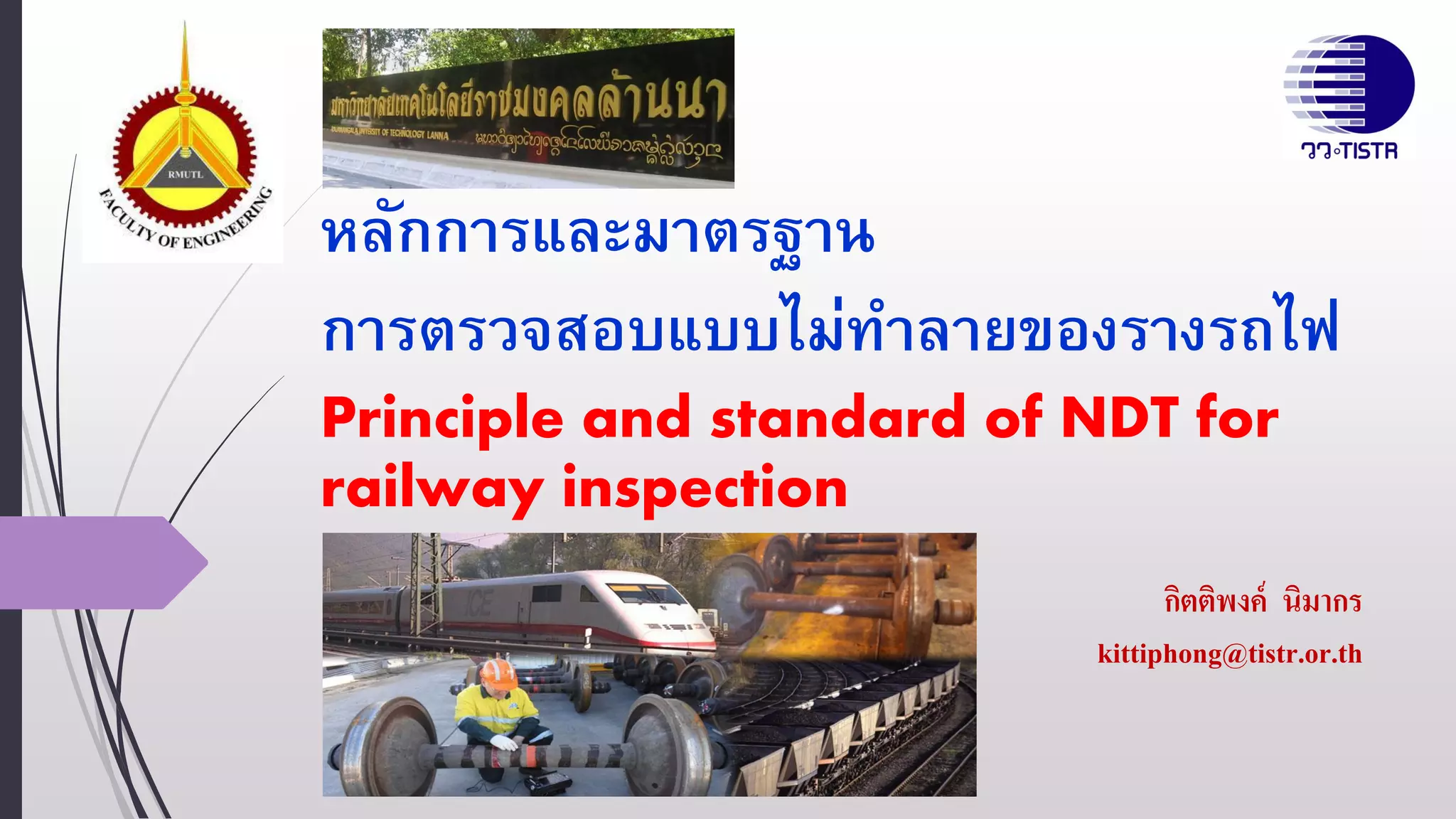
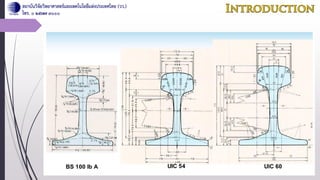
หลักการและมาตรฐาน
การตรวจสอบแบบไม่ทาลายของรางรถไฟ
Principle and standard of NDT for
railway inspection
กิตติพงค์ นิมากร
kittiphong@tistr.or.th
29/03/2561 Present by : Mr.Kittiphong Nimakorn, Email : kittiphong.n@ku.th
Department
:
Materials
Engineering,
Faculty
:
Engineering,
University
:
Kasetsart
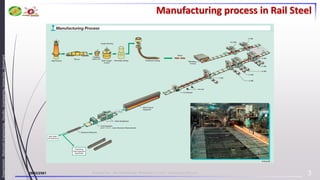
3
Manufacturing process in Rail Steel
29/03/2561 Present by : Mr.Kittiphong Nimakorn, Email : kittiphong.n@ku.th
Department
:
Materials
Engineering,
Faculty
:
Engineering,
University
:
Kasetsart
Rail steel
grades
Chemical composition % Mechanical properties
C Si Mn Pmax Smax Cr Mo
Rm
N/mm
2
A5
% HBW
R350HT
0.72-
0.80
0.15-
0.58
0.70-
1.20
0.020 0.025 - - >1175 9
350-
390
R260
0.60-
0.82
0.13-
0.60
0.65-
1.25
0.030 0.030 - - 880 10
260-
300
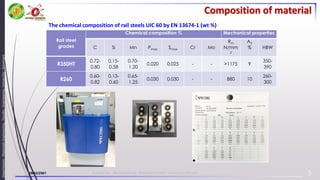
The chemical composition of rail steels UIC 60 by EN 13674-1 (wt %)
5
Composition of material
29/03/2561 Present by : Mr.Kittiphong Nimakorn, Email : kittiphong.n@ku.th
Department
:
Materials
Engineering,
Faculty
:
Engineering,
University
:
Kasetsart
Rail steel
Grade
Hardness Head hardened Remark
R260 260 HBW none All straight tract and
main line curves of
greater than 400 m
R350HT > 350 HBW Heat treatment Use in station,
switches, crossings
and main line curves
of 400 m or less
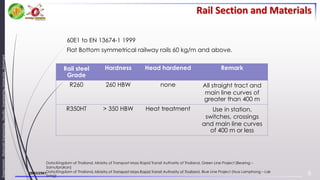
60E1 to EN 13674-1 1999
Flat Bottom symmetrical railway rails 60 kg/m and above.
Data:Kingdom of Thailand, Ministry of Transport Mass Rapid Transit Authority of Thailand, Green Line Project (Bearing –
Samutprakan)
Data:Kingdom of Thailand, Ministry of Transport Mass Rapid Transit Authority of Thailand, Blue Line Project (Hua Lamphong – Lak
Song) 6
Rail Section and Materials
29/03/2561 Present by : Mr.Kittiphong Nimakorn, Email : kittiphong.n@ku.th
Department
:
Materials
Engineering,
Faculty
:
Engineering,
University
:
Kasetsart
7
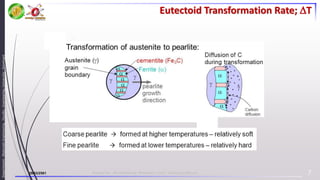
Eutectoid Transformation Rate; T
29/03/2561 Present by : Mr.Kittiphong Nimakorn, Email : kittiphong.n@ku.th
Department
:
Materials
Engineering,
Faculty
:
Engineering,
University
:
Kasetsart
Data: P.I. Christodoulou et al. / Theoretical and Applied Fracture Mechanics 83 (2016) 51–59.
http://onlinepubs.trb.org/Onlinepubs/trr/1992/1341/1341-008.pdf
8
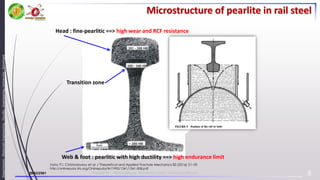
Microstructure of pearlite in rail steel
Head : fine-pearlitic ==> high wear and RCF resistance
Transition zone
Web & foot : pearlitic with high ductility ==> high endurance limit
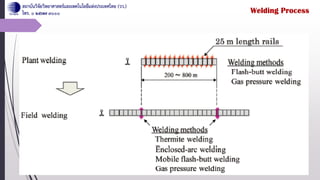
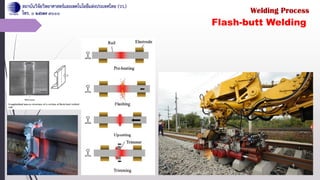
Flash-butt Welding
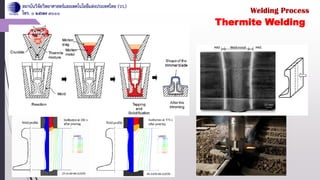
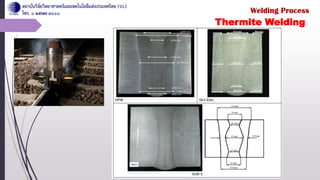
Thermite Welding
Thermite Welding
29/03/2561 Present by : Mr.Kittiphong Nimakorn, Email : kittiphong.n@ku.th
Department
:
Materials
Engineering,
Faculty
:
Engineering,
University
:
Kasetsart
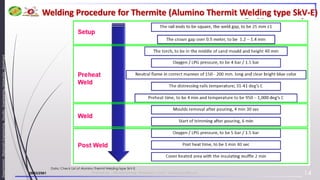
Data: Check List of Alumino Thermit Welding type SkV-E.
14
Welding Procedure for Thermite (Alumino Thermit Welding type SkV-E)
29/03/2561 Present by : Mr.Kittiphong Nimakorn, Email : kittiphong.n@ku.th
Department
:
Materials
Engineering,
Faculty
:
Engineering,
University
:
Kasetsart
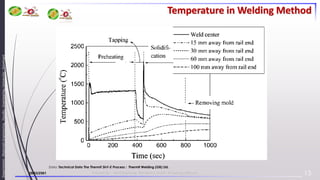
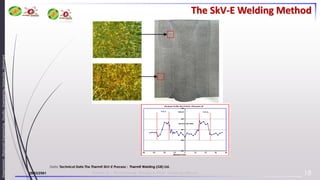
Data: Technical Data The Thermit SkV-E Process : Thermit Welding (GB) Ltd.
15
Temperature in Welding Method
29/03/2561 Present by : Mr.Kittiphong Nimakorn, Email : kittiphong.n@ku.th
Department
:
Materials
Engineering,
Faculty
:
Engineering,
University
:
Kasetsart
16
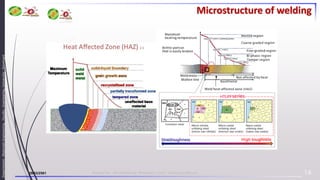
Microstructure of welding
29/03/2561 Present by : Mr.Kittiphong Nimakorn, Email : kittiphong.n@ku.th
Department
:
Materials
Engineering,
Faculty
:
Engineering,
University
:
Kasetsart
17
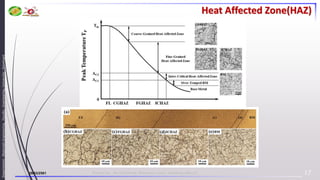
Heat Affected Zone(HAZ)
29/03/2561 Present by : Mr.Kittiphong Nimakorn, Email : kittiphong.n@ku.th
Department
:
Materials
Engineering,
Faculty
:
Engineering,
University
:
Kasetsart
Data: Technical Data The Thermit SkV-E Process : Thermit Welding (GB) Ltd.
18
The SkV-E Welding Method
29/03/2561 Present by : Mr.Kittiphong Nimakorn, Email : kittiphong.n@ku.th
Department
:
Materials
Engineering,
Faculty
:
Engineering,
University
:
Kasetsart
19
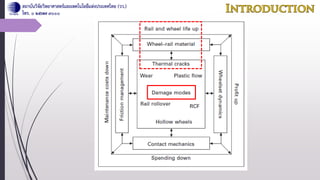
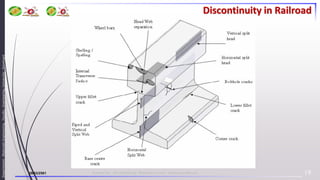
Discontinuity in Railroad
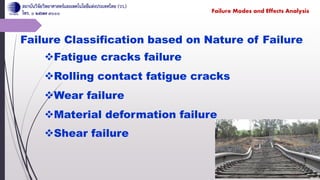
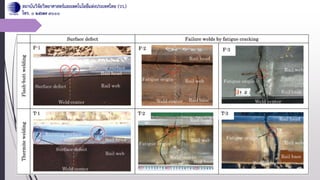
Failure Classification based on Nature of Failure
❖Fatigue cracks failure
❖Rolling contact fatigue cracks
❖Wear failure
❖Material deformation failure
❖Shear failure
Failure Modes and Effects Analysis
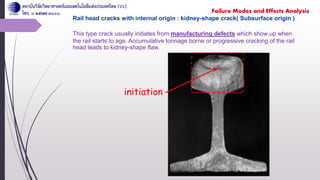
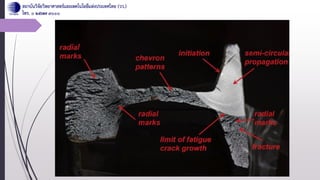
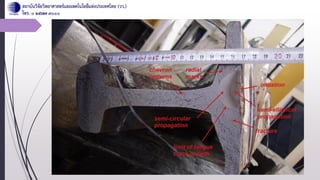
Rail head cracks with internal origin : kidney-shape crack( Subsurface origin )
This type crack usually initiates from manufacturing defects which show up when
the rail starts to age. Accumulative tonnage borne or progressive cracking of the rail
head leads to kidney-shape flaw.
initiation
Failure Modes and Effects Analysis
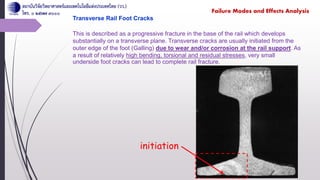
Transverse Rail Foot Cracks
This is described as a progressive fracture in the base of the rail which develops
substantially on a transverse plane. Transverse cracks are usually initiated from the
outer edge of the foot (Galling) due to wear and/or corrosion at the rail support. As
a result of relatively high bending, torsional and residual stresses, very small
underside foot cracks can lead to complete rail fracture.
initiation
Failure Modes and Effects Analysis
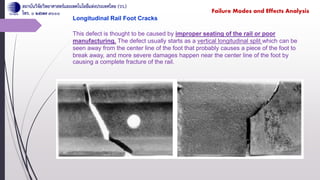
Longitudinal Rail Foot Cracks
This defect is thought to be caused by improper seating of the rail or poor
manufacturing. The defect usually starts as a vertical longitudinal split which can be
seen away from the center line of the foot that probably causes a piece of the foot to
break away, and more severe damages happen near the center line of the foot by
causing a complete fracture of the rail.
Failure Modes and Effects Analysis
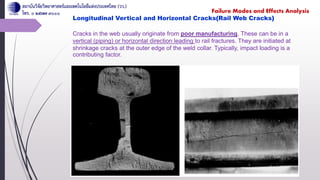
Longitudinal Vertical and Horizontal Cracks(Rail Web Cracks)
Cracks in the web usually originate from poor manufacturing. These can be in a
vertical (piping) or horizontal direction leading to rail fractures. They are initiated at
shrinkage cracks at the outer edge of the weld collar. Typically, impact loading is a
contributing factor.
Failure Modes and Effects Analysis
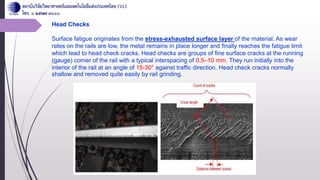
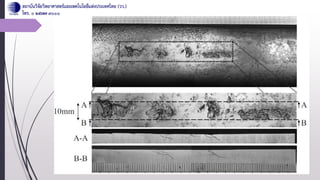
Head Checks
Surface fatigue originates from the stress-exhausted surface layer of the material. As wear
rates on the rails are low, the metal remains in place longer and finally reaches the fatigue limit
which lead to head check cracks. Head checks are groups of fine surface cracks at the running
(gauge) corner of the rail with a typical interspacing of 0.5–10 mm. They run initially into the
interior of the rail at an angle of 15-30° against traffic direction. Head check cracks normally
shallow and removed quite easily by rail grinding.
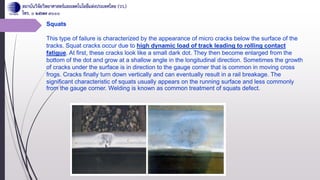
Squats
This type of failure is characterized by the appearance of micro cracks below the surface of the
tracks. Squat cracks occur due to high dynamic load of track leading to rolling contact
fatigue. At first, these cracks look like a small dark dot. They then become enlarged from the
bottom of the dot and grow at a shallow angle in the longitudinal direction. Sometimes the growth
of cracks under the surface is in direction to the gauge corner that is common in moving cross
frogs. Cracks finally turn down vertically and can eventually result in a rail breakage. The
significant characteristic of squats usually appears on the running surface and less commonly
from the gauge corner. Welding is known as common treatment of squats defect.
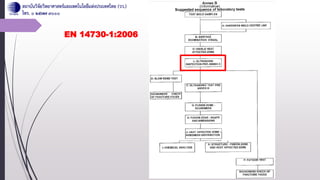
EN 14730-1:2006
35
Introduction Non Destructive Examination
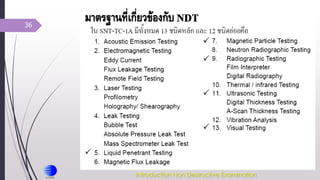
36
Introduction Non Destructive Examination
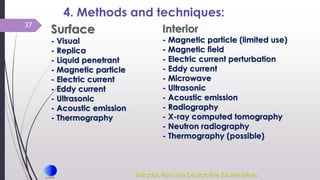
37
4. Methods and techniques:
Surface
- Visual
- Replica
- Liquid penetrant
- Magnetic particle
- Electric current
- Eddy current
- Ultrasonic
- Acoustic emission
- Thermography
Interior
- Magnetic particle (limited use)
- Magnetic field
- Electric current perturbation
- Eddy current
- Microwave
- Ultrasonic
- Acoustic emission
- Radiography
- X-ray computed tomography
- Neutron radiography
- Thermography (possible)
Introduction Non Destructive Examination
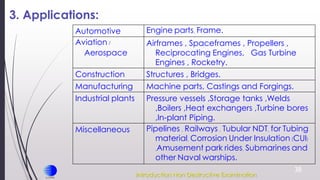
38
3. Applications:
Engine parts, Frame.
Automotive
Airframes , Spaceframes , Propellers ,
Reciprocating Engines, Gas Turbine
Engines , Rocketry.
Aviation /
Aerospace
Structures , Bridges.
Construction
Machine parts, Castings and Forgings.
Manufacturing
Pressure vessels ,Storage tanks ,Welds
,Boilers ,Heat exchangers ,Turbine bores
,In-plant Piping.
Industrial plants
Pipelines , Railways , Tubular NDT, for Tubing
material, Corrosion Under Insulation (CUI)
,Amusement park rides, Submarines and
other Naval warships.
Miscellaneous
Introduction Non Destructive Examination
39
Introduction Non Destructive Examination
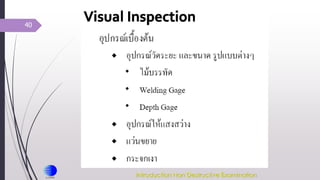
40
Introduction Non Destructive Examination
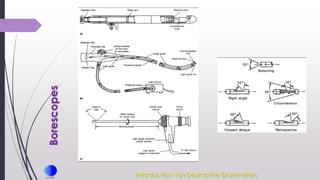
Borescopes
Introduction Non Destructive Examination
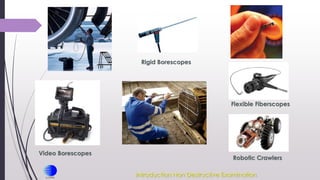
Robotic Crawlers
Video Borescopes
Rigid Borescopes
Flexible Fiberscopes
Introduction Non Destructive Examination
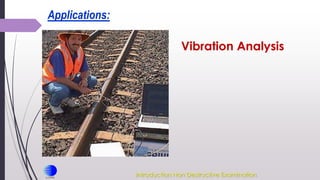
Applications:
Vibration Analysis
44
Introduction Non Destructive Examination
45
Introduction Non Destructive Examination
46
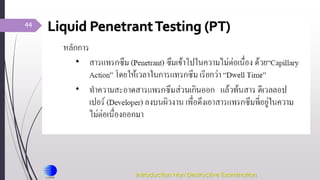
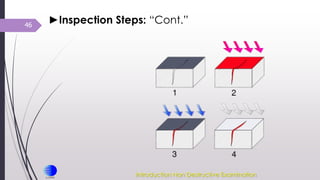
►Inspection Steps: “Cont.”
Introduction Non Destructive Examination
47
Introduction Non Destructive Examination
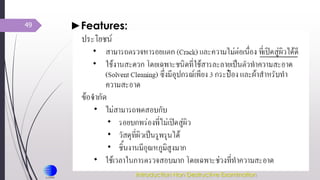
49 ►Features:
Introduction Non Destructive Examination
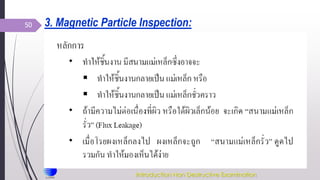
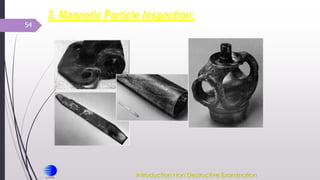
50 3. Magnetic Particle Inspection:
Introduction Non Destructive Examination
51
Introduction Non Destructive Examination
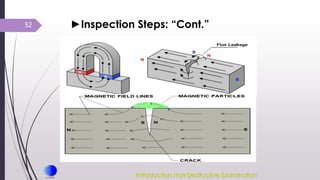
52 ►Inspection Steps: “Cont.”
Introduction Non Destructive Examination
53
Introduction Non Destructive Examination
54
Introduction Non Destructive Examination
3. Magnetic Particle Inspection:
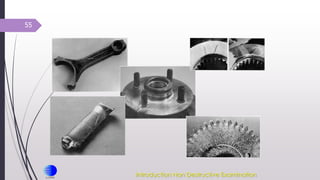
55
Introduction Non Destructive Examination
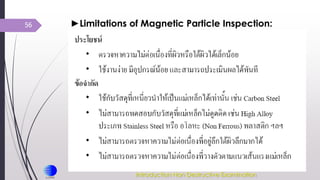
56 ►Limitations of Magnetic Particle Inspection:
Introduction Non Destructive Examination
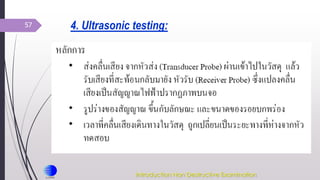
57 4. Ultrasonic testing:
Introduction Non Destructive Examination
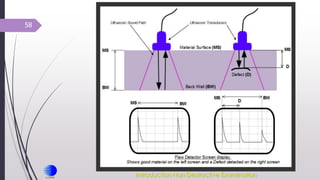
58
Introduction Non Destructive Examination
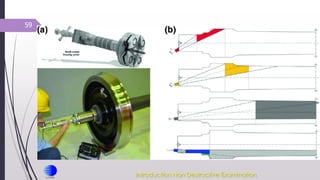
59
Introduction Non Destructive Examination
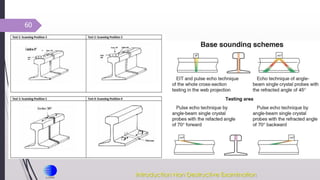
60
Introduction Non Destructive Examination
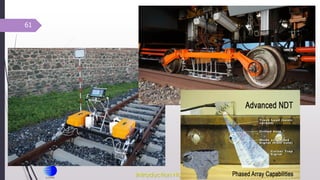
61
Introduction Non Destructive Examination
62
Introduction Non Destructive Examination
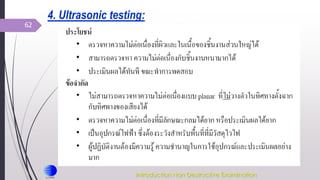
4. Ultrasonic testing:
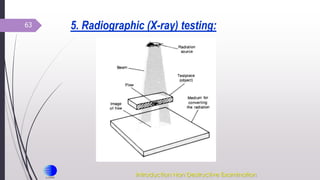
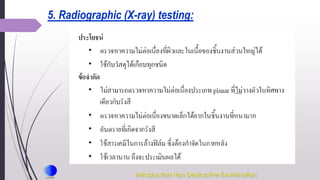
63 5. Radiographic (X-ray) testing:
Introduction Non Destructive Examination
64
Introduction Non Destructive Examination
65
Introduction Non Destructive Examination
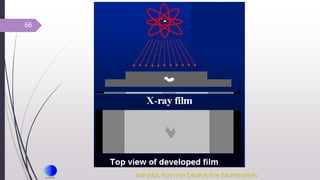
66
Introduction Non Destructive Examination
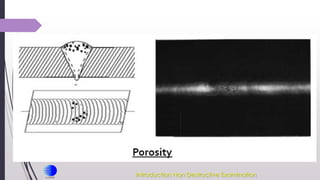
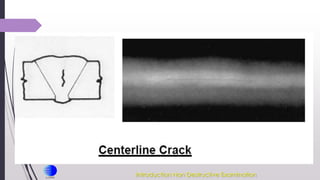
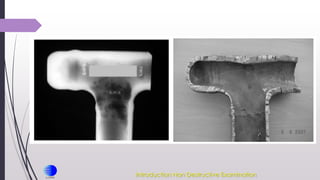
5. Radiographic (X-ray) testing:
Introduction Non Destructive Examination
Applications:
Vibration Analysis
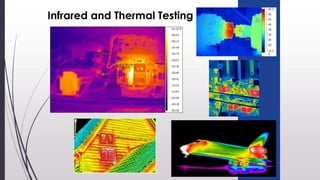
Infrared and Thermal Testing
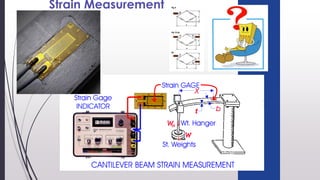
Strain Measurement
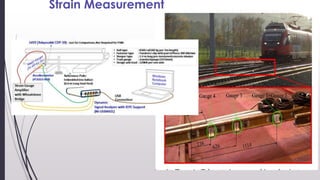
Strain Measurement
Railway inspection
Railway inspection
Railway inspection
  • 1.
  • 3.
    29/03/2561 Present by: Mr.Kittiphong Nimakorn, Email : kittiphong.n@ku.th Department : Materials Engineering, Faculty : Engineering, University : Kasetsart 3 Manufacturing process in Rail Steel
  • 5.
    29/03/2561 Present by: Mr.Kittiphong Nimakorn, Email : kittiphong.n@ku.th Department : Materials Engineering, Faculty : Engineering, University : Kasetsart Rail steel grades Chemical composition % Mechanical properties C Si Mn Pmax Smax Cr Mo Rm N/mm 2 A5 % HBW R350HT 0.72- 0.80 0.15- 0.58 0.70- 1.20 0.020 0.025 - - >1175 9 350- 390 R260 0.60- 0.82 0.13- 0.60 0.65- 1.25 0.030 0.030 - - 880 10 260- 300 The chemical composition of rail steels UIC 60 by EN 13674-1 (wt %) 5 Composition of material
  • 6.
    29/03/2561 Present by: Mr.Kittiphong Nimakorn, Email : kittiphong.n@ku.th Department : Materials Engineering, Faculty : Engineering, University : Kasetsart Rail steel Grade Hardness Head hardened Remark R260 260 HBW none All straight tract and main line curves of greater than 400 m R350HT > 350 HBW Heat treatment Use in station, switches, crossings and main line curves of 400 m or less 60E1 to EN 13674-1 1999 Flat Bottom symmetrical railway rails 60 kg/m and above. Data:Kingdom of Thailand, Ministry of Transport Mass Rapid Transit Authority of Thailand, Green Line Project (Bearing – Samutprakan) Data:Kingdom of Thailand, Ministry of Transport Mass Rapid Transit Authority of Thailand, Blue Line Project (Hua Lamphong – Lak Song) 6 Rail Section and Materials
  • 7.
    29/03/2561 Present by: Mr.Kittiphong Nimakorn, Email : kittiphong.n@ku.th Department : Materials Engineering, Faculty : Engineering, University : Kasetsart 7 Eutectoid Transformation Rate; T
  • 8.
    29/03/2561 Present by: Mr.Kittiphong Nimakorn, Email : kittiphong.n@ku.th Department : Materials Engineering, Faculty : Engineering, University : Kasetsart Data: P.I. Christodoulou et al. / Theoretical and Applied Fracture Mechanics 83 (2016) 51–59. http://onlinepubs.trb.org/Onlinepubs/trr/1992/1341/1341-008.pdf 8 Microstructure of pearlite in rail steel Head : fine-pearlitic ==> high wear and RCF resistance Transition zone Web & foot : pearlitic with high ductility ==> high endurance limit
  • 11.
  • 12.
  • 13.
  • 14.
    29/03/2561 Present by: Mr.Kittiphong Nimakorn, Email : kittiphong.n@ku.th Department : Materials Engineering, Faculty : Engineering, University : Kasetsart Data: Check List of Alumino Thermit Welding type SkV-E. 14 Welding Procedure for Thermite (Alumino Thermit Welding type SkV-E)
  • 15.
    29/03/2561 Present by: Mr.Kittiphong Nimakorn, Email : kittiphong.n@ku.th Department : Materials Engineering, Faculty : Engineering, University : Kasetsart Data: Technical Data The Thermit SkV-E Process : Thermit Welding (GB) Ltd. 15 Temperature in Welding Method
  • 16.
    29/03/2561 Present by: Mr.Kittiphong Nimakorn, Email : kittiphong.n@ku.th Department : Materials Engineering, Faculty : Engineering, University : Kasetsart 16 Microstructure of welding
  • 17.
    29/03/2561 Present by: Mr.Kittiphong Nimakorn, Email : kittiphong.n@ku.th Department : Materials Engineering, Faculty : Engineering, University : Kasetsart 17 Heat Affected Zone(HAZ)
  • 18.
    29/03/2561 Present by: Mr.Kittiphong Nimakorn, Email : kittiphong.n@ku.th Department : Materials Engineering, Faculty : Engineering, University : Kasetsart Data: Technical Data The Thermit SkV-E Process : Thermit Welding (GB) Ltd. 18 The SkV-E Welding Method
  • 19.
    29/03/2561 Present by: Mr.Kittiphong Nimakorn, Email : kittiphong.n@ku.th Department : Materials Engineering, Faculty : Engineering, University : Kasetsart 19 Discontinuity in Railroad
  • 22.
    Failure Classification basedon Nature of Failure ❖Fatigue cracks failure ❖Rolling contact fatigue cracks ❖Wear failure ❖Material deformation failure ❖Shear failure Failure Modes and Effects Analysis
  • 23.
    Failure Modes andEffects Analysis
  • 24.
    Rail head crackswith internal origin : kidney-shape crack( Subsurface origin ) This type crack usually initiates from manufacturing defects which show up when the rail starts to age. Accumulative tonnage borne or progressive cracking of the rail head leads to kidney-shape flaw. initiation Failure Modes and Effects Analysis
  • 25.
    Transverse Rail FootCracks This is described as a progressive fracture in the base of the rail which develops substantially on a transverse plane. Transverse cracks are usually initiated from the outer edge of the foot (Galling) due to wear and/or corrosion at the rail support. As a result of relatively high bending, torsional and residual stresses, very small underside foot cracks can lead to complete rail fracture. initiation Failure Modes and Effects Analysis
  • 26.
    Longitudinal Rail FootCracks This defect is thought to be caused by improper seating of the rail or poor manufacturing. The defect usually starts as a vertical longitudinal split which can be seen away from the center line of the foot that probably causes a piece of the foot to break away, and more severe damages happen near the center line of the foot by causing a complete fracture of the rail. Failure Modes and Effects Analysis
  • 27.
    Longitudinal Vertical andHorizontal Cracks(Rail Web Cracks) Cracks in the web usually originate from poor manufacturing. These can be in a vertical (piping) or horizontal direction leading to rail fractures. They are initiated at shrinkage cracks at the outer edge of the weld collar. Typically, impact loading is a contributing factor. Failure Modes and Effects Analysis
  • 28.
    Head Checks Surface fatigueoriginates from the stress-exhausted surface layer of the material. As wear rates on the rails are low, the metal remains in place longer and finally reaches the fatigue limit which lead to head check cracks. Head checks are groups of fine surface cracks at the running (gauge) corner of the rail with a typical interspacing of 0.5–10 mm. They run initially into the interior of the rail at an angle of 15-30° against traffic direction. Head check cracks normally shallow and removed quite easily by rail grinding.
  • 30.
    Squats This type offailure is characterized by the appearance of micro cracks below the surface of the tracks. Squat cracks occur due to high dynamic load of track leading to rolling contact fatigue. At first, these cracks look like a small dark dot. They then become enlarged from the bottom of the dot and grow at a shallow angle in the longitudinal direction. Sometimes the growth of cracks under the surface is in direction to the gauge corner that is common in moving cross frogs. Cracks finally turn down vertically and can eventually result in a rail breakage. The significant characteristic of squats usually appears on the running surface and less commonly from the gauge corner. Welding is known as common treatment of squats defect.
  • 34.
  • 35.
  • 36.
  • 37.
    37 4. Methods andtechniques: Surface - Visual - Replica - Liquid penetrant - Magnetic particle - Electric current - Eddy current - Ultrasonic - Acoustic emission - Thermography Interior - Magnetic particle (limited use) - Magnetic field - Electric current perturbation - Eddy current - Microwave - Ultrasonic - Acoustic emission - Radiography - X-ray computed tomography - Neutron radiography - Thermography (possible) Introduction Non Destructive Examination
  • 38.
    38 3. Applications: Engine parts,Frame. Automotive Airframes , Spaceframes , Propellers , Reciprocating Engines, Gas Turbine Engines , Rocketry. Aviation / Aerospace Structures , Bridges. Construction Machine parts, Castings and Forgings. Manufacturing Pressure vessels ,Storage tanks ,Welds ,Boilers ,Heat exchangers ,Turbine bores ,In-plant Piping. Industrial plants Pipelines , Railways , Tubular NDT, for Tubing material, Corrosion Under Insulation (CUI) ,Amusement park rides, Submarines and other Naval warships. Miscellaneous Introduction Non Destructive Examination
  • 39.
  • 40.
  • 41.
  • 42.
    Robotic Crawlers Video Borescopes RigidBorescopes Flexible Fiberscopes Introduction Non Destructive Examination
  • 43.
    Introduction Non DestructiveExamination Applications: Vibration Analysis
  • 44.
  • 45.
  • 46.
  • 47.
  • 48.
  • 49.
    49 ►Features: Introduction NonDestructive Examination
  • 50.
    50 3. MagneticParticle Inspection: Introduction Non Destructive Examination
  • 51.
  • 52.
    52 ►Inspection Steps:“Cont.” Introduction Non Destructive Examination
  • 53.
  • 54.
    54 Introduction Non DestructiveExamination 3. Magnetic Particle Inspection:
  • 55.
  • 56.
    56 ►Limitations ofMagnetic Particle Inspection: Introduction Non Destructive Examination
  • 57.
    57 4. Ultrasonictesting: Introduction Non Destructive Examination
  • 58.
  • 59.
  • 60.
  • 61.
  • 62.
    62 Introduction Non DestructiveExamination 4. Ultrasonic testing:
  • 63.
    63 5. Radiographic(X-ray) testing: Introduction Non Destructive Examination
  • 64.
  • 65.
  • 66.
  • 67.
  • 68.
  • 69.
  • 70.
    Introduction Non DestructiveExamination 5. Radiographic (X-ray) testing:
  • 72.
    Introduction Non DestructiveExamination Applications: Vibration Analysis
  • 73.
  • 74.
  • 75.