

















Rails on HBase


Zachary Pinter and Tony Hillerson
RailsConf 2011
What we will cover
What is it?
What are the
tradeoffs that HBase
      makes?
Why HBase is
probably the wrong
choice for your app
Why HBase might be
the right choice for
      your app
+


How to use HBase
   with Rails
What we won’t cover
This is not a deep
        dive
This is not a guide to
    setting up a
 production HBase
        cluster
*See http://cloudera.com
So...
What is HBase?
HBase is based on
    Bigtable
HBase Grew out of
    Hadoop
Core Concepts
Distributed Column
Oriented Database
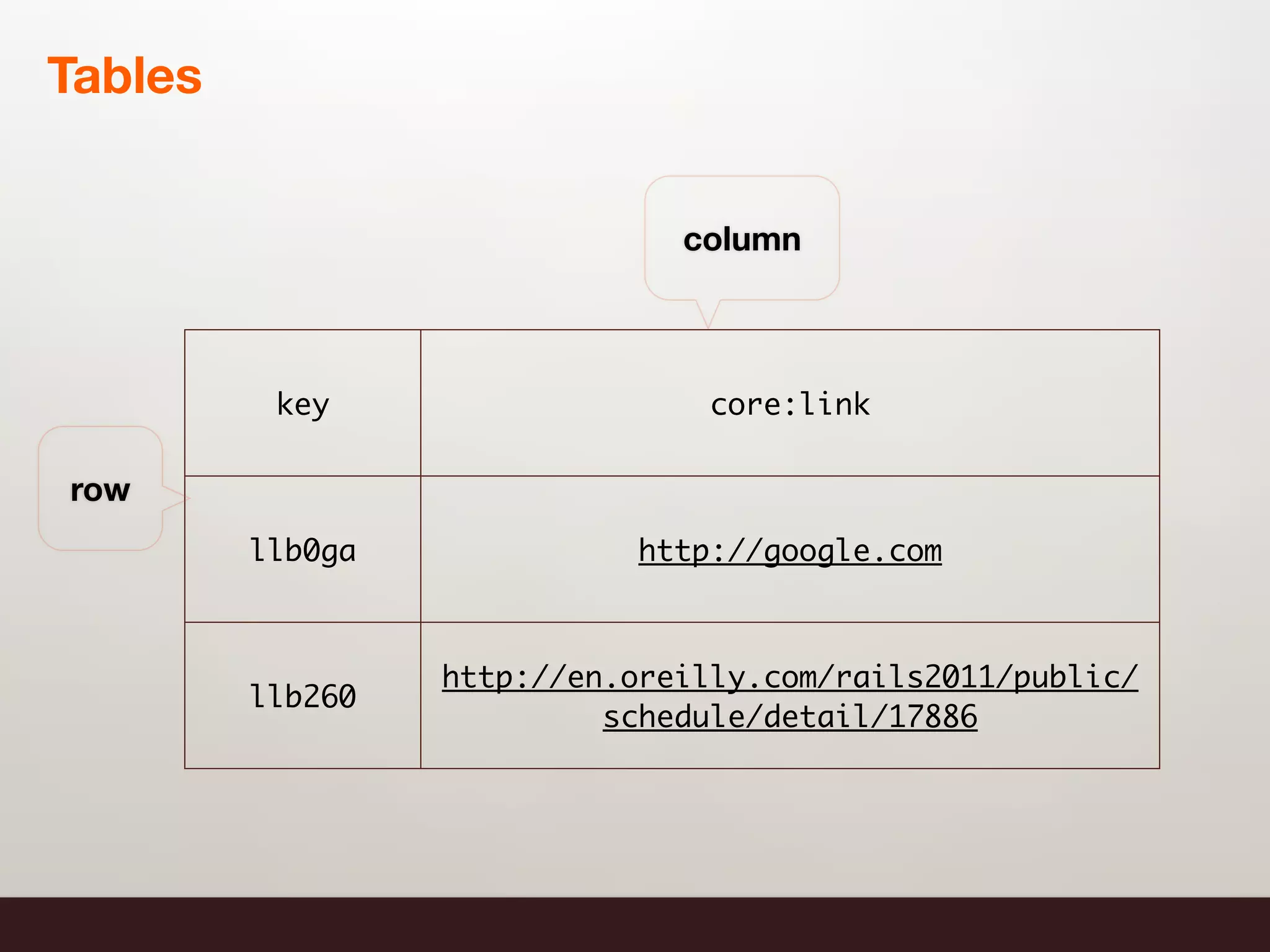
Tables


                               column


          key                    core:link

row
         llb0ga              http://google.com


                  http://en.oreilly.com/rails2011/public/
         llb260
                           schedule/detail/17886
Column Families


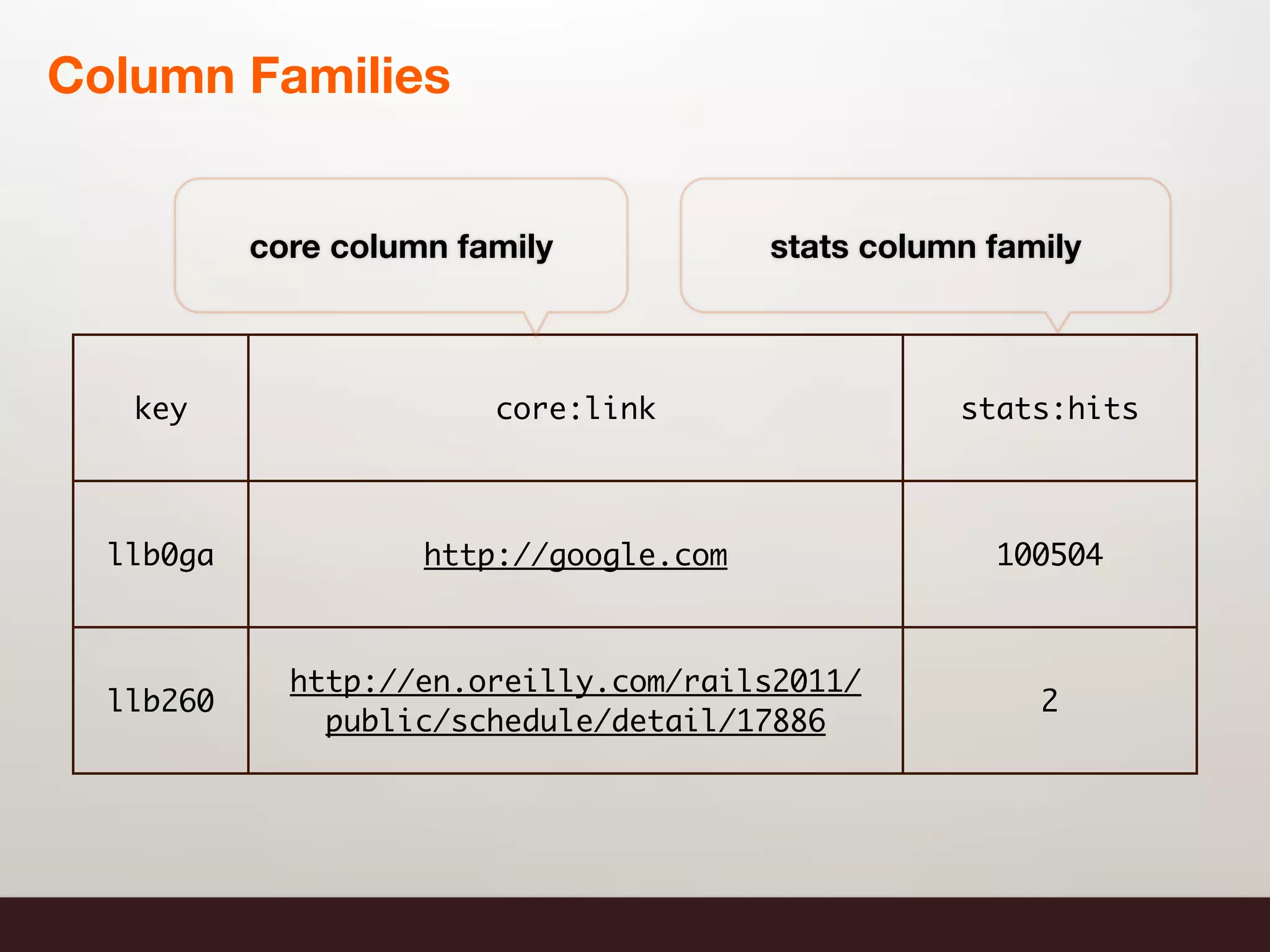
           core column family            stats column family


   key                   core:link                  stats:hits


  llb0ga             http://google.com                100504


             http://en.oreilly.com/rails2011/
  llb260                                                 2
               public/schedule/detail/17886
Column Families
   Must be defined at creation or added to schema
   later
 Should group data accessed and sized similarly
Columns
   Can be dynamically added given that the family
   exists
 Stored as a byte array - do what you need with it
Column Families:
 Data Locality
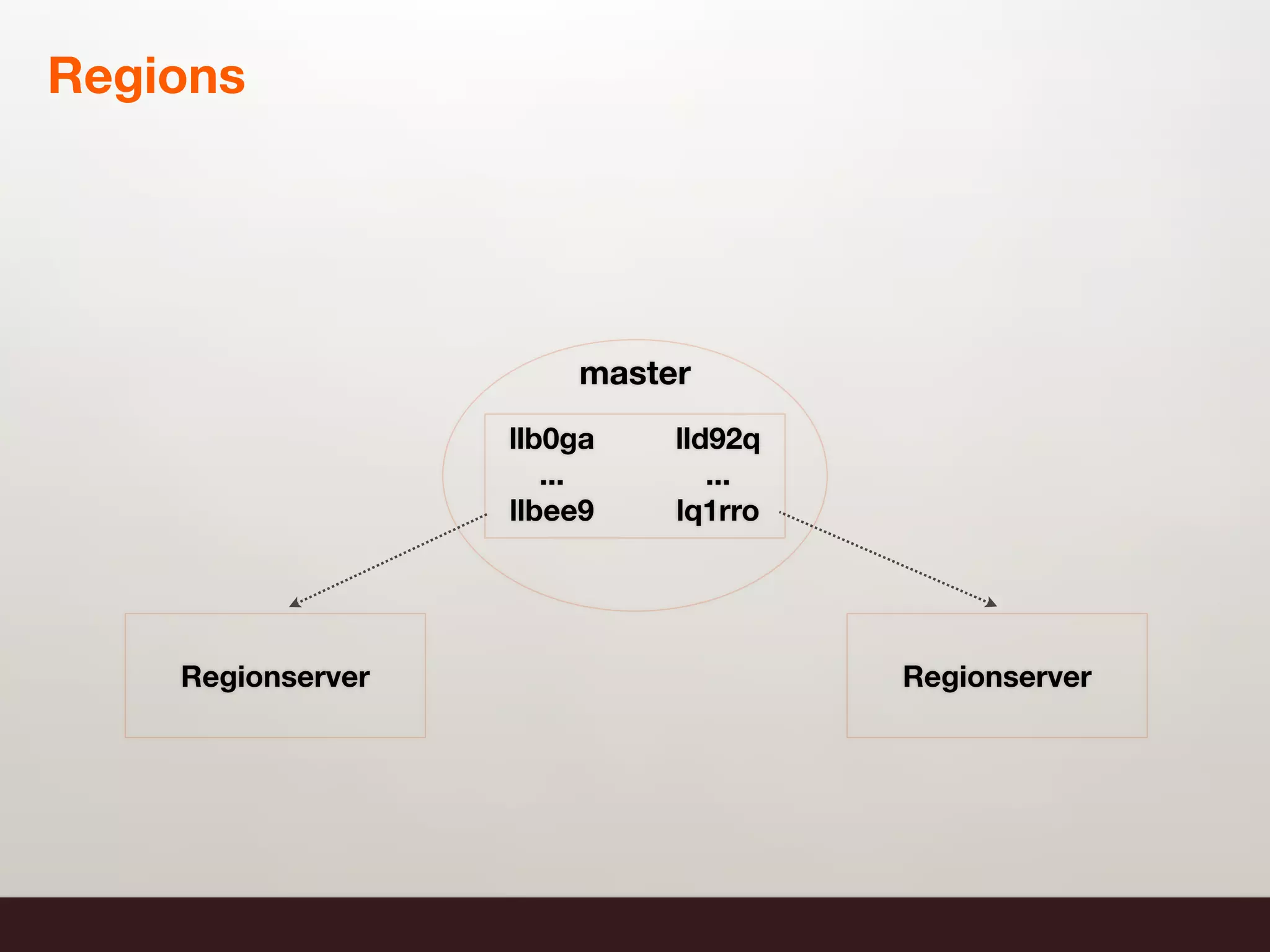
Regions


                       master
                   llb0ga   lld92q
                      ...      ...
                   llbee9   lq1rro


    Regionserver                     Regionserver
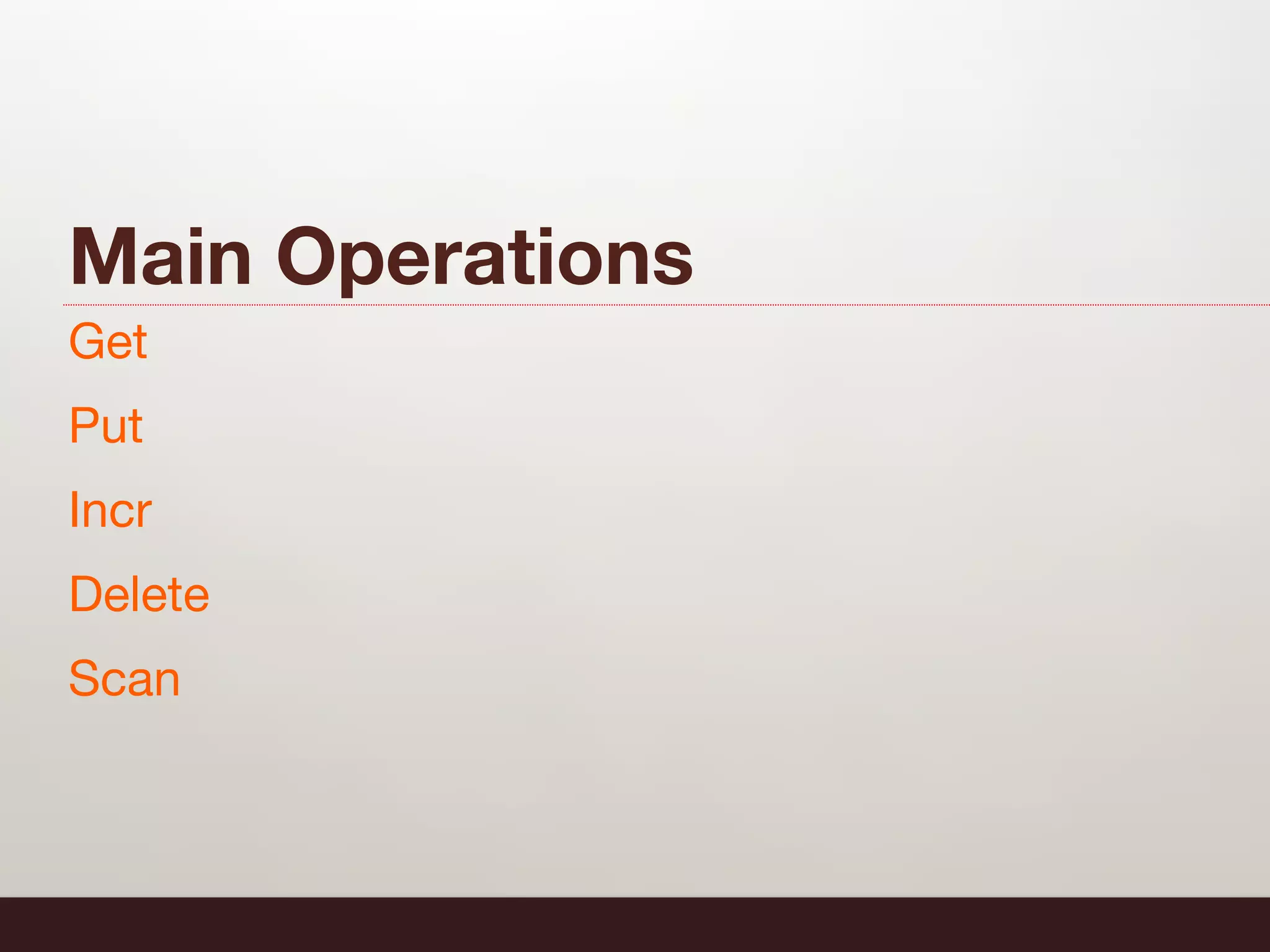
Main Operations
Get
Put
Incr
Delete
Scan
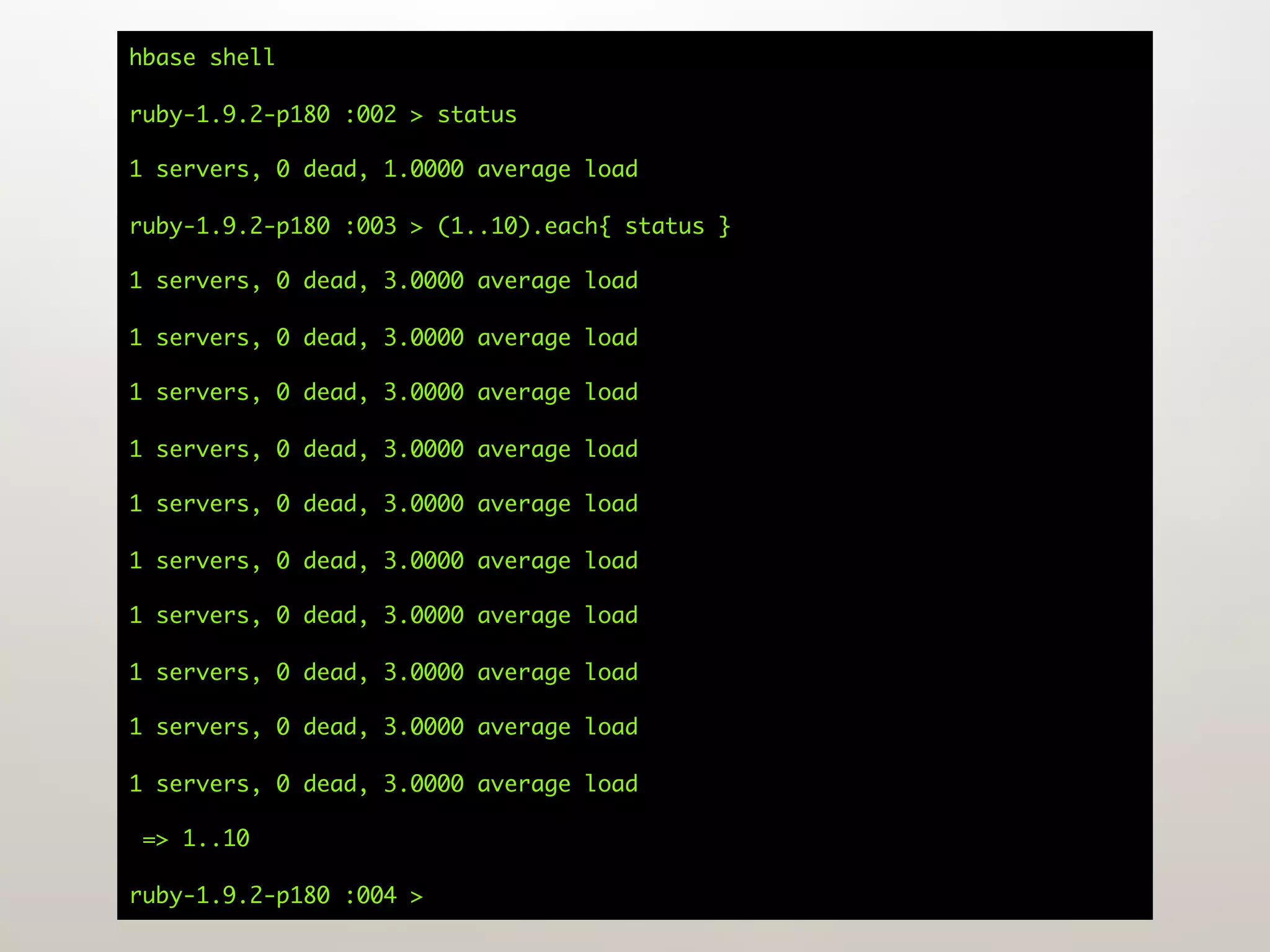
JRuby based shell
hbase shell

ruby-1.9.2-p180 :002 > status

1 servers, 0 dead, 1.0000 average load

ruby-1.9.2-p180 :003 > (1..10).each{ status }

1 servers, 0 dead, 3.0000 average load

1 servers, 0 dead, 3.0000 average load

1 servers, 0 dead, 3.0000 average load

1 servers, 0 dead, 3.0000 average load

1 servers, 0 dead, 3.0000 average load

1 servers, 0 dead, 3.0000 average load

1 servers, 0 dead, 3.0000 average load

1 servers, 0 dead, 3.0000 average load

1 servers, 0 dead, 3.0000 average load

1 servers, 0 dead, 3.0000 average load

 => 1..10

ruby-1.9.2-p180 :004 >
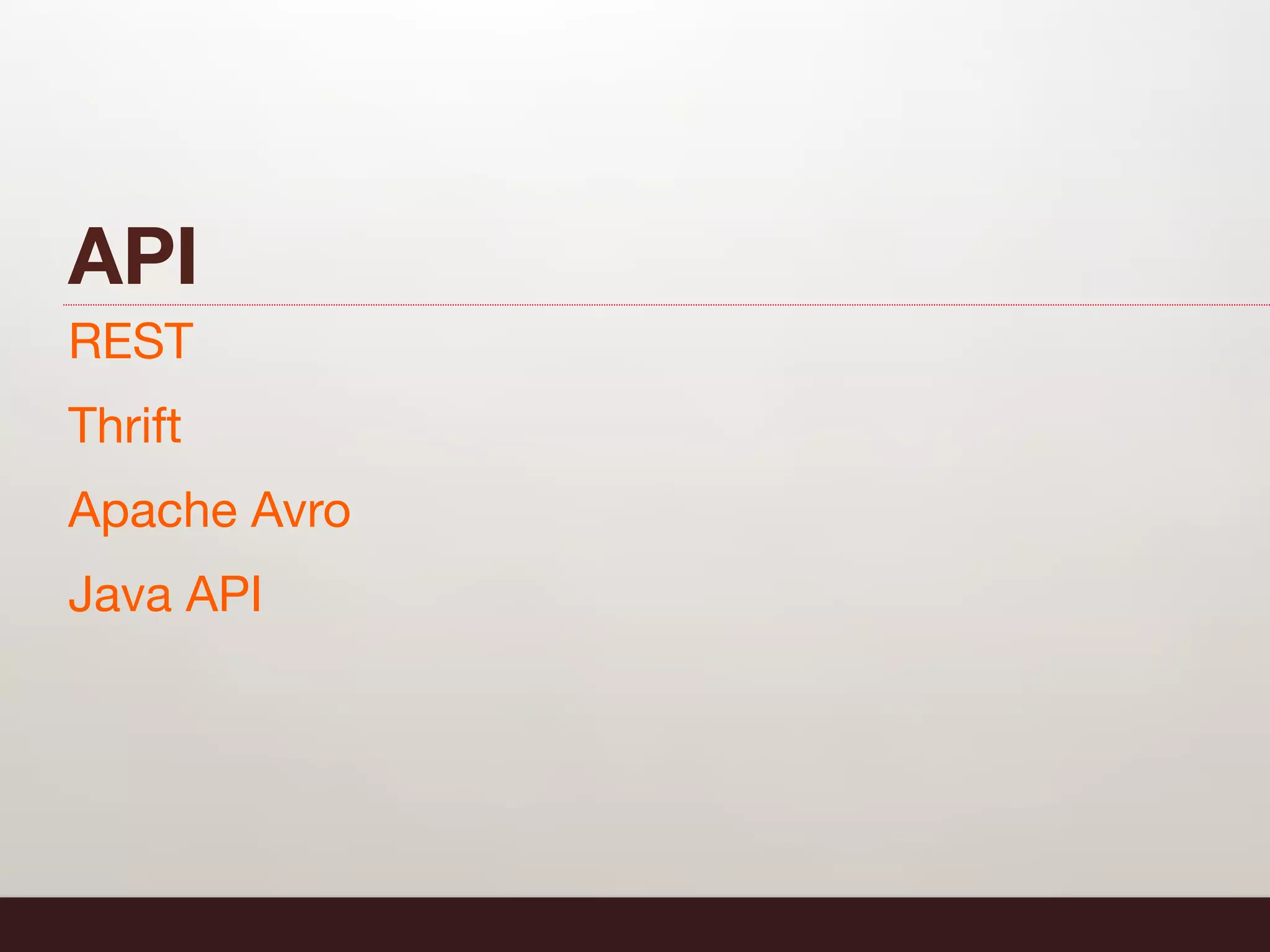
API
REST
Thrift
Apache Avro
Java API
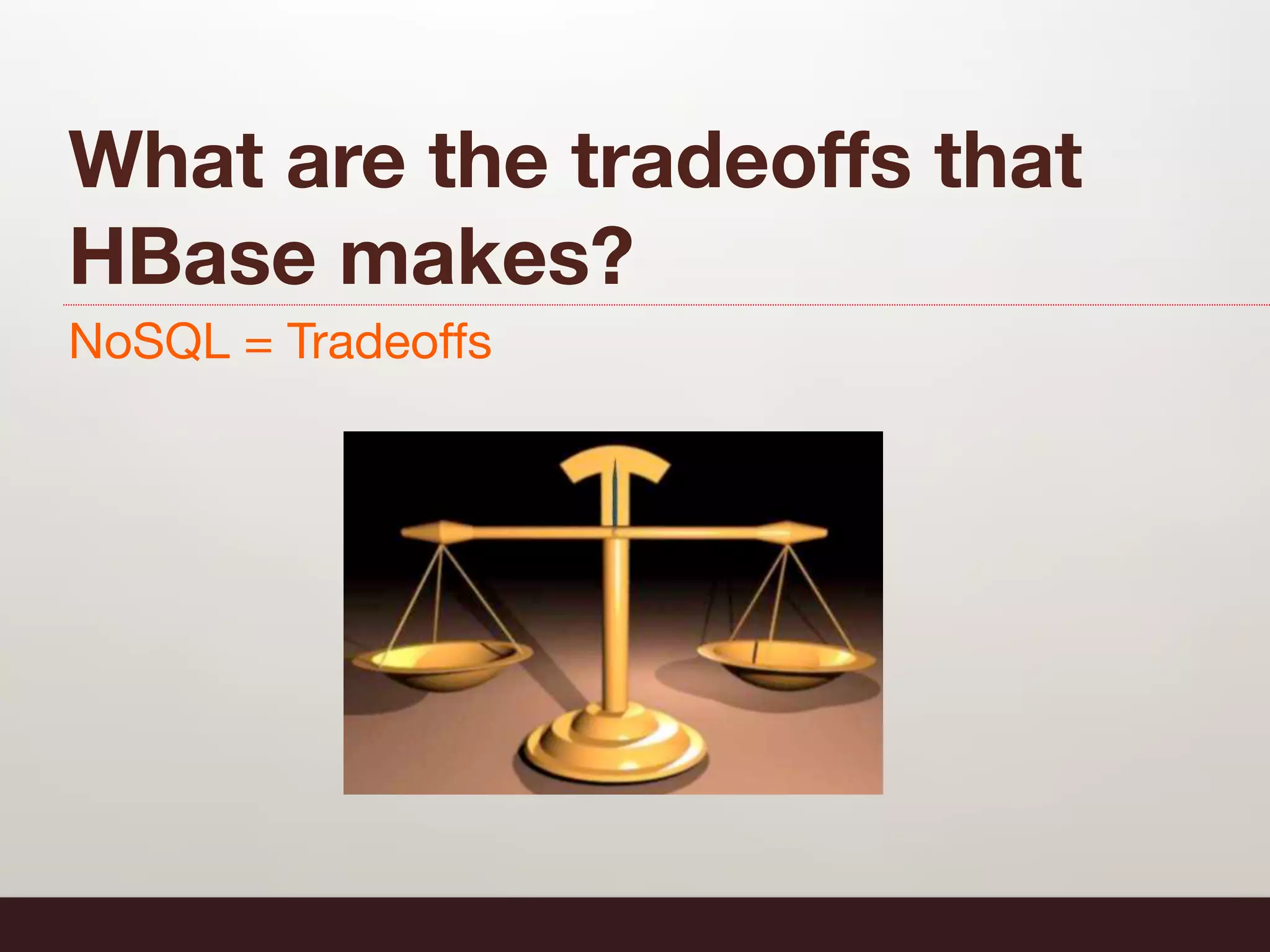
What are the tradeoffs that
HBase makes?
NoSQL = Tradeoffs
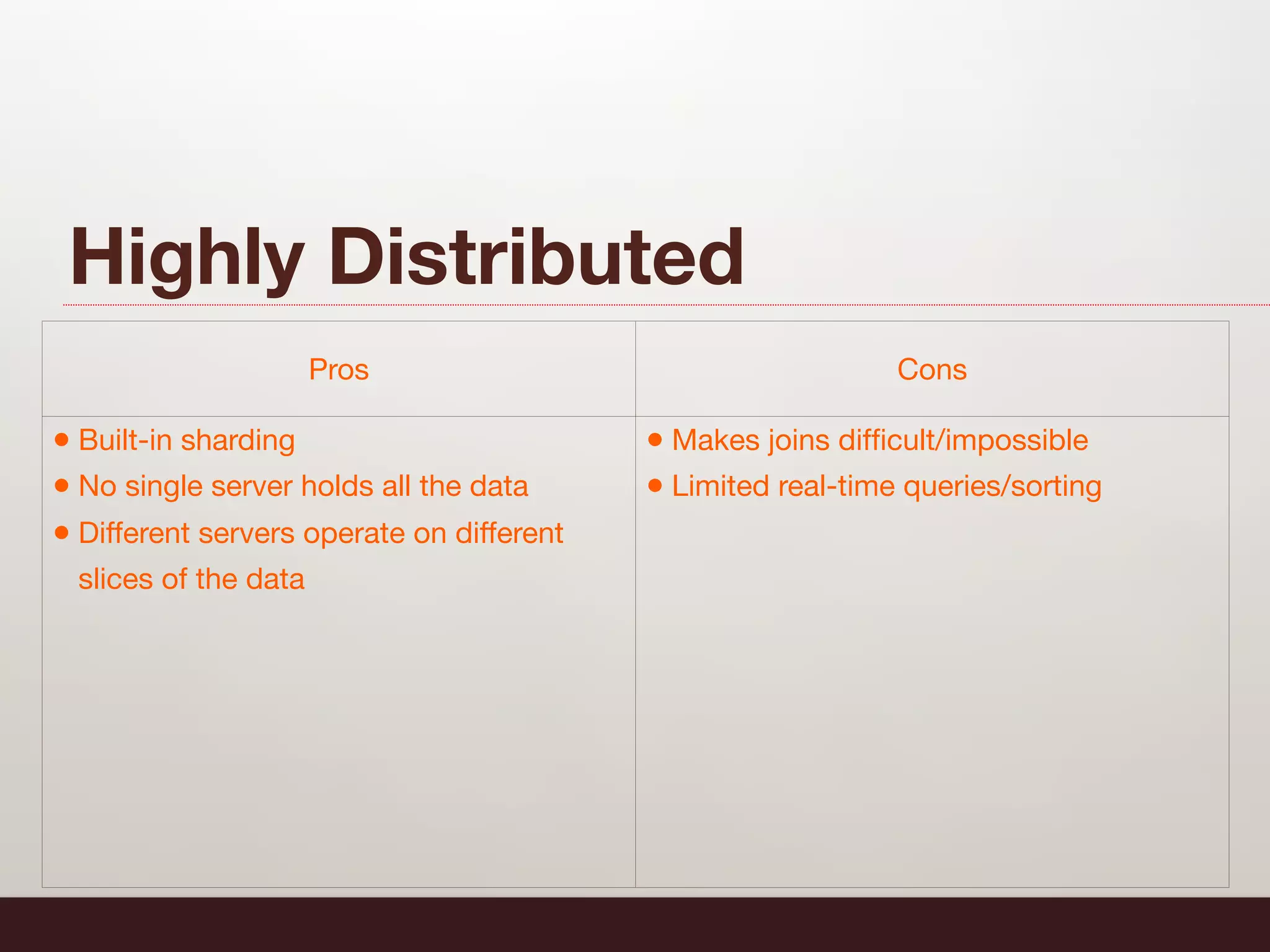
Highly Distributed
                       Pros                                   Cons

• Built-in sharding                        • Makes joins difficult/impossible
• No single server holds all the data      • Limited real-time queries/sorting
• Different servers operate on different
  slices of the data
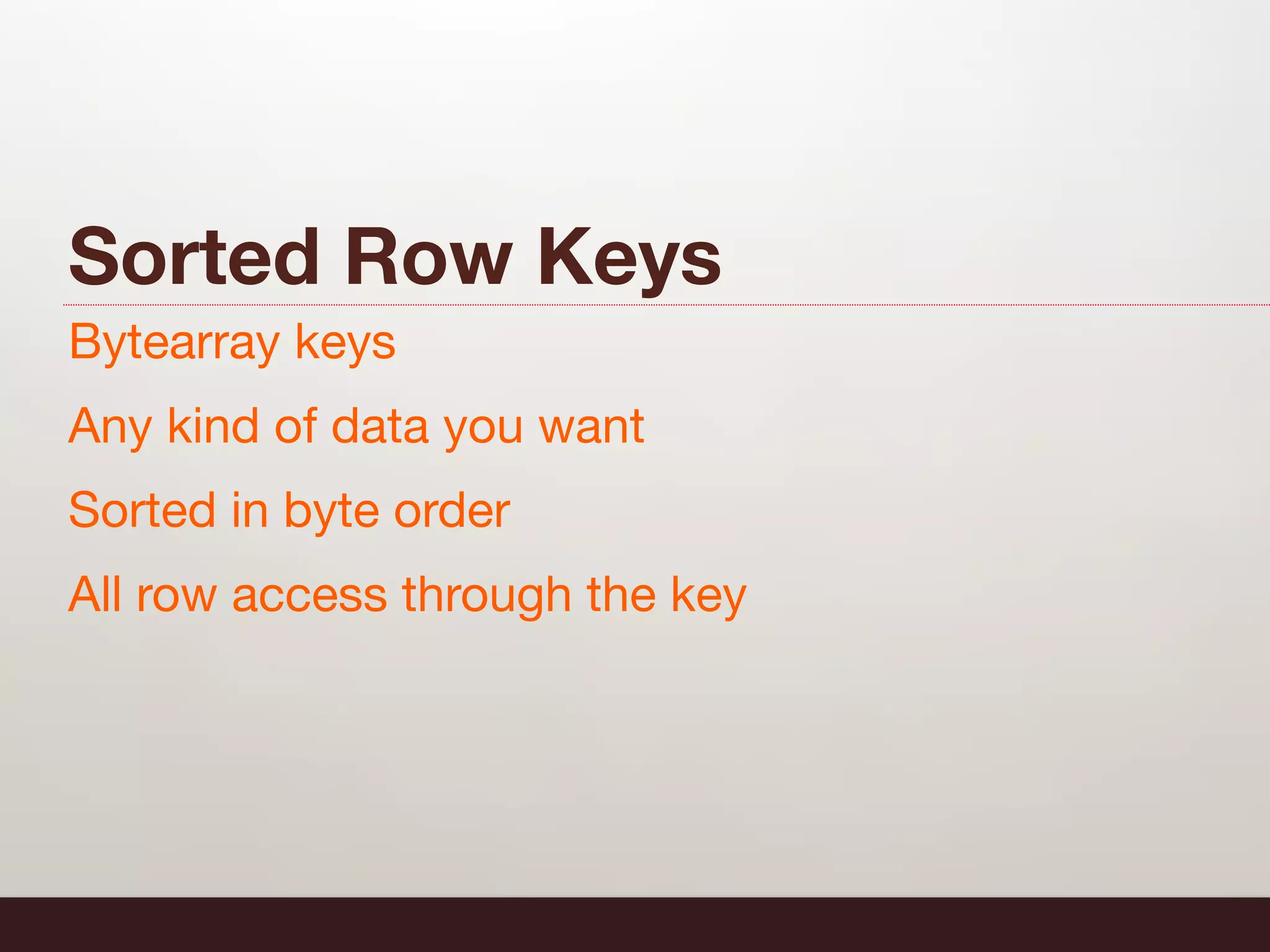
Sorted Row Keys
Bytearray keys
Any kind of data you want
Sorted in byte order
All row access through the key
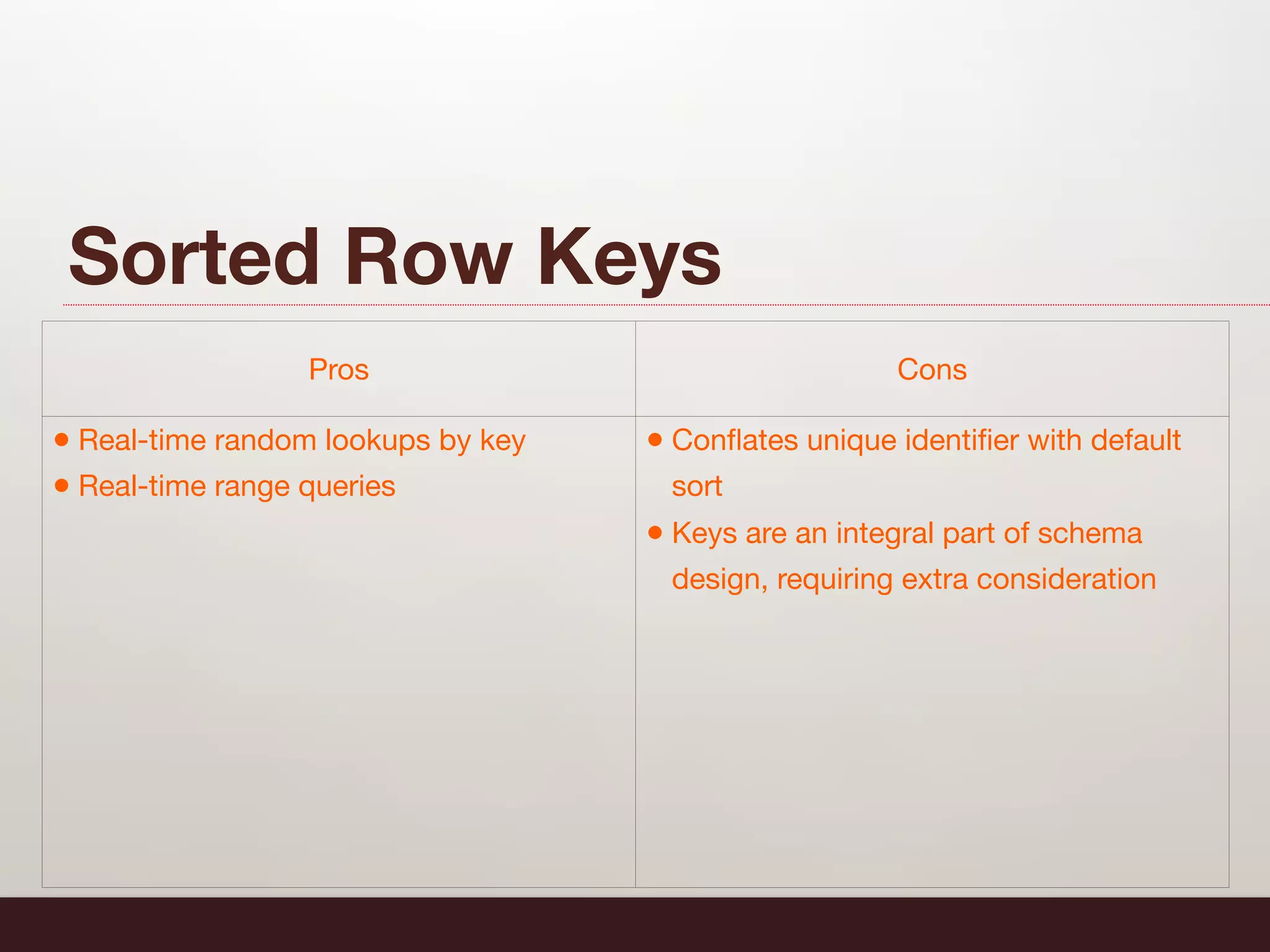
Sorted Row Keys
                 Pros                                 Cons

• Real-time random lookups by key   • Conflates unique identifier with default
• Real-time range queries            sort
                                    • Keys are an integral part of schema
                                     design, requiring extra consideration
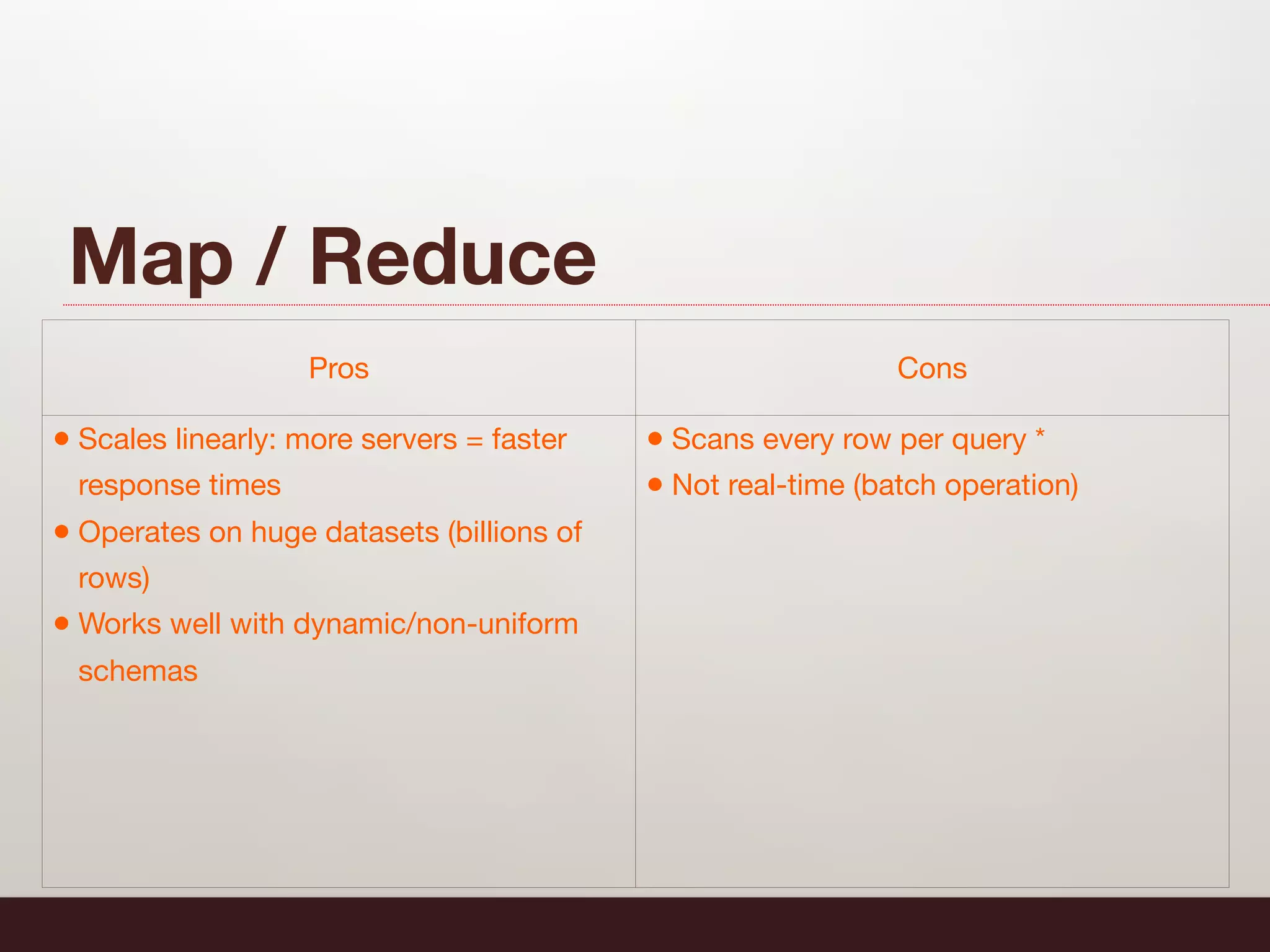
Map / Reduce
                   Pros                                       Cons

• Scales linearly: more servers = faster   • Scans every row per query *
  response times                           • Not real-time (batch operation)
• Operates on huge datasets (billions of
  rows)
• Works well with dynamic/non-uniform
  schemas
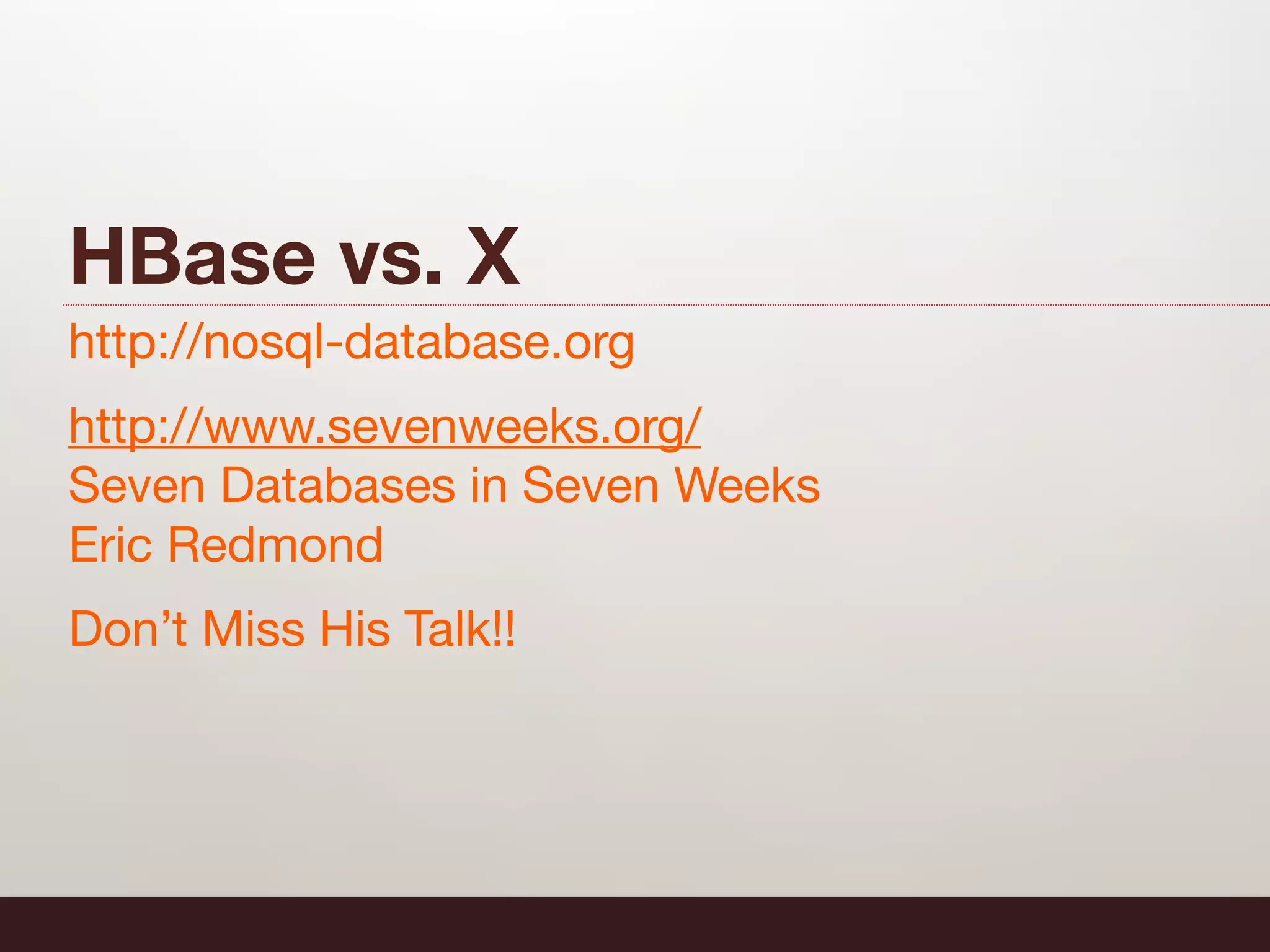
HBase vs. X
http://nosql-database.org
http://www.sevenweeks.org/
Seven Databases in Seven Weeks
Eric Redmond
Don’t Miss His Talk!!
Why HBase is
probably the wrong
choice for your app
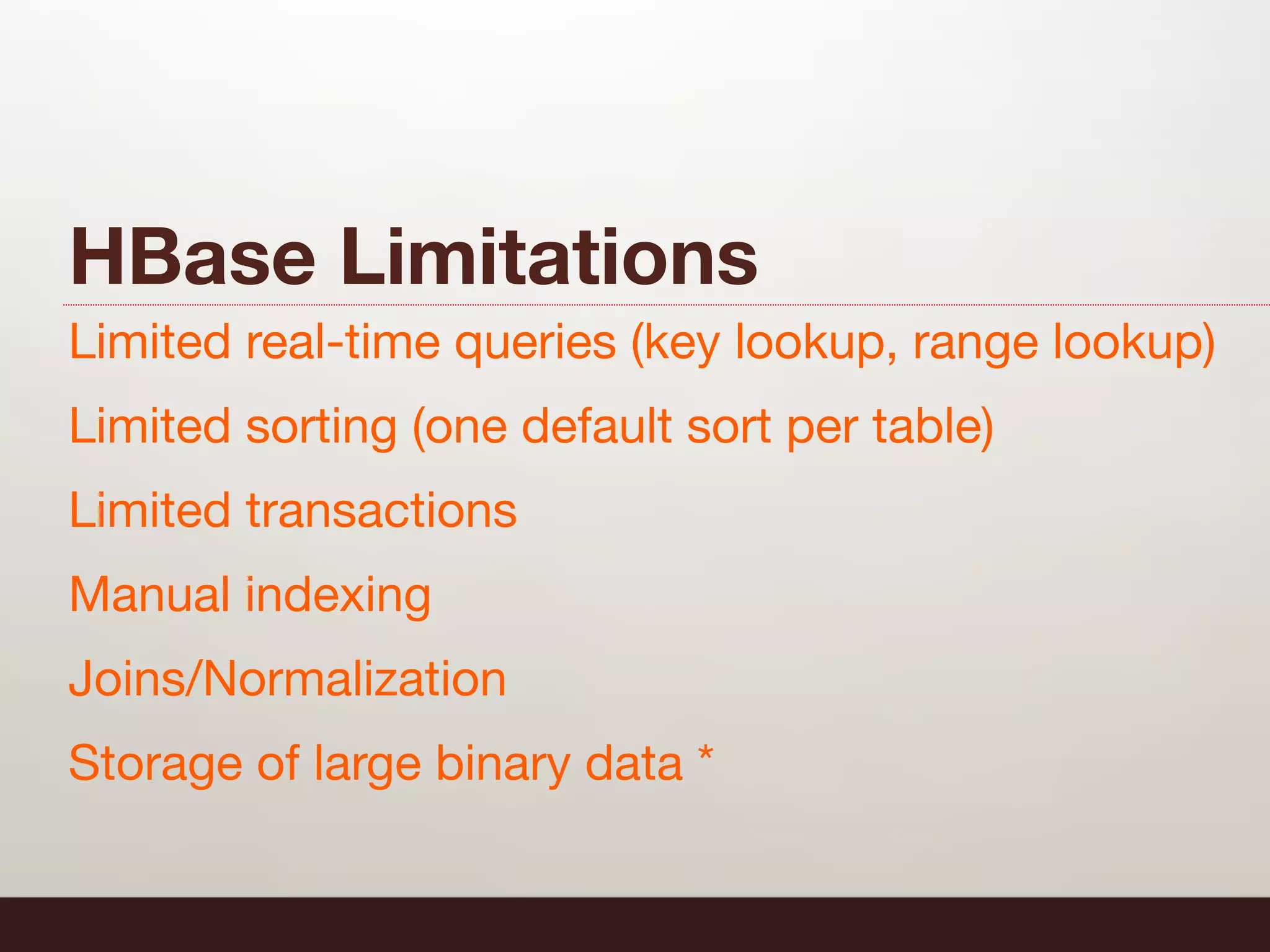
HBase Limitations
HBase Limitations
Limited real-time queries (key lookup, range lookup)
Limited sorting (one default sort per table)
Limited transactions
Manual indexing
Joins/Normalization
Storage of large binary data *
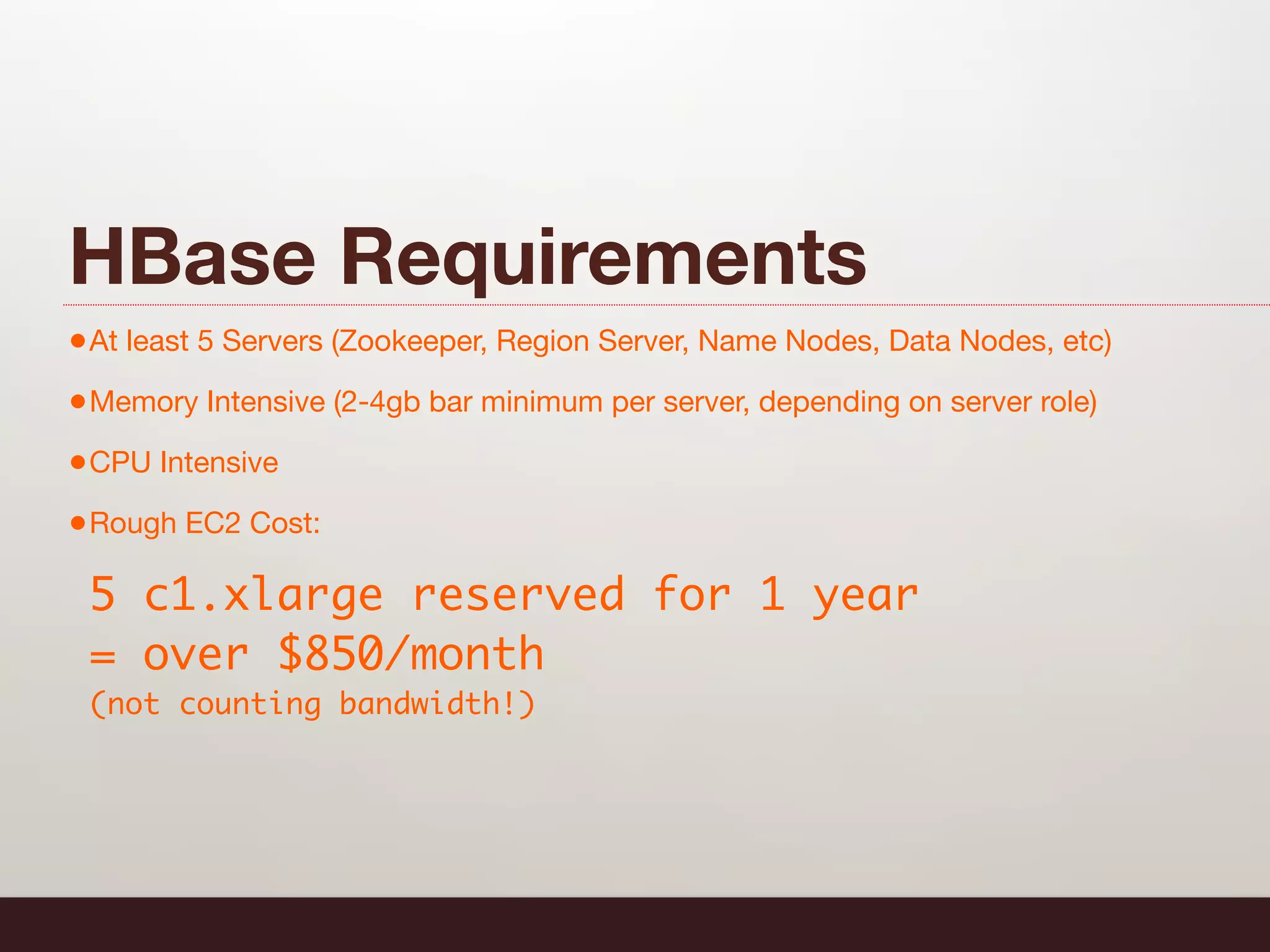
HBase Requirements
• At least 5 Servers (Zookeeper, Region Server, Name Nodes, Data Nodes, etc)
• Memory Intensive (2-4gb bar minimum per server, depending on server role)
• CPU Intensive
• Rough EC2 Cost:
 5 c1.xlarge reserved for 1 year
 = over $850/month
 (not counting bandwidth!)
Why HBase might be
the right choice for
      your app
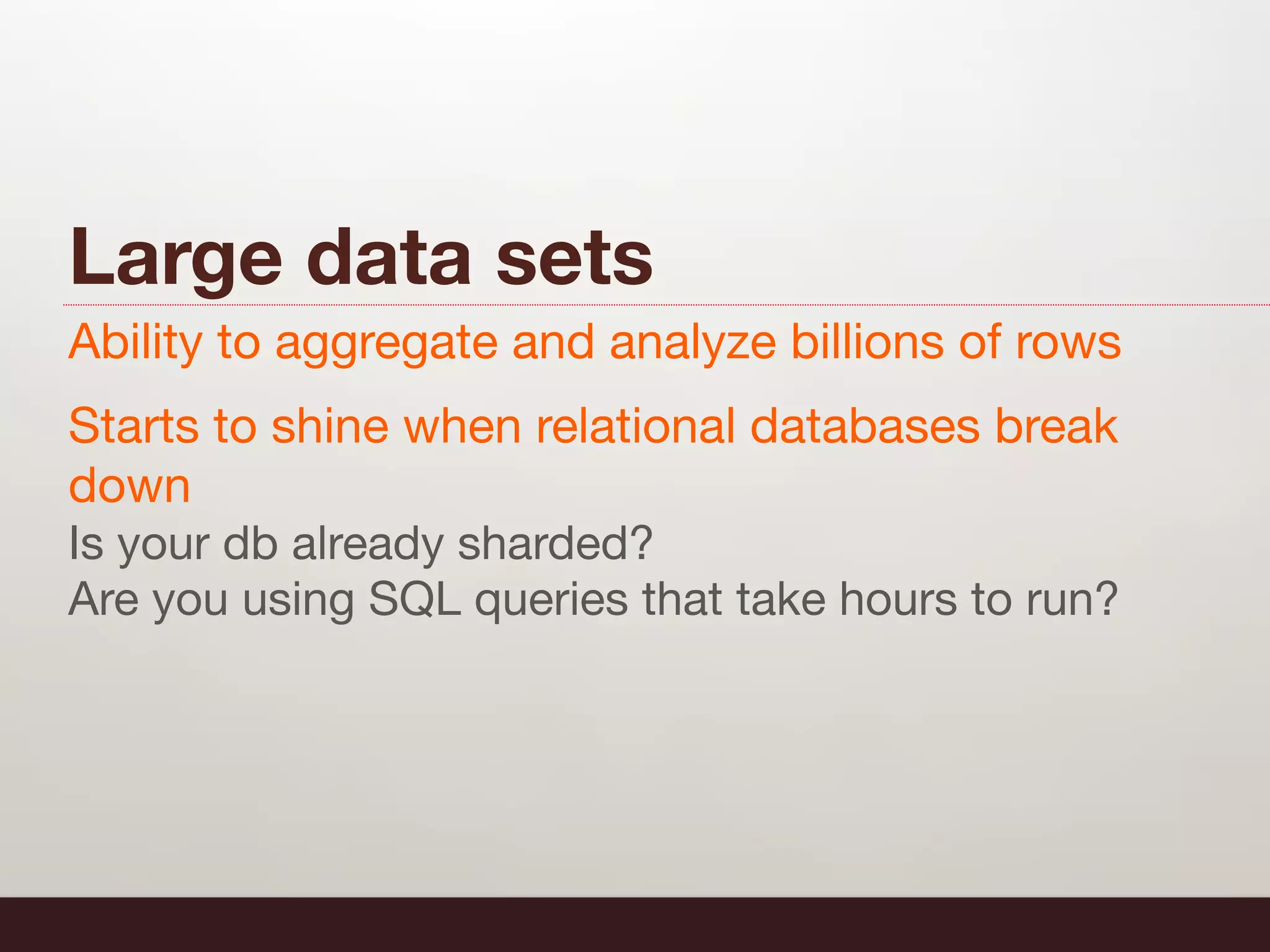
Large data sets
Ability to aggregate and analyze billions of rows
Starts to shine when relational databases break
down
Is your db already sharded?
Are you using SQL queries that take hours to run?
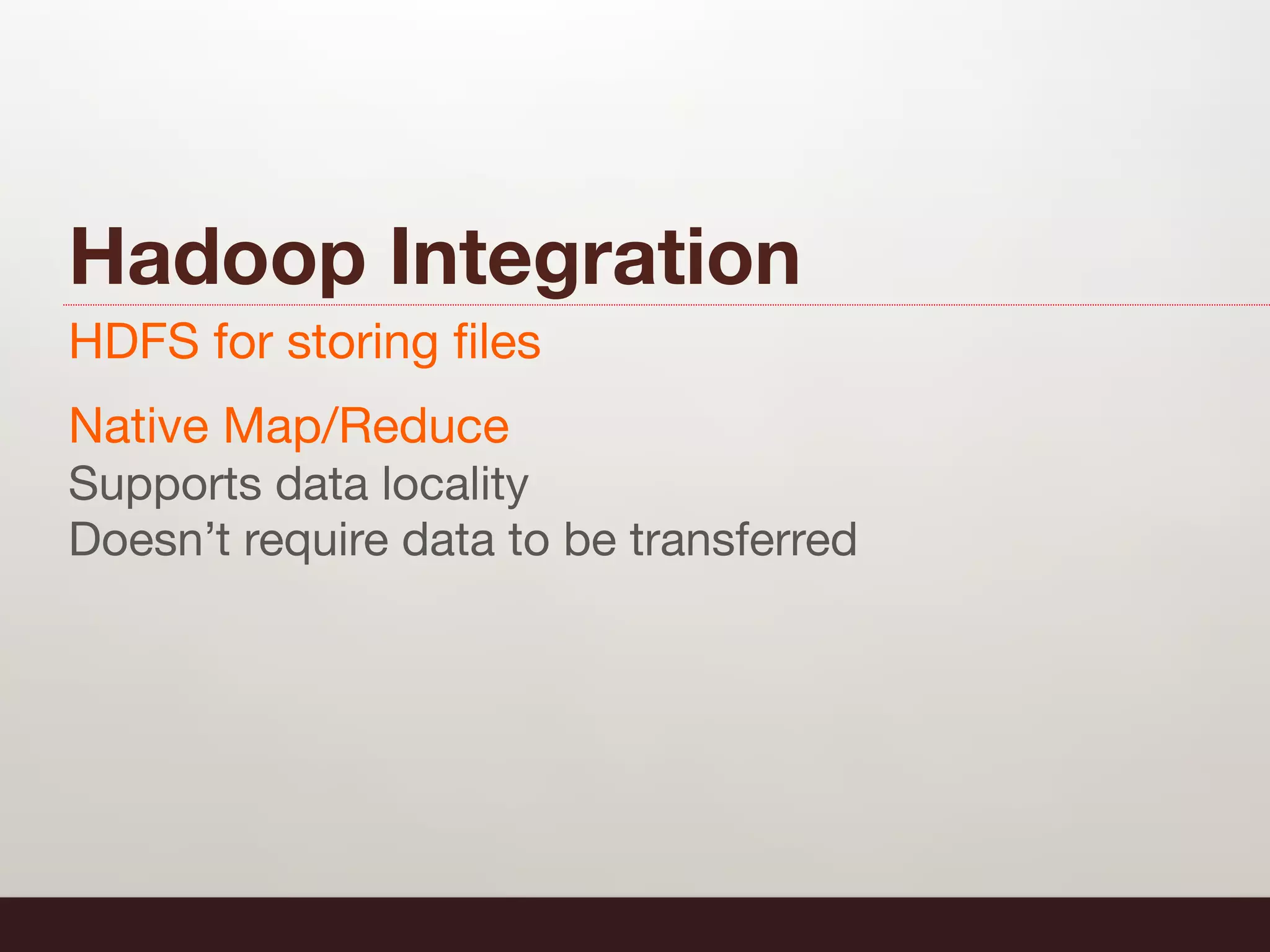
Hadoop Integration
HDFS for storing files
Native Map/Reduce
Supports data locality
Doesn’t require data to be transferred
Flexible schema
Supports non-heterogeneous data through column
families with mixed key/value pairs
Ability to refactor the data store via map/reduce
(beats a multi-day ALTER TABLE command)
Rails on HBase
hbase-stargate
https://github.com/greglu/hbase-stargate
Uses Stargate, HBase REST server
Rhino
https://github.com/sqs/rhino/
Thrift API
Seems to be abandoned?
Massive Record
https://github.com/CompanyBook/massive_record
It works!
Uses Thrift API
Kwisatz: An URL
  Shortener
Demo:
JRuby Scripts
Demo:
Rails Front-End
Source
Demo source code
github.com/effectiveui/jruby-hbase-demo
github.com/effectiveui/rails-hbase-massive-record
Getting Set Up
(Mac) brew install hbase
Cloudera VM
http://bit.ly/dSfPa9
Recap
Where Would I Use
    HBase?
Where is HBase’s
  Sweet Spot
Where Would I Use
Rails With HBase?
Questions?
Thank You!
Zachary: @zpinter
Tony: @thillerson
EffectiveUI.com

Rails on HBase