About GreyB:
We help companies solve their most pressing innovation
challenges
Who could be your next competitor? What breakthrough tech will change your industry next? What are
your competitors doing in their research labs?
And what should be your next step in your business and research strategy?
Don’t let such questions bother you in your strategic meetings and steal your sleep at night. We
constantly help our clients tackle their innovation challenges, people who are at the edge of what they
do. We can surely help you find answers as well. Let’s get in touch and reveal your industry secrets.
Sustainable Coating Innovation Trends 1
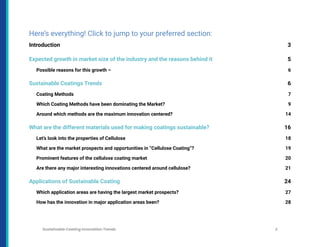
Here’s everything! Click to jump to your preferred section:
Introduction 3
Expected growth in market size of the industry and the reasons behind it 5
Possible reasons for this growth – 6
Sustainable Coatings Trends 6
Coating Methods 7
Which Coating Methods have been dominating the Market? 9
Around which methods are the maximum innovation centered? 14
What are the different materials used for making coatings sustainable? 16
Let’s look into the properties of Cellulose 18
What are the market prospects and opportunities in “Cellulose Coating”? 19
Prominent features of the cellulose coating market 20
Are there any major interesting innovations centered around cellulose? 21
Applications of Sustainable Coating 24
Which application areas are having the largest market prospects? 27
How has the innovation in major application areas been? 28
Sustainable Coating Innovation Trends 2
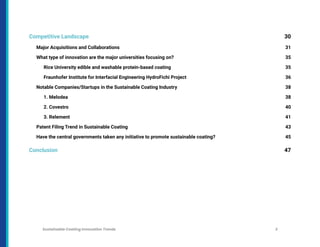
Competitive Landscape 30
Major Acquisitions and Collaborations 31
What type of innovation are the major universities focusing on? 35
Rice University edible and washable protein-based coating 35
Fraunhofer Institute for Interfacial Engineering HydroFichi Project 36
Notable Companies/Startups in the Sustainable Coating Industry 38
1. Melodea 38
2. Covestro 40
3. Relement 41
Patent Filing Trend in Sustainable Coating 43
Have the central governments taken any initiative to promote sustainable coating? 45
Conclusion 47
Sustainable Coating Innovation Trends 3
Introduction
Decades ago, green or sustainable coatings were termed eco-friendly coatings that emit almost negligible
volatile organic compounds (VOCs) during the production process. But now this definition has been
extended to sustainability aspects. Today, companies are also looking to impact the entire value chain and
consider the societal impacts of their activities.
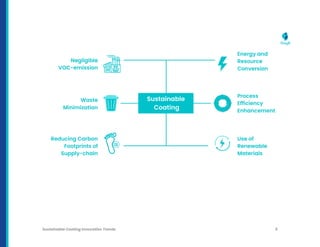
Three major elements are driving the coating industry towards sustainability, i.e. Health, Climate Change,
and Circular Economy. These entail energy and resource conservation, waste minimization, process
efficiency enhancement, use of renewable materials, and much more.
With the growing concerns for climate and sustainability, we can expect these practices to give birth to more
innovations and products soon. To get an idea of the same we researched the top innovation trends in the
Industry. And in this article, we’ll dig into these trends. But first, let’s see how the industry is growing.
Sustainable Coating Innovation Trends 4
Sustainable Coating Innovation Trends 5
Expected growth in market size of the industry and the reasons
behind it
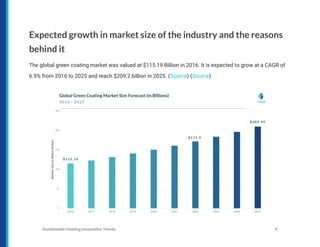
The global green coating market was valued at $115.19 Billion in 2016. It is expected to grow at a CAGR of
6.9% from 2016 to 2025 and reach $209.2 billion in 2025. (Source) (Source)
Sustainable Coating Innovation Trends 6
Possible reasons for this growth –
● The construction and automotive sectors have been witnessing a consistently growing product
penetration and exponential growth in their products and innovations.
● The climate concerns and public awareness are pushing the existing OEMs as well as start-ups
and small businesses to innovate and develop more eco-friendly coating.
● The increase in demand could also be attributed to the company’s willingness to replace the
existing coatings with low-VOC emitting coatings.
● An increase in stringent government regulations associated with VOC.
● There’s rising demand for waterborne and powder technology, especially in architectural and
automotive applications, which is also expected to drive industry growth. (Source, Source)
Sustainable Coatings Trends
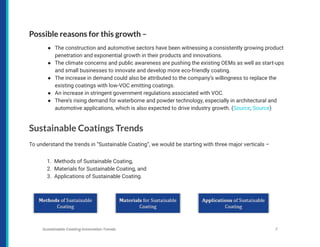
To understand the trends in “Sustainable Coating”, we would be starting with three major verticals –
1. Methods of Sustainable Coating,
2. Materials for Sustainable Coating, and
3. Applications of Sustainable Coating.
Sustainable Coating Innovation Trends 7
Note: In each vertical, we conducted an in-depth study of its types and the parameters associated with the
market and patent statistics to predict which aspects would gain traction soon.
Coating Methods
1. Powder Coating
Powdered polymer resins are melted, mixed, cooled, and grounded in uniform powder (like baking flour).
Powder coatings contain no solvents and therefore emit negligible polluting VOCs into the atmosphere. 1,2
2. High Solids Coating
It is a single or dual coating formulated with higher concentrations (at least 65%) of solids (binders,
pigments, and additives) despite a lower percentage of VOCs. They are more environmentally friendly
because less solvent is emitted as it dries or cures. 1
3. UV-Cure Coating
It is a kind of radiation cure coating that offers rapid drying time, low energy consumption (hence less
energy cost), fewer VOC emissions, reduced floor space requirements, and an indefinite pot life. 1
Sustainable Coating Innovation Trends 8
4. Waterborne Coating
It is an eco-friendly surface treatment that uses water as a solvent to disperse the resins used in coating:
They have low VOC content, high corrosion protection, less toxicity and flammability, and thus, are
eco-friendly. (Source)
5. Radiation Cure Coating
They are cross-linked or cured using high-intensity radiation energy from electron beams or ultraviolet light
radiation. They utilize less energy, hence require low energy costs and exhibit improved corrosion protection
for metals. (Source)
6. Solvent-less Coating
This kind of fluid is applied to a substrate’s surface to prevent corrosion. It has an impermeable preventative
layer with low or no moisture content. The layer helps reduce an electrolytic attack on the metal’s surface. 1
Other minor methods of sustainable or green coating are – solar reflective coating, chrome-free coating,
bio-renewable coating, etc. (Source)
Sustainable Coating Innovation Trends 9
Which Coating Methods have been dominating the Market?
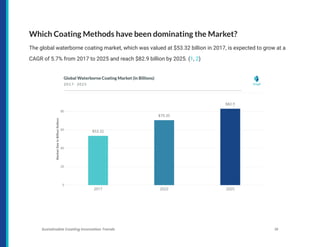
The global waterborne coating market, which was valued at $53.32 billion in 2017, is expected to grow at a
CAGR of 5.7% from 2017 to 2025 and reach $82.9 billion by 2025. (1, 2)
Sustainable Coating Innovation Trends 10
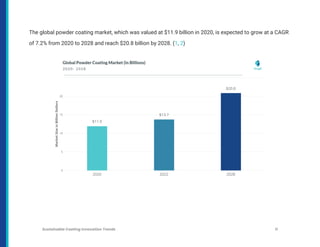
The global powder coating market, which was valued at $11.9 billion in 2020, is expected to grow at a CAGR
of 7.2% from 2020 to 2028 and reach $20.8 billion by 2028. (1, 2)
Sustainable Coating Innovation Trends 11
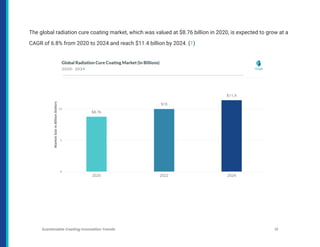
The global radiation cure coating market, which was valued at $8.76 billion in 2020, is expected to grow at a
CAGR of 6.8% from 2020 to 2024 and reach $11.4 billion by 2024. (1)
Sustainable Coating Innovation Trends 12
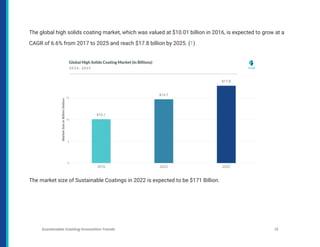
The global high solids coating market, which was valued at $10.01 billion in 2016, is expected to grow at a
CAGR of 6.6% from 2017 to 2025 and reach $17.8 billion by 2025. (1)
The market size of Sustainable Coatings in 2022 is expected to be $171 Billion.
Sustainable Coating Innovation Trends 13
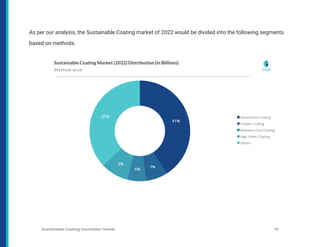
As per our analysis, the Sustainable Coating market of 2022 would be divided into the following segments
based on methods.
Sustainable Coating Innovation Trends 14
Around which methods are the maximum innovation centered?
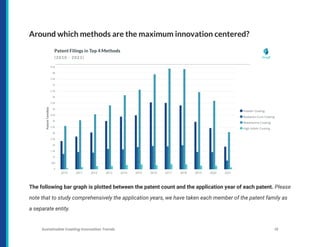
The following bar graph is plotted between the patent count and the application year of each patent. Please
note that to study comprehensively the application years, we have taken each member of the patent family as
a separate entity.
Sustainable Coating Innovation Trends 15
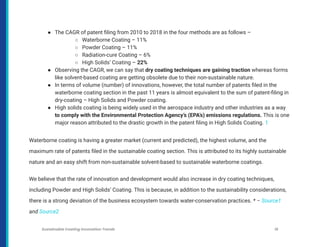
● The CAGR of patent filing from 2010 to 2018 in the four methods are as follows –
○ Waterborne Coating – 11%
○ Powder Coating – 11%
○ Radiation-cure Coating – 6%
○ High Solids’ Coating – 22%
● Observing the CAGR, we can say that dry coating techniques are gaining traction whereas forms
like solvent-based coating are getting obsolete due to their non-sustainable nature.
● In terms of volume (number) of innovations, however, the total number of patents filed in the
waterborne coating section in the past 11 years is almost equivalent to the sum of patent-filing in
dry-coating – High Solids and Powder coating.
● High solids coating is being widely used in the aerospace industry and other industries as a way
to comply with the Environmental Protection Agency’s (EPA’s) emissions regulations. This is one
major reason attributed to the drastic growth in the patent filing in High Solids Coating. 1
Waterborne coating is having a greater market (current and predicted), the highest volume, and the
maximum rate of patents filed in the sustainable coating section. This is attributed to its highly sustainable
nature and an easy shift from non-sustainable solvent-based to sustainable waterborne coatings.
We believe that the rate of innovation and development would also increase in dry coating techniques,
including Powder and High Solids’ Coating. This is because, in addition to the sustainability considerations,
there is a strong deviation of the business ecosystem towards water-conservation practices. * – Source1
and Source2
Sustainable Coating Innovation Trends 16
What are the different materials used for making coatings
sustainable?
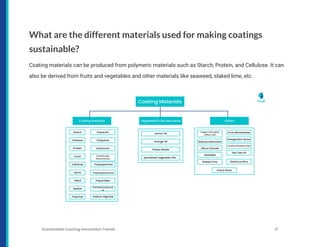
Coating materials can be produced from polymeric materials such as Starch, Protein, and Cellulose. It can
also be derived from fruits and vegetables and other materials like seaweed, slaked lime, etc.
Sustainable Coating Innovation Trends 17
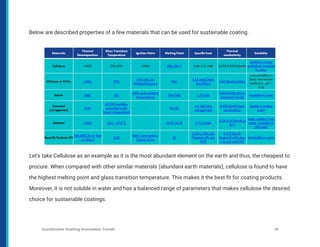
Below are described properties of a few materials that can be used for sustainable coating.
Let’s take Cellulose as an example as it is the most abundant element on the earth and thus, the cheapest to
procure. When compared with other similar materials (abundant earth materials), cellulose is found to have
the highest melting point and glass transition temperature. This makes it the best fit for coating products.
Moreover, it is not soluble in water and has a balanced range of parameters that makes cellulose the desired
choice for sustainable coatings.
Sustainable Coating Innovation Trends 18
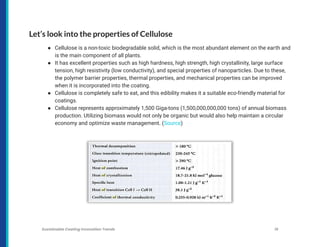
Let’s look into the properties of Cellulose
● Cellulose is a non-toxic biodegradable solid, which is the most abundant element on the earth and
is the main component of all plants.
● It has excellent properties such as high hardness, high strength, high crystallinity, large surface
tension, high resistivity (low conductivity), and special properties of nanoparticles. Due to these,
the polymer barrier properties, thermal properties, and mechanical properties can be improved
when it is incorporated into the coating.
● Cellulose is completely safe to eat, and this edibility makes it a suitable eco-friendly material for
coatings.
● Cellulose represents approximately 1,500 Giga-tons (1,500,000,000,000 tons) of annual biomass
production. Utilizing biomass would not only be organic but would also help maintain a circular
economy and optimize waste management. (Source)
Sustainable Coating Innovation Trends 19
What are the market prospects and opportunities in “Cellulose Coating”?
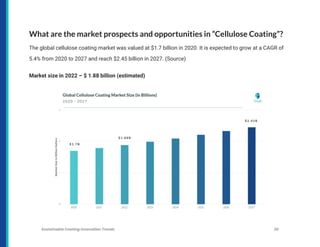
The global cellulose coating market was valued at $1.7 billion in 2020. It is expected to grow at a CAGR of
5.4% from 2020 to 2027 and reach $2.45 billion in 2027. (Source)
Market size in 2022 – $ 1.88 billion (estimated)
Sustainable Coating Innovation Trends 20
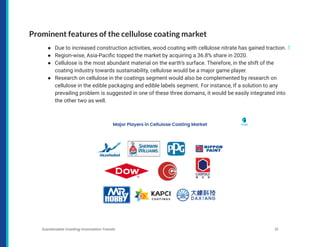
Prominent features of the cellulose coating market
● Due to increased construction activities, wood coating with cellulose nitrate has gained traction. 1
● Region-wise, Asia-Pacific topped the market by acquiring a 36.8% share in 2020.
● Cellulose is the most abundant material on the earth’s surface. Therefore, in the shift of the
coating industry towards sustainability, cellulose would be a major game player.
● Research on cellulose in the coatings segment would also be complemented by research on
cellulose in the edible packaging and edible labels segment. For instance, If a solution to any
prevailing problem is suggested in one of these three domains, it would be easily integrated into
the other two as well.
Sustainable Coating Innovation Trends 21
The cellulose coating market comprises 9.6 % of the world’s cellulose and only 1.1 % of the world’s coating
market as of 2022. However, out of the total patents in sustainable coatings that we analyzed, approximately
20% of them had mentioned cellulose in their composition.
This signifies that entities are heavily researching and filing patents in cellulose-based coatings. Cellulose
would likely be a dominant ingredient and the torch-bearer in the upcoming “Sustainable Coating” revolution!
Are there any major interesting innovations centered around cellulose?
1. EMPA Sustainable and Edible Coating
Generally in supermarkets, a lot of plastic waste is generated due to plastic packaging in fruits and
vegetables. Also, non-packaged or uncovered fruits have a greater chance of getting rotten early.
A team of researchers from the Swiss Federal Laboratories for Materials Science and Technology (Empa)
has found a solution to this problem by actually replacing plastic packaging with sustainable and edible
coating. They have developed an invisible, edible, plant-based coating that can help fresh produce last longer
— all the while taking plastic packaging out of the equation. Their coating has been created by using
“pomace” — a pulpy residue left over from the blending of fruits and vegetables for juice.
Sustainable Coating Innovation Trends 22
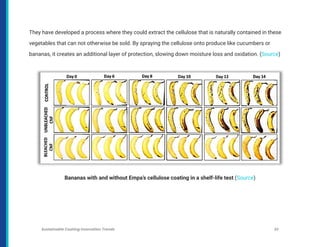
They have developed a process where they could extract the cellulose that is naturally contained in these
vegetables that can not otherwise be sold. By spraying the cellulose onto produce like cucumbers or
bananas, it creates an additional layer of protection, slowing down moisture loss and oxidation. (Source)
Bananas with and without Empa’s cellulose coating in a shelf-life test (Source)
Sustainable Coating Innovation Trends 23
2. Moscow Power Institute coating based on bacterial cellulose
Mechanical damage to the liver is one of the most prominent and commonly occurring injuries to the
organs. Some of the compositions to accelerate wound healing and tissue regeneration consist of
polypeptides, nucleic acids, and suitable carriers. The disadvantage of these solutions is the possibility of
rejection of materials due to the present antigenicity, especially when using biomaterials of animal origin.
Moscow Power Institute has patented (RU2695066C1) a solution for this problem by treating traumatic liver
breaks using a film coating based on bacterial cellulose. This cellulose, when modified with animal proteins,
is biologically compatible with the tissues of the human body and can regenerate damaged tissue.
This invention provides an expansion of the range of drugs for the rapid recovery of damaged organ.
3. Surfresca breathable coating
Surfresca, founded in 2020 and headquartered in Israel has developed a breathable coating which is an
edible, biodegradable, water-based emulsion composed of wholly natural food ingredients and inbuilt with
advanced modified atmosphere properties.
Sustainable Coating Innovation Trends 24
When the coating is applied to fresh fruit or vegetable, the solution creates a breathable coating, with minute
disruptions within the coating acting as a partial barrier, allowing for “optimal gas exchange”. This slows
down the post-harvest maturation and ripening processes and subsequent degradation and decay.
According to Surfresca, the sustainable solution could extend shelf-life by up to several weeks. (Source)
Most of the cellulose-based sustainable coating methods are associated with – edibles, cooking utensils,
tablets and capsules, medical adhesive tape, eco-friendly fertilizers, or water-based fireproof heat insulation.
We believe that the Pharmaceutical Industry, packed-food industry, and household utilities would be a major
markets demanding edible coating products like cellulose, and would open up various business
opportunities.
In addition, cellulose might also witness an increased demand in novel areas like superhydrophobic
coatings.
Sustainable Coating Innovation Trends 25
Applications of Sustainable Coating
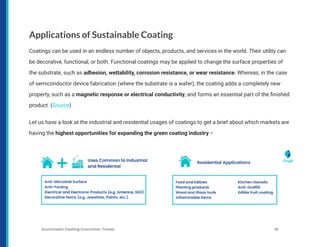
Coatings can be used in an endless number of objects, products, and services in the world. Their utility can
be decorative, functional, or both. Functional coatings may be applied to change the surface properties of
the substrate, such as adhesion, wettability, corrosion resistance, or wear resistance. Whereas, in the case
of semiconductor device fabrication (where the substrate is a wafer), the coating adds a completely new
property, such as a magnetic response or electrical conductivity, and forms an essential part of the finished
product. (Source)
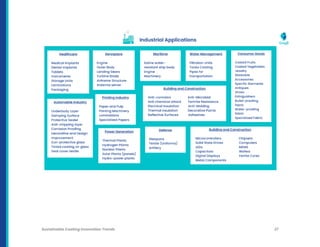
Let us have a look at the industrial and residential usages of coatings to get a brief about which markets are
having the highest opportunities for expanding the green coating industry –
Sustainable Coating Innovation Trends 26
Sustainable Coating Innovation Trends 27
Which application areas are having the largest market prospects?
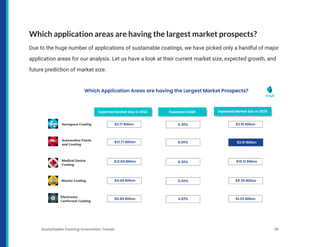
Due to the huge number of applications of sustainable coatings, we have picked only a handful of major
application areas for our analysis. Let us have a look at their current market size, expected growth, and
future prediction of market size.
Sustainable Coating Innovation Trends 28
How has the innovation in major application areas been?
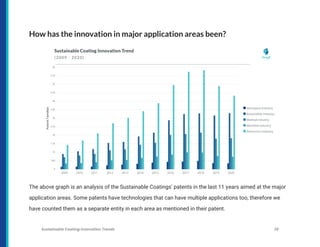
The above graph is an analysis of the Sustainable Coatings’ patents in the last 11 years aimed at the major
application areas. Some patents have technologies that can have multiple applications too, therefore we
have counted them as a separate entity in each area as mentioned in their patent.
Sustainable Coating Innovation Trends 29
Key takeaways –
● Sustainable Coating innovation in the Automobile Industry has grown at a CAGR of 11.51% from
2009 to 2020, which is the highest rate compared to these 5 application areas.
● The Electronics Industry has witnessed the highest volume of innovations (patent priorities) as
compared to the other four application areas in Sustainable Coatings. This can be attributed to
the shift from the industrial age to the information age, and also the utility of semiconductors and
microcontrollers in almost all walks of life.
Transport Industry (Road, aviation, rain, and shipping) was responsible for about 1/6th of the global
greenhouse emissions in 2016. The net total that year was 49.4 billion tonnes of CO2 eq. (Source)
This is one of the prime reasons that green coatings’ innovation in the Automobile, Maritime, and Aerospace
industries is increasing at a high rate. Moreover, the automobiles of the present time involve a lot of
semiconductor chips and sensors to integrate certain digital functionalities. Similarly, the new-age medical
devices and aerospace industry is also demanding more sustainable semiconductors and microcontrollers.
Research, development, and commercialization of sustainable electronic components would likely happen at
a higher rate in the future. However, the global chip shortage and international trade wars might alter the
demand for green semiconductor coatings.
Sustainable Coating Innovation Trends 30
Competitive Landscape
Sustainable Coating Innovation Trends 31
Major Acquisitions and Collaborations
1. PPG acquired Alpha Coating Technologies
In March 2020, PPG acquired Alpha Coating Technologies (a US-based powder coating manufacturer) to
expand its powder coating facility. This acquisition provides additional powder capacity which includes
small batch and low cure powder manufacturing capabilities for general finishes, light industrial, furniture,
and heat-sensitive substrate end uses. This acquisition also provides emerging IP in ultra low-temperature
cure powder technology.
With this acquisition, PPG will enter the growing market for powder on heat-sensitive substrates, such as
medium-density fiberboard (MDF), high-density fiberboard (HDF), and hardwoods. (Source)
Powder coatings may require up to 500°F for proper application. Low-temperature cure powder technology
supplemented PPG’s ongoing research into low-temperature powder coating manufacturing.
As a result, in November 2020, PPG introduced ENVIROCRON™ HeatSense powder coating for heat-sensitive
wood and wood-composite applications, such as medium-density fiberboard (MDF), hardwood, plywood, and
similar products. The coating can cure in as few as five minutes at 250 degrees Fahrenheit, be applied
Sustainable Coating Innovation Trends 32
uniformly over heat-sensitive substrates, and accommodate the shrinking and swelling of wood over the
finished product’s lifetime. (Source)
However, Akzo Nobel’s Interpon W (powder coating solutions for heat-sensitive wood and plastic) is still
leading the race of ultra-low temperature curing by getting cured at as low as 80°C-120°C (170°-250° F).
(Source)
2. Hempel acquired Wattyl
A leading coating manufacturer, Hempel acquired major coatings manufacturer Wattyl Australia and New
Zealand from The Sherwin-Williams Company (the world’s largest paint and coatings company) in 2021.
Hempel is undertaking Wattyl’s for the decorative and protective coating segment with a turnover of €150
million and 750 employees.
With Wattyl as part of their company, Hempel is seeking to gain a strong footprint in Australia and New
Zealand, while pursuing its strategic ambitions for the Decorative, Infrastructure, and Energy segments in the
South & East Asia region (Source)
Sustainable Coating Innovation Trends 33
Wattyl’s acquisition would help Hempel become a leading company in the protective and decorative coating
segment. Furthermore, Hempel is expanding in selected geographies and jurisdictions for the past few
years. This seems to be in line with Hempel’s ambition of doubling its revenue to EUR 3 billion by 2025 as
outlined in its Double Impact strategy. (Source)
3. Koehler collaborated with Darmstadt Technical University
Koehler and Darmstadt Technical University collaborated and founded a laboratory “Green Coating
Collaboration”. The collaboration focuses on barrier coatings that can give flexible packaging paper
properties that previously only plastic could offer. These include mineral oil barriers, water vapor barriers or
barriers for oils and fats, as well as aroma barriers.
Their main goal is to find and test more sustainable, bio-based raw materials for barrier coating to ultimately
use them on the production line. (Source)
4. Brock University collaborated with Vanchem Performance Chemicals
Sheets made out of steel or other metals that need to be ‘pre-treated’ with a substance that will guard them
against damage caused by rust and salt. This substance must be able to stick not only to the metal but also
Sustainable Coating Innovation Trends 34
to any paint that’s applied to the sheets on top of the coating. Traditional coating systems used heavy
metals – such as zinc and iron phosphates. Phosphates released into the environment cause various algal
blooms in lakes and rivers, damaging aquatic plant and animal life.
To overcome this problem, Paul Zelisko (a chemist from Brock University in Canada), along with Vanchem
Performance Chemicals, has created (and patented US20170009083A1) a technology “Greencoat”, which
uses silicon rather than heavy metals to bind coatings to both metal surfaces and paint. It’s a water-based
system that has reactive sand in it. (Source)
5. IFS Coating to use TerraPass Carbon Offsets
A privately owned manufacturer of sustainable powder coatings, IFS Coatings would purchase monthly
carbon offsets to further its work toward becoming more sustainable. IFS uses terrTerraPassgram to offset
its carbon footprint, as claimed in 2021.
The TerraPass system invests in carbon reduction projects and carbon offsets purchased through TerraPass
support a diversified portfolio of projects in communities around the US and the world, including
reforestation, renewable energy produced by wind power, and methane capture at dairy farms, landfills, and
Sustainable Coating Innovation Trends 35
abandoned coal mines. All TerraPass projects meet the highest standards for quality, monitoring, and
independent verification. (Source)
Replacing all metal-based solvent-borne coatings with powder coatings could reduce the Green House Gas
(GHG) equivalent to:
● The annual emissions of approximately 9.5 million cars, or
● Approximately 2.9 million trips around the world in a car
This could push IFS’ rank upward in the list of Top 25 Coating Companies.
What type of innovation are the major universities focusing on?
Rice University edible and washable protein-based coating
Led by a Bangladeshi scientist, a group of researchers at Rice University in Texas developed a way to
enhance the shelf life of fruits and vegetables using an entirely edible and washable protein-based coating.
The mixture of coating, mix egg white, yolk, cellulose from wood, and a turmeric extract called curcumin
keeps the perishable goods fresh for days.
Sustainable Coating Innovation Trends 36
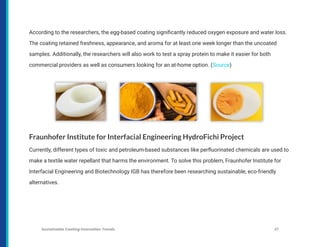
According to the researchers, the egg-based coating significantly reduced oxygen exposure and water loss.
The coating retained freshness, appearance, and aroma for at least one week longer than the uncoated
samples. Additionally, the researchers will also work to test a spray protein to make it easier for both
commercial providers as well as consumers looking for an at-home option. (Source)
Fraunhofer Institute for Interfacial Engineering HydroFichi Project
Currently, different types of toxic and petroleum-based substances like perfluorinated chemicals are used to
make a textile water repellant that harms the environment. To solve this problem, Fraunhofer Institute for
Interfacial Engineering and Biotechnology IGB has therefore been researching sustainable, eco-friendly
alternatives.
Sustainable Coating Innovation Trends 37
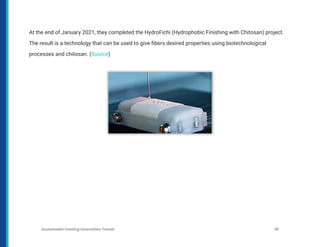
At the end of January 2021, they completed the HydroFichi (Hydrophobic Finishing with Chitosan) project.
The result is a technology that can be used to give fibers desired properties using biotechnological
processes and chitosan. (Source)
Sustainable Coating Innovation Trends 38
Notable Companies/Startups in the Sustainable Coating Industry
1. Melodea
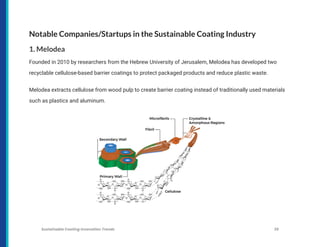
Founded in 2010 by researchers from the Hebrew University of Jerusalem, Melodea has developed two
recyclable cellulose-based barrier coatings to protect packaged products and reduce plastic waste.
Melodea extracts cellulose from wood pulp to create barrier coating instead of traditionally used materials
such as plastics and aluminum.
Sustainable Coating Innovation Trends 39
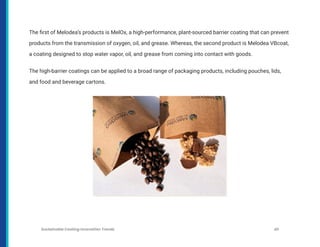
The first of Melodea’s products is MelOx, a high-performance, plant-sourced barrier coating that can prevent
products from the transmission of oxygen, oil, and grease. Whereas, the second product is Melodea VBcoat,
a coating designed to stop water vapor, oil, and grease from coming into contact with goods.
The high-barrier coatings can be applied to a broad range of packaging products, including pouches, lids,
and food and beverage cartons.
Sustainable Coating Innovation Trends 40
The startup was a winner of two of the most prestigious awards in the packaging field, the Packaging
Europe 2019 sustainability award and the WorldStar Award for 2020, granted by the World Packaging
Organization. (Source)
2. Covestro
Covestro, founded in 2015, is a German company that produces a variety of polyurethane and
polycarbonate-based raw materials. It has signed an agreement to acquire the Resins & Functional Materials
business (RFM) from Royal DSM for EUR 1.61 billion. The transaction substantially expands Covestro’s
portfolio of sustainable coating resins, making the Group one of the world’s leading providers in this growth
market. The integration of RFM will expand the Group’s revenues by around EUR 1 billion and will add more
than 20 sites to its global production network.
The acquisition of RFM adds a complete range of water-based polyacrylate resins, as well as strong brands
in terms of sustainability such as Niaga®, solutions for additive manufacturing, and an advanced solar
coatings business. In addition, Covestro is enhancing its technology portfolio to include water-based hybrid
technologies, powder-coating resins as well as radiation-curing resins. (Source)
Sustainable Coating Innovation Trends 41
3. Relement
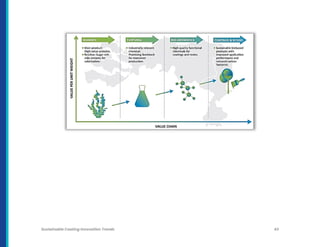
Founded in 2020, Relement is researching the development of a biobased coating using seaweed. The
seaweed is used to produce high-value proteins, a by-product of which is non-edible sugars streams.
Relement is using this by-product to create 100% biobased alkyd resin coatings that are more durable,
cost-effective, and sustainable.
The institutes such as TNO, Avans, and Maastricht University have knowledge and technology in the field of
biorefining, bio-aromatics production, coating resins, and sustainability analyses.
Sustainable Coating Innovation Trends 42
Sustainable Coating Innovation Trends 43
Patent Filing Trend in Sustainable Coating
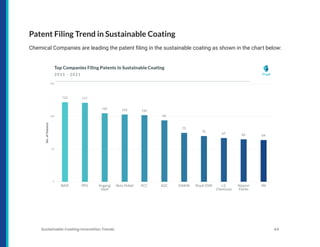
Chemical Companies are leading the patent filing in the sustainable coating as shown in the chart below:
Sustainable Coating Innovation Trends 44
Key Takeaways from Patent filing trend:
● BASF, Akzo Nobel, and PPG Industries are some of the major players of, not just in the sustainable
coating industry, but also in the antimicrobial coating, antifouling paints and coatings, and Hull
Coating market. (Source, Source, Source)
Sustainable Coating Innovation Trends 45
● The top 11 companies are from diversified geographies such as the United States, Europe, and
East Asia. Asia has 6 companies, Europe has 3 and the US has 2 companies in the top 11.
● Akzo Nobel (in 2017) claimed to have opened the world’s most sustainable paint factory powered
by biomass and solar fuel. This factory recycles the residue water and solvents and thus,
develops a circular economy for waste management and resource optimization. (Source)
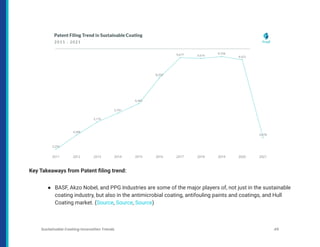
● Patent filing is increasing at an average rate of 13% per annum till 2020. This increase is
attributed to increasing climate awareness, and the vision of major companies to reinvent their
coating and paints in a sustainable form.
Have the central governments taken any initiative to promote sustainable
coating?
The US and China are not just the world’s first and second-largest economies, but also the second and
first-largest carbon emitters. To support their net-zero targets, they are already taking a lot of initiatives to
reduce emissions in major industries like coatings.
United States
● In December 2018, the US Environmental Protection Agency (EPA) proposed new greenhouse gas
emissions (GHG) regulations to modify and reconstruct power plants. This rule would replace
EPAs 2015 carbon pollution standard for new power plants. Such regulations promise
environmental sustainability and push the demand for bio-based epoxy resins, thus raising the
growth rate of the market. (Source)
Sustainable Coating Innovation Trends 46
● The U.S. Environmental Protection Agency (EPA) is proposing to amend the National Volatile
Organic Compound (VOC) Emission Standards for Aerosol Coatings. In this action, the EPA is
proposing to update coating category product-weighted reactivity limits for aerosol coatings
categories; add new compounds and reactivity factors (RFs); update existing reactivity values;
revise the default RF; amend the thresholds for compounds regulated by this document, and add
electronic reporting provisions. (Source)
China
● In 2016, China issued a consumption tax on coatings, effectively removing water-based coatings
from taxation provided production was below the VOC emission taxation threshold. (Source)
● China removed water-based coating waste from the inventory of hazardous wastes, hugely
reducing regulatory compliance requirements for the manufacture, import, and sale of these
products. (Source)
● In 2017, Shanghai Housing and Urban Development Management Commission announced a
prohibition on the use of solvent-based coatings for exterior walls and woodware in construction.
It went into effect on 1 May 2018. (Source)
● In Shanghai, after 2017 a tax of RMB 20 is levied on every kg VOC discharged. (Source)
In the future, Japan and India (3rd and 4th highest emitters) are also expected to release similar policies.
The sustainable coating is, thus, a promising space for existing companies and newer startups to step in.
Multiple M&A opportunities might also be created in the upcoming years.
Sustainable Coating Innovation Trends 47
Conclusion
Industries have come to understand the importance of sustainability and are now moving towards a
sustainable future. The coating industry is also following the lead and innovating. As a result, it is constantly
rising over the past years. Startups and Universities are stepping in and collaborating with companies to
deliver exceptional products.
So, if you are interested in coating research and want to have other crucial insights, get in touch with us now.
Sustainable Coating Innovation Trends 48
We help companies solve their most pressing innovation
challenges
Who could be your next competitor? What breakthrough tech will change your industry next? What are your
competitors doing in their research labs?
And what should be your next step in your business and research strategy?
Don’t let such questions bother you in your strategic meetings and steal your sleep at night. We constantly help
our clients tackle their innovation challenges, people who are at the edge of what they do. We can surely help you
find answers as well. Let’s get in touch and reveal your industry secrets.
Talk to me directly at -
Deepak Syal - Deepak@greyb.com
Or my partner at -
Chakshu Kalra - Chakshu@greyb.com
We are also available on call-
Singapore: +65 84306322
United States: +1 202-455-5058
India: +91 9878711122
Sustainable Coating Innovation Trends 49

Sustainable environment Coating Trends r

  • 2.
    About GreyB: We helpcompanies solve their most pressing innovation challenges Who could be your next competitor? What breakthrough tech will change your industry next? What are your competitors doing in their research labs? And what should be your next step in your business and research strategy? Don’t let such questions bother you in your strategic meetings and steal your sleep at night. We constantly help our clients tackle their innovation challenges, people who are at the edge of what they do. We can surely help you find answers as well. Let’s get in touch and reveal your industry secrets. Sustainable Coating Innovation Trends 1
  • 3.
    Here’s everything! Clickto jump to your preferred section: Introduction 3 Expected growth in market size of the industry and the reasons behind it 5 Possible reasons for this growth – 6 Sustainable Coatings Trends 6 Coating Methods 7 Which Coating Methods have been dominating the Market? 9 Around which methods are the maximum innovation centered? 14 What are the different materials used for making coatings sustainable? 16 Let’s look into the properties of Cellulose 18 What are the market prospects and opportunities in “Cellulose Coating”? 19 Prominent features of the cellulose coating market 20 Are there any major interesting innovations centered around cellulose? 21 Applications of Sustainable Coating 24 Which application areas are having the largest market prospects? 27 How has the innovation in major application areas been? 28 Sustainable Coating Innovation Trends 2
  • 4.
    Competitive Landscape 30 MajorAcquisitions and Collaborations 31 What type of innovation are the major universities focusing on? 35 Rice University edible and washable protein-based coating 35 Fraunhofer Institute for Interfacial Engineering HydroFichi Project 36 Notable Companies/Startups in the Sustainable Coating Industry 38 1. Melodea 38 2. Covestro 40 3. Relement 41 Patent Filing Trend in Sustainable Coating 43 Have the central governments taken any initiative to promote sustainable coating? 45 Conclusion 47 Sustainable Coating Innovation Trends 3
  • 5.
    Introduction Decades ago, greenor sustainable coatings were termed eco-friendly coatings that emit almost negligible volatile organic compounds (VOCs) during the production process. But now this definition has been extended to sustainability aspects. Today, companies are also looking to impact the entire value chain and consider the societal impacts of their activities. Three major elements are driving the coating industry towards sustainability, i.e. Health, Climate Change, and Circular Economy. These entail energy and resource conservation, waste minimization, process efficiency enhancement, use of renewable materials, and much more. With the growing concerns for climate and sustainability, we can expect these practices to give birth to more innovations and products soon. To get an idea of the same we researched the top innovation trends in the Industry. And in this article, we’ll dig into these trends. But first, let’s see how the industry is growing. Sustainable Coating Innovation Trends 4
  • 6.
  • 7.
    Expected growth inmarket size of the industry and the reasons behind it The global green coating market was valued at $115.19 Billion in 2016. It is expected to grow at a CAGR of 6.9% from 2016 to 2025 and reach $209.2 billion in 2025. (Source) (Source) Sustainable Coating Innovation Trends 6
  • 8.
    Possible reasons forthis growth – ● The construction and automotive sectors have been witnessing a consistently growing product penetration and exponential growth in their products and innovations. ● The climate concerns and public awareness are pushing the existing OEMs as well as start-ups and small businesses to innovate and develop more eco-friendly coating. ● The increase in demand could also be attributed to the company’s willingness to replace the existing coatings with low-VOC emitting coatings. ● An increase in stringent government regulations associated with VOC. ● There’s rising demand for waterborne and powder technology, especially in architectural and automotive applications, which is also expected to drive industry growth. (Source, Source) Sustainable Coatings Trends To understand the trends in “Sustainable Coating”, we would be starting with three major verticals – 1. Methods of Sustainable Coating, 2. Materials for Sustainable Coating, and 3. Applications of Sustainable Coating. Sustainable Coating Innovation Trends 7
  • 9.
    Note: In eachvertical, we conducted an in-depth study of its types and the parameters associated with the market and patent statistics to predict which aspects would gain traction soon. Coating Methods 1. Powder Coating Powdered polymer resins are melted, mixed, cooled, and grounded in uniform powder (like baking flour). Powder coatings contain no solvents and therefore emit negligible polluting VOCs into the atmosphere. 1,2 2. High Solids Coating It is a single or dual coating formulated with higher concentrations (at least 65%) of solids (binders, pigments, and additives) despite a lower percentage of VOCs. They are more environmentally friendly because less solvent is emitted as it dries or cures. 1 3. UV-Cure Coating It is a kind of radiation cure coating that offers rapid drying time, low energy consumption (hence less energy cost), fewer VOC emissions, reduced floor space requirements, and an indefinite pot life. 1 Sustainable Coating Innovation Trends 8
  • 10.
    4. Waterborne Coating Itis an eco-friendly surface treatment that uses water as a solvent to disperse the resins used in coating: They have low VOC content, high corrosion protection, less toxicity and flammability, and thus, are eco-friendly. (Source) 5. Radiation Cure Coating They are cross-linked or cured using high-intensity radiation energy from electron beams or ultraviolet light radiation. They utilize less energy, hence require low energy costs and exhibit improved corrosion protection for metals. (Source) 6. Solvent-less Coating This kind of fluid is applied to a substrate’s surface to prevent corrosion. It has an impermeable preventative layer with low or no moisture content. The layer helps reduce an electrolytic attack on the metal’s surface. 1 Other minor methods of sustainable or green coating are – solar reflective coating, chrome-free coating, bio-renewable coating, etc. (Source) Sustainable Coating Innovation Trends 9
  • 11.
    Which Coating Methodshave been dominating the Market? The global waterborne coating market, which was valued at $53.32 billion in 2017, is expected to grow at a CAGR of 5.7% from 2017 to 2025 and reach $82.9 billion by 2025. (1, 2) Sustainable Coating Innovation Trends 10
  • 12.
    The global powdercoating market, which was valued at $11.9 billion in 2020, is expected to grow at a CAGR of 7.2% from 2020 to 2028 and reach $20.8 billion by 2028. (1, 2) Sustainable Coating Innovation Trends 11
  • 13.
    The global radiationcure coating market, which was valued at $8.76 billion in 2020, is expected to grow at a CAGR of 6.8% from 2020 to 2024 and reach $11.4 billion by 2024. (1) Sustainable Coating Innovation Trends 12
  • 14.
    The global highsolids coating market, which was valued at $10.01 billion in 2016, is expected to grow at a CAGR of 6.6% from 2017 to 2025 and reach $17.8 billion by 2025. (1) The market size of Sustainable Coatings in 2022 is expected to be $171 Billion. Sustainable Coating Innovation Trends 13
  • 15.
    As per ouranalysis, the Sustainable Coating market of 2022 would be divided into the following segments based on methods. Sustainable Coating Innovation Trends 14
  • 16.
    Around which methodsare the maximum innovation centered? The following bar graph is plotted between the patent count and the application year of each patent. Please note that to study comprehensively the application years, we have taken each member of the patent family as a separate entity. Sustainable Coating Innovation Trends 15
  • 17.
    ● The CAGRof patent filing from 2010 to 2018 in the four methods are as follows – ○ Waterborne Coating – 11% ○ Powder Coating – 11% ○ Radiation-cure Coating – 6% ○ High Solids’ Coating – 22% ● Observing the CAGR, we can say that dry coating techniques are gaining traction whereas forms like solvent-based coating are getting obsolete due to their non-sustainable nature. ● In terms of volume (number) of innovations, however, the total number of patents filed in the waterborne coating section in the past 11 years is almost equivalent to the sum of patent-filing in dry-coating – High Solids and Powder coating. ● High solids coating is being widely used in the aerospace industry and other industries as a way to comply with the Environmental Protection Agency’s (EPA’s) emissions regulations. This is one major reason attributed to the drastic growth in the patent filing in High Solids Coating. 1 Waterborne coating is having a greater market (current and predicted), the highest volume, and the maximum rate of patents filed in the sustainable coating section. This is attributed to its highly sustainable nature and an easy shift from non-sustainable solvent-based to sustainable waterborne coatings. We believe that the rate of innovation and development would also increase in dry coating techniques, including Powder and High Solids’ Coating. This is because, in addition to the sustainability considerations, there is a strong deviation of the business ecosystem towards water-conservation practices. * – Source1 and Source2 Sustainable Coating Innovation Trends 16
  • 18.
    What are thedifferent materials used for making coatings sustainable? Coating materials can be produced from polymeric materials such as Starch, Protein, and Cellulose. It can also be derived from fruits and vegetables and other materials like seaweed, slaked lime, etc. Sustainable Coating Innovation Trends 17
  • 19.
    Below are describedproperties of a few materials that can be used for sustainable coating. Let’s take Cellulose as an example as it is the most abundant element on the earth and thus, the cheapest to procure. When compared with other similar materials (abundant earth materials), cellulose is found to have the highest melting point and glass transition temperature. This makes it the best fit for coating products. Moreover, it is not soluble in water and has a balanced range of parameters that makes cellulose the desired choice for sustainable coatings. Sustainable Coating Innovation Trends 18
  • 20.
    Let’s look intothe properties of Cellulose ● Cellulose is a non-toxic biodegradable solid, which is the most abundant element on the earth and is the main component of all plants. ● It has excellent properties such as high hardness, high strength, high crystallinity, large surface tension, high resistivity (low conductivity), and special properties of nanoparticles. Due to these, the polymer barrier properties, thermal properties, and mechanical properties can be improved when it is incorporated into the coating. ● Cellulose is completely safe to eat, and this edibility makes it a suitable eco-friendly material for coatings. ● Cellulose represents approximately 1,500 Giga-tons (1,500,000,000,000 tons) of annual biomass production. Utilizing biomass would not only be organic but would also help maintain a circular economy and optimize waste management. (Source) Sustainable Coating Innovation Trends 19
  • 21.
    What are themarket prospects and opportunities in “Cellulose Coating”? The global cellulose coating market was valued at $1.7 billion in 2020. It is expected to grow at a CAGR of 5.4% from 2020 to 2027 and reach $2.45 billion in 2027. (Source) Market size in 2022 – $ 1.88 billion (estimated) Sustainable Coating Innovation Trends 20
  • 22.
    Prominent features ofthe cellulose coating market ● Due to increased construction activities, wood coating with cellulose nitrate has gained traction. 1 ● Region-wise, Asia-Pacific topped the market by acquiring a 36.8% share in 2020. ● Cellulose is the most abundant material on the earth’s surface. Therefore, in the shift of the coating industry towards sustainability, cellulose would be a major game player. ● Research on cellulose in the coatings segment would also be complemented by research on cellulose in the edible packaging and edible labels segment. For instance, If a solution to any prevailing problem is suggested in one of these three domains, it would be easily integrated into the other two as well. Sustainable Coating Innovation Trends 21
  • 23.
    The cellulose coatingmarket comprises 9.6 % of the world’s cellulose and only 1.1 % of the world’s coating market as of 2022. However, out of the total patents in sustainable coatings that we analyzed, approximately 20% of them had mentioned cellulose in their composition. This signifies that entities are heavily researching and filing patents in cellulose-based coatings. Cellulose would likely be a dominant ingredient and the torch-bearer in the upcoming “Sustainable Coating” revolution! Are there any major interesting innovations centered around cellulose? 1. EMPA Sustainable and Edible Coating Generally in supermarkets, a lot of plastic waste is generated due to plastic packaging in fruits and vegetables. Also, non-packaged or uncovered fruits have a greater chance of getting rotten early. A team of researchers from the Swiss Federal Laboratories for Materials Science and Technology (Empa) has found a solution to this problem by actually replacing plastic packaging with sustainable and edible coating. They have developed an invisible, edible, plant-based coating that can help fresh produce last longer — all the while taking plastic packaging out of the equation. Their coating has been created by using “pomace” — a pulpy residue left over from the blending of fruits and vegetables for juice. Sustainable Coating Innovation Trends 22
  • 24.
    They have developeda process where they could extract the cellulose that is naturally contained in these vegetables that can not otherwise be sold. By spraying the cellulose onto produce like cucumbers or bananas, it creates an additional layer of protection, slowing down moisture loss and oxidation. (Source) Bananas with and without Empa’s cellulose coating in a shelf-life test (Source) Sustainable Coating Innovation Trends 23
  • 25.
    2. Moscow PowerInstitute coating based on bacterial cellulose Mechanical damage to the liver is one of the most prominent and commonly occurring injuries to the organs. Some of the compositions to accelerate wound healing and tissue regeneration consist of polypeptides, nucleic acids, and suitable carriers. The disadvantage of these solutions is the possibility of rejection of materials due to the present antigenicity, especially when using biomaterials of animal origin. Moscow Power Institute has patented (RU2695066C1) a solution for this problem by treating traumatic liver breaks using a film coating based on bacterial cellulose. This cellulose, when modified with animal proteins, is biologically compatible with the tissues of the human body and can regenerate damaged tissue. This invention provides an expansion of the range of drugs for the rapid recovery of damaged organ. 3. Surfresca breathable coating Surfresca, founded in 2020 and headquartered in Israel has developed a breathable coating which is an edible, biodegradable, water-based emulsion composed of wholly natural food ingredients and inbuilt with advanced modified atmosphere properties. Sustainable Coating Innovation Trends 24
  • 26.
    When the coatingis applied to fresh fruit or vegetable, the solution creates a breathable coating, with minute disruptions within the coating acting as a partial barrier, allowing for “optimal gas exchange”. This slows down the post-harvest maturation and ripening processes and subsequent degradation and decay. According to Surfresca, the sustainable solution could extend shelf-life by up to several weeks. (Source) Most of the cellulose-based sustainable coating methods are associated with – edibles, cooking utensils, tablets and capsules, medical adhesive tape, eco-friendly fertilizers, or water-based fireproof heat insulation. We believe that the Pharmaceutical Industry, packed-food industry, and household utilities would be a major markets demanding edible coating products like cellulose, and would open up various business opportunities. In addition, cellulose might also witness an increased demand in novel areas like superhydrophobic coatings. Sustainable Coating Innovation Trends 25
  • 27.
    Applications of SustainableCoating Coatings can be used in an endless number of objects, products, and services in the world. Their utility can be decorative, functional, or both. Functional coatings may be applied to change the surface properties of the substrate, such as adhesion, wettability, corrosion resistance, or wear resistance. Whereas, in the case of semiconductor device fabrication (where the substrate is a wafer), the coating adds a completely new property, such as a magnetic response or electrical conductivity, and forms an essential part of the finished product. (Source) Let us have a look at the industrial and residential usages of coatings to get a brief about which markets are having the highest opportunities for expanding the green coating industry – Sustainable Coating Innovation Trends 26
  • 28.
  • 29.
    Which application areasare having the largest market prospects? Due to the huge number of applications of sustainable coatings, we have picked only a handful of major application areas for our analysis. Let us have a look at their current market size, expected growth, and future prediction of market size. Sustainable Coating Innovation Trends 28
  • 30.
    How has theinnovation in major application areas been? The above graph is an analysis of the Sustainable Coatings’ patents in the last 11 years aimed at the major application areas. Some patents have technologies that can have multiple applications too, therefore we have counted them as a separate entity in each area as mentioned in their patent. Sustainable Coating Innovation Trends 29
  • 31.
    Key takeaways – ●Sustainable Coating innovation in the Automobile Industry has grown at a CAGR of 11.51% from 2009 to 2020, which is the highest rate compared to these 5 application areas. ● The Electronics Industry has witnessed the highest volume of innovations (patent priorities) as compared to the other four application areas in Sustainable Coatings. This can be attributed to the shift from the industrial age to the information age, and also the utility of semiconductors and microcontrollers in almost all walks of life. Transport Industry (Road, aviation, rain, and shipping) was responsible for about 1/6th of the global greenhouse emissions in 2016. The net total that year was 49.4 billion tonnes of CO2 eq. (Source) This is one of the prime reasons that green coatings’ innovation in the Automobile, Maritime, and Aerospace industries is increasing at a high rate. Moreover, the automobiles of the present time involve a lot of semiconductor chips and sensors to integrate certain digital functionalities. Similarly, the new-age medical devices and aerospace industry is also demanding more sustainable semiconductors and microcontrollers. Research, development, and commercialization of sustainable electronic components would likely happen at a higher rate in the future. However, the global chip shortage and international trade wars might alter the demand for green semiconductor coatings. Sustainable Coating Innovation Trends 30
  • 32.
  • 33.
    Major Acquisitions andCollaborations 1. PPG acquired Alpha Coating Technologies In March 2020, PPG acquired Alpha Coating Technologies (a US-based powder coating manufacturer) to expand its powder coating facility. This acquisition provides additional powder capacity which includes small batch and low cure powder manufacturing capabilities for general finishes, light industrial, furniture, and heat-sensitive substrate end uses. This acquisition also provides emerging IP in ultra low-temperature cure powder technology. With this acquisition, PPG will enter the growing market for powder on heat-sensitive substrates, such as medium-density fiberboard (MDF), high-density fiberboard (HDF), and hardwoods. (Source) Powder coatings may require up to 500°F for proper application. Low-temperature cure powder technology supplemented PPG’s ongoing research into low-temperature powder coating manufacturing. As a result, in November 2020, PPG introduced ENVIROCRON™ HeatSense powder coating for heat-sensitive wood and wood-composite applications, such as medium-density fiberboard (MDF), hardwood, plywood, and similar products. The coating can cure in as few as five minutes at 250 degrees Fahrenheit, be applied Sustainable Coating Innovation Trends 32
  • 34.
    uniformly over heat-sensitivesubstrates, and accommodate the shrinking and swelling of wood over the finished product’s lifetime. (Source) However, Akzo Nobel’s Interpon W (powder coating solutions for heat-sensitive wood and plastic) is still leading the race of ultra-low temperature curing by getting cured at as low as 80°C-120°C (170°-250° F). (Source) 2. Hempel acquired Wattyl A leading coating manufacturer, Hempel acquired major coatings manufacturer Wattyl Australia and New Zealand from The Sherwin-Williams Company (the world’s largest paint and coatings company) in 2021. Hempel is undertaking Wattyl’s for the decorative and protective coating segment with a turnover of €150 million and 750 employees. With Wattyl as part of their company, Hempel is seeking to gain a strong footprint in Australia and New Zealand, while pursuing its strategic ambitions for the Decorative, Infrastructure, and Energy segments in the South & East Asia region (Source) Sustainable Coating Innovation Trends 33
  • 35.
    Wattyl’s acquisition wouldhelp Hempel become a leading company in the protective and decorative coating segment. Furthermore, Hempel is expanding in selected geographies and jurisdictions for the past few years. This seems to be in line with Hempel’s ambition of doubling its revenue to EUR 3 billion by 2025 as outlined in its Double Impact strategy. (Source) 3. Koehler collaborated with Darmstadt Technical University Koehler and Darmstadt Technical University collaborated and founded a laboratory “Green Coating Collaboration”. The collaboration focuses on barrier coatings that can give flexible packaging paper properties that previously only plastic could offer. These include mineral oil barriers, water vapor barriers or barriers for oils and fats, as well as aroma barriers. Their main goal is to find and test more sustainable, bio-based raw materials for barrier coating to ultimately use them on the production line. (Source) 4. Brock University collaborated with Vanchem Performance Chemicals Sheets made out of steel or other metals that need to be ‘pre-treated’ with a substance that will guard them against damage caused by rust and salt. This substance must be able to stick not only to the metal but also Sustainable Coating Innovation Trends 34
  • 36.
    to any paintthat’s applied to the sheets on top of the coating. Traditional coating systems used heavy metals – such as zinc and iron phosphates. Phosphates released into the environment cause various algal blooms in lakes and rivers, damaging aquatic plant and animal life. To overcome this problem, Paul Zelisko (a chemist from Brock University in Canada), along with Vanchem Performance Chemicals, has created (and patented US20170009083A1) a technology “Greencoat”, which uses silicon rather than heavy metals to bind coatings to both metal surfaces and paint. It’s a water-based system that has reactive sand in it. (Source) 5. IFS Coating to use TerraPass Carbon Offsets A privately owned manufacturer of sustainable powder coatings, IFS Coatings would purchase monthly carbon offsets to further its work toward becoming more sustainable. IFS uses terrTerraPassgram to offset its carbon footprint, as claimed in 2021. The TerraPass system invests in carbon reduction projects and carbon offsets purchased through TerraPass support a diversified portfolio of projects in communities around the US and the world, including reforestation, renewable energy produced by wind power, and methane capture at dairy farms, landfills, and Sustainable Coating Innovation Trends 35
  • 37.
    abandoned coal mines.All TerraPass projects meet the highest standards for quality, monitoring, and independent verification. (Source) Replacing all metal-based solvent-borne coatings with powder coatings could reduce the Green House Gas (GHG) equivalent to: ● The annual emissions of approximately 9.5 million cars, or ● Approximately 2.9 million trips around the world in a car This could push IFS’ rank upward in the list of Top 25 Coating Companies. What type of innovation are the major universities focusing on? Rice University edible and washable protein-based coating Led by a Bangladeshi scientist, a group of researchers at Rice University in Texas developed a way to enhance the shelf life of fruits and vegetables using an entirely edible and washable protein-based coating. The mixture of coating, mix egg white, yolk, cellulose from wood, and a turmeric extract called curcumin keeps the perishable goods fresh for days. Sustainable Coating Innovation Trends 36
  • 38.
    According to theresearchers, the egg-based coating significantly reduced oxygen exposure and water loss. The coating retained freshness, appearance, and aroma for at least one week longer than the uncoated samples. Additionally, the researchers will also work to test a spray protein to make it easier for both commercial providers as well as consumers looking for an at-home option. (Source) Fraunhofer Institute for Interfacial Engineering HydroFichi Project Currently, different types of toxic and petroleum-based substances like perfluorinated chemicals are used to make a textile water repellant that harms the environment. To solve this problem, Fraunhofer Institute for Interfacial Engineering and Biotechnology IGB has therefore been researching sustainable, eco-friendly alternatives. Sustainable Coating Innovation Trends 37
  • 39.
    At the endof January 2021, they completed the HydroFichi (Hydrophobic Finishing with Chitosan) project. The result is a technology that can be used to give fibers desired properties using biotechnological processes and chitosan. (Source) Sustainable Coating Innovation Trends 38
  • 40.
    Notable Companies/Startups inthe Sustainable Coating Industry 1. Melodea Founded in 2010 by researchers from the Hebrew University of Jerusalem, Melodea has developed two recyclable cellulose-based barrier coatings to protect packaged products and reduce plastic waste. Melodea extracts cellulose from wood pulp to create barrier coating instead of traditionally used materials such as plastics and aluminum. Sustainable Coating Innovation Trends 39
  • 41.
    The first ofMelodea’s products is MelOx, a high-performance, plant-sourced barrier coating that can prevent products from the transmission of oxygen, oil, and grease. Whereas, the second product is Melodea VBcoat, a coating designed to stop water vapor, oil, and grease from coming into contact with goods. The high-barrier coatings can be applied to a broad range of packaging products, including pouches, lids, and food and beverage cartons. Sustainable Coating Innovation Trends 40
  • 42.
    The startup wasa winner of two of the most prestigious awards in the packaging field, the Packaging Europe 2019 sustainability award and the WorldStar Award for 2020, granted by the World Packaging Organization. (Source) 2. Covestro Covestro, founded in 2015, is a German company that produces a variety of polyurethane and polycarbonate-based raw materials. It has signed an agreement to acquire the Resins & Functional Materials business (RFM) from Royal DSM for EUR 1.61 billion. The transaction substantially expands Covestro’s portfolio of sustainable coating resins, making the Group one of the world’s leading providers in this growth market. The integration of RFM will expand the Group’s revenues by around EUR 1 billion and will add more than 20 sites to its global production network. The acquisition of RFM adds a complete range of water-based polyacrylate resins, as well as strong brands in terms of sustainability such as Niaga®, solutions for additive manufacturing, and an advanced solar coatings business. In addition, Covestro is enhancing its technology portfolio to include water-based hybrid technologies, powder-coating resins as well as radiation-curing resins. (Source) Sustainable Coating Innovation Trends 41
  • 43.
    3. Relement Founded in2020, Relement is researching the development of a biobased coating using seaweed. The seaweed is used to produce high-value proteins, a by-product of which is non-edible sugars streams. Relement is using this by-product to create 100% biobased alkyd resin coatings that are more durable, cost-effective, and sustainable. The institutes such as TNO, Avans, and Maastricht University have knowledge and technology in the field of biorefining, bio-aromatics production, coating resins, and sustainability analyses. Sustainable Coating Innovation Trends 42
  • 44.
  • 45.
    Patent Filing Trendin Sustainable Coating Chemical Companies are leading the patent filing in the sustainable coating as shown in the chart below: Sustainable Coating Innovation Trends 44
  • 46.
    Key Takeaways fromPatent filing trend: ● BASF, Akzo Nobel, and PPG Industries are some of the major players of, not just in the sustainable coating industry, but also in the antimicrobial coating, antifouling paints and coatings, and Hull Coating market. (Source, Source, Source) Sustainable Coating Innovation Trends 45
  • 47.
    ● The top11 companies are from diversified geographies such as the United States, Europe, and East Asia. Asia has 6 companies, Europe has 3 and the US has 2 companies in the top 11. ● Akzo Nobel (in 2017) claimed to have opened the world’s most sustainable paint factory powered by biomass and solar fuel. This factory recycles the residue water and solvents and thus, develops a circular economy for waste management and resource optimization. (Source) ● Patent filing is increasing at an average rate of 13% per annum till 2020. This increase is attributed to increasing climate awareness, and the vision of major companies to reinvent their coating and paints in a sustainable form. Have the central governments taken any initiative to promote sustainable coating? The US and China are not just the world’s first and second-largest economies, but also the second and first-largest carbon emitters. To support their net-zero targets, they are already taking a lot of initiatives to reduce emissions in major industries like coatings. United States ● In December 2018, the US Environmental Protection Agency (EPA) proposed new greenhouse gas emissions (GHG) regulations to modify and reconstruct power plants. This rule would replace EPAs 2015 carbon pollution standard for new power plants. Such regulations promise environmental sustainability and push the demand for bio-based epoxy resins, thus raising the growth rate of the market. (Source) Sustainable Coating Innovation Trends 46
  • 48.
    ● The U.S.Environmental Protection Agency (EPA) is proposing to amend the National Volatile Organic Compound (VOC) Emission Standards for Aerosol Coatings. In this action, the EPA is proposing to update coating category product-weighted reactivity limits for aerosol coatings categories; add new compounds and reactivity factors (RFs); update existing reactivity values; revise the default RF; amend the thresholds for compounds regulated by this document, and add electronic reporting provisions. (Source) China ● In 2016, China issued a consumption tax on coatings, effectively removing water-based coatings from taxation provided production was below the VOC emission taxation threshold. (Source) ● China removed water-based coating waste from the inventory of hazardous wastes, hugely reducing regulatory compliance requirements for the manufacture, import, and sale of these products. (Source) ● In 2017, Shanghai Housing and Urban Development Management Commission announced a prohibition on the use of solvent-based coatings for exterior walls and woodware in construction. It went into effect on 1 May 2018. (Source) ● In Shanghai, after 2017 a tax of RMB 20 is levied on every kg VOC discharged. (Source) In the future, Japan and India (3rd and 4th highest emitters) are also expected to release similar policies. The sustainable coating is, thus, a promising space for existing companies and newer startups to step in. Multiple M&A opportunities might also be created in the upcoming years. Sustainable Coating Innovation Trends 47
  • 49.
    Conclusion Industries have cometo understand the importance of sustainability and are now moving towards a sustainable future. The coating industry is also following the lead and innovating. As a result, it is constantly rising over the past years. Startups and Universities are stepping in and collaborating with companies to deliver exceptional products. So, if you are interested in coating research and want to have other crucial insights, get in touch with us now. Sustainable Coating Innovation Trends 48
  • 50.
    We help companiessolve their most pressing innovation challenges Who could be your next competitor? What breakthrough tech will change your industry next? What are your competitors doing in their research labs? And what should be your next step in your business and research strategy? Don’t let such questions bother you in your strategic meetings and steal your sleep at night. We constantly help our clients tackle their innovation challenges, people who are at the edge of what they do. We can surely help you find answers as well. Let’s get in touch and reveal your industry secrets. Talk to me directly at - Deepak Syal - Deepak@greyb.com Or my partner at - Chakshu Kalra - Chakshu@greyb.com We are also available on call- Singapore: +65 84306322 United States: +1 202-455-5058 India: +91 9878711122 Sustainable Coating Innovation Trends 49