Digging Deeper into New Public Management   Decentralization, accountability relations and performance management in  e ducation   Péter Radó educational policy analyst senior consultant Expanzi ó  Consulting [email_address]
Major themes Decentralization Accountability relations and their systemic conditions Accountability failures Answers to accountability failures (new public management and new public service) Performance management in education NPM and NPS compatible performance management systems
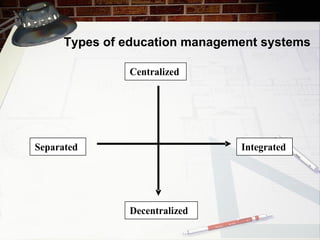
Types of education management systems
Decentralization The locus of decision-making:  devolution of decision-making competencies to lower (regional, local, school) levels of management  The actors of decision-making:  involvement of non-administrative actors into decision-making (roles: regulation, decision-making, consultation) ( Decentralization versus deconcentration )
Two approaches to decentralization The public administration approach:  the distribution of decision-making competencies among the levels and actors of management of education (e.g.: director of schools = lowest level administration agent)  –  based on PA decentralization strategy The service delivery approach:  the division of labor between public administration agents and   educational service delivery institutions with professional, organizational and financial autonomy. (e.g.: director of schools = the manager of school-based decision-making)  –  based on comprehensive education sector strategy
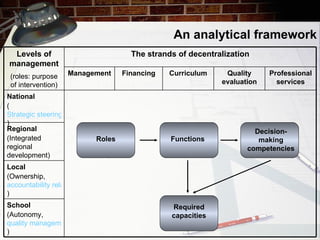
An analytical framework Roles Functions Decision-making competencies Required capacities Levels of management (roles :  purpose of intervention) The strands of decentralization Management Financing Curriculum Quality evaluation Professional services National  ( Strategic steering ) Regional (Integrated regional development) Local (Ownership,  accountability relations ) School (Autonomy,  quality management )
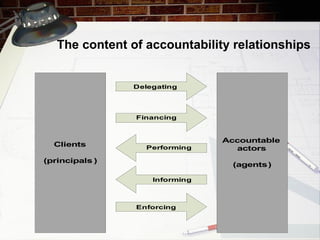
The content of accountability relationships
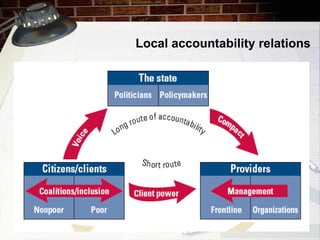
Local accountability relations
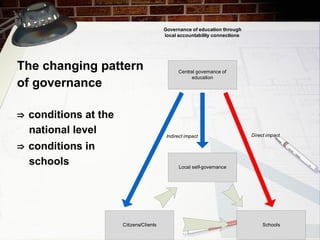
The changing pattern of governance ⇒   conditions at the national level ⇒   conditions in  schools
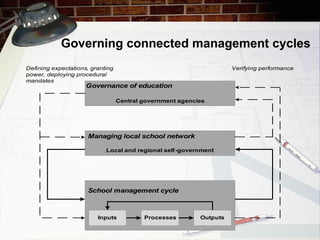
Governing connected management cycles
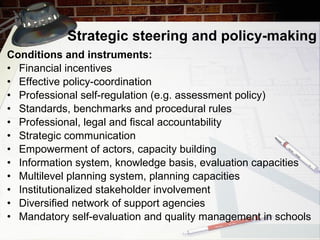
Strategic steering and policy-making Conditions and instruments: Financial incentives Effective policy-coordination Professional self-regulation (e.g. assessment policy) Standards, benchmarks and procedural rules Professional, legal and fiscal accountability Strategic communication Empowerment of actors, capacity building Information system, knowledge basis, evaluation capacities Multilevel planning system, planning capacities Institutionalized stakeholder involvement Diversified network of support agencies Mandatory self-evaluation and quality management in schools
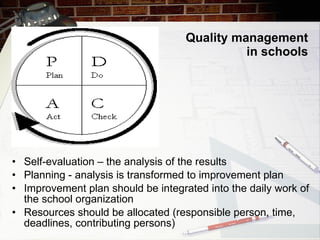
Quality management in schools Self-evaluation – the analysis of the results Planning - analysis is transformed to improvement plan Improvement plan should be integrated into the daily work of the school organization Resources should be allocated (responsible person, time, deadlines, contributing persons)
Failures of voice Lack of responsiveness of governance (e.g. too little budget is devoted to the services for the disadvantaged) Lack of open decision-making procedures (weak stakeholder consultation) Lack of accessible information on governance (lack of transparency, citizens can’t make their judgments, low trust) Lack of accessible information on locally delivered services (e.g. public reports on external evaluation ,  students’ achievement data aggregated at school level) Weak self-organization of citizens (aggregation and articulation failure, the better-off is the more affluent) Clientelism, corruption
Failures of compact (ownership) No clear mandate and delegation of tasks (ambiguous goals, lack of service specifications and standards) Overregulation -> the lack of effective regulation (e.g. centrally issued syllabi) In education often service targets are not numerical, service provision is not logistical (↔ waste management) Lack of monitoring and control (e.g. lack of financial and legal audit, lack of external evaluation, lack of professional capacities in local administration) Lack of coherent compact (the ambiguous division of labor between national and local governance, contradictory expectations) Clientelism, corruption, providers capturing local governments
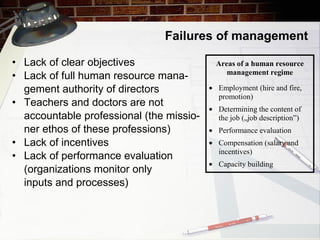
Failures of management Lack of clear objectives  Lack of full human resource mana- gement authority of directors Teachers and doctors are not  accountable professional (the missio- ner ethos of these professions) Lack of incentives Lack of performance evaluation  (organizations monitor only inputs and processes)
Failures of the short route Market relationship  is based on choice and backed by   purchasing power -> serious weaknesses for of public services: Responds to costumer needs only, does not respond to the needs of all citizens (can’t ensure equitable distribution) Does not satisfy collective objectives Choice may lead to inequalities (e.g. selection in education) Does not work out if the costumer has no relevant information about the performance of the provider ↔ doctors, teachers Client power might be written over by unbalanced power relationship between the client and the providers (doctors, teachers) In contrast to voice client power is mainly individual -> weaker, if  incentives on the providers side are weak ↔ low motivation  and weak capacities of frontliners
Answers to accountability failures  1. The failures of the long route:  NPM : Strengthening the short route by introducing choice and consumer power in the public services Managerial reshaping of national and local governments: pursuit of procedural efficiency, the division and dispersal of functions (local governments: catalyst agencies = creating mechanisms and structures to influence the actions of private and non-profit organizations) Instruments:   Competition (privatization, contracting out), simulating market relations (free choice of schools), more demand side financing (vouchers), market incentives (performance contracting, performance budgeting (performance-related pay), consumer service, strategic planning, performance measurement, deregulation, standards, reducing and modernizing public employment.
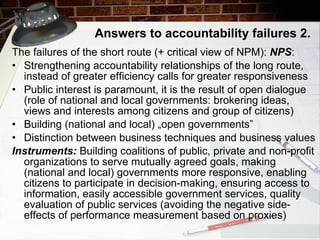
Answers to accountability failures  2. The  failures of the short route (+ critical view of NPM):  NPS : Strengthening accountability relationships of the long route, instead of greater efficiency calls for greater responsiveness Public interest is paramount, it is the result of open dialogue (role of national and local governments: brokering ideas, views and interests among citizens and group of citizens)  Building (national and local) „open governments”  Distinction between business techniques and business values Instruments:   Building coalitions of public, private and non-profit organizations to serve mutually agreed goals , m aking (national and local)   governments more responsive , e nabling citizens to participate in decision-making , e nsuring access to information , e asily accessible government services , q uality evaluation of public services  ( avoiding the negative side-effects of performance measurement  based on prox ies)
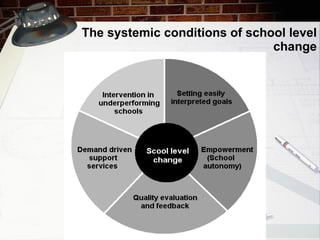
The systemic conditions of school level change
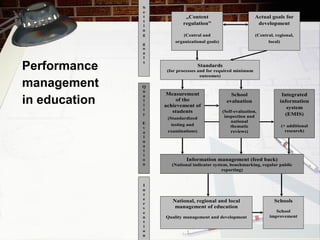
Performance  management  in education
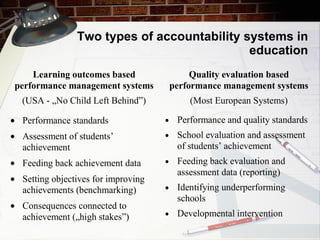
Two types of accountability systems in education
A few conclusions The first condition of implementing NPM approach based changes in education is   making the schools able to respond to diverse external expectations (among others those of the clients)  -> school autonomy The context largely depends on the context of policy-making. (USA: political procedures  -> contracting out, continental Europe: public administrational procedures -> greater roles of public institutions) Without major structural reforms (e.g. decentralization, well functioning account a bility relations) the relevance of NPM is extremely limited  -> South Eastern Europe NPM does not answers all question, NPM and NPS not necessarily mutually exclusive approaches (the context should be carefully considered)
For more see: Péter Radó: Governing Decentralized Education Systems Systemic Change in South Eastern Europe http://education.oander.hu/

Radó Péter: Decentralization and Accountability in Education

  • 1.
    Digging Deeper intoNew Public Management Decentralization, accountability relations and performance management in e ducation Péter Radó educational policy analyst senior consultant Expanzi ó Consulting [email_address]
  • 2.
    Major themes DecentralizationAccountability relations and their systemic conditions Accountability failures Answers to accountability failures (new public management and new public service) Performance management in education NPM and NPS compatible performance management systems
  • 3.
    Types of educationmanagement systems
  • 4.
    Decentralization The locusof decision-making: devolution of decision-making competencies to lower (regional, local, school) levels of management The actors of decision-making: involvement of non-administrative actors into decision-making (roles: regulation, decision-making, consultation) ( Decentralization versus deconcentration )
  • 5.
    Two approaches todecentralization The public administration approach: the distribution of decision-making competencies among the levels and actors of management of education (e.g.: director of schools = lowest level administration agent) – based on PA decentralization strategy The service delivery approach: the division of labor between public administration agents and educational service delivery institutions with professional, organizational and financial autonomy. (e.g.: director of schools = the manager of school-based decision-making) – based on comprehensive education sector strategy
  • 6.
    An analytical frameworkRoles Functions Decision-making competencies Required capacities Levels of management (roles : purpose of intervention) The strands of decentralization Management Financing Curriculum Quality evaluation Professional services National ( Strategic steering ) Regional (Integrated regional development) Local (Ownership, accountability relations ) School (Autonomy, quality management )
  • 7.
    The content ofaccountability relationships
  • 8.
  • 9.
    The changing patternof governance ⇒ conditions at the national level ⇒ conditions in schools
  • 10.
  • 11.
    Strategic steering andpolicy-making Conditions and instruments: Financial incentives Effective policy-coordination Professional self-regulation (e.g. assessment policy) Standards, benchmarks and procedural rules Professional, legal and fiscal accountability Strategic communication Empowerment of actors, capacity building Information system, knowledge basis, evaluation capacities Multilevel planning system, planning capacities Institutionalized stakeholder involvement Diversified network of support agencies Mandatory self-evaluation and quality management in schools
  • 12.
    Quality management inschools Self-evaluation – the analysis of the results Planning - analysis is transformed to improvement plan Improvement plan should be integrated into the daily work of the school organization Resources should be allocated (responsible person, time, deadlines, contributing persons)
  • 13.
    Failures of voiceLack of responsiveness of governance (e.g. too little budget is devoted to the services for the disadvantaged) Lack of open decision-making procedures (weak stakeholder consultation) Lack of accessible information on governance (lack of transparency, citizens can’t make their judgments, low trust) Lack of accessible information on locally delivered services (e.g. public reports on external evaluation , students’ achievement data aggregated at school level) Weak self-organization of citizens (aggregation and articulation failure, the better-off is the more affluent) Clientelism, corruption
  • 14.
    Failures of compact(ownership) No clear mandate and delegation of tasks (ambiguous goals, lack of service specifications and standards) Overregulation -> the lack of effective regulation (e.g. centrally issued syllabi) In education often service targets are not numerical, service provision is not logistical (↔ waste management) Lack of monitoring and control (e.g. lack of financial and legal audit, lack of external evaluation, lack of professional capacities in local administration) Lack of coherent compact (the ambiguous division of labor between national and local governance, contradictory expectations) Clientelism, corruption, providers capturing local governments
  • 15.
    Failures of managementLack of clear objectives Lack of full human resource mana- gement authority of directors Teachers and doctors are not accountable professional (the missio- ner ethos of these professions) Lack of incentives Lack of performance evaluation (organizations monitor only inputs and processes)
  • 16.
    Failures of theshort route Market relationship is based on choice and backed by purchasing power -> serious weaknesses for of public services: Responds to costumer needs only, does not respond to the needs of all citizens (can’t ensure equitable distribution) Does not satisfy collective objectives Choice may lead to inequalities (e.g. selection in education) Does not work out if the costumer has no relevant information about the performance of the provider ↔ doctors, teachers Client power might be written over by unbalanced power relationship between the client and the providers (doctors, teachers) In contrast to voice client power is mainly individual -> weaker, if incentives on the providers side are weak ↔ low motivation and weak capacities of frontliners
  • 17.
    Answers to accountabilityfailures 1. The failures of the long route: NPM : Strengthening the short route by introducing choice and consumer power in the public services Managerial reshaping of national and local governments: pursuit of procedural efficiency, the division and dispersal of functions (local governments: catalyst agencies = creating mechanisms and structures to influence the actions of private and non-profit organizations) Instruments: Competition (privatization, contracting out), simulating market relations (free choice of schools), more demand side financing (vouchers), market incentives (performance contracting, performance budgeting (performance-related pay), consumer service, strategic planning, performance measurement, deregulation, standards, reducing and modernizing public employment.
  • 18.
    Answers to accountabilityfailures 2. The failures of the short route (+ critical view of NPM): NPS : Strengthening accountability relationships of the long route, instead of greater efficiency calls for greater responsiveness Public interest is paramount, it is the result of open dialogue (role of national and local governments: brokering ideas, views and interests among citizens and group of citizens) Building (national and local) „open governments” Distinction between business techniques and business values Instruments: Building coalitions of public, private and non-profit organizations to serve mutually agreed goals , m aking (national and local) governments more responsive , e nabling citizens to participate in decision-making , e nsuring access to information , e asily accessible government services , q uality evaluation of public services ( avoiding the negative side-effects of performance measurement based on prox ies)
  • 19.
    The systemic conditionsof school level change
  • 20.
  • 21.
    Two types ofaccountability systems in education
  • 22.
    A few conclusionsThe first condition of implementing NPM approach based changes in education is making the schools able to respond to diverse external expectations (among others those of the clients) -> school autonomy The context largely depends on the context of policy-making. (USA: political procedures -> contracting out, continental Europe: public administrational procedures -> greater roles of public institutions) Without major structural reforms (e.g. decentralization, well functioning account a bility relations) the relevance of NPM is extremely limited -> South Eastern Europe NPM does not answers all question, NPM and NPS not necessarily mutually exclusive approaches (the context should be carefully considered)
  • 23.
    For more see:Péter Radó: Governing Decentralized Education Systems Systemic Change in South Eastern Europe http://education.oander.hu/