FUNCTIONALISTPERSPECTIVEON
EDUCATION
DS3004 / DS3019 / MPU 32113 – GENERAL
SOCIOLOGY
• Kee Li Jun, 00011903
• Bernice Loh Zi Teng, 00015380
• Loo Yen Yin, 00015816
• Su Yee wah, 00015345
• Brenda Chong Shi Yi, 00011203
• Lee Fei Wen, 00014891
Lecturer: Ab Rahman bin Mohd Yusof
Functionalist Perspective on Education
• Society as a living organism in which each part of the
organism contributes to its survival (Schaefer, 2011)
• Society is held together by consensus.
• Education as one crucial aspect of socialization, plays
an important role in reaching consensus.
Functionalist Perspective on Education
• Education contributes to the survival and
perpetuation of modern societies.
• Schools are developed to produce people who fit into
the society, but not people who set out to change it
(Hughes and Kroehler, 2008).
• People who are uneducated cannot survive in today’s
social-based world.
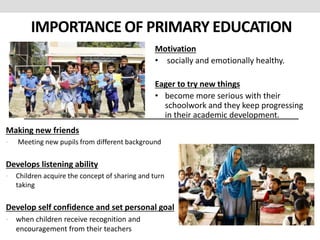
IMPORTANCE OF PRIMARY EDUCATION
Making new friends
• Meeting new pupils from different background
Develops listening ability
• Children acquire the concept of sharing and turn
taking
Develop self confidence and set personal goal
• when children receive recognition and
encouragement from their teachers
Motivation
• socially and emotionally healthy.
Eager to try new things
• become more serious with their
schoolwork and they keep progressing
in their academic development.
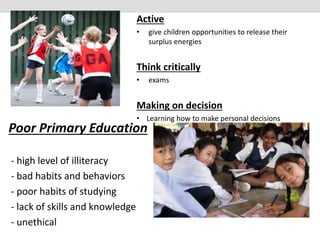
Active
• give children opportunities to release their
surplus energies
Think critically
• exams
Making on decision
• Learning how to make personal decisions
Poor Primary Education
- high level of illiteracy
- bad habits and behaviors
- poor habits of studying
- lack of skills and knowledge
- unethical
HEALTH AND EDUCATIONAL LEISURE
• Helps develop a growing
body
Health education – to teach
the pupils about their body.
Sports – keeps the body
strong to prevent diseases.
• Nurtures and enriches the
mind
Music/art classes – passion-
based classes help pupils to
relax in the midst of
studying.
Talent – endorse new
talents to the pupils.
MANIFEST FUNCTION
FUNDAMENTAL PROCESSES
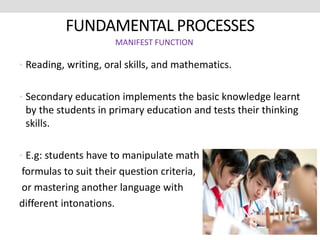
• Reading, writing, oral skills, and mathematics.
• Secondary education implements the basic knowledge learnt
by the students in primary education and tests their thinking
skills.
• E.g: students have to manipulate math
formulas to suit their question criteria,
or mastering another language with
different intonations.
MANIFEST FUNCTION
VOCATION
• Skills required for the working world
• E.g: presentation skills, computer usage.
• Secondary education helps the pupils gain these skills
more professionally as they have more equipment and
facilities than primary education institutions.
MANIFEST FUNCTION
CIVIC EDUCATION
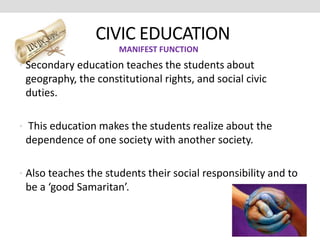
• Secondary education teaches the students about
geography, the constitutional rights, and social civic
duties.
• This education makes the students realize about the
dependence of one society with another society.
• Also teaches the students their social responsibility and to
be a ‘good Samaritan’.
MANIFEST FUNCTION
BUILDING ETHICAL CHARACTER AND SELF WORTH
• Builds ethical character
Students learn how to
interact with different
people (i.e: the opposite
sex, elders)
Secondary education
educates and reinforces the
students’ discipline and
respect
• Encourage self worth
Students are encouraged to
choose whatever field of
interest they want to pursue
Being good at something
increases the student’s self-
worth
The students are more
confident that they can
contribute to society
LATENT FUNCTION
CONCLUSION
• Secondary education teaches the students about their
respective places in society.
• Maintains order and welfare among the educated
citizens.
• Preparing the students intellectually for their tertiary
education and the working world.
Importance of Tertiary Education
 Individual
• Yields monetary benefits
• -gateway to better paying jobs which improve an individual's quality of life.
• Able to invest for the future
• -fulfillment of self-actualization needs .
• -wider opportunity of career choices .
• Well-respected in most communities
• -higher chances of being head-hunted and appointed to positions of authority.
• Expand their knowledge and skills
• -express their thoughts clearly, grasp abstract concepts and theories, and
increase their understanding of the world and their community.
Society and country
• Increase national productivity
-improve living standards.
-increase a country’s ability to compete and participate fully in the globalization
process.
• Support knowledge-driven economic growth strategies and reduce poverty
-training a qualified and adaptable labor force.
-generating new knowledge.
-providing the capacity to access the existing global knowledge.
• Supporting construction of democratic and socially cohesive societies
-improvement of the public institutions.
-support for the national innovation system.
• Values, attitudes, and ethics
-foundation of the social capital necessary for constructing healthy civil societies
and cohesive cultures.
Functionalist Perspective on Education
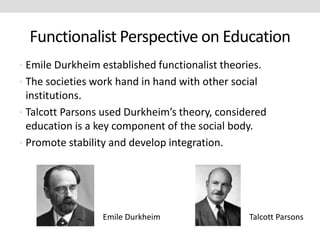
• Emile Durkheim established functionalist theories.
• The societies work hand in hand with other social
institutions.
• Talcott Parsons used Durkheim’s theory, considered
education is a key component of the social body.
• Promote stability and develop integration.
Emile Durkheim Talcott Parsons
Functionalist Perspective on Education
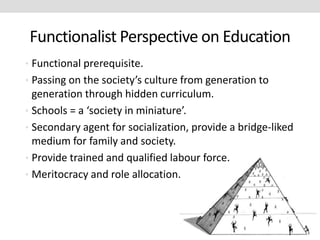
• Functional prerequisite.
• Passing on the society’s culture from generation to
generation through hidden curriculum.
• Schools = a ‘society in miniature’.
• Secondary agent for socialization, provide a bridge-liked
medium for family and society.
• Provide trained and qualified labour force.
• Meritocracy and role allocation.
CONCLUSION
• Functionalists, use education as part of their
observations, as a whole of society
• Education is the main organ if society
• If a school system works properly, then consequently a
society will function properly as well.
• In modern society, people
have to be basically skilled
• Education is important for job
opportunities and specialized
careers
Functionalist perspective-on-education

Functionalist perspective-on-education

  • 1.
    FUNCTIONALISTPERSPECTIVEON EDUCATION DS3004 / DS3019/ MPU 32113 – GENERAL SOCIOLOGY • Kee Li Jun, 00011903 • Bernice Loh Zi Teng, 00015380 • Loo Yen Yin, 00015816 • Su Yee wah, 00015345 • Brenda Chong Shi Yi, 00011203 • Lee Fei Wen, 00014891 Lecturer: Ab Rahman bin Mohd Yusof
  • 2.
    Functionalist Perspective onEducation • Society as a living organism in which each part of the organism contributes to its survival (Schaefer, 2011) • Society is held together by consensus. • Education as one crucial aspect of socialization, plays an important role in reaching consensus.
  • 3.
    Functionalist Perspective onEducation • Education contributes to the survival and perpetuation of modern societies. • Schools are developed to produce people who fit into the society, but not people who set out to change it (Hughes and Kroehler, 2008). • People who are uneducated cannot survive in today’s social-based world.
  • 4.
    IMPORTANCE OF PRIMARYEDUCATION Making new friends • Meeting new pupils from different background Develops listening ability • Children acquire the concept of sharing and turn taking Develop self confidence and set personal goal • when children receive recognition and encouragement from their teachers Motivation • socially and emotionally healthy. Eager to try new things • become more serious with their schoolwork and they keep progressing in their academic development.
  • 5.
    Active • give childrenopportunities to release their surplus energies Think critically • exams Making on decision • Learning how to make personal decisions Poor Primary Education - high level of illiteracy - bad habits and behaviors - poor habits of studying - lack of skills and knowledge - unethical
  • 6.
    HEALTH AND EDUCATIONALLEISURE • Helps develop a growing body Health education – to teach the pupils about their body. Sports – keeps the body strong to prevent diseases. • Nurtures and enriches the mind Music/art classes – passion- based classes help pupils to relax in the midst of studying. Talent – endorse new talents to the pupils. MANIFEST FUNCTION
  • 7.
    FUNDAMENTAL PROCESSES • Reading,writing, oral skills, and mathematics. • Secondary education implements the basic knowledge learnt by the students in primary education and tests their thinking skills. • E.g: students have to manipulate math formulas to suit their question criteria, or mastering another language with different intonations. MANIFEST FUNCTION
  • 8.
    VOCATION • Skills requiredfor the working world • E.g: presentation skills, computer usage. • Secondary education helps the pupils gain these skills more professionally as they have more equipment and facilities than primary education institutions. MANIFEST FUNCTION
  • 9.
    CIVIC EDUCATION • Secondaryeducation teaches the students about geography, the constitutional rights, and social civic duties. • This education makes the students realize about the dependence of one society with another society. • Also teaches the students their social responsibility and to be a ‘good Samaritan’. MANIFEST FUNCTION
  • 10.
    BUILDING ETHICAL CHARACTERAND SELF WORTH • Builds ethical character Students learn how to interact with different people (i.e: the opposite sex, elders) Secondary education educates and reinforces the students’ discipline and respect • Encourage self worth Students are encouraged to choose whatever field of interest they want to pursue Being good at something increases the student’s self- worth The students are more confident that they can contribute to society LATENT FUNCTION
  • 11.
    CONCLUSION • Secondary educationteaches the students about their respective places in society. • Maintains order and welfare among the educated citizens. • Preparing the students intellectually for their tertiary education and the working world.
  • 12.
    Importance of TertiaryEducation  Individual • Yields monetary benefits • -gateway to better paying jobs which improve an individual's quality of life. • Able to invest for the future • -fulfillment of self-actualization needs . • -wider opportunity of career choices . • Well-respected in most communities • -higher chances of being head-hunted and appointed to positions of authority. • Expand their knowledge and skills • -express their thoughts clearly, grasp abstract concepts and theories, and increase their understanding of the world and their community.
  • 13.
    Society and country •Increase national productivity -improve living standards. -increase a country’s ability to compete and participate fully in the globalization process. • Support knowledge-driven economic growth strategies and reduce poverty -training a qualified and adaptable labor force. -generating new knowledge. -providing the capacity to access the existing global knowledge. • Supporting construction of democratic and socially cohesive societies -improvement of the public institutions. -support for the national innovation system. • Values, attitudes, and ethics -foundation of the social capital necessary for constructing healthy civil societies and cohesive cultures.
  • 14.
    Functionalist Perspective onEducation • Emile Durkheim established functionalist theories. • The societies work hand in hand with other social institutions. • Talcott Parsons used Durkheim’s theory, considered education is a key component of the social body. • Promote stability and develop integration. Emile Durkheim Talcott Parsons
  • 15.
    Functionalist Perspective onEducation • Functional prerequisite. • Passing on the society’s culture from generation to generation through hidden curriculum. • Schools = a ‘society in miniature’. • Secondary agent for socialization, provide a bridge-liked medium for family and society. • Provide trained and qualified labour force. • Meritocracy and role allocation.
  • 16.
    CONCLUSION • Functionalists, useeducation as part of their observations, as a whole of society • Education is the main organ if society • If a school system works properly, then consequently a society will function properly as well. • In modern society, people have to be basically skilled • Education is important for job opportunities and specialized careers