“you can tell the
condition of nation
by looking at the
status of its women”
Jawaharlal Nehru
VENUE
Department of Sociology,
College of Basic Science and Humanities, CCS HAU, Hisar,
Haryana
Presented by-Deepika
Ph.D Research
scholar
Sociologically the word gender refers to the socio-
cultural definition of man and woman, the way
societies distinguish men and women and assign them
social roles. The distinction between sex and gender
was introduced to deal with the general tendency to
attribute women's subordination to their anatomy. For
ages it was believed that the different characteristics,
roles and status accorded to women and men in
society are determined by sex, that they are natural
and therefore not changeable.
Source: Wikipedia
Gender describes socially
constructed differences
between men and women,
boys and girls etc. Gender
is defined on the basis of
social norms, behaviors,
activities, relationship,
responsibilities which are
assigned by the society as
appropriate for male and
female (WHO, 2010).
Source :Registrar General of India.
Source :Registrar General of India
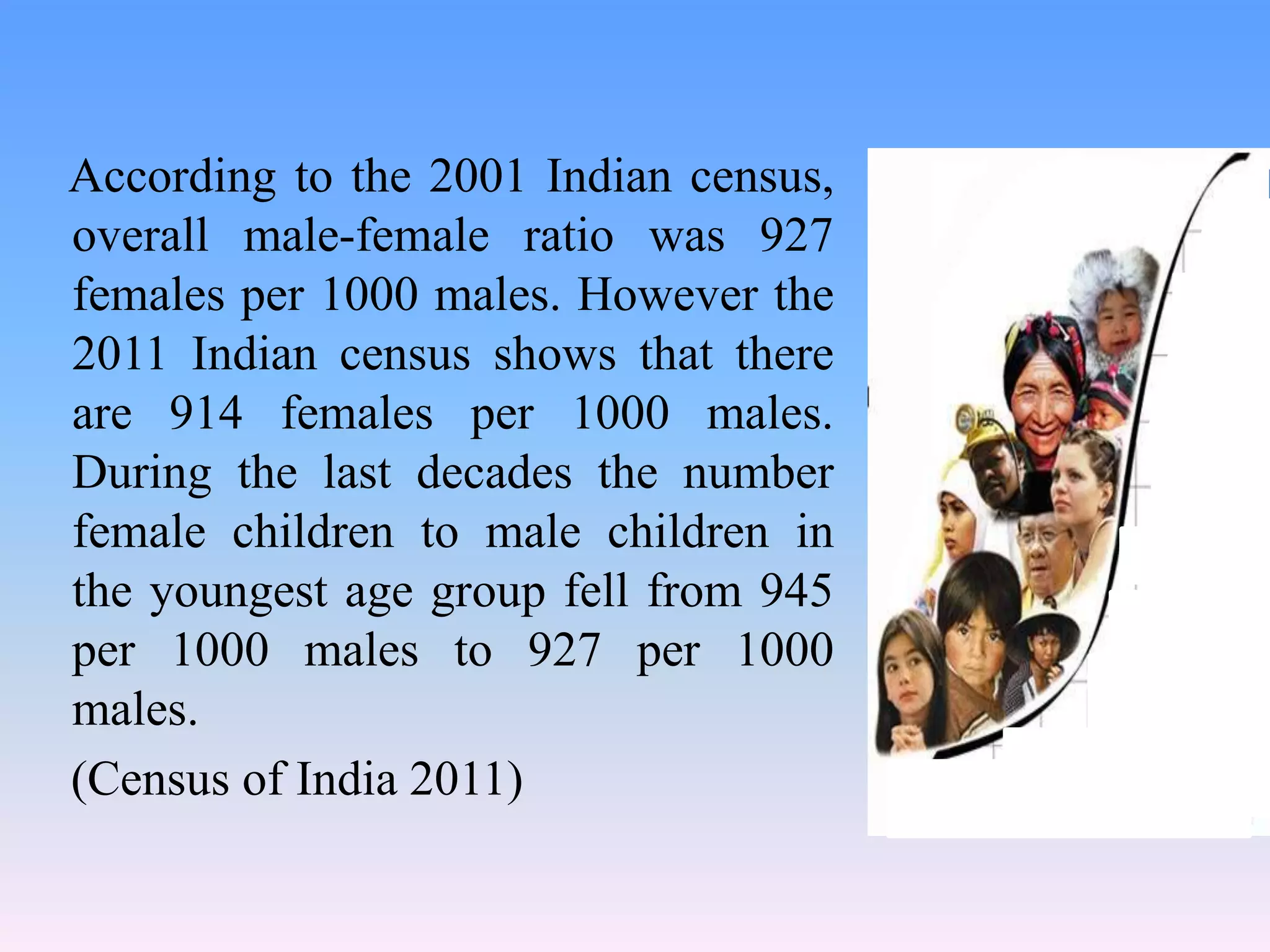
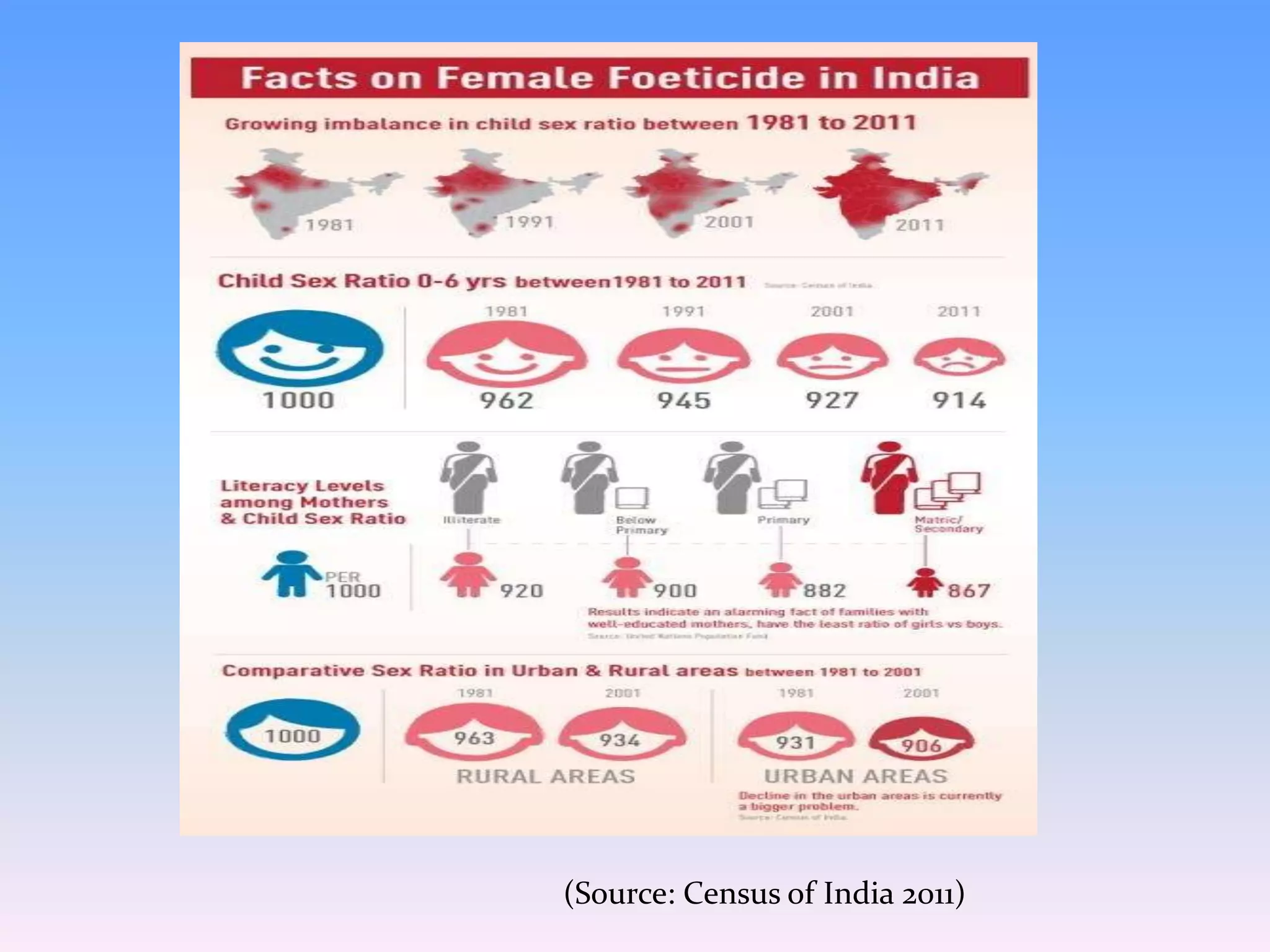
According to the 2001 Indian census,
overall male-female ratio was 927
females per 1000 males. However the
2011 Indian census shows that there
are 914 females per 1000 males.
During the last decades the number
female children to male children in
the youngest age group fell from 945
per 1000 males to 927 per 1000
males.
(Census of India 2011)
943
(Source: This data recently concluded by Census of
India 2011)
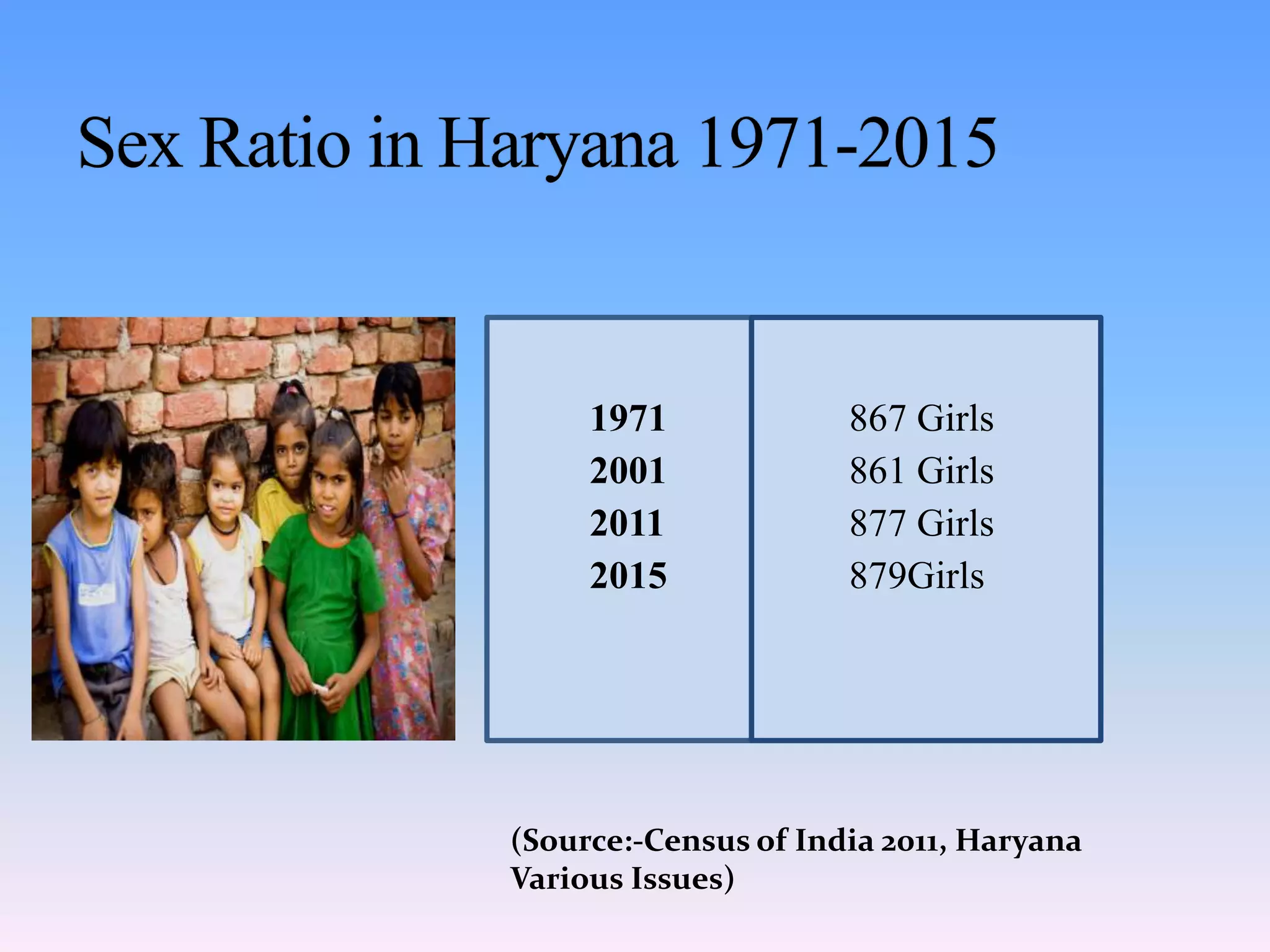
1971
2001
2011
2015
867 Girls
861 Girls
877 Girls
879Girls
(Source:-Census of India 2011, Haryana
Various Issues)
(Source: Report of the Technical group on population
projection constituted by the NATIONAL
COMMISSION ON POPULATION)
Haryana
2.7
The girl child becomes the victim
of discrimination and differential
treatment right from the time of
her birth. The birth of the male
child is welcomed with a happy
heart whereas that of the girl child
is met with depression, especially
if she is born after two or three
sisters. She is considered as a
weakness for the family, she is an
economic burden, a moral liability
that is defenseless against all types
of hazards in life.
parents of a girl are always vigilant regarding
her clothes, social relations, behavior, habits,
etc., and that they restrict girls in each and
every sphere. These restrictions are not
imposed upon their brothers. Behavior that is
acceptable for boys is considered inappropriate
Girls’ sitting, standing, talking, interacting
gestures are also considered important.
Girls should not talk loudly; they should not
stand with their hands on their hip. Generally,
their standing gestures/postures should not
look odd, or others will comment that they
stand like a male. Girls are often rebuked for
rushing to a place, jumping or running, etc. It
was observed that a girl should be docile in
manner and perform household duties very
promptly and graciously. She should not laugh
loudly.
Cont…
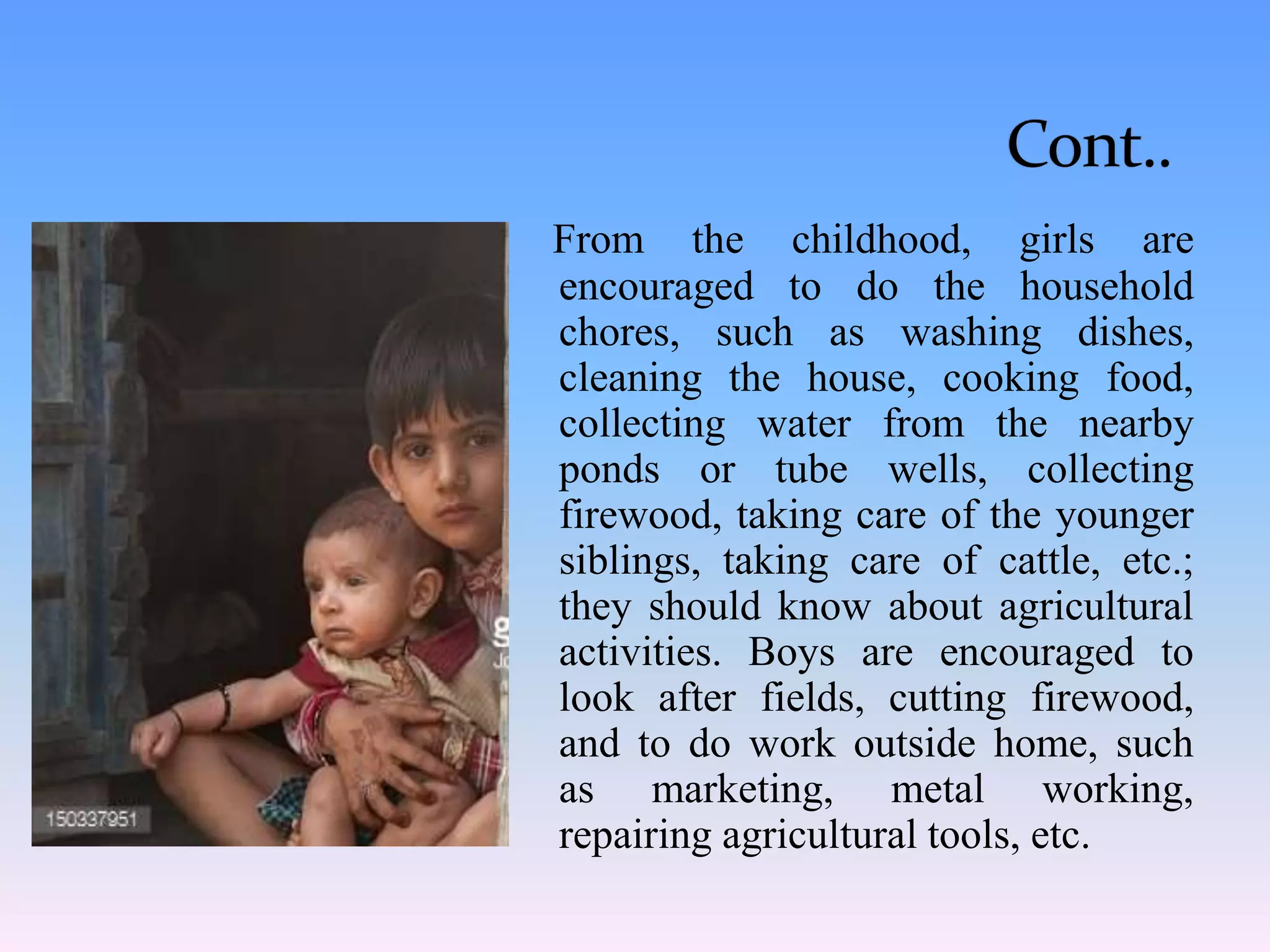
From the childhood, girls are
encouraged to do the household
chores, such as washing dishes,
cleaning the house, cooking food,
collecting water from the nearby
ponds or tube wells, collecting
firewood, taking care of the younger
siblings, taking care of cattle, etc.;
they should know about agricultural
activities. Boys are encouraged to
look after fields, cutting firewood,
and to do work outside home, such
as marketing, metal working,
repairing agricultural tools, etc.
Discriminatory behavior of the
villagers in the allocation of food
resources was observed in majority
of the cases. Majority of the males
are served food before females.
The preference is given to the
males in the sphere of health. The
girls are treated locally whereas the
boys may be taken to the doctor,
especially in the low-income
families in which more than two
daughters are present, the boy's life
is more important as compared to
the girls.
First preference was given to male child for
serving the costly and special food such as dry
fruits, eggs and meat in rural background,
Whereas in urban background costly food was
mainly served jointly followed by adult male
and male child. In all cases women eat food in
the end. Ignoring adult female and female
children while serving notorious food
adversely affect the women.
(Source:Ramchandran, N (2011). Gender, Technology And Development.
15(3):363-387.)
Source: Report of the Technical Group on Population Projections May 2006,
National Commission on Population/MOHFW/GOI.
Source: Report of the Technical Group on Population Projections May 2006,
National Commission on Population MOHFW.
The female child in India is
often deprived from her right
of an education. The numbers
of girl dropping out of school
far exceeds the boys because
girls are expected to help at
home, either with household
work like washing and
cooking or with taking care of
younger siblings
Parents prefer their sons over their daughter
because they are supposed to be the helping hands
for the parents. The boys are given education as it
is considered a sign of pride and prestige to educate
the boys (Ambreen and Mohyuddin, 2013).
A hidden fear in the minds of males is that after
getting education the females may start interfering
in the decision making process. They are kept
economically dependent on males no matter how
hard they work to contribute to the families income
Their work is not recognized as a part of
contribution to the household economy. They are
also deprived on share their property.
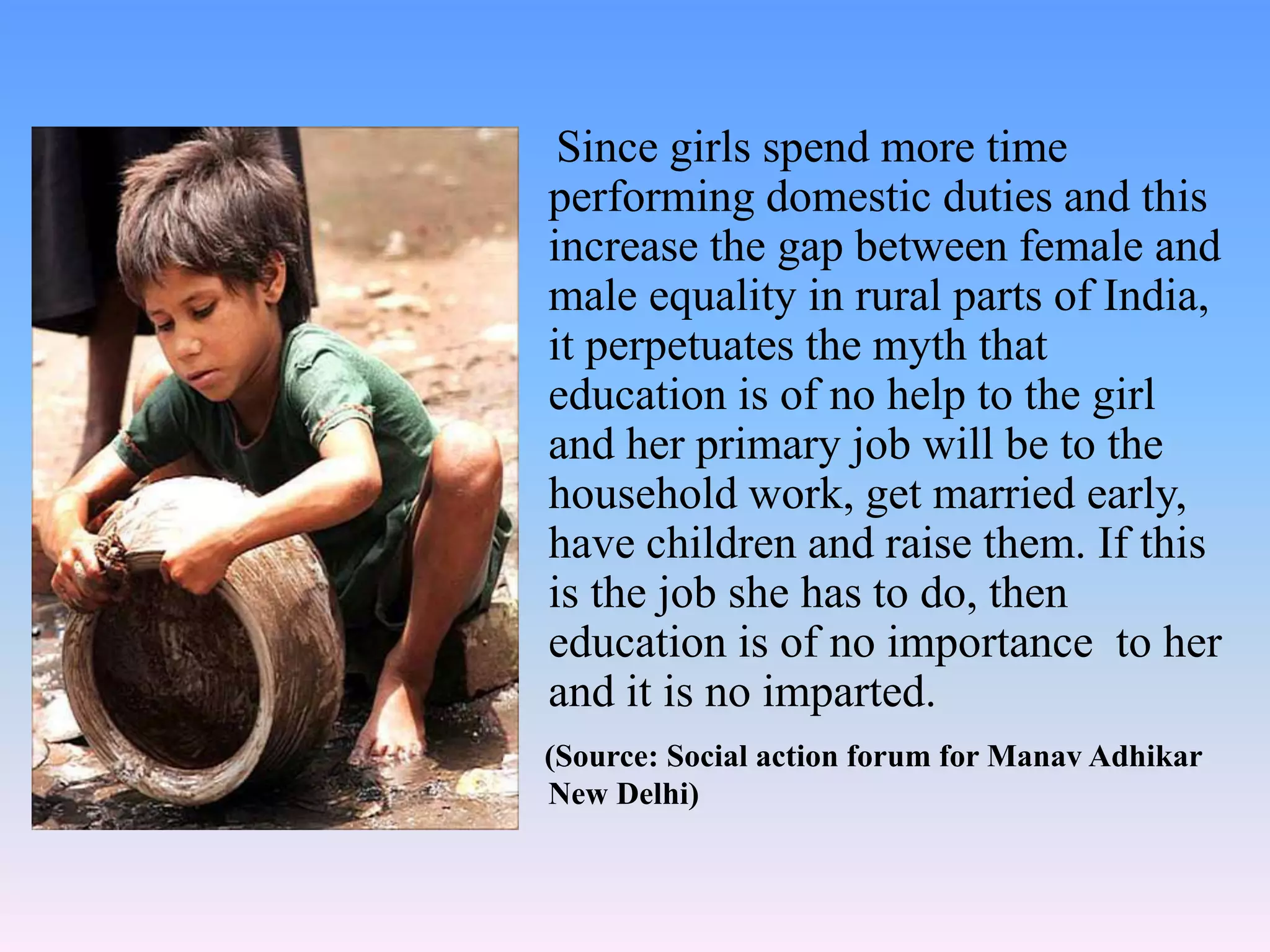
Since girls spend more time
performing domestic duties and this
increase the gap between female and
male equality in rural parts of India,
it perpetuates the myth that
education is of no help to the girl
and her primary job will be to the
household work, get married early,
have children and raise them. If this
is the job she has to do, then
education is of no importance to her
and it is no imparted.
(Source: Social action forum for Manav Adhikar
New Delhi)
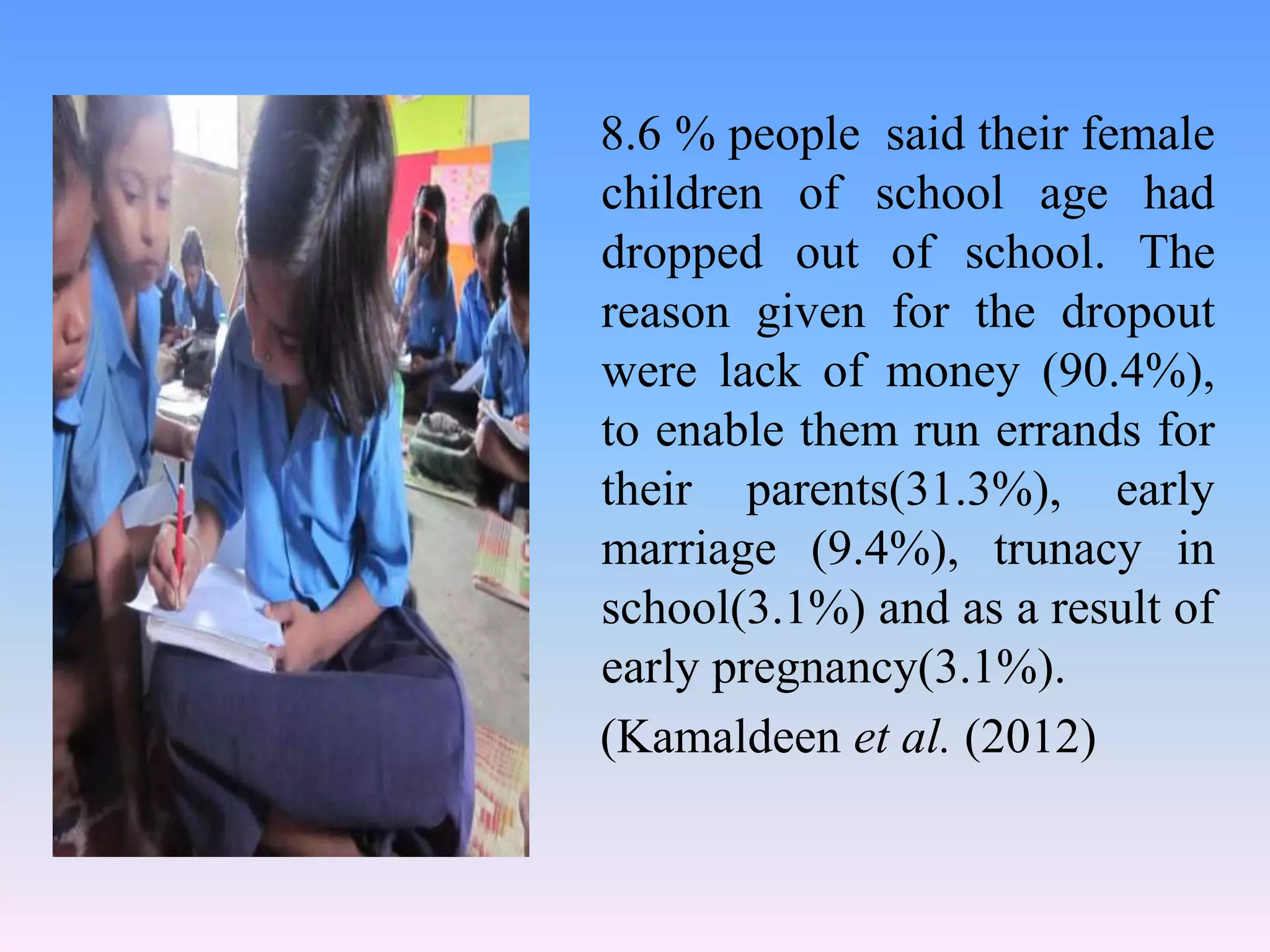
8.6 % people said their female
children of school age had
dropped out of school. The
reason given for the dropout
were lack of money (90.4%),
to enable them run errands for
their parents(31.3%), early
marriage (9.4%), trunacy in
school(3.1%) and as a result of
early pregnancy(3.1%).
(Kamaldeen et al. (2012)
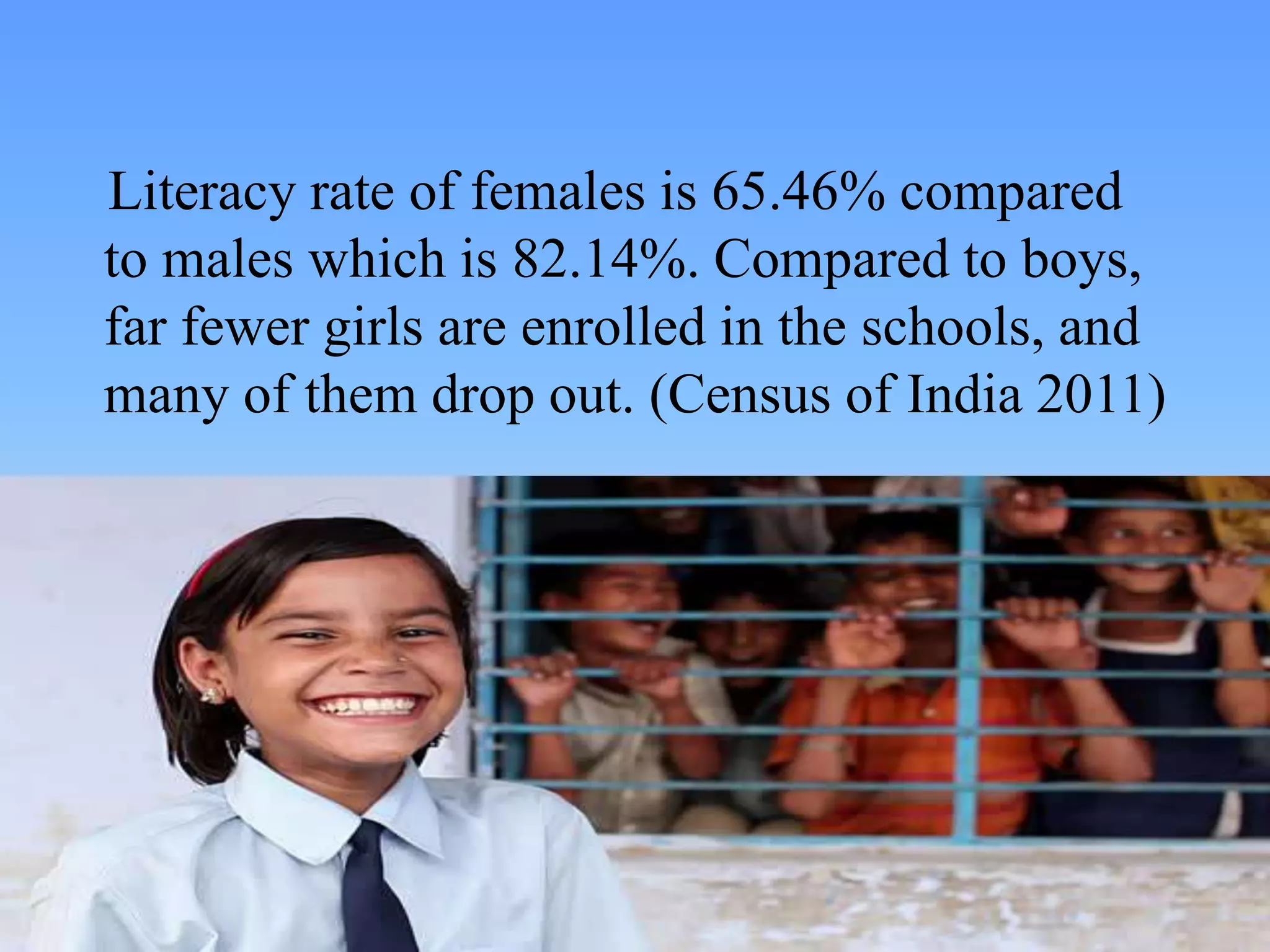
Literacy rate of females is 65.46% compared
to males which is 82.14%. Compared to boys,
far fewer girls are enrolled in the schools, and
many of them drop out. (Census of India 2011)
1951 8.86 %
1961 15.35 %
1971 21.97 %
1981 29.76 %
1991 39.29 %
2001 53.67 %
2011 65.46 %
(Source: Office of the Registrar General, India)
Note: 1. Literacy rates for 1951, 1961 and 1971 Censuses relates
to population aged five
years and above. The rates for the 1981, 1991 and 2011 Censuses
relate to the population aged seven years and above.
Source: Census of India
Literacy rate in India
has shown major sign
of improvement in last
10 years. Current
literacy rate in India
stands at 74.04 percent
in 11 September 2015.
(Source- Literacy rate of India. Census
of India 2011)
While goddess are welcomed with open arms, our
doors are shut tight for girl child.
 It’s a very common scenario in almost all
villages.
 It has become tradition for some families to have
male children only.
 Our sex ratio is : 943 females per 1000 males in
11 September 2015
Female foeticide is a unique form of violence against
women. The word “abortion” has meaning “Offensive”
and truly, the practice made to take away the wholeness
of a woman is an offense which resorts to taking away the
life of her own unborn child. in northern India social
group with strong patriarchal norms and high degree of
son preference predominantly represent higher economic
ladder. For instance, the natural biological laws of human
reproduction of mankind for balancing its natural sex
ratio, has been distorted by man-made norms, customs,
traditions, religious beliefs and more recently by
sophisticated medical technology to result lower sex ratio
in India
 Obsession for son.
 Fear of Dowry by many poor class families.
 Girls are considered as financial obligation by many
parents.
 Advancement in technology, nowadays parents
determines the sex of a child before birth.
 Some of the doctors do this heinous act to fulfill their
money desires.
(Source: Wikipedia)
(Source: Census of India 2011)
GBV is violence that is directed
at an individual based on his or
her biological sex, gender
identity, or perceived adherence
to socially defined norms of
masculinity and femininity. It
includes physical, sexual, and
psychological abuse, threats,
coercion, arbitrary deprivation
of liberty, and economic
deprivation.
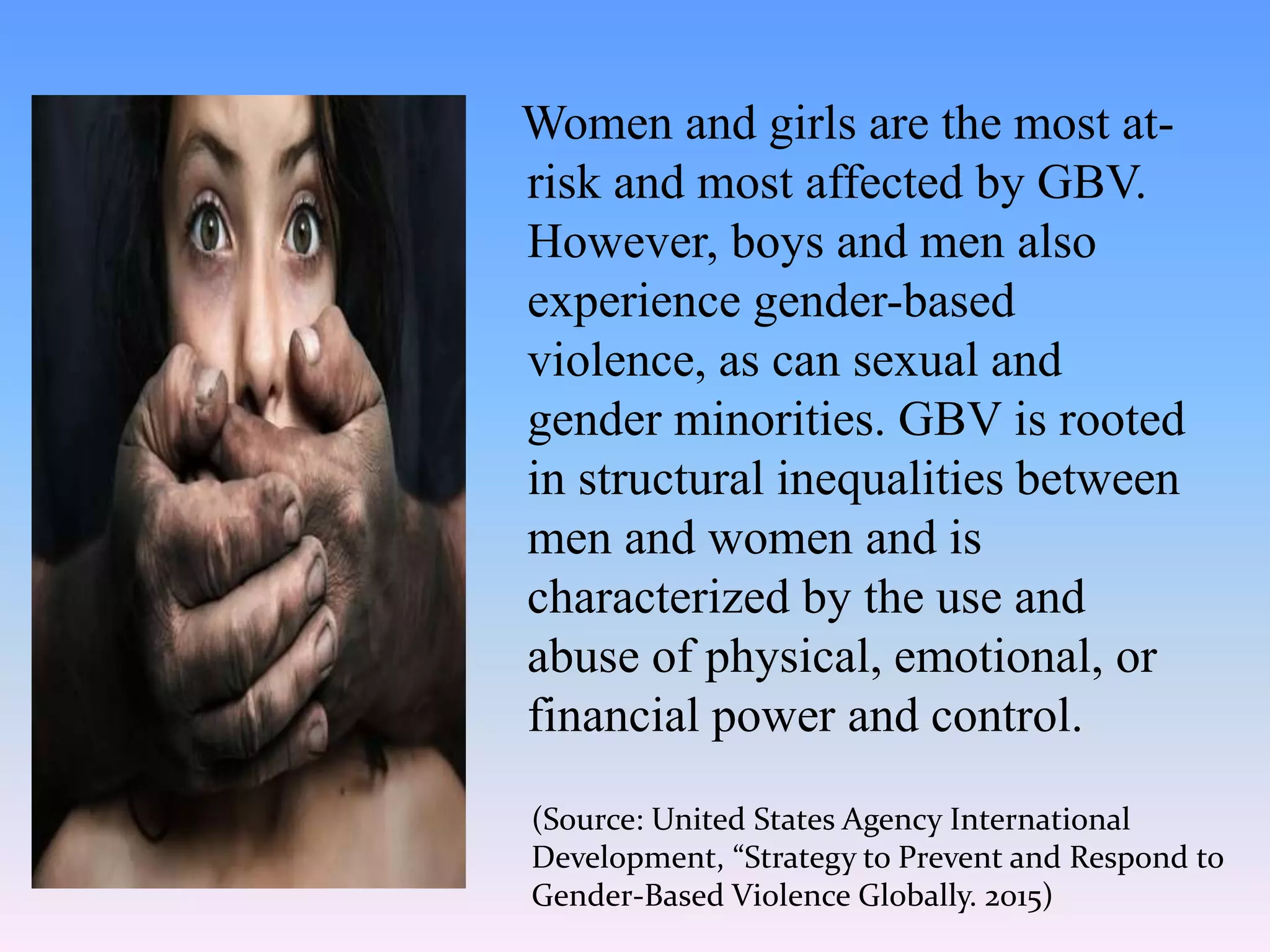
Women and girls are the most at-
risk and most affected by GBV.
However, boys and men also
experience gender-based
violence, as can sexual and
gender minorities. GBV is rooted
in structural inequalities between
men and women and is
characterized by the use and
abuse of physical, emotional, or
financial power and control.
(Source: United States Agency International
Development, “Strategy to Prevent and Respond to
Gender-Based Violence Globally. 2015)
(Source: Wikipedia)
Source:http://www.who.int/reproducti
ve health violence
 Laws under the Indian Penal Code (IPC)
 Dowry Prohibition Act: any property or valuable (direct or
indirect) given before, at or after the marriage
 Section 304B: Death of a woman within 7 years of her
marriage
 Section 498A: When husband or his family subjects
woman to cruelty (“intentional” behaviour that causes
serious injury or harassment for dowry)
 Section 376: Rape law
 Section 294: Obscene acts and songs
 Section 354: Intent to outrage a woman’s modesty
 Raises awareness among women about their rights and laws.
 Recruit men in the fight against gender discrimination. Gender
discrimination happens because people think that men are
better than women. It seems obvious that women would want
to change the system, but men are less likely want to give up
their position of power. When man take part in resisting gender
discrimination- by treating women with respect.
 Implement policies that prohibit discrimination in the family,
society, workplace and school zones.
 Provide women with access to legal representation and
opportunities to pursue justices against violence and
discrimination through the formal legal system.
1. Start with your kids because children learn very fast. Let your
sons take care of house chores. Do not reserve chores exclusively
for your daughters. Having your sons perform house duties will
not only make them aware that housework applies to everyone.
2. Do not make excuse Sons and daughters should be held
accountable for their action in the same way. Is it okay for your
son to damage every piece of furniture in the house simply
because he is a boy? Is it okay for your daughter to clog the
bathroom sink with hair (and not clean up) daily just because she
is a girl?
3. Do not tolerate violence either way Do not hit her because she is
a girl. Many parents mean well by saying that to their toddler sons
but it can create another problem. By using the “because she is a
girl "reason, parents can cause their sons to only see a girl’s
gender instead of seeing her as a person first. In addition to that,
those same parents should not tolerate their daughters hitting their
sons. This would not be fair and could cause their sons to resent
women as they grow up.
 United States Agency International Development, “Strategy to Prevent and Respond to
Gender-Based Violence Globally”. Available at: http://www.usaid.gov/documents/2155/gbv-
strategy-fact-sheet.
 Report of the Technical Group on Population Projections May 2006, National Commission on
Population/MOHFW/GOI.
 Census of India 2001, Report of the technical group on population projection constituted by
the national commission on population May 2006
 International union for health promitionn and education, Punjab chapter, Ludhiana.
 Social action forum for Manav Adhikar New Delhi.
 Kamaldeen, S.A.,Buhari, M.S. and Parakoyi, D.B (2012). Perception, attitude and practies of
parents in okene, Nigeria towards girl child education. International journal of scientific and
Research publication. 2 (8):1-7
 Ramachandran, N.(2011). Are women equally unequal in india? Looking across geographic
space. Gender, Technology and Development. 15 (3):363-387.
 United States Agency International Development, “Strategy to Prevent and Respond to
Gender-Based Violence Globally. 2015)
 Social action forum for Manav Adhikar New Delhi. Source:http://www.who.int/reproductive
health violence:
 Kenya Demographic and Health Survey, 2013)
Any Questions
Gender Bias As Correlate of Parenting

Gender Bias As Correlate of Parenting

  • 1.
    “you can tellthe condition of nation by looking at the status of its women” Jawaharlal Nehru
  • 2.
    VENUE Department of Sociology, Collegeof Basic Science and Humanities, CCS HAU, Hisar, Haryana Presented by-Deepika Ph.D Research scholar
  • 3.
    Sociologically the wordgender refers to the socio- cultural definition of man and woman, the way societies distinguish men and women and assign them social roles. The distinction between sex and gender was introduced to deal with the general tendency to attribute women's subordination to their anatomy. For ages it was believed that the different characteristics, roles and status accorded to women and men in society are determined by sex, that they are natural and therefore not changeable. Source: Wikipedia
  • 4.
    Gender describes socially constructeddifferences between men and women, boys and girls etc. Gender is defined on the basis of social norms, behaviors, activities, relationship, responsibilities which are assigned by the society as appropriate for male and female (WHO, 2010).
  • 5.
  • 6.
  • 7.
    According to the2001 Indian census, overall male-female ratio was 927 females per 1000 males. However the 2011 Indian census shows that there are 914 females per 1000 males. During the last decades the number female children to male children in the youngest age group fell from 945 per 1000 males to 927 per 1000 males. (Census of India 2011)
  • 8.
  • 9.
    (Source: This datarecently concluded by Census of India 2011)
  • 10.
    1971 2001 2011 2015 867 Girls 861 Girls 877Girls 879Girls (Source:-Census of India 2011, Haryana Various Issues)
  • 11.
    (Source: Report ofthe Technical group on population projection constituted by the NATIONAL COMMISSION ON POPULATION) Haryana 2.7
  • 13.
    The girl childbecomes the victim of discrimination and differential treatment right from the time of her birth. The birth of the male child is welcomed with a happy heart whereas that of the girl child is met with depression, especially if she is born after two or three sisters. She is considered as a weakness for the family, she is an economic burden, a moral liability that is defenseless against all types of hazards in life.
  • 14.
    parents of agirl are always vigilant regarding her clothes, social relations, behavior, habits, etc., and that they restrict girls in each and every sphere. These restrictions are not imposed upon their brothers. Behavior that is acceptable for boys is considered inappropriate Girls’ sitting, standing, talking, interacting gestures are also considered important.
  • 15.
    Girls should nottalk loudly; they should not stand with their hands on their hip. Generally, their standing gestures/postures should not look odd, or others will comment that they stand like a male. Girls are often rebuked for rushing to a place, jumping or running, etc. It was observed that a girl should be docile in manner and perform household duties very promptly and graciously. She should not laugh loudly. Cont…
  • 16.
    From the childhood,girls are encouraged to do the household chores, such as washing dishes, cleaning the house, cooking food, collecting water from the nearby ponds or tube wells, collecting firewood, taking care of the younger siblings, taking care of cattle, etc.; they should know about agricultural activities. Boys are encouraged to look after fields, cutting firewood, and to do work outside home, such as marketing, metal working, repairing agricultural tools, etc.
  • 17.
    Discriminatory behavior ofthe villagers in the allocation of food resources was observed in majority of the cases. Majority of the males are served food before females. The preference is given to the males in the sphere of health. The girls are treated locally whereas the boys may be taken to the doctor, especially in the low-income families in which more than two daughters are present, the boy's life is more important as compared to the girls.
  • 18.
    First preference wasgiven to male child for serving the costly and special food such as dry fruits, eggs and meat in rural background, Whereas in urban background costly food was mainly served jointly followed by adult male and male child. In all cases women eat food in the end. Ignoring adult female and female children while serving notorious food adversely affect the women. (Source:Ramchandran, N (2011). Gender, Technology And Development. 15(3):363-387.)
  • 19.
    Source: Report ofthe Technical Group on Population Projections May 2006, National Commission on Population/MOHFW/GOI.
  • 20.
    Source: Report ofthe Technical Group on Population Projections May 2006, National Commission on Population MOHFW.
  • 21.
    The female childin India is often deprived from her right of an education. The numbers of girl dropping out of school far exceeds the boys because girls are expected to help at home, either with household work like washing and cooking or with taking care of younger siblings
  • 22.
    Parents prefer theirsons over their daughter because they are supposed to be the helping hands for the parents. The boys are given education as it is considered a sign of pride and prestige to educate the boys (Ambreen and Mohyuddin, 2013). A hidden fear in the minds of males is that after getting education the females may start interfering in the decision making process. They are kept economically dependent on males no matter how hard they work to contribute to the families income Their work is not recognized as a part of contribution to the household economy. They are also deprived on share their property.
  • 23.
    Since girls spendmore time performing domestic duties and this increase the gap between female and male equality in rural parts of India, it perpetuates the myth that education is of no help to the girl and her primary job will be to the household work, get married early, have children and raise them. If this is the job she has to do, then education is of no importance to her and it is no imparted. (Source: Social action forum for Manav Adhikar New Delhi)
  • 24.
    8.6 % peoplesaid their female children of school age had dropped out of school. The reason given for the dropout were lack of money (90.4%), to enable them run errands for their parents(31.3%), early marriage (9.4%), trunacy in school(3.1%) and as a result of early pregnancy(3.1%). (Kamaldeen et al. (2012)
  • 25.
    Literacy rate offemales is 65.46% compared to males which is 82.14%. Compared to boys, far fewer girls are enrolled in the schools, and many of them drop out. (Census of India 2011)
  • 26.
    1951 8.86 % 196115.35 % 1971 21.97 % 1981 29.76 % 1991 39.29 % 2001 53.67 % 2011 65.46 % (Source: Office of the Registrar General, India) Note: 1. Literacy rates for 1951, 1961 and 1971 Censuses relates to population aged five years and above. The rates for the 1981, 1991 and 2011 Censuses relate to the population aged seven years and above.
  • 27.
  • 28.
    Literacy rate inIndia has shown major sign of improvement in last 10 years. Current literacy rate in India stands at 74.04 percent in 11 September 2015. (Source- Literacy rate of India. Census of India 2011)
  • 29.
    While goddess arewelcomed with open arms, our doors are shut tight for girl child.  It’s a very common scenario in almost all villages.  It has become tradition for some families to have male children only.  Our sex ratio is : 943 females per 1000 males in 11 September 2015
  • 30.
    Female foeticide isa unique form of violence against women. The word “abortion” has meaning “Offensive” and truly, the practice made to take away the wholeness of a woman is an offense which resorts to taking away the life of her own unborn child. in northern India social group with strong patriarchal norms and high degree of son preference predominantly represent higher economic ladder. For instance, the natural biological laws of human reproduction of mankind for balancing its natural sex ratio, has been distorted by man-made norms, customs, traditions, religious beliefs and more recently by sophisticated medical technology to result lower sex ratio in India
  • 31.
     Obsession forson.  Fear of Dowry by many poor class families.  Girls are considered as financial obligation by many parents.  Advancement in technology, nowadays parents determines the sex of a child before birth.  Some of the doctors do this heinous act to fulfill their money desires.
  • 32.
  • 33.
    (Source: Census ofIndia 2011)
  • 35.
    GBV is violencethat is directed at an individual based on his or her biological sex, gender identity, or perceived adherence to socially defined norms of masculinity and femininity. It includes physical, sexual, and psychological abuse, threats, coercion, arbitrary deprivation of liberty, and economic deprivation.
  • 36.
    Women and girlsare the most at- risk and most affected by GBV. However, boys and men also experience gender-based violence, as can sexual and gender minorities. GBV is rooted in structural inequalities between men and women and is characterized by the use and abuse of physical, emotional, or financial power and control. (Source: United States Agency International Development, “Strategy to Prevent and Respond to Gender-Based Violence Globally. 2015)
  • 37.
  • 38.
  • 39.
     Laws underthe Indian Penal Code (IPC)  Dowry Prohibition Act: any property or valuable (direct or indirect) given before, at or after the marriage  Section 304B: Death of a woman within 7 years of her marriage  Section 498A: When husband or his family subjects woman to cruelty (“intentional” behaviour that causes serious injury or harassment for dowry)  Section 376: Rape law  Section 294: Obscene acts and songs  Section 354: Intent to outrage a woman’s modesty
  • 40.
     Raises awarenessamong women about their rights and laws.  Recruit men in the fight against gender discrimination. Gender discrimination happens because people think that men are better than women. It seems obvious that women would want to change the system, but men are less likely want to give up their position of power. When man take part in resisting gender discrimination- by treating women with respect.  Implement policies that prohibit discrimination in the family, society, workplace and school zones.  Provide women with access to legal representation and opportunities to pursue justices against violence and discrimination through the formal legal system.
  • 41.
    1. Start withyour kids because children learn very fast. Let your sons take care of house chores. Do not reserve chores exclusively for your daughters. Having your sons perform house duties will not only make them aware that housework applies to everyone. 2. Do not make excuse Sons and daughters should be held accountable for their action in the same way. Is it okay for your son to damage every piece of furniture in the house simply because he is a boy? Is it okay for your daughter to clog the bathroom sink with hair (and not clean up) daily just because she is a girl? 3. Do not tolerate violence either way Do not hit her because she is a girl. Many parents mean well by saying that to their toddler sons but it can create another problem. By using the “because she is a girl "reason, parents can cause their sons to only see a girl’s gender instead of seeing her as a person first. In addition to that, those same parents should not tolerate their daughters hitting their sons. This would not be fair and could cause their sons to resent women as they grow up.
  • 42.
     United StatesAgency International Development, “Strategy to Prevent and Respond to Gender-Based Violence Globally”. Available at: http://www.usaid.gov/documents/2155/gbv- strategy-fact-sheet.  Report of the Technical Group on Population Projections May 2006, National Commission on Population/MOHFW/GOI.  Census of India 2001, Report of the technical group on population projection constituted by the national commission on population May 2006  International union for health promitionn and education, Punjab chapter, Ludhiana.  Social action forum for Manav Adhikar New Delhi.  Kamaldeen, S.A.,Buhari, M.S. and Parakoyi, D.B (2012). Perception, attitude and practies of parents in okene, Nigeria towards girl child education. International journal of scientific and Research publication. 2 (8):1-7  Ramachandran, N.(2011). Are women equally unequal in india? Looking across geographic space. Gender, Technology and Development. 15 (3):363-387.  United States Agency International Development, “Strategy to Prevent and Respond to Gender-Based Violence Globally. 2015)  Social action forum for Manav Adhikar New Delhi. Source:http://www.who.int/reproductive health violence:  Kenya Demographic and Health Survey, 2013)
  • 43.