Clean code
Good practices for readability and maintainability
Rafael Sousa Herves
1
Contents
1.Clean code
2.Naming
3.Functions
4.Comments
5.Error handling
6.Classes
2
What is clean code?
3
What is clean code?
4
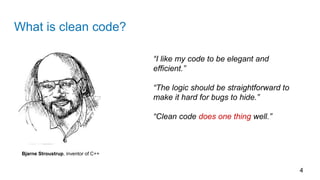
Bjarne Stroustrup, inventor of C++
“I like my code to be elegant and
efficient.”
“The logic should be straightforward to
make it hard for bugs to hide.”
“Clean code does one thing well.”
What is clean code?
5
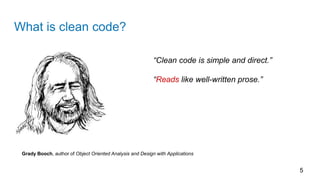
Grady Booch, author of Object Oriented Analysis and Design with Applications
“Clean code is simple and direct.”
“Reads like well-written prose.”
What is clean code?
6
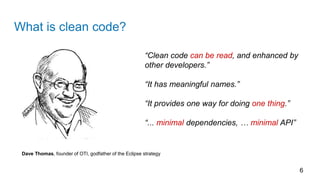
Dave Thomas, founder of OTI, godfather of the Eclipse strategy
“Clean code can be read, and enhanced by
other developers.”
“It has meaningful names.”
“It provides one way for doing one thing.”
“... minimal dependencies, … minimal API”
What is clean code?
7
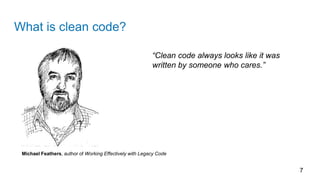
Michael Feathers, author of Working Effectively with Legacy Code
“Clean code always looks like it was
written by someone who cares.”
What is clean code?
8
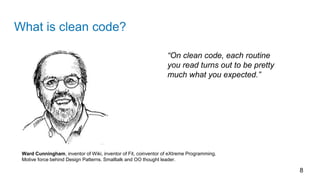
Ward Cunningham, inventor of Wiki, inventor of Fit, coinventor of eXtreme Programming.
Motive force behind Design Patterns. Smalltalk and OO thought leader.
“On clean code, each routine
you read turns out to be pretty
much what you expected.”
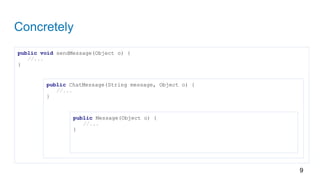
public void sendMessage(Object o) {
//...
}
Concretely
9
public ChatMessage(String message, Object o) {
//...
}
public Message(Object o) {
//...
}
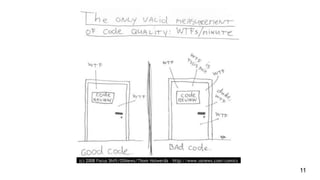
How to measure code quality?
10
11
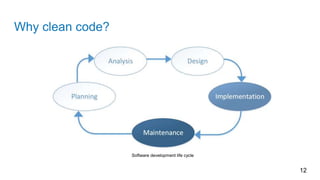
Why clean code?
12
Software development life cycle
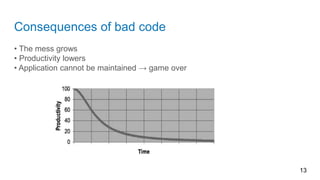
Consequences of bad code
• The mess grows
• Productivity lowers
• Application cannot be maintained → game over
13
Naming
14
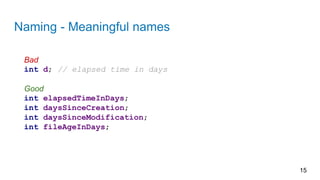
Naming - Meaningful names
15
Bad
int d; // elapsed time in days
Good
int elapsedTimeInDays;
int daysSinceCreation;
int daysSinceModification;
int fileAgeInDays;
Naming - Intention revealing names
16
Bad
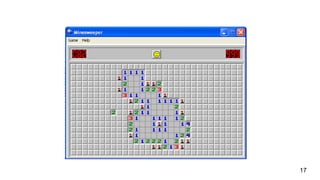
public List<int[]> getThem() {
List<int[]> list1 = new ArrayList<int[]>();
for (int[] x : theList)
if (x[0] == 4)
list1.add(x);
return list1;
}
17
Naming - Intention revealing names
18
public final static int STATUS_VALUE = 0;
public final static int FLAGGED = 4;
public List<int[]> getFlaggedCells() {
List<int[]> flaggedCells = new ArrayList<int[]>();
for (int[] cell : gameBoard)
if (cell[STATUS_VALUE] == FLAGGED)
flaggedCells.add(cell);
return flaggedCells;
}
public List<int[]> getThem() {
List<int[]> list1 = new ArrayList<int[]>();
for (int[] x : theList)
if (x[0] == 4)
list1.add(x);
return list1;
}
Bad Good
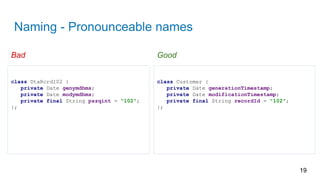
Naming - Pronounceable names
19
class Customer {
private Date generationTimestamp;
private Date modificationTimestamp;
private final String recordId = "102";
};
class DtaRcrd102 {
private Date genymdhms;
private Date modymdhms;
private final String pszqint = "102";
};
Bad Good
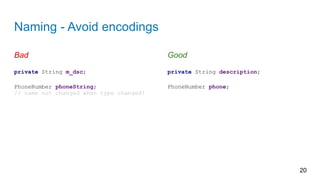
Naming - Avoid encodings
20
private String description;
PhoneNumber phone;
private String m_dsc;
PhoneNumber phoneString;
// name not changed when type changed!
Bad Good
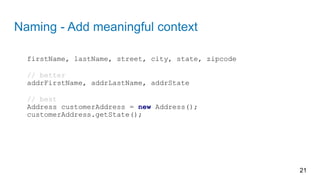
Naming - Add meaningful context
firstName, lastName, street, city, state, zipcode
// better
addrFirstName, addrLastName, addrState
// best
Address customerAddress = new Address();
customerAddress.getState();
21
Functions
22
f(x) =
Functions
23
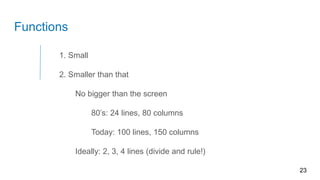
1. Small
2. Smaller than that
No bigger than the screen
80’s: 24 lines, 80 columns
Today: 100 lines, 150 columns
Ideally: 2, 3, 4 lines (divide and rule!)
Functions
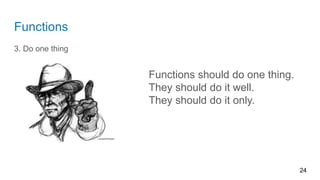
3. Do one thing
24
Functions should do one thing.
They should do it well.
They should do it only.
Functions
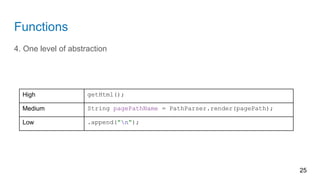
4. One level of abstraction
25
High getHtml();
Medium String pagePathName = PathParser.render(pagePath);
Low .append("n");
Functions
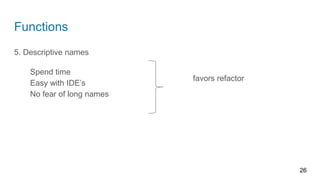
5. Descriptive names
Spend time
Easy with IDE’s
No fear of long names
26
favors refactor
Functions
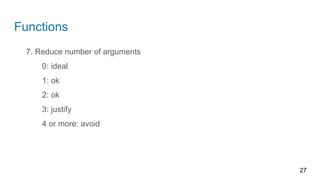
7. Reduce number of arguments
0: ideal
1: ok
2: ok
3: justify
4 or more: avoid
27
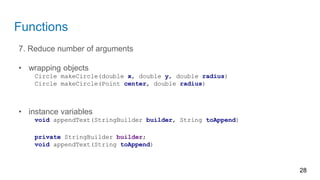
Functions
7. Reduce number of arguments
• wrapping objects
Circle makeCircle(double x, double y, double radius)
Circle makeCircle(Point center, double radius)
• instance variables
void appendText(StringBuilder builder, String toAppend)
private StringBuilder builder;
void appendText(String toAppend)
28
Comments
“Don’t comment bad code—rewrite it.”
—Brian W. Kernighan and P. J. Plaugher
29
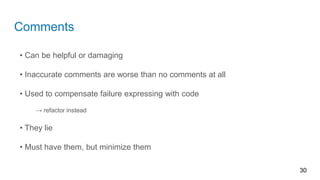
Comments
• Can be helpful or damaging
• Inaccurate comments are worse than no comments at all
• Used to compensate failure expressing with code
→ refactor instead
• They lie
• Must have them, but minimize them
30
Comments
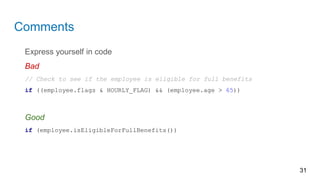
Express yourself in code
Bad
// Check to see if the employee is eligible for full benefits
if ((employee.flags & HOURLY_FLAG) && (employee.age > 65))
Good
if (employee.isEligibleForFullBenefits())
31
Comments
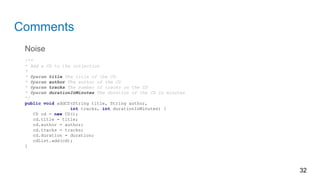
Noise
/**
* Add a CD to the collection
*
* @param title The title of the CD
* @param author The author of the CD
* @param tracks The number of tracks on the CD
* @param durationInMinutes The duration of the CD in minutes
*/
public void addCD(String title, String author,
int tracks, int durationInMinutes) {
CD cd = new CD();
cd.title = title;
cd.author = author;
cd.tracks = tracks;
cd.duration = duration;
cdList.add(cd);
}
32
Comments
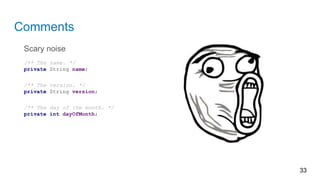
Scary noise
/** The name. */
private String name;
/** The version. */
private String version;
/** The day of the month. */
private int dayOfMonth;
33
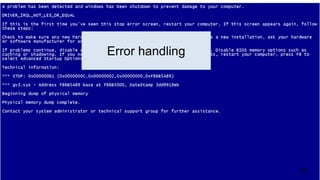
Error handling
34
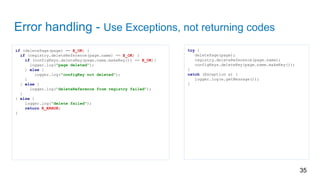
Error handling - Use Exceptions, not returning codes
if (deletePage(page) == E_OK) {
if (registry.deleteReference(page.name) == E_OK) {
if (configKeys.deleteKey(page.name.makeKey()) == E_OK){
logger.log("page deleted");
} else {
logger.log("configKey not deleted");
}
} else {
logger.log("deleteReference from registry failed");
}
} else {
logger.log("delete failed");
return E_ERROR;
}
35
try {
deletePage(page);
registry.deleteReference(page.name);
configKeys.deleteKey(page.name.makeKey());
}
catch (Exception e) {
logger.log(e.getMessage());
}
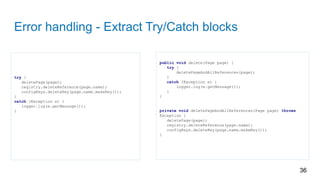
Error handling - Extract Try/Catch blocks
try {
deletePage(page);
registry.deleteReference(page.name);
configKeys.deleteKey(page.name.makeKey());
}
catch (Exception e) {
logger.log(e.getMessage());
}
36
public void delete(Page page) {
try {
deletePageAndAllReferences(page);
}
catch (Exception e) {
logger.log(e.getMessage());
}
}
private void deletePageAndAllReferences(Page page) throws
Exception {
deletePage(page);
registry.deleteReference(page.name);
configKeys.deleteKey(page.name.makeKey());
}
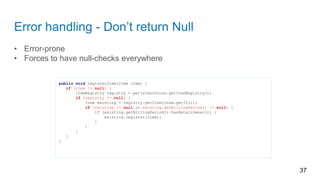
Error handling - Don’t return Null
• Error-prone
• Forces to have null-checks everywhere
37
public void registerItem(Item item) {
if (item != null) {
ItemRegistry registry = peristentStore.getItemRegistry();
if (registry != null) {
Item existing = registry.getItem(item.getID());
if (existing != null && existing.getBillingPeriod() != null) {
if (existing.getBillingPeriod().hasRetailOwner()) {
existing.register(item);
}
}
}
}
}
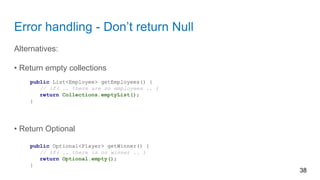
Error handling - Don’t return Null
Alternatives:
• Return empty collections
public List<Employee> getEmployees() {
// if( .. there are no employees .. )
return Collections.emptyList();
}
• Return Optional
public Optional<Player> getWinner() {
// if( .. there is no winner .. )
return Optional.empty();
}
38
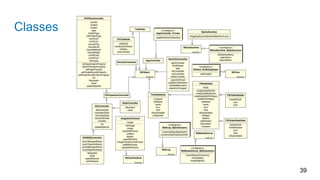
Classes
39
Classes should be small
• One responsibility
• Denoted by the name
Don’t use words such “Super”, “Manager”,
“Processor”, etc.
• Brief description of the class without using
words “and”, “or”, “but”, …
40
public class SuperDashboard extends JFrame {
public String getCustomizerLanguagePath()
public void setSystemConfigPath(String systemConfigPath)
public String getSystemConfigDocument()
public void resetDashboard()
public boolean getGuruState()
public boolean getNoviceState()
public boolean getOpenSourceState()
public void showObject(MetaObject object)
public void showProgress(String s)
public boolean isMetadataDirty()
public void setIsMetadataDirty(boolean isMetadataDirty)
public Component getLastFocusedComponent()
public void setLastFocused(Component lastFocused)
public void setMouseSelectState(boolean isMouseSelected)
public boolean isMouseSelected()
public LanguageManager getLanguageManager()
public Project getProject()
public Project getFirstProject()
public Project getLastProject()
public String getNewProjectName()
public void setComponentSizes(Dimension dim)
public String getCurrentDir()
public void setCurrentDir(String newDir)
public void updateStatus(int dotPos, int markPos)
public Class[] getDataBaseClasses()
public MetadataFeeder getMetadataFeeder()
public void addProject(Project project)
public boolean setCurrentProject(Project project)
public boolean removeProject(Project project)
// more and more ...
}
public class SuperDashboard extends JFrame{
public Component getLastFocusedComponent()
public void setLastFocused(Component lastFocused)
public int getMajorVersionNumber()
public int getMinorVersionNumber()
public int getBuildNumber()
}
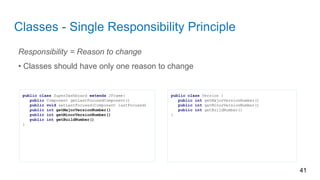
Classes - Single Responsibility Principle
Responsibility = Reason to change
• Classes should have only one reason to change
41
public class SuperDashboard extends JFrame{
public Component getLastFocusedComponent()
public void setLastFocused(Component lastFocused)
public int getMajorVersionNumber()
public int getMinorVersionNumber()
public int getBuildNumber()
}
public class Version {
public int getMajorVersionNumber()
public int getMinorVersionNumber()
public int getBuildNumber()
}
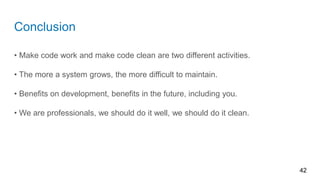
Conclusion
• Make code work and make code clean are two different activities.
• The more a system grows, the more difficult to maintain.
• Benefits on development, benefits in the future, including you.
• We are professionals, we should do it well, we should do it clean.
42
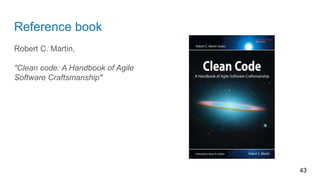
Reference book
Robert C. Martin,
"Clean code: A Handbook of Agile
Software Craftsmanship"
43
Questions?
44

R. herves. clean code (theme)2

  • 1.
    Clean code Good practicesfor readability and maintainability Rafael Sousa Herves 1
  • 2.
  • 3.
  • 4.
    What is cleancode? 4 Bjarne Stroustrup, inventor of C++ “I like my code to be elegant and efficient.” “The logic should be straightforward to make it hard for bugs to hide.” “Clean code does one thing well.”
  • 5.
    What is cleancode? 5 Grady Booch, author of Object Oriented Analysis and Design with Applications “Clean code is simple and direct.” “Reads like well-written prose.”
  • 6.
    What is cleancode? 6 Dave Thomas, founder of OTI, godfather of the Eclipse strategy “Clean code can be read, and enhanced by other developers.” “It has meaningful names.” “It provides one way for doing one thing.” “... minimal dependencies, … minimal API”
  • 7.
    What is cleancode? 7 Michael Feathers, author of Working Effectively with Legacy Code “Clean code always looks like it was written by someone who cares.”
  • 8.
    What is cleancode? 8 Ward Cunningham, inventor of Wiki, inventor of Fit, coinventor of eXtreme Programming. Motive force behind Design Patterns. Smalltalk and OO thought leader. “On clean code, each routine you read turns out to be pretty much what you expected.”
  • 9.
    public void sendMessage(Objecto) { //... } Concretely 9 public ChatMessage(String message, Object o) { //... } public Message(Object o) { //... }
  • 10.
    How to measurecode quality? 10
  • 11.
  • 12.
    Why clean code? 12 Softwaredevelopment life cycle
  • 13.
    Consequences of badcode • The mess grows • Productivity lowers • Application cannot be maintained → game over 13
  • 14.
  • 15.
    Naming - Meaningfulnames 15 Bad int d; // elapsed time in days Good int elapsedTimeInDays; int daysSinceCreation; int daysSinceModification; int fileAgeInDays;
  • 16.
    Naming - Intentionrevealing names 16 Bad public List<int[]> getThem() { List<int[]> list1 = new ArrayList<int[]>(); for (int[] x : theList) if (x[0] == 4) list1.add(x); return list1; }
  • 17.
  • 18.
    Naming - Intentionrevealing names 18 public final static int STATUS_VALUE = 0; public final static int FLAGGED = 4; public List<int[]> getFlaggedCells() { List<int[]> flaggedCells = new ArrayList<int[]>(); for (int[] cell : gameBoard) if (cell[STATUS_VALUE] == FLAGGED) flaggedCells.add(cell); return flaggedCells; } public List<int[]> getThem() { List<int[]> list1 = new ArrayList<int[]>(); for (int[] x : theList) if (x[0] == 4) list1.add(x); return list1; } Bad Good
  • 19.
    Naming - Pronounceablenames 19 class Customer { private Date generationTimestamp; private Date modificationTimestamp; private final String recordId = "102"; }; class DtaRcrd102 { private Date genymdhms; private Date modymdhms; private final String pszqint = "102"; }; Bad Good
  • 20.
    Naming - Avoidencodings 20 private String description; PhoneNumber phone; private String m_dsc; PhoneNumber phoneString; // name not changed when type changed! Bad Good
  • 21.
    Naming - Addmeaningful context firstName, lastName, street, city, state, zipcode // better addrFirstName, addrLastName, addrState // best Address customerAddress = new Address(); customerAddress.getState(); 21
  • 22.
  • 23.
    Functions 23 1. Small 2. Smallerthan that No bigger than the screen 80’s: 24 lines, 80 columns Today: 100 lines, 150 columns Ideally: 2, 3, 4 lines (divide and rule!)
  • 24.
    Functions 3. Do onething 24 Functions should do one thing. They should do it well. They should do it only.
  • 25.
    Functions 4. One levelof abstraction 25 High getHtml(); Medium String pagePathName = PathParser.render(pagePath); Low .append("n");
  • 26.
    Functions 5. Descriptive names Spendtime Easy with IDE’s No fear of long names 26 favors refactor
  • 27.
    Functions 7. Reduce numberof arguments 0: ideal 1: ok 2: ok 3: justify 4 or more: avoid 27
  • 28.
    Functions 7. Reduce numberof arguments • wrapping objects Circle makeCircle(double x, double y, double radius) Circle makeCircle(Point center, double radius) • instance variables void appendText(StringBuilder builder, String toAppend) private StringBuilder builder; void appendText(String toAppend) 28
  • 29.
    Comments “Don’t comment badcode—rewrite it.” —Brian W. Kernighan and P. J. Plaugher 29
  • 30.
    Comments • Can behelpful or damaging • Inaccurate comments are worse than no comments at all • Used to compensate failure expressing with code → refactor instead • They lie • Must have them, but minimize them 30
  • 31.
    Comments Express yourself incode Bad // Check to see if the employee is eligible for full benefits if ((employee.flags & HOURLY_FLAG) && (employee.age > 65)) Good if (employee.isEligibleForFullBenefits()) 31
  • 32.
    Comments Noise /** * Add aCD to the collection * * @param title The title of the CD * @param author The author of the CD * @param tracks The number of tracks on the CD * @param durationInMinutes The duration of the CD in minutes */ public void addCD(String title, String author, int tracks, int durationInMinutes) { CD cd = new CD(); cd.title = title; cd.author = author; cd.tracks = tracks; cd.duration = duration; cdList.add(cd); } 32
  • 33.
    Comments Scary noise /** Thename. */ private String name; /** The version. */ private String version; /** The day of the month. */ private int dayOfMonth; 33
  • 34.
  • 35.
    Error handling -Use Exceptions, not returning codes if (deletePage(page) == E_OK) { if (registry.deleteReference(page.name) == E_OK) { if (configKeys.deleteKey(page.name.makeKey()) == E_OK){ logger.log("page deleted"); } else { logger.log("configKey not deleted"); } } else { logger.log("deleteReference from registry failed"); } } else { logger.log("delete failed"); return E_ERROR; } 35 try { deletePage(page); registry.deleteReference(page.name); configKeys.deleteKey(page.name.makeKey()); } catch (Exception e) { logger.log(e.getMessage()); }
  • 36.
    Error handling -Extract Try/Catch blocks try { deletePage(page); registry.deleteReference(page.name); configKeys.deleteKey(page.name.makeKey()); } catch (Exception e) { logger.log(e.getMessage()); } 36 public void delete(Page page) { try { deletePageAndAllReferences(page); } catch (Exception e) { logger.log(e.getMessage()); } } private void deletePageAndAllReferences(Page page) throws Exception { deletePage(page); registry.deleteReference(page.name); configKeys.deleteKey(page.name.makeKey()); }
  • 37.
    Error handling -Don’t return Null • Error-prone • Forces to have null-checks everywhere 37 public void registerItem(Item item) { if (item != null) { ItemRegistry registry = peristentStore.getItemRegistry(); if (registry != null) { Item existing = registry.getItem(item.getID()); if (existing != null && existing.getBillingPeriod() != null) { if (existing.getBillingPeriod().hasRetailOwner()) { existing.register(item); } } } } }
  • 38.
    Error handling -Don’t return Null Alternatives: • Return empty collections public List<Employee> getEmployees() { // if( .. there are no employees .. ) return Collections.emptyList(); } • Return Optional public Optional<Player> getWinner() { // if( .. there is no winner .. ) return Optional.empty(); } 38
  • 39.
  • 40.
    Classes should besmall • One responsibility • Denoted by the name Don’t use words such “Super”, “Manager”, “Processor”, etc. • Brief description of the class without using words “and”, “or”, “but”, … 40 public class SuperDashboard extends JFrame { public String getCustomizerLanguagePath() public void setSystemConfigPath(String systemConfigPath) public String getSystemConfigDocument() public void resetDashboard() public boolean getGuruState() public boolean getNoviceState() public boolean getOpenSourceState() public void showObject(MetaObject object) public void showProgress(String s) public boolean isMetadataDirty() public void setIsMetadataDirty(boolean isMetadataDirty) public Component getLastFocusedComponent() public void setLastFocused(Component lastFocused) public void setMouseSelectState(boolean isMouseSelected) public boolean isMouseSelected() public LanguageManager getLanguageManager() public Project getProject() public Project getFirstProject() public Project getLastProject() public String getNewProjectName() public void setComponentSizes(Dimension dim) public String getCurrentDir() public void setCurrentDir(String newDir) public void updateStatus(int dotPos, int markPos) public Class[] getDataBaseClasses() public MetadataFeeder getMetadataFeeder() public void addProject(Project project) public boolean setCurrentProject(Project project) public boolean removeProject(Project project) // more and more ... } public class SuperDashboard extends JFrame{ public Component getLastFocusedComponent() public void setLastFocused(Component lastFocused) public int getMajorVersionNumber() public int getMinorVersionNumber() public int getBuildNumber() }
  • 41.
    Classes - SingleResponsibility Principle Responsibility = Reason to change • Classes should have only one reason to change 41 public class SuperDashboard extends JFrame{ public Component getLastFocusedComponent() public void setLastFocused(Component lastFocused) public int getMajorVersionNumber() public int getMinorVersionNumber() public int getBuildNumber() } public class Version { public int getMajorVersionNumber() public int getMinorVersionNumber() public int getBuildNumber() }
  • 42.
    Conclusion • Make codework and make code clean are two different activities. • The more a system grows, the more difficult to maintain. • Benefits on development, benefits in the future, including you. • We are professionals, we should do it well, we should do it clean. 42
  • 43.
    Reference book Robert C.Martin, "Clean code: A Handbook of Agile Software Craftsmanship" 43
  • 44.