1CONFIDENTIAL
Caring About Code
Quality
Tamas Korozsi
2015
2CONFIDENTIAL
ME
3CONFIDENTIAL
Clean Code: A Handbook of Agile Software Craftsmanship
by Robert C. Martin
The Book
4CONFIDENTIAL
Does it work?
What is Clean Code?
Does it scale?
Is it esthetic?
Is it maintainable?
Is it testable?
Is it short?
Is it clever?
Does it have explanatory
comments?
Is it easy to
understand?
Is it well-structured?
Is it object-oriented?
5CONFIDENTIAL
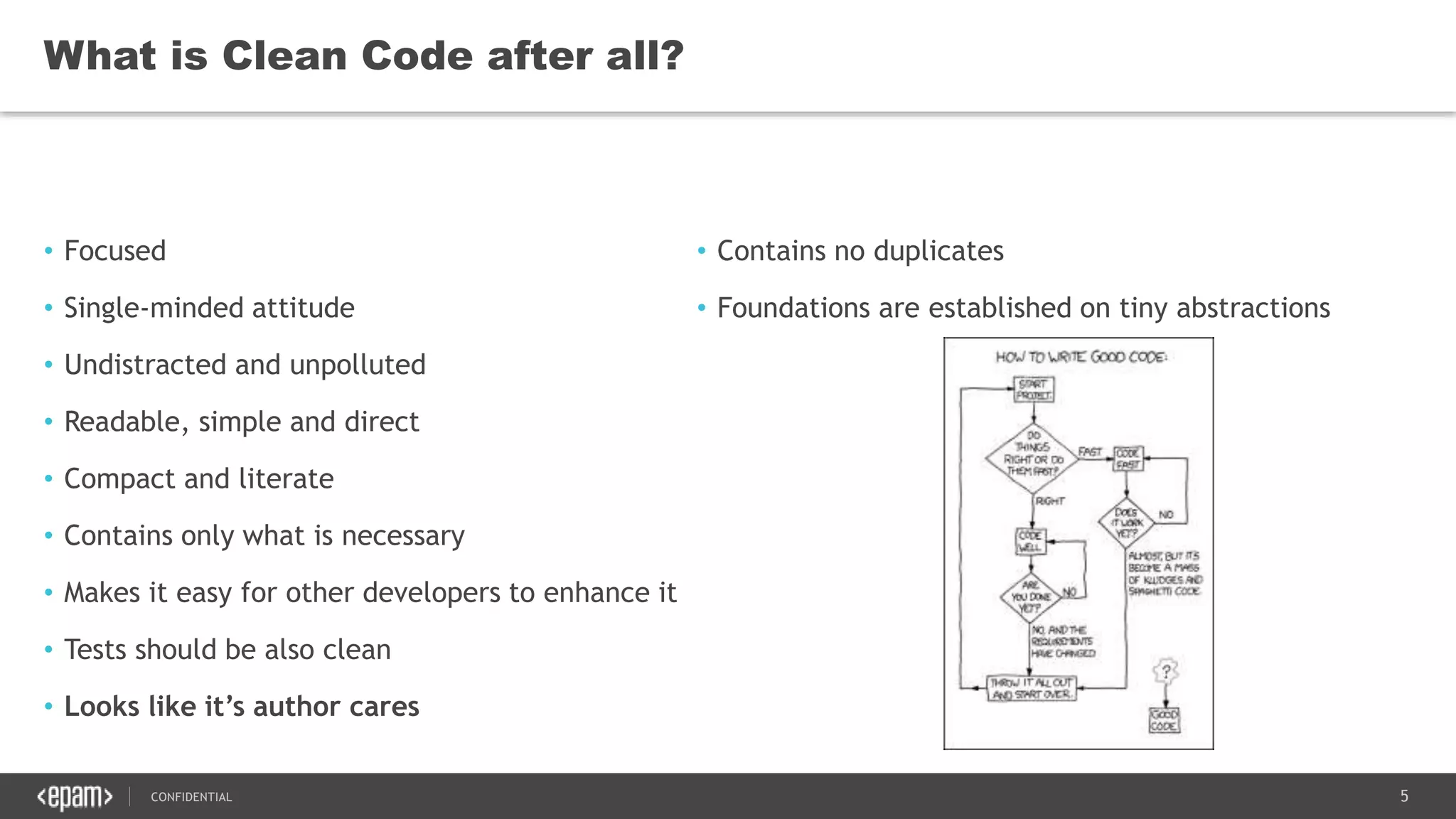
• Focused
• Single-minded attitude
• Undistracted and unpolluted
• Readable, simple and direct
• Compact and literate
• Contains only what is necessary
• Makes it easy for other developers to enhance it
• Tests should be also clean
• Looks like it’s author cares
• Contains no duplicates
• Foundations are established on tiny abstractions
What is Clean Code after all?
6CONFIDENTIAL
• Subjective
• If you can’t measure, you can’t improve
• Identify what matters
• Defend and justify decisions.
The need for measurement
7CONFIDENTIAL
Cyclomatic complexity
public void foo() {
if (c1) {
f1();
} else {
f2();
}
if (c2) {
f3();
} else {
f4();
}
}
• Upper bound for the number of test cases
that are necessary to achieve a complete
branch coverage
• Lower bound for the number of paths
through the control flow graph
• Desirable value: below 10
Cyclomatic complexity: 3
8CONFIDENTIAL
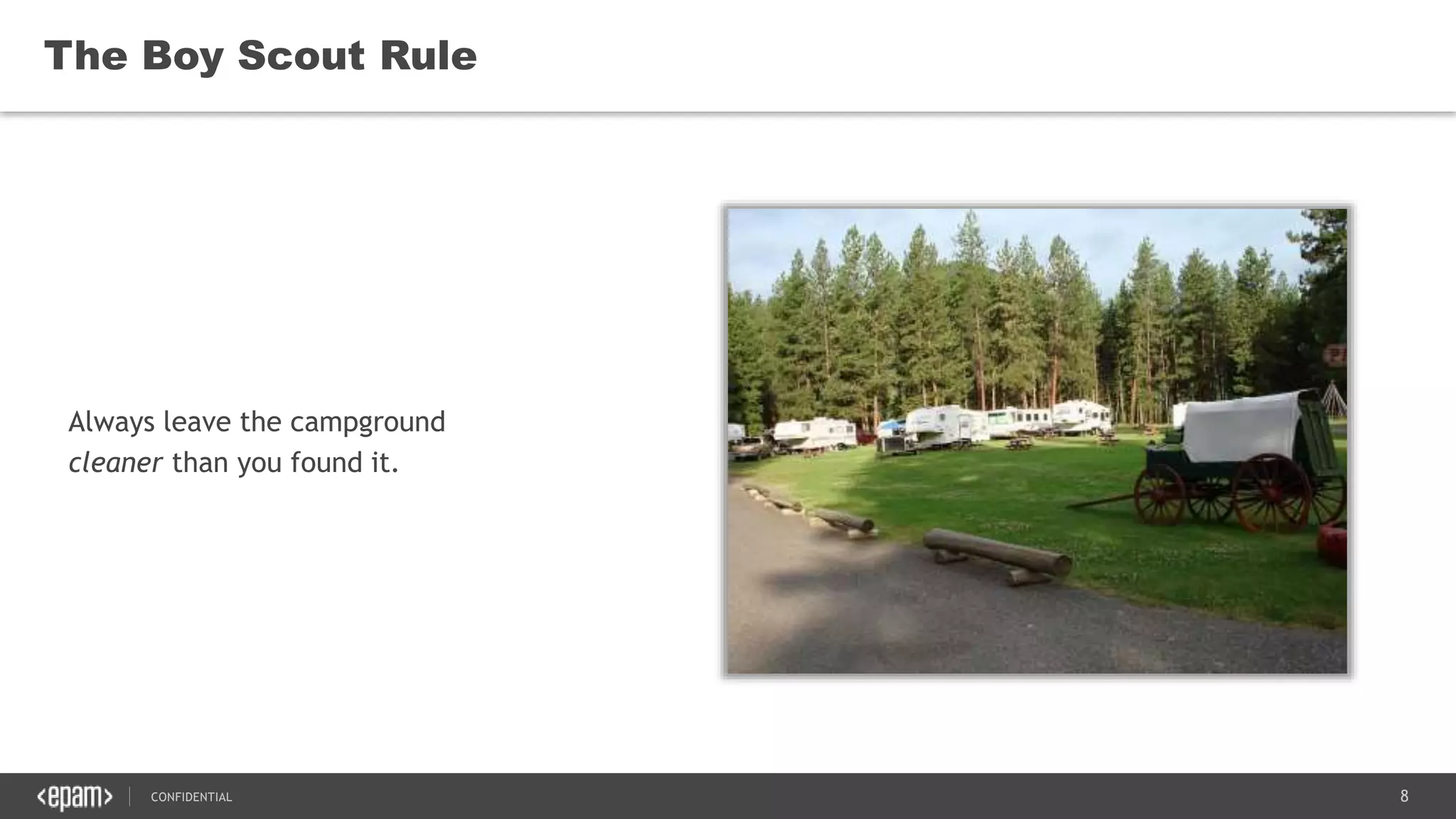
Always leave the campground
cleaner than you found it.
The Boy Scout Rule
9CONFIDENTIAL
• Came from city crime researchers
• A broken window will trigger a building into a
smashed and abandoned derelict
• So does the software
Broken Window Theory
10CONFIDENTIAL
Composed method example
public void add(Object element) {
if (!readOnly) {
int newSize = size + 1;
if (newSize > elements.length) {
Object[] newElements = new Object[elements.length + 10];
for (int index = 0; index < size; index++) {
newElements[index] = elements[index];
elements = newElements;
}
}
elements[size++] = element;
}
}
11CONFIDENTIAL
Implementation patterns
12CONFIDENTIAL
• Divide your program into methods that perform one identifiable task
• Keep all of the operation in a method at a same level of abstraction
• This will naturally result in programs with many small methods, each
few lines long.
Composed method pattern by Kent Beck
13CONFIDENTIAL
Composed method example
public void add(Object element) {
if (!isReadOnly()) {
if (atCapacity()) {
grow();
}
addElement(element);
}
}
14CONFIDENTIAL
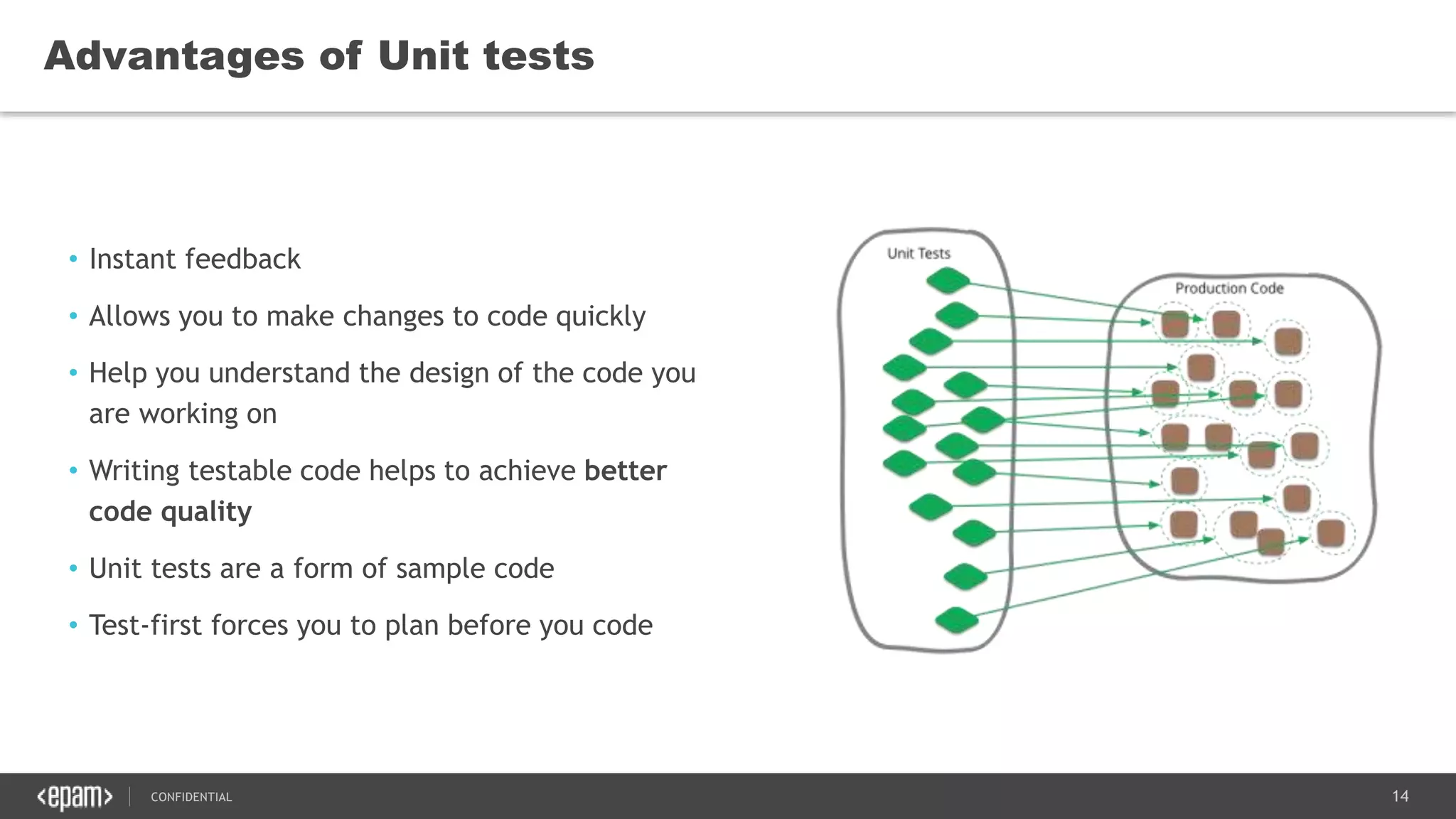
• Instant feedback
• Allows you to make changes to code quickly
• Help you understand the design of the code you
are working on
• Writing testable code helps to achieve better
code quality
• Unit tests are a form of sample code
• Test-first forces you to plan before you code
Advantages of Unit tests
15CONFIDENTIAL
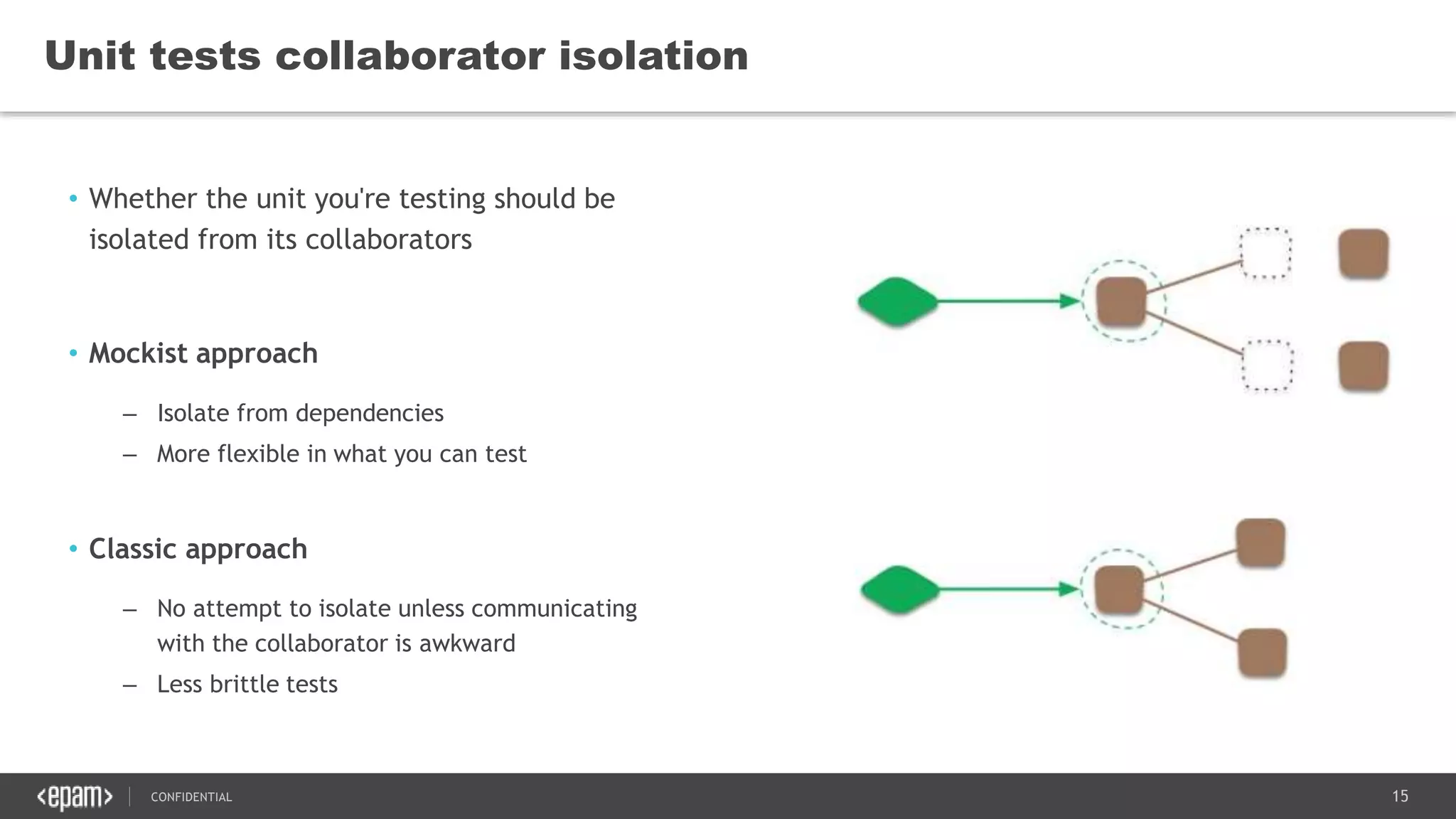
• Whether the unit you're testing should be
isolated from its collaborators
• Mockist approach
– Isolate from dependencies
– More flexible in what you can test
• Classic approach
– No attempt to isolate unless communicating
with the collaborator is awkward
– Less brittle tests
Unit tests collaborator isolation
16CONFIDENTIAL
• Change Risk Analysis and Prediction
• Help you identify code that might be particularly difficult to
understand, test, or maintain
• 𝐶𝑅𝐴𝑃 𝑚 = cycl_comp(m)2
∗ 1 − 𝑐𝑜𝑣𝑒𝑟𝑎𝑔𝑒
3
+ cycl_comp(m)
• A method with a CRAP score over 30 is considered
unacceptable
C.R.A.P. metric
Cyclomatic
Complexity
Coverage
required
0 – 5 0%
10 42%
15 57%
20 71%
25 80%
30 100%
31+ Not possible
17CONFIDENTIAL
• Don’t build complex machines
• Don’t build frameworks
• Make the software so simple that there are
obviously no deficiencies
• Keep it simple, stupid (KISS)
Rube Goldberg Machines
18CONFIDENTIAL
• Avoid Cargo cult programming
• Question authority
• Accept feedback and give feedback
Angry monkeys experiment
19CONFIDENTIAL
EPAM Academy
Aniko_b
20CONFIDENTIAL
TAMAS_KOROZSI@EPAM.COM
THANK YOU FOR ATTENTION!
QUESTIONS?

clean code - uncle bob

  • 1.
  • 2.
  • 3.
    3CONFIDENTIAL Clean Code: AHandbook of Agile Software Craftsmanship by Robert C. Martin The Book
  • 4.
    4CONFIDENTIAL Does it work? Whatis Clean Code? Does it scale? Is it esthetic? Is it maintainable? Is it testable? Is it short? Is it clever? Does it have explanatory comments? Is it easy to understand? Is it well-structured? Is it object-oriented?
  • 5.
    5CONFIDENTIAL • Focused • Single-mindedattitude • Undistracted and unpolluted • Readable, simple and direct • Compact and literate • Contains only what is necessary • Makes it easy for other developers to enhance it • Tests should be also clean • Looks like it’s author cares • Contains no duplicates • Foundations are established on tiny abstractions What is Clean Code after all?
  • 6.
    6CONFIDENTIAL • Subjective • Ifyou can’t measure, you can’t improve • Identify what matters • Defend and justify decisions. The need for measurement
  • 7.
    7CONFIDENTIAL Cyclomatic complexity public voidfoo() { if (c1) { f1(); } else { f2(); } if (c2) { f3(); } else { f4(); } } • Upper bound for the number of test cases that are necessary to achieve a complete branch coverage • Lower bound for the number of paths through the control flow graph • Desirable value: below 10 Cyclomatic complexity: 3
  • 8.
    8CONFIDENTIAL Always leave thecampground cleaner than you found it. The Boy Scout Rule
  • 9.
    9CONFIDENTIAL • Came fromcity crime researchers • A broken window will trigger a building into a smashed and abandoned derelict • So does the software Broken Window Theory
  • 10.
    10CONFIDENTIAL Composed method example publicvoid add(Object element) { if (!readOnly) { int newSize = size + 1; if (newSize > elements.length) { Object[] newElements = new Object[elements.length + 10]; for (int index = 0; index < size; index++) { newElements[index] = elements[index]; elements = newElements; } } elements[size++] = element; } }
  • 11.
  • 12.
    12CONFIDENTIAL • Divide yourprogram into methods that perform one identifiable task • Keep all of the operation in a method at a same level of abstraction • This will naturally result in programs with many small methods, each few lines long. Composed method pattern by Kent Beck
  • 13.
    13CONFIDENTIAL Composed method example publicvoid add(Object element) { if (!isReadOnly()) { if (atCapacity()) { grow(); } addElement(element); } }
  • 14.
    14CONFIDENTIAL • Instant feedback •Allows you to make changes to code quickly • Help you understand the design of the code you are working on • Writing testable code helps to achieve better code quality • Unit tests are a form of sample code • Test-first forces you to plan before you code Advantages of Unit tests
  • 15.
    15CONFIDENTIAL • Whether theunit you're testing should be isolated from its collaborators • Mockist approach – Isolate from dependencies – More flexible in what you can test • Classic approach – No attempt to isolate unless communicating with the collaborator is awkward – Less brittle tests Unit tests collaborator isolation
  • 16.
    16CONFIDENTIAL • Change RiskAnalysis and Prediction • Help you identify code that might be particularly difficult to understand, test, or maintain • 𝐶𝑅𝐴𝑃 𝑚 = cycl_comp(m)2 ∗ 1 − 𝑐𝑜𝑣𝑒𝑟𝑎𝑔𝑒 3 + cycl_comp(m) • A method with a CRAP score over 30 is considered unacceptable C.R.A.P. metric Cyclomatic Complexity Coverage required 0 – 5 0% 10 42% 15 57% 20 71% 25 80% 30 100% 31+ Not possible
  • 17.
    17CONFIDENTIAL • Don’t buildcomplex machines • Don’t build frameworks • Make the software so simple that there are obviously no deficiencies • Keep it simple, stupid (KISS) Rube Goldberg Machines
  • 18.
    18CONFIDENTIAL • Avoid Cargocult programming • Question authority • Accept feedback and give feedback Angry monkeys experiment
  • 19.
  • 20.