Download to read offline



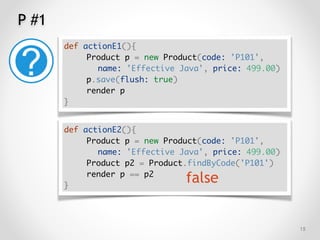
![P #2
!16
def actionH1(){
Product p = new Product(code: 'P102',
name: 'Programming Groovy 2', price: 2217.78)
p.save(flush: true)
def stock = [:]
stock[p] = 100
session.setAttribute('stock', stock)
render stock
}
def actionH2(){
def stock = session.getAttribute('stock')
println stock
Product p = new Product(code: 'P102',
name: 'Programming Groovy 2', price: 2217.78)
render stock[p]
}
null](https://image.slidesharecdn.com/gids2019effectivejavawithgroovyforslideshare-190423170100/85/Effective-Java-with-Groovy-How-Language-can-Influence-Good-Practices-16-320.jpg)
![P #2
!22
def actionH1(){
Product p = new Product(code: 'P102',
name: 'Programming Groovy 2', price: 2217.78)
p.save(flush: true)
def stock = [:]
stock[p] = 100
session.setAttribute('stock', stock)
render stock
}
def actionH2(){
def stock = session.getAttribute('stock')
println stock
Product p = new Product(code: 'P102',
name: 'Programming Groovy 2', price: 2217.78)
render stock[p]
}
100](https://image.slidesharecdn.com/gids2019effectivejavawithgroovyforslideshare-190423170100/85/Effective-Java-with-Groovy-How-Language-can-Influence-Good-Practices-22-320.jpg)
![!27
def numbers = [10, 20, 30, 40]
def sum = 0
for(int number in numbers){
sum += number
}
println "Sum: " + sum](https://image.slidesharecdn.com/gids2019effectivejavawithgroovyforslideshare-190423170100/85/Effective-Java-with-Groovy-How-Language-can-Influence-Good-Practices-27-320.jpg)
![!28
numbers.each{ number->
println number
}
println numbers.collect { number ->
number * 2
}
println numbers.inject(0,
{result, number -> result + number }
)
10
20
30
40
[20, 40, 60, 80]
100](https://image.slidesharecdn.com/gids2019effectivejavawithgroovyforslideshare-190423170100/85/Effective-Java-with-Groovy-How-Language-can-Influence-Good-Practices-28-320.jpg)
![!30
public static void main( String[] args ) {
float price = 0.1f;
float total = 0;
for(int i=0; i<10; i++){
total += price;
}
System.out.println("Total: " + total);
}
Total: 1.0000001](https://image.slidesharecdn.com/gids2019effectivejavawithgroovyforslideshare-190423170100/85/Effective-Java-with-Groovy-How-Language-can-Influence-Good-Practices-30-320.jpg)
![!31
public static void main( String[] args ) {
double price = 0.1;
double total = 0;
for(int i=0; i<10; i++){
total += price;
}
System.out.println("Total: " + total);
}
Total: 0.9999999999999999](https://image.slidesharecdn.com/gids2019effectivejavawithgroovyforslideshare-190423170100/85/Effective-Java-with-Groovy-How-Language-can-Influence-Good-Practices-31-320.jpg)
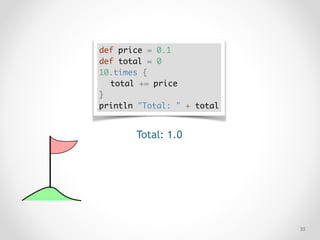
![!33
public static void main( String[] args ) {
BigDecimal price = new BigDecimal(0.1);
BigDecimal total = new BigDecimal(0);
for(int i=0; i<10; i++){
total = total.add(price);
}
System.out.println("Total: " + total);
}
Total: 1.000000000000000055511151231257827021181
5834045410156250](https://image.slidesharecdn.com/gids2019effectivejavawithgroovyforslideshare-190423170100/85/Effective-Java-with-Groovy-How-Language-can-Influence-Good-Practices-33-320.jpg)
![!34
public static void main( String[] args ) {
BigDecimal price = new BigDecimal(“0.1”);
BigDecimal total = new BigDecimal(0);
for(int i=0; i<10; i++){
total = total.add(price);
}
System.out.println("Total: " + total);
}
Total: 1.0](https://image.slidesharecdn.com/gids2019effectivejavawithgroovyforslideshare-190423170100/85/Effective-Java-with-Groovy-How-Language-can-Influence-Good-Practices-34-320.jpg)
![!37
[1, 3, 4, 8, 16, 9]
•Find all even numbers
•Find all odd numbers
•Find numbers divisible by 4
•Find numbers greater than 5](https://image.slidesharecdn.com/gids2019effectivejavawithgroovyforslideshare-190423170100/85/Effective-Java-with-Groovy-How-Language-can-Influence-Good-Practices-37-320.jpg)
![!39
interface Filter{
def includes(number)
}
class OddFilter implements Filter{
def includes(number){ number % 2 != 0 }
}
class DivisibleBy4Filter implements Filter{
def includes(number){ number % 4 == 0 }
}
def doFilter(numbers, Filter filter){
def filteredValues = []
for(int number in numbers){
if(filter.includes(number)){
filteredValues << number
}
}
filteredValues
}
println doFilter(numbers, new OddFilter())
println doFilter(numbers, new DivisibleBy4Filter())](https://image.slidesharecdn.com/gids2019effectivejavawithgroovyforslideshare-190423170100/85/Effective-Java-with-Groovy-How-Language-can-Influence-Good-Practices-39-320.jpg)
![!40
def divisibleBy4 = { number ->
number % 4 == 0
}
def odd = { number ->
number % 2 != 0
}
def numbers = [1, 3, 4, 8, 16, 9]
println "Odd numbers: " + numbers.findAll(odd)
println "Div by 4: " + numbers.findAll(divisibleBy4)
Odd numbers: [1, 3, 9]
Div by 4: [4, 8, 16]](https://image.slidesharecdn.com/gids2019effectivejavawithgroovyforslideshare-190423170100/85/Effective-Java-with-Groovy-How-Language-can-Influence-Good-Practices-40-320.jpg)
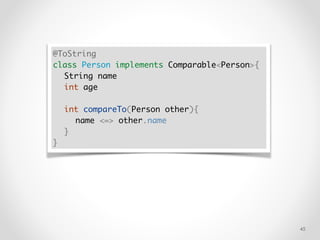
![Bring in Order
!42
@ToString
class Person {
String name
int age
}
def geeks = [
new Person(name: 'Arun', age: 35),
new Person(name: 'Raj', age: 30),
new Person(name: 'Abhi', age: 35),
new Person(name:'Kumar', age: 32),
new Person(name: 'Kumar', age: 25)
]](https://image.slidesharecdn.com/gids2019effectivejavawithgroovyforslideshare-190423170100/85/Effective-Java-with-Groovy-How-Language-can-Influence-Good-Practices-42-320.jpg)
![Default Sort Order
!46
println geeks.sort(false)
Original:
[
Person(Arun, 35),
Person(Raj, 30),
Person(Abhi, 35),
Person(Kumar, 32),
Person(Kumar, 25)
]
Sorted:
[
Person(Abhi, 35),
Person(Arun, 35),
Person(Kumar, 32),
Person(Kumar, 25),
Person(Raj, 30)
]](https://image.slidesharecdn.com/gids2019effectivejavawithgroovyforslideshare-190423170100/85/Effective-Java-with-Groovy-How-Language-can-Influence-Good-Practices-46-320.jpg)
![Sort by Age
!47
println geeks.sort(false) { a, b -> a.age <=> b.age}
Original:
[
Person(Arun, 35),
Person(Raj, 30),
Person(Abhi, 35),
Person(Kumar, 32),
Person(Kumar, 25)
]
Sorted:
[
Person(Kumar, 25),
Person(Raj, 30),
Person(Kumar, 32),
Person(Arun, 35),
Person(Abhi, 35)
]](https://image.slidesharecdn.com/gids2019effectivejavawithgroovyforslideshare-190423170100/85/Effective-Java-with-Groovy-How-Language-can-Influence-Good-Practices-47-320.jpg)
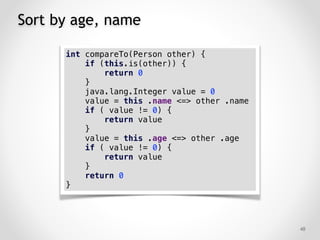
![Sort by age, name
!49
println geeks.sort(false, { a, b ->
[{it.age}, {it.name}].findResult { c ->
c(a) <=> c(b) ?: null
}
})
Original:
[
Person(Arun, 35),
Person(Raj, 30),
Person(Abhi, 35),
Person(Kumar, 32),
Person(Kumar, 25)
]
Sorted:
[
Person(Kumar, 25),
Person(Raj, 30),
Person(Kumar, 32),
Person(Abhi, 35),
Person(Arun, 35)
]](https://image.slidesharecdn.com/gids2019effectivejavawithgroovyforslideshare-190423170100/85/Effective-Java-with-Groovy-How-Language-can-Influence-Good-Practices-49-320.jpg)
![Sort by age, name
!50
Original:
[
Person(Arun, 35),
Person(Raj, 30),
Person(Abhi, 35),
Person(Kumar, 32),
Person(Kumar, 25)
]
Sorted:
[
Person(Kumar, 25),
Person(Raj, 30),
Person(Kumar, 32),
Person(Abhi, 35),
Person(Arun, 35)
]
@Sortable(includes = "name, age")
@ToString
class Person {
String name
int age
}](https://image.slidesharecdn.com/gids2019effectivejavawithgroovyforslideshare-190423170100/85/Effective-Java-with-Groovy-How-Language-can-Influence-Good-Practices-50-320.jpg)
![!56
def numbers = [2, 3, 1, 4]
println numbers.collect { it + 1} [3, 4, 2, 5]
numbers = []
println numbers.collect { it + 1} []
println numbers
.findAll { it % 2 == 0}
.collect { it * 2}
.sum()](https://image.slidesharecdn.com/gids2019effectivejavawithgroovyforslideshare-190423170100/85/Effective-Java-with-Groovy-How-Language-can-Influence-Good-Practices-56-320.jpg)
![!57
println null.collect { it } []
println null.collect { it }.sum() null
Caught: java.lang.NullPointerException: Cannot invoke method sum() on null object
println null.collect { it }.sum()
println null.sum()](https://image.slidesharecdn.com/gids2019effectivejavawithgroovyforslideshare-190423170100/85/Effective-Java-with-Groovy-How-Language-can-Influence-Good-Practices-57-320.jpg)



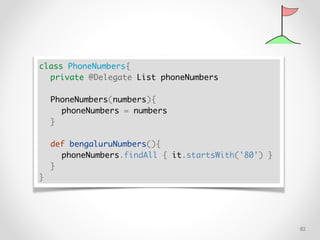
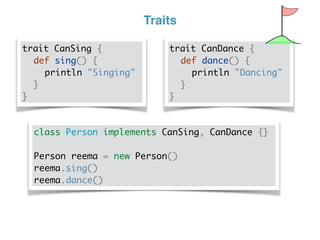
![!83
def ph = ['9812312345', '9812312346', '802312347'] as
PhoneNumbers
println ph
println ph.find { it == '9812312345'}
println ph.find { it.endsWith('6') }
println ph.bengaluruNumbers()](https://image.slidesharecdn.com/gids2019effectivejavawithgroovyforslideshare-190423170100/85/Effective-Java-with-Groovy-How-Language-can-Influence-Good-Practices-83-320.jpg)

The document discusses how Groovy, as a dynamic programming language, can enhance good programming practices derived from 'Effective Java'. It explores various programming techniques, code examples, and principles that help improve code quality, such as managing mutability, using closures for iterators, and implementing best practices for object comparison. The author emphasizes the positive impact of language capabilities on software development efficiency and clarity.


