Speaker: Alexey Golub @Tyrrrz
Expression trees in C#
I heard you like code, so we put code in your code so you can code while you code
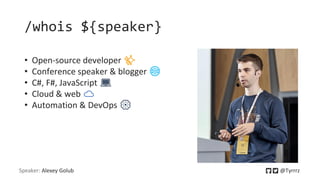
/whois ${speaker}
Speaker: Alexey Golub @Tyrrrz
• Open-source developer ✨
• Conference speaker & blogger 🌐️
• C#, F#, JavaScript 💻
• Cloud & web ☁️
• Automation & DevOps ⚙️
What is an expression tree?
Speaker: Alexey Golub @Tyrrrz
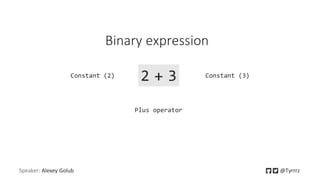
+Constant (2) Constant (3)
Plus operator
2 3
Binary expression
Speaker: Alexey Golub @Tyrrrz
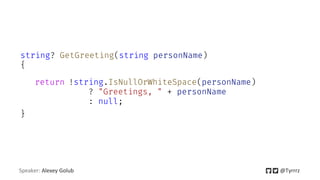
!string.IsNullOrWhiteSpace(personName)
? "Greetings, " + personName
: null;
string? GetGreeting(string personName)
{
return
}
Speaker: Alexey Golub @Tyrrrz
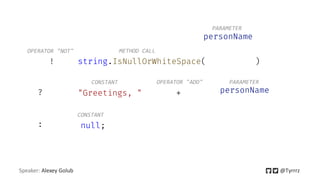
"Greetings, "
!
personName
string.IsNullOrWhiteSpace( )
null;:
? +
personName
OPERATOR "NOT" METHOD CALL
PARAMETER
PARAMETERCONSTANT OPERATOR "ADD"
CONSTANT
Speaker: Alexey Golub @Tyrrrz
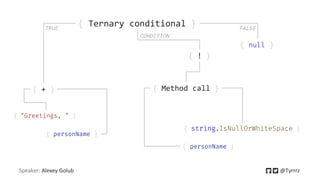
{ Ternary conditional }
{ + }
TRUE
{ null }
FALSE
{ Method call }
CONDITION
{ string.IsNullOrWhiteSpace }
{ personName }
{ personName }
{ "Greetings, " }
{ ! }
Speaker: Alexey Golub @Tyrrrz
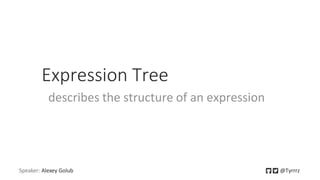
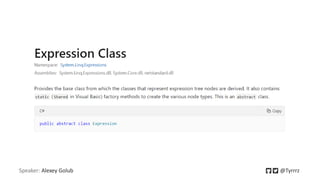
Expression Tree
describes the structure of an expression
Constructing expression
trees manually
Speaker: Alexey Golub @Tyrrrz
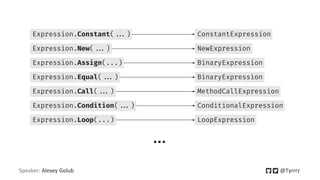
Expression.Constant(...) ConstantExpression
Expression.New(...) NewExpression
Expression.Assign(...) BinaryExpression
Expression.Equal(...) BinaryExpression
Expression.Call(...) MethodCallExpression
Expression.Condition(...) ConditionalExpression
Expression.Loop(...) LoopExpression
...
Speaker: Alexey Golub @Tyrrrz
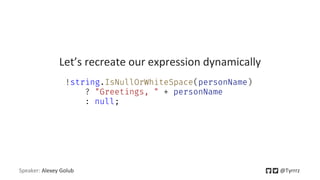
!string.IsNullOrWhiteSpace(personName)
? "Greetings, " + personName
: null;
Let’s recreate our expression dynamically
Speaker: Alexey Golub @Tyrrrz
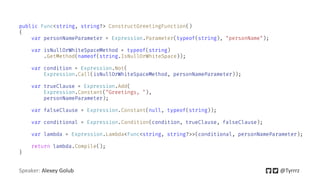
public Func<string, string?> ConstructGreetingFunction()
{
var personNameParameter = Expression.Parameter(typeof(string), "personName");
var isNullOrWhiteSpaceMethod = typeof(string)
.GetMethod(nameof(string.IsNullOrWhiteSpace));
var condition = Expression.Not(
Expression.Call(isNullOrWhiteSpaceMethod, personNameParameter));
var trueClause = Expression.Add(
Expression.Constant("Greetings, "),
personNameParameter);
var falseClause = Expression.Constant(null, typeof(string));
var conditional = Expression.Condition(condition, trueClause, falseClause);
var lambda = Expression.Lambda<Func<string, string?>>(conditional, personNameParameter);
return lambda.Compile();
}
Speaker: Alexey Golub @Tyrrrz
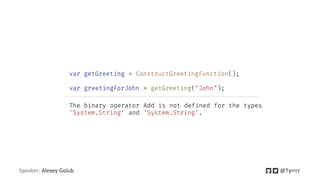
var getGreeting = ConstructGreetingFunction();
var greetingForJohn = getGreeting("John");
The binary operator Add is not defined for the types
'System.String' and 'System.String'.
Speaker: Alexey Golub @Tyrrrz
We need to call string.Concat() directly
var concatMethod = typeof(string)
.GetMethod(nameof(string.Concat), new[] {typeof(string), typeof(string)});
var trueClause = Expression.Call(
concatMethod,
Expression.Constant("Greetings, "),
personNameParameter);
Speaker: Alexey Golub @Tyrrrz
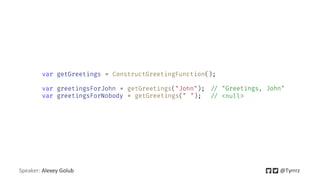
var getGreetings = ConstructGreetingFunction();
var greetingsForJohn = getGreetings("John");
var greetingsForNobody = getGreetings(" ");
// "Greetings, John"
// <null>
Not everything is an expression
Speaker: Alexey Golub @Tyrrrz
but we are not limited by that
Speaker: Alexey Golub @Tyrrrz
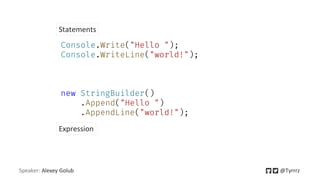
new StringBuilder()
.Append("Hello ")
.AppendLine("world!");
Statements
Expression
Console.Write("Hello ");
Console.WriteLine("world!");
Speaker: Alexey Golub @Tyrrrz
public Expression CreateStatementBlock()
{
var consoleWriteMethod = typeof(Console)
.GetMethod(nameof(Console.Write), new[] {typeof(string)});
var consoleWriteLineMethod = typeof(Console)
.GetMethod(nameof(Console.WriteLine), new[] {typeof(string)});
return Expression.Block(
Expression.Call(consoleWriteMethod, Expression.Constant("Hello ")),
Expression.Call(consoleWriteLineMethod, Expression.Constant("world!")));
}
var block = CreateStatementBlock();
var lambda = Expression.Lambda<Action>(block).Compile();
lambda(); // Hello world!
Speaker: Alexey Golub @Tyrrrz
public Expression CreateStatementBlock()
{
var variableA = Expression.Variable(typeof(string), "a");
var variableB = Expression.Variable(typeof(string), "b");
return Expression.Block(
new[] {variableA, variableB},
Expression.Assign(variableA, Expression.Constant("Foo ")),
Expression.Assign(variableB, Expression.Constant("bar")),
Expression.Call(consoleWriteMethod, variableA),
Expression.Call(consoleWriteLineMethod, variableB));
}
Declare variables
Assign values to
variables
Reference variables
Optimizing reflection-heavy
code
Speaker: Alexey Golub @Tyrrrz
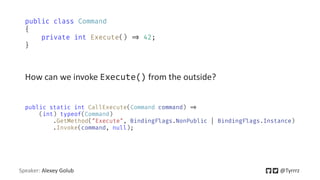
How can we invoke Execute() from the outside?
public class Command
{
private int Execute() /> 42;
}
public static int CallExecute(Command command) />
(int) typeof(Command)
.GetMethod("Execute", Binding/lags.NonPublic | Binding/lags.Instance)
.Invoke(command, null);
Speaker: Alexey Golub @Tyrrrz
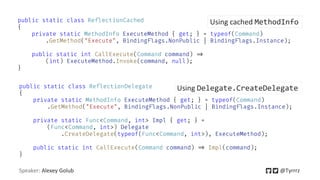
public static class Re/lectionCached
{
private static MethodInfo ExecuteMethod { get; } = typeof(Command)
.GetMethod("Execute", Binding/lags.NonPublic | Binding/lags.Instance);
public static int CallExecute(Command command) />
(int) ExecuteMethod.Invoke(command, null);
}
public static class Re/lectionDelegate
{
private static MethodInfo ExecuteMethod { get; } = typeof(Command)
.GetMethod("Execute", Binding/lags.NonPublic | Binding/lags.Instance);
private static Func<Command, int> Impl { get; } =
(Func<Command, int>) Delegate
.CreateDelegate(typeof(Func<Command, int>), ExecuteMethod);
public static int CallExecute(Command command) /> Impl(command);
}
Using cached MethodInfo
Using Delegate.CreateDelegate
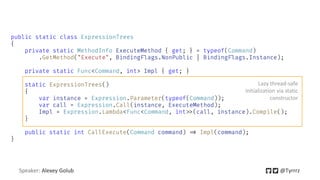
public static class ExpressionTrees
{
private static MethodInfo ExecuteMethod { get; } = typeof(Command)
.GetMethod("Execute", Binding/lags.NonPublic | Binding/lags.Instance);
private static Func<Command, int> Impl { get; }
static ExpressionTrees()
{
var instance = Expression.Parameter(typeof(Command));
var call = Expression.Call(instance, ExecuteMethod);
Impl = Expression.Lambda<Func<Command, int/>(call, instance).Compile();
}
public static int CallExecute(Command command) /> Impl(command);
}
Speaker: Alexey Golub @Tyrrrz
Lazy thread-safe
initialization via static
constructor
Speaker: Alexey Golub @Tyrrrz
public class Benchmarks
{
[Benchmark(Description = "Reflection", Baseline = true)]
public int Reflection() => (int) typeof(Command)
.GetMethod("Execute", BindingFlags.NonPublic | BindingFlags.Instance)
.Invoke(new Command(), null);
[Benchmark(Description = "Reflection (cached)")]
public int Cached() => ReflectionCached.CallExecute(new Command());
[Benchmark(Description = "Reflection (delegate)")]
public int Delegate() => ReflectionDelegate.CallExecute(new Command());
[Benchmark(Description = "Expressions")]
public int Expressions() => ExpressionTrees.CallExecute(new Command());
public static void Main() => BenchmarkRunner.Run<Benchmarks>();
}
| Method | Mean | Error | StdDev | Ratio |
|---------------------- |-----------:|----------:|----------:|------:|
| Reflection | 192.975 ns | 1.6802 ns | 1.4895 ns | 1.00 |
| Reflection (cached) | 123.762 ns | 1.1063 ns | 1.0349 ns | 0.64 |
| Reflection (delegate) | 6.419 ns | 0.0646 ns | 0.0605 ns | 0.03 |
| Expressions | 5.383 ns | 0.0433 ns | 0.0383 ns | 0.03 |
Generic operators
Speaker: Alexey Golub @Tyrrrz
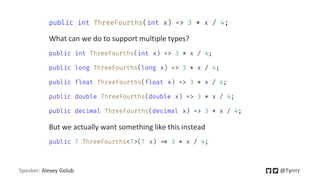
What can we do to support multiple types?
public int ThreeFourths(int x) => 3 * x / 4;
public long ThreeFourths(long x) => 3 * x / 4;
public float ThreeFourths(float x) => 3 * x / 4;
public double ThreeFourths(double x) => 3 * x / 4;
public decimal ThreeFourths(decimal x) => 3 * x / 4;
public T ThreeFourths<T>(T x) /> 3 * x / 4;
But we actually want something like this instead
Speaker: Alexey Golub @Tyrrrz
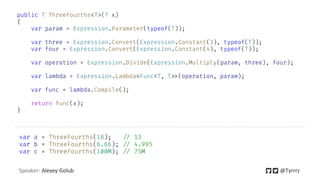
public T ThreeFourths<T>(T x)
{
var param = Expression.Parameter(typeof(T));
var three = Expression.Convert(Expression.Constant(3), typeof(T));
var four = Expression.Convert(Expression.Constant(4), typeof(T));
var operation = Expression.Divide(Expression.Multiply(param, three), four);
var lambda = Expression.Lambda<Func<T, T/>(operation, param);
var func = lambda.Compile();
return func(x);
}
var a = ThreeFourths(18); // 13
var b = ThreeFourths(6.66); // 4.995
var c = ThreeFourths(100M); // 75M
Speaker: Alexey Golub @Tyrrrz
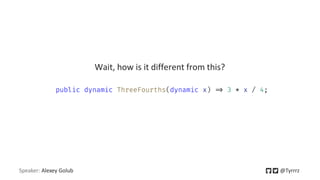
public dynamic ThreeFourths(dynamic x) /> 3 * x / 4;
Wait, how is it different from this?
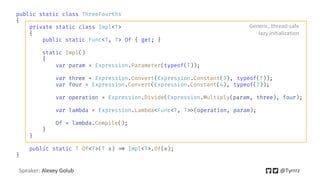
public static class ThreeFourths
{
private static class Impl<T>
{
public static Func<T, T> Of { get; }
static Impl()
{
var param = Expression.Parameter(typeof(T));
var three = Expression.Convert(Expression.Constant(3), typeof(T));
var four = Expression.Convert(Expression.Constant(4), typeof(T));
var operation = Expression.Divide(Expression.Multiply(param, three), four);
var lambda = Expression.Lambda<Func<T, T/>(operation, param);
Of = lambda.Compile();
}
}
public static T Of<T>(T x) /> Impl<T>.Of(x);
}
Speaker: Alexey Golub @Tyrrrz
Generic, thread-safe
lazy initialization
Speaker: Alexey Golub @Tyrrrz
public class Benchmarks
{
[Benchmark(Description = "Static", Baseline = true)]
[Arguments(13.37)]
public double Static(double x) /> 3 * x / 4;
[Benchmark(Description = "Expressions")]
[Arguments(13.37)]
public double Expressions(double x) /> ThreeFourths.Of(x);
[Benchmark(Description = "Dynamic")]
[Arguments(13.37)]
public dynamic Dynamic(dynamic x) /> 3 * x / 4;
public static void Main() /> BenchmarkRunner.Run<Benchmarks>();
}
| Method | x | Mean | Error | StdDev | Ratio | RatioSD |
|------------ |------ |-----------:|----------:|----------:|------:|--------:|
| Static | 13.37 | 0.6077 ns | 0.0176 ns | 0.0147 ns | 1.00 | 0.00 |
| Expressions | 13.37 | 1.9510 ns | 0.0163 ns | 0.0145 ns | 3.21 | 0.08 |
| Dynamic | 13.37 | 19.3267 ns | 0.1512 ns | 0.1340 ns | 31.82 | 0.78 |
Compiled dictionary
Speaker: Alexey Golub @Tyrrrz
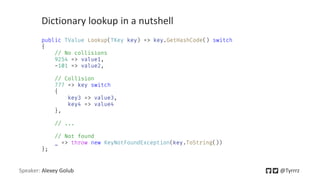
public TValue Lookup(TKey key) => key.GetHashCode() switch
{
// No collisions
9254 => value1,
-101 => value2,
// Collision
777 => key switch
{
key3 => value3,
key4 => value4
},
// ...
// Not found
_ => throw new KeyNotFoundException(key.ToString())
};
Dictionary lookup in a nutshell
Speaker: Alexey Golub @Tyrrrz
public class CompiledDictionary<TKey, TValue> : IDictionary<TKey, TValue>
{
private readonly IDictionary<TKey, TValue> _inner = new Dictionary<TKey, TValue>();
private Func<TKey, TValue> _lookup;
public void UpdateLookup()
{
// //.
}
public TValue this[TKey key]
{
get /> _lookup(key);
set /> _inner[key] = value;
}
// The rest of the interface implementation is omitted for brevity
}
Speaker: Alexey Golub @Tyrrrz
public void UpdateLookup()
{
var keyParameter = Expression.Parameter(typeof(TKey));
var keyGetHashCodeCall = Expression.Call(
keyParameter,
typeof(object).GetMethod(nameof(GetHashCode)));
var keyToStringCall = Expression.Call(
keyParameter,
typeof(object).GetMethod(nameof(ToString)));
var exceptionCtor = typeof(KeyNotFoundException)
.GetConstructor(new[] {typeof(string)});
var throwException = Expression.Throw(
Expression.New(exceptionCtor, keyToStringCall),
typeof(TValue));
var body = Expression.Switch(
// ...
));
var lambda = Expression.Lambda<Func<TKey, TValue>>(body, keyParameter);
_lookup = lambda.Compile();
}
Speaker: Alexey Golub @Tyrrrz
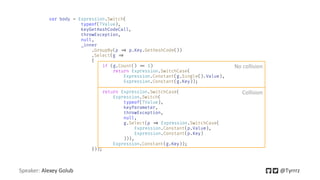
var body = Expression.Switch(
typeof(TValue),
keyGetHashCodeCall,
throwException,
null,
_inner
.GroupBy(p /> p.Key.GetHashCode())
.Select(g />
{
if (g.Count() /= 1)
return Expression.SwitchCase(
Expression.Constant(g.Single().Value),
Expression.Constant(g.Key));
return Expression.SwitchCase(
Expression.Switch(
typeof(TValue),
keyParameter,
throwException,
null,
g.Select(p /> Expression.SwitchCase(
Expression.Constant(p.Value),
Expression.Constant(p.Key)
))),
Expression.Constant(g.Key));
}));
No collision
Collision
Speaker: Alexey Golub @Tyrrrz
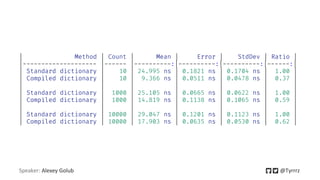
| Method | Count | Mean | Error | StdDev | Ratio |
|-------------------- |------ |----------:|----------:|----------:|------:|
| Standard dictionary | 10 | 24.995 ns | 0.1821 ns | 0.1704 ns | 1.00 |
| Compiled dictionary | 10 | 9.366 ns | 0.0511 ns | 0.0478 ns | 0.37 |
| | | | | | |
| Standard dictionary | 1000 | 25.105 ns | 0.0665 ns | 0.0622 ns | 1.00 |
| Compiled dictionary | 1000 | 14.819 ns | 0.1138 ns | 0.1065 ns | 0.59 |
| | | | | | |
| Standard dictionary | 10000 | 29.047 ns | 0.1201 ns | 0.1123 ns | 1.00 |
| Compiled dictionary | 10000 | 17.903 ns | 0.0635 ns | 0.0530 ns | 0.62 |
Parsing into expression trees
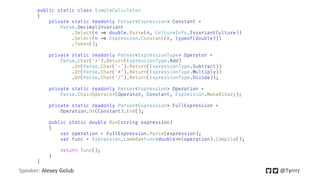
Speaker: Alexey Golub @Tyrrrz
public static class SimpleCalculator
{
private static readonly Parser<Expression> Constant =
Parse.DecimalInvariant
.Select(n /> double.Parse(n, CultureInfo.InvariantCulture))
.Select(n /> Expression.Constant(n, typeof(double)))
.Token();
private static readonly Parser<ExpressionType> Operator =
Parse.Char('+').Return(ExpressionType.Add)
.Or(Parse.Char('-').Return(ExpressionType.Subtract))
.Or(Parse.Char('*').Return(ExpressionType.Multiply))
.Or(Parse.Char('/').Return(ExpressionType.Divide));
private static readonly Parser<Expression> Operation =
Parse.ChainOperator(Operator, Constant, Expression.MakeBinary);
private static readonly Parser<Expression> FullExpression =
Operation.Or(Constant).End();
public static double Run(string expression)
{
var operation = FullExpression.Parse(expression);
var func = Expression.Lambda<Func<double/>(operation).Compile();
return func();
}
}
Speaker: Alexey Golub @Tyrrrz
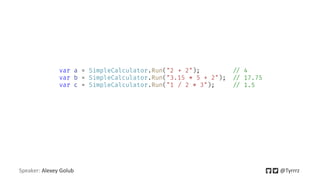
var a = SimpleCalculator.Run("2 + 2");
var b = SimpleCalculator.Run("3.15 * 5 + 2");
var c = SimpleCalculator.Run("1 / 2 * 3");
// 4
// 17.75
// 1.5
Inferring expression trees
from code
Speaker: Alexey Golub @Tyrrrz
Func<int, int, int> div =
(a, b) /> a / b;
Expression<Func<int, int, int/> divExpr =
(a, b) /> a / b;
Same value, different type
Console.WriteLine(divExpr.Type);
// System.Func`3[System.Int32,System.Int32,System.Int32]
Speaker: Alexey Golub @Tyrrrz
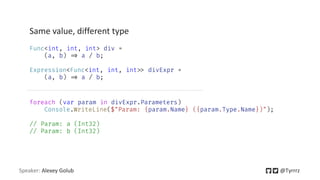
Func<int, int, int> div =
(a, b) /> a / b;
Expression<Func<int, int, int/> divExpr =
(a, b) /> a / b;
Same value, different type
foreach (var param in divExpr.Parameters)
Console.WriteLine($"Param: {param.Name} ({param.Type.Name})");
// Param: a (Int32)
// Param: b (Int32)
Speaker: Alexey Golub @Tyrrrz
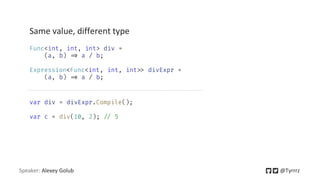
Func<int, int, int> div =
(a, b) /> a / b;
Expression<Func<int, int, int/> divExpr =
(a, b) /> a / b;
Same value, different type
var div = divExpr.Compile();
var c = div(10, 2); // 5
Speaker: Alexey Golub @Tyrrrz
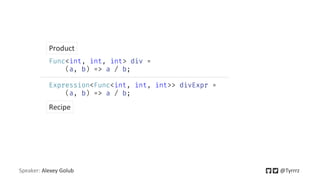
Func<int, int, int> div =
(a, b) => a / b;
Expression<Func<int, int, int>> divExpr =
(a, b) => a / b;
Product
Recipe
Speaker: Alexey Golub @Tyrrrz
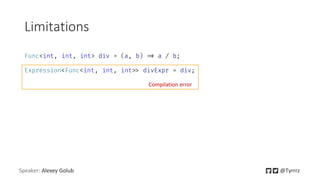
Limitations
Func<int, int, int> div = (a, b) /> a / b;
Expression<Func<int, int, int/> divExpr = div;
Compilation error
Speaker: Alexey Golub @Tyrrrz
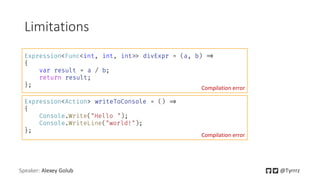
Limitations
Expression<Func<int, int, int/> divExpr = (a, b) />
{
var result = a / b;
return result;
};
Compilation error
Expression<Action> writeToConsole = () />
{
Console.Write("Hello ");
Console.WriteLine("world!");
};
Compilation error
Speaker: Alexey Golub @Tyrrrz
Limitations
• Null-coalescing operator (obj/.Prop)
• Dynamic variables (dynamic)
• Asynchronous code (async/await)
• Default or named parameters (func(a, b: 5), func(a))
• Parameters passed by reference (int.TryParse("123", out var i))
• Multi-dimensional array initializers (new int[2, 2] { { 1, 2 }, { 3, 4 } })
• Assignment operations (a = 5)
• Increment and decrement (a/+, a/-, /-a, /+a)
• Base type access (base.Prop)
• Dictionary initialization (new Dictionary<string, int> { ["foo"] = 100 })
• Unsafe code (via unsafe)
• Throw expressions (throw new Exception())
• Tuple literals ((5, x))
Can’t use any of the following:
Identifying type members
Speaker: Alexey Golub @Tyrrrz
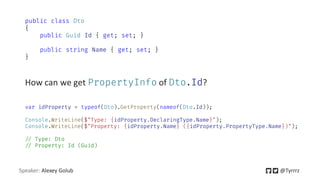
How can we get PropertyInfo of Dto.Id?
public class Dto
{
public Guid Id { get; set; }
public string Name { get; set; }
}
var idProperty = typeof(Dto).GetProperty(nameof(Dto.Id));
Console.WriteLine($"Type: {idProperty.DeclaringType.Name}");
Console.WriteLine($"Property: {idProperty.Name} ({idProperty.PropertyType.Name})");
// Type: Dto
// Property: Id (Guid)
Speaker: Alexey Golub @Tyrrrz
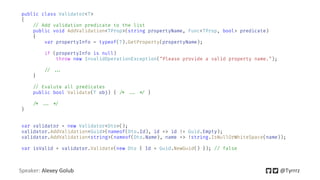
public class Validator<T>
{
// Add validation predicate to the list
public void AddValidation<TProp>(string propertyName, Func<TProp, bool> predicate)
{
var propertyInfo = typeof(T).GetProperty(propertyName);
if (propertyInfo is null)
throw new InvalidOperationException("Please provide a valid property name.");
// //.
}
// Evalute all predicates
public bool Validate(T obj) { /* //. // }
/* //. //
}
var validator = new Validator<Dto>();
validator.AddValidation<Guid>(nameof(Dto.Id), id => id != Guid.Empty);
validator.AddValidation<string>(nameof(Dto.Name), name => !string.IsNullOrWhiteSpace(name));
var isValid = validator.Validate(new Dto { Id = Guid.NewGuid() }); // false
Speaker: Alexey Golub @Tyrrrz
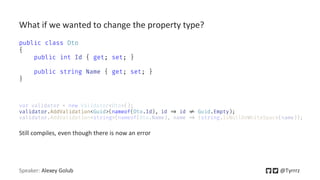
What if we wanted to change the property type?
public class Dto
{
public int Id { get; set; }
public string Name { get; set; }
}
validator.AddValidation<Guid>(nameof(Dto.Id), id /> id /= Guid.Empty);
Still compiles, even though there is now an error
Speaker: Alexey Golub @Tyrrrz
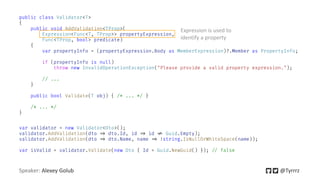
public class Validator<T>
{
public void AddValidation<TProp>(
Expression<Func<T, TProp>> propertyExpression,
Func<TProp, bool> predicate)
{
var propertyInfo = (propertyExpression.Body as MemberExpression)?.Member as PropertyInfo;
if (propertyInfo is null)
throw new InvalidOperationException("Please provide a valid property expression.");
// ...
}
public bool Validate(T obj) { /* ... */ }
/* ... */
}
Expression is used to
identify a property
var validator = new Validator<Dto>();
validator.AddValidation(dto /> dto.Id, id /> id /= Guid.Empty);
validator.AddValidation(dto /> dto.Name, name /> !string.IsNullOrWhiteSpace(name));
var isValid = validator.Validate(new Dto { Id = Guid.NewGuid() }); // false
Providing context to assertions
Speaker: Alexey Golub @Tyrrrz
[Test]
public void IntTryParse_Test()
{
// Arrange
const string s = "123";
// Act
var result = int.TryParse(s, out var value);
// Assert
Assert.That(result, Is.True, "Parsing was unsuccessful");
Assert.That(value, Is.EqualTo(124), "Parsed value is incorrect");
}
X IntTryParse_Test [60ms]
Error Message:
Parsed value is incorrect
Expected: 124
But was: 123
Speaker: Alexey Golub @Tyrrrz
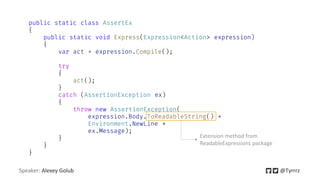
public static class AssertEx
{
public static void Express(Expression<Action> expression)
{
var act = expression.Compile();
try
{
act();
}
catch (AssertionException ex)
{
throw new AssertionException(
expression.Body.ToReadableString() +
Environment.NewLine +
ex.Message);
}
}
}
Extension method from
ReadableExpressions package
Speaker: Alexey Golub @Tyrrrz
X IntTryParse_Test [60ms]
Error Message:
Assert.That(value, Is.EqualTo(124))
Expected: 124
But was: 123
[Test]
public void IntTryParse_Test()
{
// Arrange
const string s = "123";
// Act
var result = int.TryParse(s, out var value);
// Assert
AssertEx.Express(() /> Assert.That(result, Is.True));
AssertEx.Express(() /> Assert.That(value, Is.EqualTo(124)));
}
Traversing and rewriting
expression trees
Speaker: Alexey Golub @Tyrrrz
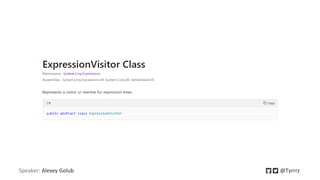
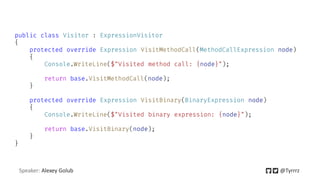
public class Visitor : ExpressionVisitor
{
protected override Expression VisitMethodCall(MethodCallExpression node)
{
Console.WriteLine($"Visited method call: {node}");
return base.VisitMethodCall(node);
}
protected override Expression VisitBinary(BinaryExpression node)
{
Console.WriteLine($"Visited binary expression: {node}");
return base.VisitBinary(node);
}
}
Speaker: Alexey Golub @Tyrrrz
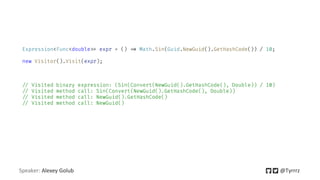
Expression<Func<double/> expr = () /> Math.Sin(Guid.NewGuid().GetHashCode()) / 10;
new Visitor().Visit(expr);
// Visited binary expression: (Sin(Convert(NewGuid().GetHashCode(), Double)) / 10)
// Visited method call: Sin(Convert(NewGuid().GetHashCode(), Double))
// Visited method call: NewGuid().GetHashCode()
// Visited method call: NewGuid()
Speaker: Alexey Golub @Tyrrrz
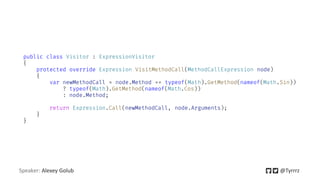
public class Visitor : ExpressionVisitor
{
protected override Expression VisitMethodCall(MethodCallExpression node)
{
var newMethodCall = node.Method == typeof(Math).GetMethod(nameof(Math.Sin))
? typeof(Math).GetMethod(nameof(Math.Cos))
: node.Method;
return Expression.Call(newMethodCall, node.Arguments);
}
}
Speaker: Alexey Golub @Tyrrrz
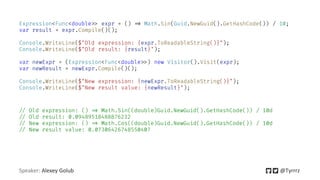
Expression<Func<double/> expr = () /> Math.Sin(Guid.NewGuid().GetHashCode()) / 10;
var result = expr.Compile()();
Console.WriteLine($"Old expression: {expr.ToReadableString()}");
Console.WriteLine($"Old result: {result}");
var newExpr = (Expression<Func<double/>) new Visitor().Visit(expr);
var newResult = newExpr.Compile()();
Console.WriteLine($"New expression: {newExpr.ToReadableString()}");
Console.WriteLine($"New result value: {newResult}");
// Old expression: () /> Math.Sin((double)Guid.NewGuid().GetHashCode()) / 10d
// Old result: 0.09489518488876232
// New expression: () /> Math.Cos((double)Guid.NewGuid().GetHashCode()) / 10d
// New result value: 0.07306426748550407
Transpiling code into a different
language
Speaker: Alexey Golub @Tyrrrz
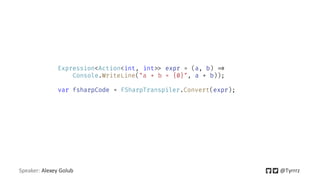
Expression<Action<int, int/> expr = (a, b) />
Console.WriteLine("a + b = {0}", a + b));
var fsharpCode = FSharpTranspiler.Convert(expr);
Speaker: Alexey Golub @Tyrrrz
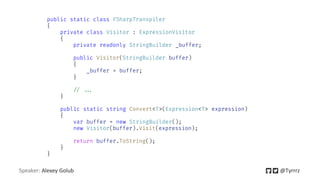
public static class FSharpTranspiler
{
private class Visitor : ExpressionVisitor
{
private readonly StringBuilder _buffer;
public Visitor(StringBuilder buffer)
{
_buffer = buffer;
}
// //.
}
public static string Convert<T>(Expression<T> expression)
{
var buffer = new StringBuilder();
new Visitor(buffer).Visit(expression);
return buffer.ToString();
}
}
Speaker: Alexey Golub @Tyrrrz
protected override Expression VisitLambda<T>(Expression<T> node)
{
_buffer.Append("fun (");
_buffer.AppendJoin(", ", node.Parameters.Select(p => p.Name));
_buffer.Append(") ->");
return base.VisitLambda(node);
}
protected override Expression VisitMethodCall(MethodCallExpression node)
{
if (node.Method.DeclaringType /= typeof(Console) /&
node.Method.Name /= nameof(Console.WriteLine))
{
_buffer.Append("printfn ");
if (node.Arguments.Count > 1)
{
var format = (string) ((ConstantExpression) node.Arguments[0]).Value;
var formatValues = node.Arguments.Skip(1).ToArray();
_buffer.Append(""").Append(Regex.Replace(format, @"{d+}", "%O")).Append("" ");
_buffer.AppendJoin(" ", formatValues.Select(v /> $"({v.ToReadableString()})"));
}
}
return base.VisitMethodCall(node);
}
Speaker: Alexey Golub @Tyrrrz
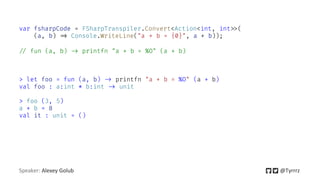
var fsharpCode = FSharpTranspiler.Convert<Action<int, int/>(
(a, b) /> Console.WriteLine("a + b = {0}", a + b));
> let foo = fun (a, b) > printfn "a + b = %O" (a + b)
val foo : a:int * b:int > unit
> foo (3, 5)
a + b = 8
val it : unit = ()
// fun (a, b) > printfn "a + b = %O" (a + b)
Summary
• Expression trees are fun
• We can make reflection-heavy code much faster
• We can do late-binding with almost no performance penalties
• We can write our own runtime-compiled DSL
• We can provide refactor-safe identification for type members
• We can analyze specified lambdas and reflect on their structure
• We can rewrite existing expressions to behave differently
• We can transpile code into other languages
Speaker: Alexey Golub @Tyrrrz
Useful packages
• FastExpressionCompiler
https://github.com/dadhi/FastExpressionCompiler
Speeds up LambdaExpression.Compile()
• ReadableExpressions
https://github.com/agileobjects/ReadableExpressions
Converts expression to readable C# code
Speaker: Alexey Golub @Tyrrrz
Learn more
• Working with expression trees in C# (by me)
https://tyrrrz.me/blog/expression-trees
• Introduction to expression trees (MS docs)
https://docs.microsoft.com/en-us/dotnet/csharp/expression-trees
• Expression trees in enterprise software (Maksim Arshinov)
https://youtube.com/watch?v=J2XzsCoJM4o
Speaker: Alexey Golub @Tyrrrz
Thank you!
Speaker: Alexey Golub @Tyrrrz

Expression trees in c#

  • 1.
    Speaker: Alexey Golub@Tyrrrz Expression trees in C# I heard you like code, so we put code in your code so you can code while you code
  • 2.
    /whois ${speaker} Speaker: AlexeyGolub @Tyrrrz • Open-source developer ✨ • Conference speaker & blogger 🌐️ • C#, F#, JavaScript 💻 • Cloud & web ☁️ • Automation & DevOps ⚙️
  • 3.
    What is anexpression tree? Speaker: Alexey Golub @Tyrrrz
  • 4.
    Speaker: Alexey Golub@Tyrrrz +Constant (2) Constant (3) Plus operator 2 3 Binary expression
  • 5.
    Speaker: Alexey Golub@Tyrrrz !string.IsNullOrWhiteSpace(personName) ? "Greetings, " + personName : null; string? GetGreeting(string personName) { return }
  • 6.
    Speaker: Alexey Golub@Tyrrrz "Greetings, " ! personName string.IsNullOrWhiteSpace( ) null;: ? + personName OPERATOR "NOT" METHOD CALL PARAMETER PARAMETERCONSTANT OPERATOR "ADD" CONSTANT
  • 7.
    Speaker: Alexey Golub@Tyrrrz { Ternary conditional } { + } TRUE { null } FALSE { Method call } CONDITION { string.IsNullOrWhiteSpace } { personName } { personName } { "Greetings, " } { ! }
  • 8.
    Speaker: Alexey Golub@Tyrrrz Expression Tree describes the structure of an expression
  • 9.
  • 10.
  • 11.
    Speaker: Alexey Golub@Tyrrrz Expression.Constant(...) ConstantExpression Expression.New(...) NewExpression Expression.Assign(...) BinaryExpression Expression.Equal(...) BinaryExpression Expression.Call(...) MethodCallExpression Expression.Condition(...) ConditionalExpression Expression.Loop(...) LoopExpression ...
  • 12.
    Speaker: Alexey Golub@Tyrrrz !string.IsNullOrWhiteSpace(personName) ? "Greetings, " + personName : null; Let’s recreate our expression dynamically
  • 13.
    Speaker: Alexey Golub@Tyrrrz public Func<string, string?> ConstructGreetingFunction() { var personNameParameter = Expression.Parameter(typeof(string), "personName"); var isNullOrWhiteSpaceMethod = typeof(string) .GetMethod(nameof(string.IsNullOrWhiteSpace)); var condition = Expression.Not( Expression.Call(isNullOrWhiteSpaceMethod, personNameParameter)); var trueClause = Expression.Add( Expression.Constant("Greetings, "), personNameParameter); var falseClause = Expression.Constant(null, typeof(string)); var conditional = Expression.Condition(condition, trueClause, falseClause); var lambda = Expression.Lambda<Func<string, string?>>(conditional, personNameParameter); return lambda.Compile(); }
  • 14.
    Speaker: Alexey Golub@Tyrrrz var getGreeting = ConstructGreetingFunction(); var greetingForJohn = getGreeting("John"); The binary operator Add is not defined for the types 'System.String' and 'System.String'.
  • 15.
    Speaker: Alexey Golub@Tyrrrz We need to call string.Concat() directly var concatMethod = typeof(string) .GetMethod(nameof(string.Concat), new[] {typeof(string), typeof(string)}); var trueClause = Expression.Call( concatMethod, Expression.Constant("Greetings, "), personNameParameter);
  • 16.
    Speaker: Alexey Golub@Tyrrrz var getGreetings = ConstructGreetingFunction(); var greetingsForJohn = getGreetings("John"); var greetingsForNobody = getGreetings(" "); // "Greetings, John" // <null>
  • 17.
    Not everything isan expression Speaker: Alexey Golub @Tyrrrz but we are not limited by that
  • 18.
    Speaker: Alexey Golub@Tyrrrz new StringBuilder() .Append("Hello ") .AppendLine("world!"); Statements Expression Console.Write("Hello "); Console.WriteLine("world!");
  • 19.
    Speaker: Alexey Golub@Tyrrrz public Expression CreateStatementBlock() { var consoleWriteMethod = typeof(Console) .GetMethod(nameof(Console.Write), new[] {typeof(string)}); var consoleWriteLineMethod = typeof(Console) .GetMethod(nameof(Console.WriteLine), new[] {typeof(string)}); return Expression.Block( Expression.Call(consoleWriteMethod, Expression.Constant("Hello ")), Expression.Call(consoleWriteLineMethod, Expression.Constant("world!"))); } var block = CreateStatementBlock(); var lambda = Expression.Lambda<Action>(block).Compile(); lambda(); // Hello world!
  • 20.
    Speaker: Alexey Golub@Tyrrrz public Expression CreateStatementBlock() { var variableA = Expression.Variable(typeof(string), "a"); var variableB = Expression.Variable(typeof(string), "b"); return Expression.Block( new[] {variableA, variableB}, Expression.Assign(variableA, Expression.Constant("Foo ")), Expression.Assign(variableB, Expression.Constant("bar")), Expression.Call(consoleWriteMethod, variableA), Expression.Call(consoleWriteLineMethod, variableB)); } Declare variables Assign values to variables Reference variables
  • 21.
  • 22.
    Speaker: Alexey Golub@Tyrrrz How can we invoke Execute() from the outside? public class Command { private int Execute() /> 42; } public static int CallExecute(Command command) /> (int) typeof(Command) .GetMethod("Execute", Binding/lags.NonPublic | Binding/lags.Instance) .Invoke(command, null);
  • 23.
    Speaker: Alexey Golub@Tyrrrz public static class Re/lectionCached { private static MethodInfo ExecuteMethod { get; } = typeof(Command) .GetMethod("Execute", Binding/lags.NonPublic | Binding/lags.Instance); public static int CallExecute(Command command) /> (int) ExecuteMethod.Invoke(command, null); } public static class Re/lectionDelegate { private static MethodInfo ExecuteMethod { get; } = typeof(Command) .GetMethod("Execute", Binding/lags.NonPublic | Binding/lags.Instance); private static Func<Command, int> Impl { get; } = (Func<Command, int>) Delegate .CreateDelegate(typeof(Func<Command, int>), ExecuteMethod); public static int CallExecute(Command command) /> Impl(command); } Using cached MethodInfo Using Delegate.CreateDelegate
  • 24.
    public static classExpressionTrees { private static MethodInfo ExecuteMethod { get; } = typeof(Command) .GetMethod("Execute", Binding/lags.NonPublic | Binding/lags.Instance); private static Func<Command, int> Impl { get; } static ExpressionTrees() { var instance = Expression.Parameter(typeof(Command)); var call = Expression.Call(instance, ExecuteMethod); Impl = Expression.Lambda<Func<Command, int/>(call, instance).Compile(); } public static int CallExecute(Command command) /> Impl(command); } Speaker: Alexey Golub @Tyrrrz Lazy thread-safe initialization via static constructor
  • 25.
    Speaker: Alexey Golub@Tyrrrz public class Benchmarks { [Benchmark(Description = "Reflection", Baseline = true)] public int Reflection() => (int) typeof(Command) .GetMethod("Execute", BindingFlags.NonPublic | BindingFlags.Instance) .Invoke(new Command(), null); [Benchmark(Description = "Reflection (cached)")] public int Cached() => ReflectionCached.CallExecute(new Command()); [Benchmark(Description = "Reflection (delegate)")] public int Delegate() => ReflectionDelegate.CallExecute(new Command()); [Benchmark(Description = "Expressions")] public int Expressions() => ExpressionTrees.CallExecute(new Command()); public static void Main() => BenchmarkRunner.Run<Benchmarks>(); } | Method | Mean | Error | StdDev | Ratio | |---------------------- |-----------:|----------:|----------:|------:| | Reflection | 192.975 ns | 1.6802 ns | 1.4895 ns | 1.00 | | Reflection (cached) | 123.762 ns | 1.1063 ns | 1.0349 ns | 0.64 | | Reflection (delegate) | 6.419 ns | 0.0646 ns | 0.0605 ns | 0.03 | | Expressions | 5.383 ns | 0.0433 ns | 0.0383 ns | 0.03 |
  • 26.
  • 27.
    Speaker: Alexey Golub@Tyrrrz What can we do to support multiple types? public int ThreeFourths(int x) => 3 * x / 4; public int ThreeFourths(int x) => 3 * x / 4; public long ThreeFourths(long x) => 3 * x / 4; public float ThreeFourths(float x) => 3 * x / 4; public double ThreeFourths(double x) => 3 * x / 4; public decimal ThreeFourths(decimal x) => 3 * x / 4; public T ThreeFourths<T>(T x) /> 3 * x / 4; But we actually want something like this instead
  • 28.
    Speaker: Alexey Golub@Tyrrrz public T ThreeFourths<T>(T x) { var param = Expression.Parameter(typeof(T)); var three = Expression.Convert(Expression.Constant(3), typeof(T)); var four = Expression.Convert(Expression.Constant(4), typeof(T)); var operation = Expression.Divide(Expression.Multiply(param, three), four); var lambda = Expression.Lambda<Func<T, T/>(operation, param); var func = lambda.Compile(); return func(x); } var a = ThreeFourths(18); // 13 var b = ThreeFourths(6.66); // 4.995 var c = ThreeFourths(100M); // 75M
  • 29.
    Speaker: Alexey Golub@Tyrrrz public dynamic ThreeFourths(dynamic x) /> 3 * x / 4; Wait, how is it different from this?
  • 30.
    public static classThreeFourths { private static class Impl<T> { public static Func<T, T> Of { get; } static Impl() { var param = Expression.Parameter(typeof(T)); var three = Expression.Convert(Expression.Constant(3), typeof(T)); var four = Expression.Convert(Expression.Constant(4), typeof(T)); var operation = Expression.Divide(Expression.Multiply(param, three), four); var lambda = Expression.Lambda<Func<T, T/>(operation, param); Of = lambda.Compile(); } } public static T Of<T>(T x) /> Impl<T>.Of(x); } Speaker: Alexey Golub @Tyrrrz Generic, thread-safe lazy initialization
  • 31.
    Speaker: Alexey Golub@Tyrrrz public class Benchmarks { [Benchmark(Description = "Static", Baseline = true)] [Arguments(13.37)] public double Static(double x) /> 3 * x / 4; [Benchmark(Description = "Expressions")] [Arguments(13.37)] public double Expressions(double x) /> ThreeFourths.Of(x); [Benchmark(Description = "Dynamic")] [Arguments(13.37)] public dynamic Dynamic(dynamic x) /> 3 * x / 4; public static void Main() /> BenchmarkRunner.Run<Benchmarks>(); } | Method | x | Mean | Error | StdDev | Ratio | RatioSD | |------------ |------ |-----------:|----------:|----------:|------:|--------:| | Static | 13.37 | 0.6077 ns | 0.0176 ns | 0.0147 ns | 1.00 | 0.00 | | Expressions | 13.37 | 1.9510 ns | 0.0163 ns | 0.0145 ns | 3.21 | 0.08 | | Dynamic | 13.37 | 19.3267 ns | 0.1512 ns | 0.1340 ns | 31.82 | 0.78 |
  • 32.
  • 33.
    Speaker: Alexey Golub@Tyrrrz public TValue Lookup(TKey key) => key.GetHashCode() switch { // No collisions 9254 => value1, -101 => value2, // Collision 777 => key switch { key3 => value3, key4 => value4 }, // ... // Not found _ => throw new KeyNotFoundException(key.ToString()) }; Dictionary lookup in a nutshell
  • 34.
    Speaker: Alexey Golub@Tyrrrz public class CompiledDictionary<TKey, TValue> : IDictionary<TKey, TValue> { private readonly IDictionary<TKey, TValue> _inner = new Dictionary<TKey, TValue>(); private Func<TKey, TValue> _lookup; public void UpdateLookup() { // //. } public TValue this[TKey key] { get /> _lookup(key); set /> _inner[key] = value; } // The rest of the interface implementation is omitted for brevity }
  • 35.
    Speaker: Alexey Golub@Tyrrrz public void UpdateLookup() { var keyParameter = Expression.Parameter(typeof(TKey)); var keyGetHashCodeCall = Expression.Call( keyParameter, typeof(object).GetMethod(nameof(GetHashCode))); var keyToStringCall = Expression.Call( keyParameter, typeof(object).GetMethod(nameof(ToString))); var exceptionCtor = typeof(KeyNotFoundException) .GetConstructor(new[] {typeof(string)}); var throwException = Expression.Throw( Expression.New(exceptionCtor, keyToStringCall), typeof(TValue)); var body = Expression.Switch( // ... )); var lambda = Expression.Lambda<Func<TKey, TValue>>(body, keyParameter); _lookup = lambda.Compile(); }
  • 36.
    Speaker: Alexey Golub@Tyrrrz var body = Expression.Switch( typeof(TValue), keyGetHashCodeCall, throwException, null, _inner .GroupBy(p /> p.Key.GetHashCode()) .Select(g /> { if (g.Count() /= 1) return Expression.SwitchCase( Expression.Constant(g.Single().Value), Expression.Constant(g.Key)); return Expression.SwitchCase( Expression.Switch( typeof(TValue), keyParameter, throwException, null, g.Select(p /> Expression.SwitchCase( Expression.Constant(p.Value), Expression.Constant(p.Key) ))), Expression.Constant(g.Key)); })); No collision Collision
  • 37.
    Speaker: Alexey Golub@Tyrrrz | Method | Count | Mean | Error | StdDev | Ratio | |-------------------- |------ |----------:|----------:|----------:|------:| | Standard dictionary | 10 | 24.995 ns | 0.1821 ns | 0.1704 ns | 1.00 | | Compiled dictionary | 10 | 9.366 ns | 0.0511 ns | 0.0478 ns | 0.37 | | | | | | | | | Standard dictionary | 1000 | 25.105 ns | 0.0665 ns | 0.0622 ns | 1.00 | | Compiled dictionary | 1000 | 14.819 ns | 0.1138 ns | 0.1065 ns | 0.59 | | | | | | | | | Standard dictionary | 10000 | 29.047 ns | 0.1201 ns | 0.1123 ns | 1.00 | | Compiled dictionary | 10000 | 17.903 ns | 0.0635 ns | 0.0530 ns | 0.62 |
  • 38.
    Parsing into expressiontrees Speaker: Alexey Golub @Tyrrrz
  • 39.
    Speaker: Alexey Golub@Tyrrrz public static class SimpleCalculator { private static readonly Parser<Expression> Constant = Parse.DecimalInvariant .Select(n /> double.Parse(n, CultureInfo.InvariantCulture)) .Select(n /> Expression.Constant(n, typeof(double))) .Token(); private static readonly Parser<ExpressionType> Operator = Parse.Char('+').Return(ExpressionType.Add) .Or(Parse.Char('-').Return(ExpressionType.Subtract)) .Or(Parse.Char('*').Return(ExpressionType.Multiply)) .Or(Parse.Char('/').Return(ExpressionType.Divide)); private static readonly Parser<Expression> Operation = Parse.ChainOperator(Operator, Constant, Expression.MakeBinary); private static readonly Parser<Expression> FullExpression = Operation.Or(Constant).End(); public static double Run(string expression) { var operation = FullExpression.Parse(expression); var func = Expression.Lambda<Func<double/>(operation).Compile(); return func(); } }
  • 40.
    Speaker: Alexey Golub@Tyrrrz var a = SimpleCalculator.Run("2 + 2"); var b = SimpleCalculator.Run("3.15 * 5 + 2"); var c = SimpleCalculator.Run("1 / 2 * 3"); // 4 // 17.75 // 1.5
  • 41.
    Inferring expression trees fromcode Speaker: Alexey Golub @Tyrrrz
  • 42.
    Speaker: Alexey Golub@Tyrrrz Func<int, int, int> div = (a, b) /> a / b; Expression<Func<int, int, int/> divExpr = (a, b) /> a / b; Same value, different type Console.WriteLine(divExpr.Type); // System.Func`3[System.Int32,System.Int32,System.Int32]
  • 43.
    Speaker: Alexey Golub@Tyrrrz Func<int, int, int> div = (a, b) /> a / b; Expression<Func<int, int, int/> divExpr = (a, b) /> a / b; Same value, different type foreach (var param in divExpr.Parameters) Console.WriteLine($"Param: {param.Name} ({param.Type.Name})"); // Param: a (Int32) // Param: b (Int32)
  • 44.
    Speaker: Alexey Golub@Tyrrrz Func<int, int, int> div = (a, b) /> a / b; Expression<Func<int, int, int/> divExpr = (a, b) /> a / b; Same value, different type var div = divExpr.Compile(); var c = div(10, 2); // 5
  • 45.
    Speaker: Alexey Golub@Tyrrrz Func<int, int, int> div = (a, b) => a / b; Expression<Func<int, int, int>> divExpr = (a, b) => a / b; Product Recipe
  • 46.
    Speaker: Alexey Golub@Tyrrrz Limitations Func<int, int, int> div = (a, b) /> a / b; Expression<Func<int, int, int/> divExpr = div; Compilation error
  • 47.
    Speaker: Alexey Golub@Tyrrrz Limitations Expression<Func<int, int, int/> divExpr = (a, b) /> { var result = a / b; return result; }; Compilation error Expression<Action> writeToConsole = () /> { Console.Write("Hello "); Console.WriteLine("world!"); }; Compilation error
  • 48.
    Speaker: Alexey Golub@Tyrrrz Limitations • Null-coalescing operator (obj/.Prop) • Dynamic variables (dynamic) • Asynchronous code (async/await) • Default or named parameters (func(a, b: 5), func(a)) • Parameters passed by reference (int.TryParse("123", out var i)) • Multi-dimensional array initializers (new int[2, 2] { { 1, 2 }, { 3, 4 } }) • Assignment operations (a = 5) • Increment and decrement (a/+, a/-, /-a, /+a) • Base type access (base.Prop) • Dictionary initialization (new Dictionary<string, int> { ["foo"] = 100 }) • Unsafe code (via unsafe) • Throw expressions (throw new Exception()) • Tuple literals ((5, x)) Can’t use any of the following:
  • 49.
  • 50.
    Speaker: Alexey Golub@Tyrrrz How can we get PropertyInfo of Dto.Id? public class Dto { public Guid Id { get; set; } public string Name { get; set; } } var idProperty = typeof(Dto).GetProperty(nameof(Dto.Id)); Console.WriteLine($"Type: {idProperty.DeclaringType.Name}"); Console.WriteLine($"Property: {idProperty.Name} ({idProperty.PropertyType.Name})"); // Type: Dto // Property: Id (Guid)
  • 51.
    Speaker: Alexey Golub@Tyrrrz public class Validator<T> { // Add validation predicate to the list public void AddValidation<TProp>(string propertyName, Func<TProp, bool> predicate) { var propertyInfo = typeof(T).GetProperty(propertyName); if (propertyInfo is null) throw new InvalidOperationException("Please provide a valid property name."); // //. } // Evalute all predicates public bool Validate(T obj) { /* //. // } /* //. // } var validator = new Validator<Dto>(); validator.AddValidation<Guid>(nameof(Dto.Id), id => id != Guid.Empty); validator.AddValidation<string>(nameof(Dto.Name), name => !string.IsNullOrWhiteSpace(name)); var isValid = validator.Validate(new Dto { Id = Guid.NewGuid() }); // false
  • 52.
    Speaker: Alexey Golub@Tyrrrz What if we wanted to change the property type? public class Dto { public int Id { get; set; } public string Name { get; set; } } validator.AddValidation<Guid>(nameof(Dto.Id), id /> id /= Guid.Empty); Still compiles, even though there is now an error
  • 53.
    Speaker: Alexey Golub@Tyrrrz public class Validator<T> { public void AddValidation<TProp>( Expression<Func<T, TProp>> propertyExpression, Func<TProp, bool> predicate) { var propertyInfo = (propertyExpression.Body as MemberExpression)?.Member as PropertyInfo; if (propertyInfo is null) throw new InvalidOperationException("Please provide a valid property expression."); // ... } public bool Validate(T obj) { /* ... */ } /* ... */ } Expression is used to identify a property var validator = new Validator<Dto>(); validator.AddValidation(dto /> dto.Id, id /> id /= Guid.Empty); validator.AddValidation(dto /> dto.Name, name /> !string.IsNullOrWhiteSpace(name)); var isValid = validator.Validate(new Dto { Id = Guid.NewGuid() }); // false
  • 54.
    Providing context toassertions Speaker: Alexey Golub @Tyrrrz
  • 55.
    Speaker: Alexey Golub@Tyrrrz [Test] public void IntTryParse_Test() { // Arrange const string s = "123"; // Act var result = int.TryParse(s, out var value); // Assert Assert.That(result, Is.True, "Parsing was unsuccessful"); Assert.That(value, Is.EqualTo(124), "Parsed value is incorrect"); } X IntTryParse_Test [60ms] Error Message: Parsed value is incorrect Expected: 124 But was: 123
  • 56.
    Speaker: Alexey Golub@Tyrrrz public static class AssertEx { public static void Express(Expression<Action> expression) { var act = expression.Compile(); try { act(); } catch (AssertionException ex) { throw new AssertionException( expression.Body.ToReadableString() + Environment.NewLine + ex.Message); } } } Extension method from ReadableExpressions package
  • 57.
    Speaker: Alexey Golub@Tyrrrz X IntTryParse_Test [60ms] Error Message: Assert.That(value, Is.EqualTo(124)) Expected: 124 But was: 123 [Test] public void IntTryParse_Test() { // Arrange const string s = "123"; // Act var result = int.TryParse(s, out var value); // Assert AssertEx.Express(() /> Assert.That(result, Is.True)); AssertEx.Express(() /> Assert.That(value, Is.EqualTo(124))); }
  • 58.
    Traversing and rewriting expressiontrees Speaker: Alexey Golub @Tyrrrz
  • 59.
  • 60.
    Speaker: Alexey Golub@Tyrrrz public class Visitor : ExpressionVisitor { protected override Expression VisitMethodCall(MethodCallExpression node) { Console.WriteLine($"Visited method call: {node}"); return base.VisitMethodCall(node); } protected override Expression VisitBinary(BinaryExpression node) { Console.WriteLine($"Visited binary expression: {node}"); return base.VisitBinary(node); } }
  • 61.
    Speaker: Alexey Golub@Tyrrrz Expression<Func<double/> expr = () /> Math.Sin(Guid.NewGuid().GetHashCode()) / 10; new Visitor().Visit(expr); // Visited binary expression: (Sin(Convert(NewGuid().GetHashCode(), Double)) / 10) // Visited method call: Sin(Convert(NewGuid().GetHashCode(), Double)) // Visited method call: NewGuid().GetHashCode() // Visited method call: NewGuid()
  • 62.
    Speaker: Alexey Golub@Tyrrrz public class Visitor : ExpressionVisitor { protected override Expression VisitMethodCall(MethodCallExpression node) { var newMethodCall = node.Method == typeof(Math).GetMethod(nameof(Math.Sin)) ? typeof(Math).GetMethod(nameof(Math.Cos)) : node.Method; return Expression.Call(newMethodCall, node.Arguments); } }
  • 63.
    Speaker: Alexey Golub@Tyrrrz Expression<Func<double/> expr = () /> Math.Sin(Guid.NewGuid().GetHashCode()) / 10; var result = expr.Compile()(); Console.WriteLine($"Old expression: {expr.ToReadableString()}"); Console.WriteLine($"Old result: {result}"); var newExpr = (Expression<Func<double/>) new Visitor().Visit(expr); var newResult = newExpr.Compile()(); Console.WriteLine($"New expression: {newExpr.ToReadableString()}"); Console.WriteLine($"New result value: {newResult}"); // Old expression: () /> Math.Sin((double)Guid.NewGuid().GetHashCode()) / 10d // Old result: 0.09489518488876232 // New expression: () /> Math.Cos((double)Guid.NewGuid().GetHashCode()) / 10d // New result value: 0.07306426748550407
  • 64.
    Transpiling code intoa different language Speaker: Alexey Golub @Tyrrrz
  • 65.
    Speaker: Alexey Golub@Tyrrrz Expression<Action<int, int/> expr = (a, b) /> Console.WriteLine("a + b = {0}", a + b)); var fsharpCode = FSharpTranspiler.Convert(expr);
  • 66.
    Speaker: Alexey Golub@Tyrrrz public static class FSharpTranspiler { private class Visitor : ExpressionVisitor { private readonly StringBuilder _buffer; public Visitor(StringBuilder buffer) { _buffer = buffer; } // //. } public static string Convert<T>(Expression<T> expression) { var buffer = new StringBuilder(); new Visitor(buffer).Visit(expression); return buffer.ToString(); } }
  • 67.
    Speaker: Alexey Golub@Tyrrrz protected override Expression VisitLambda<T>(Expression<T> node) { _buffer.Append("fun ("); _buffer.AppendJoin(", ", node.Parameters.Select(p => p.Name)); _buffer.Append(") ->"); return base.VisitLambda(node); } protected override Expression VisitMethodCall(MethodCallExpression node) { if (node.Method.DeclaringType /= typeof(Console) /& node.Method.Name /= nameof(Console.WriteLine)) { _buffer.Append("printfn "); if (node.Arguments.Count > 1) { var format = (string) ((ConstantExpression) node.Arguments[0]).Value; var formatValues = node.Arguments.Skip(1).ToArray(); _buffer.Append(""").Append(Regex.Replace(format, @"{d+}", "%O")).Append("" "); _buffer.AppendJoin(" ", formatValues.Select(v /> $"({v.ToReadableString()})")); } } return base.VisitMethodCall(node); }
  • 68.
    Speaker: Alexey Golub@Tyrrrz var fsharpCode = FSharpTranspiler.Convert<Action<int, int/>( (a, b) /> Console.WriteLine("a + b = {0}", a + b)); > let foo = fun (a, b) > printfn "a + b = %O" (a + b) val foo : a:int * b:int > unit > foo (3, 5) a + b = 8 val it : unit = () // fun (a, b) > printfn "a + b = %O" (a + b)
  • 69.
    Summary • Expression treesare fun • We can make reflection-heavy code much faster • We can do late-binding with almost no performance penalties • We can write our own runtime-compiled DSL • We can provide refactor-safe identification for type members • We can analyze specified lambdas and reflect on their structure • We can rewrite existing expressions to behave differently • We can transpile code into other languages Speaker: Alexey Golub @Tyrrrz
  • 70.
    Useful packages • FastExpressionCompiler https://github.com/dadhi/FastExpressionCompiler Speedsup LambdaExpression.Compile() • ReadableExpressions https://github.com/agileobjects/ReadableExpressions Converts expression to readable C# code Speaker: Alexey Golub @Tyrrrz
  • 71.
    Learn more • Workingwith expression trees in C# (by me) https://tyrrrz.me/blog/expression-trees • Introduction to expression trees (MS docs) https://docs.microsoft.com/en-us/dotnet/csharp/expression-trees • Expression trees in enterprise software (Maksim Arshinov) https://youtube.com/watch?v=J2XzsCoJM4o Speaker: Alexey Golub @Tyrrrz
  • 72.