LOGO
                     Questioning


Dr. Mohamed Mossad
Questioning


Types of questions:

• Open- ended questions
• Closed – ended questions
• Choice questions
• Benefit – tag questions
Questioning
Open ended questions:
Who? Where? Which? What?
When? How?

Use open-ended questions:

• To gain information.
• To uncover areas of need / buying motives.
• To check assumptions made during preparation.
• To start / maintain 2 – way communication.

Remember: "Why" must be treated with care!
Questioning

Closed-ended questions:

• To get a precise, quick and specific response.
• To ask for / gain information.
• To give information.
• To change, direct and narrow the topic.
• To ask for the order.
• To focus or refocus attention.
• To control the direction of the conversation.
Questioning
Closed-ended questions:

Example

Ask for / gain information

 Did you see my report?
 Have you started using our product?
 Are you satisfied with our services?
 Is the new offer from my company of interest to you?
 Has Mr. Samy returned back from his vacation?
Questioning

Closed-ended questions:
Example

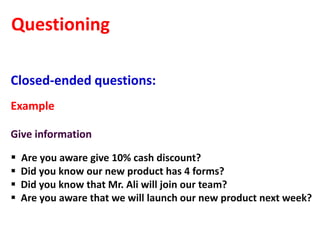
Give information

   Are you aware give 10% cash discount?
   Did you know our new product has 4 forms?
   Did you know that Mr. Ali will join our team?
   Are you aware that we will launch our new product next week?
Questioning

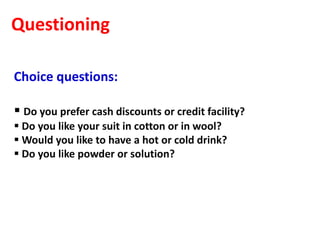
Choice questions:

 Do you prefer cash discounts or credit facility?
 Do you like your suit in cotton or in wool?
 Would you like to have a hot or cold drink?
 Do you like powder or solution?
Questioning

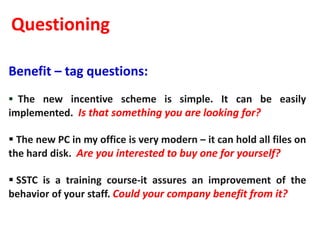
Benefit – tag questions:
 The new incentive scheme is simple. It can be easily
implemented. Is that something you are looking for?

 The new PC in my office is very modern – it can hold all files on
the hard disk. Are you interested to buy one for yourself?

 SSTC is a training course-it assures an improvement of the
behavior of your staff. Could your company benefit from it?
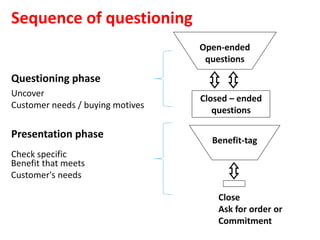
Sequence of questioning
                                  Open-ended
                                   questions

Questioning phase
Uncover
                                  Closed – ended
Customer needs / buying motives
                                     questions

Presentation phase
                                    Benefit-tag
Check specific
Benefit that meets
Customer's needs

                                      Close
                                      Ask for order or
                                      Commitment
Summary of questioning

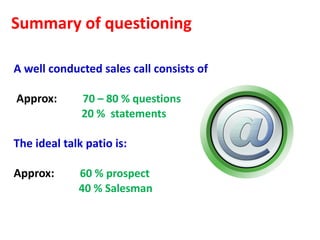
A well conducted sales call consists of

Approx:       70 – 80 % questions
              20 % statements

The ideal talk patio is:

Approx:      60 % prospect
             40 % Salesman
Summary of questioning

Major objectives of questioning:

 To uncover real needs of prospect
   To ask for / gain information
   To give information
   To lead towards successful commitment
   To conduct / control sales call
Visual
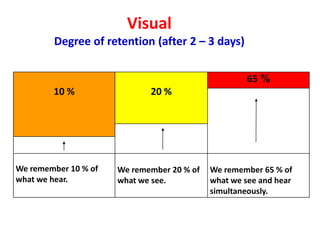
        Degree of retention (after 2 – 3 days)

                                                     65 %
        10 %                 20 %


We remember 10 % of   We remember 20 % of   We remember 65 % of
what we hear.         what we see.          what we see and hear
                                            simultaneously.
Visuals

What should we observe when using visuals?

• Illustrate one point only.
• Relate to the prospect's needs.
• Always ask questions.
• Make it coincide with what you are saying .
• Keep control of the visual aid.
Visuals

What should we observe when using visuals?

• Avoid showing it too early or too late.
• Know your visual in details.
• Make it clean and ready to use.
• Use pencil or marker.
Visuals


What should we observe when using visuals?

• Keep control of the visual aid.
• Avoid showing it too early or too late.
• Know your visual in details.
• Make it clean and ready to use.
• Use pencil or marker.
Customer responses

1. Positive customer responses:
Clear – cut objective, positive response: Pick up on the positive and
use it!

Example:

Prospect "the new offer of your company is very attractive."

Seller "I am very pleased to hear that you are happy with the new
offer."

 Pick up on the positive! "So you will give me an order, won't you?"
 Use it!
Customer responses
Positive customer responses:

A. Prospect voice inflections and positive comments:

• Tell us a great deal. When the customer makes statements / adds
information = he is interested.

Examples:

"It sounds good to me."
"It used in my office."
"the quality of your product is good."

Praise and show approval "I am very pleased to hear that"
Customer responses
Positive customer responses:

B. Statements which show hesitation:
"I suppose that …"/ "It seems that ……"
"Perhaps I ought / should…."
"Maybe…" / I'm not sure whether …“

These statements are not rejections of your proposal.

• They only express hesitation, doubts, misgivings, but are signs
  to keep selling.
• Isolate doubt by questioning, and then eliminate it.
Customer responses
Positive customer responses:

B. Statements which show hesitation:

"I suppose that …"/ "It seems that ……"
"Perhaps I ought / should…."
"Maybe…" / I'm not sure whether …"

These statements are not rejections of your proposal.

• They only express hesitation, doubts, misgivings, but are signs
  to keep selling.
• Isolate doubt by questioning, and then eliminate it.
Customer responses
Positive customer responses:
B. Statements which show hesitation:
Examples:

Prospect: "I hardly believe there is a good computer program which
can be operated easily."

Seller "As I understand you are looking for a computer program
which combines high efficiency and can be operated easily.

What is it you are particularly looking for in a good PC."
Customer responses
Positive customer responses:
C. Positive , non – verbal customer behavior:
A customer will often signal interest through body language while being
verbally skeptical.

Examples:

 Looks at stock on the shelves.
 Examines your visual aids, samples ,etc.
 Studies your order form

The rule for handling, positive customer responses is: Pick Up On The
Positive And Use It!
Customer responses
2. Positive / negative customer responses:

Statement with a positive and a negative aspect

Examples:

•   "Yes, but"
•   "I agree although….."
•   "I like that, however.."
•   It's an excellent product, but…"

Note: Pick up on the positive only and use it . Just ignore the
negative portion!
Customer responses

2. Positive / negative customer responses:

Examples:

Prospect: "Your product is very effective but is very expensive."

Seller:    "I am happy you confirm that it is highly effective.
            When do you like the next order?
Typical negative responses

 It has too many side-effects
   That creates as many problems as it solves
   This form / pack size is not suitable
   Your prices is no adequate evidence on efficacy
   It's new and untried
   I have no time now
   I don't like fixed combinations
Typical negative responses


 You never bring something new
   The customers won't accept that
   That's quite unattractive gimmick
   This detailing aid does not appeal to me
   Your sampling policy is very restrictive
   I use a competitive drug and I'm happy with it
Typical negative responses
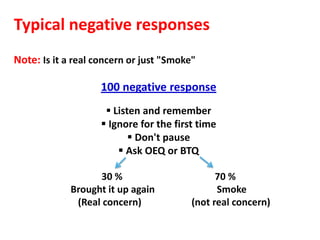
Note: Is it a real concern or just "Smoke"

                    100 negative response
                      Listen and remember
                     Ignore for the first time
                            Don't pause
                         Ask OEQ or BTQ

                   30 %                        70 %
             Brought it up again               Smoke
              (Real concern)             (not real concern)
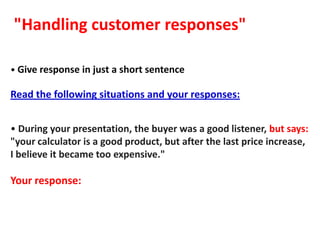
"Handling customer responses"

• Give response in just a short sentence

Read the following situations and your responses:


• During your presentation, the buyer was a good listener, but says:
"your calculator is a good product, but after the last price increase,
I believe it became too expensive."

Your response:
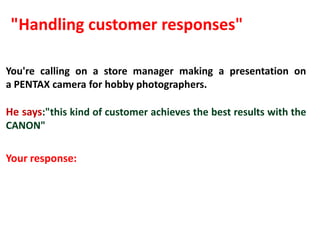
"Handling customer responses"

You're calling on a store manager making a presentation on
a PENTAX camera for hobby photographers.
He says:"this kind of customer achieves the best results with the
CANON"

Your response:
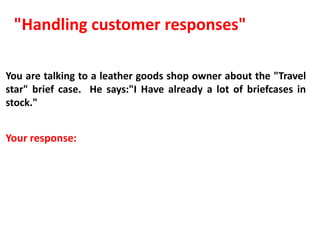
"Handling customer responses"

You are talking to a leather goods shop owner about the "Travel
star" brief case. He says:"I Have already a lot of briefcases in
stock."


Your response:
"Handling customer responses"

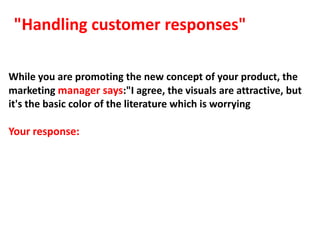
While you are promoting the new concept of your product, the
marketing manager says:"I agree, the visuals are attractive, but
it's the basic color of the literature which is worrying

Your response:
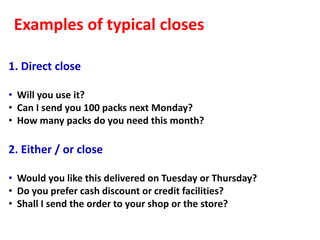
Examples of typical closes

1. Direct close

• Will you use it?
• Can I send you 100 packs next Monday?
• How many packs do you need this month?

2. Either / or close

• Would you like this delivered on Tuesday or Thursday?
• Do you prefer cash discount or credit facilities?
• Shall I send the order to your shop or the store?
Examples of typical closes
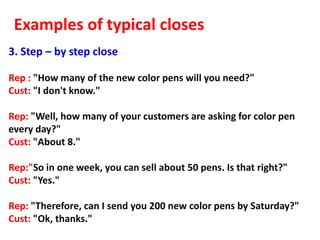
3. Step – by step close

Rep : "How many of the new color pens will you need?"
Cust: "I don't know."

Rep: "Well, how many of your customers are asking for color pen
every day?"
Cust: "About 8."

Rep:"So in one week, you can sell about 50 pens. Is that right?"
Cust: "Yes."

Rep: "Therefore, can I send you 200 new color pens by Saturday?"
Cust: "Ok, thanks."
Examples of typical closes

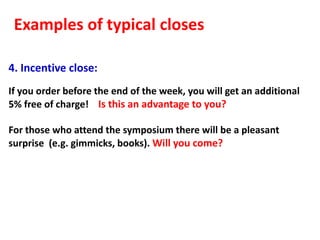
4. Incentive close:
If you order before the end of the week, you will get an additional
5% free of charge! Is this an advantage to you?

For those who attend the symposium there will be a pleasant
surprise (e.g. gimmicks, books). Will you come?
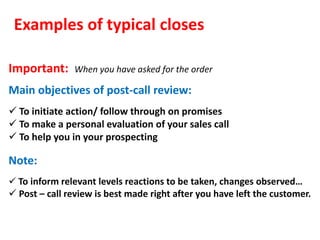
Examples of typical closes

Important:     When you have asked for the order

Main objectives of post-call review:
 To initiate action/ follow through on promises
 To make a personal evaluation of your sales call
 To help you in your prospecting

Note:
 To inform relevant levels reactions to be taken, changes observed…
 Post – call review is best made right after you have left the customer.
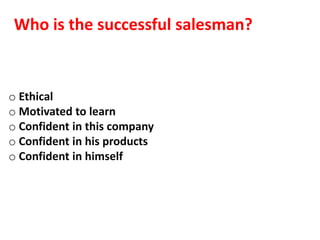
Who is the successful salesman?


o Ethical
o Motivated to learn
o Confident in this company
o Confident in his products
o Confident in himself
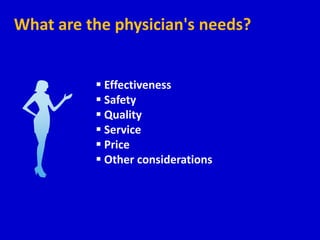
What are the physician's needs?


           Effectiveness
           Safety
           Quality
           Service
           Price
           Other considerations
LOGO
 What are the physician's needs?


 Prescriptions
 Availability………
 Profit……
 Right time to visit
 Scientific background
 Post sale services
 Other considerations
What are the role of the pharmacist?


Availability of products (order)
Dispensing the prescriptions
Change products
O.T.C.
Information about (products, competition, customer ..)
Feedback pharmacy

 Near to the physician
 Honest
 Cooperative
Thank You
      LOGO

Questioning

  • 1.
    LOGO Questioning Dr. Mohamed Mossad
  • 2.
    Questioning Types of questions: •Open- ended questions • Closed – ended questions • Choice questions • Benefit – tag questions
  • 3.
    Questioning Open ended questions: Who?Where? Which? What? When? How? Use open-ended questions: • To gain information. • To uncover areas of need / buying motives. • To check assumptions made during preparation. • To start / maintain 2 – way communication. Remember: "Why" must be treated with care!
  • 4.
    Questioning Closed-ended questions: • Toget a precise, quick and specific response. • To ask for / gain information. • To give information. • To change, direct and narrow the topic. • To ask for the order. • To focus or refocus attention. • To control the direction of the conversation.
  • 5.
    Questioning Closed-ended questions: Example Ask for/ gain information  Did you see my report?  Have you started using our product?  Are you satisfied with our services?  Is the new offer from my company of interest to you?  Has Mr. Samy returned back from his vacation?
  • 6.
    Questioning Closed-ended questions: Example Give information  Are you aware give 10% cash discount?  Did you know our new product has 4 forms?  Did you know that Mr. Ali will join our team?  Are you aware that we will launch our new product next week?
  • 7.
    Questioning Choice questions:  Doyou prefer cash discounts or credit facility?  Do you like your suit in cotton or in wool?  Would you like to have a hot or cold drink?  Do you like powder or solution?
  • 8.
    Questioning Benefit – tagquestions:  The new incentive scheme is simple. It can be easily implemented. Is that something you are looking for?  The new PC in my office is very modern – it can hold all files on the hard disk. Are you interested to buy one for yourself?  SSTC is a training course-it assures an improvement of the behavior of your staff. Could your company benefit from it?
  • 9.
    Sequence of questioning Open-ended questions Questioning phase Uncover Closed – ended Customer needs / buying motives questions Presentation phase Benefit-tag Check specific Benefit that meets Customer's needs Close Ask for order or Commitment
  • 10.
    Summary of questioning Awell conducted sales call consists of Approx: 70 – 80 % questions 20 % statements The ideal talk patio is: Approx: 60 % prospect 40 % Salesman
  • 11.
    Summary of questioning Majorobjectives of questioning:  To uncover real needs of prospect  To ask for / gain information  To give information  To lead towards successful commitment  To conduct / control sales call
  • 12.
    Visual Degree of retention (after 2 – 3 days) 65 % 10 % 20 % We remember 10 % of We remember 20 % of We remember 65 % of what we hear. what we see. what we see and hear simultaneously.
  • 13.
    Visuals What should weobserve when using visuals? • Illustrate one point only. • Relate to the prospect's needs. • Always ask questions. • Make it coincide with what you are saying . • Keep control of the visual aid.
  • 14.
    Visuals What should weobserve when using visuals? • Avoid showing it too early or too late. • Know your visual in details. • Make it clean and ready to use. • Use pencil or marker.
  • 15.
    Visuals What should weobserve when using visuals? • Keep control of the visual aid. • Avoid showing it too early or too late. • Know your visual in details. • Make it clean and ready to use. • Use pencil or marker.
  • 16.
    Customer responses 1. Positivecustomer responses: Clear – cut objective, positive response: Pick up on the positive and use it! Example: Prospect "the new offer of your company is very attractive." Seller "I am very pleased to hear that you are happy with the new offer."  Pick up on the positive! "So you will give me an order, won't you?"  Use it!
  • 17.
    Customer responses Positive customerresponses: A. Prospect voice inflections and positive comments: • Tell us a great deal. When the customer makes statements / adds information = he is interested. Examples: "It sounds good to me." "It used in my office." "the quality of your product is good." Praise and show approval "I am very pleased to hear that"
  • 18.
    Customer responses Positive customerresponses: B. Statements which show hesitation: "I suppose that …"/ "It seems that ……" "Perhaps I ought / should…." "Maybe…" / I'm not sure whether …“ These statements are not rejections of your proposal. • They only express hesitation, doubts, misgivings, but are signs to keep selling. • Isolate doubt by questioning, and then eliminate it.
  • 19.
    Customer responses Positive customerresponses: B. Statements which show hesitation: "I suppose that …"/ "It seems that ……" "Perhaps I ought / should…." "Maybe…" / I'm not sure whether …" These statements are not rejections of your proposal. • They only express hesitation, doubts, misgivings, but are signs to keep selling. • Isolate doubt by questioning, and then eliminate it.
  • 20.
    Customer responses Positive customerresponses: B. Statements which show hesitation: Examples: Prospect: "I hardly believe there is a good computer program which can be operated easily." Seller "As I understand you are looking for a computer program which combines high efficiency and can be operated easily. What is it you are particularly looking for in a good PC."
  • 21.
    Customer responses Positive customerresponses: C. Positive , non – verbal customer behavior: A customer will often signal interest through body language while being verbally skeptical. Examples:  Looks at stock on the shelves.  Examines your visual aids, samples ,etc.  Studies your order form The rule for handling, positive customer responses is: Pick Up On The Positive And Use It!
  • 22.
    Customer responses 2. Positive/ negative customer responses: Statement with a positive and a negative aspect Examples: • "Yes, but" • "I agree although….." • "I like that, however.." • It's an excellent product, but…" Note: Pick up on the positive only and use it . Just ignore the negative portion!
  • 23.
    Customer responses 2. Positive/ negative customer responses: Examples: Prospect: "Your product is very effective but is very expensive." Seller: "I am happy you confirm that it is highly effective. When do you like the next order?
  • 24.
    Typical negative responses It has too many side-effects  That creates as many problems as it solves  This form / pack size is not suitable  Your prices is no adequate evidence on efficacy  It's new and untried  I have no time now  I don't like fixed combinations
  • 25.
    Typical negative responses You never bring something new  The customers won't accept that  That's quite unattractive gimmick  This detailing aid does not appeal to me  Your sampling policy is very restrictive  I use a competitive drug and I'm happy with it
  • 26.
    Typical negative responses Note:Is it a real concern or just "Smoke" 100 negative response  Listen and remember  Ignore for the first time  Don't pause  Ask OEQ or BTQ 30 % 70 % Brought it up again Smoke (Real concern) (not real concern)
  • 27.
    "Handling customer responses" •Give response in just a short sentence Read the following situations and your responses: • During your presentation, the buyer was a good listener, but says: "your calculator is a good product, but after the last price increase, I believe it became too expensive." Your response:
  • 28.
    "Handling customer responses" You'recalling on a store manager making a presentation on a PENTAX camera for hobby photographers. He says:"this kind of customer achieves the best results with the CANON" Your response:
  • 29.
    "Handling customer responses" Youare talking to a leather goods shop owner about the "Travel star" brief case. He says:"I Have already a lot of briefcases in stock." Your response:
  • 30.
    "Handling customer responses" Whileyou are promoting the new concept of your product, the marketing manager says:"I agree, the visuals are attractive, but it's the basic color of the literature which is worrying Your response:
  • 31.
    Examples of typicalcloses 1. Direct close • Will you use it? • Can I send you 100 packs next Monday? • How many packs do you need this month? 2. Either / or close • Would you like this delivered on Tuesday or Thursday? • Do you prefer cash discount or credit facilities? • Shall I send the order to your shop or the store?
  • 32.
    Examples of typicalcloses 3. Step – by step close Rep : "How many of the new color pens will you need?" Cust: "I don't know." Rep: "Well, how many of your customers are asking for color pen every day?" Cust: "About 8." Rep:"So in one week, you can sell about 50 pens. Is that right?" Cust: "Yes." Rep: "Therefore, can I send you 200 new color pens by Saturday?" Cust: "Ok, thanks."
  • 33.
    Examples of typicalcloses 4. Incentive close: If you order before the end of the week, you will get an additional 5% free of charge! Is this an advantage to you? For those who attend the symposium there will be a pleasant surprise (e.g. gimmicks, books). Will you come?
  • 34.
    Examples of typicalcloses Important: When you have asked for the order Main objectives of post-call review:  To initiate action/ follow through on promises  To make a personal evaluation of your sales call  To help you in your prospecting Note:  To inform relevant levels reactions to be taken, changes observed…  Post – call review is best made right after you have left the customer.
  • 35.
    Who is thesuccessful salesman? o Ethical o Motivated to learn o Confident in this company o Confident in his products o Confident in himself
  • 36.
    What are thephysician's needs?  Effectiveness  Safety  Quality  Service  Price  Other considerations
  • 37.
    LOGO What arethe physician's needs?  Prescriptions  Availability………  Profit……  Right time to visit  Scientific background  Post sale services  Other considerations
  • 38.
    What are therole of the pharmacist? Availability of products (order) Dispensing the prescriptions Change products O.T.C. Information about (products, competition, customer ..)
  • 39.
    Feedback pharmacy  Nearto the physician  Honest  Cooperative
  • 40.