





TARGET-ing Readers
Teri Lesesne
rhymes with insane
@professornana
T-A-R-G-E-T-ing
 T is for trust
 A is for access
 R is for response
 G is for guidance
 E is for engagement
 T is for talk
 ING includes: readING aloud, booktalkING, and more
3
How do we…
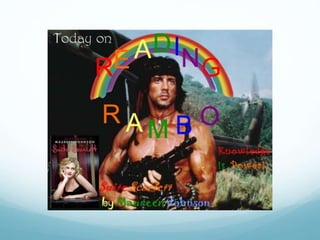
 Create those Reading Rambos?
 Base our practice on pedagogy?
 Differentiate for OUR kids?
Let’s start with some research…
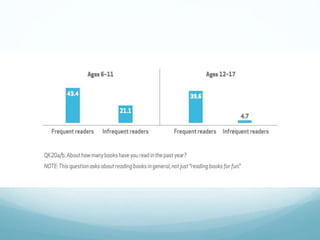
The research?
 Vickey Giles, 2003
 Karen Sue Gibson, 2002
 Replicated study from 20 years earlier, Livaudais
 Recent replication, Lesesne, 2011-14
 The questions?
6
What could someone do to
make you WANT to read
BEFORE/AFTER you read?
The converse: what could someone do to make
you HATE to read BEFORE/AFTER you read?
7
Turn and Talk
Predict what you think kids in Grades
K-12 indicated would motivate them to
read.
What could someone do to make
you want to read BEFORE you
read?
K-12
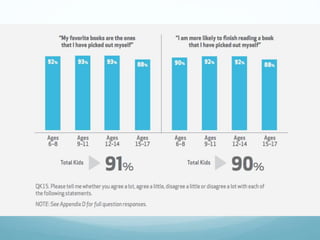
 Being allowed to choose any book you want to read
9
What could someone do to make
you want to read BEFORE you
read?
K-5
 Reading in a comfortable place like on the floor, in a
bean bag chair, or in a rocking chair
15
What could someone do to make
you want to read BEFORE you
read?
K-5
 Being allowed to buy your own book through a book
fair
21
What could someone do to
make you want to read
BEFORE you read?
K-5
 Reading books for a contest
27
What could someone do to
make you want to read
BEFORE you read?
K-12
 Having a classroom library
33
What could someone do to make
you want to read BEFORE you
read?
K-12
 Having the teacher read a book or chapter a day
39
What could someone do to
make you want to read
BEFORE you read?
K-12
 Having the teacher take you to the library
45
What could someone do to
make you want to read
BEFORE you read?
6-12
 Having the author come to the school
51
Skype in an author
 http://www.katemessner.com/authors-
who-skype-with-classes-book-clubs-for-
free/
What could someone do to make
you want to read BEFORE you
read?
 Seeing the movie or television production of a book.
53
6-12
What could someone do to make
you want to read BEFORE you
read?
6-12
 Being allowed to read books with lots of pictures in
them.
56
My survey results
 Show book trailer
 Read aloud portions of the text
 Give a booktalk
 Read aloud entire book
 Give students choice of what to read
 Create displays
 Listen to part of the audiobook
 Meet the author
 See movie or TV show
 Involve social media
Turn and Talk
What needs to be added/removed
from the list?
The late night
inspiration
T-A-R-G-E-T
61
T A R G E T
62
T is for TRUST
63
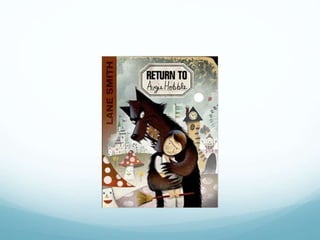
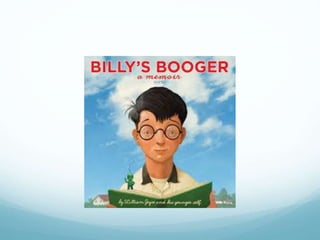
Established names
Authors to trust
68
Turn and Talk
Brainstorm at least 5 authors for your
particular grade levels that you think all
of us should know
A is for ACCESS
70
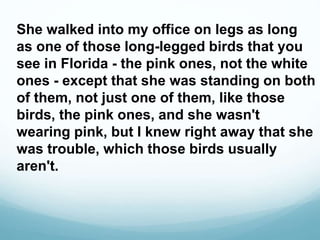
She walked into my office on legs as long
as one of those long-legged birds that you
see in Florida - the pink ones, not the white
ones - except that she was standing on both
of them, not just one of them, like those
birds, the pink ones, and she wasn't
wearing pink, but I knew right away that she
was trouble, which those birds usually
aren't.
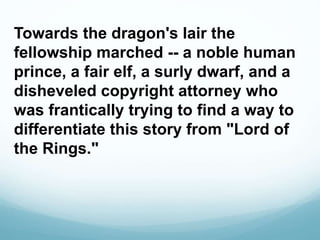
Towards the dragon's lair the
fellowship marched -- a noble human
prince, a fair elf, a surly dwarf, and a
disheveled copyright attorney who
was frantically trying to find a way to
differentiate this story from "Lord of
the Rings."
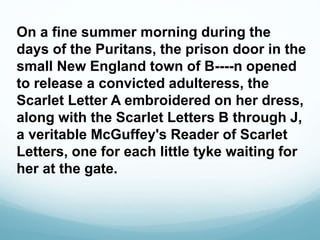
On a fine summer morning during the
days of the Puritans, the prison door in the
small New England town of B----n opened
to release a convicted adulteress, the
Scarlet Letter A embroidered on her dress,
along with the Scarlet Letters B through J,
a veritable McGuffey's Reader of Scarlet
Letters, one for each little tyke waiting for
her at the gate.
 Physical
 Intellectual
 Moral
 Emotional
Access Points
 At home
 In the classroom
 In the school library
 At hand
PHYSICAL ACCESS
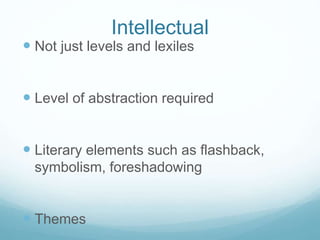
 Not just levels and lexiles
 Level of abstraction required
 Literary elements such as flashback,
symbolism, foreshadowing
 Themes
Intellectual
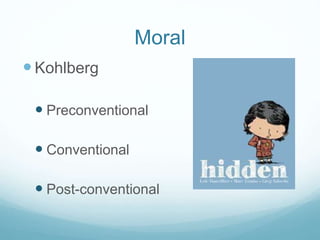
Kohlberg
 Preconventional
 Conventional
 Post-conventional
Moral
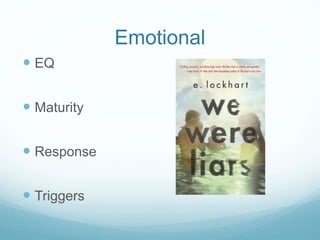
 EQ
 Maturity
 Response
 Triggers
Emotional
R is for RESPONSE
81
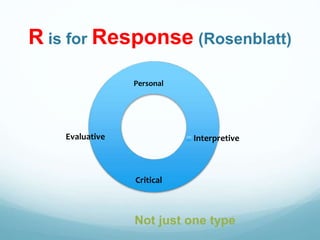
R is for Response (Rosenblatt)
Not just one type
Interpretive
Personal
Critical
Evaluative
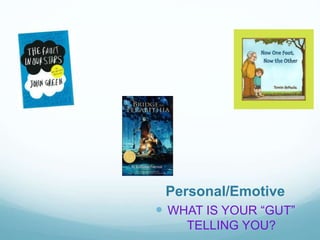
Personal/Emotive
 WHAT IS YOUR “GUT”
TELLING YOU?
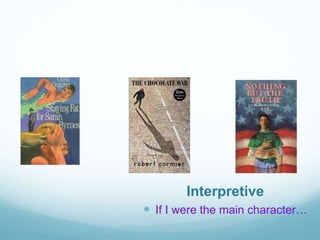
Interpretive
 If I were the main character…
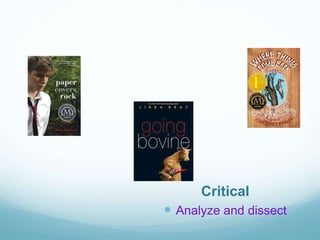
Critical
 Analyze and dissect
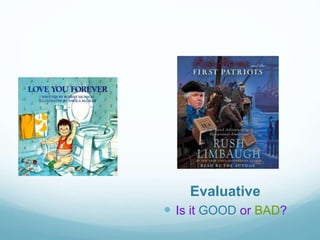
Evaluative
 Is it GOOD or BAD?
G is for GUIDANCE
93
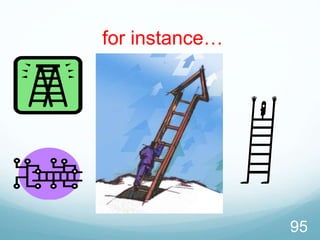
Reading ladders
Begin with where they are
Build reading experiences slowly
Move readers “up” with assistance
94
for instance…
95
E is for ENGAGEMENT
Cambourne’s Conditions for
Learning
(1995)
Learners need to be immersed in text of all
kinds.
Learners’ interests are sparked by what they
see and hear so that they want to learn the
new skill.
 Genre
 Form
 Format
 Length
Some Factors to Consider
 Historical Fiction
 Realistic Fiction
 Traditional Literature
 Science Fiction and Fantasy
Genres
 Picture books
 Graphic novels
 Poetry
 Short stories
 Drama
Forms and Formats
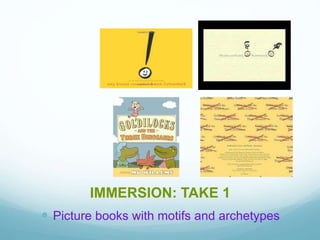
IMMERSION: TAKE 1
 Picture books with motifs and archetypes
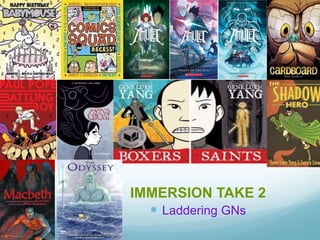
IMMERSION TAKE 2
 Laddering GNs
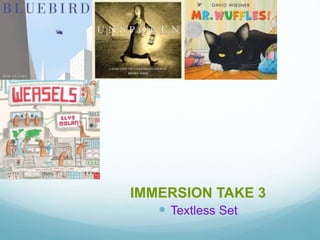
IMMERSION TAKE 3
 Textless Set
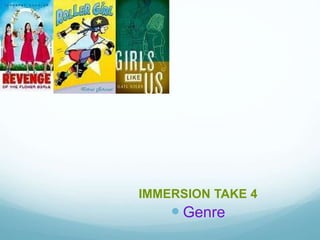
IMMERSION TAKE 4
 Genre
Learners believe that they can achieve
competence (expectation)
Expectations of those to whom learners are
bonded are powerful coercers of learners'
behaviors. "We achieve what we expect to
achieve; we fail if we expect to fail; we are
more likely to engage with demonstrations of
those whom we regard as significant and
who hold high expectations for us.
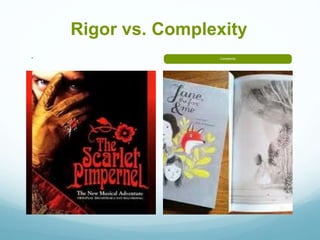
Rigor vs. Complexity
 Rigor Complexity
Complex Texts
 But accessible
Just Right Books
 that are also complex
Learners are able to make decisions about
how much they will attempt (responsibility)
Learners need to make their own
decisions about when, how, and what
"bits" to learn in any learning task.
Learners who lose the ability to make
decisions are disempowered.
 Narrow choices and set some
limits
 Genres
 Award winners
 Forms and formats
How do students learn
responsibility?
Choice
 Booktalks
 Read Alouds
 Displays
 Peer Suggestions
Provide Guidance
Allowing students to choose their
own texts fosters engagement
and increases reading motivation
and interest.
--Gambrell, Coding, & Palmer (1996); Worthy &
McKool (1996); Guthrie & Wigfield (2000)
Differentiation (Tomlinson, 2000)
Content
Process
Product
Learning Environment
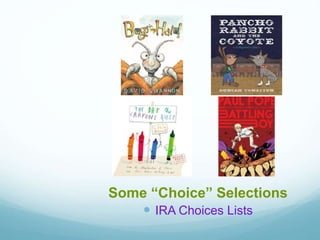
Some “Choice” Selections
 IRA Choices Lists
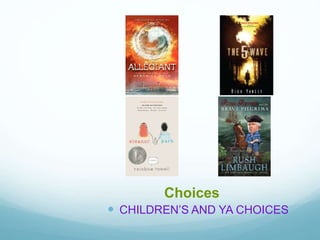
Choices
 CHILDREN’S AND YA CHOICES
T is for TALK
120
Reader's Bill of Rights
By The Readers at Book Chat
Central
There are many versions of the list
below. This one comes from Book
Chat Central. Use what you like,
adapt as you need. Enjoy.
125
1. You have the right to read in exotic settings. You have the
right to move your lips when you read You have the right
to read anything you want.
2. You have the right never to apologize for your reading
tastes.
3. You have the right to read anywhere you want—in the
bathtub, in the car (preferably at stop lights if you're
driving), in the grocery store, under the porch, or while
walking the dog.
4. You have the right to read in bed. Under the covers. With a
flashlight.
5. You have the right to carry books in your briefcase,
luggage, and pocketbook at all times.
126
 . You have the right to laugh or gasp out loud and choose
whether or not to explain.
 You have the right to read the good parts out loud to your
nearest and dearest, and when you're not near your book
bunch, to strangers if desperate.
 You have the right to read and eat at the same time.
 You have the right to read as many books as you want at the
same time.
 You have the right to throw any book on the floor and jump
up and down on it (the Dorothy Parker Rule).
127
 You have the right to ignore the critics at the New York
Review of Books.
 More importantly, you have the right to ignore all critics.
 You have the right to read the book spine of the person
sitting next to you, even on a plane. And if you can't make it
out, you have the right to ASK.
 You have the right to stop reading a book whenever you
decide it's not worth the effort, or that you simply don't like it.
 You have the right to refuse to read any book anyone else
picks out for you. Even if it's a birthday present.
128
 You have the right to read the last chapter first.
 You have the right to read the last chapter first and then put the
book back on the shelf.
 You have the right to refuse to read any book where you don't like
the picture of the author.
 You have the right to ignore all of these rules and do whatever you
please as long as it's civil...hee hee.
 You have the right to buy as many books as you want despite the
size of your TBR stack or what your significant other has to say!!!
 New Rule: when you find that you're dawdling on your way back to
a book, ditch it.
129
130
I Need a Good Book
by Steven Layne
I need a good story,
I need a good book.
The kind that explodes
Off the shelf.
I need some good writing,
Alive and exciting,
To contemplate
All by myself.
131
I need a good novel,
I need a good read,
I probably need
Two or three,
I need a good tale
Of love and betrayal
Or perhaps
An adventure at sea.
132
133
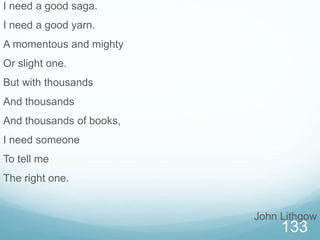
I need a good saga.
I need a good yarn.
A momentous and mighty
Or slight one.
But with thousands
And thousands
And thousands of books,
I need someone
To tell me
The right one.
John Lithgow

Target-ing readers

  • 1.
    TARGET-ing Readers Teri Lesesne rhymeswith insane @professornana
  • 2.
    T-A-R-G-E-T-ing  T isfor trust  A is for access  R is for response  G is for guidance  E is for engagement  T is for talk  ING includes: readING aloud, booktalkING, and more
  • 3.
  • 5.
    How do we… Create those Reading Rambos?  Base our practice on pedagogy?  Differentiate for OUR kids? Let’s start with some research…
  • 6.
    The research?  VickeyGiles, 2003  Karen Sue Gibson, 2002  Replicated study from 20 years earlier, Livaudais  Recent replication, Lesesne, 2011-14  The questions? 6
  • 7.
    What could someonedo to make you WANT to read BEFORE/AFTER you read? The converse: what could someone do to make you HATE to read BEFORE/AFTER you read? 7
  • 8.
    Turn and Talk Predictwhat you think kids in Grades K-12 indicated would motivate them to read.
  • 9.
    What could someonedo to make you want to read BEFORE you read? K-12  Being allowed to choose any book you want to read 9
  • 15.
    What could someonedo to make you want to read BEFORE you read? K-5  Reading in a comfortable place like on the floor, in a bean bag chair, or in a rocking chair 15
  • 21.
    What could someonedo to make you want to read BEFORE you read? K-5  Being allowed to buy your own book through a book fair 21
  • 27.
    What could someonedo to make you want to read BEFORE you read? K-5  Reading books for a contest 27
  • 33.
    What could someonedo to make you want to read BEFORE you read? K-12  Having a classroom library 33
  • 39.
    What could someonedo to make you want to read BEFORE you read? K-12  Having the teacher read a book or chapter a day 39
  • 45.
    What could someonedo to make you want to read BEFORE you read? K-12  Having the teacher take you to the library 45
  • 51.
    What could someonedo to make you want to read BEFORE you read? 6-12  Having the author come to the school 51
  • 52.
    Skype in anauthor  http://www.katemessner.com/authors- who-skype-with-classes-book-clubs-for- free/
  • 53.
    What could someonedo to make you want to read BEFORE you read?  Seeing the movie or television production of a book. 53 6-12
  • 56.
    What could someonedo to make you want to read BEFORE you read? 6-12  Being allowed to read books with lots of pictures in them. 56
  • 59.
    My survey results Show book trailer  Read aloud portions of the text  Give a booktalk  Read aloud entire book  Give students choice of what to read  Create displays  Listen to part of the audiobook  Meet the author  See movie or TV show  Involve social media
  • 60.
    Turn and Talk Whatneeds to be added/removed from the list?
  • 61.
  • 62.
    T A RG E T 62
  • 63.
    T is forTRUST 63
  • 68.
  • 69.
    Turn and Talk Brainstormat least 5 authors for your particular grade levels that you think all of us should know
  • 70.
    A is forACCESS 70
  • 71.
    She walked intomy office on legs as long as one of those long-legged birds that you see in Florida - the pink ones, not the white ones - except that she was standing on both of them, not just one of them, like those birds, the pink ones, and she wasn't wearing pink, but I knew right away that she was trouble, which those birds usually aren't.
  • 72.
    Towards the dragon'slair the fellowship marched -- a noble human prince, a fair elf, a surly dwarf, and a disheveled copyright attorney who was frantically trying to find a way to differentiate this story from "Lord of the Rings."
  • 73.
    On a finesummer morning during the days of the Puritans, the prison door in the small New England town of B----n opened to release a convicted adulteress, the Scarlet Letter A embroidered on her dress, along with the Scarlet Letters B through J, a veritable McGuffey's Reader of Scarlet Letters, one for each little tyke waiting for her at the gate.
  • 75.
     Physical  Intellectual Moral  Emotional Access Points
  • 77.
     At home In the classroom  In the school library  At hand PHYSICAL ACCESS
  • 78.
     Not justlevels and lexiles  Level of abstraction required  Literary elements such as flashback, symbolism, foreshadowing  Themes Intellectual
  • 79.
  • 80.
     EQ  Maturity Response  Triggers Emotional
  • 81.
    R is forRESPONSE 81
  • 82.
    R is forResponse (Rosenblatt) Not just one type Interpretive Personal Critical Evaluative
  • 83.
    Personal/Emotive  WHAT ISYOUR “GUT” TELLING YOU?
  • 84.
    Interpretive  If Iwere the main character…
  • 85.
  • 86.
  • 93.
    G is forGUIDANCE 93
  • 94.
    Reading ladders Begin withwhere they are Build reading experiences slowly Move readers “up” with assistance 94
  • 95.
  • 96.
    E is forENGAGEMENT
  • 97.
  • 98.
    Learners need tobe immersed in text of all kinds.
  • 99.
    Learners’ interests aresparked by what they see and hear so that they want to learn the new skill.
  • 100.
     Genre  Form Format  Length Some Factors to Consider
  • 101.
     Historical Fiction Realistic Fiction  Traditional Literature  Science Fiction and Fantasy Genres
  • 102.
     Picture books Graphic novels  Poetry  Short stories  Drama Forms and Formats
  • 103.
    IMMERSION: TAKE 1 Picture books with motifs and archetypes
  • 104.
    IMMERSION TAKE 2 Laddering GNs
  • 105.
  • 106.
  • 107.
    Learners believe thatthey can achieve competence (expectation)
  • 108.
    Expectations of thoseto whom learners are bonded are powerful coercers of learners' behaviors. "We achieve what we expect to achieve; we fail if we expect to fail; we are more likely to engage with demonstrations of those whom we regard as significant and who hold high expectations for us.
  • 109.
    Rigor vs. Complexity Rigor Complexity
  • 110.
  • 111.
    Just Right Books that are also complex
  • 112.
    Learners are ableto make decisions about how much they will attempt (responsibility)
  • 113.
    Learners need tomake their own decisions about when, how, and what "bits" to learn in any learning task. Learners who lose the ability to make decisions are disempowered.
  • 114.
     Narrow choicesand set some limits  Genres  Award winners  Forms and formats How do students learn responsibility? Choice
  • 115.
     Booktalks  ReadAlouds  Displays  Peer Suggestions Provide Guidance
  • 116.
    Allowing students tochoose their own texts fosters engagement and increases reading motivation and interest. --Gambrell, Coding, & Palmer (1996); Worthy & McKool (1996); Guthrie & Wigfield (2000)
  • 117.
  • 118.
  • 119.
  • 120.
    T is forTALK 120
  • 125.
    Reader's Bill ofRights By The Readers at Book Chat Central There are many versions of the list below. This one comes from Book Chat Central. Use what you like, adapt as you need. Enjoy. 125
  • 126.
    1. You havethe right to read in exotic settings. You have the right to move your lips when you read You have the right to read anything you want. 2. You have the right never to apologize for your reading tastes. 3. You have the right to read anywhere you want—in the bathtub, in the car (preferably at stop lights if you're driving), in the grocery store, under the porch, or while walking the dog. 4. You have the right to read in bed. Under the covers. With a flashlight. 5. You have the right to carry books in your briefcase, luggage, and pocketbook at all times. 126
  • 127.
     . Youhave the right to laugh or gasp out loud and choose whether or not to explain.  You have the right to read the good parts out loud to your nearest and dearest, and when you're not near your book bunch, to strangers if desperate.  You have the right to read and eat at the same time.  You have the right to read as many books as you want at the same time.  You have the right to throw any book on the floor and jump up and down on it (the Dorothy Parker Rule). 127
  • 128.
     You havethe right to ignore the critics at the New York Review of Books.  More importantly, you have the right to ignore all critics.  You have the right to read the book spine of the person sitting next to you, even on a plane. And if you can't make it out, you have the right to ASK.  You have the right to stop reading a book whenever you decide it's not worth the effort, or that you simply don't like it.  You have the right to refuse to read any book anyone else picks out for you. Even if it's a birthday present. 128
  • 129.
     You havethe right to read the last chapter first.  You have the right to read the last chapter first and then put the book back on the shelf.  You have the right to refuse to read any book where you don't like the picture of the author.  You have the right to ignore all of these rules and do whatever you please as long as it's civil...hee hee.  You have the right to buy as many books as you want despite the size of your TBR stack or what your significant other has to say!!!  New Rule: when you find that you're dawdling on your way back to a book, ditch it. 129
  • 130.
  • 131.
    I Need aGood Book by Steven Layne I need a good story, I need a good book. The kind that explodes Off the shelf. I need some good writing, Alive and exciting, To contemplate All by myself. 131
  • 132.
    I need agood novel, I need a good read, I probably need Two or three, I need a good tale Of love and betrayal Or perhaps An adventure at sea. 132
  • 133.
    133 I need agood saga. I need a good yarn. A momentous and mighty Or slight one. But with thousands And thousands And thousands of books, I need someone To tell me The right one. John Lithgow