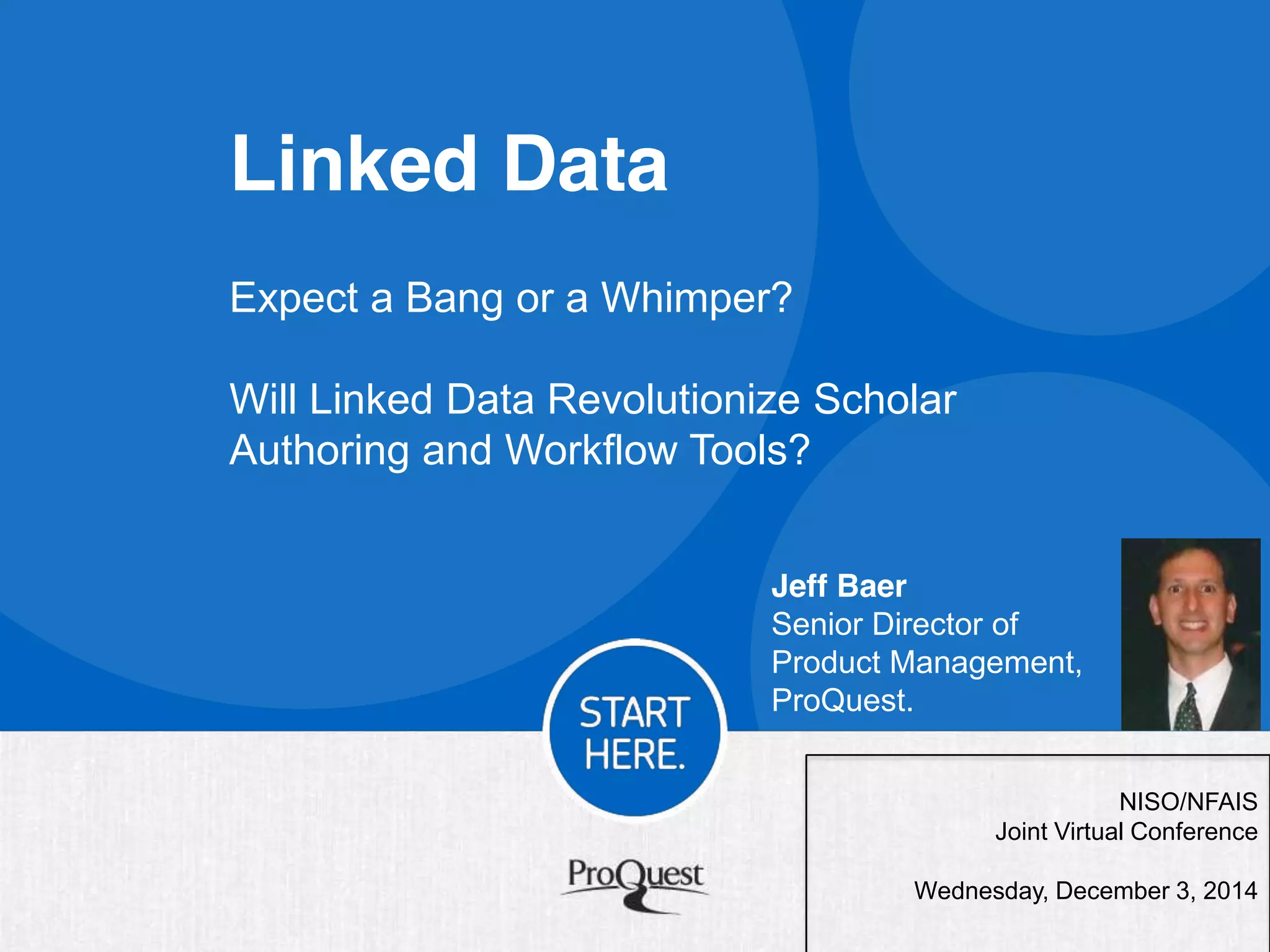
Linked Data 
NISO/NFAIS 
Expect a Bang or a Whimper? 
Will Linked Data Revolutionize Scholar 
Authoring and Workflow Tools? 
Jeff Baer 
Senior Director of 
Product Management, 
ProQuest. 
Joint Virtual Conference 
Wednesday, December 3, 2014
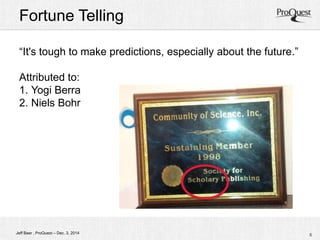
Fortune Telling 
“It's tough to make predictions, especially about the future.” 
Attributed to: 
Jeff Baer , ProQuest – Dec. 3, 2014 2
Fortune Telling 
“It's tough to make predictions, especially about the future.” 
Attributed to: 
1. Yogi Berra 
2. Niels Bohr 
Jeff Baer , ProQuest – Dec. 3, 2014 3
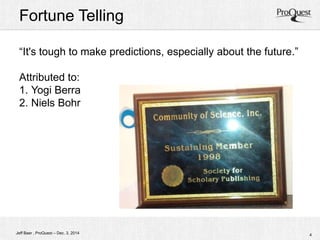
Fortune Telling 
“It's tough to make predictions, especially about the future.” 
Attributed to: 
1. Yogi Berra 
2. Niels Bohr 
Jeff Baer , ProQuest – Dec. 3, 2014 4
Fortune Telling 
“It's tough to make predictions, especially about the future.” 
Attributed to: 
1. Yogi Berra 
2. Niels Bohr 
Jeff Baer , ProQuest – Dec. 3, 2014 5
My Background and Point of View 
6 
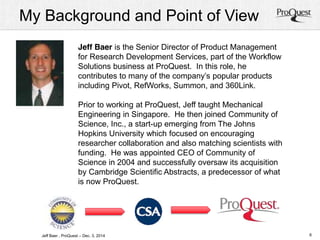
Jeff Baer is the Senior Director of Product Management 
for Research Development Services, part of the Workflow 
Solutions business at ProQuest. In this role, he 
contributes to many of the company’s popular products 
including Pivot, RefWorks, Summon, and 360Link. 
Prior to working at ProQuest, Jeff taught Mechanical 
Engineering in Singapore. He then joined Community of 
Science, Inc., a start-up emerging from The Johns 
Hopkins University which focused on encouraging 
researcher collaboration and also matching scientists with 
funding. He was appointed CEO of Community of 
Science in 2004 and successfully oversaw its acquisition 
by Cambridge Scientific Abstracts, a predecessor of what 
is now ProQuest. 
Jeff Baer , ProQuest – Dec. 3, 2014
My Background and Point of View 
Where I have a lot of experience: 
• Tools designed for the researcher, 
• Research Materials Management 
software, 
• Scholar Profiles, 
• Personalization and Recommendations 
driven by profiles and interests 
Jeff Baer , ProQuest – Dec. 3, 2014 7
My Background and Point of View 
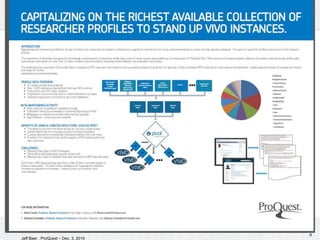
My limited experience with Linked Open Data 
Learn more about VIVO at: 
http://www.vivoweb.org/about 
Jeff Baer , ProQuest – Dec. 3, 2014 8
ProQuest – Jeff Baer Dec. 3, 2014 
9 
Jeff Baer , ProQuest – Dec. 3, 2014
VIVO Progress Report from an Outsider’s perspective 
Attendance, as well as interest levels by additional institutions, 
has not been building as I had hoped. VIVO has essentially 
remained a small club, which limits its appeal and usefulness. 
10 
1) First VIVO conference was held in August, 2010 in New 
York City. 
Most recent conference took place in Austin, Texas in August, 
2014 (co-located with the Science of Team Science 
Conference) 
Jeff Baer , ProQuest – Dec. 3, 2014
VIVO Progress Report from an Outsider’s perspective 
2) Most universities rolling out VIVO are apparently required to 
have dedicated software developers working on the project. 
11 
Thus, most universities participating in the project seem to 
fall under the “ARL” category of institutions or its 
international equivalent. 
Jeff Baer , ProQuest – Dec. 3, 2014
VIVO Progress Report from an Outsider’s perspective 
3) One of the biggest challenges is the manipulation of data in 
and out of the RDF triple format. 
12 
Jeff Baer , ProQuest – Dec. 3, 2014
VIVO Progress Report from an Outsider’s perspective 
13 
4) Regarding Data manipulation. One example  a prior 
presentation (presented in at the May, 2014 ORCID outreach 
meeting) by VIVO team members from Cornell indicated that 
ORCIDVIVO data sharing had been accomplished. 
(http://www.slideshare.net/simeonwarner/orcidvivo-integrationcornellvivo- 
Jeff Baer , ProQuest – Dec. 3, 2014 
update-on-orcid-adoption-and-integration) 
However, at the subsequent and most recent VIVO annual 
conference, questions lingered as to if the problem of data 
transfer had been fully solved. 
The main issue: who would be responsible for building and 
maintaining the VIVO to ORCID mapping and code libraries?
VIVO Progress Report from an Outsider’s perspective 
14 
5) Conversations with VIVO conference attendees revealed 
that, due to these data manipulation challenges, a significant 
portion (a majority?) of the institutions in attendance have 
chosen to stand up another specialized profile solution or a 
traditional, generic database system alongside their VIVO 
instance. 
Jeff Baer , ProQuest – Dec. 3, 2014
VIVO Progress Report from an Outsider’s perspective 
15 
6) A new organizational structure for VIVO project may begin 
to address the aforementioned issues 
Jeff Baer , ProQuest – Dec. 3, 2014
VIVO Progress Report from an Outsider’s perspective 
• Can we maintain the fiscal sustainability of the project? 
• Will the profile data update path become a problem? In 
other words, can users and information systems juggle 
ORCID, VIVO, ScienCV, and other systems simultaneously? 
Or, will we reach a “profile data circular firing squad”, where 
systems overwrite one another in a way that is unhelpful to 
the researchers and data quality? 
16 
7) Open questions to be answered by VIVO: 
• Will the privacy and security of contact information data be 
tested by “bad actors”? 
Jeff Baer , ProQuest – Dec. 3, 2014
Possible Conclusions from the VIVO example 
The lesson from VIVO? 
• Linked Open Data is a fantastic vehicle to facilitate the 
discovery of information, but its added complexities result in 
it being a poor choice for a data management solution. 
• Will VIVO become solely an export format, one optimized 
for discovery and linking? In retrospect, should the software 
system and open linked data profile format have been 
separately named to prevent misunderstandings and better 
adoption? 
17 
Jeff Baer , ProQuest – Dec. 3, 2014
Possible Conclusions from the VIVO example 
18 
The Good News: 
“hybrid” VIVO and non-Linked Data Software Solutions were 
beginning to emerge. Many of these were in fact generating 
VIVO data as an export format, specifically for the discovery 
aspects and benefits which VIVO brings to the table. 
Jeff Baer , ProQuest – Dec. 3, 2014
linked data vs. Linked data 
19 
Jeff Baer , ProQuest – Dec. 3, 2014
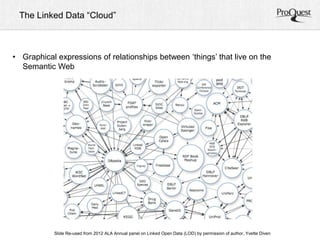
The Linked Data “Cloud” 
• Graphical expressions of relationships between ‘things’ that live on the 
Semantic Web 
Slide Re-used from 2012 ALA Annual panel on Linked Open Data (LOD) by permission of author, Yvette Diven
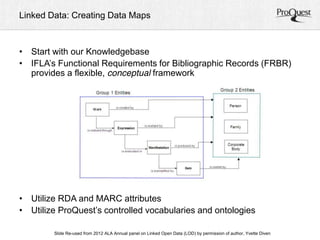
Linked Data: Creating Data Maps 
• Start with our Knowledgebase 
• IFLA’s Functional Requirements for Bibliographic Records (FRBR) 
provides a flexible, conceptual framework 
• Utilize RDA and MARC attributes 
• Utilize ProQuest’s controlled vocabularies and ontologies 
Slide Re-used from 2012 ALA Annual panel on Linked Open Data (LOD) by permission of author, Yvette Diven
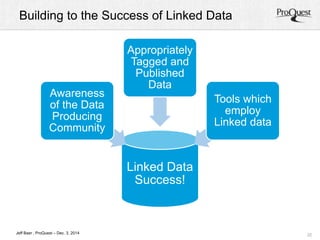
Building to the Success of Linked Data 
Linked Data 
Success! 
Awareness 
of the Data 
Producing 
Community 
Appropriately 
Tagged and 
Published 
Data 
Tools which 
employ 
Linked data 
22 
Jeff Baer , ProQuest – Dec. 3, 2014
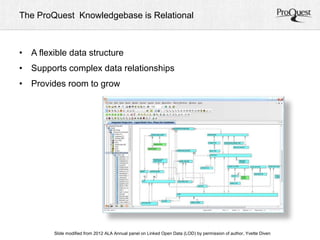
The ProQuest Knowledgebase is Relational 
• A flexible data structure 
• Supports complex data relationships 
• Provides room to grow 
Slide modified from 2012 ALA Annual panel on Linked Open Data (LOD) by permission of author, Yvette Diven
Linked Data: Authority Matters 
• Librarians care about 
– Trust/authority 
– Quality 
– Privacy 
ALA Slide Re-used from 2012 ALA Annual panel on Linked Open Data (LOD) by permission of a uAtnhonru, aYlv Cetoten fDeirveennc e, June 23, 2012
Knowledgebase Roadmap 
• Published ‘Linked Open Data’ 
– Knowledgebase data as RDF/RDF ‘triples’ to support a growing 
number of new access points 
• Suggested by our customers 
– Open Access journal metadata enriched by ProQuest 
– Discovery ‘maps’ incorporated into our web-scale solutions 
Slide Re-used from 2012 ALA Annual panel on Linked Open Data (LOD) by permission of author, Yvette Diven
Linked Data in Research Materials Management Tools 
• A quick survey of support of the most popular tools: 
• Zotero  
ALA Slide Re-used from 2012 ALA Annual panel on Linked Open Data (LOD) by permission of a uAtnhonru, aYlv Cetoten fDeirveennc e, June 23, 2012
Linked Data in Research Materials Management Tools 
• A quick survey of support of the most popular tools: 
• Zotero  Zotero data is stored in RDF triples. 
ALA Slide Re-used from 2012 ALA Annual panel on Linked Open Data (LOD) by permission of a uAtnhonru, aYlv Cetoten fDeirveennc e, June 23, 2012
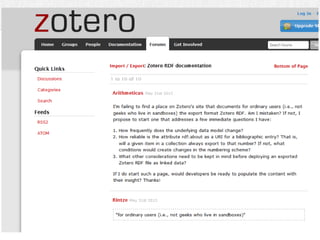
Linked Data in Research manager Tools 
ALA Annual Conference, June 23, 2012
Linked Data in Research Materials Management Tools 
• A quick survey of support of the most popular tools: 
• Zotero  Zotero data is stored in RDF triples. 
ALA Slide Re-used from 2012 ALA Annual panel on Linked Open Data (LOD) by permission of a uAtnhonru, aYlv Cetoten fDeirveennc e, June 23, 2012
Linked Data in Research Materials Management Tools 
• A quick survey of support of the most popular tools: 
• Zotero  Zotero data is stored in RDF triples. 
• Mendeley  
ALA Slide Re-used from 2012 ALA Annual panel on Linked Open Data (LOD) by permission of a uAtnhonru, aYlv Cetoten fDeirveennc e, June 23, 2012
Linked Data in Research Materials Management Tools 
• A quick survey of support of the most popular tools: 
• Zotero  Zotero data is stored in RDF triples. 
• Mendeley  Active in the CODE project: 
• Commercially Empowered Linked Open Data Ecosystems in 
Research (http://code-research.eu/) 
ALA Slide Re-used from 2012 ALA Annual panel on Linked Open Data (LOD) by permission of a uAtnhonru, aYlv Cetoten fDeirveennc e, June 23, 2012
Linked Data in Research Materials Management Tools 
• A quick survey of support of the most popular tools: 
• Zotero  Zotero data is stored in RDF triples. 
• Mendeley  Active in the CODE project: 
• Commercially Empowered Linked Open Data Ecosystems in 
Research (http://code-research.eu/) 
• RefWorks  ProQuest’s RefWorks team reports little interest or 
awareness by our end-users of Linked Data and its possible 
importance. 
ALA Slide Re-used from 2012 ALA Annual panel on Linked Open Data (LOD) by permission of a uAtnhonru, aYlv Cetoten fDeirveennc e, June 23, 2012
Additional Thoughts 
33 
1) Greater Awareness of Linked Data within the research 
community, not the librarian community, needs to be a 
priority 
Jeff Baer , ProQuest – Dec. 3, 2014
Additional Thoughts 
2) Recognition of the value of data curation should be a central 
tenet (The Wikipedia Example) 
34 
Jeff Baer , ProQuest – Dec. 3, 2014
Additional Thoughts 
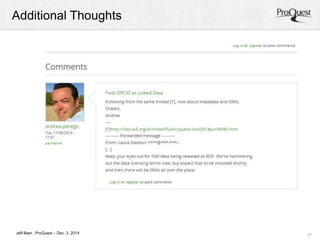
3) Online engagement is closely linked to personalization, and 
data drives personalization. ORCID is working on this 
challenge 
35 
Jeff Baer , ProQuest – Dec. 3, 2014
Additional Thoughts 
36 
Jeff Baer , ProQuest – Dec. 3, 2014
Additional Thoughts 
37 
Jeff Baer , ProQuest – Dec. 3, 2014
38 
Jeff Baer , ProQuest – Dec. 3, 2014
Final Conclusions 
Our patience will be rewarded. We are making progress. It 
will be a long build-up, perhaps another 5-10 years, before the 
possibilities and financial models of Linked Data come to the 
foreground. This revolution will arrive slowly. 
39 
Researcher tools for creating and storing data, such as the 
new generation of electronic lab notebooks (ELN’s) should 
feature systems to store and publish their data in Linked data 
formats. 
Jeff Baer , ProQuest – Dec. 3, 2014
Thank You! 
40 
Jeff Baer , ProQuest – Dec. 3, 2014 
Jeff Baer 
Senior Director of 
Product Management, 
ProQuest. 
Jeff.baer@proquest.com 
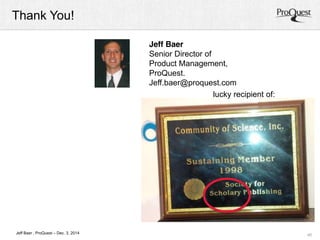
lucky recipient of:

NISO/NFAIS Joint Virtual Conference: Connecting the Library to the Wider World: Successful Applications of Linked Data

  • 1.
    Linked Data NISO/NFAIS Expect a Bang or a Whimper? Will Linked Data Revolutionize Scholar Authoring and Workflow Tools? Jeff Baer Senior Director of Product Management, ProQuest. Joint Virtual Conference Wednesday, December 3, 2014
  • 2.
    Fortune Telling “It'stough to make predictions, especially about the future.” Attributed to: Jeff Baer , ProQuest – Dec. 3, 2014 2
  • 3.
    Fortune Telling “It'stough to make predictions, especially about the future.” Attributed to: 1. Yogi Berra 2. Niels Bohr Jeff Baer , ProQuest – Dec. 3, 2014 3
  • 4.
    Fortune Telling “It'stough to make predictions, especially about the future.” Attributed to: 1. Yogi Berra 2. Niels Bohr Jeff Baer , ProQuest – Dec. 3, 2014 4
  • 5.
    Fortune Telling “It'stough to make predictions, especially about the future.” Attributed to: 1. Yogi Berra 2. Niels Bohr Jeff Baer , ProQuest – Dec. 3, 2014 5
  • 6.
    My Background andPoint of View 6 Jeff Baer is the Senior Director of Product Management for Research Development Services, part of the Workflow Solutions business at ProQuest. In this role, he contributes to many of the company’s popular products including Pivot, RefWorks, Summon, and 360Link. Prior to working at ProQuest, Jeff taught Mechanical Engineering in Singapore. He then joined Community of Science, Inc., a start-up emerging from The Johns Hopkins University which focused on encouraging researcher collaboration and also matching scientists with funding. He was appointed CEO of Community of Science in 2004 and successfully oversaw its acquisition by Cambridge Scientific Abstracts, a predecessor of what is now ProQuest. Jeff Baer , ProQuest – Dec. 3, 2014
  • 7.
    My Background andPoint of View Where I have a lot of experience: • Tools designed for the researcher, • Research Materials Management software, • Scholar Profiles, • Personalization and Recommendations driven by profiles and interests Jeff Baer , ProQuest – Dec. 3, 2014 7
  • 8.
    My Background andPoint of View My limited experience with Linked Open Data Learn more about VIVO at: http://www.vivoweb.org/about Jeff Baer , ProQuest – Dec. 3, 2014 8
  • 9.
    ProQuest – JeffBaer Dec. 3, 2014 9 Jeff Baer , ProQuest – Dec. 3, 2014
  • 10.
    VIVO Progress Reportfrom an Outsider’s perspective Attendance, as well as interest levels by additional institutions, has not been building as I had hoped. VIVO has essentially remained a small club, which limits its appeal and usefulness. 10 1) First VIVO conference was held in August, 2010 in New York City. Most recent conference took place in Austin, Texas in August, 2014 (co-located with the Science of Team Science Conference) Jeff Baer , ProQuest – Dec. 3, 2014
  • 11.
    VIVO Progress Reportfrom an Outsider’s perspective 2) Most universities rolling out VIVO are apparently required to have dedicated software developers working on the project. 11 Thus, most universities participating in the project seem to fall under the “ARL” category of institutions or its international equivalent. Jeff Baer , ProQuest – Dec. 3, 2014
  • 12.
    VIVO Progress Reportfrom an Outsider’s perspective 3) One of the biggest challenges is the manipulation of data in and out of the RDF triple format. 12 Jeff Baer , ProQuest – Dec. 3, 2014
  • 13.
    VIVO Progress Reportfrom an Outsider’s perspective 13 4) Regarding Data manipulation. One example  a prior presentation (presented in at the May, 2014 ORCID outreach meeting) by VIVO team members from Cornell indicated that ORCIDVIVO data sharing had been accomplished. (http://www.slideshare.net/simeonwarner/orcidvivo-integrationcornellvivo- Jeff Baer , ProQuest – Dec. 3, 2014 update-on-orcid-adoption-and-integration) However, at the subsequent and most recent VIVO annual conference, questions lingered as to if the problem of data transfer had been fully solved. The main issue: who would be responsible for building and maintaining the VIVO to ORCID mapping and code libraries?
  • 14.
    VIVO Progress Reportfrom an Outsider’s perspective 14 5) Conversations with VIVO conference attendees revealed that, due to these data manipulation challenges, a significant portion (a majority?) of the institutions in attendance have chosen to stand up another specialized profile solution or a traditional, generic database system alongside their VIVO instance. Jeff Baer , ProQuest – Dec. 3, 2014
  • 15.
    VIVO Progress Reportfrom an Outsider’s perspective 15 6) A new organizational structure for VIVO project may begin to address the aforementioned issues Jeff Baer , ProQuest – Dec. 3, 2014
  • 16.
    VIVO Progress Reportfrom an Outsider’s perspective • Can we maintain the fiscal sustainability of the project? • Will the profile data update path become a problem? In other words, can users and information systems juggle ORCID, VIVO, ScienCV, and other systems simultaneously? Or, will we reach a “profile data circular firing squad”, where systems overwrite one another in a way that is unhelpful to the researchers and data quality? 16 7) Open questions to be answered by VIVO: • Will the privacy and security of contact information data be tested by “bad actors”? Jeff Baer , ProQuest – Dec. 3, 2014
  • 17.
    Possible Conclusions fromthe VIVO example The lesson from VIVO? • Linked Open Data is a fantastic vehicle to facilitate the discovery of information, but its added complexities result in it being a poor choice for a data management solution. • Will VIVO become solely an export format, one optimized for discovery and linking? In retrospect, should the software system and open linked data profile format have been separately named to prevent misunderstandings and better adoption? 17 Jeff Baer , ProQuest – Dec. 3, 2014
  • 18.
    Possible Conclusions fromthe VIVO example 18 The Good News: “hybrid” VIVO and non-Linked Data Software Solutions were beginning to emerge. Many of these were in fact generating VIVO data as an export format, specifically for the discovery aspects and benefits which VIVO brings to the table. Jeff Baer , ProQuest – Dec. 3, 2014
  • 19.
    linked data vs.Linked data 19 Jeff Baer , ProQuest – Dec. 3, 2014
  • 20.
    The Linked Data“Cloud” • Graphical expressions of relationships between ‘things’ that live on the Semantic Web Slide Re-used from 2012 ALA Annual panel on Linked Open Data (LOD) by permission of author, Yvette Diven
  • 21.
    Linked Data: CreatingData Maps • Start with our Knowledgebase • IFLA’s Functional Requirements for Bibliographic Records (FRBR) provides a flexible, conceptual framework • Utilize RDA and MARC attributes • Utilize ProQuest’s controlled vocabularies and ontologies Slide Re-used from 2012 ALA Annual panel on Linked Open Data (LOD) by permission of author, Yvette Diven
  • 22.
    Building to theSuccess of Linked Data Linked Data Success! Awareness of the Data Producing Community Appropriately Tagged and Published Data Tools which employ Linked data 22 Jeff Baer , ProQuest – Dec. 3, 2014
  • 23.
    The ProQuest Knowledgebaseis Relational • A flexible data structure • Supports complex data relationships • Provides room to grow Slide modified from 2012 ALA Annual panel on Linked Open Data (LOD) by permission of author, Yvette Diven
  • 24.
    Linked Data: AuthorityMatters • Librarians care about – Trust/authority – Quality – Privacy ALA Slide Re-used from 2012 ALA Annual panel on Linked Open Data (LOD) by permission of a uAtnhonru, aYlv Cetoten fDeirveennc e, June 23, 2012
  • 25.
    Knowledgebase Roadmap •Published ‘Linked Open Data’ – Knowledgebase data as RDF/RDF ‘triples’ to support a growing number of new access points • Suggested by our customers – Open Access journal metadata enriched by ProQuest – Discovery ‘maps’ incorporated into our web-scale solutions Slide Re-used from 2012 ALA Annual panel on Linked Open Data (LOD) by permission of author, Yvette Diven
  • 26.
    Linked Data inResearch Materials Management Tools • A quick survey of support of the most popular tools: • Zotero  ALA Slide Re-used from 2012 ALA Annual panel on Linked Open Data (LOD) by permission of a uAtnhonru, aYlv Cetoten fDeirveennc e, June 23, 2012
  • 27.
    Linked Data inResearch Materials Management Tools • A quick survey of support of the most popular tools: • Zotero  Zotero data is stored in RDF triples. ALA Slide Re-used from 2012 ALA Annual panel on Linked Open Data (LOD) by permission of a uAtnhonru, aYlv Cetoten fDeirveennc e, June 23, 2012
  • 28.
    Linked Data inResearch manager Tools ALA Annual Conference, June 23, 2012
  • 29.
    Linked Data inResearch Materials Management Tools • A quick survey of support of the most popular tools: • Zotero  Zotero data is stored in RDF triples. ALA Slide Re-used from 2012 ALA Annual panel on Linked Open Data (LOD) by permission of a uAtnhonru, aYlv Cetoten fDeirveennc e, June 23, 2012
  • 30.
    Linked Data inResearch Materials Management Tools • A quick survey of support of the most popular tools: • Zotero  Zotero data is stored in RDF triples. • Mendeley  ALA Slide Re-used from 2012 ALA Annual panel on Linked Open Data (LOD) by permission of a uAtnhonru, aYlv Cetoten fDeirveennc e, June 23, 2012
  • 31.
    Linked Data inResearch Materials Management Tools • A quick survey of support of the most popular tools: • Zotero  Zotero data is stored in RDF triples. • Mendeley  Active in the CODE project: • Commercially Empowered Linked Open Data Ecosystems in Research (http://code-research.eu/) ALA Slide Re-used from 2012 ALA Annual panel on Linked Open Data (LOD) by permission of a uAtnhonru, aYlv Cetoten fDeirveennc e, June 23, 2012
  • 32.
    Linked Data inResearch Materials Management Tools • A quick survey of support of the most popular tools: • Zotero  Zotero data is stored in RDF triples. • Mendeley  Active in the CODE project: • Commercially Empowered Linked Open Data Ecosystems in Research (http://code-research.eu/) • RefWorks  ProQuest’s RefWorks team reports little interest or awareness by our end-users of Linked Data and its possible importance. ALA Slide Re-used from 2012 ALA Annual panel on Linked Open Data (LOD) by permission of a uAtnhonru, aYlv Cetoten fDeirveennc e, June 23, 2012
  • 33.
    Additional Thoughts 33 1) Greater Awareness of Linked Data within the research community, not the librarian community, needs to be a priority Jeff Baer , ProQuest – Dec. 3, 2014
  • 34.
    Additional Thoughts 2)Recognition of the value of data curation should be a central tenet (The Wikipedia Example) 34 Jeff Baer , ProQuest – Dec. 3, 2014
  • 35.
    Additional Thoughts 3)Online engagement is closely linked to personalization, and data drives personalization. ORCID is working on this challenge 35 Jeff Baer , ProQuest – Dec. 3, 2014
  • 36.
    Additional Thoughts 36 Jeff Baer , ProQuest – Dec. 3, 2014
  • 37.
    Additional Thoughts 37 Jeff Baer , ProQuest – Dec. 3, 2014
  • 38.
    38 Jeff Baer, ProQuest – Dec. 3, 2014
  • 39.
    Final Conclusions Ourpatience will be rewarded. We are making progress. It will be a long build-up, perhaps another 5-10 years, before the possibilities and financial models of Linked Data come to the foreground. This revolution will arrive slowly. 39 Researcher tools for creating and storing data, such as the new generation of electronic lab notebooks (ELN’s) should feature systems to store and publish their data in Linked data formats. Jeff Baer , ProQuest – Dec. 3, 2014
  • 40.
    Thank You! 40 Jeff Baer , ProQuest – Dec. 3, 2014 Jeff Baer Senior Director of Product Management, ProQuest. Jeff.baer@proquest.com lucky recipient of: