How does your
media product
represent
particular social
groups?
My target audience and aimed social
group is people who enjoy pop music,
tweens and young teens within the E
demographic.
These are also the people who will
buy pop music magazines as they are
able to relate to the artist.
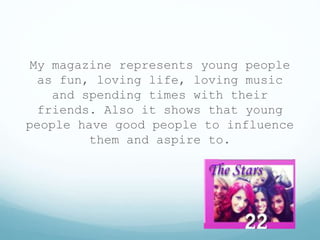
My magazine represents young people
as fun, loving life, loving music
and spending times with their
friends. Also it shows that young
people have good people to influence
them and aspire to.
Images and colour
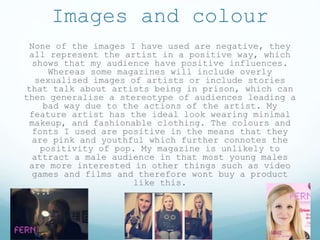
None of the images I have used are negative, they
all represent the artist in a positive way, which
shows that my audience have positive influences.
Whereas some magazines will include overly
sexualised images of artists or include stories
that talk about artists being in prison, which can
then generalise a stereotype of audiences leading a
bad way due to the actions of the artist. My
feature artist has the ideal look wearing minimal
makeup, and fashionable clothing. The colours and
fonts I used are positive in the means that they
are pink and youthful which further connotes the
positivity of pop. My magazine is unlikely to
attract a male audience in that most young males
are more interested in other things such as video
games and films and therefore wont buy a product
like this.
When thinking of my magazine and social
groups, pop in general will attract fan
girls, girlie girls and I feel my magazine
does portray this through the colour scheme
and what the magazine entails as you can
see on the contents page, there is a quiz
and certain feature stories will attract
the younger audiences as they will be
interested, whereas others wouldn’t.
Feature story
The advertisement and content of my feature story
represents my audience as willing, empowered and
self believing. Often most pop magazines will focus
on more gossip based stories, I have adhered to
that convention within my contents page as it
features both light reading articles, quizzes and a
poster special which is also reflective of my
audience as a stereotype many young girls are known
to adhere to a young teen girl culture, in which
they have lots of posters around their rooms and
are very much involved with what would be in a
magazine. Also the story I used is more likely to
appeal to a female audience as girls are most
commonly interested in heart felt stories.
When thinking about pop representation in my
research, I decided to use clean images, giving the
magazine artist a good representation, further
portraying her as a good role model, as young
people are very impressionable and will look up to
the artists and want to be like them. This way the
audience can feel comfortable with the images as
they have similar interests and styles so can
easily relate.
If my magazine was full of dark colours and old pop
artists such as Madonna, no one from my expected
target audience would buy it as they can’t relate,
therefore I used a young pretty artist.
Price
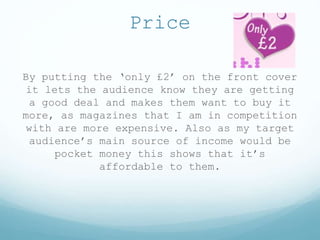
By putting the ‘only £2’ on the front cover
it lets the audience know they are getting
a good deal and makes them want to buy it
more, as magazines that I am in competition
with are more expensive. Also as my target
audience’s main source of income would be
pocket money this shows that it’s
affordable to them.
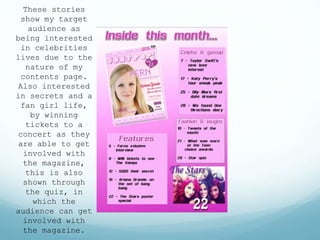
These stories
show my target
audience as
being interested
in celebrities
lives due to the
nature of my
contents page.
Also interested
in secrets and a
fan girl life,
by winning
tickets to a
concert as they
are able to get
involved with
the magazine,
this is also
shown through
the quiz, in
which the
audience can get
involved with
the magazine.

Question 2

  • 1.
    How does your mediaproduct represent particular social groups?
  • 2.
    My target audienceand aimed social group is people who enjoy pop music, tweens and young teens within the E demographic. These are also the people who will buy pop music magazines as they are able to relate to the artist.
  • 3.
    My magazine representsyoung people as fun, loving life, loving music and spending times with their friends. Also it shows that young people have good people to influence them and aspire to.
  • 4.
    Images and colour Noneof the images I have used are negative, they all represent the artist in a positive way, which shows that my audience have positive influences. Whereas some magazines will include overly sexualised images of artists or include stories that talk about artists being in prison, which can then generalise a stereotype of audiences leading a bad way due to the actions of the artist. My feature artist has the ideal look wearing minimal makeup, and fashionable clothing. The colours and fonts I used are positive in the means that they are pink and youthful which further connotes the positivity of pop. My magazine is unlikely to attract a male audience in that most young males are more interested in other things such as video games and films and therefore wont buy a product like this.
  • 5.
    When thinking ofmy magazine and social groups, pop in general will attract fan girls, girlie girls and I feel my magazine does portray this through the colour scheme and what the magazine entails as you can see on the contents page, there is a quiz and certain feature stories will attract the younger audiences as they will be interested, whereas others wouldn’t.
  • 6.
    Feature story The advertisementand content of my feature story represents my audience as willing, empowered and self believing. Often most pop magazines will focus on more gossip based stories, I have adhered to that convention within my contents page as it features both light reading articles, quizzes and a poster special which is also reflective of my audience as a stereotype many young girls are known to adhere to a young teen girl culture, in which they have lots of posters around their rooms and are very much involved with what would be in a magazine. Also the story I used is more likely to appeal to a female audience as girls are most commonly interested in heart felt stories.
  • 7.
    When thinking aboutpop representation in my research, I decided to use clean images, giving the magazine artist a good representation, further portraying her as a good role model, as young people are very impressionable and will look up to the artists and want to be like them. This way the audience can feel comfortable with the images as they have similar interests and styles so can easily relate. If my magazine was full of dark colours and old pop artists such as Madonna, no one from my expected target audience would buy it as they can’t relate, therefore I used a young pretty artist.
  • 8.
    Price By putting the‘only £2’ on the front cover it lets the audience know they are getting a good deal and makes them want to buy it more, as magazines that I am in competition with are more expensive. Also as my target audience’s main source of income would be pocket money this shows that it’s affordable to them.
  • 9.
    These stories show mytarget audience as being interested in celebrities lives due to the nature of my contents page. Also interested in secrets and a fan girl life, by winning tickets to a concert as they are able to get involved with the magazine, this is also shown through the quiz, in which the audience can get involved with the magazine.