Question 2
HOW DOES YOUR MEDIA
PRODUCT REPRESENT
PARTICULAR SOCIAL
GROUPS?
AGE
My media product mainly represents teenagers in an optimistic
and positive way. My photos of Hannah are a representation of
my target audience of teenagers (aged 12 to 18) and so in my
chosen photographs, she is looking happy by smiling and posing
in fun ways to create cheery connotations. Also, in the double
page spread, she is presented as chatty and bubbly in the
interview and so another positive connotation is displayed.
Her outfit choices are also essential in creating a representation
of my target audience; she is wearing trendy and stylish clothing
to portray how teenagers are fashionable and like to follow
trends when it comes to fashion. Her outfit may also act as an
inspiration to my teenage readers because they may like her
outfit and decide to buy a similar outfit. Additionally, the text
“It’s just that I literally do not care at all” can be seen on her
shirt, which creates another representation of teenagers
because they are stereotypically seen as carefree because of
their youth and so creates a hedonistic representation. However,
this could be seen as a negative stereotype because it portrays
how teenagers are careless and reckless. This is further
enforced in the double page spread as the interview talks about
her new single, which is called careless.
Moreover, the fact that Hannah’s Instagram is advertised in my double page
spread presents the stereotype of teenagers being obsessed with technology as it
reveals how Hannah likes to use social media to document her life. Also, the fact
that her social media is advertised to persuade readers to follow her account
reinforces this stereotype because it has been placed there to appeal to the
target audience, who presumably use social media a lot.
AGE (CONTINUED)
GENDER
My media product represents females in a variety of ways; it also creates a
representation of my target audience as my primary audience is teenage girls.
All of my photos in my magazine contain females, whilst the presence of males
are non-existent in the photos, suggesting how females are more significant in
the pop industry. The main image on my front cover shows Hannah posing with a
hand on her hip with a slightly low angle used on her – this suggests a sense of
power in society as Hannah is a popstar in my magazine and so may hold more
power; it also connotes girl power, which goes against the idea of a patriarchal
society, which is typically the ideology represented in the media. In addition,
image manipulation has been used on Hannah to highlight her beauty, which
enforces the male gaze. Furthermore, in the double page spread, Hannah is
asked about her love life, which conveys the representation of females being part
of a relationship as opposed to independence and freedom.
As for Martyna, her photos create a representation of females through the way
she is posing as it helps represent her as glamorous. On the front cover, a
secondary image of her is used and she is posing in a neutral yet glamourous
way to highlight beauty within females – this reinforces how females are typically
used for the male gaze in the media and so are made to pose in ways that
highlight their beauty in order to appeal to them.
Representations of sexuality in my media product follow the dominant ideologies
– heterosexuality is the main sexuality portrayed in my magazine. In my double
page spread, Hannah is asked about her love life and she replies with “I want to
focus on my career before boys start messing with my head”. This presents her
heterosexuality and also goes against gender stereotypes, as she is represented
as independent and career-driven, which are typically stereotypes associated with
males. This goes against the stereotypes represented in TV dramas; in Waterloo
Road, the females are represented as dependent on the males as they constantly
need saving whenever there is a crisis.
Heterosexual relationships are also portrayed in the contents page, where the
cover line “Liam and Cheryl – Yay or nay?” is used, therefore reinforcing the
dominant ideology of heterosexuality being the norm.
SEXUALITY (+ GENDER)
Diversity in ethnicity isn’t portrayed within my magazine, as both of my models
are white. This lack of diversity represents the dominant ideology in the media as
typically white people are the main protagonists of TV dramas. For example, all
of the doctors (the main protagonist) in Doctor Who have all been white,
therefore showing the unequal representation of ethnicity in TV dramas.
Existing pop magazines predominantly consists of white people and so I am
following the forms and conventions of pop magazines.
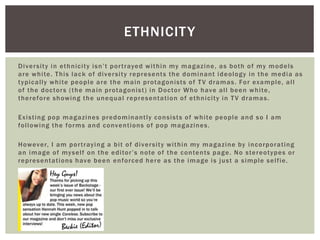
However, I am portraying a bit of diversity within my magazine by incorporating
an image of myself on the editor’s note of the contents page. No stereotypes or
representations have been enforced here as the image is just a simple selfie.
ETHNICITY

Question 2

  • 1.
    Question 2 HOW DOESYOUR MEDIA PRODUCT REPRESENT PARTICULAR SOCIAL GROUPS?
  • 2.
    AGE My media productmainly represents teenagers in an optimistic and positive way. My photos of Hannah are a representation of my target audience of teenagers (aged 12 to 18) and so in my chosen photographs, she is looking happy by smiling and posing in fun ways to create cheery connotations. Also, in the double page spread, she is presented as chatty and bubbly in the interview and so another positive connotation is displayed. Her outfit choices are also essential in creating a representation of my target audience; she is wearing trendy and stylish clothing to portray how teenagers are fashionable and like to follow trends when it comes to fashion. Her outfit may also act as an inspiration to my teenage readers because they may like her outfit and decide to buy a similar outfit. Additionally, the text “It’s just that I literally do not care at all” can be seen on her shirt, which creates another representation of teenagers because they are stereotypically seen as carefree because of their youth and so creates a hedonistic representation. However, this could be seen as a negative stereotype because it portrays how teenagers are careless and reckless. This is further enforced in the double page spread as the interview talks about her new single, which is called careless.
  • 3.
    Moreover, the factthat Hannah’s Instagram is advertised in my double page spread presents the stereotype of teenagers being obsessed with technology as it reveals how Hannah likes to use social media to document her life. Also, the fact that her social media is advertised to persuade readers to follow her account reinforces this stereotype because it has been placed there to appeal to the target audience, who presumably use social media a lot. AGE (CONTINUED)
  • 4.
    GENDER My media productrepresents females in a variety of ways; it also creates a representation of my target audience as my primary audience is teenage girls. All of my photos in my magazine contain females, whilst the presence of males are non-existent in the photos, suggesting how females are more significant in the pop industry. The main image on my front cover shows Hannah posing with a hand on her hip with a slightly low angle used on her – this suggests a sense of power in society as Hannah is a popstar in my magazine and so may hold more power; it also connotes girl power, which goes against the idea of a patriarchal society, which is typically the ideology represented in the media. In addition, image manipulation has been used on Hannah to highlight her beauty, which enforces the male gaze. Furthermore, in the double page spread, Hannah is asked about her love life, which conveys the representation of females being part of a relationship as opposed to independence and freedom. As for Martyna, her photos create a representation of females through the way she is posing as it helps represent her as glamorous. On the front cover, a secondary image of her is used and she is posing in a neutral yet glamourous way to highlight beauty within females – this reinforces how females are typically used for the male gaze in the media and so are made to pose in ways that highlight their beauty in order to appeal to them.
  • 5.
    Representations of sexualityin my media product follow the dominant ideologies – heterosexuality is the main sexuality portrayed in my magazine. In my double page spread, Hannah is asked about her love life and she replies with “I want to focus on my career before boys start messing with my head”. This presents her heterosexuality and also goes against gender stereotypes, as she is represented as independent and career-driven, which are typically stereotypes associated with males. This goes against the stereotypes represented in TV dramas; in Waterloo Road, the females are represented as dependent on the males as they constantly need saving whenever there is a crisis. Heterosexual relationships are also portrayed in the contents page, where the cover line “Liam and Cheryl – Yay or nay?” is used, therefore reinforcing the dominant ideology of heterosexuality being the norm. SEXUALITY (+ GENDER)
  • 6.
    Diversity in ethnicityisn’t portrayed within my magazine, as both of my models are white. This lack of diversity represents the dominant ideology in the media as typically white people are the main protagonists of TV dramas. For example, all of the doctors (the main protagonist) in Doctor Who have all been white, therefore showing the unequal representation of ethnicity in TV dramas. Existing pop magazines predominantly consists of white people and so I am following the forms and conventions of pop magazines. However, I am portraying a bit of diversity within my magazine by incorporating an image of myself on the editor’s note of the contents page. No stereotypes or representations have been enforced here as the image is just a simple selfie. ETHNICITY