Evaluation
Rebecca Hallissey
The Brief

Our main task given in the beginning of the A2
Media Studies course was to create the opening
5 minutes for a television documentary. We
were also told to construct a radio trailer and a
double page spread for a TV listings magazine to
help advertise our documentary to the target
audience. We started this task by researching
existing television documentaries to see what
sort of things the target audience liked.
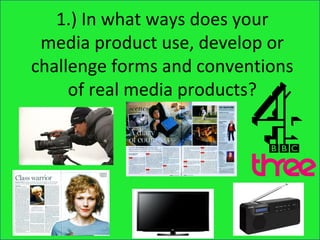
1.) In what ways does your
 media product use, develop or
challenge forms and conventions
     of real media products?
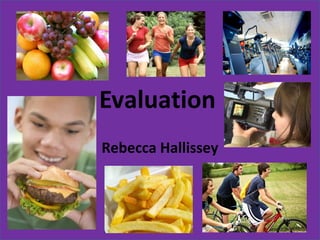
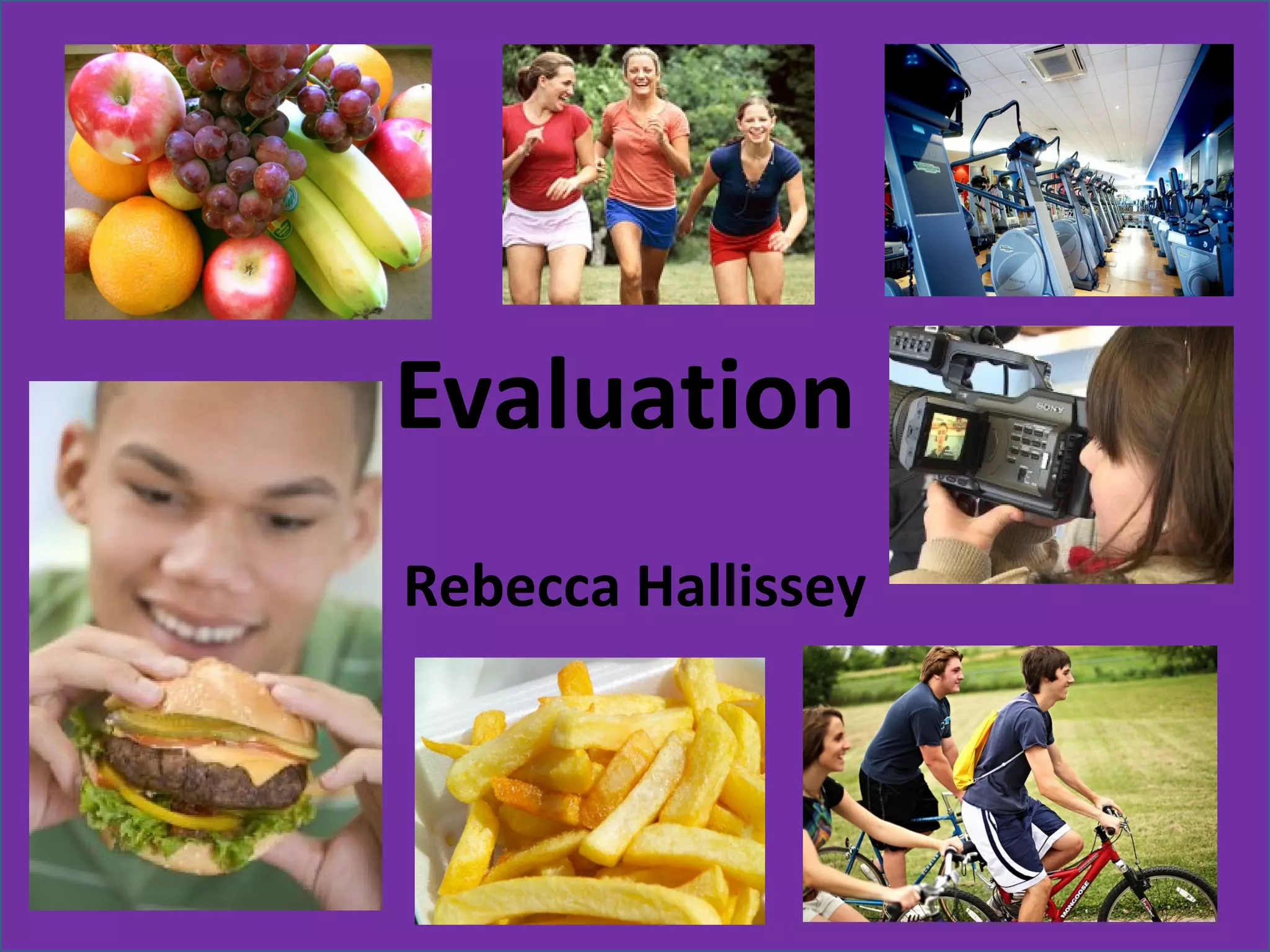
What topic did we base our documentary on?
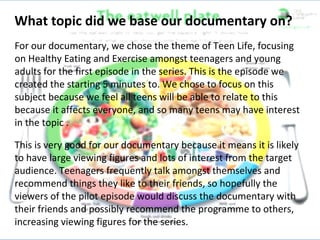
For our documentary, we chose the theme of Teen Life, focusing
on Healthy Eating and Exercise amongst teenagers and young
adults for the first episode in the series. This is the episode we
created the starting 5 minutes to. We chose to focus on this
subject because we feel all teens will be able to relate to this
because it affects everyone, and so many teens may have interest
in the topic .

This is very good for our documentary because it means it is likely
to have large viewing figures and lots of interest from the target
audience. Teenagers frequently talk amongst themselves and
recommend things they like to their friends, so hopefully the
viewers of the pilot episode would discuss the documentary with
their friends and possibly recommend the programme to others,
increasing viewing figures for the series.
Supersize Me
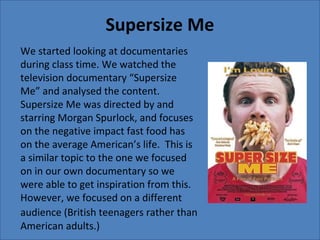
We started looking at documentaries
during class time. We watched the
television documentary “Supersize
Me” and analysed the content.
Supersize Me was directed by and
starring Morgan Spurlock, and focuses
on the negative impact fast food has
on the average American’s life. This is
a similar topic to the one we focused
on in our own documentary so we
were able to get inspiration from this.
However, we focused on a different
audience (British teenagers rather than
American adults.)
The World’s Strictest Parents
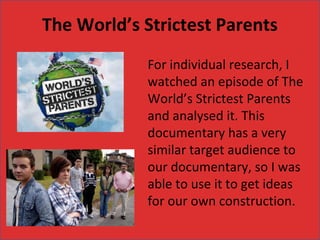
            For individual research, I
            watched an episode of The
            World’s Strictest Parents
            and analysed it. This
            documentary has a very
            similar target audience to
            our documentary, so I was
            able to use it to get ideas
            for our own construction.
Further Research
As well as watching existing documentaries to find
out the codes and conventions of this area of
television programme, we also did research into our
topic of Healthy Eating and Exercise amongst
teenagers and young people. We found lots of facts
and statistics which we could then use throughout
our documentary during cutaway shots. We used
these to inform and shock our audience, for
example: “In an official recent survey, doctors found
17% of boys and 16% of girls between 12 and 15 are
classed as either overweight or obese.”
Bill Nichol’s Theory Of Documentary
                    Modes
•
    The Expository Mode
•
    The Poetic Mode
•
    The Observational Mode
•
    The Participatory Mode
•
    The Reflexive Mode
•
    The Performative Mode
The Mode Of Our Documentary
•
    Our documentary has a voiceover throughout
•
    The narrator does not appear onscreen
•
    Formal interviews are structured
•
    Elements of fly on the wall (people eating)
•
    Background music used throughout
•
    Elements of Observational Mode
•
    Elements of Expository Mode
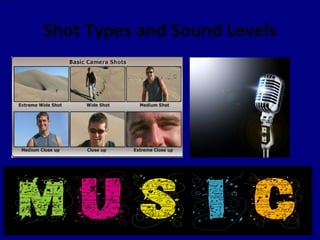
Shot Types and Sound Levels
Formal Interview
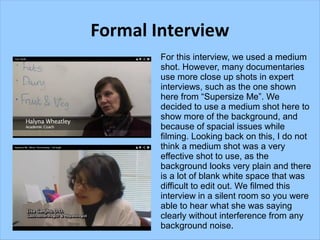
        For this interview, we used a medium
        shot. However, many documentaries
        use more close up shots in expert
        interviews, such as the one shown
        here from “Supersize Me”. We
        decided to use a medium shot here to
        show more of the background, and
        because of spacial issues while
        filming. Looking back on this, I do not
        think a medium shot was a very
        effective shot to use, as the
        background looks very plain and there
        is a lot of blank white space that was
        difficult to edit out. We filmed this
        interview in a silent room so you were
        able to hear what she was saying
        clearly without interference from any
        background noise.
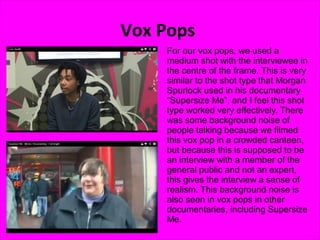
Vox Pops
    For our vox pops, we used a
    medium shot with the interviewee in
    the centre of the frame. This is very
    similar to the shot type that Morgan
    Spurlock used in his documentary
    “Supersize Me”, and I feel this shot
    type worked very effectively. There
    was some background noise of
    people talking because we filmed
    this vox pop in a crowded canteen,
    but because this is supposed to be
    an interview with a member of the
    general public and not an expert,
    this gives the interview a sense of
    realism. This background noise is
    also seen in vox pops in other
    documentaries, including Supersize
    Me.
Music
We used minimalist, upbeat music in our
piece. We set the sound level of the music
low so the audience can still hear the
voiceover and interviews clearly over the top
of the music. This is a common feature of a
lot of existing documentaries. Most
documentaries also use modern mainstream
music to set the tone of the programme, but
we were unable to do this because of
copyright reasons.

Question 1 ppt

  • 1.
  • 2.
    The Brief Our maintask given in the beginning of the A2 Media Studies course was to create the opening 5 minutes for a television documentary. We were also told to construct a radio trailer and a double page spread for a TV listings magazine to help advertise our documentary to the target audience. We started this task by researching existing television documentaries to see what sort of things the target audience liked.
  • 3.
    1.) In whatways does your media product use, develop or challenge forms and conventions of real media products?
  • 4.
    What topic didwe base our documentary on? For our documentary, we chose the theme of Teen Life, focusing on Healthy Eating and Exercise amongst teenagers and young adults for the first episode in the series. This is the episode we created the starting 5 minutes to. We chose to focus on this subject because we feel all teens will be able to relate to this because it affects everyone, and so many teens may have interest in the topic . This is very good for our documentary because it means it is likely to have large viewing figures and lots of interest from the target audience. Teenagers frequently talk amongst themselves and recommend things they like to their friends, so hopefully the viewers of the pilot episode would discuss the documentary with their friends and possibly recommend the programme to others, increasing viewing figures for the series.
  • 5.
    Supersize Me We startedlooking at documentaries during class time. We watched the television documentary “Supersize Me” and analysed the content. Supersize Me was directed by and starring Morgan Spurlock, and focuses on the negative impact fast food has on the average American’s life. This is a similar topic to the one we focused on in our own documentary so we were able to get inspiration from this. However, we focused on a different audience (British teenagers rather than American adults.)
  • 6.
    The World’s StrictestParents For individual research, I watched an episode of The World’s Strictest Parents and analysed it. This documentary has a very similar target audience to our documentary, so I was able to use it to get ideas for our own construction.
  • 7.
    Further Research As wellas watching existing documentaries to find out the codes and conventions of this area of television programme, we also did research into our topic of Healthy Eating and Exercise amongst teenagers and young people. We found lots of facts and statistics which we could then use throughout our documentary during cutaway shots. We used these to inform and shock our audience, for example: “In an official recent survey, doctors found 17% of boys and 16% of girls between 12 and 15 are classed as either overweight or obese.”
  • 8.
    Bill Nichol’s TheoryOf Documentary Modes • The Expository Mode • The Poetic Mode • The Observational Mode • The Participatory Mode • The Reflexive Mode • The Performative Mode
  • 9.
    The Mode OfOur Documentary • Our documentary has a voiceover throughout • The narrator does not appear onscreen • Formal interviews are structured • Elements of fly on the wall (people eating) • Background music used throughout • Elements of Observational Mode • Elements of Expository Mode
  • 10.
    Shot Types andSound Levels
  • 11.
    Formal Interview For this interview, we used a medium shot. However, many documentaries use more close up shots in expert interviews, such as the one shown here from “Supersize Me”. We decided to use a medium shot here to show more of the background, and because of spacial issues while filming. Looking back on this, I do not think a medium shot was a very effective shot to use, as the background looks very plain and there is a lot of blank white space that was difficult to edit out. We filmed this interview in a silent room so you were able to hear what she was saying clearly without interference from any background noise.
  • 12.
    Vox Pops For our vox pops, we used a medium shot with the interviewee in the centre of the frame. This is very similar to the shot type that Morgan Spurlock used in his documentary “Supersize Me”, and I feel this shot type worked very effectively. There was some background noise of people talking because we filmed this vox pop in a crowded canteen, but because this is supposed to be an interview with a member of the general public and not an expert, this gives the interview a sense of realism. This background noise is also seen in vox pops in other documentaries, including Supersize Me.
  • 13.
    Music We used minimalist,upbeat music in our piece. We set the sound level of the music low so the audience can still hear the voiceover and interviews clearly over the top of the music. This is a common feature of a lot of existing documentaries. Most documentaries also use modern mainstream music to set the tone of the programme, but we were unable to do this because of copyright reasons.