PLANNING BRIEF 5AM Productions
GROUP MEMBERS & ROLES
• Minoli De Silva: Director & Editor
Minoli chose to be the director as she has experience of directing
(at GCSE and AS) and she feels confident to adopt this particular
role.
Minoli will primarily be responsible for the fine editing of the
project: i.e. selecting titles, graphics, selecting any non-diegetic
sound etc.
• Alice Lupton: Cameraperson & Editor
Alice felt she would be suited to the role of cameraperson as she
also has extensive experience of being in this role and wants to
pursue a career as a TV cameraperson.
Alice will also be responsible for editing a rough cut of the project,
she will put together the basic narrative.
INTERVIEWEES
• Aaron Sullivan
• Maggie Sullivan
• Mr. C Foster
• Ms. M. Trapp
• Mr. P Lupton
• Dr. Glenys Jones
• MP Amber Rudd
• MP Wes Streeting
Our interviewees are a mix of people
affected by autism (i.e. Aaron and
his mother); people who have
experience working with those who
do have autism. For example, Mr.
Foster who is the inclusion officer at
a secondary school. We also have
political viewpoints represented with
the inclusion of the MPs, as well as
an expert opinion in the form of Dr.
Jones.
PROJECT NAME: TBC
Length
• 5 minutes
Format
• Our production will be an extract from
documentary, specifically the opening
section.
OUTLINE
Our documentary is based around the issue of how
autism and those with autism are misunderstood and
misrepresented within society. Popular misconceptions
will be addressed and corrected within this documentary
and the reasons as to why such ‘myths’ have become so
popular will be explored. Alongside this discussion of
perceptions associated with autism, the documentary will
follow the experiences of Aaron Sullivan – a teenager
diagnosed with Asperger’s Syndrome – as he embarks on
a campaign to raise awareness about autism.
TARGET AUDIENCE
The target audience for our product is quite broad as
there are numerous aspects that may attract an audience
to our documentary.
For example, young people with autism may be
interested in hearing the experiences of someone in a
similar situation to them. Someone who generally enjoys
watching documentaries about social issues may also be
attracted to our product.
Our target audience is 11 to 60 years old, both male and
female.
AREAS OF RESEARCH
Autism:
• What is autism?
• How many people in the UK are affected by autism?
• What are the ‘symptoms’ of autism?
• What are common misconceptions associated with
autism?
• Generally how well is autism understood by the wider
public?
• What kind of charities/groups work to support those
with autism?
RATIONALE
The rationale behind our product is the hope to stimulate
curiosity and intrigue. We want people to think about
whether views themselves hold in regard to autism are in
any way misinformed. We want our audiences to hear the
real stories of real people who are affected by autism, and
think about whether they themselves have been impacted
by autism in some shape or form. The desired impact of
this documentary is to shed light on commonly held ideas
and explain to people, in a friendly and open way, that
these ideas aren’t necessarily correct and suggest ways in
which they can further educate themselves beyond the
documentary.
HOW WILL YOU TEST WHETHER THE
PRODUCT IS SUCCESSFUL? HOW WILL
YOU CHECK IT IS EFFECTIVE?
In order to assess the success of our product we will
conduct a post-questionnaire, surveying a cross-sections
of our target audience. The questions within this survey
will help us to understand what specific aspects of the
product they enjoyed and what they felt could use
improvement.
Furthermore, we will screen the product to as many
people as possible in efforts to stimulate open discussion
of not only the technical aptitude of the piece, but also
the issues raised.
Finally, we will utilise social media platforms like
Facebook, twitter and YouTube in order to assess a more
general sense of our audience’s response.
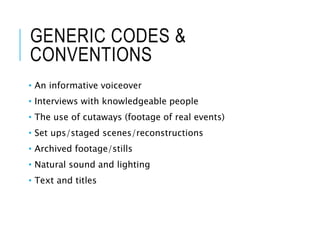
GENERIC CODES &
CONVENTIONS
• An informative voiceover
• Interviews with knowledgeable people
• The use of cutaways (footage of real events)
• Set ups/staged scenes/reconstructions
• Archived footage/stills
• Natural sound and lighting
• Text and titles
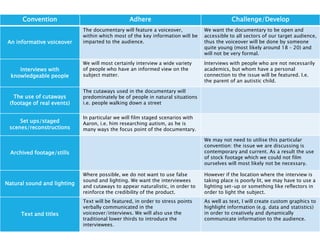
Convention Adhere Challenge/Develop
An informative voiceover
The documentary will feature a voiceover,
within which most of the key information will be
imparted to the audience.
We want the documentary to be open and
accessible to all sectors of our target audience,
thus the voiceover will be done by someone
quite young (most likely around 18 – 20) and
will not be very formal.
Interviews with
knowledgeable people
We will most certainly interview a wide variety
of people who have an informed view on the
subject matter.
Interviews with people who are not necessarily
academics, but whom have a personal
connection to the issue will be featured. I.e.
the parent of an autistic child.
The use of cutaways
(footage of real events)
The cutaways used in the documentary will
predominately be of people in natural situations
i.e. people walking down a street
Set ups/staged
scenes/reconstructions
In particular we will film staged scenarios with
Aaron, i.e. him researching autism, as he is
many ways the focus point of the documentary.
Archived footage/stills
We may not need to utilise this particular
convention: the issue we are discussing is
contemporary and current. As a result the use
of stock footage which we could not film
ourselves will most likely not be necessary.
Natural sound and lighting
Where possible, we do not want to use false
sound and lighting. We want the interviewees
and cutaways to appear naturalistic, in order to
reinforce the credibility of the product.
However if the location where the interview is
taking place is poorly lit, we may have to use a
lighting set-up or something like reflectors in
order to light the subject.
Text and titles
Text will be featured, in order to stress points
verbally communicated in the
voiceover/interviews. We will also use the
traditional lower thirds to introduce the
interviewees.
As well as text, I will create custom graphics to
highlight information (e.g. data and statistics)
in order to creatively and dynamically
communicate information to the audience.
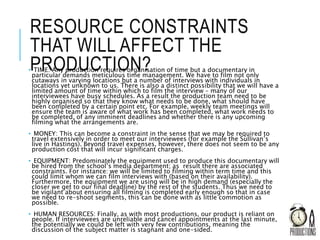
RESOURCE CONSTRAINTS
THAT WILL AFFECT THE
PRODUCTION?• TIME: Any production requires organisation of time but a documentary in
particular demands meticulous time management. We have to film not only
cutaways in varying locations but a number of interviews with individuals in
locations yet unknown to us. There is also a distinct possibility that we will have a
limited amount of time within which to film the interview – many of our
interviewees have busy schedules. As a result the production team need to be
highly organised so that they know what needs to be done, what should have
been completed by a certain point etc. For example, weekly team meetings will
ensure the team is aware of what work has been completed, what work needs to
be completed, of any imminent deadlines and whether there is any upcoming
filming what the arrangements are.
• MONEY: This can become a constraint in the sense that we may be required to
travel extensively in order to meet our interviewees (for example the Sullivan’s
live in Hastings). Beyond travel expenses, however, there does not seem to be any
production cost that will incur significant charges.
• EQUIPMENT: Predominately the equipment used to produce this documentary will
be hired from the school’s media department; as result there are associated
constraints. For instance: we will be limited to filming within term time and this
could limit whom we can film interviews with (based on their availability).
Furthermore, the equipment we are using will be in high demand (especially the
closer we get to our final deadline) by the rest of the students. Thus we need to
be vigilant about ensuring all filming is completed early enough so that in case
we need to re-shoot segments, this can be done with as little commotion as
possible.
• HUMAN RESOURCES: Finally, as with most productions, our product is reliant on
people. If interviewees are unreliable and cancel appointments at the last minute,
the potentially we could be left with very few contributions, meaning the
discussion of the subject matter is stagnant and one-sided.

Planning Brief

  • 1.
    PLANNING BRIEF 5AMProductions
  • 2.
    GROUP MEMBERS &ROLES • Minoli De Silva: Director & Editor Minoli chose to be the director as she has experience of directing (at GCSE and AS) and she feels confident to adopt this particular role. Minoli will primarily be responsible for the fine editing of the project: i.e. selecting titles, graphics, selecting any non-diegetic sound etc. • Alice Lupton: Cameraperson & Editor Alice felt she would be suited to the role of cameraperson as she also has extensive experience of being in this role and wants to pursue a career as a TV cameraperson. Alice will also be responsible for editing a rough cut of the project, she will put together the basic narrative.
  • 3.
    INTERVIEWEES • Aaron Sullivan •Maggie Sullivan • Mr. C Foster • Ms. M. Trapp • Mr. P Lupton • Dr. Glenys Jones • MP Amber Rudd • MP Wes Streeting Our interviewees are a mix of people affected by autism (i.e. Aaron and his mother); people who have experience working with those who do have autism. For example, Mr. Foster who is the inclusion officer at a secondary school. We also have political viewpoints represented with the inclusion of the MPs, as well as an expert opinion in the form of Dr. Jones.
  • 4.
    PROJECT NAME: TBC Length •5 minutes Format • Our production will be an extract from documentary, specifically the opening section.
  • 5.
    OUTLINE Our documentary isbased around the issue of how autism and those with autism are misunderstood and misrepresented within society. Popular misconceptions will be addressed and corrected within this documentary and the reasons as to why such ‘myths’ have become so popular will be explored. Alongside this discussion of perceptions associated with autism, the documentary will follow the experiences of Aaron Sullivan – a teenager diagnosed with Asperger’s Syndrome – as he embarks on a campaign to raise awareness about autism.
  • 6.
    TARGET AUDIENCE The targetaudience for our product is quite broad as there are numerous aspects that may attract an audience to our documentary. For example, young people with autism may be interested in hearing the experiences of someone in a similar situation to them. Someone who generally enjoys watching documentaries about social issues may also be attracted to our product. Our target audience is 11 to 60 years old, both male and female.
  • 7.
    AREAS OF RESEARCH Autism: •What is autism? • How many people in the UK are affected by autism? • What are the ‘symptoms’ of autism? • What are common misconceptions associated with autism? • Generally how well is autism understood by the wider public? • What kind of charities/groups work to support those with autism?
  • 8.
    RATIONALE The rationale behindour product is the hope to stimulate curiosity and intrigue. We want people to think about whether views themselves hold in regard to autism are in any way misinformed. We want our audiences to hear the real stories of real people who are affected by autism, and think about whether they themselves have been impacted by autism in some shape or form. The desired impact of this documentary is to shed light on commonly held ideas and explain to people, in a friendly and open way, that these ideas aren’t necessarily correct and suggest ways in which they can further educate themselves beyond the documentary.
  • 9.
    HOW WILL YOUTEST WHETHER THE PRODUCT IS SUCCESSFUL? HOW WILL YOU CHECK IT IS EFFECTIVE? In order to assess the success of our product we will conduct a post-questionnaire, surveying a cross-sections of our target audience. The questions within this survey will help us to understand what specific aspects of the product they enjoyed and what they felt could use improvement. Furthermore, we will screen the product to as many people as possible in efforts to stimulate open discussion of not only the technical aptitude of the piece, but also the issues raised. Finally, we will utilise social media platforms like Facebook, twitter and YouTube in order to assess a more general sense of our audience’s response.
  • 10.
    GENERIC CODES & CONVENTIONS •An informative voiceover • Interviews with knowledgeable people • The use of cutaways (footage of real events) • Set ups/staged scenes/reconstructions • Archived footage/stills • Natural sound and lighting • Text and titles
  • 11.
    Convention Adhere Challenge/Develop Aninformative voiceover The documentary will feature a voiceover, within which most of the key information will be imparted to the audience. We want the documentary to be open and accessible to all sectors of our target audience, thus the voiceover will be done by someone quite young (most likely around 18 – 20) and will not be very formal. Interviews with knowledgeable people We will most certainly interview a wide variety of people who have an informed view on the subject matter. Interviews with people who are not necessarily academics, but whom have a personal connection to the issue will be featured. I.e. the parent of an autistic child. The use of cutaways (footage of real events) The cutaways used in the documentary will predominately be of people in natural situations i.e. people walking down a street Set ups/staged scenes/reconstructions In particular we will film staged scenarios with Aaron, i.e. him researching autism, as he is many ways the focus point of the documentary. Archived footage/stills We may not need to utilise this particular convention: the issue we are discussing is contemporary and current. As a result the use of stock footage which we could not film ourselves will most likely not be necessary. Natural sound and lighting Where possible, we do not want to use false sound and lighting. We want the interviewees and cutaways to appear naturalistic, in order to reinforce the credibility of the product. However if the location where the interview is taking place is poorly lit, we may have to use a lighting set-up or something like reflectors in order to light the subject. Text and titles Text will be featured, in order to stress points verbally communicated in the voiceover/interviews. We will also use the traditional lower thirds to introduce the interviewees. As well as text, I will create custom graphics to highlight information (e.g. data and statistics) in order to creatively and dynamically communicate information to the audience.
  • 12.
    RESOURCE CONSTRAINTS THAT WILLAFFECT THE PRODUCTION?• TIME: Any production requires organisation of time but a documentary in particular demands meticulous time management. We have to film not only cutaways in varying locations but a number of interviews with individuals in locations yet unknown to us. There is also a distinct possibility that we will have a limited amount of time within which to film the interview – many of our interviewees have busy schedules. As a result the production team need to be highly organised so that they know what needs to be done, what should have been completed by a certain point etc. For example, weekly team meetings will ensure the team is aware of what work has been completed, what work needs to be completed, of any imminent deadlines and whether there is any upcoming filming what the arrangements are. • MONEY: This can become a constraint in the sense that we may be required to travel extensively in order to meet our interviewees (for example the Sullivan’s live in Hastings). Beyond travel expenses, however, there does not seem to be any production cost that will incur significant charges. • EQUIPMENT: Predominately the equipment used to produce this documentary will be hired from the school’s media department; as result there are associated constraints. For instance: we will be limited to filming within term time and this could limit whom we can film interviews with (based on their availability). Furthermore, the equipment we are using will be in high demand (especially the closer we get to our final deadline) by the rest of the students. Thus we need to be vigilant about ensuring all filming is completed early enough so that in case we need to re-shoot segments, this can be done with as little commotion as possible. • HUMAN RESOURCES: Finally, as with most productions, our product is reliant on people. If interviewees are unreliable and cancel appointments at the last minute, the potentially we could be left with very few contributions, meaning the discussion of the subject matter is stagnant and one-sided.