In what ways does your media
product use, develop or challenge
forms and conventions of real
media products?
When researching different magazines I found that I was mainly
inspired by more modern travel magazines that had very simple
layouts. When looking at travel magazines I found that most of
the layouts were very simple however some of the national
magazines like Coast had a lot more on their front cover. My
main inspiration for my magazine front cover was the travel
magazine Another Escape, I really liked how simple the layout
was and I liked the border around the main image as I found it
made the image stand out more. On my front cover I followed
many typical codes and conventions found throughout
magazines, for example I included a dominant image which
attracts the audience to just one image instead of multiple. I
also had a masthead at the top of my page which was the
name of my magazine, I didn’t want to have a sub heading on
my page as It distracted the audience away from the dominant
image and also didn’t look right on the page.
• When researching contents pages I found that travel
magazine contents pages had a mixture of photos and
text on. I liked the use of photos on a contents page and
then the page number and a brief description below.
When researching travel magazines contents page I found
I ski magazine that fitted with my theme. I liked the use of
the photos within the magazine and also the brief
description next to the pictures. When creating my
magazine I new that I wanted to put my own spin on it, so
decided to have 6 pictures and the page numbers and a
brief description about the page. The page numbers is a
common convention of a magazine so I knew I was
automatically going to use this convention on my
contents page. I wanted to have sub images on my
contents page as the genre of my magazine is travel. It is
important for the audience to see what is featured in the
magazines and the places that are featured.
• When creating my double page spread, I knew that I
wanted to have my dominate image covering the whole
of my double page spread. This convention is more
commonly seen In national magazines however I wanted
to incorporate it in my regional magazine. When looking
at regional magazines I found that a dominate image was
used and then there was multiple sub images featured
throughout the double page spread. I took inspiration
from magazines like Wanderlust, I really liked how the
dominate image covered the whole of the double page
spread. I used common codes and conventions that are
seen in magazines like Wanderlust and most magazines. I
made sure that I had a mast head on my double page
spread and also had main text. I wanted to make sure
that the text was on one side of the double page spread
so that the main part of the dominate imaged could be
seen.
• I had never created a billboard before so I looked at
multiple different billboards to try and get inspiration
from. When looking at billboards I found that I preferred
billboards that had simple layouts and focused on the
main dominate image. For example one of the billboards
that I gained most inspirations from was Coast, I liked
how simple the layout was. I also wanted to make sure
that when creating my billboard that there wasn’t a lot of
information on there as most billboards are placed on the
road which means that if there is to much information,
the audience wont be able to read it as they will be going
at a fast speed. So when creating my billboard I decided
to just use the conventions masthead, dominate image
and sub headings.
• When looking at different websites I found the overall
theme of my products and the colour scheme that I was
going to use. When doing my website deconstructions I
found that I was going to have a modern layout and a
monochrome colour scheme throughout all of my
products creating synergy. I used the common convention
of having a tab at the top of my website so my audience
can easily find their way around my website. I took
inspiration from Absolute London who used common
conventions that can also be seen in my final website. I
wanted to make website look aestically pleasing to the
eye and also attract my target audience by having a
modern theme. I also liked the use of a main image on
the website as soon as my audience click on my website
link, I think that this automatically grabs the audiences
attention as it is the first thing they see.
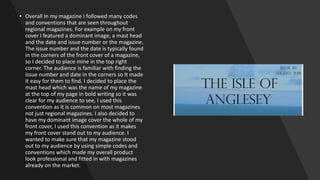
• Overall In my magazine I followed many codes
and conventions that are seen throughout
regional magazines. For example on my front
cover I featured a dominant image, a mast head
and the date and issue number or the magazine.
The issue number and the date is typically found
in the corners of the front cover of a magazine,
so I decided to place mine in the top right
corner. The audience is familiar with finding the
issue number and date in the corners so It made
it easy for them to find. I decided to place the
mast head which was the name of my magazine
at the top of my page in bold writing so it was
clear for my audience to see, I used this
convention as it is common on most magazines
not just regional magazines. I also decided to
have my dominant image cover the whole of my
front cover, I used this convention as it makes
my front cover stand out to my audience. I
wanted to make sure that my magazine stood
out to my audience by using simple codes and
conventions which made my overall product
look professional and fitted in with magazines
already on the market.
• I challenged some of the codes and conventions that are
typically used in a regional magazine and also codes and
conventions that are used in a travel magazine. For
example on my front cover I decided that I didn’t want to
use a barcode and I wanted my front cover to be modern
and simple. When researching travel magazines I found
myself drawn more towards magazines that had the
barcode featured on the back of the magazine not on the
front. One of the most biggest travel magazines in the Uk
is Coast magazine however when researching them I
found that I didn’t like their layout and that I preferred
the layouts to be more simple. Typically the layout of a
travel magazine has a lot of subheadings and information
on the front cover, however I decided that I wanted to
challenge this by making my magazine layouts very
simple and modern a I had a young target audience.
• When researching travel magazines I found that
most typically had bright colour schemes, there
colour schemes usually involved yellow, blue
and pink. However I decided to challenge this
convention throughout all of my final products, I
decided to have a monochrome colour scheme
which mainly featured black, white and different
tones of grey. The only bright colours that were
used throughout my final products were used
within my photos that I had taken. However the
travel magazines that use the bright colours like
blue and yellow use them do that the audience
can automatically link the colour scheme to an
object or emotion. For example the audience
link the use of blue to the sea or the sky and
then the colour yellow to the emotion of being
happy and also the sun. However when I asked
my audience what colour scheme they preferred
they said that they would prefer a monochrome
colour scheme as it was more aestically pleasing
• When creating my website I used many
different codes and conventions that are
found on a regional website. For example
included a gallery section which allowed my
audience to have a look at different
locations that are featured in my region. I
incorporated the convention of having a tab
also known as the navigation bar at the top
of my website which makes it easy for my
audience to find articles and information
on my magazine. I again used the same
colour scheme as my magazine on my
website as it showed a clear link between
all of my products and again the only bright
colours used throughout my website was
on my photos. On most websites not just
regional magazines a convention that
always occurs is the about page, this page
allows the audience to find out more about
my products. For example I created my
about page and wrote a brief description
about my magazine.
• I made sure that when I was creating my
website that I stuck to my modern and simple
theme. When looking at regional websites I
found that there was a lot of hyperlinked pages
featured on the home page. However I didn’t
want to have this on my final product, so I
decided to challenge this convention by just
have three simple hyperlinked pages, that were
easy and simple for my audience to find. I also
made sure that they linked with my magazine,
so for example each link was a different issue of
my magazine. However a convention that I did
follow was the contact/ follow us page or
button, as technology has become more
advanced one of the conventions now featured
on a regional website is a follow us button which
features different social medias, like Facebook,
Twitter and Instagram. I wanted to use this in
my website as I wanted to attract my audience
to different platforms for my magazine. It also
fitted in with my modern theme.

Question 1

  • 1.
    In what waysdoes your media product use, develop or challenge forms and conventions of real media products?
  • 2.
    When researching differentmagazines I found that I was mainly inspired by more modern travel magazines that had very simple layouts. When looking at travel magazines I found that most of the layouts were very simple however some of the national magazines like Coast had a lot more on their front cover. My main inspiration for my magazine front cover was the travel magazine Another Escape, I really liked how simple the layout was and I liked the border around the main image as I found it made the image stand out more. On my front cover I followed many typical codes and conventions found throughout magazines, for example I included a dominant image which attracts the audience to just one image instead of multiple. I also had a masthead at the top of my page which was the name of my magazine, I didn’t want to have a sub heading on my page as It distracted the audience away from the dominant image and also didn’t look right on the page.
  • 3.
    • When researchingcontents pages I found that travel magazine contents pages had a mixture of photos and text on. I liked the use of photos on a contents page and then the page number and a brief description below. When researching travel magazines contents page I found I ski magazine that fitted with my theme. I liked the use of the photos within the magazine and also the brief description next to the pictures. When creating my magazine I new that I wanted to put my own spin on it, so decided to have 6 pictures and the page numbers and a brief description about the page. The page numbers is a common convention of a magazine so I knew I was automatically going to use this convention on my contents page. I wanted to have sub images on my contents page as the genre of my magazine is travel. It is important for the audience to see what is featured in the magazines and the places that are featured.
  • 4.
    • When creatingmy double page spread, I knew that I wanted to have my dominate image covering the whole of my double page spread. This convention is more commonly seen In national magazines however I wanted to incorporate it in my regional magazine. When looking at regional magazines I found that a dominate image was used and then there was multiple sub images featured throughout the double page spread. I took inspiration from magazines like Wanderlust, I really liked how the dominate image covered the whole of the double page spread. I used common codes and conventions that are seen in magazines like Wanderlust and most magazines. I made sure that I had a mast head on my double page spread and also had main text. I wanted to make sure that the text was on one side of the double page spread so that the main part of the dominate imaged could be seen.
  • 5.
    • I hadnever created a billboard before so I looked at multiple different billboards to try and get inspiration from. When looking at billboards I found that I preferred billboards that had simple layouts and focused on the main dominate image. For example one of the billboards that I gained most inspirations from was Coast, I liked how simple the layout was. I also wanted to make sure that when creating my billboard that there wasn’t a lot of information on there as most billboards are placed on the road which means that if there is to much information, the audience wont be able to read it as they will be going at a fast speed. So when creating my billboard I decided to just use the conventions masthead, dominate image and sub headings.
  • 6.
    • When lookingat different websites I found the overall theme of my products and the colour scheme that I was going to use. When doing my website deconstructions I found that I was going to have a modern layout and a monochrome colour scheme throughout all of my products creating synergy. I used the common convention of having a tab at the top of my website so my audience can easily find their way around my website. I took inspiration from Absolute London who used common conventions that can also be seen in my final website. I wanted to make website look aestically pleasing to the eye and also attract my target audience by having a modern theme. I also liked the use of a main image on the website as soon as my audience click on my website link, I think that this automatically grabs the audiences attention as it is the first thing they see.
  • 7.
    • Overall Inmy magazine I followed many codes and conventions that are seen throughout regional magazines. For example on my front cover I featured a dominant image, a mast head and the date and issue number or the magazine. The issue number and the date is typically found in the corners of the front cover of a magazine, so I decided to place mine in the top right corner. The audience is familiar with finding the issue number and date in the corners so It made it easy for them to find. I decided to place the mast head which was the name of my magazine at the top of my page in bold writing so it was clear for my audience to see, I used this convention as it is common on most magazines not just regional magazines. I also decided to have my dominant image cover the whole of my front cover, I used this convention as it makes my front cover stand out to my audience. I wanted to make sure that my magazine stood out to my audience by using simple codes and conventions which made my overall product look professional and fitted in with magazines already on the market.
  • 8.
    • I challengedsome of the codes and conventions that are typically used in a regional magazine and also codes and conventions that are used in a travel magazine. For example on my front cover I decided that I didn’t want to use a barcode and I wanted my front cover to be modern and simple. When researching travel magazines I found myself drawn more towards magazines that had the barcode featured on the back of the magazine not on the front. One of the most biggest travel magazines in the Uk is Coast magazine however when researching them I found that I didn’t like their layout and that I preferred the layouts to be more simple. Typically the layout of a travel magazine has a lot of subheadings and information on the front cover, however I decided that I wanted to challenge this by making my magazine layouts very simple and modern a I had a young target audience.
  • 9.
    • When researchingtravel magazines I found that most typically had bright colour schemes, there colour schemes usually involved yellow, blue and pink. However I decided to challenge this convention throughout all of my final products, I decided to have a monochrome colour scheme which mainly featured black, white and different tones of grey. The only bright colours that were used throughout my final products were used within my photos that I had taken. However the travel magazines that use the bright colours like blue and yellow use them do that the audience can automatically link the colour scheme to an object or emotion. For example the audience link the use of blue to the sea or the sky and then the colour yellow to the emotion of being happy and also the sun. However when I asked my audience what colour scheme they preferred they said that they would prefer a monochrome colour scheme as it was more aestically pleasing
  • 10.
    • When creatingmy website I used many different codes and conventions that are found on a regional website. For example included a gallery section which allowed my audience to have a look at different locations that are featured in my region. I incorporated the convention of having a tab also known as the navigation bar at the top of my website which makes it easy for my audience to find articles and information on my magazine. I again used the same colour scheme as my magazine on my website as it showed a clear link between all of my products and again the only bright colours used throughout my website was on my photos. On most websites not just regional magazines a convention that always occurs is the about page, this page allows the audience to find out more about my products. For example I created my about page and wrote a brief description about my magazine.
  • 11.
    • I madesure that when I was creating my website that I stuck to my modern and simple theme. When looking at regional websites I found that there was a lot of hyperlinked pages featured on the home page. However I didn’t want to have this on my final product, so I decided to challenge this convention by just have three simple hyperlinked pages, that were easy and simple for my audience to find. I also made sure that they linked with my magazine, so for example each link was a different issue of my magazine. However a convention that I did follow was the contact/ follow us page or button, as technology has become more advanced one of the conventions now featured on a regional website is a follow us button which features different social medias, like Facebook, Twitter and Instagram. I wanted to use this in my website as I wanted to attract my audience to different platforms for my magazine. It also fitted in with my modern theme.