Literary Devices
Literary devices enhance writing by adding
depth, emphasis, and a richer sensory
experience for the reader.They are tools
and techniques that poets use to enrich
the meaning, imagery, and impact of their
work.
● Imagery - Descriptive language
that appeals to the senses, creating
vivid mental pictures for the reader.
Examples include visual imagery (sight), auditory imagery
(sound), olfactory imagery (smell), gustatory imagery (taste),
and tactile imagery or touch.
"The scent of fresh rain on the earth"
● Metaphor - A comparison between two unlike
things, suggesting a similarity or shared characteristic
without using "like" or "as." A direct comparison
between two unlike things
"Time is a thief"
● Simile - A comparison between two
unlike things using "like" or "as“.
"Her smile was as bright as the sun"
● Personification - Giving human
characteristics or qualities to non-human
objects, animals, or abstract concepts
"The wind whispered through the trees"
● Symbolism - Using objects, colors, or
elements to represent deeper meanings or
ideas beyond their literal significance.
"A dove symbolizes peace"
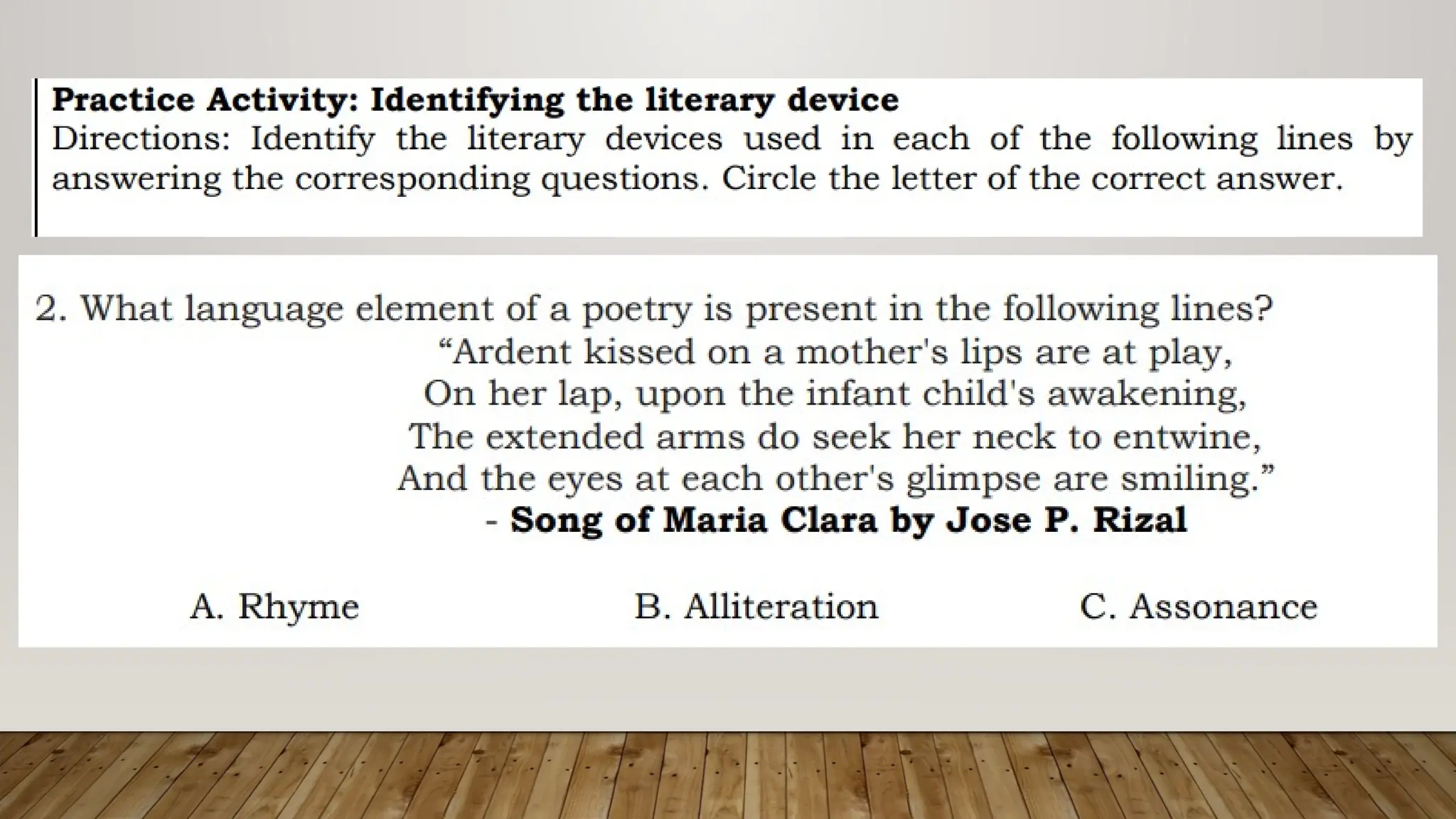
● Rhyme - The repetition of similar sounds,
usually at the ends of lines in poetry. Common
rhyme schemes include AABB,ABAB, and ABCB.
● Tone - Tone can be conveyed through
word choice, imagery, syntax, and overall
style. Common tones in poetry include
playful, serious, nostalgic, melancholic,
sarcastic, hopeful, and reflective.
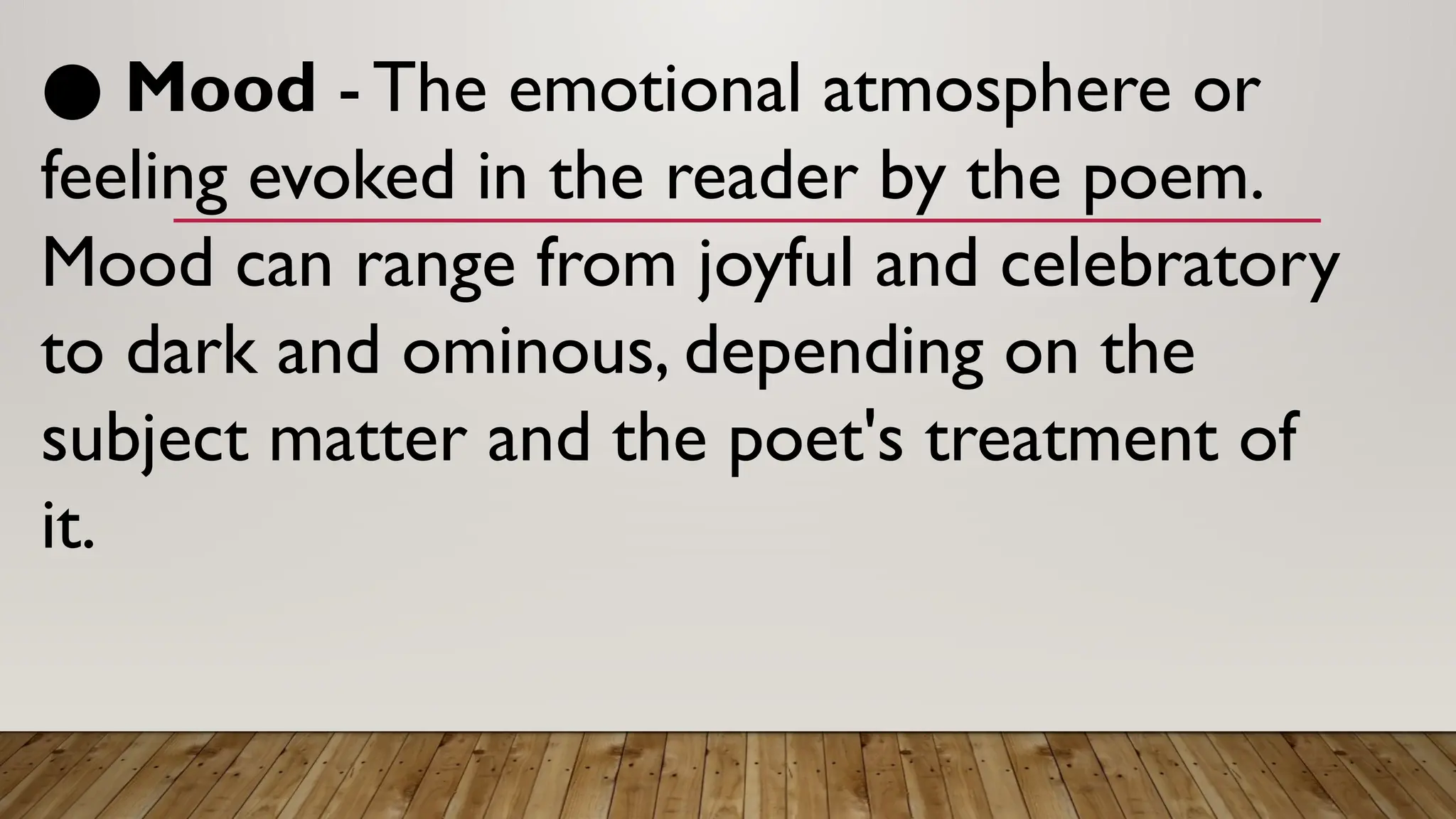
● Mood - The emotional atmosphere or
feeling evoked in the reader by the poem.
Mood can range from joyful and celebratory
to dark and ominous, depending on the
subject matter and the poet's treatment of
it.
● Alliteration - The repetition
of the same initial consonant
sounds in a series of words.
"Peter Piper picked a peck of pickled peppers."
● Hyperbole - An extreme
exaggeration used for effect.
"I'm so hungry I could eat a horse."
● Onomatopoeia - A word
that imitates the sound it
represents.
"The bees buzzed loudly in the garden."
Literary Devices (grade 7) Quarter 1 Week 4.pptx

Literary Devices (grade 7) Quarter 1 Week 4.pptx

  • 3.
    Literary Devices Literary devicesenhance writing by adding depth, emphasis, and a richer sensory experience for the reader.They are tools and techniques that poets use to enrich the meaning, imagery, and impact of their work.
  • 4.
    ● Imagery -Descriptive language that appeals to the senses, creating vivid mental pictures for the reader. Examples include visual imagery (sight), auditory imagery (sound), olfactory imagery (smell), gustatory imagery (taste), and tactile imagery or touch. "The scent of fresh rain on the earth"
  • 5.
    ● Metaphor -A comparison between two unlike things, suggesting a similarity or shared characteristic without using "like" or "as." A direct comparison between two unlike things "Time is a thief"
  • 6.
    ● Simile -A comparison between two unlike things using "like" or "as“. "Her smile was as bright as the sun"
  • 7.
    ● Personification -Giving human characteristics or qualities to non-human objects, animals, or abstract concepts "The wind whispered through the trees"
  • 8.
    ● Symbolism -Using objects, colors, or elements to represent deeper meanings or ideas beyond their literal significance. "A dove symbolizes peace"
  • 9.
    ● Rhyme -The repetition of similar sounds, usually at the ends of lines in poetry. Common rhyme schemes include AABB,ABAB, and ABCB.
  • 11.
    ● Tone -Tone can be conveyed through word choice, imagery, syntax, and overall style. Common tones in poetry include playful, serious, nostalgic, melancholic, sarcastic, hopeful, and reflective.
  • 12.
    ● Mood -The emotional atmosphere or feeling evoked in the reader by the poem. Mood can range from joyful and celebratory to dark and ominous, depending on the subject matter and the poet's treatment of it.
  • 13.
    ● Alliteration -The repetition of the same initial consonant sounds in a series of words. "Peter Piper picked a peck of pickled peppers."
  • 14.
    ● Hyperbole -An extreme exaggeration used for effect. "I'm so hungry I could eat a horse."
  • 15.
    ● Onomatopoeia -A word that imitates the sound it represents. "The bees buzzed loudly in the garden."