1
Quantum Gaussian
Processes
Gaweł Kuś
Master student at Novel Aerospace Materials (NovAM) group,
Faculty of Aerospace Engineering
Delft University of Technology
Dr.ir. M.A. (Miguel) Bessa
Assistant Professor in Materials Science and Engineering
Delft University of Technology
Prof.Dr.ir. S. (Sybrand) van der Zwaag
Chairholder of Novel Aerospace Materials (NovAM) group,
Faculty of Aerospace Engineering
Delft University of Technology
for computational design of materials
2
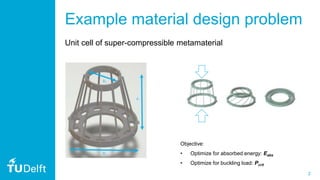
Example material design problem
Unit cell of super-compressible metamaterial
Objective:
• Optimize for absorbed energy: Eabs
• Optimize for buckling load: Pcrit
3
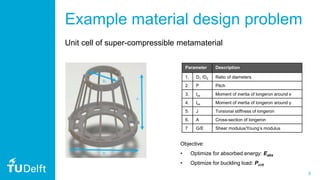
Parameter Description
1. D1 /D2 Ratio of diameters
2. P Pitch
3. Ixx Moment of inertia of longeron around x
4. Ixx Moment of inertia of longeron around y
5. J Torsional stiffness of longeron
6. A Cross-section of longeron
7 G/E Shear modulus/Young’s modulus
Objective:
• Optimize for absorbed energy: Eabs
• Optimize for buckling load: Pcrit
Example material design problem
Unit cell of super-compressible metamaterial
4
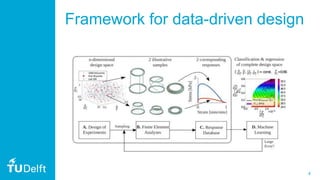
Framework for data-driven design
5
Gaussian processes regression
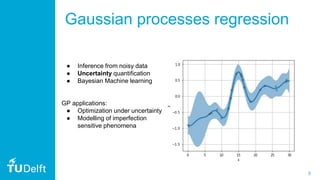
● Inference from noisy data
● Uncertainty quantification
● Bayesian Machine learning
GP applications:
● Optimization under uncertainty
● Modelling of imperfection
sensitive phenomena
6
Gaussian processes regression
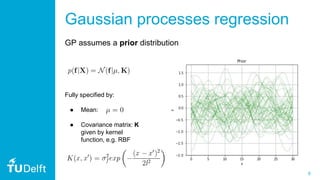
GP assumes a prior distribution
Fully specified by:
● Mean:
● Covariance matrix: K
given by kernel
function, e.g. RBF
7
Kernel function
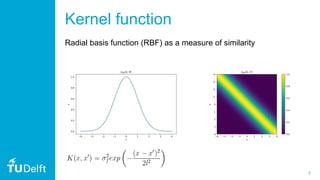
Radial basis function (RBF) as a measure of similarity
8
Gaussian processes regression
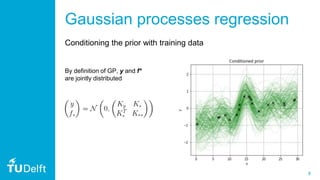
Conditioning the prior with training data
By definition of GP, y and f*
are jointly distributed
9
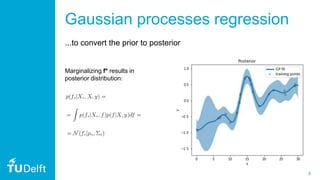
Gaussian processes regression
...to convert the prior to posterior
Marginalizing f* results in
posterior distribution:
10
● Matrix inversion scales as:
● Practical limitation: ~10 000
training points
Gaussian processes regression
In practice: solving system of linear equations
11
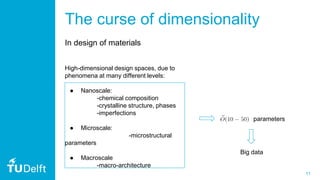
The curse of dimensionality
In design of materials
High-dimensional design spaces, due to
phenomena at many different levels:
● Nanoscale:
-chemical composition
-crystalline structure, phases
-imperfections
● Microscale:
-microstructural
parameters
● Macroscale
-macro-architecture
parameters
Big data
12
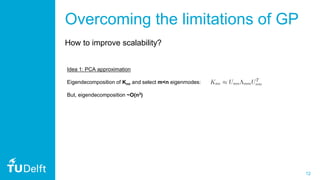
Idea 1: PCA approximation
Eigendecomposition of Knn and select m<n eigenmodes:
But, eigendecomposition ~O(n3)
Overcoming the limitations of GP
How to improve scalability?
13
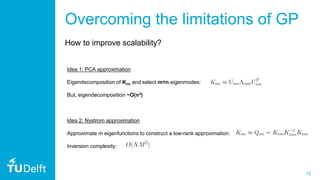
Idea 1: PCA approximation
Eigendecomposition of Knn and select m<n eigenmodes:
But, eigendecomposition ~O(n3)
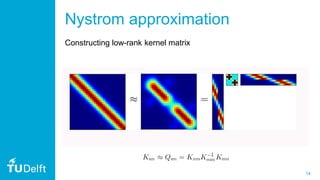
Idea 2: Nystrom approximation
Approximate m eigenfunctions to construct a low-rank approximation:
Inversion complexity:
Overcoming the limitations of GP
How to improve scalability?
14
Nystrom approximation
Constructing low-rank kernel matrix
15
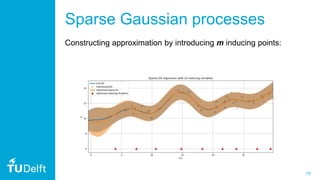
Sparse Gaussian processes
Constructing approximation by introducing m inducing points:
16
Sparse Gaussian processes
Number of inducing points (m) affects the approximation quality
17
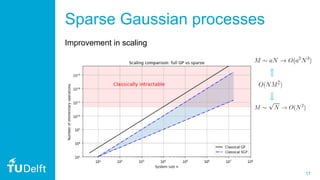
Sparse Gaussian processes
Improvement in scaling
18
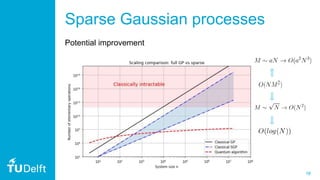
Sparse Gaussian processes
Potential improvement
19
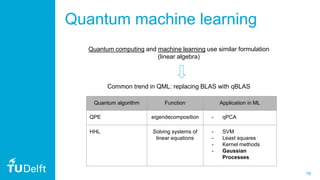
Quantum computing and machine learning use similar formulation
(linear algebra)
Common trend in QML: replacing BLAS with qBLAS
Quantum algorithm Function Application in ML
QPE eigendecomposition - qPCA
HHL Solving systems of
linear equations
- SVM
- Least squares
- Kernel methods
- Gaussian
Processes
Quantum machine learning
20
u vA
[1] Z.Zhao et al., Quantum assisted Gaussian process regression (2015)
Quantum Gaussian processes
Concept: speed-up the matrix inversion with HHL algorithm[1]
21
u vA
1. Find b = A-1v with HHL algorithmb = A-1v
[1] Z.Zhao et al., Quantum assisted Gaussian process regression (2015)
Quantum Gaussian processes
Concept: speed-up the matrix inversion with HHL algorithm[1]
22
u vA
1. Find b = A-1v with HHL algorithm
2. Apply a measurement operator to
find the dot product: u.b = uA-1v
b = A-1v
u.b = u.A-1.v
u
[1] Z.Zhao et al., Quantum assisted Gaussian process regression (2015)
Quantum Gaussian processes
Concept: speed-up the matrix inversion with HHL algorithm[1]
23
Quantum Gaussian processes
Concept: speed-up the matrix inversion with HHL algorithm[1]
u vA
1. Find b = A-1v with HHL algorithm
2. Apply a measurement operator to
find the dot product: u.b = uA-1v
Exponential speed-up due to HHL:
[1] Z.Zhao et al., Quantum assisted Gaussian process regression (2015)
24
find b = A-1v dot product:
u.b = uA-
1v
Initialize u and v
in superposition
Quantum Gaussian processes
Circuit representation
25
QGP implementation
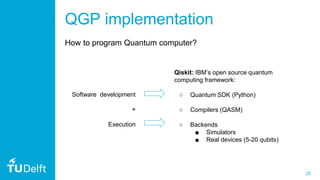
How to program Quantum computer?
Qiskit: IBM’s open source quantum
computing framework:
○ Quantum SDK (Python)
○ Compilers (QASM)
○ Backends
■ Simulators
■ Real devices (5-20 qubits)
Software development
+
Execution
26
Approximations in QGP
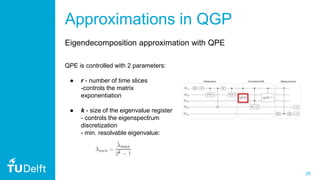
Eigendecomposition approximation with QPE
QPE is controlled with 2 parameters:
● r - number of time slices
-controls the matrix
exponentiation
● k - size of the eigenvalue register
- controls the eigenspectrum
discretization
- min. resolvable eigenvalue:
27
QGP as low-rank approximation
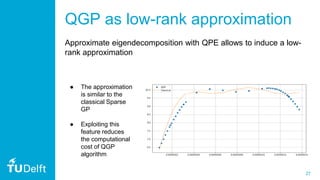
Approximate eigendecomposition with QPE allows to induce a low-
rank approximation
● The approximation
is similar to the
classical Sparse
GP
● Exploiting this
feature reduces
the computational
cost of QGP
algorithm
28
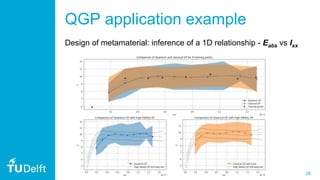
QGP application example
Design of metamaterial: inference of a 1D relationship - Eabs vs Ixx
29
Conclusions
● Discovered a mechanism for inducing the low-rank approximation, analog to
that in classical sparse Gaussian processes
● Demonstrated application of QC in materials engineering

Quantum Gaussian Processes - Gawel Kus

  • 1.
    1 Quantum Gaussian Processes Gaweł Kuś Masterstudent at Novel Aerospace Materials (NovAM) group, Faculty of Aerospace Engineering Delft University of Technology Dr.ir. M.A. (Miguel) Bessa Assistant Professor in Materials Science and Engineering Delft University of Technology Prof.Dr.ir. S. (Sybrand) van der Zwaag Chairholder of Novel Aerospace Materials (NovAM) group, Faculty of Aerospace Engineering Delft University of Technology for computational design of materials
  • 2.
    2 Example material designproblem Unit cell of super-compressible metamaterial Objective: • Optimize for absorbed energy: Eabs • Optimize for buckling load: Pcrit
  • 3.
    3 Parameter Description 1. D1/D2 Ratio of diameters 2. P Pitch 3. Ixx Moment of inertia of longeron around x 4. Ixx Moment of inertia of longeron around y 5. J Torsional stiffness of longeron 6. A Cross-section of longeron 7 G/E Shear modulus/Young’s modulus Objective: • Optimize for absorbed energy: Eabs • Optimize for buckling load: Pcrit Example material design problem Unit cell of super-compressible metamaterial
  • 4.
  • 5.
    5 Gaussian processes regression ●Inference from noisy data ● Uncertainty quantification ● Bayesian Machine learning GP applications: ● Optimization under uncertainty ● Modelling of imperfection sensitive phenomena
  • 6.
    6 Gaussian processes regression GPassumes a prior distribution Fully specified by: ● Mean: ● Covariance matrix: K given by kernel function, e.g. RBF
  • 7.
    7 Kernel function Radial basisfunction (RBF) as a measure of similarity
  • 8.
    8 Gaussian processes regression Conditioningthe prior with training data By definition of GP, y and f* are jointly distributed
  • 9.
    9 Gaussian processes regression ...toconvert the prior to posterior Marginalizing f* results in posterior distribution:
  • 10.
    10 ● Matrix inversionscales as: ● Practical limitation: ~10 000 training points Gaussian processes regression In practice: solving system of linear equations
  • 11.
    11 The curse ofdimensionality In design of materials High-dimensional design spaces, due to phenomena at many different levels: ● Nanoscale: -chemical composition -crystalline structure, phases -imperfections ● Microscale: -microstructural parameters ● Macroscale -macro-architecture parameters Big data
  • 12.
    12 Idea 1: PCAapproximation Eigendecomposition of Knn and select m<n eigenmodes: But, eigendecomposition ~O(n3) Overcoming the limitations of GP How to improve scalability?
  • 13.
    13 Idea 1: PCAapproximation Eigendecomposition of Knn and select m<n eigenmodes: But, eigendecomposition ~O(n3) Idea 2: Nystrom approximation Approximate m eigenfunctions to construct a low-rank approximation: Inversion complexity: Overcoming the limitations of GP How to improve scalability?
  • 14.
  • 15.
    15 Sparse Gaussian processes Constructingapproximation by introducing m inducing points:
  • 16.
    16 Sparse Gaussian processes Numberof inducing points (m) affects the approximation quality
  • 17.
  • 18.
  • 19.
    19 Quantum computing andmachine learning use similar formulation (linear algebra) Common trend in QML: replacing BLAS with qBLAS Quantum algorithm Function Application in ML QPE eigendecomposition - qPCA HHL Solving systems of linear equations - SVM - Least squares - Kernel methods - Gaussian Processes Quantum machine learning
  • 20.
    20 u vA [1] Z.Zhaoet al., Quantum assisted Gaussian process regression (2015) Quantum Gaussian processes Concept: speed-up the matrix inversion with HHL algorithm[1]
  • 21.
    21 u vA 1. Findb = A-1v with HHL algorithmb = A-1v [1] Z.Zhao et al., Quantum assisted Gaussian process regression (2015) Quantum Gaussian processes Concept: speed-up the matrix inversion with HHL algorithm[1]
  • 22.
    22 u vA 1. Findb = A-1v with HHL algorithm 2. Apply a measurement operator to find the dot product: u.b = uA-1v b = A-1v u.b = u.A-1.v u [1] Z.Zhao et al., Quantum assisted Gaussian process regression (2015) Quantum Gaussian processes Concept: speed-up the matrix inversion with HHL algorithm[1]
  • 23.
    23 Quantum Gaussian processes Concept:speed-up the matrix inversion with HHL algorithm[1] u vA 1. Find b = A-1v with HHL algorithm 2. Apply a measurement operator to find the dot product: u.b = uA-1v Exponential speed-up due to HHL: [1] Z.Zhao et al., Quantum assisted Gaussian process regression (2015)
  • 24.
    24 find b =A-1v dot product: u.b = uA- 1v Initialize u and v in superposition Quantum Gaussian processes Circuit representation
  • 25.
    25 QGP implementation How toprogram Quantum computer? Qiskit: IBM’s open source quantum computing framework: ○ Quantum SDK (Python) ○ Compilers (QASM) ○ Backends ■ Simulators ■ Real devices (5-20 qubits) Software development + Execution
  • 26.
    26 Approximations in QGP Eigendecompositionapproximation with QPE QPE is controlled with 2 parameters: ● r - number of time slices -controls the matrix exponentiation ● k - size of the eigenvalue register - controls the eigenspectrum discretization - min. resolvable eigenvalue:
  • 27.
    27 QGP as low-rankapproximation Approximate eigendecomposition with QPE allows to induce a low- rank approximation ● The approximation is similar to the classical Sparse GP ● Exploiting this feature reduces the computational cost of QGP algorithm
  • 28.
    28 QGP application example Designof metamaterial: inference of a 1D relationship - Eabs vs Ixx
  • 29.
    29 Conclusions ● Discovered amechanism for inducing the low-rank approximation, analog to that in classical sparse Gaussian processes ● Demonstrated application of QC in materials engineering