

Quantitative Strategic Planning
Matrix (QSPM)
NOR SYAZWANI BT NORIZAN (B1320077)
SITI NURSHAKIRAH BT ADAM (B1320025)
NOR LIYANA BT NORIZAN (B1320062)
Introduction
• Quantitative Strategic Planning
Matrix (QSPM) is a high-level
strategic management approach
for evaluating possible strategies
• QSPM provides an analytical
method for comparing feasible
alternative actions
• The QSPM method falls within
so-called stage 3 of the strategy
formulation analytical framework
stage 3 of the strategy formulation analytical
framework
Stage 1 the input stage
The first step in the overall strategic management analysis is used to identify key strategic factors. This can be
done using, for example, the EFE matrix and IFE matrix.
Stage 2 the matching stage
After we identify and analyze key strategic factors as inputs for QSPM, we can formulate the type of the
strategy we would like to pursue. This can be done using the stage 2 strategic management tools, for example
the SWOT analysis (or TOWS), SPACE matrix analysis, BCG matrix model, or the IE matrix model.
Stage 3 the decision stage
The stage 1 strategic management methods provided us with key strategic factors. Based on their analysis, we
formulated possible strategies in stage 2. Now, the task is to compare in QSPM alternative strategies and
decide which one is the most suitable for our goals.
The stage 2 strategic tools provide the needed information for setting up the Quantitative Strategic Planning
Matrix - QSPM. The QSPM method allows us to evaluate alternative strategies objectively.
Conceptually, the QSPM in stage 3 determines the relative attractiveness of various strategies based on the
extent to which key external and internal critical success factors are capitalized upon or improved. The relative
attractiveness of each strategy is computed by determining the cumulative impact of each external and
internal critical success factor.
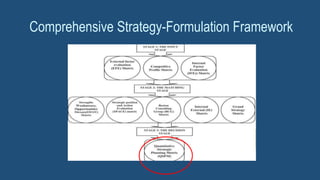
Comprehensive Strategy-Formulation Framework
Strategy
• All nine techniques in strategy
formulation required analysis as
well as intuition in assigning
weights
• This gives a shift of word
oriented to number oriented
planning which is rational to a
great extend
• But even in these methods
personal bias, emotions,
personalities and Halo error play
a dominant role
Steps to form a QSPM
1. The overall strategic management analysis is used to identify key
strategic factors. This can be done using the EFE & IFE matrix.
2. Formulation of the type of the strategy we would like to pursue. This
can be done using the SWOT analysis, SPACE matrix analysis, BCG
matrix model, or the IE matrix model.
3. Each key external and internal factor should have some weight in the
overall scheme. These weights from the IFE and EFE matrices.
4. Attractiveness Scores (AS) how each factor is important or attractive
to each alternative strategy. Attractiveness Scores are determined by
examining each key external and internal factor separately(0,1,2,3,4)
5. Total Attractiveness Scores are defined as the product of multiplying
the weights(step 3) by the Attractiveness Scores (step4) in each row.
6. Calculate the Sum Total Attractiveness Score by adding all Total
Attractiveness Scores in each strategy column of the QSPM
Rules for QSPM
• If a particular factor affects one
strategy and not other then it
affects the choice so the AS
should be recorded for both
strategies
• Scores in a row is never
duplicated
• QSPM is always prepared row-
wise
• If there is more than one
strategy in QSPM then AS scores
Limitation and advantages
Limitation
•A limitation of the QSPM is that it
can be only as good as the
prerequisite information and
matching analyses upon which it is
based.
•Requires good judgment in assigning
attractiveness scores.
•The sum total attractiveness scores
can be really close such that a final
decision is not clear.
•Like all analytical tools however, the
QSPM should not dictate decisions
but rather should be developed as
input into the owner’s final decision.
Advantages
•A QSPM provides a framework to
prioritize the strategies, it can be used
for comparing strategies at any level
such as corporate, business and
functional.
•The other positive feature of QSPM
that it integrate external and internal
factors into decision making process.
•A QSPM can be developed for small
and large scale profit and non-profit
organizations.
•Only strategies in a given set are
evaluated relative to each other
Why go for QSPM?
• QSPM approach attempts to
objectively select the best
strategy using input from other
management techniques and some
easy computations
• The QSPM method uses inputs
from stage 1 analyses, matches
them with results from stage 2
analyses, and then decides
objectively among alternative
strategies

Quantitative Strategic Planning Matrix

  • 1.
    Quantitative Strategic Planning Matrix(QSPM) NOR SYAZWANI BT NORIZAN (B1320077) SITI NURSHAKIRAH BT ADAM (B1320025) NOR LIYANA BT NORIZAN (B1320062)
  • 2.
    Introduction • Quantitative StrategicPlanning Matrix (QSPM) is a high-level strategic management approach for evaluating possible strategies • QSPM provides an analytical method for comparing feasible alternative actions • The QSPM method falls within so-called stage 3 of the strategy formulation analytical framework
  • 3.
    stage 3 ofthe strategy formulation analytical framework Stage 1 the input stage The first step in the overall strategic management analysis is used to identify key strategic factors. This can be done using, for example, the EFE matrix and IFE matrix. Stage 2 the matching stage After we identify and analyze key strategic factors as inputs for QSPM, we can formulate the type of the strategy we would like to pursue. This can be done using the stage 2 strategic management tools, for example the SWOT analysis (or TOWS), SPACE matrix analysis, BCG matrix model, or the IE matrix model. Stage 3 the decision stage The stage 1 strategic management methods provided us with key strategic factors. Based on their analysis, we formulated possible strategies in stage 2. Now, the task is to compare in QSPM alternative strategies and decide which one is the most suitable for our goals. The stage 2 strategic tools provide the needed information for setting up the Quantitative Strategic Planning Matrix - QSPM. The QSPM method allows us to evaluate alternative strategies objectively. Conceptually, the QSPM in stage 3 determines the relative attractiveness of various strategies based on the extent to which key external and internal critical success factors are capitalized upon or improved. The relative attractiveness of each strategy is computed by determining the cumulative impact of each external and internal critical success factor.
  • 4.
  • 5.
    Strategy • All ninetechniques in strategy formulation required analysis as well as intuition in assigning weights • This gives a shift of word oriented to number oriented planning which is rational to a great extend • But even in these methods personal bias, emotions, personalities and Halo error play a dominant role
  • 6.
    Steps to forma QSPM 1. The overall strategic management analysis is used to identify key strategic factors. This can be done using the EFE & IFE matrix. 2. Formulation of the type of the strategy we would like to pursue. This can be done using the SWOT analysis, SPACE matrix analysis, BCG matrix model, or the IE matrix model. 3. Each key external and internal factor should have some weight in the overall scheme. These weights from the IFE and EFE matrices. 4. Attractiveness Scores (AS) how each factor is important or attractive to each alternative strategy. Attractiveness Scores are determined by examining each key external and internal factor separately(0,1,2,3,4) 5. Total Attractiveness Scores are defined as the product of multiplying the weights(step 3) by the Attractiveness Scores (step4) in each row. 6. Calculate the Sum Total Attractiveness Score by adding all Total Attractiveness Scores in each strategy column of the QSPM
  • 7.
    Rules for QSPM •If a particular factor affects one strategy and not other then it affects the choice so the AS should be recorded for both strategies • Scores in a row is never duplicated • QSPM is always prepared row- wise • If there is more than one strategy in QSPM then AS scores
  • 8.
    Limitation and advantages Limitation •Alimitation of the QSPM is that it can be only as good as the prerequisite information and matching analyses upon which it is based. •Requires good judgment in assigning attractiveness scores. •The sum total attractiveness scores can be really close such that a final decision is not clear. •Like all analytical tools however, the QSPM should not dictate decisions but rather should be developed as input into the owner’s final decision. Advantages •A QSPM provides a framework to prioritize the strategies, it can be used for comparing strategies at any level such as corporate, business and functional. •The other positive feature of QSPM that it integrate external and internal factors into decision making process. •A QSPM can be developed for small and large scale profit and non-profit organizations. •Only strategies in a given set are evaluated relative to each other
  • 9.
    Why go forQSPM? • QSPM approach attempts to objectively select the best strategy using input from other management techniques and some easy computations • The QSPM method uses inputs from stage 1 analyses, matches them with results from stage 2 analyses, and then decides objectively among alternative strategies