Quantitative &
Qualitative Data:
A Vital Combination
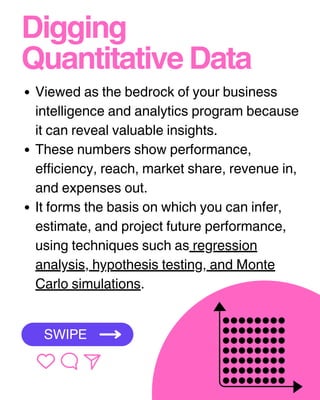
Viewed as the bedrock of your business
intelligence and analytics program because
it can reveal valuable insights.
These numbers show performance,
efficiency, reach, market share, revenue in,
and expenses out.
It forms the basis on which you can infer,
estimate, and project future performance,
using techniques such as regression
analysis, hypothesis testing, and Monte
Carlo simulations.
SWIPE
Digging
Quantitative Data
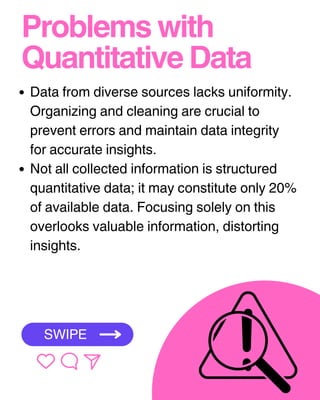
Problems with
Quantitative Data
Data from diverse sources lacks uniformity.
Organizing and cleaning are crucial to
prevent errors and maintain data integrity
for accurate insights.
Not all collected information is structured
quantitative data; it may constitute only 20%
of available data. Focusing solely on this
overlooks valuable information, distorting
insights.
SWIPE
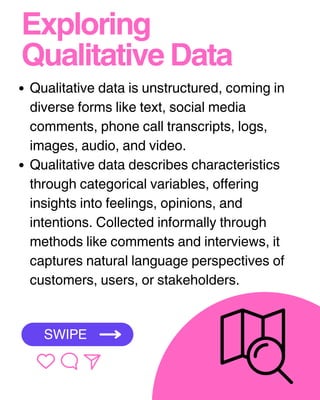
Exploring
Qualitative Data
Qualitative data is unstructured, coming in
diverse forms like text, social media
comments, phone call transcripts, logs,
images, audio, and video.
Qualitative data describes characteristics
through categorical variables, offering
insights into feelings, opinions, and
intentions. Collected informally through
methods like comments and interviews, it
captures natural language perspectives of
customers, users, or stakeholders.
SWIPE
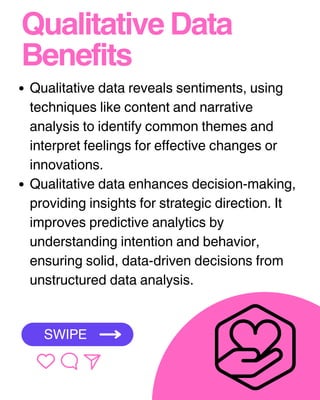
Qualitative Data
Benefits
Qualitative data reveals sentiments, using
techniques like content and narrative
analysis to identify common themes and
interpret feelings for effective changes or
innovations.
Qualitative data enhances decision-making,
providing insights for strategic direction. It
improves predictive analytics by
understanding intention and behavior,
ensuring solid, data-driven decisions from
unstructured data analysis.
SWIPE
Better together: Working
with Qualitative Data and
Quantitative data
Qualitative and quantitative data synergy
provides a holistic view, revealing both
patterns and context. Quantitative data
unveils trends, while qualitative data
explores intentions and emotions behind
the numbers.
Enables organizations to make more
accurate predictions, anticipate trends, and
proactively respond to dynamic scenarios
by considering both measurable aspects
and nuanced human elements.
SWIPE
Better together: Working
with Qualitative Data and
Quantitative data
Adding qualitative data to customer
analytics goes beyond transactions,
revealing customer experience and
sentiments. This enables tailored products,
services, and marketing strategies that
address both numerical and emotional
needs.
Continuous improvement benefits from
both data types: Quantitative metrics
optimize areas, while qualitative insights
refine processes, products, or services
iteratively.
SWIPE
YOUR PREDICTIVE INSIGHTS
www.convertml.ai
Let’s Connect
PARTNER

Quantitative & Qualitative Data_ A Vital Combination.pdf

  • 1.
  • 2.
    Viewed as thebedrock of your business intelligence and analytics program because it can reveal valuable insights. These numbers show performance, efficiency, reach, market share, revenue in, and expenses out. It forms the basis on which you can infer, estimate, and project future performance, using techniques such as regression analysis, hypothesis testing, and Monte Carlo simulations. SWIPE Digging Quantitative Data
  • 3.
    Problems with Quantitative Data Datafrom diverse sources lacks uniformity. Organizing and cleaning are crucial to prevent errors and maintain data integrity for accurate insights. Not all collected information is structured quantitative data; it may constitute only 20% of available data. Focusing solely on this overlooks valuable information, distorting insights. SWIPE
  • 4.
    Exploring Qualitative Data Qualitative datais unstructured, coming in diverse forms like text, social media comments, phone call transcripts, logs, images, audio, and video. Qualitative data describes characteristics through categorical variables, offering insights into feelings, opinions, and intentions. Collected informally through methods like comments and interviews, it captures natural language perspectives of customers, users, or stakeholders. SWIPE
  • 5.
    Qualitative Data Benefits Qualitative datareveals sentiments, using techniques like content and narrative analysis to identify common themes and interpret feelings for effective changes or innovations. Qualitative data enhances decision-making, providing insights for strategic direction. It improves predictive analytics by understanding intention and behavior, ensuring solid, data-driven decisions from unstructured data analysis. SWIPE
  • 6.
    Better together: Working withQualitative Data and Quantitative data Qualitative and quantitative data synergy provides a holistic view, revealing both patterns and context. Quantitative data unveils trends, while qualitative data explores intentions and emotions behind the numbers. Enables organizations to make more accurate predictions, anticipate trends, and proactively respond to dynamic scenarios by considering both measurable aspects and nuanced human elements. SWIPE
  • 7.
    Better together: Working withQualitative Data and Quantitative data Adding qualitative data to customer analytics goes beyond transactions, revealing customer experience and sentiments. This enables tailored products, services, and marketing strategies that address both numerical and emotional needs. Continuous improvement benefits from both data types: Quantitative metrics optimize areas, while qualitative insights refine processes, products, or services iteratively. SWIPE
  • 8.