Qualitative vs Quantitative Data – Key Differences Explained.pptx
Confused between qualitative and quantitative data? 🤔 Qualitative data is descriptive, exploring experiences and contexts, while quantitative data is numerical, measurable, and statistical. Learn when to use each for research, surveys, and analysis.
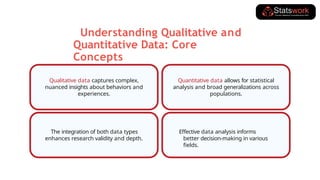
Quantitative data allowsfor statistical
analysis and broad generalizations across
populations.
Qualitative data captures complex,
nuanced insights about behaviors and
experiences.
Effective data analysis informs
better decision-making in various
fields.
The integration of both data types
enhances research validity and depth.
Understanding Qualitative and
Quantitative Data: Core
Concepts
3.
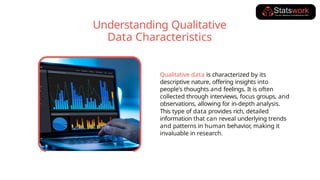
Qualitative data ischaracterized by its
descriptive nature, offering insights into
people's thoughts and feelings. It is often
collected through interviews, focus groups, and
observations, allowing for in-depth analysis.
This type of data provides rich, detailed
information that can reveal underlying trends
and patterns in human behavior, making it
invaluable in research.
Understanding Qualitative
Data Characteristics
4.
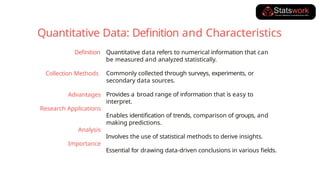
Quantitative data refersto numerical information that can
be measured and analyzed statistically.
Commonly collected through surveys, experiments, or
secondary data sources.
Provides a broad range of information that is easy to
interpret.
Enables identification of trends, comparison of groups, and
making predictions.
Involves the use of statistical methods to derive insights.
Essential for drawing data-driven conclusions in various fields.
Definition
Collection Methods
Advantages
Research Applications
Analysis
Importance
Quantitative Data: Definition and Characteristics
5.
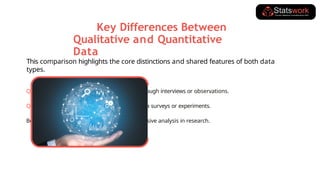
Key Differences Between
Qualitativeand Quantitative
Data
This comparison highlights the core distinctions and shared features of both data
types.
Qualitative data is descriptive and collected through interviews or observations.
Quantitative data is numerical and gathered via surveys or experiments.
Both types of data are essential for comprehensive analysis in research.
6.
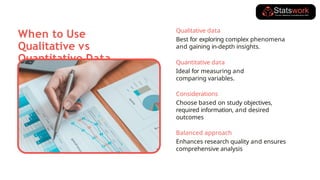
When to Use
Qualitativevs
Quantitative Data
Qualitative data
Best for exploring complex phenomena
and gaining in-depth insights.
Quantitative data
Ideal for measuring and
comparing variables.
Considerations
Choose based on study objectives,
required information, and desired
outcomes
Balanced approach
Enhances research quality and ensures
comprehensive analysis