Quality
Questioning:
What you need to know
A Summer Institute 2013 Session
presented by Katie Gray
Quality
Questioning:
What you need to know
A Summer Institute 2013 Session
presented by Katie Gray
Wait….
What?
Today’s Learning
Target:
→ I can use at least 3 strategies to create
a culture for thinking in my classroom.
A Culture for Thinking
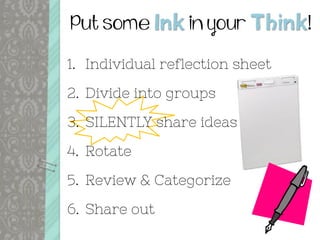
Put some Ink in your Think!
1. Individual reflection sheet
2. Divide into groups
3. SILENTLY share ideas
4. Rotate
5. Review & Categorize
6. Share out
A Culture for Thinking
What puts the
“quality” in questions?
Pre-planned!!
Fewer, deeper questions
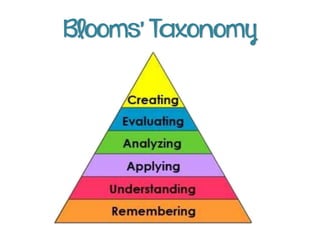
Engage students at higher
levels of thinking
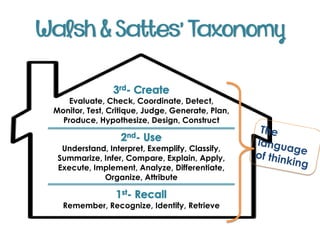
Evaluate, Check, Coordinate, Detect,
Monitor, Test, Critique, Judge, Generate, Plan,
Produce, Hypothesize, Design, Construct
Understand, Interpret, Exemplify, Classify,
Summarize, Infer, Compare, Explain, Apply,
Execute, Implement, Analyze, Differentiate,
Organize, Attribute
Remember, Recognize, Identify, Retrieve
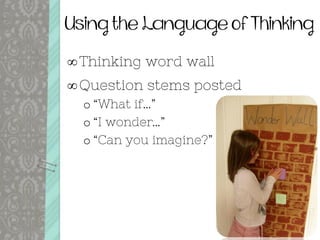
Using the Language of Thinking
Thinking word wall
Question stems posted
o “What if…”
o “I wonder…”
o “Can you imagine?”
How do we nurture
student thinking?
11 questions in 25
seconds?
Attend
to the
question
Bring into
working
memory &
decode
Search for
connection
in long-term
memory
m
a
t
c
h
Think
through
question
and
formulate
answer
Respond
aloud
11 questions in 25
seconds?
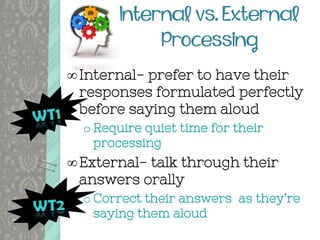
Internal- prefer to have their
responses formulated perfectly
before saying them aloud
o Require quiet time for their
processing
External- talk through their
answers orally
o Correct their answers as they’re
saying them aloud
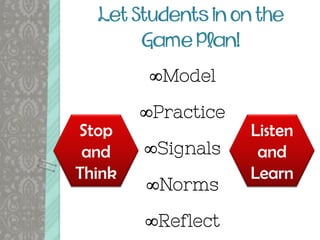
Stop
and
Think
Listen
and
Learn
10 min? 15 min?
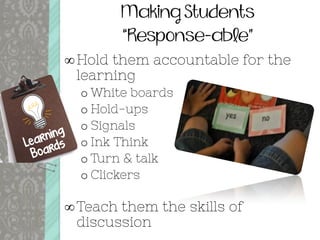
Making Students
“Response-able”
Hold them accountable for the
learning
o White boards
o Hold-ups
o Signals
o Ink Think
o Turn & talk
o Clickers
Teach them the skills of
discussion
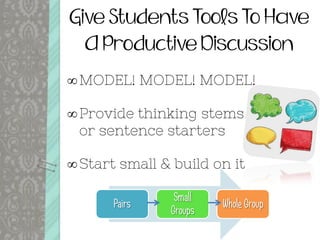
Give Students Tools To Have
A Productive Discussion
MODEL! MODEL! MODEL!
Provide thinking stems or or or
or sentence starters
Start small & build on it
Pairs
Small
Groups
Whole Group
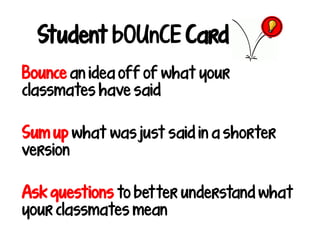
Student bOUnCE Card
Bounce an idea off of what your
classmates have said
Sum up what was just said in a shorter
version
Ask questions to better understand what
your classmates mean
Let’s Practice!
Vote with Your Feet
+
Productive Discussion
Talent is genetic.
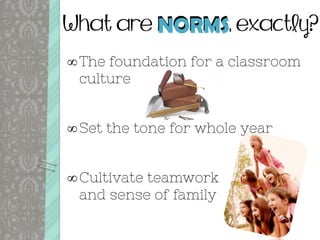
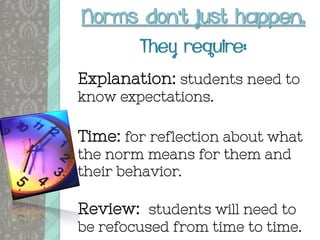
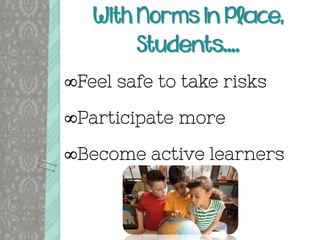
What are NORMS, exactly?
The foundation for a classroom
culture
Set the tone for whole year
Cultivate teamwork
and sense of family
NORMS
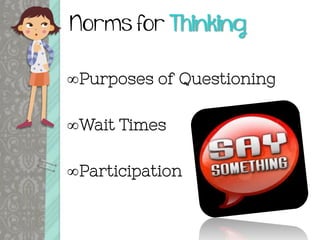
Norms for Thinking
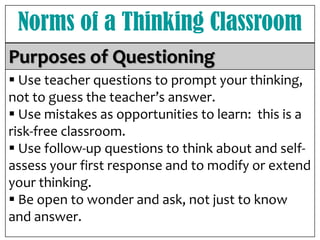
Purposes of Questioning
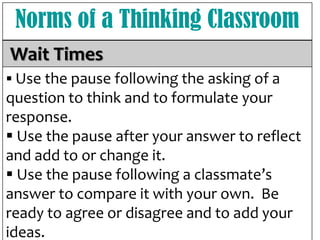
Wait Times
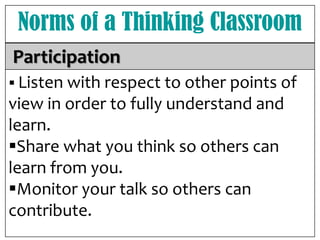
Participation
Norms of a Thinking Classroom
Purposes of Questioning
 Use teacher questions to prompt your thinking,
not to guess the teacher’s answer.
 Use mistakes as opportunities to learn: this is a
risk-free classroom.
 Use follow-up questions to think about and self-
assess your first response and to modify or extend
your thinking.
 Be open to wonder and ask, not just to know
and answer.

Norms of a Thinking Classroom
Wait Times
 Use the pause following the asking of a
question to think and to formulate your
response.

 Use the pause after your answer to reflect
and add to or change it.
 Use the pause following a classmate’s
answer to compare it with your own. Be
ready to agree or disagree and to add your
ideas.
Norms of a Thinking Classroom
Participation
 Listen with respect to other points of
view in order to fully understand and
learn.
Share what you think so others can
learn from you.
Monitor your talk so others can
contribute.
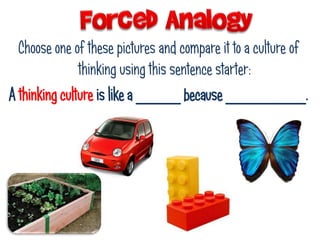
A Culture for Thinking
Choose one of these pictures and compare it to a culture of
thinking using this sentence starter:
A thinking culture is like a _____ because _________.
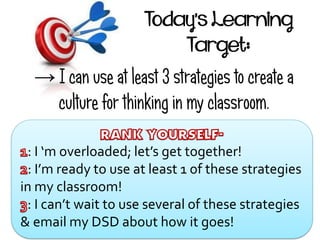
Today’s Learning
Target:
→ I can use at least 3 strategies to create a
culture for thinking in my classroom.
: I ‘m overloaded; let’s get together!
: I’m ready to use at least 1 of these strategies
in my classroom!
: I can’t wait to use several of these strategies
& email my DSD about how it goes!
Thank you so much your
participation today!
Don’t forget to “like” us on
Facebook
(www.facebook.com/pdotpage)
& follow us on Twitter
@pdotlearning!
Do you TWEET?
BISD has a new hashtag (#) that we will use
anytime any one of us engages in
professional learning or wants to connect
with fellow BISD educators
#educ8bisd

Quality Questioning: What you Need to Know

  • 1.
    Quality Questioning: What you needto know A Summer Institute 2013 Session presented by Katie Gray
  • 3.
    Quality Questioning: What you needto know A Summer Institute 2013 Session presented by Katie Gray Wait…. What?
  • 5.
    Today’s Learning Target: → Ican use at least 3 strategies to create a culture for thinking in my classroom.
  • 6.
    A Culture forThinking
  • 7.
    Put some Inkin your Think! 1. Individual reflection sheet 2. Divide into groups 3. SILENTLY share ideas 4. Rotate 5. Review & Categorize 6. Share out
  • 8.
    A Culture forThinking
  • 9.
    What puts the “quality”in questions? Pre-planned!! Fewer, deeper questions Engage students at higher levels of thinking
  • 11.
    Evaluate, Check, Coordinate,Detect, Monitor, Test, Critique, Judge, Generate, Plan, Produce, Hypothesize, Design, Construct Understand, Interpret, Exemplify, Classify, Summarize, Infer, Compare, Explain, Apply, Execute, Implement, Analyze, Differentiate, Organize, Attribute Remember, Recognize, Identify, Retrieve
  • 12.
    Using the Languageof Thinking Thinking word wall Question stems posted o “What if…” o “I wonder…” o “Can you imagine?”
  • 13.
    How do wenurture student thinking? 11 questions in 25 seconds?
  • 14.
    Attend to the question Bring into working memory& decode Search for connection in long-term memory m a t c h Think through question and formulate answer Respond aloud 11 questions in 25 seconds?
  • 16.
    Internal- prefer tohave their responses formulated perfectly before saying them aloud o Require quiet time for their processing External- talk through their answers orally o Correct their answers as they’re saying them aloud
  • 21.
  • 22.
  • 23.
    Making Students “Response-able” Hold themaccountable for the learning o White boards o Hold-ups o Signals o Ink Think o Turn & talk o Clickers Teach them the skills of discussion
  • 25.
    Give Students ToolsTo Have A Productive Discussion MODEL! MODEL! MODEL! Provide thinking stems or or or or sentence starters Start small & build on it Pairs Small Groups Whole Group
  • 26.
    Student bOUnCE Card Bouncean idea off of what your classmates have said Sum up what was just said in a shorter version Ask questions to better understand what your classmates mean
  • 27.
    Let’s Practice! Vote withYour Feet + Productive Discussion Talent is genetic.
  • 28.
    What are NORMS,exactly? The foundation for a classroom culture Set the tone for whole year Cultivate teamwork and sense of family NORMS
  • 29.
    Norms for Thinking Purposesof Questioning Wait Times Participation
  • 30.
    Norms of aThinking Classroom Purposes of Questioning  Use teacher questions to prompt your thinking, not to guess the teacher’s answer.  Use mistakes as opportunities to learn: this is a risk-free classroom.  Use follow-up questions to think about and self- assess your first response and to modify or extend your thinking.  Be open to wonder and ask, not just to know and answer.
  • 31.
    Norms of aThinking Classroom Wait Times  Use the pause following the asking of a question to think and to formulate your response.  Use the pause after your answer to reflect and add to or change it.  Use the pause following a classmate’s answer to compare it with your own. Be ready to agree or disagree and to add your ideas.
  • 32.
    Norms of aThinking Classroom Participation  Listen with respect to other points of view in order to fully understand and learn. Share what you think so others can learn from you. Monitor your talk so others can contribute.
  • 35.
    A Culture forThinking
  • 36.
    Choose one ofthese pictures and compare it to a culture of thinking using this sentence starter: A thinking culture is like a _____ because _________.
  • 37.
    Today’s Learning Target: → Ican use at least 3 strategies to create a culture for thinking in my classroom. : I ‘m overloaded; let’s get together! : I’m ready to use at least 1 of these strategies in my classroom! : I can’t wait to use several of these strategies & email my DSD about how it goes!
  • 38.
    Thank you somuch your participation today! Don’t forget to “like” us on Facebook (www.facebook.com/pdotpage) & follow us on Twitter @pdotlearning!
  • 39.
    Do you TWEET? BISDhas a new hashtag (#) that we will use anytime any one of us engages in professional learning or wants to connect with fellow BISD educators #educ8bisd