Running Head: QUALITY IMPROVEMENT IN THE EMERGENCY DEPARTMENT 1
Quality Improvement in the Emergency Department
Davis Kivairo Chore
Health Quality Management
QUALITY IMPROVEMENT IN THE EMERGENCY DEPARTMENT 2
Contents
Quality Improvement in the Emergency Department..................................................................... 4
Introduction................................................................................................................................. 4
Goal............................................................................................................................................. 4
Problem statement....................................................................................................................... 5
Approach..................................................................................................................................... 5
Management................................................................................................................................ 6
Audit/ Assessment....................................................................................................................... 9
Communication........................................................................................................................... 9
Technology................................................................................................................................ 10
Staff Recruitment ...................................................................................................................... 11
Training and Education............................................................................................................. 11
Clinical Process Guidance......................................................................................................... 12
Triage workflow .................................................................................................................... 12
Streaming............................................................................................................................... 13
Rapid Assessment system...................................................................................................... 14
Performance Measures .............................................................................................................. 15
Evaluation.............................................................................................................................. 15
Monitoring............................................................................................................................. 17
Conclusion................................................................................................................................. 17
QUALITY IMPROVEMENT IN THE EMERGENCY DEPARTMENT 3
References ................................................................................................................................. 18
QUALITY IMPROVEMENT IN THE EMERGENCY DEPARTMENT 4
Quality Improvement in the Emergency Department
Introduction
Emergency departments are facing increasing challenges worldwide due to increased
patient numbers and an inability to flex capacity to meet demand. Approximately 54% of
worldwide morbidity and mortality is due to emergency conditions that are necessary for patient
health example time taken to see a physician ("Defining quality indicators for emergency care
delivery: findings of an expert consensus process by emergency care practitioners in Africa,"
2018). Emergency Department (ED) crowding and inefficient performance are the biggest
barriers to timely and adequate medical delivery in the emergency care area. Overcrowded ED
cause problems to the patients and caregivers, such as increased waiting time, medical errors,
mortality rates, and financial loss("Emergency Department Quality Improvement: Transforming
the Delivery of Care," 2019). Crowding occurs when demands placed on the ED are greater than
the entire hospital's capacity to ensure timely care in the ED. Reducing the time taken by each
patient is key in reducing the emergency area overcrowding. According to The Royal College Of
Emergency Medicine, 2019, emergency care system key performance indicators include the
number of patients left unattended to, re-attendance rate, time to initial assessment, and total time
in the ED. Service delivery in emergency care should be effective, patient-centered, timely,
efficient equitable to all, and safe to both the staff and patient.
Goal
The main goal for quality improvement in the ED is to reduce the patient waiting time by
less than 30 minutes and ED consultation to within 120 minutes. This will enable serve the
patients in the ED timely and effectively to reduce the number of patients leaving the hospital
unattended hence improving patients' outcomes and increase in hospital revenue generation. In
QUALITY IMPROVEMENT IN THE EMERGENCY DEPARTMENT 5
the cultural aspect, the ED will honor the individual patient and respect each one choice and
ideas in ensuring better service provision to the patients. The ED will provide quality medical
care to all patients without racial and ethnic segregation. The quality improvement strategies will
provide security and ensure quality in service delivery in the hospital. The quality improvement
team will provide information on every program executed to ensure accountability in service
provision.
Problem statement
Overcrowding is a problem in every emergency area due to the ED mandate of providing
medical care to the patients and the shortage of primary care providers. ("Emergency Department
Quality Improvement: Transforming the Delivery of Care," 2019). Overcrowding and limited
staff in the ED have led to patients leaving unattended, excessive wait times, increased patient
mortality in the ED and staff exhaustion hence negatively impacting throughput and patients’
experience. ED overcrowding has led to reduced hospital income, negative healthcare outcomes
and dissatisfaction among patients and staff. Redesigning the delivery of care through emergency
department quality improvement is necessary to ensure an improved patient experience of care
and reduce the cost of service delivery.
Approach
Emergency area quality comprises structure and resource availability, service delivery
process and health outcomes such as morbidity and mortality. Quality improvement in the ED
involves improving the patent experience, improving the health of populations and reducing the
cost of healthcare services. The quality improvement team will use the analytics platform to
analyze the challenges, evaluate the findings, develop a solution and monitor the performance.
The team will monitor the number of patients visiting the hospital, the number of patients
QUALITY IMPROVEMENT IN THE EMERGENCY DEPARTMENT 6
attended and unattended, and the time taken by each patient in the ED before admission or
discharge. Information sharing and idea generation through engagement with frontline staff, key
stakeholders, patients, and families will be used in developing solutions for better service
delivery.
Management
Building a management team with great skills is important in ensuring better leadership,
patient safety, better service delivery, and improved patients outcome. Leadership is important in
monitoring and enforcing the rules within the organization. Communication leadership
establishes the lineage of communication and coordination within the ED hence smooth
workflow. The management will provide accountability in the implementation of quality
improvement strategies. The management will be responsible for providing a detailed
implementation plan, the resources required and the workforce for the implementation of
projects. The management will ensure formal and efficient collaboration between staff, patients,
Identify Goals and
Strategies
Plan Approach
Estimate time and
expences
Identify performance
measures
QUALITY IMPROVEMENT IN THE EMERGENCY DEPARTMENT 7
community, management, and stakeholders in idea generation, problem-solving and participation
in the implementation framework.
The quality improvement team will include Head of Quality assurance, ED physicians,
ED nurses, and quality improvement specialists, representatives from radiology, pharmacy,
registration, behavioral health, ambulance team, patients, community, laboratory, and security.
The ED team leader, senior ED nurse and the physician, and a technical leader will head the
quality improvement team and supervised by the quality assurance manager. The ED team leader
will be responsible for communicating information on the strategies implementation plan and
overseeing the day to day flow of patients in the ED. The senior ED physician and nurse will
oversee the performance of the physician and nurses in the ED respectively. This will enable
them to recognize the challenges and implications of the quality improvement program. A
technical leader will guide other technical and support staff in the ED.
Plan-Do-Study-Act (PDSA) process will be used evaluation of quality improvement
measures. The hospital quality management team will conduct planning for any changes in the
Head of Quality
Assuarance
Day-to-day
Leader
Incharge of day-
to-day staff in
the ED
Senoir ED
Leader
Incharge of all
Representatives
of ED Staff
Technical Leader
Incharge of
Technical
Operation of ED
QUALITY IMPROVEMENT IN THE EMERGENCY DEPARTMENT 8
ED, carry out the test on the changes enacted, collect and analyze data on the effect of the change
on the overall performance of the ED, identify gaps and problems, learn and develop solutions to
improve the overall service delivery in the ED.
Emergency area improvement will take place in 3 months from January 2021 to March
2021 to enable proper communication and sensitization of patients and staff on new changes in
the ED. The quality improvement team will source funds through stakeholder funding and bank
loan that will be used in the implementation of strategies to improve service delivery in the ED.
ED systems Framework
The main causes for roadblocks to patient flow in the ED are long waiting period for a
physician specialist consult, long wait for laboratory and radiology report, improper movement
and poor leadership in the ED ("Section 4. Identifying Strategies," n.d.). Performance
improvement methodologies, process mapping, evaluation, and monitoring is important in the
identification of specific causes of blockages. Improving emergency care will involve improving
the patient experience of care, improving the staff and patients' ED environment, and reducing
Data gathering
and monitoring
Identification of
gaps and
solutions
Measuring
Performance
Making and
Analysis of
Improvements
Corrective
action plans
QUALITY IMPROVEMENT IN THE EMERGENCY DEPARTMENT 9
the per capita cost of care in the ED. Standard guidelines are important in the systematical
organization of hospital activities to ensure efficiency and accountability. Performance
improvement methodologies such as training and inclusion of technology in the delivery of
service in the ED will be used to ensure the goals of the hospital are met. The finance department
will conduct internal and invite external auditors to evaluate the accounts for accountability.
Audit/ Assessment
The quality improvement will develop a Hospital Emergency Unit Assessment Tool
(HEAT) that will be used in the internal auditing of the procedures, personnel, and Equipment in
the ED. HEAT will be used in evaluating the functions of an emergency unit, develop a
validation system for instruments and tools, identify the gaps for implementation of standards
and allow partners to develop target strategies for emergency unit improvements. The hospital
record such as emergency department records, nursing notes, operative records, admission
records, treatment records, and discharge summary will be analyzed and evaluated to identify
better strategies for quality improvement.
Communication
Effective communication and interpersonal relationship skills are fundamental to the
quality service delivery in the ED. The management will describe, map and analyze
communication framework to ensure timely and efficient communication between staff to staff,
patients, management, and stakeholders. The communication framework will ensure the use of
languages that are understood by the local community example in Kenya Kiswahili and English
since they are the official language of communication. Technology use is important in delivering
information directly to patients or staff. Messaging will be used to transmit information directly
to patients and staff. Each department will conduct a weekly meeting to discuss the challenges
QUALITY IMPROVEMENT IN THE EMERGENCY DEPARTMENT 10
and effective measures in the quality improvement program. The leader of every department will
conduct a discussion for 40 minutes to review, discuss and analyze the improvement measures
and proposed corrective action.
Engaging staff, patients, community, and stakeholders throughout the planning, and
implementation of patient flow in the ED is important in ensuring a strategic and lasting change.
The quality improvement team will enhance adopting staff and patient-driven strategies to
encourage the provision of valuable perspectives, knowledge, understanding, and expertise in
ensuring better service delivery (Health Sciences Research Commons | Himmelfarb Health
Sciences Library, The George Washington University, n.d.).
Technology
The hospital will develop an electronic health records system that will be used in
registering, storing, and coordination of patients in the ED. The real-time capture and
transmission of ED data for processing for example in medication administration will be used to
improve the flow patients, staff coordination and mobilization of resources during a surge in the
ED. Automated discharge and referral systems will ensure effective and efficient organization of
bed capacity in the hospital. Automated discharge and referral systems will be installed to
monitor the availability of beds, establish resource constraints and facilitate information transfer
for admitted and referral patients hence ensuring adequate coordination in the ED.
QUALITY IMPROVEMENT IN THE EMERGENCY DEPARTMENT 11
Staff Recruitment
The staffing will be redesign to ensure the right amount of staff are at the right time and
in the right place in the ED. Analytics information will be used to establish critical areas and
staff mobilization techniques to be used. The hospital will employ staff with the right skill mix
and expertise to work in the ED. Staff design patterns will be based on seasonality in volume
trends, data prediction on upcoming high volume trends and historical trends. The analysis will
enable the management to understand and respond to surges in volume, hence efficient and
quality service delivery in the ED. The ED will be led by a senior physician who holds a
certificate in Emergency Medicine.
Training and Education
An Emergency Unit Management Course will be introduced to provide a curriculum and
study schedule for the staff. The course will be carried out in 3 weeks will train on the use of
triage, new standard guidelines, rules, and responsibilities of each person in the ED. The training
will involve short courses and workshops to teach the emergency service providers on the
Areas for
priority
action
Standards
and
Guidelines
Technology
to improve
Service
Delivery
Formal
triage and
Protocols
Training
and
Education
Developing
workflow
systems
QUALITY IMPROVEMENT IN THE EMERGENCY DEPARTMENT 12
systematic assessment and management of time-sensitive conditions such as injury, stroke, heart
attack, and pediatrics. Continuous educational training on knowledge and skills to perform
diagnostic and therapeutic activities is important in ensuring safe and successful medical service
delivery. Given the rapidly expanding volume of medical information and the wide variety of
conditions that present to an ED example COVID 19, an integrated information resources
sharing system will be established to promote the idea and knowledge sharing information,
procedure or practice that were unheard of during training or new to the system. The hospital
website will provide a section for medical reference to facilitate remote viewing, subject
searches, routine errata, and addendums. ED programs will use high fidelity patient simulators to
enhance teaching and evaluation of core competencies among trainees hence reducing the
administrative and cost burdens of individual programs. A monthly assessment will be conducted
by the quality improvement team to evaluate the trainees’ performance and award certificate to
the staff.
Clinical Process Guidance
Triage workflow
Triage is a brief intervention used to identify patients needing immediate care. Triage will
operate appropriately timely and with the required urgency to avoid under triage or over triage.
Correct assessment of patient urgency will be performed according to the standard guidelines
and recommendations to ensure patients' safety and satisfaction in the ED. Triage will be
performed by the senior physicians to accelerate patient flow in the ED, reduce admissions and
improve time to key decision making. According to CDC 2010-2011 ED report (2014), the
median wait times to be treated in the ED was 30 minutes and the median treatment time was
more than 90 minutes, hence the average recommended time for a physician to respond to a
QUALITY IMPROVEMENT IN THE EMERGENCY DEPARTMENT 13
request will be 30 minutes and complete consultation within 120 minutes in ED ("QuickStats:
Median Emergency Department (ED) Wait and Treatment Times,* by Triage Level† — National
Hospital Ambulatory Medical Care Survey, United States, 2010–2011§," 2014). A designated
resuscitation area to ensure critical patients are identified to all staff and needed resources are
hand to deliver lifesaving care. The ED will develop separate Pediatric areas for children and
plan compliant rooms to enhance vigilance in service provision. For effective and efficient
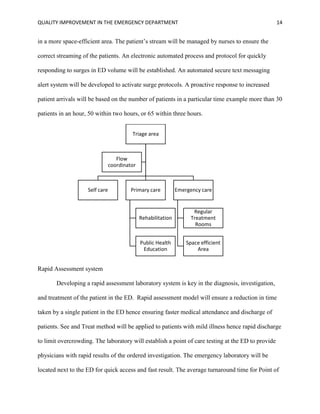
workflow in the triage area, a flow coordinator will be in charge of establishing surge,
communicating and coordinating the workflow process.
Emergency Department Flow Chart
Streaming
Streaming is the process of allocating similar patients with the same disease severity and
complaints to a particular workstream. The patient's streaming system will be based on the type
of care required for example self-care, primary care, and emergency care. Higher-acuity patients
will be placed in regular treatment rooms while patients who are not critically ill will be treated
Patients Arrival Registration Triage
Consultations
Interventions
Discharge/Admission
QUALITY IMPROVEMENT IN THE EMERGENCY DEPARTMENT 14
in a more space-efficient area. The patient’s stream will be managed by nurses to ensure the
correct streaming of the patients. An electronic automated process and protocol for quickly
responding to surges in ED volume will be established. An automated secure text messaging
alert system will be developed to activate surge protocols. A proactive response to increased
patient arrivals will be based on the number of patients in a particular time example more than 30
patients in an hour, 50 within two hours, or 65 within three hours.
Rapid Assessment system
Developing a rapid assessment laboratory system is key in the diagnosis, investigation,
and treatment of the patient in the ED. Rapid assessment model will ensure a reduction in time
taken by a single patient in the ED hence ensuring faster medical attendance and discharge of
patients. See and Treat method will be applied to patients with mild illness hence rapid discharge
to limit overcrowding. The laboratory will establish a point of care testing at the ED to provide
physicians with rapid results of the ordered investigation. The emergency laboratory will be
located next to the ED for quick access and fast result. The average turnaround time for Point of
Triage area
Self care Primary care
Rehabilitation
Public Health
Education
Emergency care
Regular
Treatment
Rooms
Space efficient
Area
Flow
coordinator
QUALITY IMPROVEMENT IN THE EMERGENCY DEPARTMENT 15
Care Testing Laboratory results will be within one hour. Real-time PCR tests, rapid malaria
diagnosis, rapid glucose, hemoglobin levels, meningitis, and occult blood tests will be done at
the ED laboratory to expedite diagnosis, improve the accuracy of clinical decision making and
speedy recovery of the patients.
Performance Measures
Evaluation
Developing guidelines for personnel, equipment, management and patient care is critical
in healthcare service delivery. Standardization is important in developing strategies,
implementation plans, and evaluation mechanisms to ensure guidelines are followed hence
customer satisfaction and personnel safety. The standards protocol and operation guidelines will
be developed through research, cooperation among all stakeholders, and by following guidelines
of the recommended educational materials. Patients, staff, and management will participate in
developing standards to ensure the decision made are user friendly. Evaluation of emergency
care compliance to the standard operating guidelines will be to ensure better patients outcomes
and a healthy population.
An internal audit will be developed and conducted for products, services, and the quality
assurance system to measure the effectiveness of improvement objectives. The performance
measurements will be based on time of patient arrival to time assessed by a qualified medical
provider, percentage of patients who left without seeing a doctor, time from arrival to disposition
order, percentage of patients who left before completing treatment, time from discharge order to
ED departure time, number of patients who are discharged and admitted, and patient satisfaction
outcomes. An internal audit will be conducted by the quality improvement team to establish gaps
and find solutions. Trained internal reviewers will conduct a systematic and comprehensive
QUALITY IMPROVEMENT IN THE EMERGENCY DEPARTMENT 16
internal assessment on essential components in the ED and on the pre-established standards to
identify gaps, and offer training to help improve service delivery.
External peer evaluation is important in establishing areas for quality improvement and
developing a positive reputation in an organization. An independent organization will conduct an
audit of the ED efficiency on service delivery for accreditation or certification. Accreditation will
improve the quality of patient care, assessment, and evaluation of the healthcare system by
providing a commitment to continuous improvement ("Accreditation of Emergency Department
at a Teaching Hospital in Tehran University of Medical Sciences in 2010," 2011).
Questionnaires of quality and patient safety will be used in the ED to evaluate the quality and
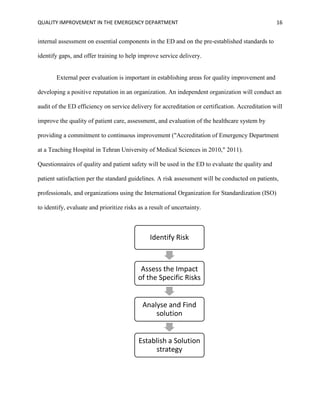
patient satisfaction per the standard guidelines. A risk assessment will be conducted on patients,
professionals, and organizations using the International Organization for Standardization (ISO)
to identify, evaluate and prioritize risks as a result of uncertainty.
Identify Risk
Assess the Impact
of the Specific Risks
Analyse and Find
solution
Establish a Solution
strategy
QUALITY IMPROVEMENT IN THE EMERGENCY DEPARTMENT 17
Monitoring
According to Becker’s Hospital Review, negative patient experience in the ED affects all
aspects of patient satisfaction (Jeffrey Frank, MD, MBA, Director of Quality and Performance,
CEP America, n.d.).Patients and staff feedback are important in understanding the performance
of ED and improving staff and patient experience. The leadership will conduct a patient and staff
experience training, review patient feedback, develop quality improvement program and
communicate feedback to the staff and patients. Emergency care data and quality guidance will
be established to track the activities and will be used in designing future improvement strategies.
Leaders will perform daily rounds to evaluate the performance of the ED, report any incident and
develop improvement programs to ensure effective and efficient service delivery in the ED hence
patients’ satisfaction. A comparison system through benchmarking from peers and creating
standardization metrics will be developed to measure the ED performance.
Conclusion
Quality improvement is important in ensuring continuous development in service
delivery, design or staff education hence a continuous improvement in patient outcome. Patient
satisfaction begins in the ED, service delivery in the ED should be exemplary to ensure a better
reputation for the hospital in the community and among patients. Quality improvement in the ED
will improve patients’ outcomes, the process of care and reduce mortality due to ED delay.
Prolonged emergency waiting time and deficiencies in emergency area resources such as
qualified nurse and physicians are the main reason for deaths in the ED, hence proper design,
adequate and qualified staff, and proper standard operating procedures are important in ensuring
effective and efficient workflow in the ED hence reduced ED mortality and other complications.
QUALITY IMPROVEMENT IN THE EMERGENCY DEPARTMENT 18
References
Accreditation of Emergency Department at a Teaching Hospital in Tehran University of
Medical Sciences in 2010. (2011, September 20). Home · Science
Publications. https://thescipub.com/abstract/10.3844/ajebasp.2011.498.505
Defining quality indicators for emergency care delivery: findings of an expert consensus
process by emergency care practitioners in Africa. (2018, February 1). BMJ Global
Health. https://gh.bmj.com/content/3/1/e000479
Emergency Department Quality Improvement: Transforming the Delivery of Care. (2019,
October 29). Health Catalyst. https://www.healthcatalyst.com/insights/emergency-
department-quality-improvement-transforming-delivery-care
(n.d.). Health Sciences Research Commons | Himmelfarb Health Sciences Library, The George
Washington
University. https://hsrc.himmelfarb.gwu.edu/cgi/viewcontent.cgi?referer=https://scholar.
google.com/&httpsredir=1&article=1041&context=sphhs_policy_facpubs
Jeffrey Frank, MD, MBA, Director of Quality and Performance, CEP America.
(n.d.). Improving patient satisfaction begins in the emergency department: Studies show
that no matter how positive the patient experience is in the hospital, no matter how much
they like their nurses, hospitalists or other providers if patients have a negative
experience in the emergency department (ED), it will affect all aspects of patient
satisfaction. Becker's Hospital Review. https://www.beckershospitalreview.com/patient-
experience/improving-patient-satisfaction-begins-in-the-emergency-department.html
QuickStats: Median Emergency Department (ED) Wait and Treatment Times,* by Triage Level†
— National Hospital Ambulatory Medical Care Survey, United States, 2010–2011§.
QUALITY IMPROVEMENT IN THE EMERGENCY DEPARTMENT 19
(2014, May 16). Centers for Disease Control and
Prevention. https://www.cdc.gov/mmwr/preview/mmwrhtml/mm6319a8.htm
The Royal College of Emergency Medicine. (2019). Improving Quality Indicators and System
Metrics for Emergency Departments in
England. https://www.rcem.ac.uk/docs/Policy/RCEM_position_statement_Improving_q
uality_indicators_and_system_metrics.pdf
Section 4. Identifying Strategies. (n.d.). Agency for Health Research and
Quality. https://www.ahrq.gov/research/findings/final-reports/ptflow/section4.html

Quality Improvement in the Emergency Department

  • 1.
    Running Head: QUALITYIMPROVEMENT IN THE EMERGENCY DEPARTMENT 1 Quality Improvement in the Emergency Department Davis Kivairo Chore Health Quality Management
  • 2.
    QUALITY IMPROVEMENT INTHE EMERGENCY DEPARTMENT 2 Contents Quality Improvement in the Emergency Department..................................................................... 4 Introduction................................................................................................................................. 4 Goal............................................................................................................................................. 4 Problem statement....................................................................................................................... 5 Approach..................................................................................................................................... 5 Management................................................................................................................................ 6 Audit/ Assessment....................................................................................................................... 9 Communication........................................................................................................................... 9 Technology................................................................................................................................ 10 Staff Recruitment ...................................................................................................................... 11 Training and Education............................................................................................................. 11 Clinical Process Guidance......................................................................................................... 12 Triage workflow .................................................................................................................... 12 Streaming............................................................................................................................... 13 Rapid Assessment system...................................................................................................... 14 Performance Measures .............................................................................................................. 15 Evaluation.............................................................................................................................. 15 Monitoring............................................................................................................................. 17 Conclusion................................................................................................................................. 17
  • 3.
    QUALITY IMPROVEMENT INTHE EMERGENCY DEPARTMENT 3 References ................................................................................................................................. 18
  • 4.
    QUALITY IMPROVEMENT INTHE EMERGENCY DEPARTMENT 4 Quality Improvement in the Emergency Department Introduction Emergency departments are facing increasing challenges worldwide due to increased patient numbers and an inability to flex capacity to meet demand. Approximately 54% of worldwide morbidity and mortality is due to emergency conditions that are necessary for patient health example time taken to see a physician ("Defining quality indicators for emergency care delivery: findings of an expert consensus process by emergency care practitioners in Africa," 2018). Emergency Department (ED) crowding and inefficient performance are the biggest barriers to timely and adequate medical delivery in the emergency care area. Overcrowded ED cause problems to the patients and caregivers, such as increased waiting time, medical errors, mortality rates, and financial loss("Emergency Department Quality Improvement: Transforming the Delivery of Care," 2019). Crowding occurs when demands placed on the ED are greater than the entire hospital's capacity to ensure timely care in the ED. Reducing the time taken by each patient is key in reducing the emergency area overcrowding. According to The Royal College Of Emergency Medicine, 2019, emergency care system key performance indicators include the number of patients left unattended to, re-attendance rate, time to initial assessment, and total time in the ED. Service delivery in emergency care should be effective, patient-centered, timely, efficient equitable to all, and safe to both the staff and patient. Goal The main goal for quality improvement in the ED is to reduce the patient waiting time by less than 30 minutes and ED consultation to within 120 minutes. This will enable serve the patients in the ED timely and effectively to reduce the number of patients leaving the hospital unattended hence improving patients' outcomes and increase in hospital revenue generation. In
  • 5.
    QUALITY IMPROVEMENT INTHE EMERGENCY DEPARTMENT 5 the cultural aspect, the ED will honor the individual patient and respect each one choice and ideas in ensuring better service provision to the patients. The ED will provide quality medical care to all patients without racial and ethnic segregation. The quality improvement strategies will provide security and ensure quality in service delivery in the hospital. The quality improvement team will provide information on every program executed to ensure accountability in service provision. Problem statement Overcrowding is a problem in every emergency area due to the ED mandate of providing medical care to the patients and the shortage of primary care providers. ("Emergency Department Quality Improvement: Transforming the Delivery of Care," 2019). Overcrowding and limited staff in the ED have led to patients leaving unattended, excessive wait times, increased patient mortality in the ED and staff exhaustion hence negatively impacting throughput and patients’ experience. ED overcrowding has led to reduced hospital income, negative healthcare outcomes and dissatisfaction among patients and staff. Redesigning the delivery of care through emergency department quality improvement is necessary to ensure an improved patient experience of care and reduce the cost of service delivery. Approach Emergency area quality comprises structure and resource availability, service delivery process and health outcomes such as morbidity and mortality. Quality improvement in the ED involves improving the patent experience, improving the health of populations and reducing the cost of healthcare services. The quality improvement team will use the analytics platform to analyze the challenges, evaluate the findings, develop a solution and monitor the performance. The team will monitor the number of patients visiting the hospital, the number of patients
  • 6.
    QUALITY IMPROVEMENT INTHE EMERGENCY DEPARTMENT 6 attended and unattended, and the time taken by each patient in the ED before admission or discharge. Information sharing and idea generation through engagement with frontline staff, key stakeholders, patients, and families will be used in developing solutions for better service delivery. Management Building a management team with great skills is important in ensuring better leadership, patient safety, better service delivery, and improved patients outcome. Leadership is important in monitoring and enforcing the rules within the organization. Communication leadership establishes the lineage of communication and coordination within the ED hence smooth workflow. The management will provide accountability in the implementation of quality improvement strategies. The management will be responsible for providing a detailed implementation plan, the resources required and the workforce for the implementation of projects. The management will ensure formal and efficient collaboration between staff, patients, Identify Goals and Strategies Plan Approach Estimate time and expences Identify performance measures
  • 7.
    QUALITY IMPROVEMENT INTHE EMERGENCY DEPARTMENT 7 community, management, and stakeholders in idea generation, problem-solving and participation in the implementation framework. The quality improvement team will include Head of Quality assurance, ED physicians, ED nurses, and quality improvement specialists, representatives from radiology, pharmacy, registration, behavioral health, ambulance team, patients, community, laboratory, and security. The ED team leader, senior ED nurse and the physician, and a technical leader will head the quality improvement team and supervised by the quality assurance manager. The ED team leader will be responsible for communicating information on the strategies implementation plan and overseeing the day to day flow of patients in the ED. The senior ED physician and nurse will oversee the performance of the physician and nurses in the ED respectively. This will enable them to recognize the challenges and implications of the quality improvement program. A technical leader will guide other technical and support staff in the ED. Plan-Do-Study-Act (PDSA) process will be used evaluation of quality improvement measures. The hospital quality management team will conduct planning for any changes in the Head of Quality Assuarance Day-to-day Leader Incharge of day- to-day staff in the ED Senoir ED Leader Incharge of all Representatives of ED Staff Technical Leader Incharge of Technical Operation of ED
  • 8.
    QUALITY IMPROVEMENT INTHE EMERGENCY DEPARTMENT 8 ED, carry out the test on the changes enacted, collect and analyze data on the effect of the change on the overall performance of the ED, identify gaps and problems, learn and develop solutions to improve the overall service delivery in the ED. Emergency area improvement will take place in 3 months from January 2021 to March 2021 to enable proper communication and sensitization of patients and staff on new changes in the ED. The quality improvement team will source funds through stakeholder funding and bank loan that will be used in the implementation of strategies to improve service delivery in the ED. ED systems Framework The main causes for roadblocks to patient flow in the ED are long waiting period for a physician specialist consult, long wait for laboratory and radiology report, improper movement and poor leadership in the ED ("Section 4. Identifying Strategies," n.d.). Performance improvement methodologies, process mapping, evaluation, and monitoring is important in the identification of specific causes of blockages. Improving emergency care will involve improving the patient experience of care, improving the staff and patients' ED environment, and reducing Data gathering and monitoring Identification of gaps and solutions Measuring Performance Making and Analysis of Improvements Corrective action plans
  • 9.
    QUALITY IMPROVEMENT INTHE EMERGENCY DEPARTMENT 9 the per capita cost of care in the ED. Standard guidelines are important in the systematical organization of hospital activities to ensure efficiency and accountability. Performance improvement methodologies such as training and inclusion of technology in the delivery of service in the ED will be used to ensure the goals of the hospital are met. The finance department will conduct internal and invite external auditors to evaluate the accounts for accountability. Audit/ Assessment The quality improvement will develop a Hospital Emergency Unit Assessment Tool (HEAT) that will be used in the internal auditing of the procedures, personnel, and Equipment in the ED. HEAT will be used in evaluating the functions of an emergency unit, develop a validation system for instruments and tools, identify the gaps for implementation of standards and allow partners to develop target strategies for emergency unit improvements. The hospital record such as emergency department records, nursing notes, operative records, admission records, treatment records, and discharge summary will be analyzed and evaluated to identify better strategies for quality improvement. Communication Effective communication and interpersonal relationship skills are fundamental to the quality service delivery in the ED. The management will describe, map and analyze communication framework to ensure timely and efficient communication between staff to staff, patients, management, and stakeholders. The communication framework will ensure the use of languages that are understood by the local community example in Kenya Kiswahili and English since they are the official language of communication. Technology use is important in delivering information directly to patients or staff. Messaging will be used to transmit information directly to patients and staff. Each department will conduct a weekly meeting to discuss the challenges
  • 10.
    QUALITY IMPROVEMENT INTHE EMERGENCY DEPARTMENT 10 and effective measures in the quality improvement program. The leader of every department will conduct a discussion for 40 minutes to review, discuss and analyze the improvement measures and proposed corrective action. Engaging staff, patients, community, and stakeholders throughout the planning, and implementation of patient flow in the ED is important in ensuring a strategic and lasting change. The quality improvement team will enhance adopting staff and patient-driven strategies to encourage the provision of valuable perspectives, knowledge, understanding, and expertise in ensuring better service delivery (Health Sciences Research Commons | Himmelfarb Health Sciences Library, The George Washington University, n.d.). Technology The hospital will develop an electronic health records system that will be used in registering, storing, and coordination of patients in the ED. The real-time capture and transmission of ED data for processing for example in medication administration will be used to improve the flow patients, staff coordination and mobilization of resources during a surge in the ED. Automated discharge and referral systems will ensure effective and efficient organization of bed capacity in the hospital. Automated discharge and referral systems will be installed to monitor the availability of beds, establish resource constraints and facilitate information transfer for admitted and referral patients hence ensuring adequate coordination in the ED.
  • 11.
    QUALITY IMPROVEMENT INTHE EMERGENCY DEPARTMENT 11 Staff Recruitment The staffing will be redesign to ensure the right amount of staff are at the right time and in the right place in the ED. Analytics information will be used to establish critical areas and staff mobilization techniques to be used. The hospital will employ staff with the right skill mix and expertise to work in the ED. Staff design patterns will be based on seasonality in volume trends, data prediction on upcoming high volume trends and historical trends. The analysis will enable the management to understand and respond to surges in volume, hence efficient and quality service delivery in the ED. The ED will be led by a senior physician who holds a certificate in Emergency Medicine. Training and Education An Emergency Unit Management Course will be introduced to provide a curriculum and study schedule for the staff. The course will be carried out in 3 weeks will train on the use of triage, new standard guidelines, rules, and responsibilities of each person in the ED. The training will involve short courses and workshops to teach the emergency service providers on the Areas for priority action Standards and Guidelines Technology to improve Service Delivery Formal triage and Protocols Training and Education Developing workflow systems
  • 12.
    QUALITY IMPROVEMENT INTHE EMERGENCY DEPARTMENT 12 systematic assessment and management of time-sensitive conditions such as injury, stroke, heart attack, and pediatrics. Continuous educational training on knowledge and skills to perform diagnostic and therapeutic activities is important in ensuring safe and successful medical service delivery. Given the rapidly expanding volume of medical information and the wide variety of conditions that present to an ED example COVID 19, an integrated information resources sharing system will be established to promote the idea and knowledge sharing information, procedure or practice that were unheard of during training or new to the system. The hospital website will provide a section for medical reference to facilitate remote viewing, subject searches, routine errata, and addendums. ED programs will use high fidelity patient simulators to enhance teaching and evaluation of core competencies among trainees hence reducing the administrative and cost burdens of individual programs. A monthly assessment will be conducted by the quality improvement team to evaluate the trainees’ performance and award certificate to the staff. Clinical Process Guidance Triage workflow Triage is a brief intervention used to identify patients needing immediate care. Triage will operate appropriately timely and with the required urgency to avoid under triage or over triage. Correct assessment of patient urgency will be performed according to the standard guidelines and recommendations to ensure patients' safety and satisfaction in the ED. Triage will be performed by the senior physicians to accelerate patient flow in the ED, reduce admissions and improve time to key decision making. According to CDC 2010-2011 ED report (2014), the median wait times to be treated in the ED was 30 minutes and the median treatment time was more than 90 minutes, hence the average recommended time for a physician to respond to a
  • 13.
    QUALITY IMPROVEMENT INTHE EMERGENCY DEPARTMENT 13 request will be 30 minutes and complete consultation within 120 minutes in ED ("QuickStats: Median Emergency Department (ED) Wait and Treatment Times,* by Triage Level† — National Hospital Ambulatory Medical Care Survey, United States, 2010–2011§," 2014). A designated resuscitation area to ensure critical patients are identified to all staff and needed resources are hand to deliver lifesaving care. The ED will develop separate Pediatric areas for children and plan compliant rooms to enhance vigilance in service provision. For effective and efficient workflow in the triage area, a flow coordinator will be in charge of establishing surge, communicating and coordinating the workflow process. Emergency Department Flow Chart Streaming Streaming is the process of allocating similar patients with the same disease severity and complaints to a particular workstream. The patient's streaming system will be based on the type of care required for example self-care, primary care, and emergency care. Higher-acuity patients will be placed in regular treatment rooms while patients who are not critically ill will be treated Patients Arrival Registration Triage Consultations Interventions Discharge/Admission
  • 14.
    QUALITY IMPROVEMENT INTHE EMERGENCY DEPARTMENT 14 in a more space-efficient area. The patient’s stream will be managed by nurses to ensure the correct streaming of the patients. An electronic automated process and protocol for quickly responding to surges in ED volume will be established. An automated secure text messaging alert system will be developed to activate surge protocols. A proactive response to increased patient arrivals will be based on the number of patients in a particular time example more than 30 patients in an hour, 50 within two hours, or 65 within three hours. Rapid Assessment system Developing a rapid assessment laboratory system is key in the diagnosis, investigation, and treatment of the patient in the ED. Rapid assessment model will ensure a reduction in time taken by a single patient in the ED hence ensuring faster medical attendance and discharge of patients. See and Treat method will be applied to patients with mild illness hence rapid discharge to limit overcrowding. The laboratory will establish a point of care testing at the ED to provide physicians with rapid results of the ordered investigation. The emergency laboratory will be located next to the ED for quick access and fast result. The average turnaround time for Point of Triage area Self care Primary care Rehabilitation Public Health Education Emergency care Regular Treatment Rooms Space efficient Area Flow coordinator
  • 15.
    QUALITY IMPROVEMENT INTHE EMERGENCY DEPARTMENT 15 Care Testing Laboratory results will be within one hour. Real-time PCR tests, rapid malaria diagnosis, rapid glucose, hemoglobin levels, meningitis, and occult blood tests will be done at the ED laboratory to expedite diagnosis, improve the accuracy of clinical decision making and speedy recovery of the patients. Performance Measures Evaluation Developing guidelines for personnel, equipment, management and patient care is critical in healthcare service delivery. Standardization is important in developing strategies, implementation plans, and evaluation mechanisms to ensure guidelines are followed hence customer satisfaction and personnel safety. The standards protocol and operation guidelines will be developed through research, cooperation among all stakeholders, and by following guidelines of the recommended educational materials. Patients, staff, and management will participate in developing standards to ensure the decision made are user friendly. Evaluation of emergency care compliance to the standard operating guidelines will be to ensure better patients outcomes and a healthy population. An internal audit will be developed and conducted for products, services, and the quality assurance system to measure the effectiveness of improvement objectives. The performance measurements will be based on time of patient arrival to time assessed by a qualified medical provider, percentage of patients who left without seeing a doctor, time from arrival to disposition order, percentage of patients who left before completing treatment, time from discharge order to ED departure time, number of patients who are discharged and admitted, and patient satisfaction outcomes. An internal audit will be conducted by the quality improvement team to establish gaps and find solutions. Trained internal reviewers will conduct a systematic and comprehensive
  • 16.
    QUALITY IMPROVEMENT INTHE EMERGENCY DEPARTMENT 16 internal assessment on essential components in the ED and on the pre-established standards to identify gaps, and offer training to help improve service delivery. External peer evaluation is important in establishing areas for quality improvement and developing a positive reputation in an organization. An independent organization will conduct an audit of the ED efficiency on service delivery for accreditation or certification. Accreditation will improve the quality of patient care, assessment, and evaluation of the healthcare system by providing a commitment to continuous improvement ("Accreditation of Emergency Department at a Teaching Hospital in Tehran University of Medical Sciences in 2010," 2011). Questionnaires of quality and patient safety will be used in the ED to evaluate the quality and patient satisfaction per the standard guidelines. A risk assessment will be conducted on patients, professionals, and organizations using the International Organization for Standardization (ISO) to identify, evaluate and prioritize risks as a result of uncertainty. Identify Risk Assess the Impact of the Specific Risks Analyse and Find solution Establish a Solution strategy
  • 17.
    QUALITY IMPROVEMENT INTHE EMERGENCY DEPARTMENT 17 Monitoring According to Becker’s Hospital Review, negative patient experience in the ED affects all aspects of patient satisfaction (Jeffrey Frank, MD, MBA, Director of Quality and Performance, CEP America, n.d.).Patients and staff feedback are important in understanding the performance of ED and improving staff and patient experience. The leadership will conduct a patient and staff experience training, review patient feedback, develop quality improvement program and communicate feedback to the staff and patients. Emergency care data and quality guidance will be established to track the activities and will be used in designing future improvement strategies. Leaders will perform daily rounds to evaluate the performance of the ED, report any incident and develop improvement programs to ensure effective and efficient service delivery in the ED hence patients’ satisfaction. A comparison system through benchmarking from peers and creating standardization metrics will be developed to measure the ED performance. Conclusion Quality improvement is important in ensuring continuous development in service delivery, design or staff education hence a continuous improvement in patient outcome. Patient satisfaction begins in the ED, service delivery in the ED should be exemplary to ensure a better reputation for the hospital in the community and among patients. Quality improvement in the ED will improve patients’ outcomes, the process of care and reduce mortality due to ED delay. Prolonged emergency waiting time and deficiencies in emergency area resources such as qualified nurse and physicians are the main reason for deaths in the ED, hence proper design, adequate and qualified staff, and proper standard operating procedures are important in ensuring effective and efficient workflow in the ED hence reduced ED mortality and other complications.
  • 18.
    QUALITY IMPROVEMENT INTHE EMERGENCY DEPARTMENT 18 References Accreditation of Emergency Department at a Teaching Hospital in Tehran University of Medical Sciences in 2010. (2011, September 20). Home · Science Publications. https://thescipub.com/abstract/10.3844/ajebasp.2011.498.505 Defining quality indicators for emergency care delivery: findings of an expert consensus process by emergency care practitioners in Africa. (2018, February 1). BMJ Global Health. https://gh.bmj.com/content/3/1/e000479 Emergency Department Quality Improvement: Transforming the Delivery of Care. (2019, October 29). Health Catalyst. https://www.healthcatalyst.com/insights/emergency- department-quality-improvement-transforming-delivery-care (n.d.). Health Sciences Research Commons | Himmelfarb Health Sciences Library, The George Washington University. https://hsrc.himmelfarb.gwu.edu/cgi/viewcontent.cgi?referer=https://scholar. google.com/&httpsredir=1&article=1041&context=sphhs_policy_facpubs Jeffrey Frank, MD, MBA, Director of Quality and Performance, CEP America. (n.d.). Improving patient satisfaction begins in the emergency department: Studies show that no matter how positive the patient experience is in the hospital, no matter how much they like their nurses, hospitalists or other providers if patients have a negative experience in the emergency department (ED), it will affect all aspects of patient satisfaction. Becker's Hospital Review. https://www.beckershospitalreview.com/patient- experience/improving-patient-satisfaction-begins-in-the-emergency-department.html QuickStats: Median Emergency Department (ED) Wait and Treatment Times,* by Triage Level† — National Hospital Ambulatory Medical Care Survey, United States, 2010–2011§.
  • 19.
    QUALITY IMPROVEMENT INTHE EMERGENCY DEPARTMENT 19 (2014, May 16). Centers for Disease Control and Prevention. https://www.cdc.gov/mmwr/preview/mmwrhtml/mm6319a8.htm The Royal College of Emergency Medicine. (2019). Improving Quality Indicators and System Metrics for Emergency Departments in England. https://www.rcem.ac.uk/docs/Policy/RCEM_position_statement_Improving_q uality_indicators_and_system_metrics.pdf Section 4. Identifying Strategies. (n.d.). Agency for Health Research and Quality. https://www.ahrq.gov/research/findings/final-reports/ptflow/section4.html