Improving patient flow in
Emergency department
By: Sehrish Khakwani, Atinuke Shobowale, &
Matthew Lopez
INTRODUCTION
➢ED - Busiest department
➢Throughput refers to emergency department processes that impact patient
flow.
➢“The annual number of ED visits in the United States was 90.3 million in
1996, and that number increased to 129.8 million in 2010.”(Murphy, Barth,
Carlton, Gleason, Cannon 2014)
➢Includes triage, staffing, availability of specialty and diagnostic services,
surgical scheduling and information technology resources.
BACKGROUND
➢Increase ED lengths of stay
➢Safe, efficient, quality care in the ED requires frequent and effective
communication.
➢The physical design of individual patient rooms can greatly affect throughput.
➢Emergency department crowding has been identified as a major public health
problem in the United States by the Institute of Medicine.
➢Delays in treatment
➢Long wait times
STATEMENT OF PROBLEM
ED crowding is associated with:
➢Poor patient outcomes
➢Longer wait times
➢Inefficient use of staff
➢Decreased patient-centered care
➢Increase of patient not receiving care/ leave without being seen (LWBS)
➢Impacting Revenue
PURPOSE
➢To review and analyse the literature concerning ED patient throughput
➢To find techniques to improve ED efficiency
SIGNIFICANCE
➢To provide assessment of the throughput of ED patients to identify the gaps in
the system that lead to overcrowding.
➢To pinpoint where organization can focus its resources to optimize better
outcome.
➢To provide other organizations with the information needed to manage
emergency department patient flow.
METHODOLOGY
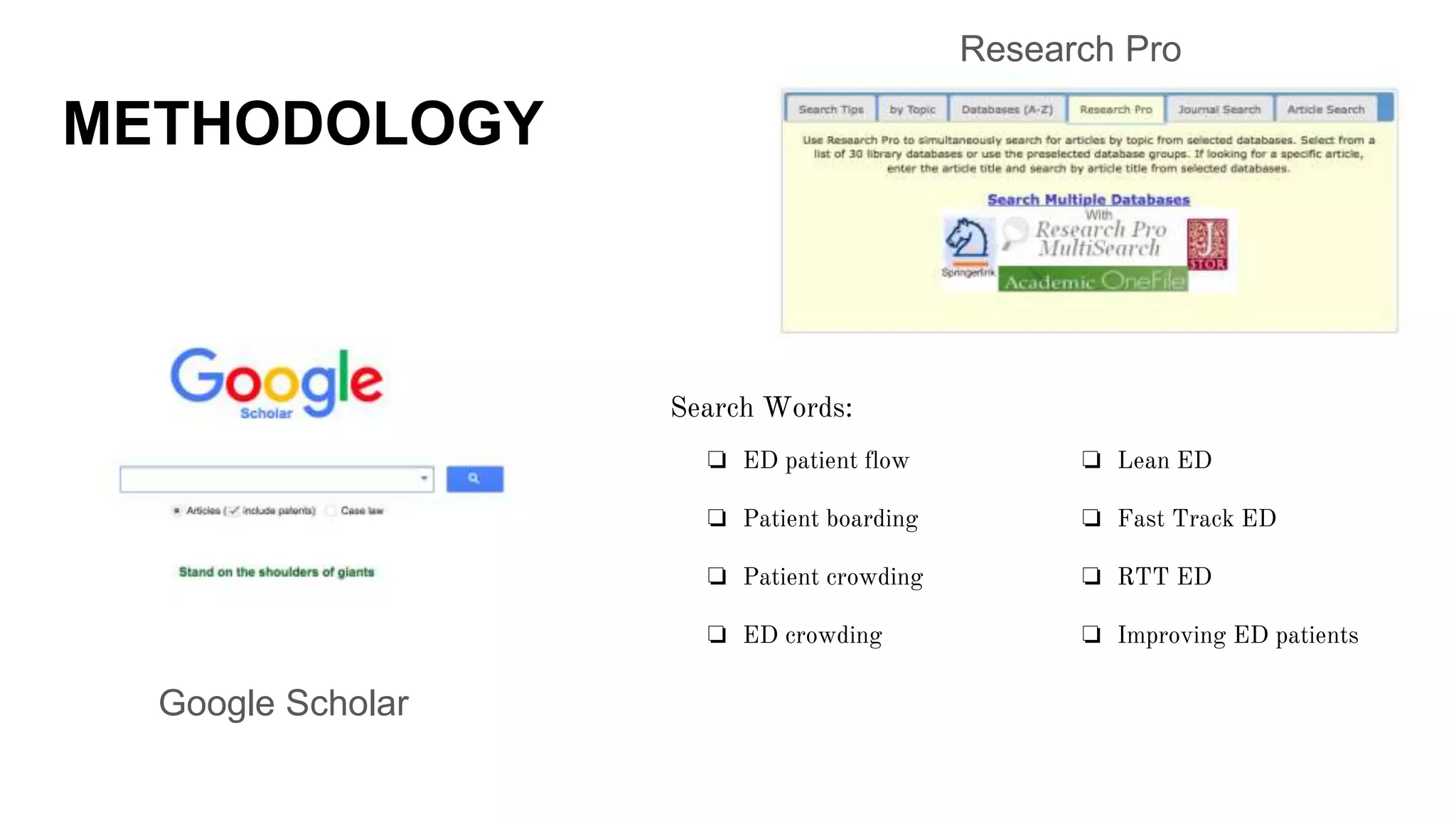
Google Scholar
Research Pro
Search Words:
❏ ED patient flow
❏ Patient boarding
❏ Patient crowding
❏ ED crowding
❏ Lean ED
❏ Fast Track ED
❏ RTT ED
❏ Improving ED patients
CONCLUSION
Fast Track
➢ Triage patients according to High Acuity or Low
Acuity
○ A-side
○ B-side
➢ Patient satisfaction with:
○ wait times
○ doctor courtesy
○ nurse courtesy
○ staying informed about delays
Rapid Triage and Treatment (RTT)
➢ RTT Physician and Nurse
○ increase efficiency through improved
communication and teamwork
○ Lower acuity patient placed in RTT area
■ Can be seen in:
● hallway chairs
● 3 small exam rooms
➢ Decreased:
○ Wait times
CONCLUSION CONT.
1st - Safety Culture
➢“Every member of the organization must develop an equivalent
commitment to quality” (Zidel, 2011).
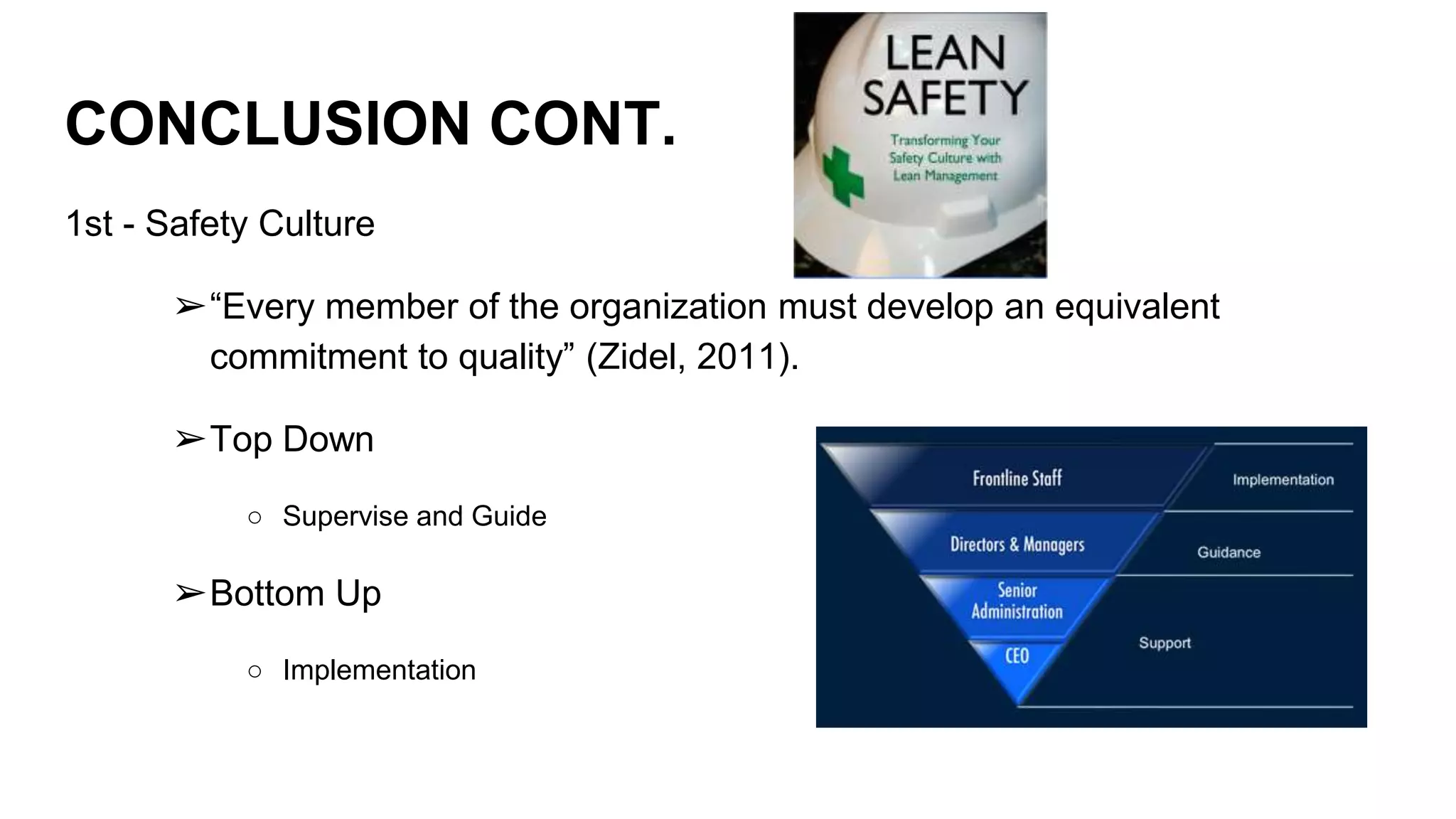
➢Top Down
○ Supervise and Guide
➢Bottom Up
○ Implementation
CONCLUSION CONT.
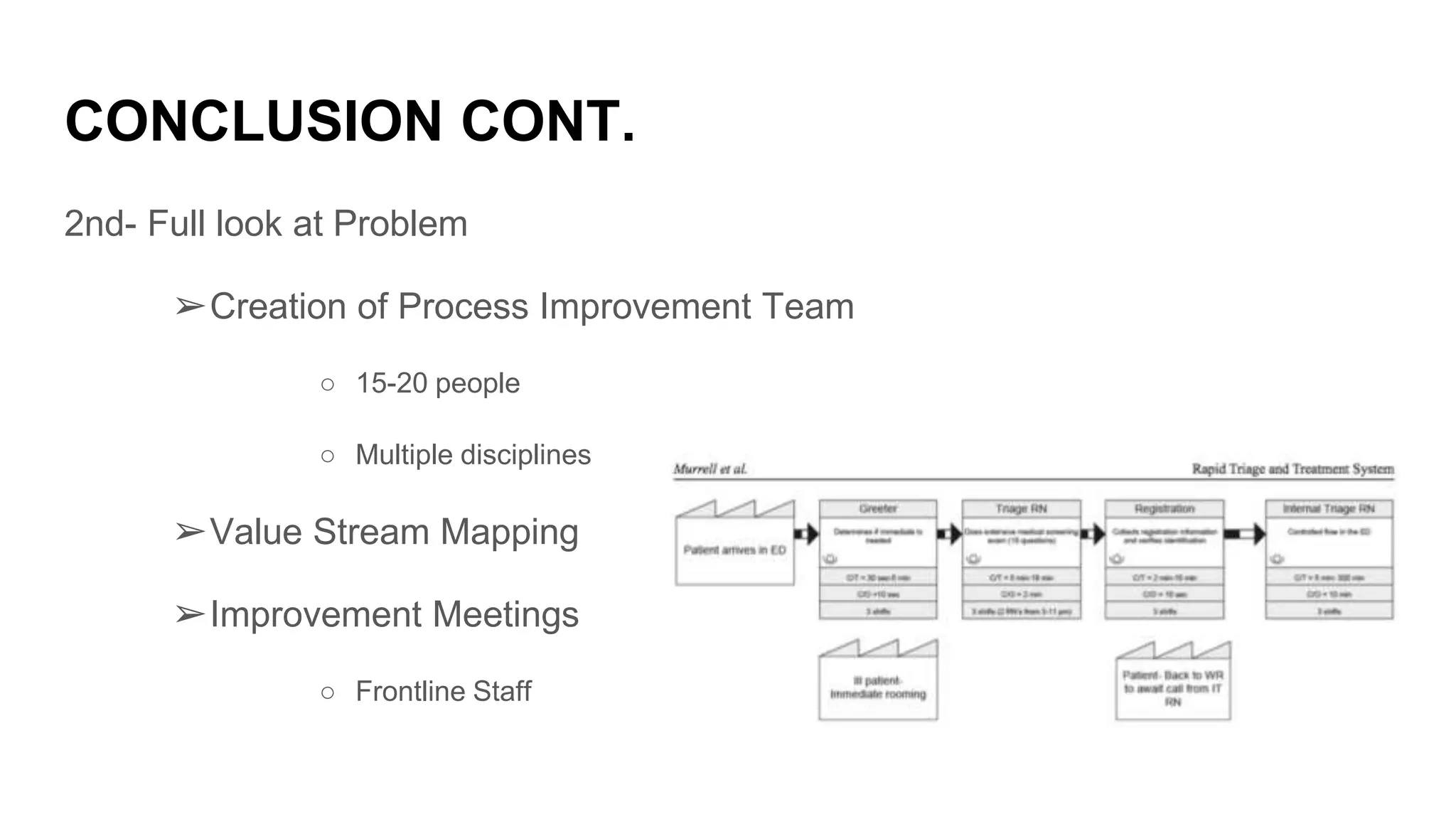
2nd- Full look at Problem
➢Creation of Process Improvement Team
○ 15-20 people
○ Multiple disciplines
➢Value Stream Mapping
➢Improvement Meetings
○ Frontline Staff
CONCLUSION CONT.
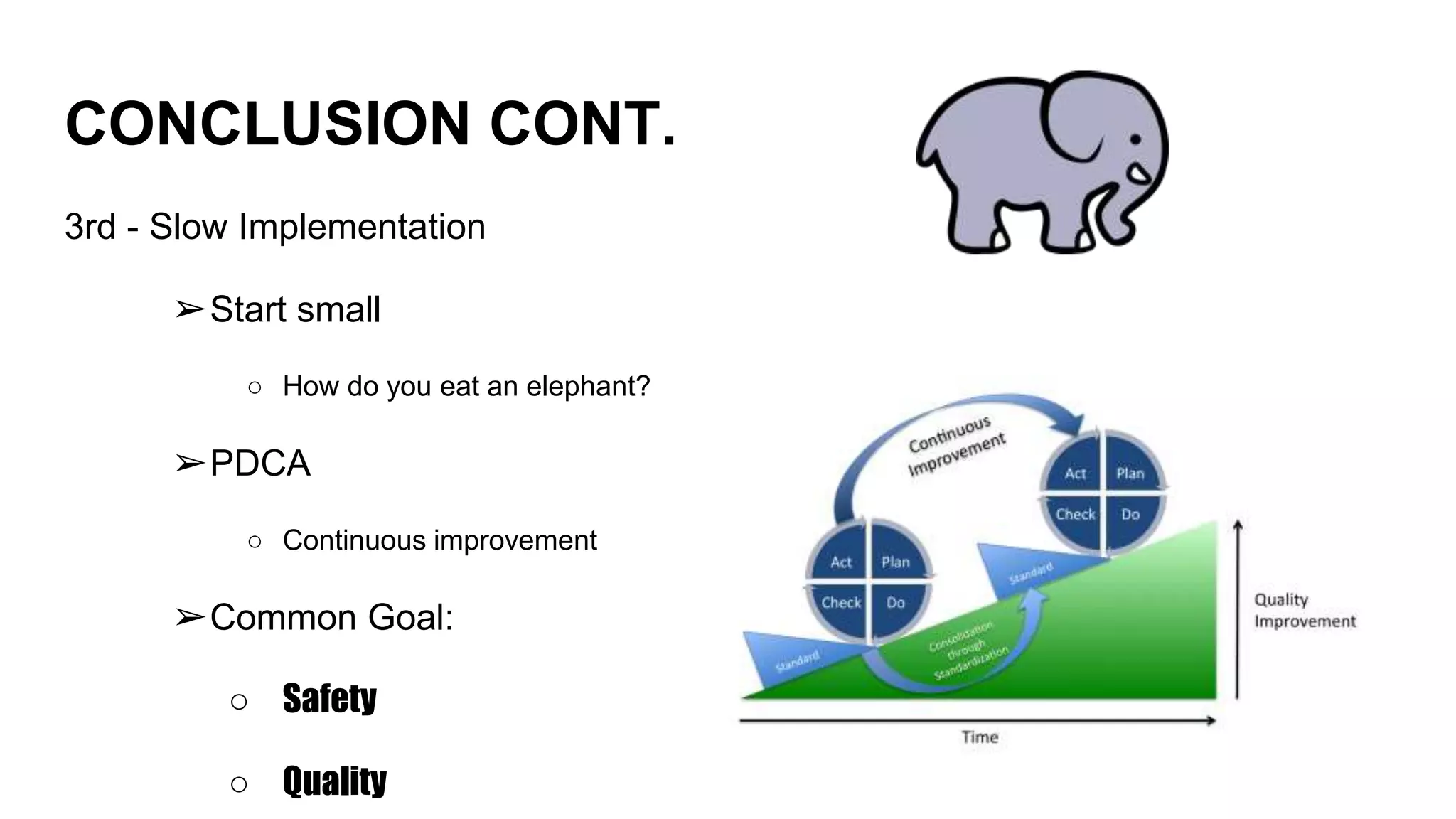
3rd - Slow Implementation
➢Start small
○ How do you eat an elephant?
➢PDCA
○ Continuous improvement
➢Common Goal:
○ Safety
○ Quality
REFERENCES
➢ Adamski, P. (2013). Navigating the challenges of patient flow and boarding in hospitals. The Joint Commission Perspectives, 32(6).
➢ Dickson, E. W., Singh, S., Cheung, D. S., Wyatt, C. C., & Nugent, A. S. (2009). Application of lean manufacturing techniques in the
emergency department. The Journal of Emergency Medicine, 37(2), 177–182. http://doi.org/10.1016/j.jemermed.2007.11.108
➢ Hwang, C., Lipman, G., & Kane, M. (2015). Effect of an emergency department fast track on Press-Ganey patient satisfaction scores. Western
Journal of Emergency Medicine, 16(1), 34–38. http://doi.org/10.5811/westjem.2014.11.21768
➢ Joint Commission. (2013). The ‘Patient Flow Standard’ and the 4-hour recommendation. Joint Commission Perspectives, 33(6), 1–4.
Retrieved from http://www.jointcommission.org/assets/1/18/S1-JCP-06-13.pdf
➢ Murrell, K., Offerman, S., & Kauffman, M. (2010). Applying Lean: Implementation of a Rapid Triage and Treatment System. Western Journal of
Emergency Medicine, XII(2), 184–191.
➢ Zidel, T. G. (2011). Lean done right: Achieve and maintain reform in your healthcare organization. Chicago, IL: Health Administration
Press.

Process Improvement Project-2

  • 1.
    Improving patient flowin Emergency department By: Sehrish Khakwani, Atinuke Shobowale, & Matthew Lopez
  • 2.
    INTRODUCTION ➢ED - Busiestdepartment ➢Throughput refers to emergency department processes that impact patient flow. ➢“The annual number of ED visits in the United States was 90.3 million in 1996, and that number increased to 129.8 million in 2010.”(Murphy, Barth, Carlton, Gleason, Cannon 2014) ➢Includes triage, staffing, availability of specialty and diagnostic services, surgical scheduling and information technology resources.
  • 3.
    BACKGROUND ➢Increase ED lengthsof stay ➢Safe, efficient, quality care in the ED requires frequent and effective communication. ➢The physical design of individual patient rooms can greatly affect throughput. ➢Emergency department crowding has been identified as a major public health problem in the United States by the Institute of Medicine. ➢Delays in treatment ➢Long wait times
  • 4.
    STATEMENT OF PROBLEM EDcrowding is associated with: ➢Poor patient outcomes ➢Longer wait times ➢Inefficient use of staff ➢Decreased patient-centered care ➢Increase of patient not receiving care/ leave without being seen (LWBS) ➢Impacting Revenue
  • 5.
    PURPOSE ➢To review andanalyse the literature concerning ED patient throughput ➢To find techniques to improve ED efficiency
  • 6.
    SIGNIFICANCE ➢To provide assessmentof the throughput of ED patients to identify the gaps in the system that lead to overcrowding. ➢To pinpoint where organization can focus its resources to optimize better outcome. ➢To provide other organizations with the information needed to manage emergency department patient flow.
  • 7.
    METHODOLOGY Google Scholar Research Pro SearchWords: ❏ ED patient flow ❏ Patient boarding ❏ Patient crowding ❏ ED crowding ❏ Lean ED ❏ Fast Track ED ❏ RTT ED ❏ Improving ED patients
  • 8.
    CONCLUSION Fast Track ➢ Triagepatients according to High Acuity or Low Acuity ○ A-side ○ B-side ➢ Patient satisfaction with: ○ wait times ○ doctor courtesy ○ nurse courtesy ○ staying informed about delays Rapid Triage and Treatment (RTT) ➢ RTT Physician and Nurse ○ increase efficiency through improved communication and teamwork ○ Lower acuity patient placed in RTT area ■ Can be seen in: ● hallway chairs ● 3 small exam rooms ➢ Decreased: ○ Wait times
  • 9.
    CONCLUSION CONT. 1st -Safety Culture ➢“Every member of the organization must develop an equivalent commitment to quality” (Zidel, 2011). ➢Top Down ○ Supervise and Guide ➢Bottom Up ○ Implementation
  • 10.
    CONCLUSION CONT. 2nd- Fulllook at Problem ➢Creation of Process Improvement Team ○ 15-20 people ○ Multiple disciplines ➢Value Stream Mapping ➢Improvement Meetings ○ Frontline Staff
  • 11.
    CONCLUSION CONT. 3rd -Slow Implementation ➢Start small ○ How do you eat an elephant? ➢PDCA ○ Continuous improvement ➢Common Goal: ○ Safety ○ Quality
  • 12.
    REFERENCES ➢ Adamski, P.(2013). Navigating the challenges of patient flow and boarding in hospitals. The Joint Commission Perspectives, 32(6). ➢ Dickson, E. W., Singh, S., Cheung, D. S., Wyatt, C. C., & Nugent, A. S. (2009). Application of lean manufacturing techniques in the emergency department. The Journal of Emergency Medicine, 37(2), 177–182. http://doi.org/10.1016/j.jemermed.2007.11.108 ➢ Hwang, C., Lipman, G., & Kane, M. (2015). Effect of an emergency department fast track on Press-Ganey patient satisfaction scores. Western Journal of Emergency Medicine, 16(1), 34–38. http://doi.org/10.5811/westjem.2014.11.21768 ➢ Joint Commission. (2013). The ‘Patient Flow Standard’ and the 4-hour recommendation. Joint Commission Perspectives, 33(6), 1–4. Retrieved from http://www.jointcommission.org/assets/1/18/S1-JCP-06-13.pdf ➢ Murrell, K., Offerman, S., & Kauffman, M. (2010). Applying Lean: Implementation of a Rapid Triage and Treatment System. Western Journal of Emergency Medicine, XII(2), 184–191. ➢ Zidel, T. G. (2011). Lean done right: Achieve and maintain reform in your healthcare organization. Chicago, IL: Health Administration Press.