1 
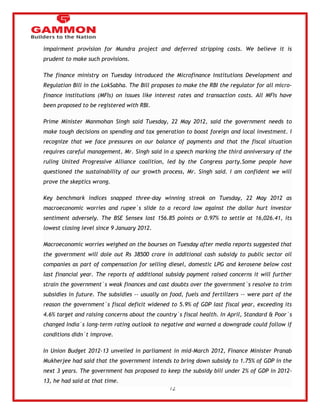
A study 
On 
―QUALITY AND CONTINUAL IMPROVEMENT IN GAMMON INDIA “ 
.” 
Submitted in Partial Fulfillment of the Requirements of 
Sikkim Manipal University for the Award of the Degree of 
MASTER OF BUSINESS ADMINISTRATION 
By 
BINAI KUMAR SINGH 
Reg.No :521102441 
Under the Guidance of 
Mr. SHAKTI PRASAD TIWARY& Mr.KAUTILYA RAJ
2 
DECLARATION 
I,BINAI KUMAR SINGH,(TQM)hereby declare that this dissertation titled, QUALITY AND 
CONTINUAL IMPROVEMENT IN GAMMON INDIA 
The Role of, is based on the original project study conducted by me under the guidance of Mr. 
SHAKTI PRASAD TIWARY& Mr.KAUTILYA RAJ. 
This has not been submitted earlier for the award of any other degree / diploma by SMU 
University or any other University. 
Date: 
Place: (BINAI KUMAR SINGH) 
SIKKIM MANIPAL UNIVERSITY 
OF HEALTH, MEDICAL AND TECHONOLOGY
3 
CERTIFICATE 
Certified that this dissertation titled “QUALITY AND CONTINUAL IMPROVEMENT IN GAMMON 
INDIA.”is based on the study conducted by Mr. BINAI KUMAR SINGH of IV Semester MBA under 
the guidance of Prof S.P TIWARY. 
This dissertation is based on the original project study undergone and has not formed the basis 
for the award of any other degree/diploma by Sikkim Manipal University or any other 
University 
Mr. SHAKTI PRASAD TIWARY Mr. A.K SINGH 
Department of Management DIRECTOR, 
SET ACADEMY SET ACADEMY 
Date: Date: 
Place: Place:
4 
CERTIFICATE FROM THE GUIDE 
Certified that this dissertation titled “QUALITY AND CONTINUAL IMPROVEMENT IN 
GAMMON CONSTRUCTION LTD.”is based on an original project study conducted by Mr. BINAI 
KUMAR SINGH of IV Semester MBA(TQM) under my guidance. 
This dissertation has not formed the basis for the award of any other degree / diploma by 
Sikkim Manipal University or any other University. 
Date: 
Place: (SHAKTI PRASAD TIWARY& Mr.KAUTILYA RAJ)
5 
Acknowledgement 
The successful completion of this project report would be incomplete without mentioning the 
people who made it possible, whose guidance and encouragement served as path of success. 
First I express my gratitude to Mr. B.K. Kurmi,Project manager, of GAMMON INDIA LTD., 
ASSAM(Rangia) for providing necessary support and facilities to carry out this Project. 
I express my heart-felt gratitude to Mr.S.P TIWARY, Sr. facultyof SET ACADEMY, Sasaramfor 
his guidance and supervision without which my study would not have been successfully 
completed. 
I am thankful to Mr. KAUTILYA RAJ,Sr. faculty ofSET ACADEMY, Sasaram. 
I also wish to thank all those respondents who were patient enough in giving the answer to my 
questionnaire. 
I am thankful to my parents, all the faculty members, friends, and all the persons who 
directly and indirectly supported me in carrying out this Project. 
(BINAI KUMAR SINGH)
6 
EXECUTIVE SUMMARY 
The dissertation titled ―QUALITY AND CONTINUAL IMPROVEMENT IN GAMMON INDIA LTD.‖is 
based on an original project study conducted by (Binai Kumar Singh of) IV semester MBA, 
student of Sikkim Manipal University under the guidance of Mr. Shakti pd.Tiwari 
The research, ―Quality And Continual Improvement in Gammon india : A Study on in Assam‖, 
was conducted with an intension of determining the perception of the customers on their 
solutions as well as to identify the different systems currently in use and their future 
requirements. The study is useful to understand the needs of the customer so as to develop 
new models for their businesses. 
The ultimate objective is to increase the productivity of the GAMMON India with any Occurring 
in steady and rapid succession. Therefore it is necessary, that Gammon have a well equipped 
Construction system and supporting technical staff. Presently the GAMMON India company 
have been reported to be facing challenges on sustainability & growth. So, Construction 
Company foresaw the enormous business potential possible in empowering these organizations 
with IT enabled business solutions. The present study would thereby emphasize on identifying 
the Market Potential for IT solutions and E-Business models for GAMMON company customers 
in and around the city. 
For this study a descriptive research has been employed. The response was gathered using 
questionnaire method. The questionnaires were filled by few of the GAMMON company 
customers of Construction Company and also from other GAMMON company in India. The 
sampling method used for this study is convenient sampling. 
The study has revealed some interesting facts on the requirements of “Quality And Continual 
Improvement infor customers, if met meticulously can empower these organizations Occurring 
in steady and rapid succession with flexibility and competitive edge over their business rivals. 
The study and its findings could be considered to be important in terms of providing the 
opportunity for further research.
7 
Contents 
Chapter No Description Page no 
Chapter 1 INTRODUCTION 08 
1.1 Continuous Versus Continual 10 
1.2 Continuous Or Continual 11 
1.3 India Infarstructure Company in India 13 
1.4 Challenges before Construction Industry in India 21 
Chapter 2 COMPANY PROFILE 34 
2.1 History of company 35 
2.3 Area specialization 41 
2.4 Area Expertise 61 
Chapter 3 FACT SHEET 68 
3.1 CORPORATE GOVERNANCE 78 
3.2 BOARD OF COMMITTEE 82 
Chapter 4 CAREER 86 
4.1 INVESTOR FEEDBACK FORM 90 
4.2 Methodology 92 
4.3 Bibliography 93
8 
CHAPTER 1 
INTRODUCTION
9 
Chapter 1 
INTRODUCTION 
―Quality is about meeting the needs and expectations of customers‖ A continual 
improvement process (CIP or CI), also often called a continuous improvement process (usage 
preference discussed below), is an ongoing effort to improve products, services, or processes. 
These efforts can seek "incremental" improvement over time or "breakthrough" improvement 
all at once. Delivery (customer valued) processes are constantly evaluated and improved in the 
light of their efficiency, effectiveness and flexibility. 
Some see CIPs as a meta-process for most management systems (such as business process 
management, quality management, project management, and program management). W. 
Edwards Deming, a pioneer of the field, saw it as part of the 'system' whereby feedback from 
the process and customer were evaluated against organisational goals. The fact that it can be 
called a management process does not mean that it needs to be executed by 'management'; 
but rather merely that it makes decisions about the implementation of the delivery process 
and the design of the delivery process itself. 
Some successful implementations use the approach known as Kaizen (the translation of kai 
(―change‖) zen (―good‖) is ―improvement‖). This method became famous by the book of 
Masaaki Imai ―Kaizen: The Key to Japan's Competitive Success.‖ 
 The core principle of CIP is the (self) reflection of processes. (Feedback) 
 The purpose of CIP is the identification, reduction, and elimination of suboptimal 
processes. (Efficiency) 
The emphasis of CIP is on incremental, continual steps rather than giant leaps.The CIP-concept 
is also used in Environmental Management Systems (EMS), such as ISO 14000 and EMAS. The 
term "continual improvement", not "continuous improvement", is used in ISO 14000, and is 
understood to refer to an ongoing series of small or large-scale improvements which are each 
done discretely, i.e. in a step-wise fashion. Several differences exist between the CIP concept 
as it is applied in quality management and environmental management. CIP in EMS aims to 
improve the natural consequences of products and activities, not the products and activities as 
such. Secondly, there is no client-orientation in EMS-related CIP. Also, CIP in EMS is not
10 
limited to small, incremental improvements as in Kaizen, it also includes innovations of any 
scale (Gastl) 
"Continuous" versus "continual" 
In English-language linguistic prescription there is a common piece of usage advice that the 
word "continuous" should be used for things that are continuous in a way literally or 
figuratively equal to the mathematical sense of the word, whereas the word "continual" 
should be used for things that continue in discrete jumps (that is, quantum-wise). When this 
distinction is enforced, it is more accurate to speak of "continual improvement" and "continual 
improvement processes" than of "continuous improvement" or "continuous improvement 
processes". 
Meanwhile, for several decades it has been common usage in the linguistic corpus of business 
management to use the one set term, "continuous improvement", to cover both of those graph 
shapes in umbrella fashion. It is merely the way the word has been conventionally used in this 
context, in a common understanding that existed regardless of prescriptive preferences. 
However, ISO has chosen the more careful usage for its standards including ISO 9000 and ISO 
14000; so it may be reasonable to expect that usage among business managers will evolve in 
coming decades to conform to the preferred usage . 
Continuous improvement is an ongoing effort to improve products, services or processes. 
These efforts can seek ―incremental‖ improvement over time or ―breakthrough‖ improvement 
all at once. 
Among the most widely used tools for continuous improvement is a four-step quality model— 
the plan-do-check-act (PDCA) cycle, also known as Deming Cycle or Shewhart Cycle: 
 Plan: Identify an opportunity and plan for change. 
 Do: Implement the change on a small scale. 
 Check: Use data to analyze the results of the change and determine whether it made a 
difference. 
 Act: If the change was successful, implement it on a wider scale and continuously assess 
your results. If the change did not work, begin the cycle again. 
Other widely used methods of continuous improvement — such as Six Sigma, Lean, and Total 
Quality Management — emphasize employee involvement and teamwork; measuring and 
systematizing processes; and reducing variation, defects and cycle times.
11 
Continuous or Continual? 
The terms continuous improvement and continual improvement are frequently used 
interchangeably. But some quality practitioners make the following distinction: 
 Continual improvement: a broader term preferred by W. Edwards Deming to refer to 
general processes of improvement and encompassing ―discontinuous‖ improvements—that is, 
many different approaches, covering different areas. 
 Continuous improvement: a subset of continual improvement, with a more specific focus 
on linear, incremental improvement within an existing process. Some practitioners also 
associate continuous improvement more closely with techniques of statistical process control. 
Continuous quality improvement (CQI), a system that seeks to improve the provision of 
services with an emphasis on future results. Like total quality management, CQI uses a set of 
statistical tools to understand subsystems and uncover problems, but its emphasis is on 
maintaining quality in the future, not just controlling a process. Once a process that needs 
improvement is identified, a team of knowledgeable individuals is gathered to research and 
document each step of that process. Once specific expectations and the means to measure 
them have been established, implementation aims at preventing future failures and involves 
the setting of goals, education, and the measurement of results. If necessary, the plan may be 
revised on the basis of the results, so that the improvement is ongoing. 
GAMMON Ltd. has a unique business model, with proven expertise in innovative thinking, 
project and cost management. We are focused on delivering high quality work within budgeted 
time and costs, as evident in the various accolades and repeat business. 
Our key objectives have also been to continuously broad base the operating portfolio and 
enhance the order book, thus opening new avenues to growth and profitability. We have also 
developed an appropriate blend of entrepreneurs and hands on professionals, constantly 
thinking & executing innovative and cost effective solutions to clients‘ requirements. 
Since our incorporation, we have acquired expertise in EPC contracts, and have also recently 
forayed into Urban Infrastructure projects. We commenced our construction projects by
12 
undertaking two contracts of Rs.0.3 million each in 1996 and presently have a prequalification 
capacity to quote for contracts over Rs. 10.3 billion. 
In desire to continual improvement of processes, services, meeting statutory & regulatory 
requirements and enhanced customer delight, GAMMON has established an Integrated 
Management System. The IMS adheres to the standards set out by ISO 9001:2008.
13 
India's Infrastructure Companies 
By Construction Week Research Team 
India’s infrastructural development is scaling greater heights with each new day. We 
present the TOP stars from the 2009-10 EDITION OF this BIG growth story. 
One of the most talked about aspects of the global financial crisis has been the resilience 
shown by emerging economies – particularly by India. Indian economy‘s competence to 
considerably shield itself from external influences has resulted from a strong domestic market 
and a sturdy performance by the infrastructure industry led by some of the established as well 
as rapidly emerging companies. 
India‘s infrastructure companies have shown their expertise in dealing with the challenges and 
making the most of the available opportunities – both critical qualities for achieving great 
success. 
Equally important has been the role played by the government's determination to participate 
in and encourage the development of world class infrastructure in the country. It has lead 
from the front through various initiatives, refinements in processes and reforms in policies. 
Full credit should be given to the infrastructure companies that positively used the 
government‘s support to their advantage and added substantially to the cause of nation 
building. While there are hundreds of companies who continue to participate in India‘s 
infrastructure story, it is always an interesting and insightful exercise to find out the names 
of the leaders. 
Our task has been both easy and difficult. It was easy because the leaders have been very 
consistent in the proficiency, productivity and performance over the years and one can hardly 
miss out these names that regularly grab headlines. It was difficult because filtering down the 
list to just ten names is a statistician‘s nightmare. 
Of course, it would have been unfair if we had relied purely on statistics; there‘s a lot more 
to it. We do not (and cannot) claim that this is the ultimate list since all such lists are subject 
to industry ups and downs. But we are confident that this list is as good as it gets and gives 
you a very fine idea about who the top players are. 
For all right reasons, Construction Week's 'India's Top Ten Infrastructure Companies' list is 
based on various criteria including research & analysis, financial results for the recently ended 
fiscal, order book standings, general market perception, key ongoing projects and so on. While 
care has been taken to make this list as comprehensive and as updated as possible, we do not 
claim it to be beyond market dynamics.
14 
1 Larsen &Toubro Ltd 
Larsen &Toubro (L&T) remains the undisputed number one infrastructure company in India. 
Nobody could have summarised its role in nation building better than P Chidambaram, who 
called it India's only national sector company (on the company‘s 70th anniversary when he was 
the Union Finance Minister). That was in 2007. Today, L&T continues to build on its reputation 
by maintaining an all round growth across the infrastructure segments where it operates. The 
recently concluded fiscal has been quite good for the company. 
As a company statement said, 'various cost optimization initiatives launched by the Company, 
aided by lower input costs, led to an improvement in the profitability of both project and 
product businesses'. 
The Profit after Tax for L&T as a group for the year at Rs5451 crore grew by a whopping 44% 
as compared to the previous year. Subsidiaries and associate companies together contributed 
Rs613 crore to the Group's profits, posting a rise of more than 100% over the similar amount 
for the previous year. The Group‘s consolidated total income registered Rs 43970 crorevis-a-vis 
Rs40511 crore for the previous year. 
The operating margin at 13.1% improved by 140 basis points over last year, while the order 
book crossed the Rs100,000crore mark as of March 31, 2010. (The Engineering & Construction 
Segment‘s contribution to this is Rs 63899 crore). The huge order book gives ample visibility to 
the company‘s continued leadership position. L&T is well poised to take advantage of the 
opportunities presented by India's amazing infrastructure development. Moreover, L&T has 
considerable presence and capabilities in the international markets. 
2 Punj Lloyd Group 
This is the next 'No surprise' name. Punj Lloyd Group's consolidated total income for FY2010 
stood at Rs10,539crore with an EBIDTA of Rs218 crore and PAT at Rs108 crore. In a recent 
interview with Construction Week, AtulPunj, Chairman of the Punj Lloyd Group had said that 
his group aims to be amongst the top five EPC players globally by 2012. 
Quite pleased at the financial performance of the Group, he said, "We've seen good traction in 
order inflow from most of our business verticals during the quarter under review. Our order 
book continues to be robust at Rs27,770crore which is 2.64 times of our FY10 revenues. Some 
of our large wins include India‘s largest solar-based EPC contract as well as two projects from 
Mangalore Refinery. We have also completed repayment of all loans and outstanding of Simon
15 
Carves UK. The results of our initiatives enhance my confidence in our capabilities and 
strengths. 
I believe Punj Lloyd is well positioned to leverage the considerable opportunities in the 
infrastructure and hydrocarbons business." This year, the Group also won its first project in 
Thailand. The contract, valued at Rs574 crore, was secured from PTT Public Company Ltd, a 
Thailand state-owned oil & gas major and one of the largest corporations in Thailand listed in 
the Fortune Global 500 companies. Punj Lloyd Group sold its entire stake of 19.43% in Pipavav 
Shipyard (PSL) to the Company‘s co-promoter, Skil Infrastructure, making profits of Rs3,071 
million in the overall deal. 
3 Jaiprakash Associates Ltd 
Jaiprakash Associates Ltd (JAL) has emerged as a leading infrastructure conglomerate having 
business interest in a wide range of areas like engineering & construction, cement, power, 
expressways, real estate and hospitality. The Group showed an impressive performance during 
financial year ended March 31, 2010 with total revenues of Rs10316.04 crore; up 72.52% from 
Rs5979.52 crore in the same period last fiscal. This is the first time that the Group has crossed 
the Rs10,000crore turnover mark. 
While Ebidta stood at Rs2891.44 crore up 40.36% from Rs2059.91 crore, the net profit (after 
extraordinary items) for FY10 stood at Rs1708.36 crore registering a growth of 90.45% from 
Rs897.01 crore in FY09. Commenting on this, Manoj Gaur, Executive Chairman, JAL, said, "The 
roadmap that we have laid at the start of the fiscal has helped us achieve an all-round growth 
across all sectors. The group is fully geared up with the avenues opened by the government of 
India in infrastructure, real estate and power sectors. I would like to thank all our 
shareholders for the faith that they have reposed in the recent listing of our group company – 
JaypeeInfratech Ltd (JIL)." Commenting on the group‘s performance in core business sectors, 
Mr. Gaur further added, "We are currently on a high-growth path. Jaypee Group is a unique 
group with a de-risked business model having diversified portfolios with business interests in 
all spheres of infrastructure sector - be it engineering & construction, power, expressways and 
real estate." 
JIL sold over 1.5-million sqft of developed real estate between April-May 2010 in the Group‘s 
integrated township at Noida. In the last fiscal, JIL has sold over 13,000 units comprising of 
20.35 mlnsqft area. In the cement business, Jaypee Group has an installed capacity of 21.3 
MTPA and going forward it plans to scale up the capacity to over 33.00 MTPA by FY12.
16 
"With government‘s impetus on infrastructure sector and our new capacities operating at full 
capacities, we expect a significant growth in our cement business," said Mr Gaur. 
4 LancoInfratech Limited 
With operating revenue up by 36% from Rs6945.66 crore to Rs9457.21 crore in 2009-10, 
LancoInfratech is today one of the fastest growing infra companies in India. It has subsidiaries 
and divisions across a synergistic span of verticals including construction, power, EPC, 
infrastructure, property development and renewables. 
The company has Rs25713.70 crore worth of construction and EPC order book as on March 31, 
2010 which is spread over power projects (88%); roads & building projects (8%) and other 
projects (4%). "The trajectory of the construction and EPC division is much strong and very 
visible. On a long run basis, at least over the next four years, we will see significant amount 
of visibility to the construction and EPC order book," J Suresh Kumar, CFO, LancoInfratech Ltd 
told Construction Week. 
In the power segment, Lanco currently has 9311 MW under operation and construction. This 
includes 1349 MW under operation; 733 MW under synchronization; 1875 MW expected be 
commissioned in FY 2011 and 5354 MW under construction. The company expects that 5354 MW 
of projects under construction to be commissioned by FY 2014. 
"In the space of power, we will be adding about 2,600 MW additional operating capacity this 
year, increasing our operational capacity to around 4,000 MW of which our merchant portfolio 
would be about 766 MW. The cash flows that we are going to generate from these projects will 
cater to the equity requirements of power projects which are currently under execution and 
development," Kumar added. 
The company is currently constructing two road projects in Karnataka, the 81 km Bangalore- 
Hoskote-Mudbagal stretch on National Highway 4 and the 82 km Neelamangla - Devihalli 
stretch on National Highway 48 on Build, Operate and Transfer (BOT) basis. The total project 
cost is estimated at Rs1300 crore and involves six laning of 16 km stretch and four laning of 
the remaining stretches. 
5 Nagarjuna Construction Company 
Since crossing the Rs1 billion-turnover in 1995, Nagarjuna Construction Company Ltd (NCC) has 
kept itself busy establishing new divisions for its business. It established a property division in
17 
1996, followed by transportation (roads, highways and bridges), water, electrical, power, 
irrigation, metals and oil & gas. 
With a strong order book worth Rs15,370crore, NCC is today one of the most dynamic 
infrastructure companies in India. Its order book includes 24% from buildings & housings, 16% 
from water & environment, 21% from international projects, 13% from new divisions, 10% from 
irrigation, 8% from transportation, 5% from electricals and 3% from metals. The company is 
looking at building an order book of around Rs25,000crore by this fiscal. 
NCC has achieved a turnover of Rs5897 crore for the year ended March 31, 2010 as against 
turnover of Rs4786 crore in the previous year, registering a growth of 23%. It looks to become 
a US$2-billion turnover company by the next financial year. 
The company posted an EBIDTA of Rs 658.23 crore and net profit after tax of Rs282.74 crore 
for the year as against Rs504 crore and Rs181 crore respectively in the previous year. Seeing 
huge opportunities in power sector construction and execution business, NCC is looking at 
power generation capacity of 5,000 MW in a few years. It is expected to achieve financial 
closure of 1,320-MW Phase I project at Srikakulam by next month. It will take up the second 
phase of 1320-MW at the same location at the later stage. 
NCC was among the few companies to make early entry into BOT and BOOT projects. Moving 
forward, the company said it looks to increase focus on transportation and power sector. It is 
also looking at expanding in international markets by focusing more on roads, water supply 
and buildings projects. NCC employs 4,400 people directly and 35,000 piece rate workers 
indirectly. 
6 IVRCL Infrastructures & Projects Ltd 
Established as a premier EPC & LSTK service provider in 1990, IVRCL Infrastructures & Projects 
achieved group turnover of US$1 billion in less than two decades of its operation. It has strong 
presence in water, transportation, building & industrial structures and power sector. 
The company entered into BOT/BOOT/DBOOT projects in 2001 and currently is executing some 
of the big projects across the country. With current order book standing at Rs23,375crore, the 
Hyderabad-based IVRCL expects the figure to reach Rs32,000 crore in FY11, thanks to rise in 
government orders. In addition to its current order book, it has bided for close to about 
Rs19,000crore worth of work which it expects to open soon. 
IVRCL had recently won Rs3,100-crore BOT toll road projects on the Goa-Maharashtra border 
from NHAI. The 122.06-km stretch will be taken up for four-and six-lane work on the NH 17
18 
from Maharashtra-Goa border to Panaji-Goa-Karnataka. The project includes a six-lane cable-stay 
bridge over the Zuaririver. 
The company has achieved a consolidated turnover of Rs5841.42 crore against Rs5074.07 crore, 
recording a growth of 15.12%. IVRCL is bullish about its revenue in current financial year to 
reach Rs7,000crore, up from around Rs5,500 crore this year. 
The company sees huge potential in the water sector as almost all the states in India are 
water starved or water stressed. IVRCL has been maintaining about 45% to 55% top-line and 
close to about 60% bottom-line in the water sector. Moving forward, the company expects 
states like Rajasthan, Madhya Pradesh, Karnataka, Maharashtra and Gujarat to spend about 
US$4-5 billion each to meet water need, not only for drinking water but also irrigation. 
7 Simplex Infrastructures Ltd 
Present in business since 1924, Simplex Infrastructures is one of the largest pure play civil 
construction & engineering contractors in India. It has strong presence across various 
construction verticals, which include industrial plants, power plants – thermal; nuclear; hydel; 
urban infrastructures & utilities, buildings and housing, marine, roads; railways; bridges & 
elevated road & rail corridors. 
The company's order book at the yearend was 14% higher at Rs11,491crore against Rs10,059 
crore last year, comprising power (27%); building & housing (22%); industrial plants (19%); 
urban infra (16%); bridges (9%); marine & piling (3% each) and roads & railways(2%). The 
company said there was further order inflow of Rs1289 crore during the first two months of 
the current year. The company has given a guidance of top-line growth of 15-20% during the 
current year FY11. 
During Q4 FY10, the company secured Rs2,166crore new orders, nearly double of Rs1,116 crore 
for the same quarter last year. This includes Rs1501 crore from domestic markets (69%) and 
Rs665 crore from overseas markets (31%). The order intake comprises of Industrial 
Construction Rs908 crore, Power Rs512 crore, Building & Housing Rs499 crore, Urban Infra 
Rs178 crore and Piling Rs69 crore. The order intake during the whole of FY10 stands at 
Rs5,984crore against Rs5,629 crore last year. 
The company has created strong presence in almost all Middle East countries, West Indies, Sri 
Lanka as well as in Russia. 
www.simplexinfrastructures.com
19 
8 GMR Group 
When GMR opened the T3 at Indira Gandhi International Airport in New Delhi recently, it was 
more than the opening of a terminal. It was a statement that airport infrastructure in India 
had attained a new level. Although the revenues for the Group have gone up a modest 14% and 
the net profit has declined, the Ebidta went up 27%, cash profit by 14% and free cash flow by 
27.5%, signifying the efficient and profitable operations of the business. 
Commenting on the performance of the full year, GM Rao, Group Chairman said: "We are 
continuing our focus on business building and institution building at the same time and 
achieved significant progress on both fronts. We made a strong start to the year as we 
acquired key power plants, thereby adding 1970 MW to our portfolio. We commenced 
operations in the newly constructed domestic terminal T1D of Delhi International Airport. We 
won three highway projects spread across three states. The 235 MW barge mounted power 
plant was successfully relocated from Mangalore to Kakinada. 
We successfully completed the construction of the brand new Delhi Terminal 3 and it will 
stand tall as an infrastructure icon and modern gateway of India for our country to be truly 
proud of. We launched some important institution building initiatives and strengthened 
several others across the company with special focus on all our stakeholders – shareholders, 
lenders, customers, government, employees, partners, environment and society. We launched 
Business Excellence program, Knowledge Management initiatives took speed, initiated 
Enterprise Risk Management framework, launched powerful development programs on 
leadership for senior executives and made significant progress in performance management 
and talent review. The year gone by has been satisfying on all fronts as we created a robust 
platform of sustainable long-term growth for our company. With 3 airports, 13 power plants, 
9 highways, and 22 locations of our CSR activities we have positioned ourselves as a 
responsible corporate citizen and as a strong, infrastructure developer known for world-class 
quality delivered on time." 
www.gmrgroup.in 
9 Gammon India 
The last financial year wasn't exactly a memorable one for Gammon India; the DMRC accidents 
definitely did not help. But it would be wrong to judge the company purely on these two 
issues.
20 
There are many reasons why this company makes to the top ten list – one of the reasons being 
the fact that it is the only Indian Construction Company to have been accredited with ISO 9001 
certification for all fields of civil engineering works including design. Another reason is the 
wide range of complex projects that the firm is handling across geographies with an order 
book standing of Rs14745 crore on the year ending March 31, 2010. This is substantially better 
(14%) compared to Rs12900 crore as end of FY09. The order book has a good mix of 
transportation, energy & transmission and water. 
Gammon India's operational income stood at Rs 4488.94 crore with the operating profit at Rs 
418.19 crore. One highlight of the financial year gone by has been the acquisition of 69.41% 
stake in AnsaldoCaldaie Boilers India Pvt Ltd (ACBIPL). ACBIPL is engaged in the business of 
designing, procuring, manufacturing, erecting of steam generation units. 
Some of the key ongoing projects undertaken by Gammon India include a huge order from 
Iskcon, another Rs 631.81 crore order from Delhi Tourism and Transportation Development 
Corporation for construction of bridge and its approaches over river Yamuna at Wazirabad 
(Delhi), a contract aggregating Rs 308 crore from Jindal Power for civil works amongst others. 
Gammon India‘s Italy-based wholly-owned subsidiary SAE Power lines bagged $22.5 million 
worth of turnkey contract in Algeria for a 220 KV transmission line along with another power 
transmission project worth $31 million in Tanzania. Franco TosiMeccanica SPA Italy, another 
subsidiary of Gammon India, secured Rs510 crore worth of order for the supply of hydro 
turbines. 
www.gammonindia.com 
10 Hindustan Construction Company (HCC) 
Even we were surprised to see Hindustan Construction Company at Number 10 - nothing to 
take away from the other companies at the top. One is further surprised to see that 
MrGulabchand has described the last one year as a 'slow year' in the annual report. Of course, 
he has added that the year 'allowed the company to focus on 'nuts and bolts' and prepare for 
more aggressive multi-pronged growth'. 
Nevertheless, one cannot overlook the various happenings at the Group in this 'slow year'. The 
Bandra-Worli Sea link was opened in June 2009 and then the company raised Rs480 crore 
through QIP in July 2009. While developing and implementing an excellent IT system for its 
own projects and for others, HCC also launched Asia's first IT Company for the infrastructure 
sector.
21 
It made its first international acquisition with Karl Steiner AG. HCC also made considerable 
progress at Lavasa; the project has now been expanded to 18000 acres as against the earlier 
plans of 12500 acres. HCC Real Estate too has shown great promise with 247Park. The company 
also signed contracts for several projects. There has been a sizeable growth in the company‘s 
order book, which stood at Rs18810 crore as on March 31, 2010. HCC‘s income from operations 
increased by 10% to Rs3863crore in 2009-10 with Ebidta increasing by 3% to Rs443 crore. 
www.hccindia.com 
Challenges before Construction Industry in India 
ArghadeepLaskar and C. V. R. Murty 
Department of Civil Engineering 
Indian Institute of Technology Kanpur 
Abstract 
The construction industry is the second largest industry of the country afteragriculture. It 
makes a significant contribution to the national economy and providesemployment to large 
number of people. The use of various new technologies anddeployment of project 
management strategies has made it possible to undertakeprojects of mega scale. In its path of 
advancement, the industry has to overcome anumber of challenges. However, the industry is 
still faced with some major 
challenges, including housing, disaster resistant construction, water managementand mass 
transportation. Recent experiences of several new mega-projects are clearindicators that the 
industry is poised for a bright future. It is the second homecomingof the civil engineering 
profession to the forefront amongst all professions in thecountry. 
1. CONSTRUCTION INDUSTRY AND NATIONAL ECONOMY 
Presently, the annual expenditure budget of India is Rs.438,795 Croresagainstthe backdrop of 
the total Gross National Product (GNP) of the country of aboutRs.2200,000 Croresor more 
(www.indiabudget.nic.in, 2004). Over the years, morethan half of the expenditure budget is 
spent on civil engineering works. The constructionindustry sets in motion the process of 
economical growth in the country; investmentin this sector contributes 6.5% of Gross Domestic 
Product (GDP) growth (Das, 2003).Every Re.1 investment in the construction industry causes an 
Rs.0.80 increment inGDP as against Rs.0.20 and Rs.0.14 in the fields of agriculture and 
manufacturingindustry, respectively. Statistics over the period have shown that compared to 
othersectors, this sector of economic activity generally creates 4.7 times increase inincomes
22 
and 7.76 times increase in employment generation potentiality. Sustainedefforts by the Indian 
construction industry and the Planning Commission have led toassigning the industry status to 
construction today. This means formal planning and 
above board financial planning will be the obvious destination of the construction 
sector in the country, with over 3.1 Crore persons employed in it. 
1. NEW MEGA-PROJECTS 
In the recent times, India has stepped up its development agenda. One 
explicit indicator of this is the aggressive pace of construction activity in the country.The 
honorable President of India, Dr. A. P. J. Abdul Kalam, has set the goal of 2020for India to 
become a developed nation. However, economists and developmentanalysts of the country 
have a different perception. They believe that if the currentnational level initiatives are 
consistently supported along with a few new initiativesin the areas of education, health and 
labour, this country will be in the driving seatand on a one-way street of growth. The 
particular emphasis on infrastructuredevelopment will put India on a road map with Brazil, 
China and Russia towards 
becoming a developed nation by 2050. The following are some of the physical 
infrastructure related projects that the country has undertaken or is poised to 
undertake in the near future. 
1.1 Delhi Metro Rail Project 
This project is developing a Mass Rapid Transit System (MRTS) in Delhi. Thefirst phase of the 
project is presently under operation. It aims to provide 68.3 km ofMRTS by September 2005. 
The estimated completion cost of this phase aloneRs.10,500Crores. It involves construction of 
10.5 km of surface lines, 45.6 km ofelevated routes and 12.2 km of underground routes. The 
construction ofunderground segments involves tunneling through hard rock strata. Special 
giant size (6m diameter) 
2.0 Highway Projects 
Until recently, India lacked proper highway network across the length andbreadth of the 
country, which severely affected the pace of growth. The developmentagenda of the nation 
and the projected industrial growth demanded world-classroad network for safer, faster and 
efficient movement of men and material. Adetailed assessment of needs was done and 
ambitious plans were prepared toundertake a mega-project for highways as part of the Ninth 
Five Year Plan. The 
project comprises of two parts , namely:
23 
(a) Part I : Golden Quadrangle – Connecting all four mega-cities of India; and 
(b) Part II : North-South and East-West Corridors – Connecting Srinagar-Kanyakumari 
andSilchar-Porbandar respectively.During 1999-2007, about 14,846 km of 4/6 lane highways 
are to be built at anapproximate rate of 1650 km per year (Das, 2003).The total capital 
investment is estimated to be Rs.58,000Croresin the GoldenQuadrangle and Rs.40,000 Croresin 
North-South East-West Corridors. During 2001-04 it has been estimated that total 18 Crore 
man-days will be created due to thisproject, comprising of employment to 250,000 
construction workers and 10,000supervisory technical personnel per day. World Bank in its 
report has estimated that 
approximatelyRs.8,000 Croreswill be saved on fuel and vehicle maintenance cost 
every year due to high standards of Golden Quadrilateral alone. 
2.1 River Inter-Linking Project 
This project of developing a mega-network of canals linking major Indianrivers is a long-term, 
multi-Crore solutions of Country‘s drought, flood, inter-statewater dispute, chronic power 
shortage and pollution. It would open-up windows ofopportunities like water transport and 
tourism, which have ample geo-political andsocio-economic benefits. The total project is 
expected to cost Rs.560,000Crores, whichis expected to irrigate an additional 15,00,00,000 
hectares land (NWDA, 2003).Presently, out of the total geographic area of 32,80,00,000 
hectares of the country, 
14,20,00,000 hectares is irrigated. Thus, with the implementation of this project, theirrigated 
land in the country would double covering almost the entire nation. Theproject is also 
expected to generate 35,000 MW of electricity. This would increase thepower generating 
capacity of the nation by 33% of the present capacity of 104,918MW (www.ntpc.co.in, 2004). 
The National Water Development Agency (NWDA), the nodal agency to steerthis project, has 
divided the project into two broad components, namely theHimalayan Component with 14 
river links and the Peninsular Component with 17 river links . Some obvious benefits expected 
from the project are: 
1. Creating the potential to increase agricultural production by an additional 100%in the next 
5 years; 
2. Avoiding huge financial losses that result from loss of crops due to drought andflooding 
conditions in many parts of the country; 
3. Saving Rs.3,000Croresannually in foreign exchange by avoiding importing oilbecause of the 
alternative navigation provided along the coastline; 
4. Enhancing national security by providing additional water-line of defense; and
24 
5. Providing employment to 10,00,000 people for the next 10 years. 
Proposed Links of the Peninsular Component (Reddy, 2002) 
Proposed River Links 
1. Mahanadi-Burhabalang 
2. Mahanadi-Godavari 
3. Indravati-Wainganga 
4. Wainganga-Krishna 
5. Krishna (Srisailam)-Pennar (Prodattur) 
6. Pennar (Gandikotta)-Palar-Cauvery 
7. Cauvery-Vaigai 
8. Godavari (Inchampalli)-Krishna (Nagarjunasagar) 
9. Krishna (Nagarjunasagar)-Pennar (Somasila) 
9.A Krishna (Almatti)- Pennar 
10. Pennar (Somasila)-Palar-Cauvery (Coleroon) 
11. Godavari (Inchampalli)-Krishna (Pulichintala) 
12. Godavari (Polavaram)-Krishna (Vijaywada) 
13. Par-Tapi-Narmada 
14. Damanganga-Tansa/Pinjal 
15. West Flowing Rivers of Kerala and Karnataka 
(Bedti-Varda; Netravati-Hemavati; Pamba- 
Anchankovil-Vaippar) 
16. Ken-Betwa 
17. Parbati-Kalisindh-Chambal 
2.2 Sea-Ports Project 
This project of upgrading existing ports along the gigantic coastline of thecountry will be an 
invitation to traders from all directions to conduct business withIndia; the project is therefore 
called as the SaagarMela Project and sometimes as theNecklace Project. With an total outlay 
of about Rs.60,000Crores, this project is alsoexpected to relieve the pressure on the rail, road 
and air traffic systems, by allowingthe ship and ferry services between various port cities. The 
project entailsimprovement of harbor structures, developing advanced navigational 
inventorysystems for small and large vessels, and adding a few smaller ports to facilitate 
offloadingof cargo at points where the rail or road traffic is not already too congested.
25 
2.3 Air-Taxi Project 
Another mega-project that is under plan preparation is one that will enhanceair connectivity 
between various places in the country. It is expected that theenhancement of existing airports 
to higher standards and capacity, and addition ofnew airports at critical locations will lead to 
more hubs for traffic exchange, incontrast to just Delhi and Bombay currently. It is also 
proposed to have a highcapacity airport at Nagpur, which will off load and carry passengers 
from any corner 
of the country to another such destination without having to necessarily reach one ofthe 
already busy airports of Delhi and Bombay. This project along with othernational level 
initiatives of the Central Government is expected to result in a sharpdrop (by about 70-80%) in 
the current air travel cost in the country. The financialoutlay for this project is expected to 
far exceed some of the ongoing mega-projectslike the highways project or the sea-ports 
project. 
Proposed River Links 
1. Kosi-Mechi 
2. Kosi-Ghagra 
3. Gandak-Ganga 
4. Ghagra-Yamuna 
5. Sarda-Yamuna 
6. Yamuna-Rajasthan 
7. Rajasthan-Sabarmati 
8. Chunar-Sone Barrage 
9. Sone Dam-Southern Tributaries of Ganga 
10. Brahmaputra-Ganga (Mstg) 
11. Brahmaputra-Ganga (Jtf) (Alt) 
12. Farakka-Sunderbans 
13. Ganga-Damodar-Subarnarekha 
14. Subarnarekha-Mahanadi 
3. NEW MATERIALS, EQUIPMENT AND TECHNOLOGIES 
New mega-project undertaken, involvement of international consultants, andparticipation of 
Indian consultants/contractors in international projects has led toinfusion of new materials, 
equipment and technologies in the construction practicesin India. While manufacturing of new 
materials is going on at a more aggressivepace, the manufacturing of new equipment is 
constrained by large capitalinvestments and the uncertain markets. However, the growing
26 
market for suchadvanced equipment will eventually push the entrepreneurs to manufacture 
thesealso. On the technological front, the picture is abysmally low. The country has 
notinvested adequately into making technical human resources capable of addressingthe 
professional services needs of the construction industry like litigation, training ofartisans, cost 
indices, contracting, insurance, finance, banking and taxation. On theengineering design front, 
the college education of the practicing engineers has notbeen adequately augmented from 
time to time with in-house or distance educationmodules. Thus, senior engineers are often 
found oblivious to new technologies andtools. As a consequence, the country is faced with a 
dire need for qualified technicalmanpower. The following are some of the newer initiatives of 
the constructionindustry in the area of materials and construction strategies. 
3.1 Corrosion Resistant Steel (CRS) 
This new-generation high strength ribbed reinforcement bar, was firstintroduced in India by 
m/s TATA Steel Limited, Jamshedpur. It is different fromtraditional bars in its method of 
manufacture and consequently, in its properties.CRS is produced using the Tempcore Process, 
introduced in India for the first time byTATA Steel under license from Center de 
RechaercheMetallurgiques(CRM), Belgium –inventors of the process. The process imparts high 
strength to the bar using thethermo mechanical treatment (TMT) technique; this is in contrast 
to the cold twistingthat was used in the manufacture of traditional reinforcing bars. The 
cross-section ofbars produced by this treatment process has a strong outer layer of 
temperedmartensiteand a ductile inner core of ferrite-pearlite. The duality in the 
constitutiongives these bars their unique combination of high strength and high ductility. 
Thesebars have additional desirable properties: no residual stress, uniform propertiesalong 
the length, high bond strength (2-3 times that in mild steel bars), and superiorbendability. 
3.2 Closed Structurals 
The structural and functional advantages of hollow sections havealways appealed to the 
engineers. Till 1959, square and rectangular hollow sectionswere shop fabricated by welding 
or jointing together structural plates and sections.This involved expensive fabrication, 
restricting architectural expressions totraditional steel forms. Research and development of 
hollow sections are carried outby an international organization, CIDECT (Headquarters: Paris). 
In India, TATASTEEL adopted this concept. The excellent distribution of the material around 
thecentroidal axis of closed structurals exhibits remarkable strength qualities, and thus 
offers decisive advantages in its applications. Compared to conventional sections, 
hollow sections result in reduced use of steel . 
Property of Closed Structurals Application inStructural Systems
27 
Steel Saved compared toConventional Sections (%) 
Symmetry about all axes Tension Ties 15 
Higher Radius of Gyration Compression Struts 45 
Higher Lateral Rigidity Flexural Members 25 
Higher Shear Area Members under Shear 40 
Greater Enclosed Torsional Area Members under Torsion 80 
3.3 Pre-engineered Buildings (PEB) 
These are a special class of buildings, which are constructed by assemblingpre-built primary 
framing systems with other secondary structures and claddings. Various types of framing 
systems such as clear span rigid frames, beamand column frames, space saver frames, single 
slope, multi-span and lean-to framesare available depending upon the needs of the builders. 
They are also built toaccommodate various sidewall heights, bay spacings and loading 
conditions. Theinvention of these buildings has greatly increased the speed of 
construction.However, concerns have been expressed over the multi-disaster resistance of 
thesebuildings. Hence, full scale testing should be conducted on them and especially on 
their connections to confirm their reliability in sustaining hazards. 
3.4 Engineered Steel Guardrail Systems 
A noticeable change in the construction projects is the quantitative design ofsystems that 
were hitherto provided in a prescriptive way. The engineered steelguardrail systems provide 
utmost safety for vehicles and pedestrians on roads,highways and bridges. These rail systems 
are specially profiled with W- or 3-Beamsystems . They are manufactured using facilities such 
as high precisioncold forming lines, large presses, automated welding lines and complete in-housefabrication 
facilities ideally suitable for manufacture of high quality steel guardsystems. 
Mainly used as medians and edges of highways and bridges, these systemsare highly beneficial. 
For instance, they: (a) absorb impact of the vehicle and ensureminimum damage to the 
vehicle; (b) restrain laterally the vehicle from veering offthe carriageway; (c) prevent vehicles 
from skidding back to the carriageway duringimpact; (d) provide gradual deceleration of the 
vehicle into the carriageway after 
impact thereby avoiding any risk to flowing traffic; (e) act as a visible guide todrivers during 
nights and bad weather; and (f) permit quick repair in case of damagedue to accident. 
3.5 Urban Construction Strategies 
Large-size precast piers are used in the construction of flyovers over existingroads or other 
utility services that are too important to be closed or dismantled forthe construction work of 
the flyovers . These massive precast structuresare erected at site with large capacity cranes
28 
that are themselves not to restrict theflow of traffic . In addition, the Indian Society of 
Trench less Technology(INDSTT) introduced the trench-less pipe laying technology to assist in 
interruption free construction in urban environments. Besides project design, 
development,implementation and monitoring are gradually getting transferred to the 
computersby consultants, project owners and contractors. Some leading corporate agencies 
areplanning initiatives for web-enabled design, control and monitoring of 
constructionprojects. 
4. PROJECT MANAGEMENT 
4.1 Site Selection and Landscaping 
Considered to be the first step in planning of a mega project, site selection andlandscaping is 
also the most important step in development of any mega-project.Apart from determining the 
cost and completion time, it also affects the quality andoverall impact of the project. Almost 
all the factors that contribute to the project costdepend on location of the sites, as it 
determines impact on environment, impact onthe overall development of nearby area and 
impact on human/material resources(Natarajan, 2003). The main factors that influence the 
selection of sites for megaprojectsare availability of distribution or transmission lines of 
electricity, availabilityof raw material sources and availability of transmission facilities like 
roads, rail,airport and waterways. 
4.2 Basic Infrastructure 
Multiple basic infrastructure support is needed for the development of anymega-project. 
These supports should be developed in parallel with the project itselfas the project 
progresses. The major points to be kept in mind for development ofbasic infrastructure are 
water supply, power supply, roads and hospitals,entertainment and shopping facilities 
(Natarajan, 2003). 
4.3 Contract Management 
Management of contracts is one of the important aspects of constructionmanagement. 
Contractors engaged for the specific purpose usually execute civilengineering construction 
projects. Even when large-scale turnkey contracts of largeprojects are awarded to big 
contacting agencies, sub-contractors execute the works.In some instances, the owner of the 
project does not have control over these subcontractors,as they are normally accountable only 
to the main contractor, resultingin delays and poor quality output.Problems of contract 
management in civil engineering constructions in Indiacan be minimized to a great extent, if 
management of contracts is taken up evenbefore drafting the contract documents. In fact, this 
should be done while carryingout the planning and investigations of the project and
29 
estimation of items of work attender stage. Therefore, it should be ensured that what is 
likely to be asked for, ispossible to be performed, well before formulation of the contract 
documents. A goodcontract document should therefore have fairness or equity to either 
parties to thecontract, clarity or un-ambiguity of all items of work, avoidance of redundancy 
dueto lack of knowledge or in-attention to details and general and detailed specifications 
(Saha, 2003). 
4.4 Consultancy Services 
It is absolutely necessary to ensure optimum involvement of consultants inconstruction 
projects, as the decision makers cannot be master of all the jobs. Asound advice and proper 
guidance is required for the execution of the project inright direction. Hence evolution of a 
system where the contribution of the consultantis optimized and the scarce resources are 
utilized to their fullest potential is veryimportant. Today, consultancy services are available 
in India for proper siteselection, for planning and design of project, for financial resources, 
for legal aspects, 
for environmental impact assessment and rehabilitation, and for realization ofbenefits of 
projects (Natarajan, 2003). 
4.5 Project Control 
Time and cost over-runs in Indian projects often discouraged owners fromundertaking such 
projects. Control of mega-projects must be catered-for in theplanning stage itself. The 
parameters to be measured or assessed, the method andfrequency of reporting, and the levels 
at which corrective decisions are to be taken,should all be planned in advance (Natarajan, 
2003). Client owners of projects in Indiawill benefit immensely by drawing their attention to 
some important aspects ofproject control such as: 
1. Resource Scheduling –The completion of a construction project is mainly governed 
by resource constraints. It is essential to develop a systematic method for theallocation of 
resources when the resources are limited and conflicting demandsare made for same type of 
resource. This can be attained through proper resourcesmoothing or resource leveling. 
Procurement of resources must relate closely tothe project schedule for operations and other 
resources. 
2. Financial Control – It ensures that permissible limits are not exceeded in the 
totalestimates for each project. Expenditures or liabilities are not incurred until fundsare 
made available. The funds should be utilized in those duly authorizedprojects for which they 
are allotted and no others. Finally, it ensures that fundsallotted in any particular year are
30 
spent within limits. Therefore it is essential tomaintain correct and meticulous account of 
expenditure and liabilities to exerciseeffective financial control. 
3. Budget Formulations and Periodic Review -Determining the planned the progress of 
each contract along with the requirement of stores is essential before the budgetprojection 
for capital works is made. 
4. Expenditure Reporting and Monitoring -Financial control over construction projects 
is exercised by all levels of engineering authorities from the expenditure return. From these 
returns, deviations if any, are detected by analyzing the trends of expenditure, vis-à-vis 
allotments. Thereafter remedial actions are initiated to ensure that the final expenditure in 
the financial year is contained within the budgetary allocation for the year. 
5. TECHNICAL HUMAN RESOURCE and EMPLOYMENT POTENTIAL 
In India, traditionally the construction industry has been labour intensive asthe labour is 
cheap and easily available. In 1995-96, approximately 1.50 Crorespeople were employed in 
this industry which is expected to be 3.26 Crores by theyear 2004-2005 (Das, 2003). There are 
three categories of manpower involved in thisindustry consisting of the artisan level, the 
supervisory level and managerial level. Ithas been observed that every Rs.1 Crore, investment 
on construction project,generates employments of 22,000 unskilled man-days, 23,000 skilled 
or semiskilledman-days and 9,000 managerial and technical man-days approximately. With 
only3% of total teaching in the country addressing the direct needs of the 
constructionengineering and management aspects required in the construction industry, the 
14thEngineering Congress on Human Capital Development in January 2002 observed 
that ―in time to come, India will not have sufficient quality civil engineers even to undertake 
basic infrastructure work.‖ Urgent steps are to be initiated to reverse this trend of 
severe shortage of technical manpower. 
6. THE CHALLENGES 
The construction industry everywhere faces problems and challenges.However, in developing 
countries like India, these difficulties and challenges arepresent alongside a general situation 
of socio-economic stress, chronic resourceshortages, institutional weaknesses and a general 
inability to deal with the keyissues. There is also evidence that the problems have become 
greater in extent andseverity in recent years. One of the charges leveled at the construction 
industry, as atthe beginning of the 21st century, is that it has a poor record on innovation, 
whencompared with manufacturing industries such as aerospace or electronics. 
6.1 Housing
31 
As per 2001 census, the total number of houses in India is 24,90,95,869, ofwhich only 
23,32,84,677 are occupied; the rest were found vacant(www.censusindia.net, 2004). However, 
even today, a large segment of India‘spopulation is still houseless. Three major bottlenecks in 
the construction of housesare (a) constraints of taking to the common-man the know-how on 
making disasterresistanthousing, (b) constraints of taking to the common-man the know-how 
ofeffectively using local material in house construction, and (c) inadequate 
finances.Notwithstanding this, the State Governments in association with the Central 
Government have undertaken several housing projects to provide houses to the 
needy. Two such schemes are: 
1. ValmikiAmbedkarAwasYojna – This project aims at providing shelters orupgrading the 
existing shelters of people living below poverty line in slums ofurban areas. A grant of about 
Rs.1,000Croresis sanctioned annually under thisproject. HUDCO and the Ministry of Urban 
Development and Poverty Alleviationjointly fund the project (www.ciionline.org, 2004). 
2. Indira AwasYojna – This project provides grants for the construction of houses to 
the people of backward and weaker sections living below poverty line in ruralareas of the 
country. Ex-servicemen, and widows or next-of-kin of defensepersonnel and paramilitary 
forces killed in service are also included under thisproject. The construction assistance 
granted is Rs.20,000for each house in plainsand Rs.22,000 for each house in hilly terrains or 
difficult areas. The CentralGovernment bears 20% of this cost and the State Governments take 
the rest(www.panasia.org, 2004). 
Often, it is found that type-design houses were made with locally availablematerials (). This is 
particularly common in post-disasterreconstruction projects. For instance, the Government of 
Maharashtra constructedtype-design houses at Vondh village (Gujarat), as a contribution to 
post-earthquakereconstruction after the 2001 Bhuj earthquake in Gujarat. After the 
reconstruction,the upper-class citizens of the village did not want to occupy the identically 
sizedhouse as their lower-class counterpart in the same reconstructed village. Suchsignificant 
sociological issues surfaced when the houses remained un-occupied forover a year. 
Intervention of non-governmental groups is desirable to sort out suchissues even before the 
reconstruction is undertaken. 
6.2 Transportation 
The National Highways Development Project (NHDP) aims at 4/6 laning ofabout 14,846 km of 
National Highways in the country between 1999 and 2007. Apartfrom the stringent physical 
targets, which are perhaps unparallel in the history ofhighway construction, the cost of the 
Project is huge – about Rs.54,000Croresat 1999prices. This amount was required over a period
32 
of 9 years from 1999-2000 to 2007-08with peaks reaching up to Rs.10,000Croresin mid-period 
(Sinha, 2003b). Historically,development of National Highways road infrastructure was 
financed from thebudgetary allocations of the government. But, these were of the order of 
onlyRs.2,000Crores. Thus, financing of NHDP was not possible from budgetary source 
and some innovative financing mechanism was necessary. Hence, a time-plan for 
financing was developed for the project . 
Sources Amounts (Rs. Crores) 
Cess Accruals 20,000 
Loan Assistance from International Lending Agencies 20,000 
Private Sector Participation 4,000 
Market Borrowing 10,000 
Total 54,000 
The project also required extensive transportation planning so that optimumbenefit may be 
obtained from it. Since the project extends over the entire country, it will involve 
construction in extreme hot and cold climates as well as in highly humidweather in different 
locations. 
6.3 Power 
As per the 2001 census, 57.3% houses in rural areas and 12.4% in urban areasof India do not 
have electricity and rely on other sources for lighting. Nowadays,large apartments and 
multiplexes in big cities are being built with captive powergenerating units. These self-sufficient 
of power generating systems are being insistedby the Municipal Corporations at the 
time of providing clearance to such highbudgetprojects generating systems (Source: 
www.unitech-limited.com) 
6.5 Natural Hazards 
India as a nation is quite susceptible to all forms of natural hazards. Of all 
these, floods happen to be the most frequent form of natural disaster faced by the 
country. It has 40 million hectares of flood prone lands and on an average 18.6 millionhectares 
of its land is flooded annually (www.rrtd.nic.in, 2004).Earthquakes cause the most dangerous 
and most devastating natural disasters inIndia. Over 60% of the land area of the country is 
vulnerable to earthquakes ofmoderate to severe seismic intensities . Also, the Indian Ocean 
isconsidered to be the six most cyclone prone areas of the world. This exposes the8,040 km 
long coastline of the country to tropical cyclones . NaturalHazards like earthquakes, floods
33 
and cyclones always lead to immense damage andwidespread destruction of civil engineering 
structures. 
7.0 CONCLUDING REMARKS 
In the years ahead, the construction industry in India has to overcome variouschallenges - be it 
with respect to housing, environment, transportation, power ornatural hazards. Technocrats 
associated with the Indian construction industry needto employ innovative technologies and 
skilled project handling strategies toovercome these challenges. The outstanding performance 
under demandingsituations in the past will stand in good stead and give confidence to the 
Indianconstruction industry to bring about an overall development in the infrastructure ofthe 
nation. The gains of large investments in the mega-projects eventually willfeedback to the 
construction industry itself in the form of better economy and 
improved work conditions.
34 
CHAPTER 2 
COMPANY PROFILE
35 
History of company 
YEAR EVENTS 1922 - The company was incorporated and then converted into a public Ltd. 
company on 31st April 1962. The main object of the company was Builders and contractors, 
reinformed concrete specialists, engineers, architects, surveyors estimators and designers. 
Also manufacturers of sulphuric acid and superphosphate. 
- 13,200 shares issued without payment in cash. (Of which 8,000 shares were issued to 
vendors). saa 
1932 - Capital reduced by reducing the nominal value of the share from Rs. 100 to Rs. 40 as 
per Capital Reduction Scheme approved by High Court on 4.12.1931. 
1953 - 10,000 Bonus shares issued in the proportion 2:3. 
1956 - At the time of incorporation, the name of the Company was J.C. Gammon (Mumbai) 
Ltd. The name was changed to Gammon India Ltd. 
- 12,500 bonus shares issued in the proportion 1:2. 1962 - 2,50,000 Bonus share issued in 
proportion 5:6. 
1963 - In May, 6,00,000 shares offered (prem. Rs.7 per share). 1,97,500 shares reserved for 
directors etc. and the staff of the company. 4,02,500 shares offered to the public. 
1964 - 2,30,000 Right shares offered (prem. Rs. 1.50 per share; prop. 1:5) 
1967 - In October, 1,65,600 Bonus Equity shares issued in the proportion 3:25. 
1975 - On 23rd August, Gammon Nirma Ltd., was incorporated as a subsidiary of the company. 
10,200 equity shares of Rs. 100 each out of 10,204 shares issued are held by Gammon India 
Ltd. 
- Gammon Turnkeys Ltd., is a subsidiary of the Company with a holding of 9,990 No. of equity 
shares of Rs. 100 each out of 10,000 No. of equity shares issued. 
- Bhagirathi Bridge Construction Co. Ltd., is an associated company of Gammon India Ltd., 
while Gammon-Shah is a partnership firm with 50% share for Gammon India Ltd. 
1977 - The company is associated with Gammon Eastern Union Ltd., Hong Kong, who promoted 
Gammon Midest Ltd. joint venture company in Sharjah, United Arab Emirates with a
36 
participation of Dh. 7,85,000 representing 50% of the capital of the joint venture entered with 
Dh. 27,15,000 (Dh. 1 = Rs.2.2 approximately) as term loan for three years. 
- This joint venture company was incorporated in April, and was to undertake construction and 
service contracts in the Middle East and elsewhere. 
1979 - The Company entered into a collaboration agreement with KoninklijkeMachinenfabrick 
Stork B.V. Hengelo, Netherlands for a period of 5 years for the manufacture of fibreglass 
impeller blades for cooling towers. 
- Another agreement was entered into with SocieteHamonSobelco S.A. Belgium which provides 
for consultancy services in advanced computer analysis for the natural drought cooling towers 
which the Company undertook to construct for the Narora Atomic Power Project. 
- MachinenFabrick Stork were the collaborators for the manufacture of fibre-reinforced plastic 
blended impellers. In order to keep abreast of the improvements abroad, the Company 
applied for extension of the collaboration agreement including the know-how for new 
generation ENF impeller series with the collaborators. Approval from the Government was 
received and the agreement was extended for a further period of 3 years. 
1980 - The capital of Gammon Midest Ltd., increased from Dh. 15.70 lakhs to Dh. 50 lakhs and 
the company's contribution thereby increased from Dh. 7.85 lakhs to Dh. 25 lakhs. - This 
increase of Dh. 17.15 lakhs in the capital comprised 357 bonus equity share of Dh. 10,000 each 
and 1,358 right equity shares of Dh. 1,000 each. The 1,358 right shares were subscribed for 
through a loan advance by a non-Indian Director to be repaid by the company from further 
profits as approved by the Government of India. 
1982 - 6,18,240 Bonus Equity shares issued in proportion 2:5 in March. 
1985 - Gammon Midest Ltd., ceased operations since the year due to Gulf war. The company 
went into liquidation on 27th June, 1988 by order of Sharjah Civil Court, Sharjah. 1986 - The 
performance and the future outlook of Gammon Fer-Chems, division the company proposed to 
dispose of the division by sale or lease, subject to necessary approvals being obtained. 
1987 - Production of sulphuric acid and super phosphate was restricted to four months. 
1988 - Approval of the shareholders was received on 29th January, for closure of Gammon 
Fer-Chems Unit. The unit was subsequently closed down.
37 
- A new joint venture company, Heitkamp Gammon Ltd., was being established with Gammon 
India Ltd., and HeitkampRohrbau GmbH, West Germany as the principal promoter shareholder. 
The proposed company would have an authorised capital of Rs. 25 lakhs. 
- Gammon India proposed to invest in the share capital of the joint venture company upto 
49.5% of the subscribed capital, the total nominal value of the shares subscribed by the 
Company not exceeding Rs. 12,37,500 at any time. 
- The new company, Heitkamp Gammon Ltd., would undertake contracts of repairing and 
protecting water lines, sewerage lines and similar public works by exploiting the sprayed 
cement mortar lining technique. 
- The Company in association with HanonSabelco (U.K.), Ltd., proposed to set up a joint 
venture Company for the manufacture of cooling tower infill products, with an authorised 
capital of Rs. 50,00,000 and a paid up capital of Rs. 25,00,000. Hanon proposed to subscribe 
39.5% of the capital while the Company and others proposed to subscribe to 49.5% and 11% 
respectively in the joint venture. 
1989 - The R&D Division undertook development of energy efficient GFRP bladed fans for ID 
Cooling towers and PP splash grid modular packing system for ND/ID covering towers, 
alternative packing systems etc. 
- Also, development and manufacture of places booms for concreting, mobile shuttering 
systems complete with hydraulic arrangement. For jacking and lowering upto a height of 2.5 
mm, Integrated sereed vibration systems for deck concreting, sprial tube making machine upto 
200 mm dia. for prestressing cables etc. were undertaken. 
1990 - A turnkey contract of the approximate value of Rs. 120.00 crores secured from 
International Youth Travel Bureau of USSR and `SPUTNIK', Moscow, USSR for the contruction of 
a 900 bed hotel in Moscow. Contracts valued at Rs. 100 crores were under negotiation. 
1992 - The contract for construction of 900 bed hotel in Moscow was foreclosed, with the 
concurrence of the working group Committee of the Exim Bank in terms of the agreement 
entered into between the Company and Sputnik on 23rd February, 1993. Due to the 
fragmentation of the erstwhile USSR and further due to the abrogation of the Soviet Indian, 
Business Treaty. 
1994 - The company was awarded a time bound large size Civil Engineering contract for 
construction of three bridges with approach road replacing flood damaged bridge of Prithvi 
Highway towards Noubise and Malekhu section of sakkar, Nepal.
38 
- The contract is funded by the world bank and 70% of the payment is in US Dollars. 
- R & D division developed, fabricated and put into commission the headmast and tail-mast for 
700 m span cable ropeway for Alamatti Dam as also 1500 mm dia. double-wall casing for 
executing the pile foundations for transmission towers at Tezpur for 60 m deep piles. 
1995 - The Company made a rights issue of 6,24,000 No. of Equity shares of Rs. 10 each for 
cash at par which was unsubscribed to the extent of 5,02,898 equity shares of Rs. 10 each. 
- The Freyssinet Pre-stressed Concrete Co. Ltd., is a subsidiary of the Company. 1,01,744 
shares of Rs. 10 each out of 1,04,000 shares issued by this subsidiary are held by the company. 
- Gilcon Project Services Ltd., with a paid up capital of Rs.25,000 is a wholly owned subsidiary 
of the company. 
- The R & D division designed and manufactured a special reverse circulation pilling rig for 
1500 mm diameter piles capable for depths upto 75 m. 
- The R&D division also developed special techniques for installation of 1500 mm diameter 
piles through the reinforced concrete well steining for a Bridge across Brahmaputra river at 
Jogighopa. 
1996 - Based on applied R & D, the company has further improved the tapered slipform 
system. The R & D of the Company has also designed a mini batching plant of capacities in the 
range of 3 to 5 cu. m. per hour. 
1998 - 43,27,680 rights shares allotted at Rs 10 per share (prem. Rs 30 per share) prop., 2:1 of 
which 95,680 No. of equity shares kept in abeyance. 
2000 - The Company has proposed sub-division of the company's shares from Rs 10 per share to 
Rs 1 per share. 
- The issued share capital of the company is 64,91,520 No. of equity shares of Rs 10 each. The 
Company has decided to issue equity shares of Re 1 each at a premium of Rs 2 per share on 
rights basis in the ratio of 1:1. 
2002 
-Mr Ashok Kumar, Director expires. 
-Replaces Sandvik Asia in BSE-500 Index. 
-Sells part of its stake in Cochin Bridge Infrastructure Company Ltd, its subsidiary by reducing 
its stake from 97.66% to 51%.
39 
-Nouveaw Exports Pvt Ltd ceases to be the subsidiary of the company. 
-Appoints MrRajul A Bhansali as the Executive Director on the Board of the company. 
-Reduces stake in both its subsidiaries M/s Gammon Nirman Ltd and M/s Gammon Turnkeys 
from 100% to 51%. 
2004 
-Gammon India Ltd. has informed about the demise of the Company's Director Mr. S 
Chakrabarti on January 28, 2004. 
-Gammon India wins order worth Rs 200 cr 
-Road Corridor Project of Rs 800 million consisting of Railway over Bridges (ROBs) linking 
Santacruz and Chembur, under Mumbai Urban Transport Project (MUTP), has been awarded to 
the company by MSRDC. 
2005 
-Sikkim govt signs MoU with Gammon India, Jalpahara Power Corp 
2007 
-Gammon India signs up with Wyndham for Hotel business. 
2008 
-Gammon India Ltd has appointed Mr. Jagdish C Sheth and Mrs. UrvashiSaxena as Additional 
Directors of the Company. 
-Gammon India Ltd has informed BSE that Mr. Himanshu V Parikh, Whole-time Director whose 
term of office expired on April 30, 2008, has been re-appointed as Whole-time Director of the 
Company for a further period of 5 (Five) years effective from May 01, 2008. 
2009 
- Gammon India Ltd has informed that the Board of Directors of the Company at its meeting 
held on July 09, 2009, has appointed the following Directors: 1. Mr. Atul Kumar Shukla has 
been appointed as an Additional Director (Non-Executive, Independent) of the Company w.e.f. 
July 09, 2009, subject to approval by Shareholders. 2. Mr. D C Bagde has been appointed as an 
Additional Director (Executive, Non-Independent) of the Company w.e.f. July 09, 2009, 
subject to approval by Shareholders.
40 
- Gammon India Ltd's Wholly Owned Subsidiary, SAE PowerlinesS.r.l., Italy, has been awarded 
a power transmission project aggregating to USD 31 Million in Tanzania. 
2010 
- Gammon India Ltd has been awarded a contract by ISKCON (International Society for Krishna 
Conciousness), aggregating to Rs. 137.28 crores for Construction of 'Sri 
ChaitanyaChandrodayaMandir and Indian Educational & Cultural Centre' at Sri Mayapur, Dist: 
Nadia, West Bengal. 
2011 
- Gammon Bags Chennai Metro Contracts. 
- Gammon Subsidiary lights up Pallekele International Cricket Stadium at Sri Lanka. 
-Gammon India Ltd has informed BSE that Gammon-OJSC Mosmetrostroy has been awarded 
two prestigious contracts of Design and construction of underground stations and associated 
tunnels for Chennai Metro Rail Limited (CMRL) amounting to Rs. 1947 crores. 
GAMMON Core Values 
Quality forms an integral part of GAMMON‘s commitment and we aim to maintain the highest 
degree of professional and personal ethics. 
At GAMMON Constructions we are constantly driven by our Quality Policy which ensures our 
dedication and continual improvement of its business processes in the infrastructure segment. 
We develop organizational excellence and quality awareness through pioneering Engineering 
practices, Training, Process performance measurements, and development of customer and 
employee satisfaction programmes. 
At GAMMON Constructions, we believe in creating the best value out of every resource - 
Finance, Manpower, Time, Design or Architecture, to give our clients the best. With inherent 
skills and resources to develop and execute high value projects, 
GAMMON Constructions Ltd. has ventured into its different sectors successfully.
41 
Areas of Specialisation 
BRIDGES 
With more than a thousand bridges connecting India, Gammon has expertise in the design, 
engineering and building of bridges. The range includes Arch and Bowstring Girder Bridges, 
Cable-Stayed Bridges and Balanced Cantilever Bridges to name a few. The Delhi-Noida Toll 
Bridge was completed using Elevated Prestressed Segmental Construction methods. The 
Company is adept in the techniques of launching Underwater Concreting, developing 
supporting equipment like Pneumatic Caissons, Winches, Cables and Grouting Machinery, as 
well as building supporting structures. 
Some of the bridges built by Gammon in the 1930‘s still stand the test of time; evidence of 
our technological excellence. 
AWARDS 
• 1998 ICI-MC Boucheme Award for the Most Outstanding Concrete Structure - Jadukata 
Bridge 
• IFAWPCA Gold Medal - Thane Creek Bridge
42 
JADUKATA BRIDGE 
Ranikor, Meghalaya 
River: Jadukata 
Client: Meghalaya Public Works Department 
140m Single Span Prestressed Concrete 
Cantilever Bridge. 
VIDYASAGAR SETU 
Kolkata, West Bengal, India 
River: Hooghly 
Client: Hooghly River Bridge Commissioners 
Long-span cable stay bridge founded on wells. Main 
span 457m. Deck width 35m. Concrete foundations 
and piers. Structural steel superstructure girders. 
823m in 
length. 22m base diameter. 
PAMBAN BRIDGE 
Rameshwaram, Tamil Nadu, India 
Strait: Pamban Strait 
Client: MORTH through Tamil Nadu Highways 
Department 
The longest road bridge across the open sea.
43 
Prestressed concrete superstructure. 100m navigation 
span. Reinforced concrete piers. Constructed in 
dangerous shark infested waters. 2.5km in length. 
EXTRA DOSED BRIDGE AT INDRAPRASTHA 
Delhi, India 
Across 8 Railway Tracks 
Client: Delhi Metro Rail Corporation 
The first Extradosed Bridge in India and the 
second of its kind in the world. Across 
5 railway lines that experience high-density 
traffic. 
DELHI NOIDA BRIDGE 
Delhi, India 
River: Yamuna 
Client: Mitsui Marubeni Corporation 
Construction of Main Bridge across river 
Yamuna. Grade separated interchange at 
Delhi and Noida end . Under Pass for Bund 
Road - Noida. Civil Works for 22 lane toll 
Plaza. Pile foundation, PSC Superstructure 
box segmental. 
MAHATMA GANDHI SETU
44 
Patna, Bihar, India 
River: Ganges 
Client: Public Works Department - Govt. of Bihar 
The longest river bridge in the world in the 80‘s. 
5.575km in length. 120m main span. 46 spans of 
121.065m each & 2 spans of 63.53m. Pre-cast 
segment assembly by epoxy glue. Superstructure 
constructed by cantilever segmental construction 
method. 100 tonne capacity crane designed and 
fabricated. 
NUCLEAR POWER 
Nuclear power is an alternative source of energy and the face of the future. At 
Gammon we have always been at the forefront of clean energy. 
We built our first nuclear power plant in India in 1965. Since then we have 
consistently set standards in the industry. Ninety percent of the nuclear power plants 
in India bear the Gammon hallmark. 
The building of a power plant summons a huge sense of responsibility in terms of the 
environment and the safety of life. We adhere to stringent standards to ensure this. 
BENCHMARKS 
 The first nuclear containment structure in prestressed concrete in India at Kota, 
Rajasthan. 
 The Nuclear Island Building Package for the nuclear power project at Kalpakkam.
45 
This is India‘s first 500MW fast breed reactor. 
 
 
 
 
KALPAKKAM FAST BREED REACTOR 
Kalpakkam, Tamil Nadu, India 
Client: BharatiyaNabhikyaVidyut Nigam 
Limited 
1st Fast Breeder Reactor (500MW). 
Construction of Nuclear Island Connected 
Buildings & Other Safety Related Structures 
for Prototype Fast Breeder Reactor. 
Design & Construction of Power Island 
Building Package consisting of - turbine 
building, raw water & fire water pump house, 
raw water reservoir, auxiliary boiler building, 
Piping, DM plant, effluent treatment plant, 
transformer yard and pipe rack and others. 
Complete plant design and construction. 
Engineering, Procurement, Construction of 
Sea Water Intake Structure consisting of - 
intake structure, submarine tunnel (565 m), 
approach jetty alongside (526m), onshore & 
offshore shaft(6.0m diameter & 4.2m 
diameter) - 48m deep. 
KAIGA ATOMIC POWER PROJECT 
Kaiga, Karnataka, India 
Client: Nuclear Power Corporation of India 
Complete Civil Works for Nuclear Reactor,
46 
Turbine Buildings and related Civil Structures. 
HYDROELECTRIC POWER 
The force of water tapped intelligently, provides benefits in terms of power and 
irrigation. 
Planning, constructing and maintaining a hydroelectric power plant is a mammoth 
task. At Gammon, we are adept at tackling the challenges this offers. 
The superiority of our equipment empowers us to provide bold solutions for 
engineering problems. For the Parbati Hydroelectric Power Project, we used a tunnel 
boring machine to bore two of the world‘s steepest pressure shafts in a single 
stretch. 
Our scientific analysis, technical proficiency, skilled manpower and innovative 
thinking permit us to undertake complex projects. These projects conform to the 
best norms of sustainability and eco-friendly practices. 
RANGANADI DAM 
Lower Subansiri District, Arunachal Pradesh, India 
River: Ranganadi 
Client: NEEPCO – North East Electric Power 
Corporation
47 
400MW output. 68m in height. 355m in length. 
Concrete gravity dam. Constructed in a record time of 
4 years. 408 lakh cubic meter concrete and 13 lakh 
cubic meters of hard rock excavation. 110 ton and 13 
ton cable way. 
KOPILI HYDROELECTRIC PROJECT 
Assam, India 
River: Kopili 
Client: North East Electric Power Corporation 
(NEEPCO) 
Khandong dam 52m height and 404m in length. 
Umrong dam - 180MW output. 
TEESTA TUNNEL 
Teesta, Sikkim, India 
River: Teesta 
Client: NHPC Ltd. 
9m diameter. 13.5km in length. Concrete lined head 
race tunnel. 
KARBI LANGPI 
KarbiAnglong, Assam, India 
River: Borpani 
Client: Assam State Electricity Board 
52m in height. 197m in length. C oncrete gravity dam.
48 
PARBATI STAGE II AND III 
Parbati, Himachal Pradesh, India 
River: Parbati 
Client: NHPC Ltd. 
Set a world record of two Inclined Pressure Shafts for 
the first time in India. 4.88m diameter, each shaft is 
1545m long. Constructed using a tunnel boring 
machine, tail race tunnel, underground powerhouse. 
Thermal Power 
THERMAL POWER 
Gammon is a pioneer in the field of Thermal Energy in India. Through in house research 
and development initiatives, the first RCC Natural Draught cooling Tower in India was 
built by Gammon in 1934 for the Sabarmati power plant. A battery of forty Induced 
Draught Cooling Towers at Koradi is also outstanding for its excellence. 
We have developed our own software for the structural design of Natural-Draught 
Cooling Towers. The innovative Slip-From technique developed by Gammon allows 
chimneys of greater heights to be constructed fficiently and speedily. An example is the 
220m high chimney for the Jindal Thermal Energy Project. 
We constantly harness geological and natural resources to provide people with a source 
of energy. 
NEYVELI 
Tamil Nadu, India 
Client: Neyveli Lignite Corporation Ltd. 
Tower height 114m. Base diameter 94.4m. Project rating 
2x210MW.
49 
TATA POWER PROJECT 
Trombay, Maharashtra, India 
Client: Tata Electric Company, Mumbai 
India‘s first 500MW thermal power plant. Construction 
of station building. 136m in length with bay of 33m span 
x 40m height to house turbo generating unit. Adjoining 
bay with a span of 12m and 5 interfloors to house the 
cable vault. 
RAICHUR COOLING TOWER 
Raichur, Karnataka, India 
Client: Karnataka Power Corporation Ltd., Bangalore 
135m in height. Base diameter 112.2m. 
BELLARY THERMAL ENERGY PROJECT 
Bellary, Karnataka, India 
Client: Bharat Heavy Electric Ltd. 
275m - height of the chimney. 130m - height of the 
Natural Draft Cooling Tower. 
SABARMATI THERMAL ENERGY PROJECT 
Sabarmati, Gujarat, India 
Client: Ahemdabad Electric Company 
Induced Draft Cooling Towers, 50m in length. 20m in 
width. 15.6m in height.
50 
TRANSMISSION LINES 
Gammon is now one of the leading companies in the execution of extra high voltage 
Transmission Lines and Rural Electrification solutions .We provide comprehensive Power 
Transmission and Distribution solutions (T&D). 
The Gammon T&D Business offers design, testing, fabrication, supply of materials, erection, 
stringing, testing and commissioning solutions across the globe. Today, Gammon T&D has 
more than 900 competent personnel at the executive level alone. We currently handle more 
than 30 projects, which include 3 overseas projects. 
Gammon T&D Business is certified under ISO 9001:2000, 14001 and OHSAS 18001. 
WARDHA-AKOLA PROJECT 
Termination arrangement at 400 kv
51 
OVERVIEW OF THE T&D BUSINESS 
The Transmission and Distribution (T&D) business of the Company operates on Engineering 
Procurement Construction (EPC) basis in power transmission and distribution sector. With its 
execution capacities, large manufacturing capabilities for Transmission Tower & Conductor 
and Customer focus the Company is recognised as a leading player in India. 
The Company has also been expanding its footings into overseas countries and executing EPC 
contracts in Algeria, Kenya, Afghanistan and also supplying towers to Nigeria, Ethiopia, 
Ghana, Sri Lanka, Oman, etc. With the thrust on privatization of Transmission Lines involving 
large investments in BOOT / BOO basis, the division is well positioned to capture the business 
opportunity having large manufacturing capacity for towers as well as conductors. 
To cater to the ever growing power consumption, rapid industrialization and huge energy 
deficit, the Government of India had planned to make large capital expenditure in the 11th 
Five Year Plan in the Power Generation, Transmission and Distribution segments and set a 
target of adding about 78000 MW of additional capacity. This will enable your company to 
cater to the ever growing demand of power transmission and distribution. 
Government had initiated several Schemes including Accelerated Power Development and 
Reforms Programme (APDRP) and the Rajiv Gandhi GrameenVidyutikaranYojana (RGGVY) for 
bringing about qualitative improvements of the power distribution systems and electrification 
of all rural households and villages in India. The electrical energy requirement is expected to 
grow about 8% per annum. 
Gammon India is also looking for international opportunities in transmission and distribution 
business in Africa, Middle East and Central Asia. 
With the addition of third tower manufacturing plant at Deoli, Wardha district, the capacity 
has been enhanced to 110000MT per annum. In addition to this, state of the art Tower Testing
52 
Station (R&D Centre) to test towers up to 1200 kV has been set up at Deoli. 
During the year, the Company successfully commissioned seven projects covering more than 
748 Kms transmission lines of 765 and 400 KV and 2441 km of distribution lines. The company 
also tested 735 kV towers for Canada and 400 kV Towers for Indian clients 
During the year, the Company was successful in securing transmission line orders for more 
than 1375 Kms in various voltage classes from domestic and overseas markets. 
The Company has also forayed into manufacturing of high mast poles with the setting up of 
its subsidiary, Tranrsrail Lighting Ltd. (TLL) which was commissioned in September 2010. The 
Company has in-house design, pole manufacturing capacity of 30000 MT per annum which are 
required for Street Lights, Telecom, Stadiums, power transmission & distribution etc. 
OUTLOOK AND OPPORTUNITIES: 
INDIA 
Transmission: The T&D business of the Company mainly comes from Central utilities, State 
utilities and Private Sector clients. The power sector in India has an estimated capacity 
addition of more than 1, 60,000 MW during the period 2012-17, in order to provide 
availability of over 1,000 units of per capita electricity by the year 2012. 
Distribution: APDRP and RGGVY schemes are expected to accelerate investment in the power 
distribution sector. The RGGVY scheme aims to bring about access to electricity to all rural 
households by the year 2012. 
INTERNATIONAL 
The Company sees immense opportunities in the emerging markets such as Africa and Middle 
East on account of need for better power transmission network, funding support from 
multilateral agencies, power generation plans and spending by oil producing countries. The 
company has adopted the route of forming subsidiaries and JV overseas to enter into newer 
markets with its subsidiary SAE Power Lines S.r.l., Italy which has been the global player in 
T&D sector. 
With large Engineering set up, modern testing station and large manufacturing capabilities, 
the company is looking for Tower and Conductor supply opportunities in the United States and 
Canada. Towards this, the Company has established ―Gammon – SAE INC‖ in USA for 
promoting and marketing its products. 
For more information visit Trainsrail Lighting Limited.
53 
PIPELINES 
The pipelines built by Gammon play a vital role in engineering and construction 
projects. They meet specific requirement of gas, oil and water in India and overseas. 
Gammon is endorsed as a member of International Pipe line and Offshore Contractors 
Association (IPLOCA). 
It has an inventory of specialized pipelines equipment, thus enabling us to be cost and 
time effective, putting our projects and clients at an advantage. 
These address myriads of environmental, commercial, industrial and safety 
considerations. The pipelines provide sustenance to people and enterprises without 
displacing the existing environments. 
SOHAR WATER TRANSMISSION PROJECT 
Sohar, Oman 
Client: Ministry of Housing, Electricity and Water - 
Sultanate of Oman 
200km of Mild Steel Pipeline. 92 km of Ductile Iron 
Pipeline. Pumphouses and Related Civil Works. 
SAHARANPUR PIPELINE PROJECT 
Saharanpur, Uttar Pradesh, India 
Client: Indian Oil Corporation Limited 
10.75‖ OD x 106km in length with CTE coating API 5Lx45. 
BARAUNI PATNA PIPELINE PROJECT 
Barauni, Bihar, India 
Client: Indian Oil Corporation Ltd. 
Laying of 111 km long, 20‖ OD X 0.25‖ WT API 5L X 60
54 
cross country pipeline from Barauni Refinery to Patna. 
Replacement of Barauni-Patna Section of existing 
Barauni Kanpur pipeline in the state of Bihar. 
PARADIP PIPELINE PROJECT 
Paradip, Orissa, India 
Client: Indian Oil Corporation Ltd. 
Laying Cross Country Pipeline & Associated Facilities for 
ParadipHaldia Crude Oil Pipeline Project, Group B, 170 
Km X 30‖ OD, API 5L X 65, CTE Coated. 
MORA SAJOD PIPELINE PROJECT 
Gandhinagar, Gujarat, India. 
Client: Gujarat State Petronet Ltd. 
Development of Mora Sajod Pipeline on EPC basis, 58 Km 
X 24‖ OD with 3LPE, External coating and Epoxy Internal 
Coating, API 5L x 65. 
DAHEJ URAN PIPELINE PROJECT 
Dahej, Gujarat and Maharashtra, India 
Client: GAIL Ltd. 
Pipeline - 30‖ OD - 108 km ; 24‖ OD - 75 kms, 18‖OD - 
15km
55 
MARINE STRUCTURES 
Gammon‘s marine projects include a variety of structures like sea ports, jetties, 
wharves, bridges and intake works. These structures serve as hubs for trade and 
transport. Some have tremendous strategic importance for the Armed Forces of 
India. Our Naval wharves and jetties also serve as submarine bases. Beginning in India 
with the Trivandrum Jetty in 1946 to the Mumbai Port Trust today, we have a stellar 
track record of building marine structures. This is accomplished in complicated 
geographical conditions with great attention to detail and quality. Our reputation 
has sailed far, and we have to our credit projects like the Tripoli Works in Libya and 
Senegal, Galle Harbouring Fisheries Harbour in Sri Lanka, break waters in Bahrain and 
the Sohar jetty in the U.A.E. 
On the crest of a wave of projects, Gammon leads in the field of marine engineering. 
SOHAR JETTY 
Sohar, Oman 
Client: Oman Mining & Company 
Fourth OTL Jetty, 1410M long jetty founded on 
600mm dia. x 31M long piles, pump station, mooring 
dolphins & walkways, complete with mooring 
bollards, fenders and 
ladders at the jetty. 
MUMBAI CONTAINER TERMINAL 
Offshore Terminal for Mumbai Port Trust, Mumbai, 
India 
Client : Mumbai Port Trust, Mumbai
56 
Design, engineering, procurement and construction of 
offshore terminal. 
VIZAG BERTH ON BOT BASIS 
Vishakhapatnam, Andhra Pradesh, India 
Client: Vishakhapatnam Port Limited 
Design and construction of two multipurpose Berths 
EQ8 & EQ9 at Visakhapatanam Port including 
Mechanical and Electrical works, etc. 
DOLPHIN JETTY 
Chittagong, Bangladesh 
Client: Eastern Refinery Ltd., Bangladesh 
Each jetty consists of breasting dolphins, mooring 
dolphins, loading / unloading Platform, access bridge, 
approach way and pipe way nads shall be equipped 
with all loading arms, fender systems, piping & 
related hardware, power supply & lighting, fire 
fighting facilities including all necessary 
appurtenances, filling and fixtures. 
IRRIGATION PROJECTS 
The canals and lift irrigation schemes designed and built by Gammon have played a 
vital role in changing the landscape of India. Our projects have enabled remote areas
57 
of the country to be productive and economically self-sustaining. 
The Kalwakurthy Lift Irrigation Scheme utilizes five pumps of 30MW each. These are 
the largest yet in India. 
Gammon derives satisfaction from executing challenging projects in far flung and 
hazardous regions.Such socially driven projects enhance the quality of life of millions 
of people. 
SRISAILAM LEFT BANK CANAL 
Srisailam, Andhra Pradesh, India 
Client: Andhra Pradesh State Electricity Board 
Hyderabad 
Construction of Circular tunnel of 6m diameter and 
length 1480m through D shape Adit of 7m x 5.5m and 
319m length. 5 Inclined pressure shafts, 3.5m dia and 
84m length each. 5 Draft tube tunnels 7.3m x 4.8m 
dia and 30m length each. Surge Pool of size 50m x 
20m x 62m. Pump house of size 60m x 16m x 64m and 
annex of size 60m x 15m x 22m. 
TARAPUR ATOMIC POWER PROJECT UNIT 3&4 
Tarapur, Maharashtra, India 
Client: Nuclear Power Corporation of India Limited 
Construction of Intake and Discharge Structures. 
Excavation in all types of rock below sea bed level. 
Underwater drilling and blasting, rock bunding for 
training bund and along intake channel, tetrapods 
casting 
and laying. 
KALWAKURTHY LIFT IRRIGATION SCHEME 
Mehboob Nagar District, Andhra Pradesh, India
58 
Client: Irrigation and CAD Department, Andhra 
Pradesh Govt. 
Execution of Stage-3 Pumping station, 5x30 MW 
Ground Engineering & Water Supply 
GROUND ENGINEERING & WATER SUPPLY 
At Gammon we devise innovative approaches to the process of supplying water. 
From reservoirs and pumping stations to water intake works and desalination plants, 
all our projects include unique engineering solutions and rapid translation of ideas 
into concrete reality. 
Today, as we channel water across different terrains, we also replenish human lives 
and economies. 
SURENDRANAGAR WATER SUPPLY 
Gujarat, India 
Client: Gujarat Water Supply & Sewerage Board 
Project Detail: Water supply for 216 villages for a 
length of 1016km. 
HALDIA RIVER WATER SUPPLY SCHEME
59 
Haldia, West Bengal, India 
COMMERCIAL BUILDINGS | At GAMMON, architecture is a blend of Imagination and 
mathematics as proven by state-of-the-art buildings 
At GAMMON, we believe that the taller the building, the deeper the foundation to be laid. We 
offer the right mix of function and sophistication. Spacious and uncluttered, the ambiance is 
designed to enhance user experience. 
With skills and resources to develop and execute high value projects, we have ventured into 
the building sector and completed 3 major projects – 
GAMMON Corporate Office, 
Ware House in Hasanpur, 
Transmission Tower Plant in Kalamb, Himachal Pradesh.
60 
One of the most prestigious projects under execution is the building of the new Afghan 
Parliament and Chancery in Kabul. 
WATER SUPPLY AND SANITATION, SEWERAGE | GAMMON works hard to raise the living 
standards of India‘s billions 
Our transformation from a road-building organization to a large scale infrastructure 
company began as we forayed into water supply, sanitation and sewerage sector. We have 
made a modest beginning with an order Rs 730 Million from Ramky Infrastructure Limited for 
―providing, laying, testing and Trunk Sever and outfall Sewer‖ in Jabalpur. 
The key to meeting our clients‘ goals on these challenging projects is a thorough 
understanding of the stringent quality standards and specialized systems required for these 
high value projects. 
We aspire to take our new verticals to a new height and enhance our capabilities and 
competence in each of them. 
AREAS OF EXPERTISE 
Water Sanitation Facilities 
Providing and installing Sewerage System 
Water Sewerage Treatment Plant
61 
Irrigation Piping Network 
RAIL INFRASTRUCTURE | GAMMON is committed to laying an excellent network of rail roads 
that would take India into the future 
A state-of-the-art and efficient railway network is the backbone of any country‘s economy. At 
GAMMON, we are committed to pulling out the bottle necks along India‘s growth path by 
working on the world class railway Dedicated Freight Corridor of India. 
AREAS OF EXPERTISE 
Dedicated Freight Corridor 
URBAN INFRASTRUCTURE | GAMMON is poised for ‗enabling sustainable Urban Infrastructure‘ 
leading India into a better tomorrow
62 
Urban infrastructure is important in its own right and is in the nature of public good. 
GAMMON is geared to support its vision for greater and better urban development .The 
organizational capacity, and professional staff, that comes about for urban infrastructure 
service provision can take this functions in a significant ‗footprint‘ which would harness 
economies of scale and scope. 
CONCESSIONS | GAMMON, takes great pride in building the nation - kilometer by kilometer 
brick by brick. 
List of Current Projects Having Contract Value More Than 100cr. 
Projectproject Contract 
Value 
in Crore (Rs.) 
Parbati HE Project Stage II 603.00 
SEWA HE Project Stage II 196.51
63 
KolDamhepp (4 X 200 mw) for NTPC in Himachal Pradesh. 189.22 
Construction of Nuclear island connected buildings & other safety related 
structures for PFBR at Kalpakkam 
156.67 
Earth work of GNSS Main Canal PKG 2- cuddapah 294.45 
Package No. 19 – Investigation, design, estimation and construction of 
proposed diversion scheme across peddavagu 
118.90 
Rehabilitation and Upgradation from Km 75.00 to Km. 80.60 of NH25 in the 
town of Kanpur (including bridge across river Ganga (Contract Pkg. UP-6) 
159.06 
BOT Nasik-Wadape-Gonde 4-Laning 621.00 
Package no. 20- Design & C/o of Resevoir across Modikuntavagu 118.95 
Stage 3 Pumping station (5X30 MW) of Kalwakurthy Lift irrigation Scheme. 631.99 
Construction of Part Head Race Tunnel surge shaft, pressure shaft, power 
house and tail race tunnel (civil works) pkg. III, Lot-2, Parbati HE Pr.stage III 
304.72 
Widening and strengthening to 4-lane of existing single / intermediate lane 
carriageway of National Highway No. 57 Section from Km. 230.00 to Km. 
190.00 in the State of Bihar on East West Corridor under NHDP, Phase – II, 
Pkg. No. C-II/BR-3 
356.51 
Design & Construction of 2-lane Elevated Road from GT Road to Golden 
Temple 
173.00 
Brahmaputra Bridge near Guwahati on NH-31 in Assam 238.34 
Construction of 4 lane Bridge across river Kosi-BOT 347.00 
Construction of Gorakhpur Byepass in the state of U.P.-BOT 559.00 
Construction of Cable Strayed Bridge across river Chambal on Kota Byepass 213.59 
Rampur HE Project package – I 382.44 
Gajol-Hilli Road Project in West Bengal 223.09 
Leela Palace Hotel, Chennai 117.65 
MbPT 397.49 
Civil Work of Hot Strip Mill (HSL), Steel Melt Shop at Duburi, Orissa for 
Jindal 
106.07 
Main Plant and Offsite Civil Works Package for NTPC – Tamilnadu Energy 
Company Limited Power Project, (2 X 500 MW) 
286.32 
Inland Transportation, Insurance, Installation, Testing, Commissioning and 
Guarantee Tests of Natural Draught Cooling Tower Package for Indira Gandhi 
STPP, Jhajjar, Haryana 
172.62 
Bhusawal TPS Expansion Project 2x500 MW-Construction of Natural Draught 
Cooling Tower and Multi-Flue Chimney including Associated Civil and 
Structural Works 
135.55 
Const. of Well Foundation and sub- struacture of Bogibeel Rail cum Road 
Bridge across the river Brahmaputra near Dibrugarh 
343.90 
Istallation services of NDCT Pkg. for Simhadri STPP Stage-II 133.24 
Construction of Bridge and its approaches over river Yamuna D/s of existing 
bridge at Wazirabad, Delhi 
348.90 
Cooling Water System for 4000 MW Power Project at Mundra-Gujarat for 236.28
64 
Coastal Gujarat Limited 
Western Transport Corridor, TumkurHaveri Section of NH4 Project- 
Rehabitilation and upgrading of Chitrdurga-Harihar Section (Km 207 to 284) 
in the state of Karnataka Pkg.-4 Balance Work 
207.56 
Western Transport Corridor, TumkurHaveri Section of NH4 Project- 
Rehabitilation and upgrading of Harihar-Haveri Section (Km 284 to 340) in 
the state of Karnataka Pkg.-5 Balance Work 
196.66 
Design Construction, Finance Operation and Maintenance of Major Bridge 
across river Godavari 
700.00 
Construction Of Civil Works, Miscellaneous Structural Works And 
Architectural Works For 1980mw Tpp At Tiroda, Dist: Gondia, Maharashra 
220.15 
Improvement / Upgradation of Dumuria-Imamganj-Sherghati-Karamain- 
Mathurapur-Guraru-Ahiyapur-Tikari-Mau-Kurtha-Kinjar-Paligunj-Ranitalab 
Road (SH-69) length 153.00 km (Contract Package No.2) 
313.50 
Improvement/ Upgradation of Gaya-Fatehpur-sirdalla-Rajauli Road (SH-70) 
length 58.00 km (Contract Package No.3) 
105.51 
Package -19:Investigation,Designs and execution of water conveyor system 
with capacity of 84.21 Cumecs from Thipparam reservoir to Chevella 
Reservoir Main Canal-Reach 3 with all associated work such as lined gravity 
canal CM & CD works including distributory network of 25,000 acres from 
Muhunnadabad(v) to Cherial(v) km 70.00 to km 96.00 
435.89 
Design and Construction of complete new 107 MLD capacity potable Water 
Supply Infrastructure Project on Turnkey basis for Guwahati City 
349.70 
Part Design &Constru. of 4.725 Km viaduct from Ch.7.763 to 13.328 Km and 
viaduct connection to Central park Depot and portals for junction 
arrangment for future link to airport of East West Corridir of Kolkata Metro 
Excl. viaduct at stations Sector-V 
212.54 
Installation of Induced Draft Cooling Towers Package for NTPC Tamilnadu 
Energy Company Ltd. (NTECl)'s Vallur Thermal Power Project (3X500MW) 
135.61 
Integarted Water Supply Scheme of SurendranagarDist (Pahase-II, Part-B), 
Under different five groups distribution Pipeline Network Civil and 
Mechanical Work. Designing Constru. And Commissioning and operation and 
maintenenace for 3 years acceptance 
107.45 
Punatsangchhu-I Hydroelectric Project (1200 MW) Contract Package # MC@ " 
Construction of Headrace Tunnel from Adit-I &Adit-II 
399.94 
30MW Pravara Bagasse based Cogenerated Power Plant-EPC 119.00 
Construction of Steel Superstructure and other ancillary Works of Rail cum 
Road Bridge across river Ganga at Munger, Bihar 
375.19 
Construction (civil works), erection & commissioning of 2 nos. Natura, draft 
cooling towers (ndct‘s) with all associated appurtenances and equipment for 
sridamodaransanjeevaiah thermal power project at krishnapatnam 
125.77 
Design Build & Operate Contract For Distribution Network For Narmada 108.28
65 
Canal Based Wankaner Group Water Supply Scheme Of Wankaner, Morbi, 
TankaraTaluka Of Rajkot District 
Main Plant, Offsite Civil Works, Chimney and Chimney Elevator Package (for 
1 X 500 MW) for NTPC – Tamilnadu Energy Company Limited Power project 
(Vallur Thermal Power project) (2 X 500 MW + 1 X 500 MW) 
160.11 
Bangalore Water Supply and Sewerage Project(II) 309.46 
Civil & Structural Steel Works for 2X600 MW Thermal Power near Tuticorin in 
Tamilnadu 
397.00 
Complete Design Detailed Engineering Supply Construction Erection Testing 
and Commissioning of 2 nos. Natural Draft Cooling Towers for 2X600 MW 
Shree Singaji TPP village Dongalia, DistKhandawa of M.P. Power Generating 
Co. Ltd. 
120.89 
Design and Construction of Four nos. film fill type NDCT for Jindal at Raigarh 214.00 
Main Plant & Civil Works Construction TirodaAdani Power 129.51 
Construction of Sir ChaitanyaChandrodayaMandir and India Educational & 
Cultural Center 
137.28 
Construction of Bridge and its approaches over river Yamuna D/s of existing 
bridge at Wazirabad, Delhi 
631.81 
Tuticorin Thermal Power Project (TTPP) (2X500 MW) located at Tuticorin in 
Tamil Nadu Natural Draught Cooling Towers Package (TA 7) 
127.05 
Construction (Civil Works) of Residential Building at RNA Exotica (Residential 
Bldg - Basements + Podium levels + upper floors) at Ram Mandir road, 
Goregoan (W) Mumabi-400 072 
115.44 
Civil & Structural works for Building 1 to 8 (Basement+5 Podium (Below 
Footprint of Building) + Stilt + 41 Habitab;e Floors) at the Project Runwal 
Greens - Commercial & Residential Development site at Merind Mill 
Compound, Mulund - Goregoan Link Road, Mulund (W) Mumbai-400 078 
313.31 
Construction of Cable Stay Bridge and its approaches on Tapi river joining 
Athwalines - Adajan in Surat 
143.65 
Civil & Structural Works for Residential Building for HDIL Whispering Towers 
at Bombay Oxygen, Mulund (W) 
310.32 
Kakatiya Thermal Power Project, Stage-II, Unit 2 (1X600 MW) at Chelpur 
(Village), Warangal Dist, Andra Pradesh for Cooling Tower & Chimney 
100.00 
Rayalseema Thermal Power Project (1X600 MW) at Muddanur, Dr. Y.S.R. 
Reddy Dist., Andhra Pradesh for Cooling Tower & Chimney 
125.00 
Civil & Structural Works for Tower No. 1,2 & 3 (2 Basement+8 podiums+30 
upper floors) at the Project ―RunwalElegnate‖ Residential development site 
at Lokhandwala – Kamat Club, Andheri, Mumbai 
206.00 
Cooling Water System for Dahej Petrochemical Complex 268.50 
Procurement of Works (item rate) for Supply, Installation, Construction and 
Commissioning of Rising & Transmission Main Reservoirs for the South 
Central Zone 
175.72
66 
CMRL Design and Construction of under ground stations at Govt. Estate LIC 
Building, Thousands Lights and associated tunnels UG Package-2 
418.39 
CMRL Design and Construction of under ground stations at Gemini, Tenoypet, 
Chamiers, Road, Saidapet& associated tunnels UG Package-3 
541.72 
RCC Natural Draft Cooling Tower (NDCT Package) for 2 X 685 MW GMR 
Chhattisgarh Thermal Power Plant Chhattisgarh India 
126.00 
Design, development & Construction of Residential Building Complex (3 
Basements + 3 Podiums + 47 Upper Floors) at Rainbow Ground, Andheri, 
Mumbai 
160.00 
Design, Supply, Construction and Commissioning of two nos. 275m high Tri 
Steel Flue RCC Chimney for 6 X 150 MW Power Plant at Lapanga, Orrisa 
113.10 
Landmark Projects 
Project 
The tallest cooling tower at Bhusawal 
India‘s first cable stayed bridge at Akkar, Sikkim 
Elevated viaducts for Delhi Metro Rail Corporation 
Terminal building for Sharjah International Airport 
The first 500 MW thermal power station at Trombay 
The longest urban flyover at Hebbal for the Bangalore Development Authority - 
5.3km 
The longest river bridge then in the world across the Ganges at Patna 
Construction of the longest railway tunnel in Asia for Konkan Railway at 
Ratnagiri 
The first precast reinforced concrete piling job in India - Construction of the 
foundations of the Gateway Of India, Mumbai in 1919 
The first extradosed elevated structure (viaduct) at the Barakhamba - 
Indraprastha section on Line-3 for Delhi Metro Rail Corporation 
The longest span cantilever bridge in India across river Jadukata - an example of 
an innovative and 
aesthetically beautiful bridge 
The longest and highest pumping of concrete for 1542m long inclined (30°) 
pressure shaft at Parbati Hydro Electric Project 
International Projects 
Project Location 
IWPP Sohar Water Transmission Project Oman 
Dolphin Jetties at RM-5 & RM-6 Bangladesh 
Kurichu Power House Bhutan
67 
22 Bridges in Nepal Nepal 
Prithvi Highway Nepal 
Derna and Baida Grain Silo Libya 
Khalidiyah Bridge Iraq 
Tripoli Intake Works Libya 
H.N. Bridge Nepal 
Sohar Jetty Oman 
Abu Dhabi Substations Abu Dhabi 
AltunKopari Bridge Iraq 
Seven Storey Tripoli Building Libya 
Tripoli West Thermal Power Station North Africa 
Dubai Desalination Plant Dubai 
Terminal Building for Sharjah Airport Sharjah 
Water Supply Scheme Sohar
68 
Fact sheet 
CHAPTER 3 
Fact Sheet
69 
INVESTOR PACK | FACT SHEET
70 
INVESTOR PACK | SHAREHOLDING GUIDE 
Shareholders’ Guide 
Market Outlook [ 24.04.2012 ] 
The market is likely to start on a subdued note on weak Asian equities. Trading of S&P CNX 
Nifty futures on the Singapore stock exchange indicates a fall of 12 points at the opening bell. 
Data showing selling by foreign institutional investors (FIIs) recently may weigh on investor 
sentiment. India`s largest power equipment maker Bhel unveils its Q4 results today, 23 May 
2012. Tata Power may edge lower after the company after market hours on Tuesday reported 
net loss in Q4 March 2012. 
Reliance Industries (RIL) and partners BP and Canada`s Niko Resources have reportedly 
abandoned the D4 oil and gas block off east coast, underlining the production problems in the 
region. The D4 block, situated in the Mahanadi basin, lies north of RIL`s main D6 block in the 
neighbouring Krishna-Godavari basin, where gas output has declined sharply over the last 
year, marring growth outlook for the Indian energy major and forcing the government to hold 
back approvals. Calgary, Alberta-based Niko has a 15% interest in the D4 block, while BP holds 
30%. RIL owns the rest and is also the operator of the block.
71 
Private sector power generation major Tata Power Company reported consolidated net loss of 
Rs 1087.68 crore in the year ended March 2012 (FY 2012) as compared to net profit of Rs 
2059.60 crore in the year ended March 2011 (FY 2011). The reason for the reverse turnaround 
in FY 2012 was because the company made provisions for Mundra project impairment and 
deferred stripping costs. The company made provision of Rs 1800 crore for impairment for 
Mundra project and Rs 659.44 crore on account of deferred stripping costs. 
Based on assessment of fuel, forex and other operating costs on cash flows for the Mundra 
project, a total provision of Rs 1800 crore was made in FY 2012 as impairment loss for the 
year, Tata Power said. Given the volatility of coal prices and forex, the assumptions will be 
monitored on a periodic basis and necessary adjustments will be made if external conditions 
relating to the assumptions indicate that such adjustments are appropriate, Tata Power said. 
The company`s consolidated revenue jumped 34% to Rs 25868.87 crore in FY 2012 over FY 
2011. The company said the surge in revenue reflected strong operational performance and 
higher coal price realizations. 
The company reported consolidated net loss of Rs 628.75 crore in Q4 March 2012 as compared 
to net profit of Rs 625.02 crore in Q4 March 2011. The reason for reverse turnaround in Q4 
March 2012 was because of additional provision made for impairment of Rs 815 crore for 
Mundra project, Tata Power said. The impairment is mainly on account of forex losses 
incurred due to rupee depreciation, Tata Power said. Consolidated revenue jumped 44% to Rs 
7169.85 crore in the Q4 March 2012 over Q4 March 2011. 
Mr. Anil Sardana, Managing Director, Tata Power, said, During the financial year, all our 
businesses have registered robust performance. The company crossed a historic milestone of 
5000 megawatt (MW) of power generation capacity, reaffirming its position as the largest 
integrated power company in India. During this period, we commissioned several large 
projects -- Unit 1 of India`s first UMPP in Mundra, Unit 1 of 1050 MW Maithon Power Project 
and 25 MW solar plant at Mithapur. Tata Power`s global footprint has been further augmented 
through its JV with Exxaro to explore electricity generation opportunities across South Africa, 
Botswana and Namibia. We are also pleased to share that Cennergi has been announced as 
preferred bidder for two wind projects of 234 MW -- Amakhala 139 MW and Tsitsikamma 95 
MW projects. We look forward to early resolution on imported coal compensation issue for 
long-term sustenance of power sector. The annual consolidated results reflect non-cash
72 
impairment provision for Mundra project and deferred stripping costs. We believe it is 
prudent to make such provisions. 
The finance ministry on Tuesday introduced the Microfinance Institutions Development and 
Regulation Bill in the LokSabha. The Bill proposes to make the RBI the regulator for all micro-finance 
institutions (MFIs) on issues like interest rates and transaction costs. All MFIs have 
been proposed to be registered with RBI. 
Prime Minister Manmohan Singh said Tuesday, 22 May 2012, said the government needs to 
make tough decisions on spending and tax generation to boost foreign and local investment. I 
recognize that we face pressures on our balance of payments and that the fiscal situation 
requires careful management, Mr. Singh said in a speech marking the third anniversary of the 
ruling United Progressive Alliance coalition, led by the Congress party.Some people have 
questioned the sustainability of our growth process, Mr. Singh said. I am confident we will 
prove the skeptics wrong. 
Key benchmark indices snapped three-day winning streak on Tuesday, 22 May 2012 as 
macroeconomic worries and rupee`s slide to a record low against the dollar hurt investor 
sentiment adversely. The BSE Sensex lost 156.85 points or 0.97% to settle at 16,026.41, its 
lowest closing level since 9 January 2012. 
Macroeconomic worries weighed on the bourses on Tuesday after media reports suggested that 
the government will dole out Rs 38500 crore in additional cash subsidy to public sector oil 
companies as part of compensation for selling diesel, domestic LPG and kerosene below cost 
last financial year. The reports of additional subsidy payment raised concerns it will further 
strain the government`s weak finances and cast doubts over the government`s resolve to trim 
subsidies in future. The subsidies -- usually on food, fuels and fertilizers -- were part of the 
reason the government`s fiscal deficit widened to 5.9% of GDP last fiscal year, exceeding its 
4.6% target and raising concerns about the country`s fiscal health. In April, Standard & Poor`s 
changed India`s long-term rating outlook to negative and warned a downgrade could follow if 
conditions didn`t improve. 
In Union Budget 2012-13 unveiled in parliament in mid-March 2012, Finance Minister Pranab 
Mukherjee had said that the government intends to bring down subsidy to 1.75% of GDP in the 
next 3 years. The government has proposed to keep the subsidy bill under 2% of GDP in 2012- 
13, he had said at that time.
73 
The While Paper says that as per data released by the Department of Industrial Policy and 
Promotion (DIPP), from April 2000 to March 2011, FDI from Mauritius is 41.8% of the entire FDI 
received by India. The two topmost sources of the cumulative inflows from April 2000 to 
March 2011 are Mauritius 41.8% and Singapore 9.17%. Mauritius and Singapore with their small 
economies cannot be the sources of such huge investments and it is apparent that the 
investments are routed through these jurisdictions for avoidance of taxes and/or for 
concealing the identities from the revenue authorities of the ultimate investors, many of 
whom could actually be Indian residents, who have invested in their own companies, though a 
process known as round tripping, the While Paper says. 
US stocks closed mostly flat on Tuesday as investors preferred to stay on the sidelines amid 
political turmoil in euro zone. The Dow Jones Industrial Average dipped 1.67 points, or 0.01%, 
to 12,502.81. The Standard & Poor`s 500 index was up just 0.64 of a point, or 0.05%, to 
1,316.63. The Nasdaq Composite index declined 8.13 points, or 0.29%, to 2,839.08. 
The G8 world leaders on Saturday, 19 May 2012, affirmed they want Greece to remain in the 
euro zone. At a summit of the Group of Eight major economies at the US, G8 leaders failed to 
reach an agreement on how to calm the escalating economic crisis in Europe, though the 
meeting`s final statement did affirm that leaders wanted Greece to remain in the euro zone. 
Also in the joint statement, leaders said that they would take steps to boost their economies. 
Greek voters return to the polls on 17 June 2012 after the splintered results of a May 6 
parliamentary election left no party able to put together a government. Strong support for 
anti-austerity parties has stirred fears that Greece won`t meet pledges it made in return for 
its second bailout, potentially leading to its exit from the shared-currency project. 
The Organisation for Economic Co-operation & Development (OECD) on Tuesday forecast that 
global growth would fall to 3.4% this year from 3.6% in 2011, before accelerating to 4.2% in 
2013. Growth across the Paris-based organisation`s 34 members, considered the richest in the 
world, would drop this year to 1.6% from 1.8% in 2011 and then reach 2.2% in 2013, roughly in 
line with previous estimates. 
BOARD OF COMMITTEE
74 
Audit Committee 
The Board constituted an Audit Committee on 6th October, 2006. Audit Committee consists of 
three independent Non-Executive Directors and one Executive Director. The members of the 
committee are well versed in matters relating to finance, accounts and general management 
practices. The Committee was constituted with following terms of reference 
Overseeing our financial reporting process and the disclosure of our financial information to 
ensure that the financial statements are correct, sufficient and credible; 
Recommending the appointment and removal of external auditors, fixation of audit fee and 
also approval for payment for any other services; 
Investors’ Grievance Committee The Board of Directors had constituted Shareholders/ 
Investors‘ Grievance Committee on 06.10.2006 inter-alia to look after Share transfer, issue of 
duplicate share certificates readressal of shareholders‘ complaints relating to non receipt of 
refund orders/declared dividend, annual reports etc. 
The Board of Directors at its meeting held on 30.06.2007 changed the terms of reference of 
the Committee as following 
to approve the share transfer, transmission, transposition 
to approve the de-materialization and re-materialization of shares 
to approve the split, consolidation, renewal of share certificates. 
to approve the issue of duplicate share certificate in lieu of lost, old, defaced, 
torned, destroyed share certificate. 
to approve the issue of share certificates in any other cases. 
to authorize any person for signing and sealing of share certificates. 
to authorize for endorsement on share certificates and signing the same. any other 
matter as may be referred/ delegated by the Board.‖ 
The Committee oversees the performance of the Registrar and Transfer Agent and 
recommends measures for overall improvement in the quality of investor services. 
The Constitution of the Shareholders‘ Grievance Committee is as below:
75 
Remuneration Committee 
The Board had Constituted a Remuneration Committee on 06.10.2006 with a view to 
recommend the Remuneration payable to Managing Director/whole time Directors, Sitting fee 
payable to non executive Directors and also remuneration policy covering policy on 
remuneration payable to our senior executives. 
Finance Committee The Board on its meeting held on 05.12.2006 constituted Finance 
Committee for operating day to day finance affairs of the Company including the following 
matters 
To open and operate Bank Accounts. 
To authorize change in signatories. 
To give instructions relating to the transactions of the Company with the Banks. 
To give necessary instructions for closure of Bank Accounts. 
To issue / revalidate / cancel Powers of Attorney. 
To authorize persons to act on behalf of the Company. 
To invest the funds of the Company upto a limit of Rs. 100,00,00,000/- (Rupees One 
Hundred Crores) in Shares, Debentures, Mutual Funds, FDRs and Bonds of Bodies Corporate and 
Government or Semi Government agencies. 
To avail of loans, credit facilities, lease arrangements, inter corporate borrowings and 
other borrowing from Banks / Financial Institutions upto a limit of Rs. 200 Crores, as approved 
by the Company in the Extraordinary General Meeting held on 6th October, 2006. 
To accept the terms and conditions for availing the said financial assistance. 
To authorize execution of documents and affix the Common Seal of the Company, 
wherever necessary. 
To request Banks or Financial Institutions for disbursement of funds. 
To deal with matters of hire purchase etc. from suppliers etc. in addition to Bank / 
Financial Institutions. 
To create security on the assets of the Company for availing of the above-mentioned 
facilities. 
To do all acts, deeds and things, as may be required or considered necessary or 
incidental thereto.
76 
Any other related matters. 
Code of Conduct 
The Company believes that good governance is voluntary and self-disciplining with the 
strongest impetus coming from Directors and the Management itself, and ultimately leading to 
paramount satisfaction to all the stakeholders. 
In pursuit of the same, this Code of Conduct encourages the Board of Directors and the Senior 
Management of the Company to strive to achieve highest standards of Corporate Governance 
by setting new levels of excellence, integrity, transparency and fairness. The matters covered 
in this Code are of utmost importance to the Company, our shareholders and our business 
partners. This Code is intended to be implemented as ―C & C Code of Conduct‖ drawn in 
pursuance to Clause 49 I (E) of the ‗Listing agreement‘. 
This Code is applicable to the following persons (hereafter referred to as ‗Officers‘): 
1. The Board of Directors, 
2. Senior Managerial Personnel. 
However, the provision shall apply to Executive and Non-Executive Directors including 
Independent Directors only to such extent, as may be applicable depending on their roles and 
responsibility. 
Accordingly, Officers are expected to read and understand this Code, uphold these standards 
in day-to-day activities, and comply with: 
1 All applicable laws; 
2 Rules and Regulations; 
3 All applicable policies adopted by the Company that govern the conduct of its employees and 
associates. 
The principles described in this Code are general in nature and in case of any query or
77 
clarification, the Officers may contact the Company Secretary who will be the Compliance 
officer of the Company. 
Gammon House 
Veer SavarkarMarg, Prabhadevi, 
Mumbai 400 025. India. 
Tel: +91 22 6111 4000 
Fax: +91 22 2430 0221 
Email: gammon@gammonindia.com , marketing@gammonindia.com 
• For all Media related queries correspond with corpcom@gammonindia.com 
• For all Marketing related queries please correspond with marketing@gammonindia.com 
• For all Human Resources related queries please correspond with hr@gammonindia.com
78 
ANNEXURE 
To 
The Compliance Officer, 
Gammon india ltd 
Compliance Certificate 
I, ___________________ _, being a member of the Board of Directors / Senior Management of 
C & C constructions Limited (―the Company‖) hereby acknowledge, confirm and certify that: 
i) I have received, read and understood the Code of Business Conduct and Ethics for Directors 
and Senior Management of the Company; 
ii) I am bound by the said Code to the extent applicable to my functions as a member of the 
Board of Directors / Senior Management of the Company; 
iii) During the financial year _________, I have complied with the provisions of the said Code; 
iv) I am not aware of nor am I a party to any non-compliance with the said Code. 
Signed : 
Name: 
Designation: 
Date:
79 
CORPORATE GOVERNANCE | INSIDER TRADING CODE 
Trading in a company’s Shares by Directors and Employees (who enjoy a special status 
when compared with the general investor) on the basis of price sensitive information and who 
as a result thereof are able to use their special status for individual benefit, is common known 
as insider trading. 
In Order to prohibit such practice, the market regulator, the Securities and Exchange Board of 
India (SEBI) had come out with regulations known as SEBI (Prohibition of Insider Trading) 
Regulations, 1992. 
Under these regulations, as amended, it is mandatory for every listed company to lay down a 
Code of Conduct to be observed by its Directors and employees while dealing with Shares of 
the Company EXECUTIVE SUMMARY – INSIDER TRADING 
Trading in a company‘s Shares by Directors and Employees (who enjoy a special status when 
compared with the general investor) on the basis of price sensitive information and who as a 
result thereof are able to use their special status for individual benefit, is commonly known as 
insider trading. 
In Order to prohibit such practice, the market regulator, the Securities and Exchange Board of 
India (SEBI) had come out with regulations known as SEBI (Prohibition of Insider Trading) 
Regulations, 1992.
80 
Under these regulations, as amended, it is mandatory for every listed company to lay down a 
Code of Conduct to be observed by its Directors and employees while dealing with Shares of 
the Company.
81 
 Standalone Audited Results for the Year ended 31st March, 2013. 
 Unaudited Financial Results for the Quarter ended 31st December 2012 alongwith Limited 
Review Report. 
 Unaudited Financial Results for the Quarter and Half year ended 30th September 2012 
alongwith Limited Review Report. 
 Consolidated Audited Financial Results for the Year ended 31st March, 2012. 
 Standalone Audited Results for the Year ended 31st March, 2012 and Standalone Unaudited 
Financial Results for the First Quarter ended 30th June, 2012 alongwithLimited Review 
Report. 
 Unaudited Financial Results for the Fourth Quarter and Year ended 31st March, 2012 
alongwith Limited Review Report 
 Unaudited Financial Results for the Third Quarter ended 31st December, 2011 alongwith 
Limited Review Report 
 Limited Review Report for the Second Quarter and Half Year ended 30th September, 2011 
 Unaudited Financial Results for the Second Quarter and Half Year ended 30th September, 
2011 
 Consolidated Audited Financial Results for the Year ended 31st March, 2011 
 Unaudited Financial Results for the First Quarter ended 30th June, 2011 
 Audited Financial Results for the Year ended 31st March, 2011 
 Unaudited Financial Results for the quarter ended 31st March, 2011 
 Unaudited Financial Results for the quarter ended 31st December, 2010 
 Unaudited Financial Results for the quarter ended 30th September, 2010 
 Unaudited Financial Results for the quarter ended 30th June, 2010 
 Annual Audited Financial Results for the year ended 31st March, 2010
82 
 Unaudited Financial Results for the quarter ended 31st March, 2010 
Investors Information » Contact Details 
Company Secretary and Compliance Officer 
Ms. Gita Bade 
Tel: +91-22-6111 4000 
Email: gita.bade@gammonindia.com 
Registrar and Share Transfer Agent 
M/s Link Intime India Private Limited 
C-13 Pannalal Silk Mills Compound 
LBS Road, Bhandup (west) 
Mumbai - 400 078 
Tel: +91-22-2596 3838 
Fax: +91-22-2594 6969 
Email: mumbai@linkintime.co.in 
Corporate Governance » Company's Philosophy 
 The Company envisages accountability, responsibility and transparency in the conduct 
of the Company‘s business and its affairs vis-à-vis its employees, shareholders, 
bankers, lenders, government, suppliers, dealers etc. 
 It firmly believes that Corporate Governance is a powerful tool to subserve its long-term 
growth. 
 It continues to give high priority to the principles and practice of Corporate 
Governance. 
 It has benchmarked its practices with the existing guidelines of Corporate Governance 
as laid down in the Listing Agreement. 
Unpaid Dividend Information as on 28th September 2012 
 Unpaid Final Dividend for Financial Year 2010-2011.
83 
 Unpaid Interim Dividend for Financial Year 2010-2011. 
 Unpaid Dividend for Financial Year 2009-2010. 
 Unpaid Dividend for Financial Year 2008-2009. 
 Unpaid Dividend for Financial Year 2007-2008. 
 Unpaid Interim Dividend for Financial Year 2006-2007. 
 Unpaid Final Dividend for Financial Year 2006-2007. 
 Unpaid Dividend for Financial Year 2005-2006. 
 Unpaid Fixed Deposit. 
Board Of Committee 
Top Management:
84 
Mr. AbhijitRajan 
(Chairman & Managing Director) 
EXECUTIVE DIRECTORS 
 Mr. Himanshu Parikh 
 Mr. Rajul A. Bhansali 
 Mr. Digambar C .Bagde 
 Mr. ChayanBhattacharjee 
 Mr. Ajit Desai 
 Mr. Mohan V Jatkar 
Number of employees: 3350 (As of September 2012) 
Brief Profile of CMD (AbhijitRajan): 
MrAbhijitRajan (50), a commerce graduate pursued his 
management studies in Europe. As an industrialist, he 
has built his reputation on the basis of good stewardship 
of the Gammon Group. MrRajan has also been a whole 
time Director in IPCA Laboratories Limited. 
He was inducted as a Director of Gammon India Limited 
on February 14, 1991. In 2001 he was appointed as the 
Chairman and Managing Director of the Company. Under 
his leadership, Gammon registered an impressive growth 
over the last decade. Effective May 17, 2006, he was re-appointed as the Chairman and 
Managing Director of Gammon India for a further period of 5 years. MrRajan also holds 
the position of President of Group companies, Franco TosiMecanicaSpA and 
AnsaldoCaldeieSpA, Italy. His dynamic vision, strategic focus and entrepreneurial skills 
continue to guide the growth of the Company‘s businesses across demanding markets 
and competitive scenarios. MrRajan is also a member of the Young Presidents‘ 
Organisation, USA.
85 
OUR MISSION & VISION |To deliver to the Clients the best Solutions 
Vision 
To deliver to the client the best solutions and broaden activity base by diversifying into other 
infrastructure disciplines to sustain a healthy growth rate. 
Mission 
To achieve our objectives in an environment of fairness and courtesy to our clients, 
employees, vendors, investors and the
86 
CAREER | JOIN GAMMON | Individually, we are one drop. Together, we are an ocean. 
CHAPTER 4 
Career
87 
AtConstructions, we pride our self on the perfect execution of all our projects. This level 
of excellence is achieved by flawless teamwork, an eye for detail, a no-compromise 
attitude, a passion for putting our best into every task - and the desire to overcome every 
challenge. 
GAMMON is having very vibrant, lively, sincere working culture. The working environment is 
such that when you work with GAMMON you actually work for yourself because each task 
gifts you a unique insight about yourself making you feel enriched and valued with each 
passing day.‘ Yes I can‘ attitude is filled in our atmosphere motivating and inspiring every 
employee for every job. 
At GAMMON the human resource policy is very much employee centric leaving every 
employee content and satisfied as we strongly feel contentment leads to better performance 
- On a regular basis, GAMMON hire trainees at several streams and levels as Management 
Trainee, Engineer Trainee, and Diploma Trainee etc. 
- GAMMON is always looking for excellent and long lasting relationships with various 
institutions of repute depending on our specific requirements. 
Careers 
•Gammon India Limited is a one of the largest civil engineering construction companies in 
India. 
•It has been in existence for over 90 years and continues to grow robustly across segments 
within the industry. 
•Strong professional management backs its expertise in engineering and technology. 
•It continues to house the best in class of employees throughout the organization. 
•It actively encourages its employees to strive for excellence. 
•The opportunities and incentives it offers its team members allow them to fulfil professional 
aspirations and achieve high career growth.
88 
Currently, the following divisions have openings: 
•Sector Finance Manager 
Career Opportunities » Sector Finance Manager 
Sector Finance Manager 
Purpose 
•To support management, finance team at site and Head office. 
•To ensure projects are working smoothly and observing requisite commercial prudence. 
•Focus on cost, controls and compliance 
•To ensure control estimate is in place and operational financial progress of the project is in 
line with the plan 
•Training and development of team members 
Job Responsibility 
Job Location: Mumbai 
Qualification: Chartered Accountant with post qualification relevant experience of 5 years 
Media Centre » Press Releases » Current Press Releases 
• Signature Bridge Project 
Apr 02, 2011 
• Gammon Subsidiary lights up Pallekele International Cricket Stadium at Sri Lanka 
Mar 18, 2011 
• Indian Court Allows Ansaldo Venture to Bid for NTPC Contract - Bloomberg 
Mar 07, 2011
89 
• Gammon Bags Chennai Metro Contracts 
Feb 21, 2011 
• Gammon bags Nagai Power Project 
Sep 22, 2010 
News Clippings 
• Transrail Lighting Completes The Largest Signage Gantry In India 
July 03, 2012 
• Stadium Masts at Subroto Roy Sahara International Cricket Stadium - Pune 
April 06, 2012 
• Gammon To Demonstrate Its Expertise In The Hydro Sector: Parbati Project Is No. 1 In The 
Engineering Sector 
29 July, 2011, AapkaFaisla 
• Landslides disrupt roads in Arunachal 
16 July, 2011, www.timesofindia.com 
• Delivering Corporate Social Responsibility 
2 April, 2011, Himachal This Week 
• Gammon Makes A Name In Providing Healthcare Services 
28 March, 2011, AapkaFaisla 
• Bihali Dispensary Treats 40 Patients Daily 
Divya Himachal 
• Gammon India to build Metro tunnels, stations along Anna Salai
90 
22 February, 2011, Times of India, Chennai 
• Signature Bridge Project picks up momentum 
20 January, 2011, DainikJagran, Delhi 
INVESTOR FEEDBACK FORM (Please tick the appropriate box) 
1. Dissemination of Information 
a). Quality & adequacy of Information on the Company's website 
Excellent Good Satisfactory Not Satisfactory Not Experienced 
b). Contents, Quality & Clarity of the information in the latest annual report 
Excellent Good Satisfactory Not Satisfactory Not Experienced 
c). Timely dissemination of information through Company's website, Stock 
Exchanges,newspapers etc. 
Excellent Good Satisfactory Not Satisfactory Not Experienced 
2. Arrangement & Presentation made at the Company's last annual general meeting of the 
Company 
Excellent Good Satisfactory Not Satisfactory Not Experienced 
3. Satisfaction level with initiative taken by the Company to improve the services to 
shareholders viz.: 
a) disbursement of dividend through ECS 
Excellent Good Satisfactory Not Satisfactory Not Experienced 
b). Complaint registering mechanism on the Company's website
91 
Excellent Good Satisfactory Not Satisfactory Not Experienced 
4.Extent of satisfaction with responses received from 
a) Secretarial department of the Company 
Excellent Good Satisfactory Not Satisfactory Not Experienced 
b). Registrar and Share Transfer Agent 
Excellent Good Satisfactory Not Satisfactory Not Experienced 
5.If you have any unredressed query, please give details below 
6. Please indicate your observation/ suggestion that you may have for raising the quality 
of investor:
92 
Methodology 
Our methodology consists of the following principle steps 
Obtain a good understanding of client's business and strategy to build a strong 
partnership. 
Detailed study of set-up documents, the principle information requirements and 
critical success factor at each operating level. 
Identifying Information Technology opportunities suitable to client's need. 
Redesign existing business process with a view to: 
Avoid 100 % duplication of work. 
Catch the data at source. 
Single point entry of any data. 
Comprehensive user training of the proposed business.
93 
BIBLIOGRAPHY 
www.candcinfrastructure.com 
www.ncclimited.com 
www.olx.in/project-engineering-me. 
www.sebi.gov.in/dp/cccondraft 
www.moneycontrol.com/.../ccconst... - 
www.business-standard.com/...const. 
http://www.gammonindia.com/about-gammon-india/gammon-group-overview. 
candcinfrastructure.com/ 
www.ask.com/Construction+Information 
www.abcinfosoft.com/images/method.jpg 
www.punjlloydgroup.comhttp://www.gammonindia.com/projects/current-project-for-gammon- 
india. 
www.equitymaster.com/result.asp?... 
www.info.shine.com/...Constructions.../1... 
http://www.tutor2u.net/business/gcse/production_quality_introduction.htm
94

Quality and continual improvement in gammon india

  • 1.
    1 A study On ―QUALITY AND CONTINUAL IMPROVEMENT IN GAMMON INDIA “ .” Submitted in Partial Fulfillment of the Requirements of Sikkim Manipal University for the Award of the Degree of MASTER OF BUSINESS ADMINISTRATION By BINAI KUMAR SINGH Reg.No :521102441 Under the Guidance of Mr. SHAKTI PRASAD TIWARY& Mr.KAUTILYA RAJ
  • 2.
    2 DECLARATION I,BINAIKUMAR SINGH,(TQM)hereby declare that this dissertation titled, QUALITY AND CONTINUAL IMPROVEMENT IN GAMMON INDIA The Role of, is based on the original project study conducted by me under the guidance of Mr. SHAKTI PRASAD TIWARY& Mr.KAUTILYA RAJ. This has not been submitted earlier for the award of any other degree / diploma by SMU University or any other University. Date: Place: (BINAI KUMAR SINGH) SIKKIM MANIPAL UNIVERSITY OF HEALTH, MEDICAL AND TECHONOLOGY
  • 3.
    3 CERTIFICATE Certifiedthat this dissertation titled “QUALITY AND CONTINUAL IMPROVEMENT IN GAMMON INDIA.”is based on the study conducted by Mr. BINAI KUMAR SINGH of IV Semester MBA under the guidance of Prof S.P TIWARY. This dissertation is based on the original project study undergone and has not formed the basis for the award of any other degree/diploma by Sikkim Manipal University or any other University Mr. SHAKTI PRASAD TIWARY Mr. A.K SINGH Department of Management DIRECTOR, SET ACADEMY SET ACADEMY Date: Date: Place: Place:
  • 4.
    4 CERTIFICATE FROMTHE GUIDE Certified that this dissertation titled “QUALITY AND CONTINUAL IMPROVEMENT IN GAMMON CONSTRUCTION LTD.”is based on an original project study conducted by Mr. BINAI KUMAR SINGH of IV Semester MBA(TQM) under my guidance. This dissertation has not formed the basis for the award of any other degree / diploma by Sikkim Manipal University or any other University. Date: Place: (SHAKTI PRASAD TIWARY& Mr.KAUTILYA RAJ)
  • 5.
    5 Acknowledgement Thesuccessful completion of this project report would be incomplete without mentioning the people who made it possible, whose guidance and encouragement served as path of success. First I express my gratitude to Mr. B.K. Kurmi,Project manager, of GAMMON INDIA LTD., ASSAM(Rangia) for providing necessary support and facilities to carry out this Project. I express my heart-felt gratitude to Mr.S.P TIWARY, Sr. facultyof SET ACADEMY, Sasaramfor his guidance and supervision without which my study would not have been successfully completed. I am thankful to Mr. KAUTILYA RAJ,Sr. faculty ofSET ACADEMY, Sasaram. I also wish to thank all those respondents who were patient enough in giving the answer to my questionnaire. I am thankful to my parents, all the faculty members, friends, and all the persons who directly and indirectly supported me in carrying out this Project. (BINAI KUMAR SINGH)
  • 6.
    6 EXECUTIVE SUMMARY The dissertation titled ―QUALITY AND CONTINUAL IMPROVEMENT IN GAMMON INDIA LTD.‖is based on an original project study conducted by (Binai Kumar Singh of) IV semester MBA, student of Sikkim Manipal University under the guidance of Mr. Shakti pd.Tiwari The research, ―Quality And Continual Improvement in Gammon india : A Study on in Assam‖, was conducted with an intension of determining the perception of the customers on their solutions as well as to identify the different systems currently in use and their future requirements. The study is useful to understand the needs of the customer so as to develop new models for their businesses. The ultimate objective is to increase the productivity of the GAMMON India with any Occurring in steady and rapid succession. Therefore it is necessary, that Gammon have a well equipped Construction system and supporting technical staff. Presently the GAMMON India company have been reported to be facing challenges on sustainability & growth. So, Construction Company foresaw the enormous business potential possible in empowering these organizations with IT enabled business solutions. The present study would thereby emphasize on identifying the Market Potential for IT solutions and E-Business models for GAMMON company customers in and around the city. For this study a descriptive research has been employed. The response was gathered using questionnaire method. The questionnaires were filled by few of the GAMMON company customers of Construction Company and also from other GAMMON company in India. The sampling method used for this study is convenient sampling. The study has revealed some interesting facts on the requirements of “Quality And Continual Improvement infor customers, if met meticulously can empower these organizations Occurring in steady and rapid succession with flexibility and competitive edge over their business rivals. The study and its findings could be considered to be important in terms of providing the opportunity for further research.
  • 7.
    7 Contents ChapterNo Description Page no Chapter 1 INTRODUCTION 08 1.1 Continuous Versus Continual 10 1.2 Continuous Or Continual 11 1.3 India Infarstructure Company in India 13 1.4 Challenges before Construction Industry in India 21 Chapter 2 COMPANY PROFILE 34 2.1 History of company 35 2.3 Area specialization 41 2.4 Area Expertise 61 Chapter 3 FACT SHEET 68 3.1 CORPORATE GOVERNANCE 78 3.2 BOARD OF COMMITTEE 82 Chapter 4 CAREER 86 4.1 INVESTOR FEEDBACK FORM 90 4.2 Methodology 92 4.3 Bibliography 93
  • 8.
    8 CHAPTER 1 INTRODUCTION
  • 9.
    9 Chapter 1 INTRODUCTION ―Quality is about meeting the needs and expectations of customers‖ A continual improvement process (CIP or CI), also often called a continuous improvement process (usage preference discussed below), is an ongoing effort to improve products, services, or processes. These efforts can seek "incremental" improvement over time or "breakthrough" improvement all at once. Delivery (customer valued) processes are constantly evaluated and improved in the light of their efficiency, effectiveness and flexibility. Some see CIPs as a meta-process for most management systems (such as business process management, quality management, project management, and program management). W. Edwards Deming, a pioneer of the field, saw it as part of the 'system' whereby feedback from the process and customer were evaluated against organisational goals. The fact that it can be called a management process does not mean that it needs to be executed by 'management'; but rather merely that it makes decisions about the implementation of the delivery process and the design of the delivery process itself. Some successful implementations use the approach known as Kaizen (the translation of kai (―change‖) zen (―good‖) is ―improvement‖). This method became famous by the book of Masaaki Imai ―Kaizen: The Key to Japan's Competitive Success.‖  The core principle of CIP is the (self) reflection of processes. (Feedback)  The purpose of CIP is the identification, reduction, and elimination of suboptimal processes. (Efficiency) The emphasis of CIP is on incremental, continual steps rather than giant leaps.The CIP-concept is also used in Environmental Management Systems (EMS), such as ISO 14000 and EMAS. The term "continual improvement", not "continuous improvement", is used in ISO 14000, and is understood to refer to an ongoing series of small or large-scale improvements which are each done discretely, i.e. in a step-wise fashion. Several differences exist between the CIP concept as it is applied in quality management and environmental management. CIP in EMS aims to improve the natural consequences of products and activities, not the products and activities as such. Secondly, there is no client-orientation in EMS-related CIP. Also, CIP in EMS is not
  • 10.
    10 limited tosmall, incremental improvements as in Kaizen, it also includes innovations of any scale (Gastl) "Continuous" versus "continual" In English-language linguistic prescription there is a common piece of usage advice that the word "continuous" should be used for things that are continuous in a way literally or figuratively equal to the mathematical sense of the word, whereas the word "continual" should be used for things that continue in discrete jumps (that is, quantum-wise). When this distinction is enforced, it is more accurate to speak of "continual improvement" and "continual improvement processes" than of "continuous improvement" or "continuous improvement processes". Meanwhile, for several decades it has been common usage in the linguistic corpus of business management to use the one set term, "continuous improvement", to cover both of those graph shapes in umbrella fashion. It is merely the way the word has been conventionally used in this context, in a common understanding that existed regardless of prescriptive preferences. However, ISO has chosen the more careful usage for its standards including ISO 9000 and ISO 14000; so it may be reasonable to expect that usage among business managers will evolve in coming decades to conform to the preferred usage . Continuous improvement is an ongoing effort to improve products, services or processes. These efforts can seek ―incremental‖ improvement over time or ―breakthrough‖ improvement all at once. Among the most widely used tools for continuous improvement is a four-step quality model— the plan-do-check-act (PDCA) cycle, also known as Deming Cycle or Shewhart Cycle:  Plan: Identify an opportunity and plan for change.  Do: Implement the change on a small scale.  Check: Use data to analyze the results of the change and determine whether it made a difference.  Act: If the change was successful, implement it on a wider scale and continuously assess your results. If the change did not work, begin the cycle again. Other widely used methods of continuous improvement — such as Six Sigma, Lean, and Total Quality Management — emphasize employee involvement and teamwork; measuring and systematizing processes; and reducing variation, defects and cycle times.
  • 11.
    11 Continuous orContinual? The terms continuous improvement and continual improvement are frequently used interchangeably. But some quality practitioners make the following distinction:  Continual improvement: a broader term preferred by W. Edwards Deming to refer to general processes of improvement and encompassing ―discontinuous‖ improvements—that is, many different approaches, covering different areas.  Continuous improvement: a subset of continual improvement, with a more specific focus on linear, incremental improvement within an existing process. Some practitioners also associate continuous improvement more closely with techniques of statistical process control. Continuous quality improvement (CQI), a system that seeks to improve the provision of services with an emphasis on future results. Like total quality management, CQI uses a set of statistical tools to understand subsystems and uncover problems, but its emphasis is on maintaining quality in the future, not just controlling a process. Once a process that needs improvement is identified, a team of knowledgeable individuals is gathered to research and document each step of that process. Once specific expectations and the means to measure them have been established, implementation aims at preventing future failures and involves the setting of goals, education, and the measurement of results. If necessary, the plan may be revised on the basis of the results, so that the improvement is ongoing. GAMMON Ltd. has a unique business model, with proven expertise in innovative thinking, project and cost management. We are focused on delivering high quality work within budgeted time and costs, as evident in the various accolades and repeat business. Our key objectives have also been to continuously broad base the operating portfolio and enhance the order book, thus opening new avenues to growth and profitability. We have also developed an appropriate blend of entrepreneurs and hands on professionals, constantly thinking & executing innovative and cost effective solutions to clients‘ requirements. Since our incorporation, we have acquired expertise in EPC contracts, and have also recently forayed into Urban Infrastructure projects. We commenced our construction projects by
  • 12.
    12 undertaking twocontracts of Rs.0.3 million each in 1996 and presently have a prequalification capacity to quote for contracts over Rs. 10.3 billion. In desire to continual improvement of processes, services, meeting statutory & regulatory requirements and enhanced customer delight, GAMMON has established an Integrated Management System. The IMS adheres to the standards set out by ISO 9001:2008.
  • 13.
    13 India's InfrastructureCompanies By Construction Week Research Team India’s infrastructural development is scaling greater heights with each new day. We present the TOP stars from the 2009-10 EDITION OF this BIG growth story. One of the most talked about aspects of the global financial crisis has been the resilience shown by emerging economies – particularly by India. Indian economy‘s competence to considerably shield itself from external influences has resulted from a strong domestic market and a sturdy performance by the infrastructure industry led by some of the established as well as rapidly emerging companies. India‘s infrastructure companies have shown their expertise in dealing with the challenges and making the most of the available opportunities – both critical qualities for achieving great success. Equally important has been the role played by the government's determination to participate in and encourage the development of world class infrastructure in the country. It has lead from the front through various initiatives, refinements in processes and reforms in policies. Full credit should be given to the infrastructure companies that positively used the government‘s support to their advantage and added substantially to the cause of nation building. While there are hundreds of companies who continue to participate in India‘s infrastructure story, it is always an interesting and insightful exercise to find out the names of the leaders. Our task has been both easy and difficult. It was easy because the leaders have been very consistent in the proficiency, productivity and performance over the years and one can hardly miss out these names that regularly grab headlines. It was difficult because filtering down the list to just ten names is a statistician‘s nightmare. Of course, it would have been unfair if we had relied purely on statistics; there‘s a lot more to it. We do not (and cannot) claim that this is the ultimate list since all such lists are subject to industry ups and downs. But we are confident that this list is as good as it gets and gives you a very fine idea about who the top players are. For all right reasons, Construction Week's 'India's Top Ten Infrastructure Companies' list is based on various criteria including research & analysis, financial results for the recently ended fiscal, order book standings, general market perception, key ongoing projects and so on. While care has been taken to make this list as comprehensive and as updated as possible, we do not claim it to be beyond market dynamics.
  • 14.
    14 1 Larsen&Toubro Ltd Larsen &Toubro (L&T) remains the undisputed number one infrastructure company in India. Nobody could have summarised its role in nation building better than P Chidambaram, who called it India's only national sector company (on the company‘s 70th anniversary when he was the Union Finance Minister). That was in 2007. Today, L&T continues to build on its reputation by maintaining an all round growth across the infrastructure segments where it operates. The recently concluded fiscal has been quite good for the company. As a company statement said, 'various cost optimization initiatives launched by the Company, aided by lower input costs, led to an improvement in the profitability of both project and product businesses'. The Profit after Tax for L&T as a group for the year at Rs5451 crore grew by a whopping 44% as compared to the previous year. Subsidiaries and associate companies together contributed Rs613 crore to the Group's profits, posting a rise of more than 100% over the similar amount for the previous year. The Group‘s consolidated total income registered Rs 43970 crorevis-a-vis Rs40511 crore for the previous year. The operating margin at 13.1% improved by 140 basis points over last year, while the order book crossed the Rs100,000crore mark as of March 31, 2010. (The Engineering & Construction Segment‘s contribution to this is Rs 63899 crore). The huge order book gives ample visibility to the company‘s continued leadership position. L&T is well poised to take advantage of the opportunities presented by India's amazing infrastructure development. Moreover, L&T has considerable presence and capabilities in the international markets. 2 Punj Lloyd Group This is the next 'No surprise' name. Punj Lloyd Group's consolidated total income for FY2010 stood at Rs10,539crore with an EBIDTA of Rs218 crore and PAT at Rs108 crore. In a recent interview with Construction Week, AtulPunj, Chairman of the Punj Lloyd Group had said that his group aims to be amongst the top five EPC players globally by 2012. Quite pleased at the financial performance of the Group, he said, "We've seen good traction in order inflow from most of our business verticals during the quarter under review. Our order book continues to be robust at Rs27,770crore which is 2.64 times of our FY10 revenues. Some of our large wins include India‘s largest solar-based EPC contract as well as two projects from Mangalore Refinery. We have also completed repayment of all loans and outstanding of Simon
  • 15.
    15 Carves UK.The results of our initiatives enhance my confidence in our capabilities and strengths. I believe Punj Lloyd is well positioned to leverage the considerable opportunities in the infrastructure and hydrocarbons business." This year, the Group also won its first project in Thailand. The contract, valued at Rs574 crore, was secured from PTT Public Company Ltd, a Thailand state-owned oil & gas major and one of the largest corporations in Thailand listed in the Fortune Global 500 companies. Punj Lloyd Group sold its entire stake of 19.43% in Pipavav Shipyard (PSL) to the Company‘s co-promoter, Skil Infrastructure, making profits of Rs3,071 million in the overall deal. 3 Jaiprakash Associates Ltd Jaiprakash Associates Ltd (JAL) has emerged as a leading infrastructure conglomerate having business interest in a wide range of areas like engineering & construction, cement, power, expressways, real estate and hospitality. The Group showed an impressive performance during financial year ended March 31, 2010 with total revenues of Rs10316.04 crore; up 72.52% from Rs5979.52 crore in the same period last fiscal. This is the first time that the Group has crossed the Rs10,000crore turnover mark. While Ebidta stood at Rs2891.44 crore up 40.36% from Rs2059.91 crore, the net profit (after extraordinary items) for FY10 stood at Rs1708.36 crore registering a growth of 90.45% from Rs897.01 crore in FY09. Commenting on this, Manoj Gaur, Executive Chairman, JAL, said, "The roadmap that we have laid at the start of the fiscal has helped us achieve an all-round growth across all sectors. The group is fully geared up with the avenues opened by the government of India in infrastructure, real estate and power sectors. I would like to thank all our shareholders for the faith that they have reposed in the recent listing of our group company – JaypeeInfratech Ltd (JIL)." Commenting on the group‘s performance in core business sectors, Mr. Gaur further added, "We are currently on a high-growth path. Jaypee Group is a unique group with a de-risked business model having diversified portfolios with business interests in all spheres of infrastructure sector - be it engineering & construction, power, expressways and real estate." JIL sold over 1.5-million sqft of developed real estate between April-May 2010 in the Group‘s integrated township at Noida. In the last fiscal, JIL has sold over 13,000 units comprising of 20.35 mlnsqft area. In the cement business, Jaypee Group has an installed capacity of 21.3 MTPA and going forward it plans to scale up the capacity to over 33.00 MTPA by FY12.
  • 16.
    16 "With government‘simpetus on infrastructure sector and our new capacities operating at full capacities, we expect a significant growth in our cement business," said Mr Gaur. 4 LancoInfratech Limited With operating revenue up by 36% from Rs6945.66 crore to Rs9457.21 crore in 2009-10, LancoInfratech is today one of the fastest growing infra companies in India. It has subsidiaries and divisions across a synergistic span of verticals including construction, power, EPC, infrastructure, property development and renewables. The company has Rs25713.70 crore worth of construction and EPC order book as on March 31, 2010 which is spread over power projects (88%); roads & building projects (8%) and other projects (4%). "The trajectory of the construction and EPC division is much strong and very visible. On a long run basis, at least over the next four years, we will see significant amount of visibility to the construction and EPC order book," J Suresh Kumar, CFO, LancoInfratech Ltd told Construction Week. In the power segment, Lanco currently has 9311 MW under operation and construction. This includes 1349 MW under operation; 733 MW under synchronization; 1875 MW expected be commissioned in FY 2011 and 5354 MW under construction. The company expects that 5354 MW of projects under construction to be commissioned by FY 2014. "In the space of power, we will be adding about 2,600 MW additional operating capacity this year, increasing our operational capacity to around 4,000 MW of which our merchant portfolio would be about 766 MW. The cash flows that we are going to generate from these projects will cater to the equity requirements of power projects which are currently under execution and development," Kumar added. The company is currently constructing two road projects in Karnataka, the 81 km Bangalore- Hoskote-Mudbagal stretch on National Highway 4 and the 82 km Neelamangla - Devihalli stretch on National Highway 48 on Build, Operate and Transfer (BOT) basis. The total project cost is estimated at Rs1300 crore and involves six laning of 16 km stretch and four laning of the remaining stretches. 5 Nagarjuna Construction Company Since crossing the Rs1 billion-turnover in 1995, Nagarjuna Construction Company Ltd (NCC) has kept itself busy establishing new divisions for its business. It established a property division in
  • 17.
    17 1996, followedby transportation (roads, highways and bridges), water, electrical, power, irrigation, metals and oil & gas. With a strong order book worth Rs15,370crore, NCC is today one of the most dynamic infrastructure companies in India. Its order book includes 24% from buildings & housings, 16% from water & environment, 21% from international projects, 13% from new divisions, 10% from irrigation, 8% from transportation, 5% from electricals and 3% from metals. The company is looking at building an order book of around Rs25,000crore by this fiscal. NCC has achieved a turnover of Rs5897 crore for the year ended March 31, 2010 as against turnover of Rs4786 crore in the previous year, registering a growth of 23%. It looks to become a US$2-billion turnover company by the next financial year. The company posted an EBIDTA of Rs 658.23 crore and net profit after tax of Rs282.74 crore for the year as against Rs504 crore and Rs181 crore respectively in the previous year. Seeing huge opportunities in power sector construction and execution business, NCC is looking at power generation capacity of 5,000 MW in a few years. It is expected to achieve financial closure of 1,320-MW Phase I project at Srikakulam by next month. It will take up the second phase of 1320-MW at the same location at the later stage. NCC was among the few companies to make early entry into BOT and BOOT projects. Moving forward, the company said it looks to increase focus on transportation and power sector. It is also looking at expanding in international markets by focusing more on roads, water supply and buildings projects. NCC employs 4,400 people directly and 35,000 piece rate workers indirectly. 6 IVRCL Infrastructures & Projects Ltd Established as a premier EPC & LSTK service provider in 1990, IVRCL Infrastructures & Projects achieved group turnover of US$1 billion in less than two decades of its operation. It has strong presence in water, transportation, building & industrial structures and power sector. The company entered into BOT/BOOT/DBOOT projects in 2001 and currently is executing some of the big projects across the country. With current order book standing at Rs23,375crore, the Hyderabad-based IVRCL expects the figure to reach Rs32,000 crore in FY11, thanks to rise in government orders. In addition to its current order book, it has bided for close to about Rs19,000crore worth of work which it expects to open soon. IVRCL had recently won Rs3,100-crore BOT toll road projects on the Goa-Maharashtra border from NHAI. The 122.06-km stretch will be taken up for four-and six-lane work on the NH 17
  • 18.
    18 from Maharashtra-Goaborder to Panaji-Goa-Karnataka. The project includes a six-lane cable-stay bridge over the Zuaririver. The company has achieved a consolidated turnover of Rs5841.42 crore against Rs5074.07 crore, recording a growth of 15.12%. IVRCL is bullish about its revenue in current financial year to reach Rs7,000crore, up from around Rs5,500 crore this year. The company sees huge potential in the water sector as almost all the states in India are water starved or water stressed. IVRCL has been maintaining about 45% to 55% top-line and close to about 60% bottom-line in the water sector. Moving forward, the company expects states like Rajasthan, Madhya Pradesh, Karnataka, Maharashtra and Gujarat to spend about US$4-5 billion each to meet water need, not only for drinking water but also irrigation. 7 Simplex Infrastructures Ltd Present in business since 1924, Simplex Infrastructures is one of the largest pure play civil construction & engineering contractors in India. It has strong presence across various construction verticals, which include industrial plants, power plants – thermal; nuclear; hydel; urban infrastructures & utilities, buildings and housing, marine, roads; railways; bridges & elevated road & rail corridors. The company's order book at the yearend was 14% higher at Rs11,491crore against Rs10,059 crore last year, comprising power (27%); building & housing (22%); industrial plants (19%); urban infra (16%); bridges (9%); marine & piling (3% each) and roads & railways(2%). The company said there was further order inflow of Rs1289 crore during the first two months of the current year. The company has given a guidance of top-line growth of 15-20% during the current year FY11. During Q4 FY10, the company secured Rs2,166crore new orders, nearly double of Rs1,116 crore for the same quarter last year. This includes Rs1501 crore from domestic markets (69%) and Rs665 crore from overseas markets (31%). The order intake comprises of Industrial Construction Rs908 crore, Power Rs512 crore, Building & Housing Rs499 crore, Urban Infra Rs178 crore and Piling Rs69 crore. The order intake during the whole of FY10 stands at Rs5,984crore against Rs5,629 crore last year. The company has created strong presence in almost all Middle East countries, West Indies, Sri Lanka as well as in Russia. www.simplexinfrastructures.com
  • 19.
    19 8 GMRGroup When GMR opened the T3 at Indira Gandhi International Airport in New Delhi recently, it was more than the opening of a terminal. It was a statement that airport infrastructure in India had attained a new level. Although the revenues for the Group have gone up a modest 14% and the net profit has declined, the Ebidta went up 27%, cash profit by 14% and free cash flow by 27.5%, signifying the efficient and profitable operations of the business. Commenting on the performance of the full year, GM Rao, Group Chairman said: "We are continuing our focus on business building and institution building at the same time and achieved significant progress on both fronts. We made a strong start to the year as we acquired key power plants, thereby adding 1970 MW to our portfolio. We commenced operations in the newly constructed domestic terminal T1D of Delhi International Airport. We won three highway projects spread across three states. The 235 MW barge mounted power plant was successfully relocated from Mangalore to Kakinada. We successfully completed the construction of the brand new Delhi Terminal 3 and it will stand tall as an infrastructure icon and modern gateway of India for our country to be truly proud of. We launched some important institution building initiatives and strengthened several others across the company with special focus on all our stakeholders – shareholders, lenders, customers, government, employees, partners, environment and society. We launched Business Excellence program, Knowledge Management initiatives took speed, initiated Enterprise Risk Management framework, launched powerful development programs on leadership for senior executives and made significant progress in performance management and talent review. The year gone by has been satisfying on all fronts as we created a robust platform of sustainable long-term growth for our company. With 3 airports, 13 power plants, 9 highways, and 22 locations of our CSR activities we have positioned ourselves as a responsible corporate citizen and as a strong, infrastructure developer known for world-class quality delivered on time." www.gmrgroup.in 9 Gammon India The last financial year wasn't exactly a memorable one for Gammon India; the DMRC accidents definitely did not help. But it would be wrong to judge the company purely on these two issues.
  • 20.
    20 There aremany reasons why this company makes to the top ten list – one of the reasons being the fact that it is the only Indian Construction Company to have been accredited with ISO 9001 certification for all fields of civil engineering works including design. Another reason is the wide range of complex projects that the firm is handling across geographies with an order book standing of Rs14745 crore on the year ending March 31, 2010. This is substantially better (14%) compared to Rs12900 crore as end of FY09. The order book has a good mix of transportation, energy & transmission and water. Gammon India's operational income stood at Rs 4488.94 crore with the operating profit at Rs 418.19 crore. One highlight of the financial year gone by has been the acquisition of 69.41% stake in AnsaldoCaldaie Boilers India Pvt Ltd (ACBIPL). ACBIPL is engaged in the business of designing, procuring, manufacturing, erecting of steam generation units. Some of the key ongoing projects undertaken by Gammon India include a huge order from Iskcon, another Rs 631.81 crore order from Delhi Tourism and Transportation Development Corporation for construction of bridge and its approaches over river Yamuna at Wazirabad (Delhi), a contract aggregating Rs 308 crore from Jindal Power for civil works amongst others. Gammon India‘s Italy-based wholly-owned subsidiary SAE Power lines bagged $22.5 million worth of turnkey contract in Algeria for a 220 KV transmission line along with another power transmission project worth $31 million in Tanzania. Franco TosiMeccanica SPA Italy, another subsidiary of Gammon India, secured Rs510 crore worth of order for the supply of hydro turbines. www.gammonindia.com 10 Hindustan Construction Company (HCC) Even we were surprised to see Hindustan Construction Company at Number 10 - nothing to take away from the other companies at the top. One is further surprised to see that MrGulabchand has described the last one year as a 'slow year' in the annual report. Of course, he has added that the year 'allowed the company to focus on 'nuts and bolts' and prepare for more aggressive multi-pronged growth'. Nevertheless, one cannot overlook the various happenings at the Group in this 'slow year'. The Bandra-Worli Sea link was opened in June 2009 and then the company raised Rs480 crore through QIP in July 2009. While developing and implementing an excellent IT system for its own projects and for others, HCC also launched Asia's first IT Company for the infrastructure sector.
  • 21.
    21 It madeits first international acquisition with Karl Steiner AG. HCC also made considerable progress at Lavasa; the project has now been expanded to 18000 acres as against the earlier plans of 12500 acres. HCC Real Estate too has shown great promise with 247Park. The company also signed contracts for several projects. There has been a sizeable growth in the company‘s order book, which stood at Rs18810 crore as on March 31, 2010. HCC‘s income from operations increased by 10% to Rs3863crore in 2009-10 with Ebidta increasing by 3% to Rs443 crore. www.hccindia.com Challenges before Construction Industry in India ArghadeepLaskar and C. V. R. Murty Department of Civil Engineering Indian Institute of Technology Kanpur Abstract The construction industry is the second largest industry of the country afteragriculture. It makes a significant contribution to the national economy and providesemployment to large number of people. The use of various new technologies anddeployment of project management strategies has made it possible to undertakeprojects of mega scale. In its path of advancement, the industry has to overcome anumber of challenges. However, the industry is still faced with some major challenges, including housing, disaster resistant construction, water managementand mass transportation. Recent experiences of several new mega-projects are clearindicators that the industry is poised for a bright future. It is the second homecomingof the civil engineering profession to the forefront amongst all professions in thecountry. 1. CONSTRUCTION INDUSTRY AND NATIONAL ECONOMY Presently, the annual expenditure budget of India is Rs.438,795 Croresagainstthe backdrop of the total Gross National Product (GNP) of the country of aboutRs.2200,000 Croresor more (www.indiabudget.nic.in, 2004). Over the years, morethan half of the expenditure budget is spent on civil engineering works. The constructionindustry sets in motion the process of economical growth in the country; investmentin this sector contributes 6.5% of Gross Domestic Product (GDP) growth (Das, 2003).Every Re.1 investment in the construction industry causes an Rs.0.80 increment inGDP as against Rs.0.20 and Rs.0.14 in the fields of agriculture and manufacturingindustry, respectively. Statistics over the period have shown that compared to othersectors, this sector of economic activity generally creates 4.7 times increase inincomes
  • 22.
    22 and 7.76times increase in employment generation potentiality. Sustainedefforts by the Indian construction industry and the Planning Commission have led toassigning the industry status to construction today. This means formal planning and above board financial planning will be the obvious destination of the construction sector in the country, with over 3.1 Crore persons employed in it. 1. NEW MEGA-PROJECTS In the recent times, India has stepped up its development agenda. One explicit indicator of this is the aggressive pace of construction activity in the country.The honorable President of India, Dr. A. P. J. Abdul Kalam, has set the goal of 2020for India to become a developed nation. However, economists and developmentanalysts of the country have a different perception. They believe that if the currentnational level initiatives are consistently supported along with a few new initiativesin the areas of education, health and labour, this country will be in the driving seatand on a one-way street of growth. The particular emphasis on infrastructuredevelopment will put India on a road map with Brazil, China and Russia towards becoming a developed nation by 2050. The following are some of the physical infrastructure related projects that the country has undertaken or is poised to undertake in the near future. 1.1 Delhi Metro Rail Project This project is developing a Mass Rapid Transit System (MRTS) in Delhi. Thefirst phase of the project is presently under operation. It aims to provide 68.3 km ofMRTS by September 2005. The estimated completion cost of this phase aloneRs.10,500Crores. It involves construction of 10.5 km of surface lines, 45.6 km ofelevated routes and 12.2 km of underground routes. The construction ofunderground segments involves tunneling through hard rock strata. Special giant size (6m diameter) 2.0 Highway Projects Until recently, India lacked proper highway network across the length andbreadth of the country, which severely affected the pace of growth. The developmentagenda of the nation and the projected industrial growth demanded world-classroad network for safer, faster and efficient movement of men and material. Adetailed assessment of needs was done and ambitious plans were prepared toundertake a mega-project for highways as part of the Ninth Five Year Plan. The project comprises of two parts , namely:
  • 23.
    23 (a) PartI : Golden Quadrangle – Connecting all four mega-cities of India; and (b) Part II : North-South and East-West Corridors – Connecting Srinagar-Kanyakumari andSilchar-Porbandar respectively.During 1999-2007, about 14,846 km of 4/6 lane highways are to be built at anapproximate rate of 1650 km per year (Das, 2003).The total capital investment is estimated to be Rs.58,000Croresin the GoldenQuadrangle and Rs.40,000 Croresin North-South East-West Corridors. During 2001-04 it has been estimated that total 18 Crore man-days will be created due to thisproject, comprising of employment to 250,000 construction workers and 10,000supervisory technical personnel per day. World Bank in its report has estimated that approximatelyRs.8,000 Croreswill be saved on fuel and vehicle maintenance cost every year due to high standards of Golden Quadrilateral alone. 2.1 River Inter-Linking Project This project of developing a mega-network of canals linking major Indianrivers is a long-term, multi-Crore solutions of Country‘s drought, flood, inter-statewater dispute, chronic power shortage and pollution. It would open-up windows ofopportunities like water transport and tourism, which have ample geo-political andsocio-economic benefits. The total project is expected to cost Rs.560,000Crores, whichis expected to irrigate an additional 15,00,00,000 hectares land (NWDA, 2003).Presently, out of the total geographic area of 32,80,00,000 hectares of the country, 14,20,00,000 hectares is irrigated. Thus, with the implementation of this project, theirrigated land in the country would double covering almost the entire nation. Theproject is also expected to generate 35,000 MW of electricity. This would increase thepower generating capacity of the nation by 33% of the present capacity of 104,918MW (www.ntpc.co.in, 2004). The National Water Development Agency (NWDA), the nodal agency to steerthis project, has divided the project into two broad components, namely theHimalayan Component with 14 river links and the Peninsular Component with 17 river links . Some obvious benefits expected from the project are: 1. Creating the potential to increase agricultural production by an additional 100%in the next 5 years; 2. Avoiding huge financial losses that result from loss of crops due to drought andflooding conditions in many parts of the country; 3. Saving Rs.3,000Croresannually in foreign exchange by avoiding importing oilbecause of the alternative navigation provided along the coastline; 4. Enhancing national security by providing additional water-line of defense; and
  • 24.
    24 5. Providingemployment to 10,00,000 people for the next 10 years. Proposed Links of the Peninsular Component (Reddy, 2002) Proposed River Links 1. Mahanadi-Burhabalang 2. Mahanadi-Godavari 3. Indravati-Wainganga 4. Wainganga-Krishna 5. Krishna (Srisailam)-Pennar (Prodattur) 6. Pennar (Gandikotta)-Palar-Cauvery 7. Cauvery-Vaigai 8. Godavari (Inchampalli)-Krishna (Nagarjunasagar) 9. Krishna (Nagarjunasagar)-Pennar (Somasila) 9.A Krishna (Almatti)- Pennar 10. Pennar (Somasila)-Palar-Cauvery (Coleroon) 11. Godavari (Inchampalli)-Krishna (Pulichintala) 12. Godavari (Polavaram)-Krishna (Vijaywada) 13. Par-Tapi-Narmada 14. Damanganga-Tansa/Pinjal 15. West Flowing Rivers of Kerala and Karnataka (Bedti-Varda; Netravati-Hemavati; Pamba- Anchankovil-Vaippar) 16. Ken-Betwa 17. Parbati-Kalisindh-Chambal 2.2 Sea-Ports Project This project of upgrading existing ports along the gigantic coastline of thecountry will be an invitation to traders from all directions to conduct business withIndia; the project is therefore called as the SaagarMela Project and sometimes as theNecklace Project. With an total outlay of about Rs.60,000Crores, this project is alsoexpected to relieve the pressure on the rail, road and air traffic systems, by allowingthe ship and ferry services between various port cities. The project entailsimprovement of harbor structures, developing advanced navigational inventorysystems for small and large vessels, and adding a few smaller ports to facilitate offloadingof cargo at points where the rail or road traffic is not already too congested.
  • 25.
    25 2.3 Air-TaxiProject Another mega-project that is under plan preparation is one that will enhanceair connectivity between various places in the country. It is expected that theenhancement of existing airports to higher standards and capacity, and addition ofnew airports at critical locations will lead to more hubs for traffic exchange, incontrast to just Delhi and Bombay currently. It is also proposed to have a highcapacity airport at Nagpur, which will off load and carry passengers from any corner of the country to another such destination without having to necessarily reach one ofthe already busy airports of Delhi and Bombay. This project along with othernational level initiatives of the Central Government is expected to result in a sharpdrop (by about 70-80%) in the current air travel cost in the country. The financialoutlay for this project is expected to far exceed some of the ongoing mega-projectslike the highways project or the sea-ports project. Proposed River Links 1. Kosi-Mechi 2. Kosi-Ghagra 3. Gandak-Ganga 4. Ghagra-Yamuna 5. Sarda-Yamuna 6. Yamuna-Rajasthan 7. Rajasthan-Sabarmati 8. Chunar-Sone Barrage 9. Sone Dam-Southern Tributaries of Ganga 10. Brahmaputra-Ganga (Mstg) 11. Brahmaputra-Ganga (Jtf) (Alt) 12. Farakka-Sunderbans 13. Ganga-Damodar-Subarnarekha 14. Subarnarekha-Mahanadi 3. NEW MATERIALS, EQUIPMENT AND TECHNOLOGIES New mega-project undertaken, involvement of international consultants, andparticipation of Indian consultants/contractors in international projects has led toinfusion of new materials, equipment and technologies in the construction practicesin India. While manufacturing of new materials is going on at a more aggressivepace, the manufacturing of new equipment is constrained by large capitalinvestments and the uncertain markets. However, the growing
  • 26.
    26 market forsuchadvanced equipment will eventually push the entrepreneurs to manufacture thesealso. On the technological front, the picture is abysmally low. The country has notinvested adequately into making technical human resources capable of addressingthe professional services needs of the construction industry like litigation, training ofartisans, cost indices, contracting, insurance, finance, banking and taxation. On theengineering design front, the college education of the practicing engineers has notbeen adequately augmented from time to time with in-house or distance educationmodules. Thus, senior engineers are often found oblivious to new technologies andtools. As a consequence, the country is faced with a dire need for qualified technicalmanpower. The following are some of the newer initiatives of the constructionindustry in the area of materials and construction strategies. 3.1 Corrosion Resistant Steel (CRS) This new-generation high strength ribbed reinforcement bar, was firstintroduced in India by m/s TATA Steel Limited, Jamshedpur. It is different fromtraditional bars in its method of manufacture and consequently, in its properties.CRS is produced using the Tempcore Process, introduced in India for the first time byTATA Steel under license from Center de RechaercheMetallurgiques(CRM), Belgium –inventors of the process. The process imparts high strength to the bar using thethermo mechanical treatment (TMT) technique; this is in contrast to the cold twistingthat was used in the manufacture of traditional reinforcing bars. The cross-section ofbars produced by this treatment process has a strong outer layer of temperedmartensiteand a ductile inner core of ferrite-pearlite. The duality in the constitutiongives these bars their unique combination of high strength and high ductility. Thesebars have additional desirable properties: no residual stress, uniform propertiesalong the length, high bond strength (2-3 times that in mild steel bars), and superiorbendability. 3.2 Closed Structurals The structural and functional advantages of hollow sections havealways appealed to the engineers. Till 1959, square and rectangular hollow sectionswere shop fabricated by welding or jointing together structural plates and sections.This involved expensive fabrication, restricting architectural expressions totraditional steel forms. Research and development of hollow sections are carried outby an international organization, CIDECT (Headquarters: Paris). In India, TATASTEEL adopted this concept. The excellent distribution of the material around thecentroidal axis of closed structurals exhibits remarkable strength qualities, and thus offers decisive advantages in its applications. Compared to conventional sections, hollow sections result in reduced use of steel . Property of Closed Structurals Application inStructural Systems
  • 27.
    27 Steel Savedcompared toConventional Sections (%) Symmetry about all axes Tension Ties 15 Higher Radius of Gyration Compression Struts 45 Higher Lateral Rigidity Flexural Members 25 Higher Shear Area Members under Shear 40 Greater Enclosed Torsional Area Members under Torsion 80 3.3 Pre-engineered Buildings (PEB) These are a special class of buildings, which are constructed by assemblingpre-built primary framing systems with other secondary structures and claddings. Various types of framing systems such as clear span rigid frames, beamand column frames, space saver frames, single slope, multi-span and lean-to framesare available depending upon the needs of the builders. They are also built toaccommodate various sidewall heights, bay spacings and loading conditions. Theinvention of these buildings has greatly increased the speed of construction.However, concerns have been expressed over the multi-disaster resistance of thesebuildings. Hence, full scale testing should be conducted on them and especially on their connections to confirm their reliability in sustaining hazards. 3.4 Engineered Steel Guardrail Systems A noticeable change in the construction projects is the quantitative design ofsystems that were hitherto provided in a prescriptive way. The engineered steelguardrail systems provide utmost safety for vehicles and pedestrians on roads,highways and bridges. These rail systems are specially profiled with W- or 3-Beamsystems . They are manufactured using facilities such as high precisioncold forming lines, large presses, automated welding lines and complete in-housefabrication facilities ideally suitable for manufacture of high quality steel guardsystems. Mainly used as medians and edges of highways and bridges, these systemsare highly beneficial. For instance, they: (a) absorb impact of the vehicle and ensureminimum damage to the vehicle; (b) restrain laterally the vehicle from veering offthe carriageway; (c) prevent vehicles from skidding back to the carriageway duringimpact; (d) provide gradual deceleration of the vehicle into the carriageway after impact thereby avoiding any risk to flowing traffic; (e) act as a visible guide todrivers during nights and bad weather; and (f) permit quick repair in case of damagedue to accident. 3.5 Urban Construction Strategies Large-size precast piers are used in the construction of flyovers over existingroads or other utility services that are too important to be closed or dismantled forthe construction work of the flyovers . These massive precast structuresare erected at site with large capacity cranes
  • 28.
    28 that arethemselves not to restrict theflow of traffic . In addition, the Indian Society of Trench less Technology(INDSTT) introduced the trench-less pipe laying technology to assist in interruption free construction in urban environments. Besides project design, development,implementation and monitoring are gradually getting transferred to the computersby consultants, project owners and contractors. Some leading corporate agencies areplanning initiatives for web-enabled design, control and monitoring of constructionprojects. 4. PROJECT MANAGEMENT 4.1 Site Selection and Landscaping Considered to be the first step in planning of a mega project, site selection andlandscaping is also the most important step in development of any mega-project.Apart from determining the cost and completion time, it also affects the quality andoverall impact of the project. Almost all the factors that contribute to the project costdepend on location of the sites, as it determines impact on environment, impact onthe overall development of nearby area and impact on human/material resources(Natarajan, 2003). The main factors that influence the selection of sites for megaprojectsare availability of distribution or transmission lines of electricity, availabilityof raw material sources and availability of transmission facilities like roads, rail,airport and waterways. 4.2 Basic Infrastructure Multiple basic infrastructure support is needed for the development of anymega-project. These supports should be developed in parallel with the project itselfas the project progresses. The major points to be kept in mind for development ofbasic infrastructure are water supply, power supply, roads and hospitals,entertainment and shopping facilities (Natarajan, 2003). 4.3 Contract Management Management of contracts is one of the important aspects of constructionmanagement. Contractors engaged for the specific purpose usually execute civilengineering construction projects. Even when large-scale turnkey contracts of largeprojects are awarded to big contacting agencies, sub-contractors execute the works.In some instances, the owner of the project does not have control over these subcontractors,as they are normally accountable only to the main contractor, resultingin delays and poor quality output.Problems of contract management in civil engineering constructions in Indiacan be minimized to a great extent, if management of contracts is taken up evenbefore drafting the contract documents. In fact, this should be done while carryingout the planning and investigations of the project and
  • 29.
    29 estimation ofitems of work attender stage. Therefore, it should be ensured that what is likely to be asked for, ispossible to be performed, well before formulation of the contract documents. A goodcontract document should therefore have fairness or equity to either parties to thecontract, clarity or un-ambiguity of all items of work, avoidance of redundancy dueto lack of knowledge or in-attention to details and general and detailed specifications (Saha, 2003). 4.4 Consultancy Services It is absolutely necessary to ensure optimum involvement of consultants inconstruction projects, as the decision makers cannot be master of all the jobs. Asound advice and proper guidance is required for the execution of the project inright direction. Hence evolution of a system where the contribution of the consultantis optimized and the scarce resources are utilized to their fullest potential is veryimportant. Today, consultancy services are available in India for proper siteselection, for planning and design of project, for financial resources, for legal aspects, for environmental impact assessment and rehabilitation, and for realization ofbenefits of projects (Natarajan, 2003). 4.5 Project Control Time and cost over-runs in Indian projects often discouraged owners fromundertaking such projects. Control of mega-projects must be catered-for in theplanning stage itself. The parameters to be measured or assessed, the method andfrequency of reporting, and the levels at which corrective decisions are to be taken,should all be planned in advance (Natarajan, 2003). Client owners of projects in Indiawill benefit immensely by drawing their attention to some important aspects ofproject control such as: 1. Resource Scheduling –The completion of a construction project is mainly governed by resource constraints. It is essential to develop a systematic method for theallocation of resources when the resources are limited and conflicting demandsare made for same type of resource. This can be attained through proper resourcesmoothing or resource leveling. Procurement of resources must relate closely tothe project schedule for operations and other resources. 2. Financial Control – It ensures that permissible limits are not exceeded in the totalestimates for each project. Expenditures or liabilities are not incurred until fundsare made available. The funds should be utilized in those duly authorizedprojects for which they are allotted and no others. Finally, it ensures that fundsallotted in any particular year are
  • 30.
    30 spent withinlimits. Therefore it is essential tomaintain correct and meticulous account of expenditure and liabilities to exerciseeffective financial control. 3. Budget Formulations and Periodic Review -Determining the planned the progress of each contract along with the requirement of stores is essential before the budgetprojection for capital works is made. 4. Expenditure Reporting and Monitoring -Financial control over construction projects is exercised by all levels of engineering authorities from the expenditure return. From these returns, deviations if any, are detected by analyzing the trends of expenditure, vis-à-vis allotments. Thereafter remedial actions are initiated to ensure that the final expenditure in the financial year is contained within the budgetary allocation for the year. 5. TECHNICAL HUMAN RESOURCE and EMPLOYMENT POTENTIAL In India, traditionally the construction industry has been labour intensive asthe labour is cheap and easily available. In 1995-96, approximately 1.50 Crorespeople were employed in this industry which is expected to be 3.26 Crores by theyear 2004-2005 (Das, 2003). There are three categories of manpower involved in thisindustry consisting of the artisan level, the supervisory level and managerial level. Ithas been observed that every Rs.1 Crore, investment on construction project,generates employments of 22,000 unskilled man-days, 23,000 skilled or semiskilledman-days and 9,000 managerial and technical man-days approximately. With only3% of total teaching in the country addressing the direct needs of the constructionengineering and management aspects required in the construction industry, the 14thEngineering Congress on Human Capital Development in January 2002 observed that ―in time to come, India will not have sufficient quality civil engineers even to undertake basic infrastructure work.‖ Urgent steps are to be initiated to reverse this trend of severe shortage of technical manpower. 6. THE CHALLENGES The construction industry everywhere faces problems and challenges.However, in developing countries like India, these difficulties and challenges arepresent alongside a general situation of socio-economic stress, chronic resourceshortages, institutional weaknesses and a general inability to deal with the keyissues. There is also evidence that the problems have become greater in extent andseverity in recent years. One of the charges leveled at the construction industry, as atthe beginning of the 21st century, is that it has a poor record on innovation, whencompared with manufacturing industries such as aerospace or electronics. 6.1 Housing
  • 31.
    31 As per2001 census, the total number of houses in India is 24,90,95,869, ofwhich only 23,32,84,677 are occupied; the rest were found vacant(www.censusindia.net, 2004). However, even today, a large segment of India‘spopulation is still houseless. Three major bottlenecks in the construction of housesare (a) constraints of taking to the common-man the know-how on making disasterresistanthousing, (b) constraints of taking to the common-man the know-how ofeffectively using local material in house construction, and (c) inadequate finances.Notwithstanding this, the State Governments in association with the Central Government have undertaken several housing projects to provide houses to the needy. Two such schemes are: 1. ValmikiAmbedkarAwasYojna – This project aims at providing shelters orupgrading the existing shelters of people living below poverty line in slums ofurban areas. A grant of about Rs.1,000Croresis sanctioned annually under thisproject. HUDCO and the Ministry of Urban Development and Poverty Alleviationjointly fund the project (www.ciionline.org, 2004). 2. Indira AwasYojna – This project provides grants for the construction of houses to the people of backward and weaker sections living below poverty line in ruralareas of the country. Ex-servicemen, and widows or next-of-kin of defensepersonnel and paramilitary forces killed in service are also included under thisproject. The construction assistance granted is Rs.20,000for each house in plainsand Rs.22,000 for each house in hilly terrains or difficult areas. The CentralGovernment bears 20% of this cost and the State Governments take the rest(www.panasia.org, 2004). Often, it is found that type-design houses were made with locally availablematerials (). This is particularly common in post-disasterreconstruction projects. For instance, the Government of Maharashtra constructedtype-design houses at Vondh village (Gujarat), as a contribution to post-earthquakereconstruction after the 2001 Bhuj earthquake in Gujarat. After the reconstruction,the upper-class citizens of the village did not want to occupy the identically sizedhouse as their lower-class counterpart in the same reconstructed village. Suchsignificant sociological issues surfaced when the houses remained un-occupied forover a year. Intervention of non-governmental groups is desirable to sort out suchissues even before the reconstruction is undertaken. 6.2 Transportation The National Highways Development Project (NHDP) aims at 4/6 laning ofabout 14,846 km of National Highways in the country between 1999 and 2007. Apartfrom the stringent physical targets, which are perhaps unparallel in the history ofhighway construction, the cost of the Project is huge – about Rs.54,000Croresat 1999prices. This amount was required over a period
  • 32.
    32 of 9years from 1999-2000 to 2007-08with peaks reaching up to Rs.10,000Croresin mid-period (Sinha, 2003b). Historically,development of National Highways road infrastructure was financed from thebudgetary allocations of the government. But, these were of the order of onlyRs.2,000Crores. Thus, financing of NHDP was not possible from budgetary source and some innovative financing mechanism was necessary. Hence, a time-plan for financing was developed for the project . Sources Amounts (Rs. Crores) Cess Accruals 20,000 Loan Assistance from International Lending Agencies 20,000 Private Sector Participation 4,000 Market Borrowing 10,000 Total 54,000 The project also required extensive transportation planning so that optimumbenefit may be obtained from it. Since the project extends over the entire country, it will involve construction in extreme hot and cold climates as well as in highly humidweather in different locations. 6.3 Power As per the 2001 census, 57.3% houses in rural areas and 12.4% in urban areasof India do not have electricity and rely on other sources for lighting. Nowadays,large apartments and multiplexes in big cities are being built with captive powergenerating units. These self-sufficient of power generating systems are being insistedby the Municipal Corporations at the time of providing clearance to such highbudgetprojects generating systems (Source: www.unitech-limited.com) 6.5 Natural Hazards India as a nation is quite susceptible to all forms of natural hazards. Of all these, floods happen to be the most frequent form of natural disaster faced by the country. It has 40 million hectares of flood prone lands and on an average 18.6 millionhectares of its land is flooded annually (www.rrtd.nic.in, 2004).Earthquakes cause the most dangerous and most devastating natural disasters inIndia. Over 60% of the land area of the country is vulnerable to earthquakes ofmoderate to severe seismic intensities . Also, the Indian Ocean isconsidered to be the six most cyclone prone areas of the world. This exposes the8,040 km long coastline of the country to tropical cyclones . NaturalHazards like earthquakes, floods
  • 33.
    33 and cyclonesalways lead to immense damage andwidespread destruction of civil engineering structures. 7.0 CONCLUDING REMARKS In the years ahead, the construction industry in India has to overcome variouschallenges - be it with respect to housing, environment, transportation, power ornatural hazards. Technocrats associated with the Indian construction industry needto employ innovative technologies and skilled project handling strategies toovercome these challenges. The outstanding performance under demandingsituations in the past will stand in good stead and give confidence to the Indianconstruction industry to bring about an overall development in the infrastructure ofthe nation. The gains of large investments in the mega-projects eventually willfeedback to the construction industry itself in the form of better economy and improved work conditions.
  • 34.
    34 CHAPTER 2 COMPANY PROFILE
  • 35.
    35 History ofcompany YEAR EVENTS 1922 - The company was incorporated and then converted into a public Ltd. company on 31st April 1962. The main object of the company was Builders and contractors, reinformed concrete specialists, engineers, architects, surveyors estimators and designers. Also manufacturers of sulphuric acid and superphosphate. - 13,200 shares issued without payment in cash. (Of which 8,000 shares were issued to vendors). saa 1932 - Capital reduced by reducing the nominal value of the share from Rs. 100 to Rs. 40 as per Capital Reduction Scheme approved by High Court on 4.12.1931. 1953 - 10,000 Bonus shares issued in the proportion 2:3. 1956 - At the time of incorporation, the name of the Company was J.C. Gammon (Mumbai) Ltd. The name was changed to Gammon India Ltd. - 12,500 bonus shares issued in the proportion 1:2. 1962 - 2,50,000 Bonus share issued in proportion 5:6. 1963 - In May, 6,00,000 shares offered (prem. Rs.7 per share). 1,97,500 shares reserved for directors etc. and the staff of the company. 4,02,500 shares offered to the public. 1964 - 2,30,000 Right shares offered (prem. Rs. 1.50 per share; prop. 1:5) 1967 - In October, 1,65,600 Bonus Equity shares issued in the proportion 3:25. 1975 - On 23rd August, Gammon Nirma Ltd., was incorporated as a subsidiary of the company. 10,200 equity shares of Rs. 100 each out of 10,204 shares issued are held by Gammon India Ltd. - Gammon Turnkeys Ltd., is a subsidiary of the Company with a holding of 9,990 No. of equity shares of Rs. 100 each out of 10,000 No. of equity shares issued. - Bhagirathi Bridge Construction Co. Ltd., is an associated company of Gammon India Ltd., while Gammon-Shah is a partnership firm with 50% share for Gammon India Ltd. 1977 - The company is associated with Gammon Eastern Union Ltd., Hong Kong, who promoted Gammon Midest Ltd. joint venture company in Sharjah, United Arab Emirates with a
  • 36.
    36 participation ofDh. 7,85,000 representing 50% of the capital of the joint venture entered with Dh. 27,15,000 (Dh. 1 = Rs.2.2 approximately) as term loan for three years. - This joint venture company was incorporated in April, and was to undertake construction and service contracts in the Middle East and elsewhere. 1979 - The Company entered into a collaboration agreement with KoninklijkeMachinenfabrick Stork B.V. Hengelo, Netherlands for a period of 5 years for the manufacture of fibreglass impeller blades for cooling towers. - Another agreement was entered into with SocieteHamonSobelco S.A. Belgium which provides for consultancy services in advanced computer analysis for the natural drought cooling towers which the Company undertook to construct for the Narora Atomic Power Project. - MachinenFabrick Stork were the collaborators for the manufacture of fibre-reinforced plastic blended impellers. In order to keep abreast of the improvements abroad, the Company applied for extension of the collaboration agreement including the know-how for new generation ENF impeller series with the collaborators. Approval from the Government was received and the agreement was extended for a further period of 3 years. 1980 - The capital of Gammon Midest Ltd., increased from Dh. 15.70 lakhs to Dh. 50 lakhs and the company's contribution thereby increased from Dh. 7.85 lakhs to Dh. 25 lakhs. - This increase of Dh. 17.15 lakhs in the capital comprised 357 bonus equity share of Dh. 10,000 each and 1,358 right equity shares of Dh. 1,000 each. The 1,358 right shares were subscribed for through a loan advance by a non-Indian Director to be repaid by the company from further profits as approved by the Government of India. 1982 - 6,18,240 Bonus Equity shares issued in proportion 2:5 in March. 1985 - Gammon Midest Ltd., ceased operations since the year due to Gulf war. The company went into liquidation on 27th June, 1988 by order of Sharjah Civil Court, Sharjah. 1986 - The performance and the future outlook of Gammon Fer-Chems, division the company proposed to dispose of the division by sale or lease, subject to necessary approvals being obtained. 1987 - Production of sulphuric acid and super phosphate was restricted to four months. 1988 - Approval of the shareholders was received on 29th January, for closure of Gammon Fer-Chems Unit. The unit was subsequently closed down.
  • 37.
    37 - Anew joint venture company, Heitkamp Gammon Ltd., was being established with Gammon India Ltd., and HeitkampRohrbau GmbH, West Germany as the principal promoter shareholder. The proposed company would have an authorised capital of Rs. 25 lakhs. - Gammon India proposed to invest in the share capital of the joint venture company upto 49.5% of the subscribed capital, the total nominal value of the shares subscribed by the Company not exceeding Rs. 12,37,500 at any time. - The new company, Heitkamp Gammon Ltd., would undertake contracts of repairing and protecting water lines, sewerage lines and similar public works by exploiting the sprayed cement mortar lining technique. - The Company in association with HanonSabelco (U.K.), Ltd., proposed to set up a joint venture Company for the manufacture of cooling tower infill products, with an authorised capital of Rs. 50,00,000 and a paid up capital of Rs. 25,00,000. Hanon proposed to subscribe 39.5% of the capital while the Company and others proposed to subscribe to 49.5% and 11% respectively in the joint venture. 1989 - The R&D Division undertook development of energy efficient GFRP bladed fans for ID Cooling towers and PP splash grid modular packing system for ND/ID covering towers, alternative packing systems etc. - Also, development and manufacture of places booms for concreting, mobile shuttering systems complete with hydraulic arrangement. For jacking and lowering upto a height of 2.5 mm, Integrated sereed vibration systems for deck concreting, sprial tube making machine upto 200 mm dia. for prestressing cables etc. were undertaken. 1990 - A turnkey contract of the approximate value of Rs. 120.00 crores secured from International Youth Travel Bureau of USSR and `SPUTNIK', Moscow, USSR for the contruction of a 900 bed hotel in Moscow. Contracts valued at Rs. 100 crores were under negotiation. 1992 - The contract for construction of 900 bed hotel in Moscow was foreclosed, with the concurrence of the working group Committee of the Exim Bank in terms of the agreement entered into between the Company and Sputnik on 23rd February, 1993. Due to the fragmentation of the erstwhile USSR and further due to the abrogation of the Soviet Indian, Business Treaty. 1994 - The company was awarded a time bound large size Civil Engineering contract for construction of three bridges with approach road replacing flood damaged bridge of Prithvi Highway towards Noubise and Malekhu section of sakkar, Nepal.
  • 38.
    38 - Thecontract is funded by the world bank and 70% of the payment is in US Dollars. - R & D division developed, fabricated and put into commission the headmast and tail-mast for 700 m span cable ropeway for Alamatti Dam as also 1500 mm dia. double-wall casing for executing the pile foundations for transmission towers at Tezpur for 60 m deep piles. 1995 - The Company made a rights issue of 6,24,000 No. of Equity shares of Rs. 10 each for cash at par which was unsubscribed to the extent of 5,02,898 equity shares of Rs. 10 each. - The Freyssinet Pre-stressed Concrete Co. Ltd., is a subsidiary of the Company. 1,01,744 shares of Rs. 10 each out of 1,04,000 shares issued by this subsidiary are held by the company. - Gilcon Project Services Ltd., with a paid up capital of Rs.25,000 is a wholly owned subsidiary of the company. - The R & D division designed and manufactured a special reverse circulation pilling rig for 1500 mm diameter piles capable for depths upto 75 m. - The R&D division also developed special techniques for installation of 1500 mm diameter piles through the reinforced concrete well steining for a Bridge across Brahmaputra river at Jogighopa. 1996 - Based on applied R & D, the company has further improved the tapered slipform system. The R & D of the Company has also designed a mini batching plant of capacities in the range of 3 to 5 cu. m. per hour. 1998 - 43,27,680 rights shares allotted at Rs 10 per share (prem. Rs 30 per share) prop., 2:1 of which 95,680 No. of equity shares kept in abeyance. 2000 - The Company has proposed sub-division of the company's shares from Rs 10 per share to Rs 1 per share. - The issued share capital of the company is 64,91,520 No. of equity shares of Rs 10 each. The Company has decided to issue equity shares of Re 1 each at a premium of Rs 2 per share on rights basis in the ratio of 1:1. 2002 -Mr Ashok Kumar, Director expires. -Replaces Sandvik Asia in BSE-500 Index. -Sells part of its stake in Cochin Bridge Infrastructure Company Ltd, its subsidiary by reducing its stake from 97.66% to 51%.
  • 39.
    39 -Nouveaw ExportsPvt Ltd ceases to be the subsidiary of the company. -Appoints MrRajul A Bhansali as the Executive Director on the Board of the company. -Reduces stake in both its subsidiaries M/s Gammon Nirman Ltd and M/s Gammon Turnkeys from 100% to 51%. 2004 -Gammon India Ltd. has informed about the demise of the Company's Director Mr. S Chakrabarti on January 28, 2004. -Gammon India wins order worth Rs 200 cr -Road Corridor Project of Rs 800 million consisting of Railway over Bridges (ROBs) linking Santacruz and Chembur, under Mumbai Urban Transport Project (MUTP), has been awarded to the company by MSRDC. 2005 -Sikkim govt signs MoU with Gammon India, Jalpahara Power Corp 2007 -Gammon India signs up with Wyndham for Hotel business. 2008 -Gammon India Ltd has appointed Mr. Jagdish C Sheth and Mrs. UrvashiSaxena as Additional Directors of the Company. -Gammon India Ltd has informed BSE that Mr. Himanshu V Parikh, Whole-time Director whose term of office expired on April 30, 2008, has been re-appointed as Whole-time Director of the Company for a further period of 5 (Five) years effective from May 01, 2008. 2009 - Gammon India Ltd has informed that the Board of Directors of the Company at its meeting held on July 09, 2009, has appointed the following Directors: 1. Mr. Atul Kumar Shukla has been appointed as an Additional Director (Non-Executive, Independent) of the Company w.e.f. July 09, 2009, subject to approval by Shareholders. 2. Mr. D C Bagde has been appointed as an Additional Director (Executive, Non-Independent) of the Company w.e.f. July 09, 2009, subject to approval by Shareholders.
  • 40.
    40 - GammonIndia Ltd's Wholly Owned Subsidiary, SAE PowerlinesS.r.l., Italy, has been awarded a power transmission project aggregating to USD 31 Million in Tanzania. 2010 - Gammon India Ltd has been awarded a contract by ISKCON (International Society for Krishna Conciousness), aggregating to Rs. 137.28 crores for Construction of 'Sri ChaitanyaChandrodayaMandir and Indian Educational & Cultural Centre' at Sri Mayapur, Dist: Nadia, West Bengal. 2011 - Gammon Bags Chennai Metro Contracts. - Gammon Subsidiary lights up Pallekele International Cricket Stadium at Sri Lanka. -Gammon India Ltd has informed BSE that Gammon-OJSC Mosmetrostroy has been awarded two prestigious contracts of Design and construction of underground stations and associated tunnels for Chennai Metro Rail Limited (CMRL) amounting to Rs. 1947 crores. GAMMON Core Values Quality forms an integral part of GAMMON‘s commitment and we aim to maintain the highest degree of professional and personal ethics. At GAMMON Constructions we are constantly driven by our Quality Policy which ensures our dedication and continual improvement of its business processes in the infrastructure segment. We develop organizational excellence and quality awareness through pioneering Engineering practices, Training, Process performance measurements, and development of customer and employee satisfaction programmes. At GAMMON Constructions, we believe in creating the best value out of every resource - Finance, Manpower, Time, Design or Architecture, to give our clients the best. With inherent skills and resources to develop and execute high value projects, GAMMON Constructions Ltd. has ventured into its different sectors successfully.
  • 41.
    41 Areas ofSpecialisation BRIDGES With more than a thousand bridges connecting India, Gammon has expertise in the design, engineering and building of bridges. The range includes Arch and Bowstring Girder Bridges, Cable-Stayed Bridges and Balanced Cantilever Bridges to name a few. The Delhi-Noida Toll Bridge was completed using Elevated Prestressed Segmental Construction methods. The Company is adept in the techniques of launching Underwater Concreting, developing supporting equipment like Pneumatic Caissons, Winches, Cables and Grouting Machinery, as well as building supporting structures. Some of the bridges built by Gammon in the 1930‘s still stand the test of time; evidence of our technological excellence. AWARDS • 1998 ICI-MC Boucheme Award for the Most Outstanding Concrete Structure - Jadukata Bridge • IFAWPCA Gold Medal - Thane Creek Bridge
  • 42.
    42 JADUKATA BRIDGE Ranikor, Meghalaya River: Jadukata Client: Meghalaya Public Works Department 140m Single Span Prestressed Concrete Cantilever Bridge. VIDYASAGAR SETU Kolkata, West Bengal, India River: Hooghly Client: Hooghly River Bridge Commissioners Long-span cable stay bridge founded on wells. Main span 457m. Deck width 35m. Concrete foundations and piers. Structural steel superstructure girders. 823m in length. 22m base diameter. PAMBAN BRIDGE Rameshwaram, Tamil Nadu, India Strait: Pamban Strait Client: MORTH through Tamil Nadu Highways Department The longest road bridge across the open sea.
  • 43.
    43 Prestressed concretesuperstructure. 100m navigation span. Reinforced concrete piers. Constructed in dangerous shark infested waters. 2.5km in length. EXTRA DOSED BRIDGE AT INDRAPRASTHA Delhi, India Across 8 Railway Tracks Client: Delhi Metro Rail Corporation The first Extradosed Bridge in India and the second of its kind in the world. Across 5 railway lines that experience high-density traffic. DELHI NOIDA BRIDGE Delhi, India River: Yamuna Client: Mitsui Marubeni Corporation Construction of Main Bridge across river Yamuna. Grade separated interchange at Delhi and Noida end . Under Pass for Bund Road - Noida. Civil Works for 22 lane toll Plaza. Pile foundation, PSC Superstructure box segmental. MAHATMA GANDHI SETU
  • 44.
    44 Patna, Bihar,India River: Ganges Client: Public Works Department - Govt. of Bihar The longest river bridge in the world in the 80‘s. 5.575km in length. 120m main span. 46 spans of 121.065m each & 2 spans of 63.53m. Pre-cast segment assembly by epoxy glue. Superstructure constructed by cantilever segmental construction method. 100 tonne capacity crane designed and fabricated. NUCLEAR POWER Nuclear power is an alternative source of energy and the face of the future. At Gammon we have always been at the forefront of clean energy. We built our first nuclear power plant in India in 1965. Since then we have consistently set standards in the industry. Ninety percent of the nuclear power plants in India bear the Gammon hallmark. The building of a power plant summons a huge sense of responsibility in terms of the environment and the safety of life. We adhere to stringent standards to ensure this. BENCHMARKS  The first nuclear containment structure in prestressed concrete in India at Kota, Rajasthan.  The Nuclear Island Building Package for the nuclear power project at Kalpakkam.
  • 45.
    45 This isIndia‘s first 500MW fast breed reactor.     KALPAKKAM FAST BREED REACTOR Kalpakkam, Tamil Nadu, India Client: BharatiyaNabhikyaVidyut Nigam Limited 1st Fast Breeder Reactor (500MW). Construction of Nuclear Island Connected Buildings & Other Safety Related Structures for Prototype Fast Breeder Reactor. Design & Construction of Power Island Building Package consisting of - turbine building, raw water & fire water pump house, raw water reservoir, auxiliary boiler building, Piping, DM plant, effluent treatment plant, transformer yard and pipe rack and others. Complete plant design and construction. Engineering, Procurement, Construction of Sea Water Intake Structure consisting of - intake structure, submarine tunnel (565 m), approach jetty alongside (526m), onshore & offshore shaft(6.0m diameter & 4.2m diameter) - 48m deep. KAIGA ATOMIC POWER PROJECT Kaiga, Karnataka, India Client: Nuclear Power Corporation of India Complete Civil Works for Nuclear Reactor,
  • 46.
    46 Turbine Buildingsand related Civil Structures. HYDROELECTRIC POWER The force of water tapped intelligently, provides benefits in terms of power and irrigation. Planning, constructing and maintaining a hydroelectric power plant is a mammoth task. At Gammon, we are adept at tackling the challenges this offers. The superiority of our equipment empowers us to provide bold solutions for engineering problems. For the Parbati Hydroelectric Power Project, we used a tunnel boring machine to bore two of the world‘s steepest pressure shafts in a single stretch. Our scientific analysis, technical proficiency, skilled manpower and innovative thinking permit us to undertake complex projects. These projects conform to the best norms of sustainability and eco-friendly practices. RANGANADI DAM Lower Subansiri District, Arunachal Pradesh, India River: Ranganadi Client: NEEPCO – North East Electric Power Corporation
  • 47.
    47 400MW output.68m in height. 355m in length. Concrete gravity dam. Constructed in a record time of 4 years. 408 lakh cubic meter concrete and 13 lakh cubic meters of hard rock excavation. 110 ton and 13 ton cable way. KOPILI HYDROELECTRIC PROJECT Assam, India River: Kopili Client: North East Electric Power Corporation (NEEPCO) Khandong dam 52m height and 404m in length. Umrong dam - 180MW output. TEESTA TUNNEL Teesta, Sikkim, India River: Teesta Client: NHPC Ltd. 9m diameter. 13.5km in length. Concrete lined head race tunnel. KARBI LANGPI KarbiAnglong, Assam, India River: Borpani Client: Assam State Electricity Board 52m in height. 197m in length. C oncrete gravity dam.
  • 48.
    48 PARBATI STAGEII AND III Parbati, Himachal Pradesh, India River: Parbati Client: NHPC Ltd. Set a world record of two Inclined Pressure Shafts for the first time in India. 4.88m diameter, each shaft is 1545m long. Constructed using a tunnel boring machine, tail race tunnel, underground powerhouse. Thermal Power THERMAL POWER Gammon is a pioneer in the field of Thermal Energy in India. Through in house research and development initiatives, the first RCC Natural Draught cooling Tower in India was built by Gammon in 1934 for the Sabarmati power plant. A battery of forty Induced Draught Cooling Towers at Koradi is also outstanding for its excellence. We have developed our own software for the structural design of Natural-Draught Cooling Towers. The innovative Slip-From technique developed by Gammon allows chimneys of greater heights to be constructed fficiently and speedily. An example is the 220m high chimney for the Jindal Thermal Energy Project. We constantly harness geological and natural resources to provide people with a source of energy. NEYVELI Tamil Nadu, India Client: Neyveli Lignite Corporation Ltd. Tower height 114m. Base diameter 94.4m. Project rating 2x210MW.
  • 49.
    49 TATA POWERPROJECT Trombay, Maharashtra, India Client: Tata Electric Company, Mumbai India‘s first 500MW thermal power plant. Construction of station building. 136m in length with bay of 33m span x 40m height to house turbo generating unit. Adjoining bay with a span of 12m and 5 interfloors to house the cable vault. RAICHUR COOLING TOWER Raichur, Karnataka, India Client: Karnataka Power Corporation Ltd., Bangalore 135m in height. Base diameter 112.2m. BELLARY THERMAL ENERGY PROJECT Bellary, Karnataka, India Client: Bharat Heavy Electric Ltd. 275m - height of the chimney. 130m - height of the Natural Draft Cooling Tower. SABARMATI THERMAL ENERGY PROJECT Sabarmati, Gujarat, India Client: Ahemdabad Electric Company Induced Draft Cooling Towers, 50m in length. 20m in width. 15.6m in height.
  • 50.
    50 TRANSMISSION LINES Gammon is now one of the leading companies in the execution of extra high voltage Transmission Lines and Rural Electrification solutions .We provide comprehensive Power Transmission and Distribution solutions (T&D). The Gammon T&D Business offers design, testing, fabrication, supply of materials, erection, stringing, testing and commissioning solutions across the globe. Today, Gammon T&D has more than 900 competent personnel at the executive level alone. We currently handle more than 30 projects, which include 3 overseas projects. Gammon T&D Business is certified under ISO 9001:2000, 14001 and OHSAS 18001. WARDHA-AKOLA PROJECT Termination arrangement at 400 kv
  • 51.
    51 OVERVIEW OFTHE T&D BUSINESS The Transmission and Distribution (T&D) business of the Company operates on Engineering Procurement Construction (EPC) basis in power transmission and distribution sector. With its execution capacities, large manufacturing capabilities for Transmission Tower & Conductor and Customer focus the Company is recognised as a leading player in India. The Company has also been expanding its footings into overseas countries and executing EPC contracts in Algeria, Kenya, Afghanistan and also supplying towers to Nigeria, Ethiopia, Ghana, Sri Lanka, Oman, etc. With the thrust on privatization of Transmission Lines involving large investments in BOOT / BOO basis, the division is well positioned to capture the business opportunity having large manufacturing capacity for towers as well as conductors. To cater to the ever growing power consumption, rapid industrialization and huge energy deficit, the Government of India had planned to make large capital expenditure in the 11th Five Year Plan in the Power Generation, Transmission and Distribution segments and set a target of adding about 78000 MW of additional capacity. This will enable your company to cater to the ever growing demand of power transmission and distribution. Government had initiated several Schemes including Accelerated Power Development and Reforms Programme (APDRP) and the Rajiv Gandhi GrameenVidyutikaranYojana (RGGVY) for bringing about qualitative improvements of the power distribution systems and electrification of all rural households and villages in India. The electrical energy requirement is expected to grow about 8% per annum. Gammon India is also looking for international opportunities in transmission and distribution business in Africa, Middle East and Central Asia. With the addition of third tower manufacturing plant at Deoli, Wardha district, the capacity has been enhanced to 110000MT per annum. In addition to this, state of the art Tower Testing
  • 52.
    52 Station (R&DCentre) to test towers up to 1200 kV has been set up at Deoli. During the year, the Company successfully commissioned seven projects covering more than 748 Kms transmission lines of 765 and 400 KV and 2441 km of distribution lines. The company also tested 735 kV towers for Canada and 400 kV Towers for Indian clients During the year, the Company was successful in securing transmission line orders for more than 1375 Kms in various voltage classes from domestic and overseas markets. The Company has also forayed into manufacturing of high mast poles with the setting up of its subsidiary, Tranrsrail Lighting Ltd. (TLL) which was commissioned in September 2010. The Company has in-house design, pole manufacturing capacity of 30000 MT per annum which are required for Street Lights, Telecom, Stadiums, power transmission & distribution etc. OUTLOOK AND OPPORTUNITIES: INDIA Transmission: The T&D business of the Company mainly comes from Central utilities, State utilities and Private Sector clients. The power sector in India has an estimated capacity addition of more than 1, 60,000 MW during the period 2012-17, in order to provide availability of over 1,000 units of per capita electricity by the year 2012. Distribution: APDRP and RGGVY schemes are expected to accelerate investment in the power distribution sector. The RGGVY scheme aims to bring about access to electricity to all rural households by the year 2012. INTERNATIONAL The Company sees immense opportunities in the emerging markets such as Africa and Middle East on account of need for better power transmission network, funding support from multilateral agencies, power generation plans and spending by oil producing countries. The company has adopted the route of forming subsidiaries and JV overseas to enter into newer markets with its subsidiary SAE Power Lines S.r.l., Italy which has been the global player in T&D sector. With large Engineering set up, modern testing station and large manufacturing capabilities, the company is looking for Tower and Conductor supply opportunities in the United States and Canada. Towards this, the Company has established ―Gammon – SAE INC‖ in USA for promoting and marketing its products. For more information visit Trainsrail Lighting Limited.
  • 53.
    53 PIPELINES Thepipelines built by Gammon play a vital role in engineering and construction projects. They meet specific requirement of gas, oil and water in India and overseas. Gammon is endorsed as a member of International Pipe line and Offshore Contractors Association (IPLOCA). It has an inventory of specialized pipelines equipment, thus enabling us to be cost and time effective, putting our projects and clients at an advantage. These address myriads of environmental, commercial, industrial and safety considerations. The pipelines provide sustenance to people and enterprises without displacing the existing environments. SOHAR WATER TRANSMISSION PROJECT Sohar, Oman Client: Ministry of Housing, Electricity and Water - Sultanate of Oman 200km of Mild Steel Pipeline. 92 km of Ductile Iron Pipeline. Pumphouses and Related Civil Works. SAHARANPUR PIPELINE PROJECT Saharanpur, Uttar Pradesh, India Client: Indian Oil Corporation Limited 10.75‖ OD x 106km in length with CTE coating API 5Lx45. BARAUNI PATNA PIPELINE PROJECT Barauni, Bihar, India Client: Indian Oil Corporation Ltd. Laying of 111 km long, 20‖ OD X 0.25‖ WT API 5L X 60
  • 54.
    54 cross countrypipeline from Barauni Refinery to Patna. Replacement of Barauni-Patna Section of existing Barauni Kanpur pipeline in the state of Bihar. PARADIP PIPELINE PROJECT Paradip, Orissa, India Client: Indian Oil Corporation Ltd. Laying Cross Country Pipeline & Associated Facilities for ParadipHaldia Crude Oil Pipeline Project, Group B, 170 Km X 30‖ OD, API 5L X 65, CTE Coated. MORA SAJOD PIPELINE PROJECT Gandhinagar, Gujarat, India. Client: Gujarat State Petronet Ltd. Development of Mora Sajod Pipeline on EPC basis, 58 Km X 24‖ OD with 3LPE, External coating and Epoxy Internal Coating, API 5L x 65. DAHEJ URAN PIPELINE PROJECT Dahej, Gujarat and Maharashtra, India Client: GAIL Ltd. Pipeline - 30‖ OD - 108 km ; 24‖ OD - 75 kms, 18‖OD - 15km
  • 55.
    55 MARINE STRUCTURES Gammon‘s marine projects include a variety of structures like sea ports, jetties, wharves, bridges and intake works. These structures serve as hubs for trade and transport. Some have tremendous strategic importance for the Armed Forces of India. Our Naval wharves and jetties also serve as submarine bases. Beginning in India with the Trivandrum Jetty in 1946 to the Mumbai Port Trust today, we have a stellar track record of building marine structures. This is accomplished in complicated geographical conditions with great attention to detail and quality. Our reputation has sailed far, and we have to our credit projects like the Tripoli Works in Libya and Senegal, Galle Harbouring Fisheries Harbour in Sri Lanka, break waters in Bahrain and the Sohar jetty in the U.A.E. On the crest of a wave of projects, Gammon leads in the field of marine engineering. SOHAR JETTY Sohar, Oman Client: Oman Mining & Company Fourth OTL Jetty, 1410M long jetty founded on 600mm dia. x 31M long piles, pump station, mooring dolphins & walkways, complete with mooring bollards, fenders and ladders at the jetty. MUMBAI CONTAINER TERMINAL Offshore Terminal for Mumbai Port Trust, Mumbai, India Client : Mumbai Port Trust, Mumbai
  • 56.
    56 Design, engineering,procurement and construction of offshore terminal. VIZAG BERTH ON BOT BASIS Vishakhapatnam, Andhra Pradesh, India Client: Vishakhapatnam Port Limited Design and construction of two multipurpose Berths EQ8 & EQ9 at Visakhapatanam Port including Mechanical and Electrical works, etc. DOLPHIN JETTY Chittagong, Bangladesh Client: Eastern Refinery Ltd., Bangladesh Each jetty consists of breasting dolphins, mooring dolphins, loading / unloading Platform, access bridge, approach way and pipe way nads shall be equipped with all loading arms, fender systems, piping & related hardware, power supply & lighting, fire fighting facilities including all necessary appurtenances, filling and fixtures. IRRIGATION PROJECTS The canals and lift irrigation schemes designed and built by Gammon have played a vital role in changing the landscape of India. Our projects have enabled remote areas
  • 57.
    57 of thecountry to be productive and economically self-sustaining. The Kalwakurthy Lift Irrigation Scheme utilizes five pumps of 30MW each. These are the largest yet in India. Gammon derives satisfaction from executing challenging projects in far flung and hazardous regions.Such socially driven projects enhance the quality of life of millions of people. SRISAILAM LEFT BANK CANAL Srisailam, Andhra Pradesh, India Client: Andhra Pradesh State Electricity Board Hyderabad Construction of Circular tunnel of 6m diameter and length 1480m through D shape Adit of 7m x 5.5m and 319m length. 5 Inclined pressure shafts, 3.5m dia and 84m length each. 5 Draft tube tunnels 7.3m x 4.8m dia and 30m length each. Surge Pool of size 50m x 20m x 62m. Pump house of size 60m x 16m x 64m and annex of size 60m x 15m x 22m. TARAPUR ATOMIC POWER PROJECT UNIT 3&4 Tarapur, Maharashtra, India Client: Nuclear Power Corporation of India Limited Construction of Intake and Discharge Structures. Excavation in all types of rock below sea bed level. Underwater drilling and blasting, rock bunding for training bund and along intake channel, tetrapods casting and laying. KALWAKURTHY LIFT IRRIGATION SCHEME Mehboob Nagar District, Andhra Pradesh, India
  • 58.
    58 Client: Irrigationand CAD Department, Andhra Pradesh Govt. Execution of Stage-3 Pumping station, 5x30 MW Ground Engineering & Water Supply GROUND ENGINEERING & WATER SUPPLY At Gammon we devise innovative approaches to the process of supplying water. From reservoirs and pumping stations to water intake works and desalination plants, all our projects include unique engineering solutions and rapid translation of ideas into concrete reality. Today, as we channel water across different terrains, we also replenish human lives and economies. SURENDRANAGAR WATER SUPPLY Gujarat, India Client: Gujarat Water Supply & Sewerage Board Project Detail: Water supply for 216 villages for a length of 1016km. HALDIA RIVER WATER SUPPLY SCHEME
  • 59.
    59 Haldia, WestBengal, India COMMERCIAL BUILDINGS | At GAMMON, architecture is a blend of Imagination and mathematics as proven by state-of-the-art buildings At GAMMON, we believe that the taller the building, the deeper the foundation to be laid. We offer the right mix of function and sophistication. Spacious and uncluttered, the ambiance is designed to enhance user experience. With skills and resources to develop and execute high value projects, we have ventured into the building sector and completed 3 major projects – GAMMON Corporate Office, Ware House in Hasanpur, Transmission Tower Plant in Kalamb, Himachal Pradesh.
  • 60.
    60 One ofthe most prestigious projects under execution is the building of the new Afghan Parliament and Chancery in Kabul. WATER SUPPLY AND SANITATION, SEWERAGE | GAMMON works hard to raise the living standards of India‘s billions Our transformation from a road-building organization to a large scale infrastructure company began as we forayed into water supply, sanitation and sewerage sector. We have made a modest beginning with an order Rs 730 Million from Ramky Infrastructure Limited for ―providing, laying, testing and Trunk Sever and outfall Sewer‖ in Jabalpur. The key to meeting our clients‘ goals on these challenging projects is a thorough understanding of the stringent quality standards and specialized systems required for these high value projects. We aspire to take our new verticals to a new height and enhance our capabilities and competence in each of them. AREAS OF EXPERTISE Water Sanitation Facilities Providing and installing Sewerage System Water Sewerage Treatment Plant
  • 61.
    61 Irrigation PipingNetwork RAIL INFRASTRUCTURE | GAMMON is committed to laying an excellent network of rail roads that would take India into the future A state-of-the-art and efficient railway network is the backbone of any country‘s economy. At GAMMON, we are committed to pulling out the bottle necks along India‘s growth path by working on the world class railway Dedicated Freight Corridor of India. AREAS OF EXPERTISE Dedicated Freight Corridor URBAN INFRASTRUCTURE | GAMMON is poised for ‗enabling sustainable Urban Infrastructure‘ leading India into a better tomorrow
  • 62.
    62 Urban infrastructureis important in its own right and is in the nature of public good. GAMMON is geared to support its vision for greater and better urban development .The organizational capacity, and professional staff, that comes about for urban infrastructure service provision can take this functions in a significant ‗footprint‘ which would harness economies of scale and scope. CONCESSIONS | GAMMON, takes great pride in building the nation - kilometer by kilometer brick by brick. List of Current Projects Having Contract Value More Than 100cr. Projectproject Contract Value in Crore (Rs.) Parbati HE Project Stage II 603.00 SEWA HE Project Stage II 196.51
  • 63.
    63 KolDamhepp (4X 200 mw) for NTPC in Himachal Pradesh. 189.22 Construction of Nuclear island connected buildings & other safety related structures for PFBR at Kalpakkam 156.67 Earth work of GNSS Main Canal PKG 2- cuddapah 294.45 Package No. 19 – Investigation, design, estimation and construction of proposed diversion scheme across peddavagu 118.90 Rehabilitation and Upgradation from Km 75.00 to Km. 80.60 of NH25 in the town of Kanpur (including bridge across river Ganga (Contract Pkg. UP-6) 159.06 BOT Nasik-Wadape-Gonde 4-Laning 621.00 Package no. 20- Design & C/o of Resevoir across Modikuntavagu 118.95 Stage 3 Pumping station (5X30 MW) of Kalwakurthy Lift irrigation Scheme. 631.99 Construction of Part Head Race Tunnel surge shaft, pressure shaft, power house and tail race tunnel (civil works) pkg. III, Lot-2, Parbati HE Pr.stage III 304.72 Widening and strengthening to 4-lane of existing single / intermediate lane carriageway of National Highway No. 57 Section from Km. 230.00 to Km. 190.00 in the State of Bihar on East West Corridor under NHDP, Phase – II, Pkg. No. C-II/BR-3 356.51 Design & Construction of 2-lane Elevated Road from GT Road to Golden Temple 173.00 Brahmaputra Bridge near Guwahati on NH-31 in Assam 238.34 Construction of 4 lane Bridge across river Kosi-BOT 347.00 Construction of Gorakhpur Byepass in the state of U.P.-BOT 559.00 Construction of Cable Strayed Bridge across river Chambal on Kota Byepass 213.59 Rampur HE Project package – I 382.44 Gajol-Hilli Road Project in West Bengal 223.09 Leela Palace Hotel, Chennai 117.65 MbPT 397.49 Civil Work of Hot Strip Mill (HSL), Steel Melt Shop at Duburi, Orissa for Jindal 106.07 Main Plant and Offsite Civil Works Package for NTPC – Tamilnadu Energy Company Limited Power Project, (2 X 500 MW) 286.32 Inland Transportation, Insurance, Installation, Testing, Commissioning and Guarantee Tests of Natural Draught Cooling Tower Package for Indira Gandhi STPP, Jhajjar, Haryana 172.62 Bhusawal TPS Expansion Project 2x500 MW-Construction of Natural Draught Cooling Tower and Multi-Flue Chimney including Associated Civil and Structural Works 135.55 Const. of Well Foundation and sub- struacture of Bogibeel Rail cum Road Bridge across the river Brahmaputra near Dibrugarh 343.90 Istallation services of NDCT Pkg. for Simhadri STPP Stage-II 133.24 Construction of Bridge and its approaches over river Yamuna D/s of existing bridge at Wazirabad, Delhi 348.90 Cooling Water System for 4000 MW Power Project at Mundra-Gujarat for 236.28
  • 64.
    64 Coastal GujaratLimited Western Transport Corridor, TumkurHaveri Section of NH4 Project- Rehabitilation and upgrading of Chitrdurga-Harihar Section (Km 207 to 284) in the state of Karnataka Pkg.-4 Balance Work 207.56 Western Transport Corridor, TumkurHaveri Section of NH4 Project- Rehabitilation and upgrading of Harihar-Haveri Section (Km 284 to 340) in the state of Karnataka Pkg.-5 Balance Work 196.66 Design Construction, Finance Operation and Maintenance of Major Bridge across river Godavari 700.00 Construction Of Civil Works, Miscellaneous Structural Works And Architectural Works For 1980mw Tpp At Tiroda, Dist: Gondia, Maharashra 220.15 Improvement / Upgradation of Dumuria-Imamganj-Sherghati-Karamain- Mathurapur-Guraru-Ahiyapur-Tikari-Mau-Kurtha-Kinjar-Paligunj-Ranitalab Road (SH-69) length 153.00 km (Contract Package No.2) 313.50 Improvement/ Upgradation of Gaya-Fatehpur-sirdalla-Rajauli Road (SH-70) length 58.00 km (Contract Package No.3) 105.51 Package -19:Investigation,Designs and execution of water conveyor system with capacity of 84.21 Cumecs from Thipparam reservoir to Chevella Reservoir Main Canal-Reach 3 with all associated work such as lined gravity canal CM & CD works including distributory network of 25,000 acres from Muhunnadabad(v) to Cherial(v) km 70.00 to km 96.00 435.89 Design and Construction of complete new 107 MLD capacity potable Water Supply Infrastructure Project on Turnkey basis for Guwahati City 349.70 Part Design &Constru. of 4.725 Km viaduct from Ch.7.763 to 13.328 Km and viaduct connection to Central park Depot and portals for junction arrangment for future link to airport of East West Corridir of Kolkata Metro Excl. viaduct at stations Sector-V 212.54 Installation of Induced Draft Cooling Towers Package for NTPC Tamilnadu Energy Company Ltd. (NTECl)'s Vallur Thermal Power Project (3X500MW) 135.61 Integarted Water Supply Scheme of SurendranagarDist (Pahase-II, Part-B), Under different five groups distribution Pipeline Network Civil and Mechanical Work. Designing Constru. And Commissioning and operation and maintenenace for 3 years acceptance 107.45 Punatsangchhu-I Hydroelectric Project (1200 MW) Contract Package # MC@ " Construction of Headrace Tunnel from Adit-I &Adit-II 399.94 30MW Pravara Bagasse based Cogenerated Power Plant-EPC 119.00 Construction of Steel Superstructure and other ancillary Works of Rail cum Road Bridge across river Ganga at Munger, Bihar 375.19 Construction (civil works), erection & commissioning of 2 nos. Natura, draft cooling towers (ndct‘s) with all associated appurtenances and equipment for sridamodaransanjeevaiah thermal power project at krishnapatnam 125.77 Design Build & Operate Contract For Distribution Network For Narmada 108.28
  • 65.
    65 Canal BasedWankaner Group Water Supply Scheme Of Wankaner, Morbi, TankaraTaluka Of Rajkot District Main Plant, Offsite Civil Works, Chimney and Chimney Elevator Package (for 1 X 500 MW) for NTPC – Tamilnadu Energy Company Limited Power project (Vallur Thermal Power project) (2 X 500 MW + 1 X 500 MW) 160.11 Bangalore Water Supply and Sewerage Project(II) 309.46 Civil & Structural Steel Works for 2X600 MW Thermal Power near Tuticorin in Tamilnadu 397.00 Complete Design Detailed Engineering Supply Construction Erection Testing and Commissioning of 2 nos. Natural Draft Cooling Towers for 2X600 MW Shree Singaji TPP village Dongalia, DistKhandawa of M.P. Power Generating Co. Ltd. 120.89 Design and Construction of Four nos. film fill type NDCT for Jindal at Raigarh 214.00 Main Plant & Civil Works Construction TirodaAdani Power 129.51 Construction of Sir ChaitanyaChandrodayaMandir and India Educational & Cultural Center 137.28 Construction of Bridge and its approaches over river Yamuna D/s of existing bridge at Wazirabad, Delhi 631.81 Tuticorin Thermal Power Project (TTPP) (2X500 MW) located at Tuticorin in Tamil Nadu Natural Draught Cooling Towers Package (TA 7) 127.05 Construction (Civil Works) of Residential Building at RNA Exotica (Residential Bldg - Basements + Podium levels + upper floors) at Ram Mandir road, Goregoan (W) Mumabi-400 072 115.44 Civil & Structural works for Building 1 to 8 (Basement+5 Podium (Below Footprint of Building) + Stilt + 41 Habitab;e Floors) at the Project Runwal Greens - Commercial & Residential Development site at Merind Mill Compound, Mulund - Goregoan Link Road, Mulund (W) Mumbai-400 078 313.31 Construction of Cable Stay Bridge and its approaches on Tapi river joining Athwalines - Adajan in Surat 143.65 Civil & Structural Works for Residential Building for HDIL Whispering Towers at Bombay Oxygen, Mulund (W) 310.32 Kakatiya Thermal Power Project, Stage-II, Unit 2 (1X600 MW) at Chelpur (Village), Warangal Dist, Andra Pradesh for Cooling Tower & Chimney 100.00 Rayalseema Thermal Power Project (1X600 MW) at Muddanur, Dr. Y.S.R. Reddy Dist., Andhra Pradesh for Cooling Tower & Chimney 125.00 Civil & Structural Works for Tower No. 1,2 & 3 (2 Basement+8 podiums+30 upper floors) at the Project ―RunwalElegnate‖ Residential development site at Lokhandwala – Kamat Club, Andheri, Mumbai 206.00 Cooling Water System for Dahej Petrochemical Complex 268.50 Procurement of Works (item rate) for Supply, Installation, Construction and Commissioning of Rising & Transmission Main Reservoirs for the South Central Zone 175.72
  • 66.
    66 CMRL Designand Construction of under ground stations at Govt. Estate LIC Building, Thousands Lights and associated tunnels UG Package-2 418.39 CMRL Design and Construction of under ground stations at Gemini, Tenoypet, Chamiers, Road, Saidapet& associated tunnels UG Package-3 541.72 RCC Natural Draft Cooling Tower (NDCT Package) for 2 X 685 MW GMR Chhattisgarh Thermal Power Plant Chhattisgarh India 126.00 Design, development & Construction of Residential Building Complex (3 Basements + 3 Podiums + 47 Upper Floors) at Rainbow Ground, Andheri, Mumbai 160.00 Design, Supply, Construction and Commissioning of two nos. 275m high Tri Steel Flue RCC Chimney for 6 X 150 MW Power Plant at Lapanga, Orrisa 113.10 Landmark Projects Project The tallest cooling tower at Bhusawal India‘s first cable stayed bridge at Akkar, Sikkim Elevated viaducts for Delhi Metro Rail Corporation Terminal building for Sharjah International Airport The first 500 MW thermal power station at Trombay The longest urban flyover at Hebbal for the Bangalore Development Authority - 5.3km The longest river bridge then in the world across the Ganges at Patna Construction of the longest railway tunnel in Asia for Konkan Railway at Ratnagiri The first precast reinforced concrete piling job in India - Construction of the foundations of the Gateway Of India, Mumbai in 1919 The first extradosed elevated structure (viaduct) at the Barakhamba - Indraprastha section on Line-3 for Delhi Metro Rail Corporation The longest span cantilever bridge in India across river Jadukata - an example of an innovative and aesthetically beautiful bridge The longest and highest pumping of concrete for 1542m long inclined (30°) pressure shaft at Parbati Hydro Electric Project International Projects Project Location IWPP Sohar Water Transmission Project Oman Dolphin Jetties at RM-5 & RM-6 Bangladesh Kurichu Power House Bhutan
  • 67.
    67 22 Bridgesin Nepal Nepal Prithvi Highway Nepal Derna and Baida Grain Silo Libya Khalidiyah Bridge Iraq Tripoli Intake Works Libya H.N. Bridge Nepal Sohar Jetty Oman Abu Dhabi Substations Abu Dhabi AltunKopari Bridge Iraq Seven Storey Tripoli Building Libya Tripoli West Thermal Power Station North Africa Dubai Desalination Plant Dubai Terminal Building for Sharjah Airport Sharjah Water Supply Scheme Sohar
  • 68.
    68 Fact sheet CHAPTER 3 Fact Sheet
  • 69.
    69 INVESTOR PACK| FACT SHEET
  • 70.
    70 INVESTOR PACK| SHAREHOLDING GUIDE Shareholders’ Guide Market Outlook [ 24.04.2012 ] The market is likely to start on a subdued note on weak Asian equities. Trading of S&P CNX Nifty futures on the Singapore stock exchange indicates a fall of 12 points at the opening bell. Data showing selling by foreign institutional investors (FIIs) recently may weigh on investor sentiment. India`s largest power equipment maker Bhel unveils its Q4 results today, 23 May 2012. Tata Power may edge lower after the company after market hours on Tuesday reported net loss in Q4 March 2012. Reliance Industries (RIL) and partners BP and Canada`s Niko Resources have reportedly abandoned the D4 oil and gas block off east coast, underlining the production problems in the region. The D4 block, situated in the Mahanadi basin, lies north of RIL`s main D6 block in the neighbouring Krishna-Godavari basin, where gas output has declined sharply over the last year, marring growth outlook for the Indian energy major and forcing the government to hold back approvals. Calgary, Alberta-based Niko has a 15% interest in the D4 block, while BP holds 30%. RIL owns the rest and is also the operator of the block.
  • 71.
    71 Private sectorpower generation major Tata Power Company reported consolidated net loss of Rs 1087.68 crore in the year ended March 2012 (FY 2012) as compared to net profit of Rs 2059.60 crore in the year ended March 2011 (FY 2011). The reason for the reverse turnaround in FY 2012 was because the company made provisions for Mundra project impairment and deferred stripping costs. The company made provision of Rs 1800 crore for impairment for Mundra project and Rs 659.44 crore on account of deferred stripping costs. Based on assessment of fuel, forex and other operating costs on cash flows for the Mundra project, a total provision of Rs 1800 crore was made in FY 2012 as impairment loss for the year, Tata Power said. Given the volatility of coal prices and forex, the assumptions will be monitored on a periodic basis and necessary adjustments will be made if external conditions relating to the assumptions indicate that such adjustments are appropriate, Tata Power said. The company`s consolidated revenue jumped 34% to Rs 25868.87 crore in FY 2012 over FY 2011. The company said the surge in revenue reflected strong operational performance and higher coal price realizations. The company reported consolidated net loss of Rs 628.75 crore in Q4 March 2012 as compared to net profit of Rs 625.02 crore in Q4 March 2011. The reason for reverse turnaround in Q4 March 2012 was because of additional provision made for impairment of Rs 815 crore for Mundra project, Tata Power said. The impairment is mainly on account of forex losses incurred due to rupee depreciation, Tata Power said. Consolidated revenue jumped 44% to Rs 7169.85 crore in the Q4 March 2012 over Q4 March 2011. Mr. Anil Sardana, Managing Director, Tata Power, said, During the financial year, all our businesses have registered robust performance. The company crossed a historic milestone of 5000 megawatt (MW) of power generation capacity, reaffirming its position as the largest integrated power company in India. During this period, we commissioned several large projects -- Unit 1 of India`s first UMPP in Mundra, Unit 1 of 1050 MW Maithon Power Project and 25 MW solar plant at Mithapur. Tata Power`s global footprint has been further augmented through its JV with Exxaro to explore electricity generation opportunities across South Africa, Botswana and Namibia. We are also pleased to share that Cennergi has been announced as preferred bidder for two wind projects of 234 MW -- Amakhala 139 MW and Tsitsikamma 95 MW projects. We look forward to early resolution on imported coal compensation issue for long-term sustenance of power sector. The annual consolidated results reflect non-cash
  • 72.
    72 impairment provisionfor Mundra project and deferred stripping costs. We believe it is prudent to make such provisions. The finance ministry on Tuesday introduced the Microfinance Institutions Development and Regulation Bill in the LokSabha. The Bill proposes to make the RBI the regulator for all micro-finance institutions (MFIs) on issues like interest rates and transaction costs. All MFIs have been proposed to be registered with RBI. Prime Minister Manmohan Singh said Tuesday, 22 May 2012, said the government needs to make tough decisions on spending and tax generation to boost foreign and local investment. I recognize that we face pressures on our balance of payments and that the fiscal situation requires careful management, Mr. Singh said in a speech marking the third anniversary of the ruling United Progressive Alliance coalition, led by the Congress party.Some people have questioned the sustainability of our growth process, Mr. Singh said. I am confident we will prove the skeptics wrong. Key benchmark indices snapped three-day winning streak on Tuesday, 22 May 2012 as macroeconomic worries and rupee`s slide to a record low against the dollar hurt investor sentiment adversely. The BSE Sensex lost 156.85 points or 0.97% to settle at 16,026.41, its lowest closing level since 9 January 2012. Macroeconomic worries weighed on the bourses on Tuesday after media reports suggested that the government will dole out Rs 38500 crore in additional cash subsidy to public sector oil companies as part of compensation for selling diesel, domestic LPG and kerosene below cost last financial year. The reports of additional subsidy payment raised concerns it will further strain the government`s weak finances and cast doubts over the government`s resolve to trim subsidies in future. The subsidies -- usually on food, fuels and fertilizers -- were part of the reason the government`s fiscal deficit widened to 5.9% of GDP last fiscal year, exceeding its 4.6% target and raising concerns about the country`s fiscal health. In April, Standard & Poor`s changed India`s long-term rating outlook to negative and warned a downgrade could follow if conditions didn`t improve. In Union Budget 2012-13 unveiled in parliament in mid-March 2012, Finance Minister Pranab Mukherjee had said that the government intends to bring down subsidy to 1.75% of GDP in the next 3 years. The government has proposed to keep the subsidy bill under 2% of GDP in 2012- 13, he had said at that time.
  • 73.
    73 The WhilePaper says that as per data released by the Department of Industrial Policy and Promotion (DIPP), from April 2000 to March 2011, FDI from Mauritius is 41.8% of the entire FDI received by India. The two topmost sources of the cumulative inflows from April 2000 to March 2011 are Mauritius 41.8% and Singapore 9.17%. Mauritius and Singapore with their small economies cannot be the sources of such huge investments and it is apparent that the investments are routed through these jurisdictions for avoidance of taxes and/or for concealing the identities from the revenue authorities of the ultimate investors, many of whom could actually be Indian residents, who have invested in their own companies, though a process known as round tripping, the While Paper says. US stocks closed mostly flat on Tuesday as investors preferred to stay on the sidelines amid political turmoil in euro zone. The Dow Jones Industrial Average dipped 1.67 points, or 0.01%, to 12,502.81. The Standard & Poor`s 500 index was up just 0.64 of a point, or 0.05%, to 1,316.63. The Nasdaq Composite index declined 8.13 points, or 0.29%, to 2,839.08. The G8 world leaders on Saturday, 19 May 2012, affirmed they want Greece to remain in the euro zone. At a summit of the Group of Eight major economies at the US, G8 leaders failed to reach an agreement on how to calm the escalating economic crisis in Europe, though the meeting`s final statement did affirm that leaders wanted Greece to remain in the euro zone. Also in the joint statement, leaders said that they would take steps to boost their economies. Greek voters return to the polls on 17 June 2012 after the splintered results of a May 6 parliamentary election left no party able to put together a government. Strong support for anti-austerity parties has stirred fears that Greece won`t meet pledges it made in return for its second bailout, potentially leading to its exit from the shared-currency project. The Organisation for Economic Co-operation & Development (OECD) on Tuesday forecast that global growth would fall to 3.4% this year from 3.6% in 2011, before accelerating to 4.2% in 2013. Growth across the Paris-based organisation`s 34 members, considered the richest in the world, would drop this year to 1.6% from 1.8% in 2011 and then reach 2.2% in 2013, roughly in line with previous estimates. BOARD OF COMMITTEE
  • 74.
    74 Audit Committee The Board constituted an Audit Committee on 6th October, 2006. Audit Committee consists of three independent Non-Executive Directors and one Executive Director. The members of the committee are well versed in matters relating to finance, accounts and general management practices. The Committee was constituted with following terms of reference Overseeing our financial reporting process and the disclosure of our financial information to ensure that the financial statements are correct, sufficient and credible; Recommending the appointment and removal of external auditors, fixation of audit fee and also approval for payment for any other services; Investors’ Grievance Committee The Board of Directors had constituted Shareholders/ Investors‘ Grievance Committee on 06.10.2006 inter-alia to look after Share transfer, issue of duplicate share certificates readressal of shareholders‘ complaints relating to non receipt of refund orders/declared dividend, annual reports etc. The Board of Directors at its meeting held on 30.06.2007 changed the terms of reference of the Committee as following to approve the share transfer, transmission, transposition to approve the de-materialization and re-materialization of shares to approve the split, consolidation, renewal of share certificates. to approve the issue of duplicate share certificate in lieu of lost, old, defaced, torned, destroyed share certificate. to approve the issue of share certificates in any other cases. to authorize any person for signing and sealing of share certificates. to authorize for endorsement on share certificates and signing the same. any other matter as may be referred/ delegated by the Board.‖ The Committee oversees the performance of the Registrar and Transfer Agent and recommends measures for overall improvement in the quality of investor services. The Constitution of the Shareholders‘ Grievance Committee is as below:
  • 75.
    75 Remuneration Committee The Board had Constituted a Remuneration Committee on 06.10.2006 with a view to recommend the Remuneration payable to Managing Director/whole time Directors, Sitting fee payable to non executive Directors and also remuneration policy covering policy on remuneration payable to our senior executives. Finance Committee The Board on its meeting held on 05.12.2006 constituted Finance Committee for operating day to day finance affairs of the Company including the following matters To open and operate Bank Accounts. To authorize change in signatories. To give instructions relating to the transactions of the Company with the Banks. To give necessary instructions for closure of Bank Accounts. To issue / revalidate / cancel Powers of Attorney. To authorize persons to act on behalf of the Company. To invest the funds of the Company upto a limit of Rs. 100,00,00,000/- (Rupees One Hundred Crores) in Shares, Debentures, Mutual Funds, FDRs and Bonds of Bodies Corporate and Government or Semi Government agencies. To avail of loans, credit facilities, lease arrangements, inter corporate borrowings and other borrowing from Banks / Financial Institutions upto a limit of Rs. 200 Crores, as approved by the Company in the Extraordinary General Meeting held on 6th October, 2006. To accept the terms and conditions for availing the said financial assistance. To authorize execution of documents and affix the Common Seal of the Company, wherever necessary. To request Banks or Financial Institutions for disbursement of funds. To deal with matters of hire purchase etc. from suppliers etc. in addition to Bank / Financial Institutions. To create security on the assets of the Company for availing of the above-mentioned facilities. To do all acts, deeds and things, as may be required or considered necessary or incidental thereto.
  • 76.
    76 Any otherrelated matters. Code of Conduct The Company believes that good governance is voluntary and self-disciplining with the strongest impetus coming from Directors and the Management itself, and ultimately leading to paramount satisfaction to all the stakeholders. In pursuit of the same, this Code of Conduct encourages the Board of Directors and the Senior Management of the Company to strive to achieve highest standards of Corporate Governance by setting new levels of excellence, integrity, transparency and fairness. The matters covered in this Code are of utmost importance to the Company, our shareholders and our business partners. This Code is intended to be implemented as ―C & C Code of Conduct‖ drawn in pursuance to Clause 49 I (E) of the ‗Listing agreement‘. This Code is applicable to the following persons (hereafter referred to as ‗Officers‘): 1. The Board of Directors, 2. Senior Managerial Personnel. However, the provision shall apply to Executive and Non-Executive Directors including Independent Directors only to such extent, as may be applicable depending on their roles and responsibility. Accordingly, Officers are expected to read and understand this Code, uphold these standards in day-to-day activities, and comply with: 1 All applicable laws; 2 Rules and Regulations; 3 All applicable policies adopted by the Company that govern the conduct of its employees and associates. The principles described in this Code are general in nature and in case of any query or
  • 77.
    77 clarification, theOfficers may contact the Company Secretary who will be the Compliance officer of the Company. Gammon House Veer SavarkarMarg, Prabhadevi, Mumbai 400 025. India. Tel: +91 22 6111 4000 Fax: +91 22 2430 0221 Email: gammon@gammonindia.com , marketing@gammonindia.com • For all Media related queries correspond with corpcom@gammonindia.com • For all Marketing related queries please correspond with marketing@gammonindia.com • For all Human Resources related queries please correspond with hr@gammonindia.com
  • 78.
    78 ANNEXURE To The Compliance Officer, Gammon india ltd Compliance Certificate I, ___________________ _, being a member of the Board of Directors / Senior Management of C & C constructions Limited (―the Company‖) hereby acknowledge, confirm and certify that: i) I have received, read and understood the Code of Business Conduct and Ethics for Directors and Senior Management of the Company; ii) I am bound by the said Code to the extent applicable to my functions as a member of the Board of Directors / Senior Management of the Company; iii) During the financial year _________, I have complied with the provisions of the said Code; iv) I am not aware of nor am I a party to any non-compliance with the said Code. Signed : Name: Designation: Date:
  • 79.
    79 CORPORATE GOVERNANCE| INSIDER TRADING CODE Trading in a company’s Shares by Directors and Employees (who enjoy a special status when compared with the general investor) on the basis of price sensitive information and who as a result thereof are able to use their special status for individual benefit, is common known as insider trading. In Order to prohibit such practice, the market regulator, the Securities and Exchange Board of India (SEBI) had come out with regulations known as SEBI (Prohibition of Insider Trading) Regulations, 1992. Under these regulations, as amended, it is mandatory for every listed company to lay down a Code of Conduct to be observed by its Directors and employees while dealing with Shares of the Company EXECUTIVE SUMMARY – INSIDER TRADING Trading in a company‘s Shares by Directors and Employees (who enjoy a special status when compared with the general investor) on the basis of price sensitive information and who as a result thereof are able to use their special status for individual benefit, is commonly known as insider trading. In Order to prohibit such practice, the market regulator, the Securities and Exchange Board of India (SEBI) had come out with regulations known as SEBI (Prohibition of Insider Trading) Regulations, 1992.
  • 80.
    80 Under theseregulations, as amended, it is mandatory for every listed company to lay down a Code of Conduct to be observed by its Directors and employees while dealing with Shares of the Company.
  • 81.
    81  StandaloneAudited Results for the Year ended 31st March, 2013.  Unaudited Financial Results for the Quarter ended 31st December 2012 alongwith Limited Review Report.  Unaudited Financial Results for the Quarter and Half year ended 30th September 2012 alongwith Limited Review Report.  Consolidated Audited Financial Results for the Year ended 31st March, 2012.  Standalone Audited Results for the Year ended 31st March, 2012 and Standalone Unaudited Financial Results for the First Quarter ended 30th June, 2012 alongwithLimited Review Report.  Unaudited Financial Results for the Fourth Quarter and Year ended 31st March, 2012 alongwith Limited Review Report  Unaudited Financial Results for the Third Quarter ended 31st December, 2011 alongwith Limited Review Report  Limited Review Report for the Second Quarter and Half Year ended 30th September, 2011  Unaudited Financial Results for the Second Quarter and Half Year ended 30th September, 2011  Consolidated Audited Financial Results for the Year ended 31st March, 2011  Unaudited Financial Results for the First Quarter ended 30th June, 2011  Audited Financial Results for the Year ended 31st March, 2011  Unaudited Financial Results for the quarter ended 31st March, 2011  Unaudited Financial Results for the quarter ended 31st December, 2010  Unaudited Financial Results for the quarter ended 30th September, 2010  Unaudited Financial Results for the quarter ended 30th June, 2010  Annual Audited Financial Results for the year ended 31st March, 2010
  • 82.
    82  UnauditedFinancial Results for the quarter ended 31st March, 2010 Investors Information » Contact Details Company Secretary and Compliance Officer Ms. Gita Bade Tel: +91-22-6111 4000 Email: gita.bade@gammonindia.com Registrar and Share Transfer Agent M/s Link Intime India Private Limited C-13 Pannalal Silk Mills Compound LBS Road, Bhandup (west) Mumbai - 400 078 Tel: +91-22-2596 3838 Fax: +91-22-2594 6969 Email: mumbai@linkintime.co.in Corporate Governance » Company's Philosophy  The Company envisages accountability, responsibility and transparency in the conduct of the Company‘s business and its affairs vis-à-vis its employees, shareholders, bankers, lenders, government, suppliers, dealers etc.  It firmly believes that Corporate Governance is a powerful tool to subserve its long-term growth.  It continues to give high priority to the principles and practice of Corporate Governance.  It has benchmarked its practices with the existing guidelines of Corporate Governance as laid down in the Listing Agreement. Unpaid Dividend Information as on 28th September 2012  Unpaid Final Dividend for Financial Year 2010-2011.
  • 83.
    83  UnpaidInterim Dividend for Financial Year 2010-2011.  Unpaid Dividend for Financial Year 2009-2010.  Unpaid Dividend for Financial Year 2008-2009.  Unpaid Dividend for Financial Year 2007-2008.  Unpaid Interim Dividend for Financial Year 2006-2007.  Unpaid Final Dividend for Financial Year 2006-2007.  Unpaid Dividend for Financial Year 2005-2006.  Unpaid Fixed Deposit. Board Of Committee Top Management:
  • 84.
    84 Mr. AbhijitRajan (Chairman & Managing Director) EXECUTIVE DIRECTORS  Mr. Himanshu Parikh  Mr. Rajul A. Bhansali  Mr. Digambar C .Bagde  Mr. ChayanBhattacharjee  Mr. Ajit Desai  Mr. Mohan V Jatkar Number of employees: 3350 (As of September 2012) Brief Profile of CMD (AbhijitRajan): MrAbhijitRajan (50), a commerce graduate pursued his management studies in Europe. As an industrialist, he has built his reputation on the basis of good stewardship of the Gammon Group. MrRajan has also been a whole time Director in IPCA Laboratories Limited. He was inducted as a Director of Gammon India Limited on February 14, 1991. In 2001 he was appointed as the Chairman and Managing Director of the Company. Under his leadership, Gammon registered an impressive growth over the last decade. Effective May 17, 2006, he was re-appointed as the Chairman and Managing Director of Gammon India for a further period of 5 years. MrRajan also holds the position of President of Group companies, Franco TosiMecanicaSpA and AnsaldoCaldeieSpA, Italy. His dynamic vision, strategic focus and entrepreneurial skills continue to guide the growth of the Company‘s businesses across demanding markets and competitive scenarios. MrRajan is also a member of the Young Presidents‘ Organisation, USA.
  • 85.
    85 OUR MISSION& VISION |To deliver to the Clients the best Solutions Vision To deliver to the client the best solutions and broaden activity base by diversifying into other infrastructure disciplines to sustain a healthy growth rate. Mission To achieve our objectives in an environment of fairness and courtesy to our clients, employees, vendors, investors and the
  • 86.
    86 CAREER |JOIN GAMMON | Individually, we are one drop. Together, we are an ocean. CHAPTER 4 Career
  • 87.
    87 AtConstructions, wepride our self on the perfect execution of all our projects. This level of excellence is achieved by flawless teamwork, an eye for detail, a no-compromise attitude, a passion for putting our best into every task - and the desire to overcome every challenge. GAMMON is having very vibrant, lively, sincere working culture. The working environment is such that when you work with GAMMON you actually work for yourself because each task gifts you a unique insight about yourself making you feel enriched and valued with each passing day.‘ Yes I can‘ attitude is filled in our atmosphere motivating and inspiring every employee for every job. At GAMMON the human resource policy is very much employee centric leaving every employee content and satisfied as we strongly feel contentment leads to better performance - On a regular basis, GAMMON hire trainees at several streams and levels as Management Trainee, Engineer Trainee, and Diploma Trainee etc. - GAMMON is always looking for excellent and long lasting relationships with various institutions of repute depending on our specific requirements. Careers •Gammon India Limited is a one of the largest civil engineering construction companies in India. •It has been in existence for over 90 years and continues to grow robustly across segments within the industry. •Strong professional management backs its expertise in engineering and technology. •It continues to house the best in class of employees throughout the organization. •It actively encourages its employees to strive for excellence. •The opportunities and incentives it offers its team members allow them to fulfil professional aspirations and achieve high career growth.
  • 88.
    88 Currently, thefollowing divisions have openings: •Sector Finance Manager Career Opportunities » Sector Finance Manager Sector Finance Manager Purpose •To support management, finance team at site and Head office. •To ensure projects are working smoothly and observing requisite commercial prudence. •Focus on cost, controls and compliance •To ensure control estimate is in place and operational financial progress of the project is in line with the plan •Training and development of team members Job Responsibility Job Location: Mumbai Qualification: Chartered Accountant with post qualification relevant experience of 5 years Media Centre » Press Releases » Current Press Releases • Signature Bridge Project Apr 02, 2011 • Gammon Subsidiary lights up Pallekele International Cricket Stadium at Sri Lanka Mar 18, 2011 • Indian Court Allows Ansaldo Venture to Bid for NTPC Contract - Bloomberg Mar 07, 2011
  • 89.
    89 • GammonBags Chennai Metro Contracts Feb 21, 2011 • Gammon bags Nagai Power Project Sep 22, 2010 News Clippings • Transrail Lighting Completes The Largest Signage Gantry In India July 03, 2012 • Stadium Masts at Subroto Roy Sahara International Cricket Stadium - Pune April 06, 2012 • Gammon To Demonstrate Its Expertise In The Hydro Sector: Parbati Project Is No. 1 In The Engineering Sector 29 July, 2011, AapkaFaisla • Landslides disrupt roads in Arunachal 16 July, 2011, www.timesofindia.com • Delivering Corporate Social Responsibility 2 April, 2011, Himachal This Week • Gammon Makes A Name In Providing Healthcare Services 28 March, 2011, AapkaFaisla • Bihali Dispensary Treats 40 Patients Daily Divya Himachal • Gammon India to build Metro tunnels, stations along Anna Salai
  • 90.
    90 22 February,2011, Times of India, Chennai • Signature Bridge Project picks up momentum 20 January, 2011, DainikJagran, Delhi INVESTOR FEEDBACK FORM (Please tick the appropriate box) 1. Dissemination of Information a). Quality & adequacy of Information on the Company's website Excellent Good Satisfactory Not Satisfactory Not Experienced b). Contents, Quality & Clarity of the information in the latest annual report Excellent Good Satisfactory Not Satisfactory Not Experienced c). Timely dissemination of information through Company's website, Stock Exchanges,newspapers etc. Excellent Good Satisfactory Not Satisfactory Not Experienced 2. Arrangement & Presentation made at the Company's last annual general meeting of the Company Excellent Good Satisfactory Not Satisfactory Not Experienced 3. Satisfaction level with initiative taken by the Company to improve the services to shareholders viz.: a) disbursement of dividend through ECS Excellent Good Satisfactory Not Satisfactory Not Experienced b). Complaint registering mechanism on the Company's website
  • 91.
    91 Excellent GoodSatisfactory Not Satisfactory Not Experienced 4.Extent of satisfaction with responses received from a) Secretarial department of the Company Excellent Good Satisfactory Not Satisfactory Not Experienced b). Registrar and Share Transfer Agent Excellent Good Satisfactory Not Satisfactory Not Experienced 5.If you have any unredressed query, please give details below 6. Please indicate your observation/ suggestion that you may have for raising the quality of investor:
  • 92.
    92 Methodology Ourmethodology consists of the following principle steps Obtain a good understanding of client's business and strategy to build a strong partnership. Detailed study of set-up documents, the principle information requirements and critical success factor at each operating level. Identifying Information Technology opportunities suitable to client's need. Redesign existing business process with a view to: Avoid 100 % duplication of work. Catch the data at source. Single point entry of any data. Comprehensive user training of the proposed business.
  • 93.
    93 BIBLIOGRAPHY www.candcinfrastructure.com www.ncclimited.com www.olx.in/project-engineering-me. www.sebi.gov.in/dp/cccondraft www.moneycontrol.com/.../ccconst... - www.business-standard.com/...const. http://www.gammonindia.com/about-gammon-india/gammon-group-overview. candcinfrastructure.com/ www.ask.com/Construction+Information www.abcinfosoft.com/images/method.jpg www.punjlloydgroup.comhttp://www.gammonindia.com/projects/current-project-for-gammon- india. www.equitymaster.com/result.asp?... www.info.shine.com/...Constructions.../1... http://www.tutor2u.net/business/gcse/production_quality_introduction.htm
  • 94.