


Contemporary Organizations and the Future Six Sigma / Innovation FacetSalilDeshmukhJohn GastreichJustin FreyPrem Anand Mathiyalagan
2AgendaProblem statementRecommendationsInnovative companiesLinks between Six Sigma and innovationIntegrated Enterprise ExcellenceWeighted criteria matrix
Problem StatementFutureofSix SigmaGrowthversusPerformance3How to find a balance between efforts to grow the business and the diligence needed to maintain high performance operations?Which Six Sigma approach or evolution is most appropriate for meeting future business challenges over the next decade?
ScopeWithin ScopeOut of ScopeResearch next-generation Six Sigma and continuous improvement practices. Compare and contrast how industry front-runners apply six sigma in terms of innovation and growth.Identify qualitative metrics for performance assessment and for rewarding/incentivizing.Perform analysis of as-is RMS Six Sigma methodologies.Perform primary research of direct competitors to RMS.Provide recommendations for a roadmap to move from as-is RMS methodologies to to-be RMS methodologies.4
Research MethodologyPrimary research: interviews with SMEsDr. Pamela Slaten– Operations
Dr. Kenneth Smith – Innovation
Dr. Sudha Ram – Business Intelligence
Larry Dyer – Six Sigma
Thomas Pyzdek – Six SigmaSecondary researchTrade magazines
Scholarly articles
Books
Others (company websites, industry data)5
RecommendationsDo NOT use Six Sigma for innovation activities directlyIdentify processes/methodologies used to support innovation and other activities; use Six Sigma to improve such processesInnovation Maturity ModelNext generation organizational behaviorsInstead of applying Six Sigma in silos, use it for the processes of the entire organization  6
Innovative companiesJustin7
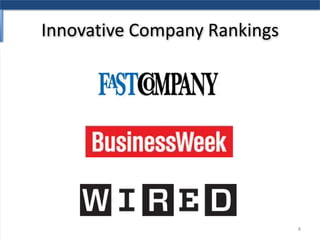
Innovative Company Rankings8
Most Innovative Companies9
Six Sigma in InnovationOf the most innovative companies, only GE couples Six Sigma with InnovationReasonsStifles creativityLowers employee moraleOnly used for process improvement10
Qualities of Innovative CompaniesAttitudesWillingness to cannibalize assets Future focus Tolerance for riskPracticesEmpowerment of product championsIncentives for enterpriseInternal markets 11
RecommendationsDo not use Six Sigma for Innovation Activities directlyIdentify processes/methodologies used to support innovation and other activities; use Six Sigma to improve such processes.Innovation Maturity ModelNext generation organizational behaviorsInstead of applying Six Sigma in silos, use it for the processes of the entire organization  12
Methodologies and toolsPrem Anand13
Is there an indirect connection between Six Sigma & Innovation?14
Yes15
Indirect BenefitsOrganization are undergoing significant changesEmphasis on innovationProposed methodologyUse standard framework to manage innovationIdentify processesUse Six Sigma to improve processesHence Six Sigma can be used indirectly16
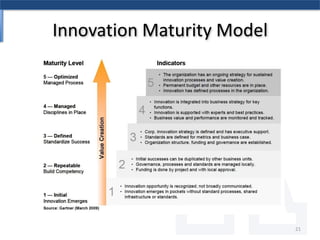
Frameworks and ModelsInnovation Network FrameworkFramework used to manage innovation within a large organizationInnovation Maturity ModelModel to assess the maturity level of the innovation process within an organization17
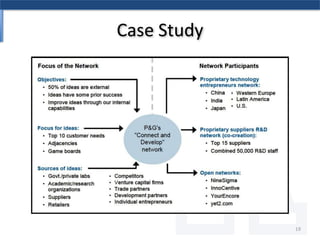
Innovation NetworkFrameworkNetwork with internal and external groups to generate ideasIdentify objectives and define metricsObjectives and metricsBusiness objectivesStructural objectivesActivity metricsBehavioral metricsInnovation Network MetricsCustomer innovation metricsCase Study – P&G18
Case Study19
General Innovation ManagementChoose appropriate innovation strategyFirst-mover strategyFast-follower strategyConservative slow-follower strategyAlternative innovation strategyFocus innovation on a business imperativeDefine an innovation process modelOrganize to accomplish innovationInnovation Maturity Model20
Innovation Maturity Model21
BehaviorsHighly Collaborative Environment22
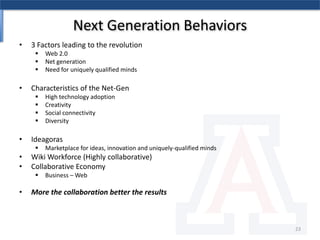
Next Generation Behaviors3 Factors leading to the revolutionWeb 2.0Net generationNeed for uniquely qualified mindsCharacteristics of the Net-GenHigh technology adoptionCreativitySocial connectivityDiversityIdeagorasMarketplace for ideas, innovation and uniquely-qualified mindsWiki Workforce (Highly collaborative)Collaborative EconomyBusiness – WebMore the collaboration better the results23
Boeing 787…Boeing executives concluded that mass collaboration was the only way to create the kind of cheaper, more fuel-efficient jetliner that airlines want…24
Sentiment AnalysisAlso known as Opinion MiningDetermines opinion polarity on a topicQuantifies the qualitative (sentiment)First used for movie reviewsUsed heavily in marketing analysisCan be used to quantify opinion surveysCommercially available sentiment analysis software25
RecommendationsDon’t use Six Sigma for Innovation Activities directly; it stifles creativity.
Identify processes/methodologies used to support innovation and other activities; Use six sigma to improve such processes.Innovation Maturity ModelNext generation organizational behaviorsInstead of applying Six Sigma in silos, use it for the processes of the entire organization  26
Integrated Enterprise ExcellenceSalil27
Integrated Enterprise ExcellenceDeveloped by Forrest W. Breyfogle III, the President and CEO of Smarter Solutions, IncUses the familiar Six Sigma DMAIC road map not only at the project level, but at the enterprise level as well. 28IEEE - DMAICP - DMAICEnterprise Level RoadmapProject Level RoadmapIntegrated Enterprise Excellence* DMAIC = define, measure, analyze, improve, control
The NeedWhere Lean Sigma Falls Short Just another Problem Solving System
Steering committee aims at process improvement and providing certifications
Low hanging fruit gets selected as a goal
Most process improvement techniques often occur in silos
Benefits are not propagated to executive level
In a financial crisis, Lean Six Sigma programs are often downsized29
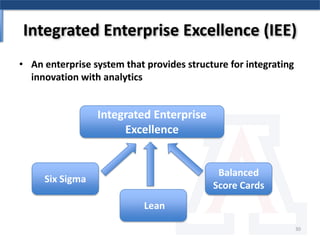
Integrated Enterprise Excellence (IEE)An enterprise system that provides structure for integrating innovation with analytics30Integrated Enterprise ExcellenceSix SigmaBalanced Score Cards Lean
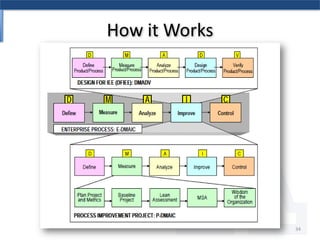
How it Works31
How it WorksStep 1: Describe a vision and a missionStep 2: Describe the value chainStep 3: Analyze the enterpriseStep 4: Establish goals for satellite-level metrics32DefineMeasureAnalyzeAnalyze
How it WorksStep 5: Create strategiesStep 6: Identify high-potential improvement areasStep 7: Identify and execute projectsStep 8: Assess the project’s final impact on enterprise goalsStep 9 : Maintain the gain33AnalyzeAnalyzeImproveImproveControl
How it Works34

Six Sigma Presentation

  • 1.
    Contemporary Organizations andthe Future Six Sigma / Innovation FacetSalilDeshmukhJohn GastreichJustin FreyPrem Anand Mathiyalagan
  • 2.
    2AgendaProblem statementRecommendationsInnovative companiesLinksbetween Six Sigma and innovationIntegrated Enterprise ExcellenceWeighted criteria matrix
  • 3.
    Problem StatementFutureofSix SigmaGrowthversusPerformance3Howto find a balance between efforts to grow the business and the diligence needed to maintain high performance operations?Which Six Sigma approach or evolution is most appropriate for meeting future business challenges over the next decade?
  • 4.
    ScopeWithin ScopeOut ofScopeResearch next-generation Six Sigma and continuous improvement practices. Compare and contrast how industry front-runners apply six sigma in terms of innovation and growth.Identify qualitative metrics for performance assessment and for rewarding/incentivizing.Perform analysis of as-is RMS Six Sigma methodologies.Perform primary research of direct competitors to RMS.Provide recommendations for a roadmap to move from as-is RMS methodologies to to-be RMS methodologies.4
  • 5.
    Research MethodologyPrimary research:interviews with SMEsDr. Pamela Slaten– Operations
  • 6.
    Dr. Kenneth Smith– Innovation
  • 7.
    Dr. Sudha Ram– Business Intelligence
  • 8.
  • 9.
    Thomas Pyzdek –Six SigmaSecondary researchTrade magazines
  • 10.
  • 11.
  • 12.
  • 13.
    RecommendationsDo NOT useSix Sigma for innovation activities directlyIdentify processes/methodologies used to support innovation and other activities; use Six Sigma to improve such processesInnovation Maturity ModelNext generation organizational behaviorsInstead of applying Six Sigma in silos, use it for the processes of the entire organization 6
  • 14.
  • 15.
  • 16.
  • 17.
    Six Sigma inInnovationOf the most innovative companies, only GE couples Six Sigma with InnovationReasonsStifles creativityLowers employee moraleOnly used for process improvement10
  • 18.
    Qualities of InnovativeCompaniesAttitudesWillingness to cannibalize assets Future focus Tolerance for riskPracticesEmpowerment of product championsIncentives for enterpriseInternal markets 11
  • 19.
    RecommendationsDo not useSix Sigma for Innovation Activities directlyIdentify processes/methodologies used to support innovation and other activities; use Six Sigma to improve such processes.Innovation Maturity ModelNext generation organizational behaviorsInstead of applying Six Sigma in silos, use it for the processes of the entire organization 12
  • 20.
  • 21.
    Is there anindirect connection between Six Sigma & Innovation?14
  • 22.
  • 23.
    Indirect BenefitsOrganization areundergoing significant changesEmphasis on innovationProposed methodologyUse standard framework to manage innovationIdentify processesUse Six Sigma to improve processesHence Six Sigma can be used indirectly16
  • 24.
    Frameworks and ModelsInnovationNetwork FrameworkFramework used to manage innovation within a large organizationInnovation Maturity ModelModel to assess the maturity level of the innovation process within an organization17
  • 25.
    Innovation NetworkFrameworkNetwork withinternal and external groups to generate ideasIdentify objectives and define metricsObjectives and metricsBusiness objectivesStructural objectivesActivity metricsBehavioral metricsInnovation Network MetricsCustomer innovation metricsCase Study – P&G18
  • 26.
  • 27.
    General Innovation ManagementChooseappropriate innovation strategyFirst-mover strategyFast-follower strategyConservative slow-follower strategyAlternative innovation strategyFocus innovation on a business imperativeDefine an innovation process modelOrganize to accomplish innovationInnovation Maturity Model20
  • 28.
  • 29.
  • 30.
    Next Generation Behaviors3Factors leading to the revolutionWeb 2.0Net generationNeed for uniquely qualified mindsCharacteristics of the Net-GenHigh technology adoptionCreativitySocial connectivityDiversityIdeagorasMarketplace for ideas, innovation and uniquely-qualified mindsWiki Workforce (Highly collaborative)Collaborative EconomyBusiness – WebMore the collaboration better the results23
  • 31.
    Boeing 787…Boeing executivesconcluded that mass collaboration was the only way to create the kind of cheaper, more fuel-efficient jetliner that airlines want…24
  • 32.
    Sentiment AnalysisAlso knownas Opinion MiningDetermines opinion polarity on a topicQuantifies the qualitative (sentiment)First used for movie reviewsUsed heavily in marketing analysisCan be used to quantify opinion surveysCommercially available sentiment analysis software25
  • 33.
    RecommendationsDon’t use SixSigma for Innovation Activities directly; it stifles creativity.
  • 34.
    Identify processes/methodologies usedto support innovation and other activities; Use six sigma to improve such processes.Innovation Maturity ModelNext generation organizational behaviorsInstead of applying Six Sigma in silos, use it for the processes of the entire organization 26
  • 35.
  • 36.
    Integrated Enterprise ExcellenceDevelopedby Forrest W. Breyfogle III, the President and CEO of Smarter Solutions, IncUses the familiar Six Sigma DMAIC road map not only at the project level, but at the enterprise level as well. 28IEEE - DMAICP - DMAICEnterprise Level RoadmapProject Level RoadmapIntegrated Enterprise Excellence* DMAIC = define, measure, analyze, improve, control
  • 37.
    The NeedWhere LeanSigma Falls Short Just another Problem Solving System
  • 38.
    Steering committee aimsat process improvement and providing certifications
  • 39.
    Low hanging fruitgets selected as a goal
  • 40.
    Most process improvementtechniques often occur in silos
  • 41.
    Benefits are notpropagated to executive level
  • 42.
    In a financialcrisis, Lean Six Sigma programs are often downsized29
  • 43.
    Integrated Enterprise Excellence(IEE)An enterprise system that provides structure for integrating innovation with analytics30Integrated Enterprise ExcellenceSix SigmaBalanced Score Cards Lean
  • 44.
  • 45.
    How it WorksStep1: Describe a vision and a missionStep 2: Describe the value chainStep 3: Analyze the enterpriseStep 4: Establish goals for satellite-level metrics32DefineMeasureAnalyzeAnalyze
  • 46.
    How it WorksStep5: Create strategiesStep 6: Identify high-potential improvement areasStep 7: Identify and execute projectsStep 8: Assess the project’s final impact on enterprise goalsStep 9 : Maintain the gain33AnalyzeAnalyzeImproveImproveControl
  • 47.

Editor's Notes

  • #4 Talk about the two questions put forth to us here.
  • #7 List the recommendation briefly.
  • #13 Talk about the one recommendation again. Refresh their memory.
  • #27 Talk about the one recommendation again. Refresh their memory.
  • #28 Now that we have seen few methodologies to promote innovation in the organization, let us now take a look at variation or a new form of SIX SIGMA can help us achieve it.
  • #30 Lean-waste reduction and Six Sigma-quality improvement methodologyWhen Lean meets Six Sigma, all projects begin with a problem statement, so the Lean Six Sigma frameworkis, de facto, a problem-solving system. Adding Lean expands traditional Six Sigma defect-reduction problem statements to include thereduction of waste in both time and resources.Yet the aim of typical Lean Six Sigma deployments is modest.A steering committee or some level of management selects projects with two objectives: to improve a process and/or to provide certification for an employee.When certification is the overriding goal, the company usually selects low-hanging fruit for the initial project, and that first project is often the last project the person completes. Either way, this system is a “push” approach to project creation; people hunt for projects because they need to get certified or because members of the Lean Six Sigma steering committee want to brag about how much money they saved the company. Such a system of project selection can produce initial successes, since the projects with the mostpotential benefit to the organization are obvious to everybody without enterprise analysis.
  • #31 In the IEE framework, in contrast, the organizational value chain is examined for improvementopportunities during the E-DMAIC analyze phase. It consolidates the Lean approach to waste reduction with the Six Sigma quality improvement methodology — and incorporates a pragmatic, no-gaming scorecard, to build targeted strategies for improving the business as a whole.These strategies then lead to the identification of improvement needs in value-chain performance metrics,so project creation is driven by a pull — rather than push — approach.The result can be either process improvement or R&D design projects that focus on developing innovative new solutions. Emphasis is given to creating financial benefits that will be felt by the entire company, not just at the individual sub-process level. Thus Integrated Enterprise Excellence (IEE), an enterprise system that provides structure for integrating innovation with analytics.
  • #32 In IEE strategy is not a 5 step DMAIC process but a nice step process as we see in the figure
  • #33 1. Define: Describe a vision and a mission. The organization builds a vision and mission that willremain consistent over time, as leaders and strategies come and go. The company’s full management teammust sign on, and employees must also be on board.2. Define-Measure: Describe the value chain, including satellite-level and 30,000-foot-levelmetrics. The IEE approach tracks two types of high-level metrics as part of the company’s value chain: 30,000-foot-level (operational) metrics and satellite-level (financial) metrics. An IEE company uses satellite-level metrics to track performance in areas such as financial revenue growth and profit margins. Once it has set performance targets for its satellite-level metrics, it builds strategies for achieving those goals. Then, from those strategies, it determines goals for its 30,000-foot-level metrics in an analytic/innovation assessment of the enterprise as a whole. The 30,000-foot-level metrics can include defective rates, on-time delivery, inventory, safety, product development time, and production lead time.3. Analyze: Analyze the enterprise. Using the metrics it has selected, the company needs to identifyaction opportunities, considering both problems and improvement possibilities.The four “analyze” phases are critically important to the E-DMAIC process. These steps can lead toan innovative solution.4. Analyze: Establish goals for satellite-level metrics. Next, the company needs to set specific,measurable, actionable, relevant, and time-based (i.e., “SMART”) goals at the satellite level. The highestlevelgoals need to be realistic and consistent with the improvement opportunities identified in the thirdE-DMAIC step.
  • #34 5. Analyze: Create strategies. Every organization requires a certain level of innovation. Some needmuch; others need little. It’s essential to find the optimum level, and E-DMAIC provides a structuredmethod for doing so.5. Analyze: Identify high-potential improvement areas, and establish related SMART 30,000-foot-level metric goals. Goals set for the 30,000-foot-level metrics are the ultimate determinants of whatchanges in an organization.6. Improve: Identify and execute projects. Once improvement goals are set, the company shouldselect and assign well-scoped projects that are neither too large nor too small. All projects must reflect theintegration of analytics and innovation. This isn’t difficult once a company has established IEE, becausethe system’s no-nonsense approach to metric tracking and identification of improvement opportunitiesestablishes a culture focused on better use of analytics.7. Improve: Assess the project’s final impact on enterprise goals. Assess how well objectiveswere met relative to the achievement of enterprise goals. Establish a system for collecting and analyzinglessons learned.8. Control: Maintain the gain. IEE businesses track high-level value-chain metrics, then reviewthose results as part of management meetings to ensure that the performance of a particular metric thatimproved as a result of a given project does not subsequently degrade to its previous level.
  • #35 The analyze phase of the enterprise-level DMAIC road map blends analytics with innovationas part of the corporate strategy-building process.
  • #36 Talk about the one recommendation again. Refresh their memory.