Quality criteria for architectural 3D data in usage and 
30 / 05 / 14 
preservation processes 
QQML 2014 
Istanbul, May 27th – 30th 2014 
Michelle Lindlar (LUH / TIB) 
Martin Tamke, Morten Myrup Jensen, Henrik Leander Evers (CITA)
Brief introduction to DURAARK 
• to 3D scans 
• to 3D plans(BIM) 
Brief introduction to 
digital preservation 
Quality factors 
• A digital preservation view 
• A 3D plan / BIM view 
• A 3D scanview 
• A stakeholder view 
Conclusion and Outlook 
30 / 05 / 14 
Overview
30 / 05 / 14
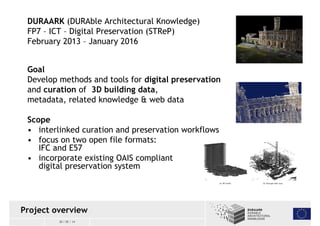
DURAARK (DURAble Architectural Knowledge) 
FP7 – ICT – Digital Preservation (STReP) 
February 2013 – January 2016 
Goal 
Develop methods and tools for digital preservation 
and curation of 3D building data, 
metadata, related knowledge & web data 
Scope 
• interlinked curation and preservation workflows 
• focus on two open file formats: 
IFC and E57 
• incorporate existing OAIS compliant 
digital preservation system 
Project overview 
30 / 05 / 14
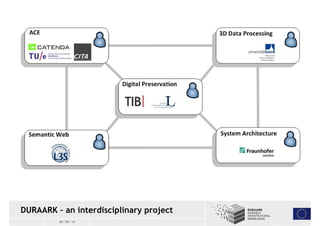
DURAARK – an interdisciplinary project 
30 / 05 / 14
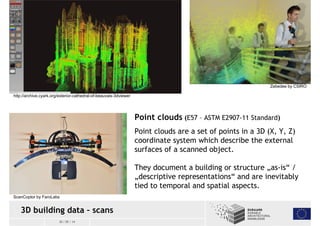
ScanCoptor by FaroLabs 
3D building data – scans 
30 / 05 / 14 
Zebedee by CSIRO 
Point clouds (E57 – ASTM E2907-11 Standard) 
Point clouds are a set of points in a 3D (X, Y, Z) 
coordinate system which describe the external 
surfaces of a scanned object. 
They document a building or structure „as-is“ / 
„descriptive representations“ and are inevitably 
tied to temporal and spatial aspects. 
http://archive.cyark.org/exterior-cathedral-of-beauvais-3dviewer
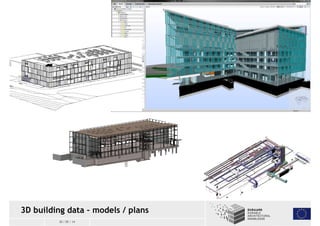
3D building data – models / plans 
30 / 05 / 14 
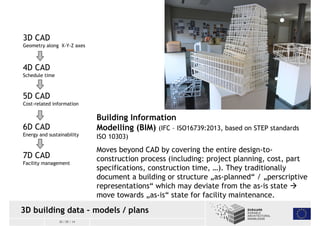
Building Information 
Modelling (BIM) (IFC – ISO16739:2013, based on STEP standards 
ISO 10303) 
Moves beyond CAD by covering the entire design-to-construction 
process (including: project planning, cost, part 
specifications, construction time, …). They traditionally 
document a building or structure „as-planned“ / „perscriptive 
representations“ which may deviate from the as-is state  
move towards „as-is“ state for facility maintenance. 
3D CAD 
Geometry along X-Y-Z axes 
4D CAD 
Schedule time 
5D CAD 
Cost-related information 
6D CAD 
Energy and sustainability 
7D CAD 
Facility management
3D building data – models / plans 
30 / 05 / 14
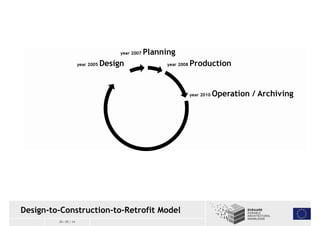
Design-to-Construction-to-Retrofit Model 
30 / 05 / 14
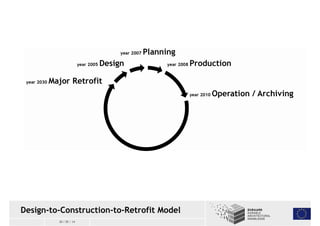
Design-to-Construction-to-Retrofit Model 
30 / 05 / 14
3D scans and plans are the research 
output of respective 
departments and will be found in 
future legacy deposits of 
architects and engineers / 
current institutional repositories 
BIM is already mandatory in several 
countries for (some) publically 
funded buildings, including 
Denmark, Finland, Hong 
Kong, Netherlands, Norway, 
Singapore, UK, USA. Out of those 
countries all but Hong Kong 
require IFC for BIM 
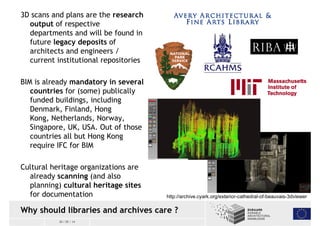
Cultural heritage organizations are 
already scanning (and also 
planning) cultural heritage sites 
for documentation http://archive.cyark.org/exterior-cathedral-of-beauvais-3dviewer 
Why should libraries and archives care ? 
30 / 05 / 14
The 3 [preservation] layers of a digital object 
30 / 05 / 14
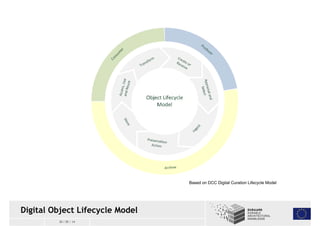
Digital Object Lifecycle Model 
30 / 05 / 14 
Based on DCC Digital Curation Lifecycle Model
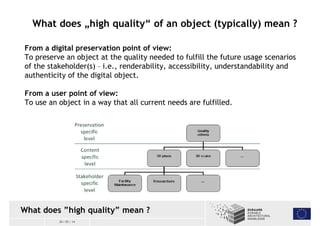
What does „high quality“ of an object (typically) mean ? 
From a digital preservation point of view: 
To preserve an object at the quality needed to fulfill the future usage scenarios 
of the stakeholder(s) – i.e., renderability, accessibility, understandability and 
authenticity of the digital object. 
From a user point of view: 
To use an object in a way that all current needs are fulfilled. 
What does ”high quality” mean ? 
30 / 05 / 14
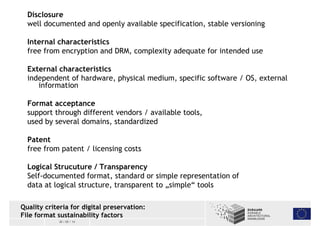
Disclosure 
well documented and openly available specification, stable versioning 
Internal characteristics 
free from encryption and DRM, complexity adequate for intended use 
External characteristics 
independent of hardware, physical medium, specific software / OS, external 
information 
Format acceptance 
support through different vendors / available tools, 
used by several domains, standardized 
Patent 
free from patent / licensing costs 
Logical Strucuture / Transparency 
Self-documented format, standard or simple representation of 
data at logical structure, transparent to „simple“ tools 
Quality criteria for digital preservation: 
File format sustainability factors 
30 / 05 / 14
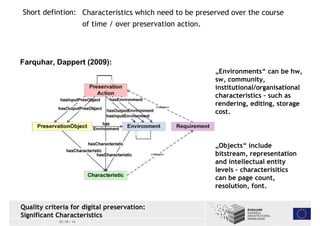
Short defintion: 
30 / 05 / 14 
Characteristics which need to be preserved over the course 
of time / over preservation action. 
„Environments“ can be hw, 
sw, community, 
institutional/organisational 
characteristics – such as 
rendering, editing, storage 
cost. 
Farquhar, Dappert (2009): 
„Objects“ include 
bitstream, representation 
and intellectual entity 
levels – characterisitics 
can be page count, 
resolution, font. 
Quality criteria for digital preservation: 
Significant Characteristics
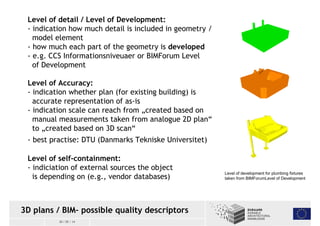
Level of detail / Level of Development: 
- indication how much detail is included in geometry / 
model element 
- how much each part of the geometry is developed 
- e.g. CCS Informationsniveuaer or BIMForum Level 
of Development 
Level of Accuracy: 
- indication whether plan (for existing building) is 
accurate representation of as-is 
- indication scale can reach from „created based on 
manual measurements taken from analogue 2D plan“ 
to „created based on 3D scan“ 
- best practise: DTU (Danmarks Tekniske Universitet) 
Level of self-containment: 
- indiciation of external sources the object 
is depending on (e.g., vendor databases) Level of development for plumbing fixtures 
3D plans / BIM– possible quality descriptors 
30 / 05 / 14 
taken from BIMForumLevel of Development
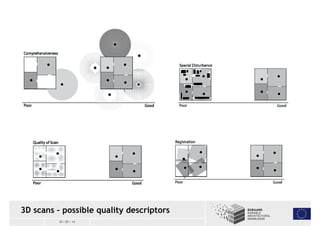
3D scans – possible quality descriptors 
30 / 05 / 14
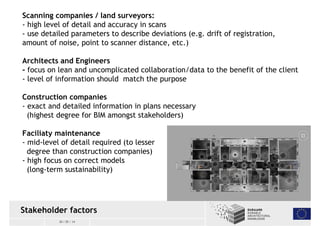
Scanning companies / land surveyors: 
- high level of detail and accuracy in scans 
- use detailed parameters to describe deviations (e.g. drift of registration, 
amount of noise, point to scanner distance, etc.) 
Architects and Engineers 
- focus on lean and uncomplicated collaboration/data to the benefit of the client 
- level of information should match the purpose 
Construction companies 
- exact and detailed information in plans necessary 
(highest degree for BIM amongst stakeholders) 
Faciliaty maintenance 
- mid-level of detail required (to lesser 
degree than construction companies) 
- high focus on correct models 
(long-term sustainability) 
Stakeholder factors 
30 / 05 / 14
Findings 
- first quality factors which can serve as 
significant characteristics have been identified 
- quality expectations differ greatly between the 
stakeholder groups for architectural data 
- long-term archives need processes to assess the 
quality for the respective stakeholders 
- first tool for E57 quality assessment has been 
developed in DURAARK project 
Outlook 
- development of IFC quality assessment tool 
is currently underway 
- workshops to test tools and processes with 
stakeholders will take place in the fall 
Interested in further information? 
Deliverables are available on the website 
www.duraark.eu 
Conclusion and outlook 
30 / 05 / 14
Thank you. Questions? Suggestions? 
21 / 10 / 13 
Do you have architectural 
3D data? Contact us! 
www.duraark.eu 
michelle.lindlar@tib.uni-hannover.de 
martin.tamke@kadk.dk

Quality criteria for architectural 3D data in usage and preservation processes

  • 1.
    Quality criteria forarchitectural 3D data in usage and 30 / 05 / 14 preservation processes QQML 2014 Istanbul, May 27th – 30th 2014 Michelle Lindlar (LUH / TIB) Martin Tamke, Morten Myrup Jensen, Henrik Leander Evers (CITA)
  • 2.
    Brief introduction toDURAARK • to 3D scans • to 3D plans(BIM) Brief introduction to digital preservation Quality factors • A digital preservation view • A 3D plan / BIM view • A 3D scanview • A stakeholder view Conclusion and Outlook 30 / 05 / 14 Overview
  • 3.
    30 / 05/ 14
  • 4.
    DURAARK (DURAble ArchitecturalKnowledge) FP7 – ICT – Digital Preservation (STReP) February 2013 – January 2016 Goal Develop methods and tools for digital preservation and curation of 3D building data, metadata, related knowledge & web data Scope • interlinked curation and preservation workflows • focus on two open file formats: IFC and E57 • incorporate existing OAIS compliant digital preservation system Project overview 30 / 05 / 14
  • 5.
    DURAARK – aninterdisciplinary project 30 / 05 / 14
  • 6.
    ScanCoptor by FaroLabs 3D building data – scans 30 / 05 / 14 Zebedee by CSIRO Point clouds (E57 – ASTM E2907-11 Standard) Point clouds are a set of points in a 3D (X, Y, Z) coordinate system which describe the external surfaces of a scanned object. They document a building or structure „as-is“ / „descriptive representations“ and are inevitably tied to temporal and spatial aspects. http://archive.cyark.org/exterior-cathedral-of-beauvais-3dviewer
  • 7.
    3D building data– models / plans 30 / 05 / 14 Building Information Modelling (BIM) (IFC – ISO16739:2013, based on STEP standards ISO 10303) Moves beyond CAD by covering the entire design-to-construction process (including: project planning, cost, part specifications, construction time, …). They traditionally document a building or structure „as-planned“ / „perscriptive representations“ which may deviate from the as-is state  move towards „as-is“ state for facility maintenance. 3D CAD Geometry along X-Y-Z axes 4D CAD Schedule time 5D CAD Cost-related information 6D CAD Energy and sustainability 7D CAD Facility management
  • 8.
    3D building data– models / plans 30 / 05 / 14
  • 9.
  • 10.
  • 11.
    3D scans andplans are the research output of respective departments and will be found in future legacy deposits of architects and engineers / current institutional repositories BIM is already mandatory in several countries for (some) publically funded buildings, including Denmark, Finland, Hong Kong, Netherlands, Norway, Singapore, UK, USA. Out of those countries all but Hong Kong require IFC for BIM Cultural heritage organizations are already scanning (and also planning) cultural heritage sites for documentation http://archive.cyark.org/exterior-cathedral-of-beauvais-3dviewer Why should libraries and archives care ? 30 / 05 / 14
  • 12.
    The 3 [preservation]layers of a digital object 30 / 05 / 14
  • 13.
    Digital Object LifecycleModel 30 / 05 / 14 Based on DCC Digital Curation Lifecycle Model
  • 14.
    What does „highquality“ of an object (typically) mean ? From a digital preservation point of view: To preserve an object at the quality needed to fulfill the future usage scenarios of the stakeholder(s) – i.e., renderability, accessibility, understandability and authenticity of the digital object. From a user point of view: To use an object in a way that all current needs are fulfilled. What does ”high quality” mean ? 30 / 05 / 14
  • 15.
    Disclosure well documentedand openly available specification, stable versioning Internal characteristics free from encryption and DRM, complexity adequate for intended use External characteristics independent of hardware, physical medium, specific software / OS, external information Format acceptance support through different vendors / available tools, used by several domains, standardized Patent free from patent / licensing costs Logical Strucuture / Transparency Self-documented format, standard or simple representation of data at logical structure, transparent to „simple“ tools Quality criteria for digital preservation: File format sustainability factors 30 / 05 / 14
  • 16.
    Short defintion: 30/ 05 / 14 Characteristics which need to be preserved over the course of time / over preservation action. „Environments“ can be hw, sw, community, institutional/organisational characteristics – such as rendering, editing, storage cost. Farquhar, Dappert (2009): „Objects“ include bitstream, representation and intellectual entity levels – characterisitics can be page count, resolution, font. Quality criteria for digital preservation: Significant Characteristics
  • 17.
    Level of detail/ Level of Development: - indication how much detail is included in geometry / model element - how much each part of the geometry is developed - e.g. CCS Informationsniveuaer or BIMForum Level of Development Level of Accuracy: - indication whether plan (for existing building) is accurate representation of as-is - indication scale can reach from „created based on manual measurements taken from analogue 2D plan“ to „created based on 3D scan“ - best practise: DTU (Danmarks Tekniske Universitet) Level of self-containment: - indiciation of external sources the object is depending on (e.g., vendor databases) Level of development for plumbing fixtures 3D plans / BIM– possible quality descriptors 30 / 05 / 14 taken from BIMForumLevel of Development
  • 18.
    3D scans –possible quality descriptors 30 / 05 / 14
  • 19.
    Scanning companies /land surveyors: - high level of detail and accuracy in scans - use detailed parameters to describe deviations (e.g. drift of registration, amount of noise, point to scanner distance, etc.) Architects and Engineers - focus on lean and uncomplicated collaboration/data to the benefit of the client - level of information should match the purpose Construction companies - exact and detailed information in plans necessary (highest degree for BIM amongst stakeholders) Faciliaty maintenance - mid-level of detail required (to lesser degree than construction companies) - high focus on correct models (long-term sustainability) Stakeholder factors 30 / 05 / 14
  • 20.
    Findings - firstquality factors which can serve as significant characteristics have been identified - quality expectations differ greatly between the stakeholder groups for architectural data - long-term archives need processes to assess the quality for the respective stakeholders - first tool for E57 quality assessment has been developed in DURAARK project Outlook - development of IFC quality assessment tool is currently underway - workshops to test tools and processes with stakeholders will take place in the fall Interested in further information? Deliverables are available on the website www.duraark.eu Conclusion and outlook 30 / 05 / 14
  • 21.
    Thank you. Questions?Suggestions? 21 / 10 / 13 Do you have architectural 3D data? Contact us! www.duraark.eu michelle.lindlar@tib.uni-hannover.de martin.tamke@kadk.dk