16 / 05 / 14
A Domain-driven Approach to Digital Curation and
Preservation of 3D Architectural Data
- Stakeholder Identification and Alignment in the DURAARK project -
Michelle Lindlar (LUH / TIB)
Martin Tamke (CITA)
Archiving 2014
Berlin, May 13th – 16th 2014
16 / 05 / 14
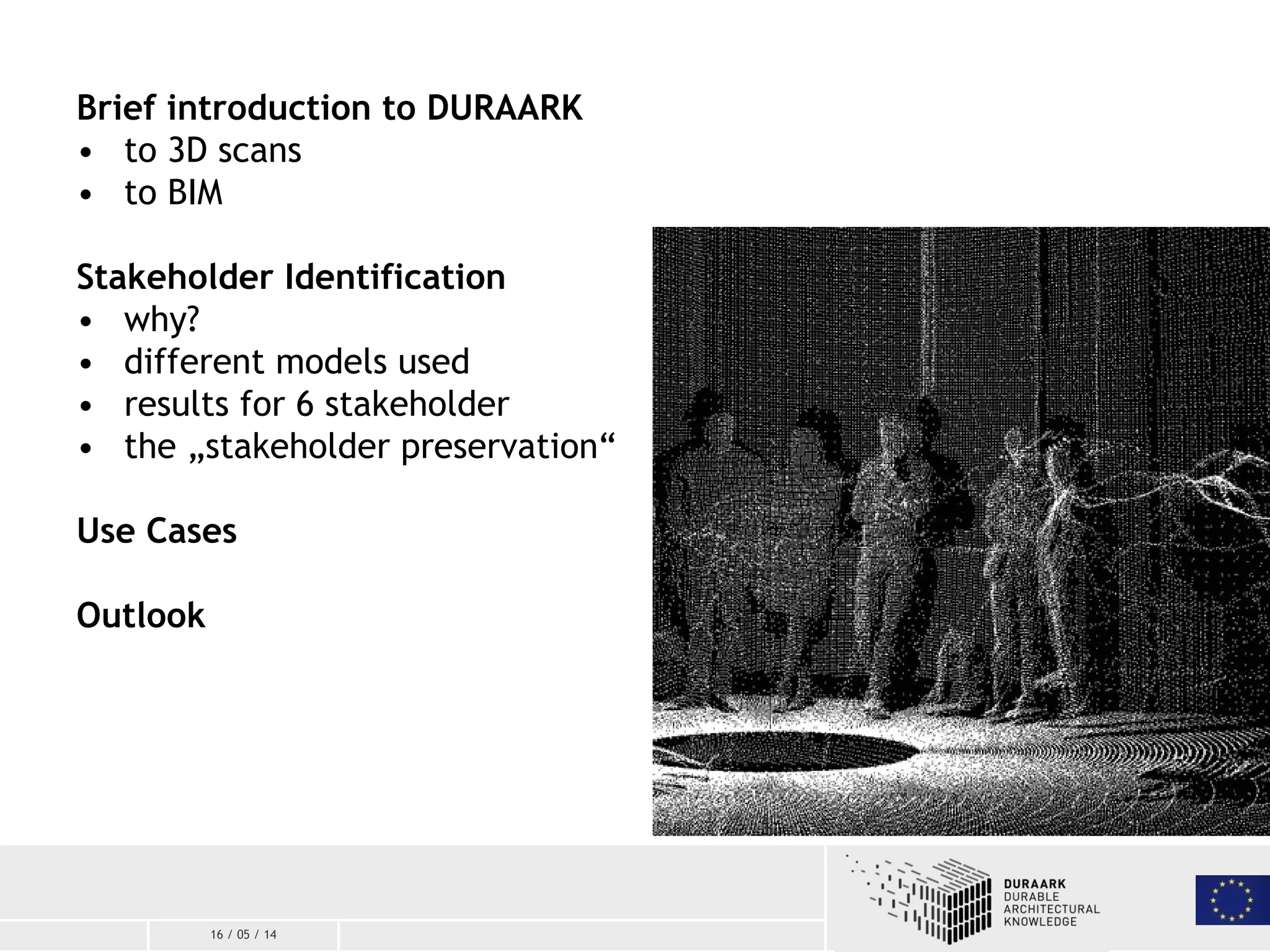
Brief introduction to DURAARK
• to 3D scans
• to BIM
Stakeholder Identification
• why?
• different models used
• results for 6 stakeholder
• the „stakeholder preservation“
Use Cases
Outlook
16 / 05 / 14
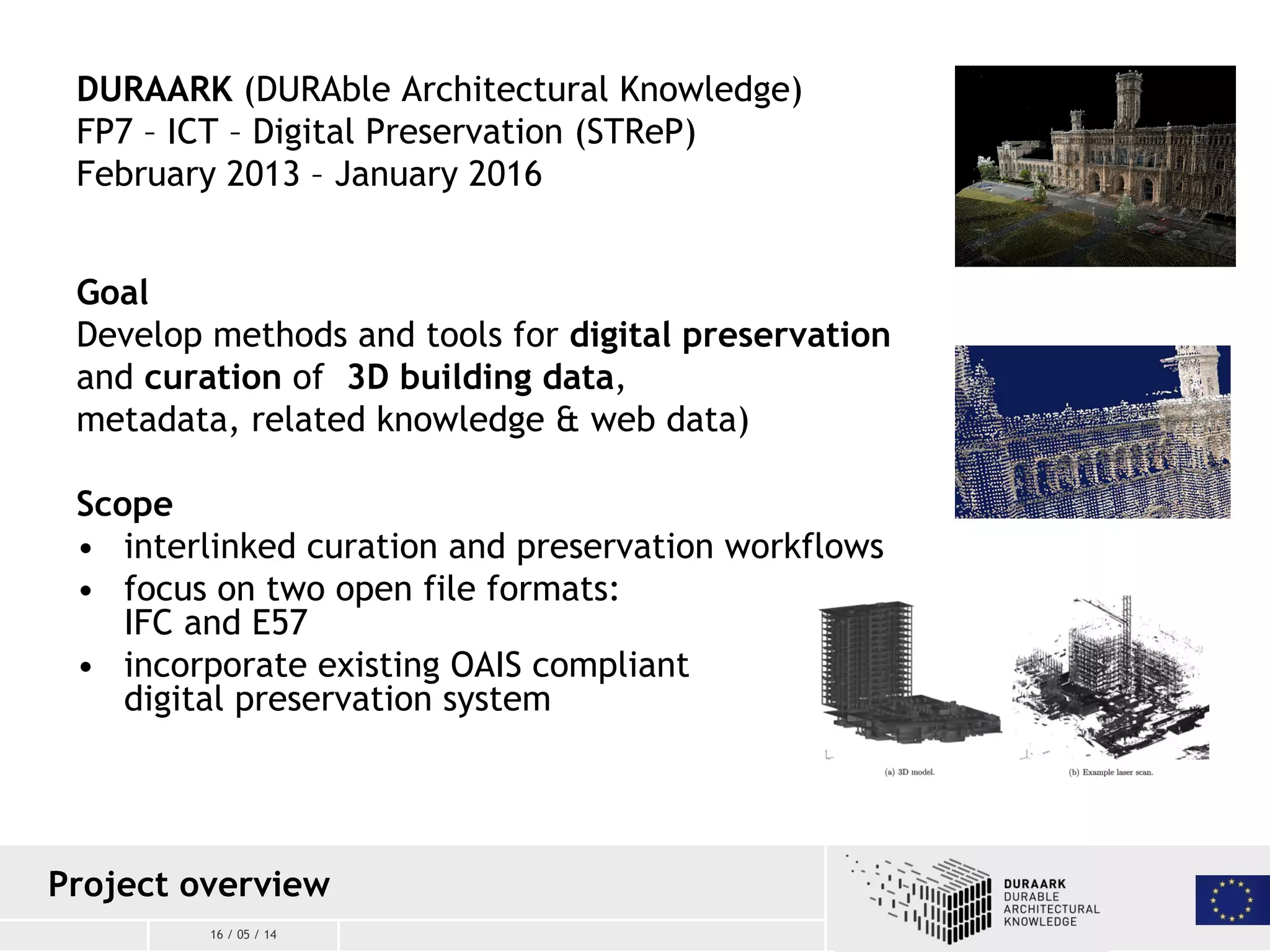
DURAARK (DURAble Architectural Knowledge)
FP7 – ICT – Digital Preservation (STReP)
February 2013 – January 2016
Goal
Develop methods and tools for digital preservation
and curation of 3D building data,
metadata, related knowledge & web data)
Scope
• interlinked curation and preservation workflows
• focus on two open file formats:
IFC and E57
• incorporate existing OAIS compliant
digital preservation system
Project overview
16 / 05 / 14
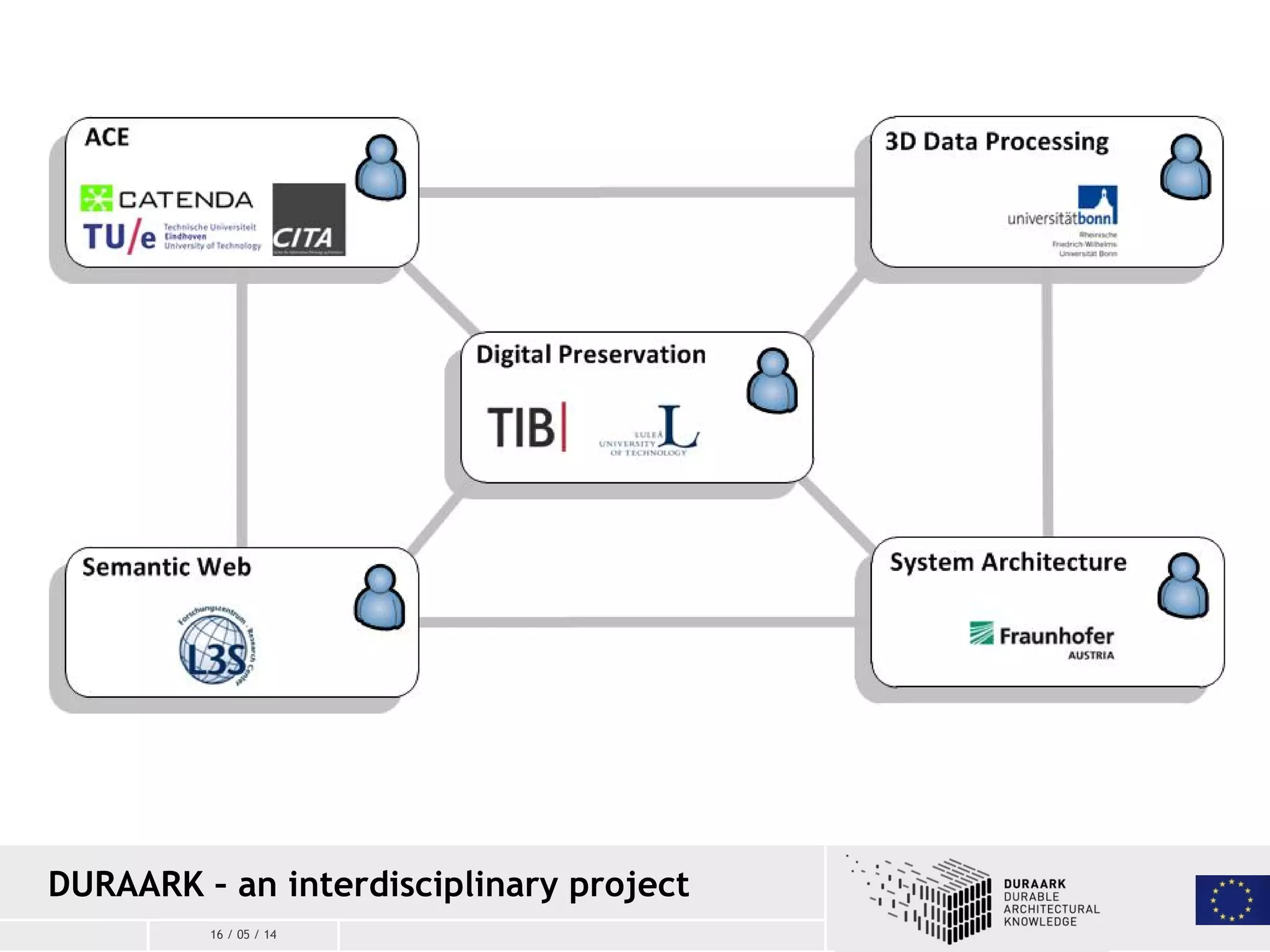
DURAARK – an interdisciplinary project
16 / 05 / 14
3D building data – scans
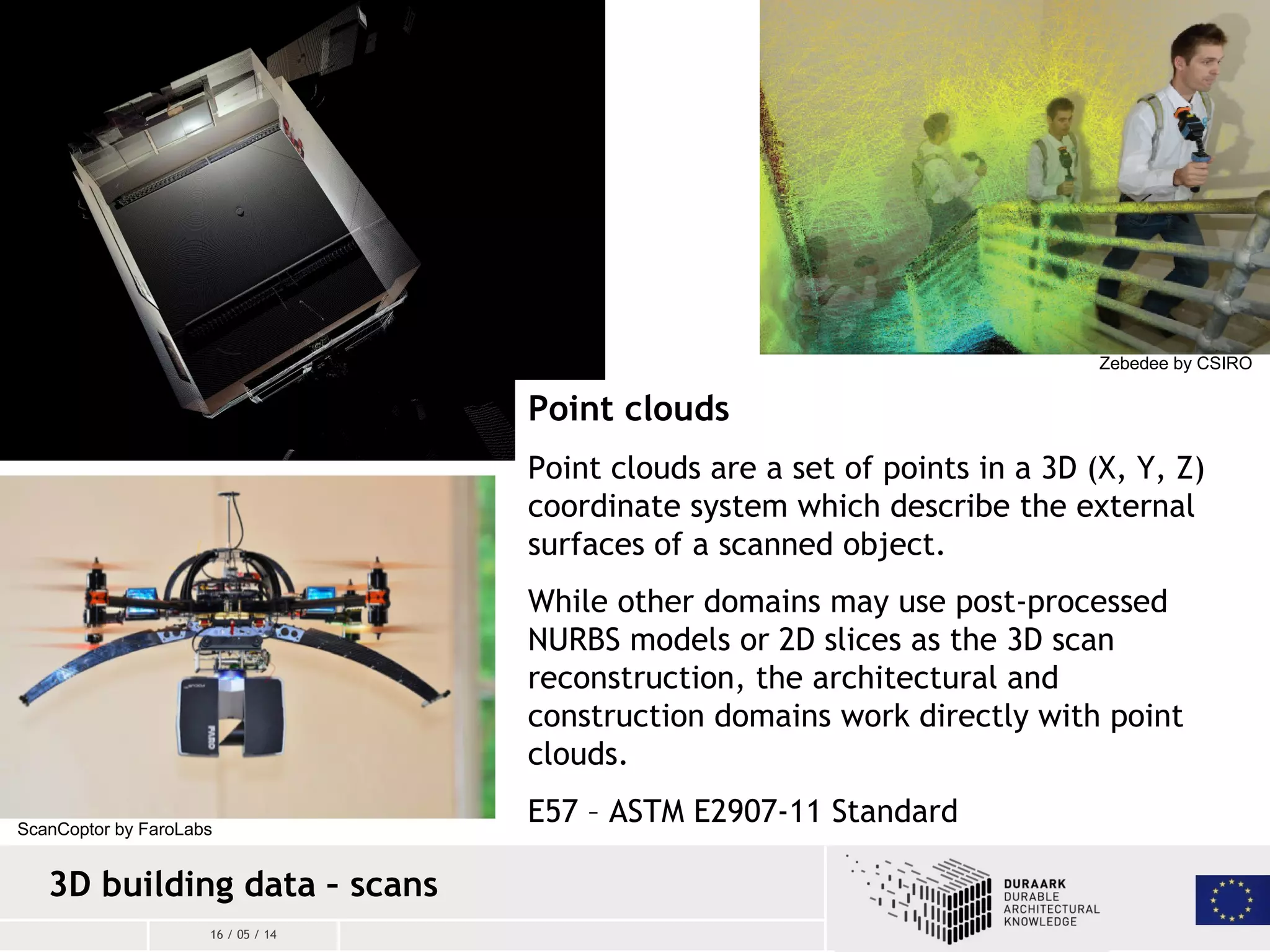
ScanCoptor by FaroLabs
Point clouds
Point clouds are a set of points in a 3D (X, Y, Z)
coordinate system which describe the external
surfaces of a scanned object.
While other domains may use post-processed
NURBS models or 2D slices as the 3D scan
reconstruction, the architectural and
construction domains work directly with point
clouds.
E57 – ASTM E2907-11 Standard
Zebedee by CSIRO
16 / 05 / 14
3D building data – models
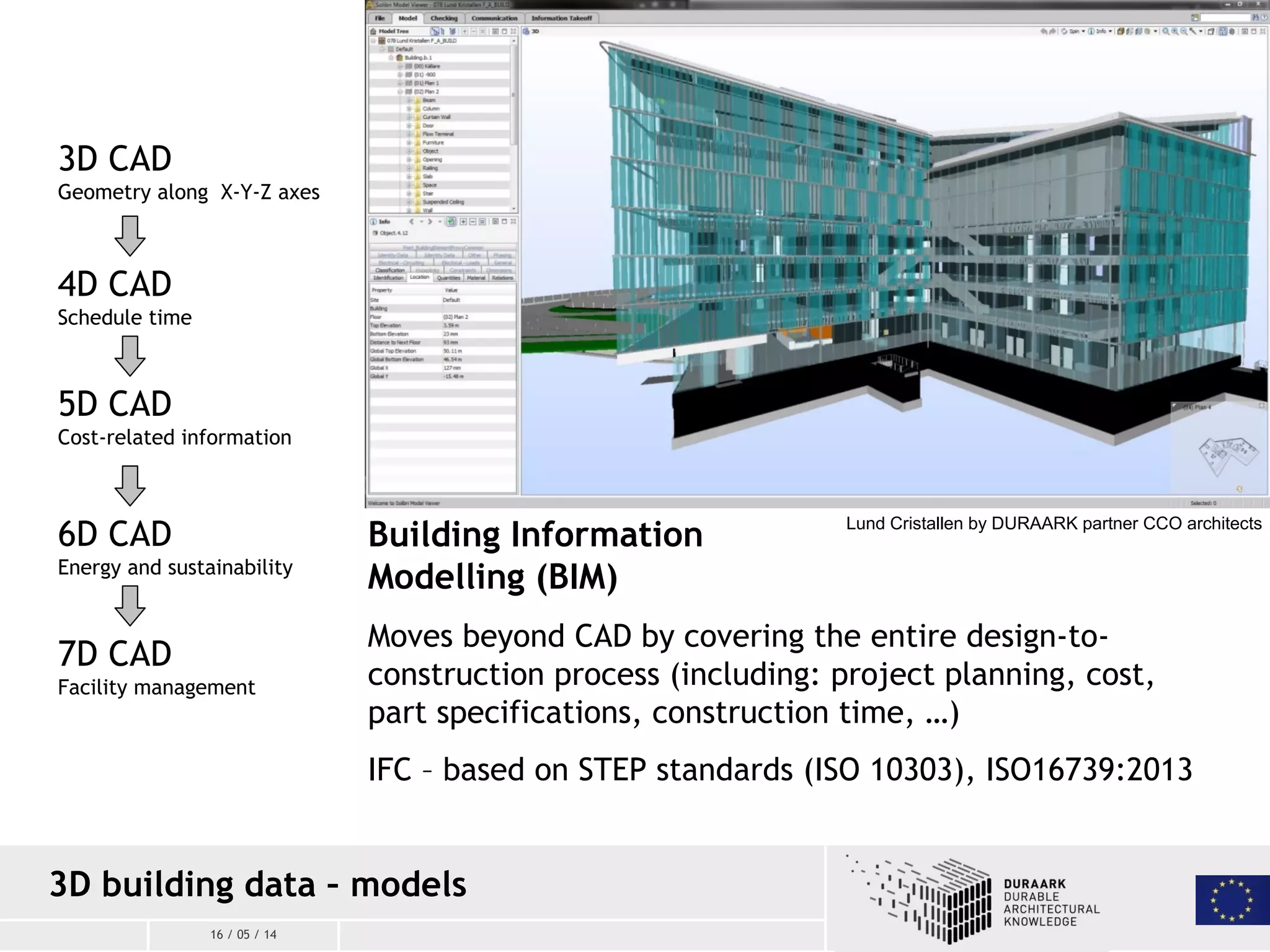
Building Information
Modelling (BIM)
Moves beyond CAD by covering the entire design-to-
construction process (including: project planning, cost,
part specifications, construction time, …)
IFC – based on STEP standards (ISO 10303), ISO16739:2013
3D CAD
Geometry along X-Y-Z axes
4D CAD
Schedule time
5D CAD
Cost-related information
6D CAD
Energy and sustainability
7D CAD
Facility management
Lund Cristallen by DURAARK partner CCO architects
16 / 05 / 14
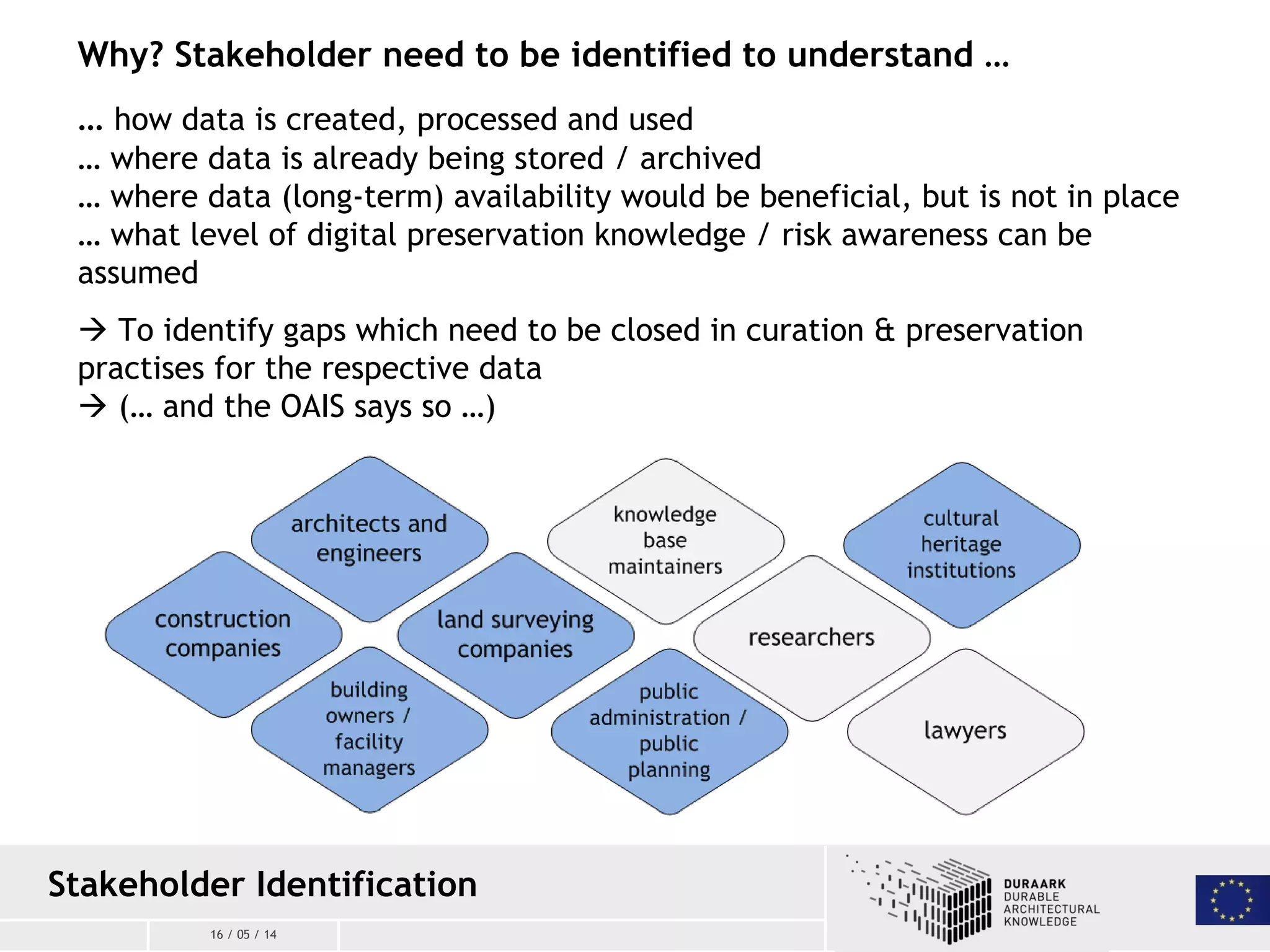
Stakeholder Identification
Why? Stakeholder need to be identified to understand …
… how data is created, processed and used
… where data is already being stored / archived
… where data (long-term) availability would be beneficial, but is not in place
… what level of digital preservation knowledge / risk awareness can be
assumed
 To identify gaps which need to be closed in curation & preservation
practises for the respective data
 (… and the OAIS says so …)
16 / 05 / 14
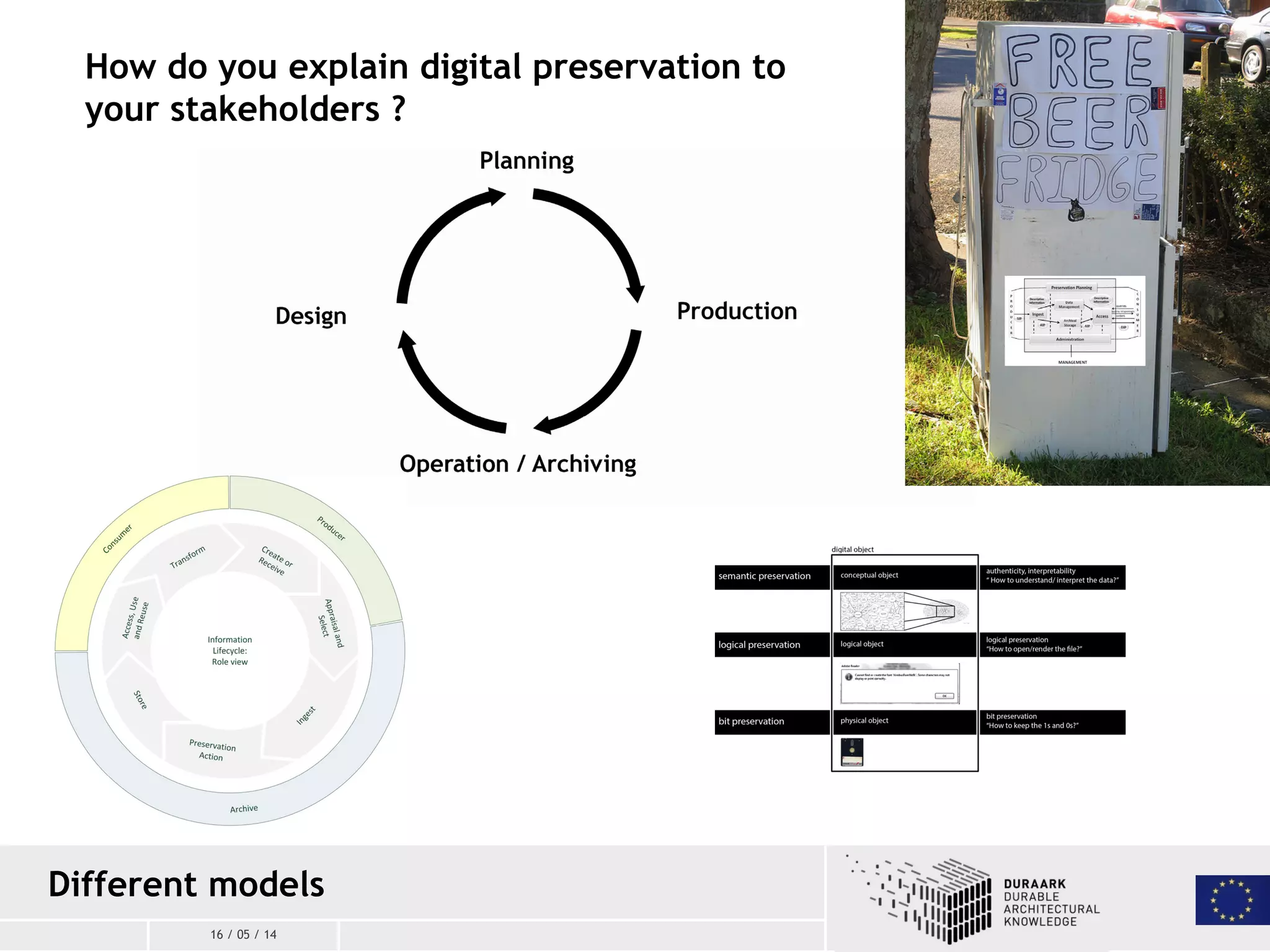
Different models
How do you explain digital preservation to
your stakeholders ?
16 / 05 / 14
Design-to-Construction-to-Retrofit Model
16 / 05 / 14
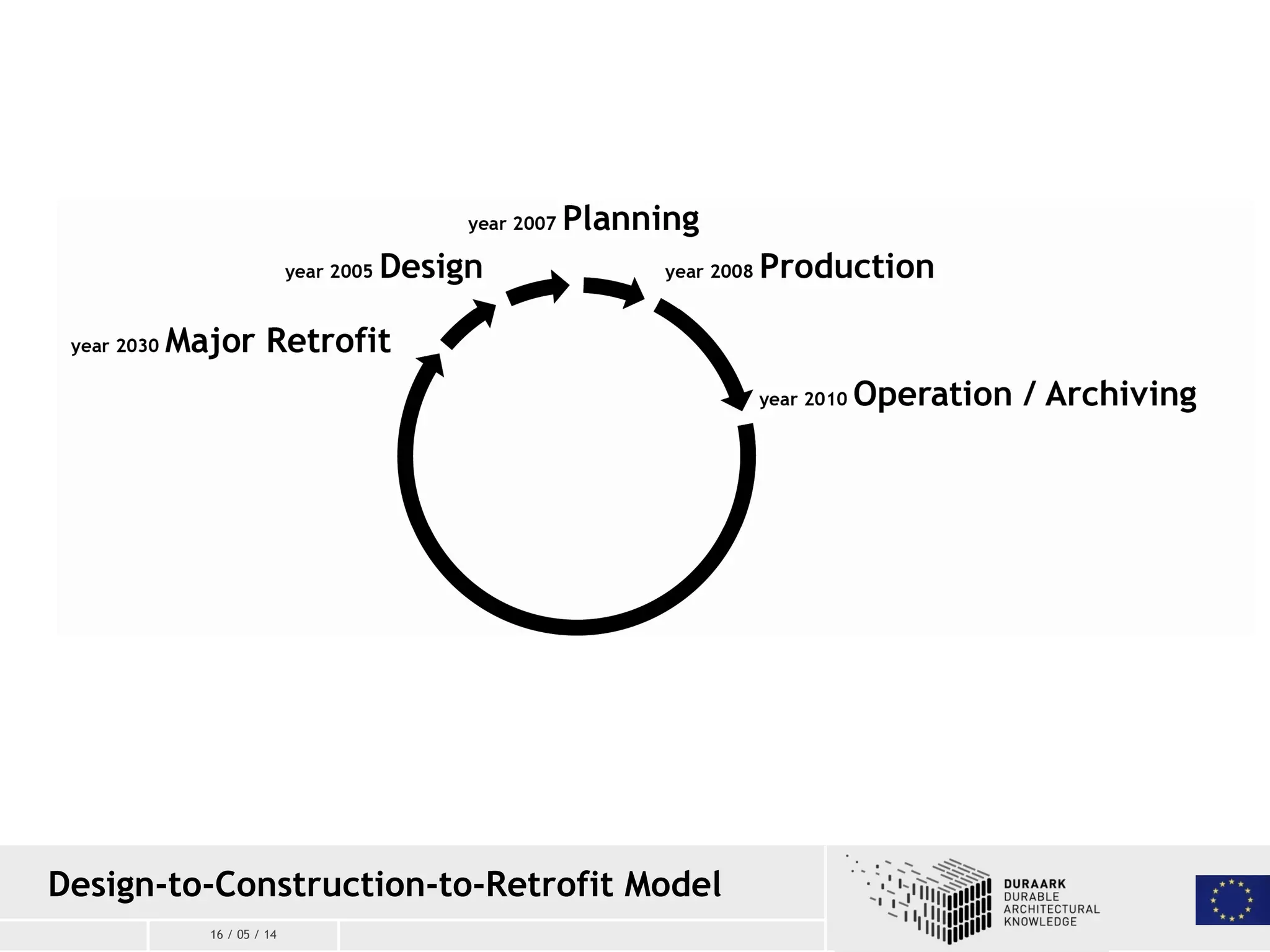
Design-to-Construction-to-Retrofit Model
16 / 05 / 14
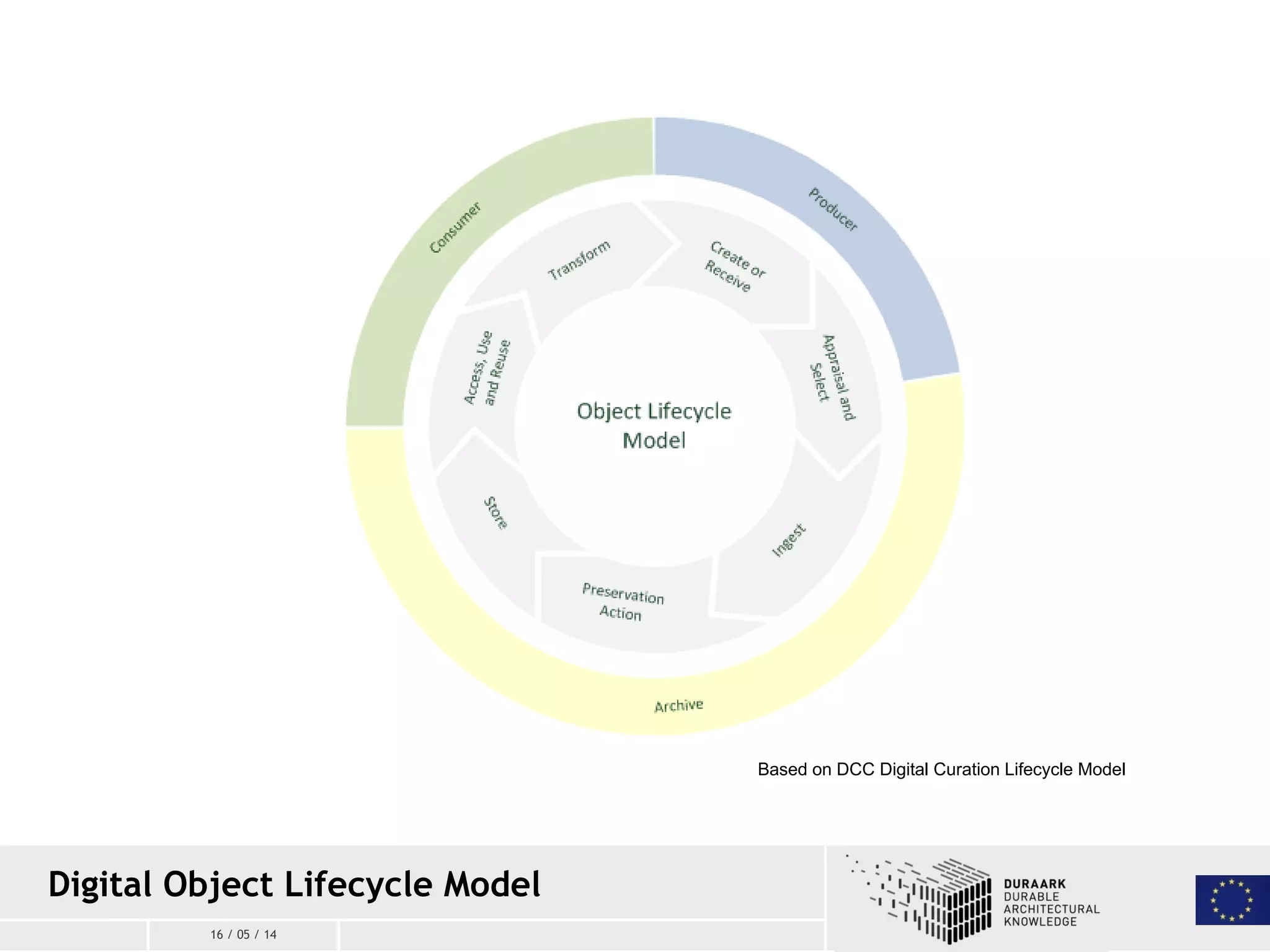
Digital Object Lifecycle Model
Based on DCC Digital Curation Lifecycle Model
16 / 05 / 14
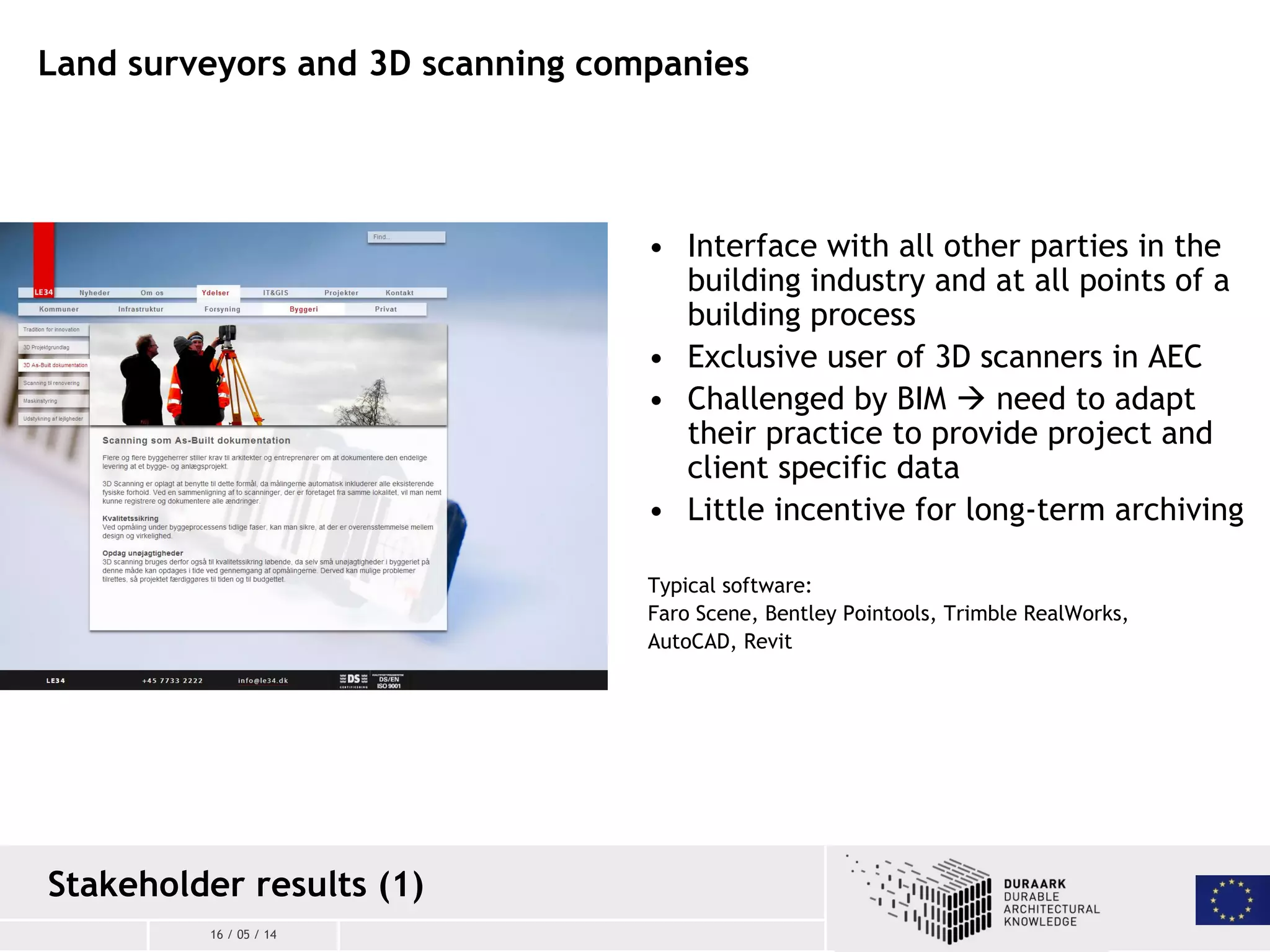
Land surveyors and 3D scanning companies
• Interface with all other parties in the
building industry and at all points of a
building process
• Exclusive user of 3D scanners in AEC
• Challenged by BIM  need to adapt
their practice to provide project and
client specific data
• Little incentive for long-term archiving
Typical software:
Faro Scene, Bentley Pointools, Trimble RealWorks,
AutoCAD, Revit
Stakeholder results (1)
16 / 05 / 14
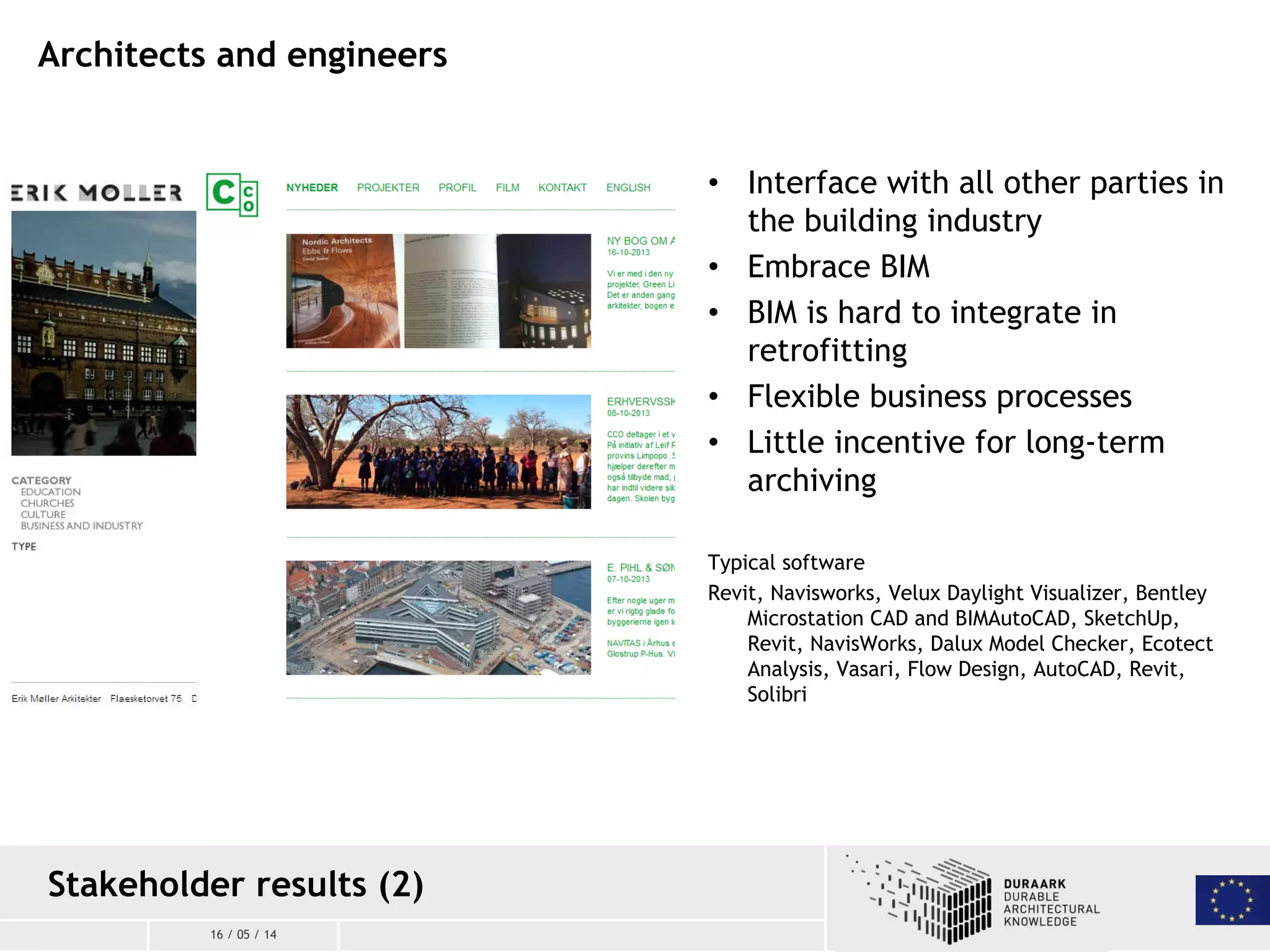
• Interface with all other parties in
the building industry
• Embrace BIM
• BIM is hard to integrate in
retrofitting
• Flexible business processes
• Little incentive for long-term
archiving
Typical software
Revit, Navisworks, Velux Daylight Visualizer, Bentley
Microstation CAD and BIMAutoCAD, SketchUp,
Revit, NavisWorks, Dalux Model Checker, Ecotect
Analysis, Vasari, Flow Design, AutoCAD, Revit,
Solibri
Architects and engineers
Stakeholder results (2)
16 / 05 / 14
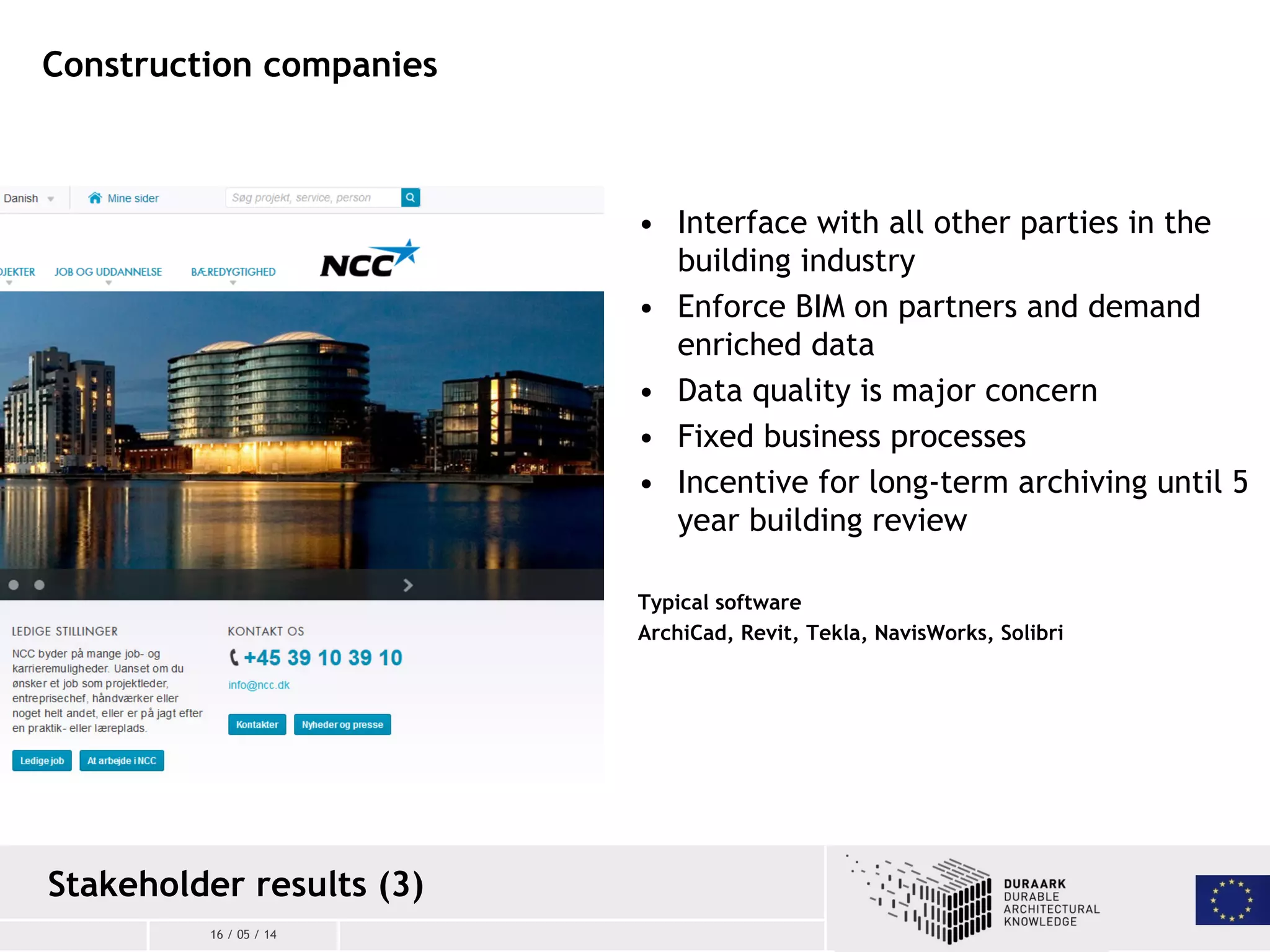
• Interface with all other parties in the
building industry
• Enforce BIM on partners and demand
enriched data
• Data quality is major concern
• Fixed business processes
• Incentive for long-term archiving until 5
year building review
Typical software
ArchiCad, Revit, Tekla, NavisWorks, Solibri
Construction companies
Stakeholder results (3)
16 / 05 / 14
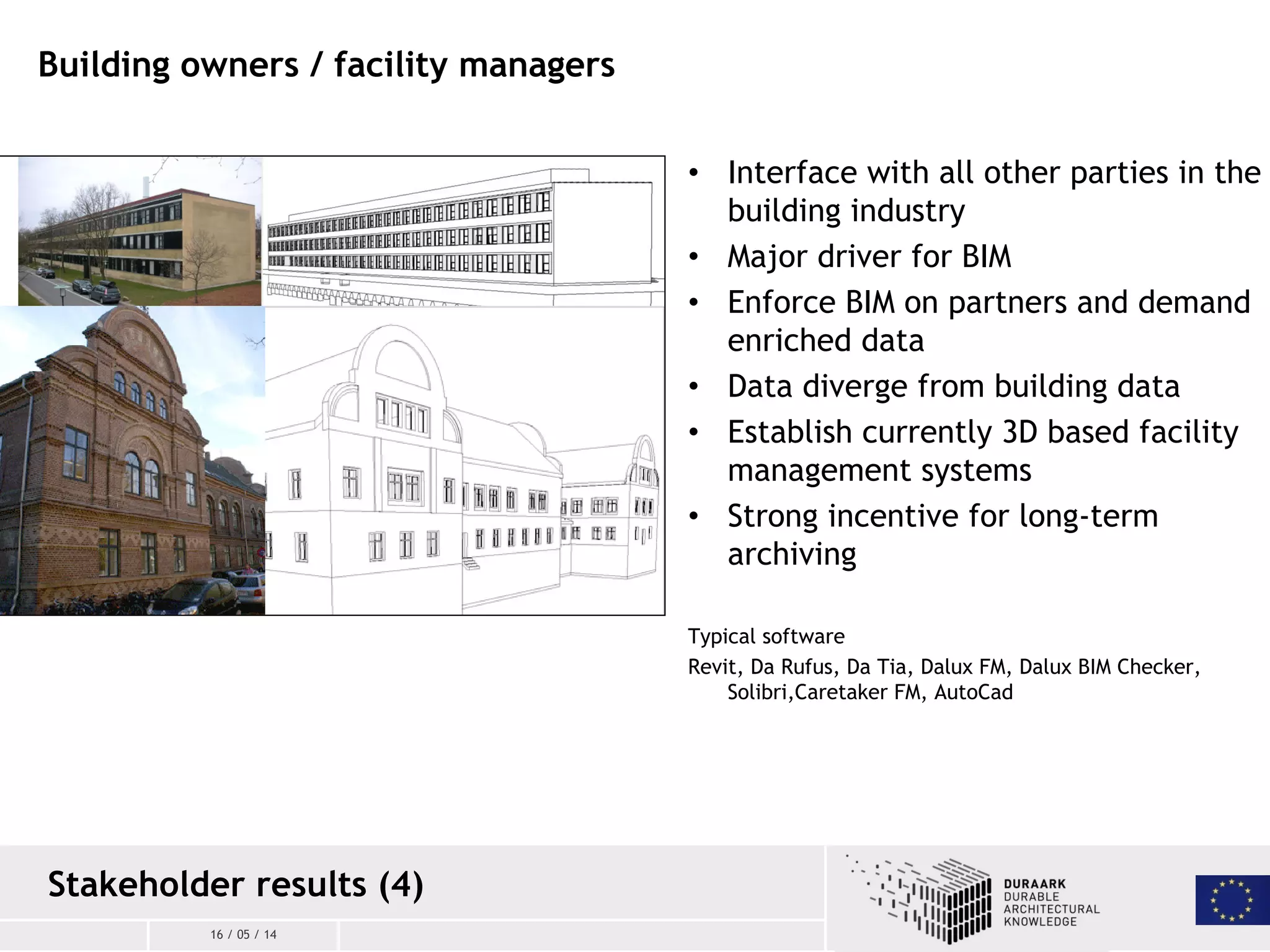
• Interface with all other parties in the
building industry
• Major driver for BIM
• Enforce BIM on partners and demand
enriched data
• Data diverge from building data
• Establish currently 3D based facility
management systems
• Strong incentive for long-term
archiving
Typical software
Revit, Da Rufus, Da Tia, Dalux FM, Dalux BIM Checker,
Solibri,Caretaker FM, AutoCad
Building owners / facility managers
Stakeholder results (4)
16 / 05 / 14
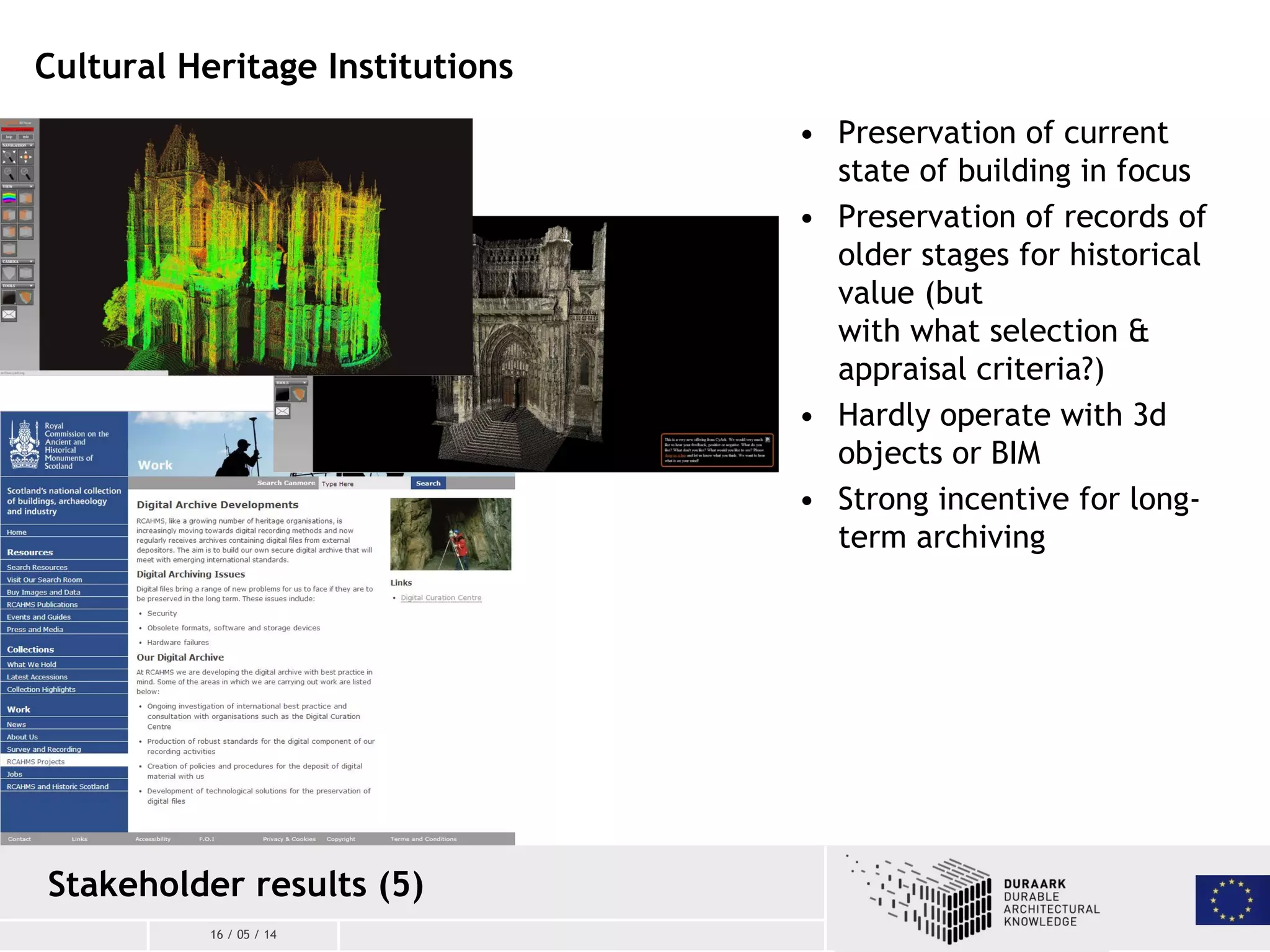
• Preservation of current
state of building in focus
• Preservation of records of
older stages for historical
value (but
with what selection &
appraisal criteria?)
• Hardly operate with 3d
objects or BIM
• Strong incentive for long-
term archiving
Cultural Heritage Institutions
Stakeholder results (5)
16 / 05 / 14
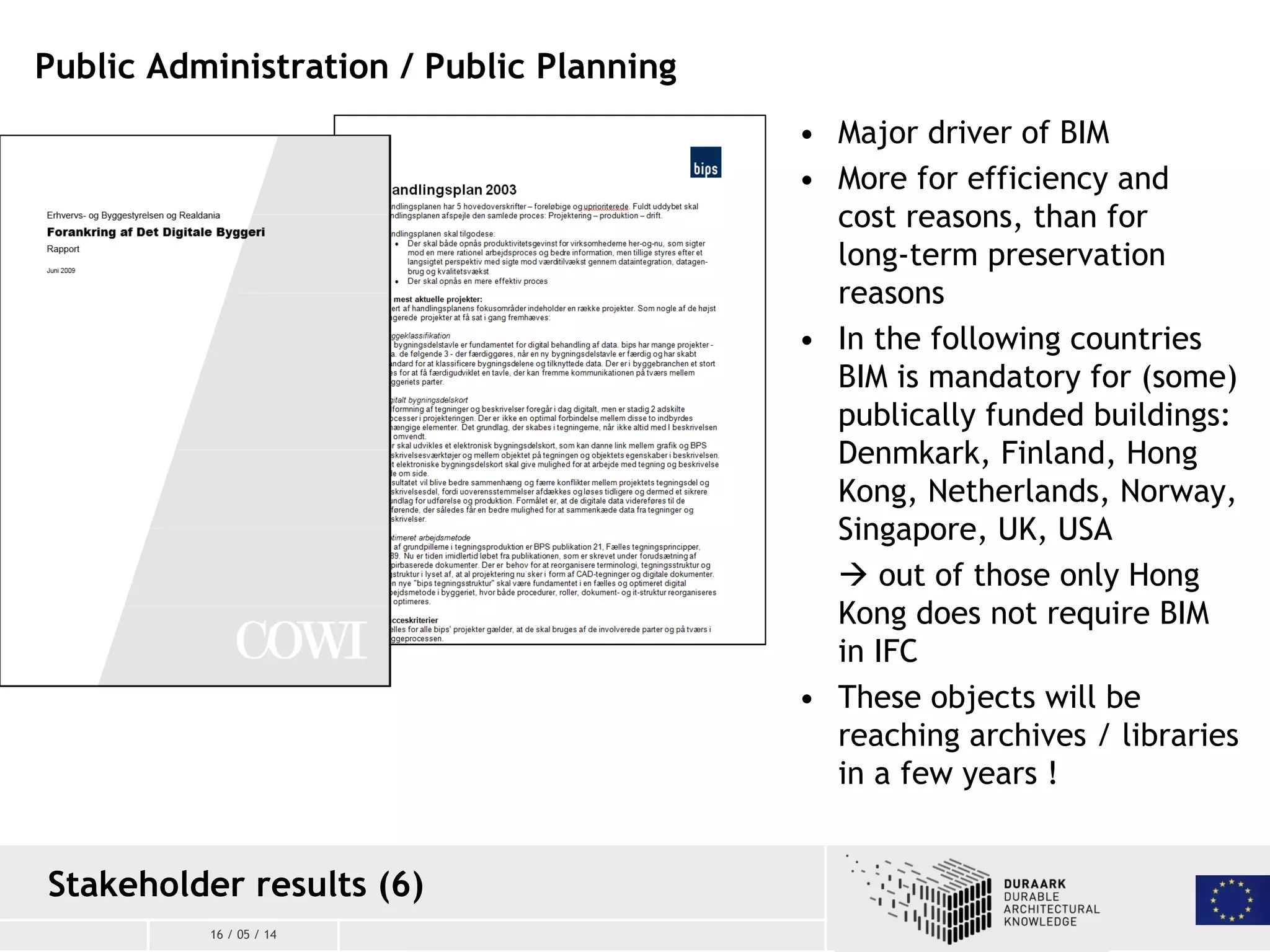
Public Administration / Public Planning
• Major driver of BIM
• More for efficiency and
cost reasons, than for
long-term preservation
reasons
• In the following countries
BIM is mandatory for (some)
publically funded buildings:
Denmkark, Finland, Hong
Kong, Netherlands, Norway,
Singapore, UK, USA
 out of those only Hong
Kong does not require BIM
in IFC
• These objects will be
reaching archives / libraries
in a few years !
Stakeholder results (6)
16 / 05 / 14
We now know who, what and why.
But how can the objects be preserved ?
16 / 05 / 14
The 3 [preservation] layers of a digital object
16 / 05 / 14
Bit preservation
- integrity checks
- storage choice and location
- storage montitoring (including monitored redudancy) and desaster
recovery planning
- organizational implementation of good IT practise
Logical preservation
- file format description, e.g. in registry
- Identification, technical metadata extraction, validation
- file format sustainability
Semantic preservation
- metadata capturing at all levels
- enrichment on ingest with additional information
- montioring of sources
- Tracing and capturing changes in semantic information
The 3 [preservation] layers of a digital object
16 / 05 / 14
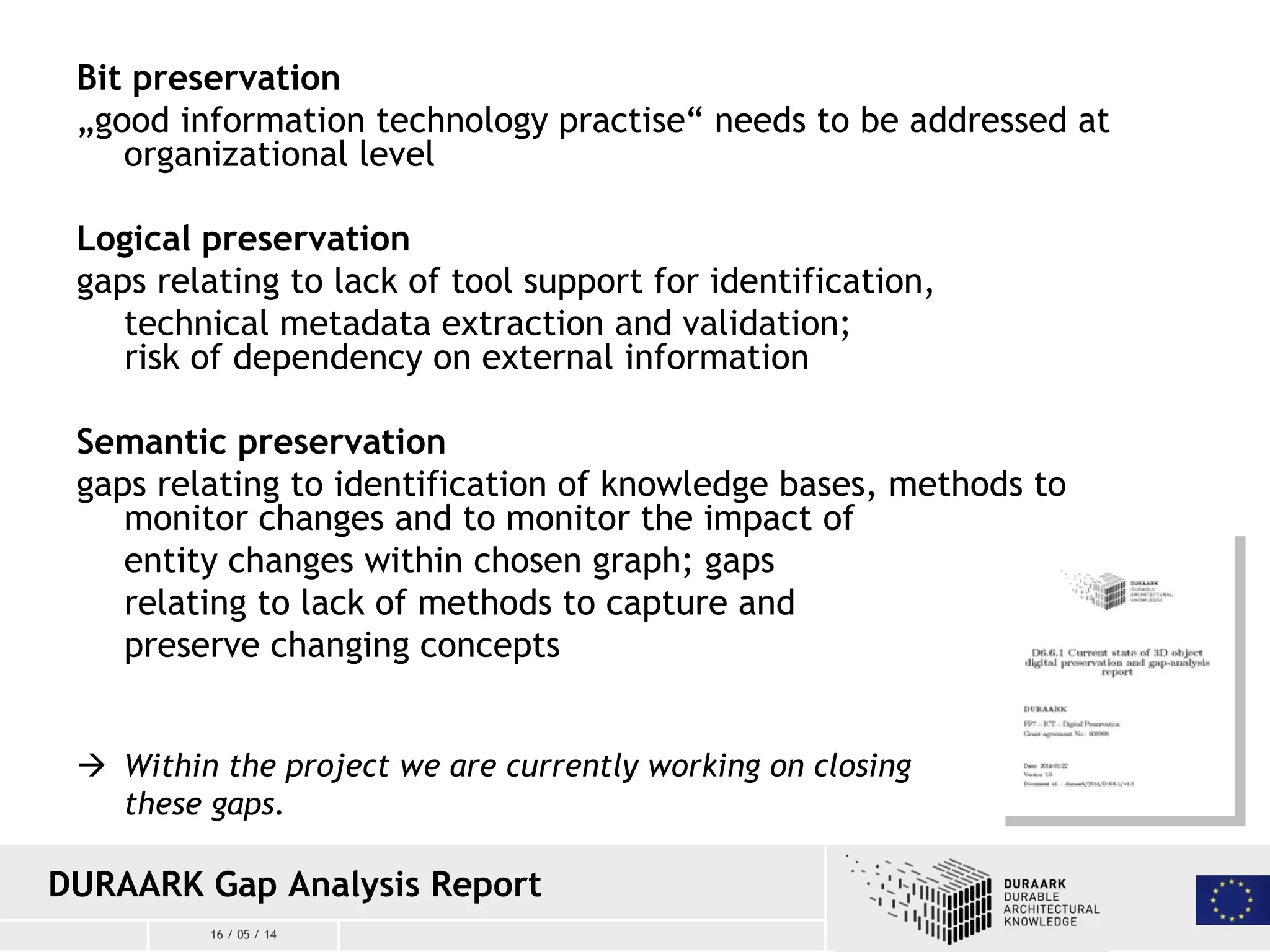
DURAARK Gap Analysis Report
Bit preservation
„good information technology practise“ needs to be addressed at
organizational level
Logical preservation
gaps relating to lack of tool support for identification,
technical metadata extraction and validation;
risk of dependency on external information
Semantic preservation
gaps relating to identification of knowledge bases, methods to
monitor changes and to monitor the impact of
entity changes within chosen graph; gaps
relating to lack of methods to capture and
preserve changing concepts
 Within the project we are currently working on closing
these gaps.
16 / 05 / 14
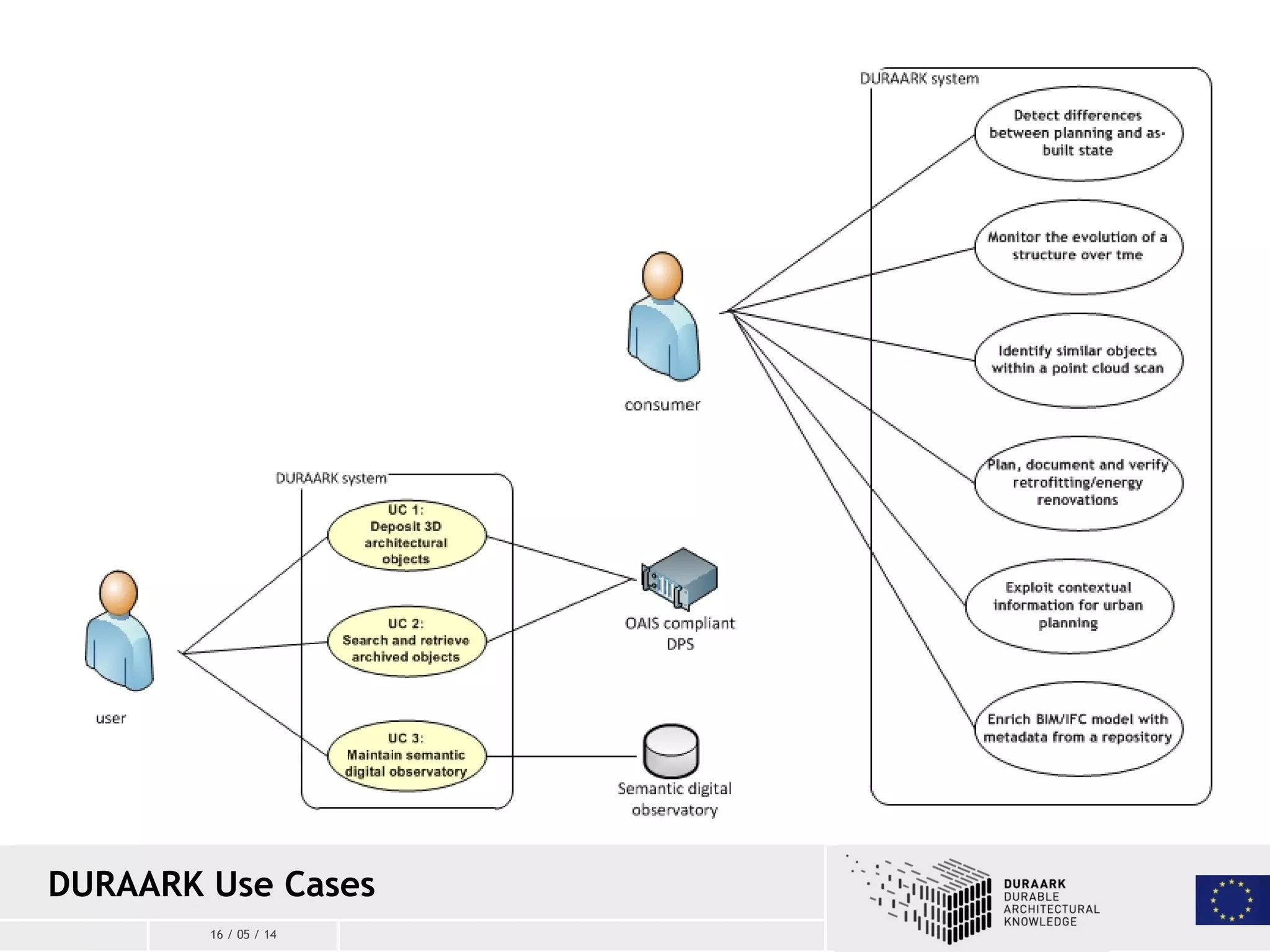
DURAARK Use Cases
16 / 05 / 14
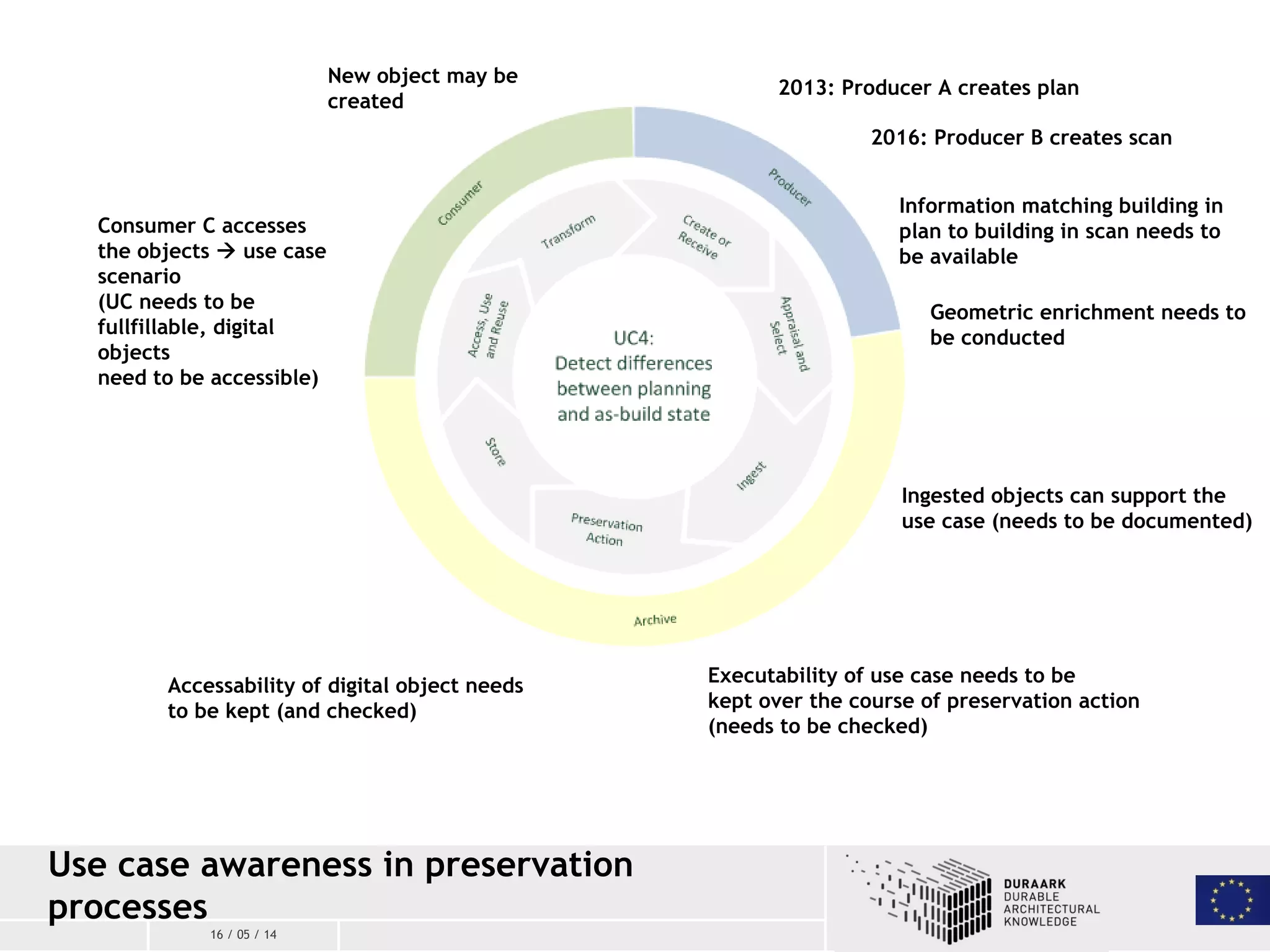
Use case awareness in preservation
processes
2013: Producer A creates plan
2016: Producer B creates scan
Information matching building in
plan to building in scan needs to
be available
Geometric enrichment needs to
be conducted
Ingested objects can support the
use case (needs to be documented)
Executability of use case needs to be
kept over the course of preservation action
(needs to be checked)
Accessability of digital object needs
to be kept (and checked)
Consumer C accesses
the objects  use case
scenario
(UC needs to be
fullfillable, digital
objects
need to be accessible)
New object may be
created
16 / 05 / 14
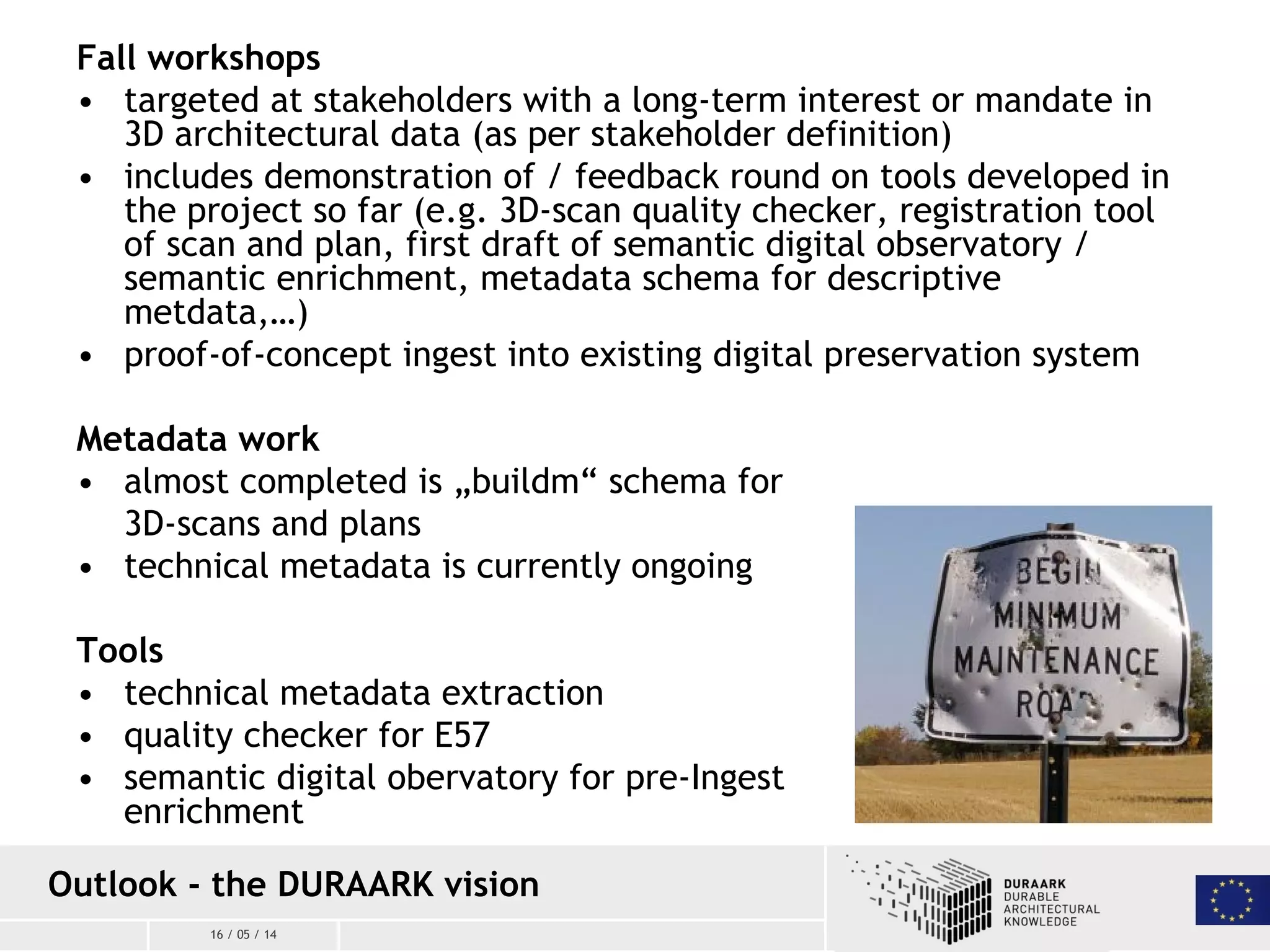
Outlook - the DURAARK vision
Fall workshops
• targeted at stakeholders with a long-term interest or mandate in
3D architectural data (as per stakeholder definition)
• includes demonstration of / feedback round on tools developed in
the project so far (e.g. 3D-scan quality checker, registration tool
of scan and plan, first draft of semantic digital observatory /
semantic enrichment, metadata schema for descriptive
metdata,…)
• proof-of-concept ingest into existing digital preservation system
Metadata work
• almost completed is „buildm“ schema for
3D-scans and plans
• technical metadata is currently ongoing
Tools
• technical metadata extraction
• quality checker for E57
• semantic digital obervatory for pre-Ingest
enrichment
16 / 05 / 14
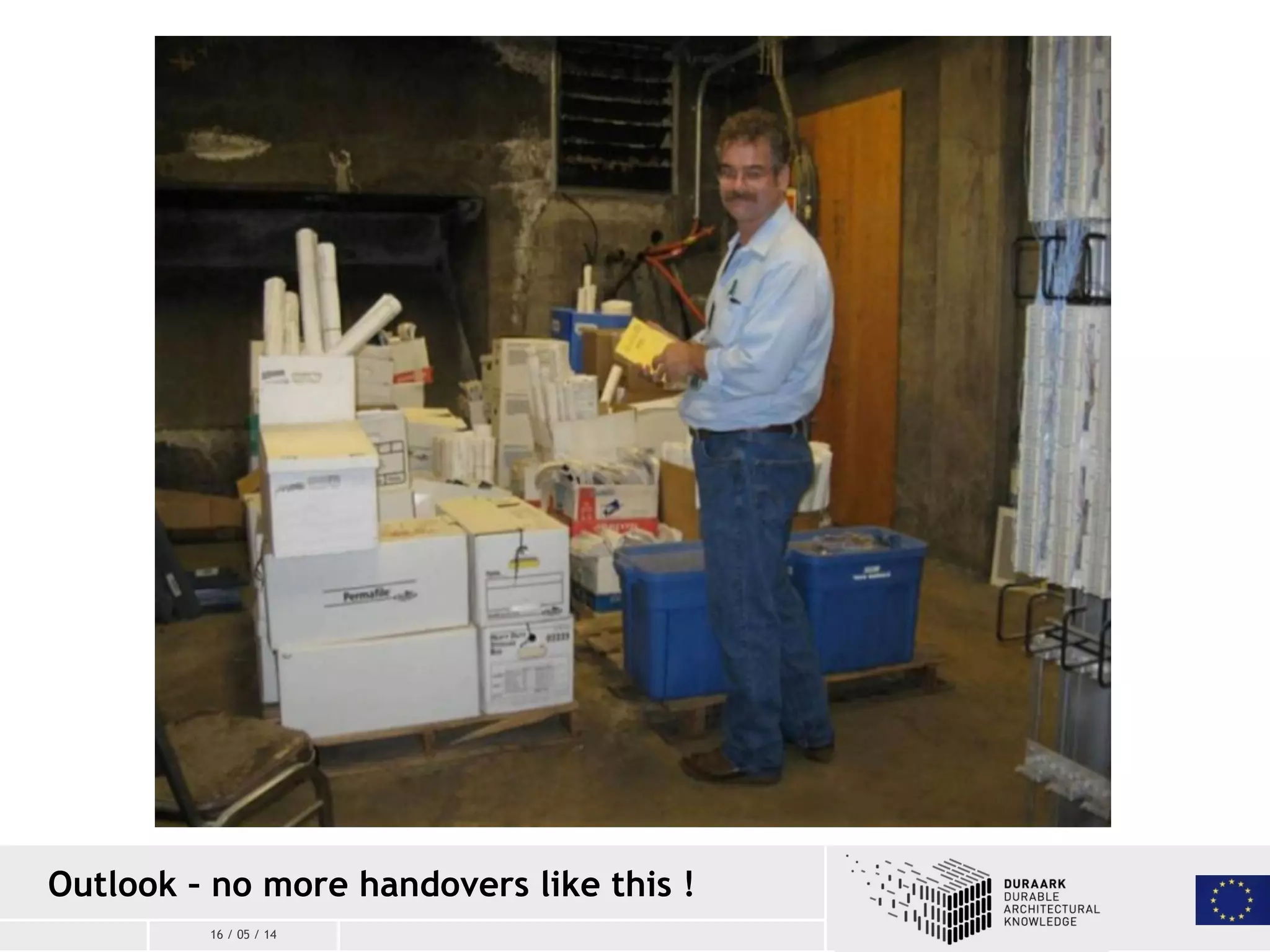
Outlook – no more handovers like this !
21 / 10 / 13
Thank you. Questions? Suggestions?
www.duraark.eu
michelle.lindlar@tib.uni-hannover.de
martin.tamke@kadk.dk
Do you have architectural
3D data? Contact us!

A Domain-driven Approach to Digital Curation and Preservation of 3D Architectural Data - Stakeholder Identification and Alignment in the DURAARK project

  • 1.
    16 / 05/ 14 A Domain-driven Approach to Digital Curation and Preservation of 3D Architectural Data - Stakeholder Identification and Alignment in the DURAARK project - Michelle Lindlar (LUH / TIB) Martin Tamke (CITA) Archiving 2014 Berlin, May 13th – 16th 2014
  • 2.
    16 / 05/ 14 Brief introduction to DURAARK • to 3D scans • to BIM Stakeholder Identification • why? • different models used • results for 6 stakeholder • the „stakeholder preservation“ Use Cases Outlook
  • 3.
    16 / 05/ 14 DURAARK (DURAble Architectural Knowledge) FP7 – ICT – Digital Preservation (STReP) February 2013 – January 2016 Goal Develop methods and tools for digital preservation and curation of 3D building data, metadata, related knowledge & web data) Scope • interlinked curation and preservation workflows • focus on two open file formats: IFC and E57 • incorporate existing OAIS compliant digital preservation system Project overview
  • 4.
    16 / 05/ 14 DURAARK – an interdisciplinary project
  • 5.
    16 / 05/ 14 3D building data – scans ScanCoptor by FaroLabs Point clouds Point clouds are a set of points in a 3D (X, Y, Z) coordinate system which describe the external surfaces of a scanned object. While other domains may use post-processed NURBS models or 2D slices as the 3D scan reconstruction, the architectural and construction domains work directly with point clouds. E57 – ASTM E2907-11 Standard Zebedee by CSIRO
  • 6.
    16 / 05/ 14 3D building data – models Building Information Modelling (BIM) Moves beyond CAD by covering the entire design-to- construction process (including: project planning, cost, part specifications, construction time, …) IFC – based on STEP standards (ISO 10303), ISO16739:2013 3D CAD Geometry along X-Y-Z axes 4D CAD Schedule time 5D CAD Cost-related information 6D CAD Energy and sustainability 7D CAD Facility management Lund Cristallen by DURAARK partner CCO architects
  • 7.
    16 / 05/ 14 Stakeholder Identification Why? Stakeholder need to be identified to understand … … how data is created, processed and used … where data is already being stored / archived … where data (long-term) availability would be beneficial, but is not in place … what level of digital preservation knowledge / risk awareness can be assumed  To identify gaps which need to be closed in curation & preservation practises for the respective data  (… and the OAIS says so …)
  • 8.
    16 / 05/ 14 Different models How do you explain digital preservation to your stakeholders ?
  • 9.
    16 / 05/ 14 Design-to-Construction-to-Retrofit Model
  • 10.
    16 / 05/ 14 Design-to-Construction-to-Retrofit Model
  • 11.
    16 / 05/ 14 Digital Object Lifecycle Model Based on DCC Digital Curation Lifecycle Model
  • 12.
    16 / 05/ 14 Land surveyors and 3D scanning companies • Interface with all other parties in the building industry and at all points of a building process • Exclusive user of 3D scanners in AEC • Challenged by BIM  need to adapt their practice to provide project and client specific data • Little incentive for long-term archiving Typical software: Faro Scene, Bentley Pointools, Trimble RealWorks, AutoCAD, Revit Stakeholder results (1)
  • 13.
    16 / 05/ 14 • Interface with all other parties in the building industry • Embrace BIM • BIM is hard to integrate in retrofitting • Flexible business processes • Little incentive for long-term archiving Typical software Revit, Navisworks, Velux Daylight Visualizer, Bentley Microstation CAD and BIMAutoCAD, SketchUp, Revit, NavisWorks, Dalux Model Checker, Ecotect Analysis, Vasari, Flow Design, AutoCAD, Revit, Solibri Architects and engineers Stakeholder results (2)
  • 14.
    16 / 05/ 14 • Interface with all other parties in the building industry • Enforce BIM on partners and demand enriched data • Data quality is major concern • Fixed business processes • Incentive for long-term archiving until 5 year building review Typical software ArchiCad, Revit, Tekla, NavisWorks, Solibri Construction companies Stakeholder results (3)
  • 15.
    16 / 05/ 14 • Interface with all other parties in the building industry • Major driver for BIM • Enforce BIM on partners and demand enriched data • Data diverge from building data • Establish currently 3D based facility management systems • Strong incentive for long-term archiving Typical software Revit, Da Rufus, Da Tia, Dalux FM, Dalux BIM Checker, Solibri,Caretaker FM, AutoCad Building owners / facility managers Stakeholder results (4)
  • 16.
    16 / 05/ 14 • Preservation of current state of building in focus • Preservation of records of older stages for historical value (but with what selection & appraisal criteria?) • Hardly operate with 3d objects or BIM • Strong incentive for long- term archiving Cultural Heritage Institutions Stakeholder results (5)
  • 17.
    16 / 05/ 14 Public Administration / Public Planning • Major driver of BIM • More for efficiency and cost reasons, than for long-term preservation reasons • In the following countries BIM is mandatory for (some) publically funded buildings: Denmkark, Finland, Hong Kong, Netherlands, Norway, Singapore, UK, USA  out of those only Hong Kong does not require BIM in IFC • These objects will be reaching archives / libraries in a few years ! Stakeholder results (6)
  • 18.
    16 / 05/ 14 We now know who, what and why. But how can the objects be preserved ?
  • 19.
    16 / 05/ 14 The 3 [preservation] layers of a digital object
  • 20.
    16 / 05/ 14 Bit preservation - integrity checks - storage choice and location - storage montitoring (including monitored redudancy) and desaster recovery planning - organizational implementation of good IT practise Logical preservation - file format description, e.g. in registry - Identification, technical metadata extraction, validation - file format sustainability Semantic preservation - metadata capturing at all levels - enrichment on ingest with additional information - montioring of sources - Tracing and capturing changes in semantic information The 3 [preservation] layers of a digital object
  • 21.
    16 / 05/ 14 DURAARK Gap Analysis Report Bit preservation „good information technology practise“ needs to be addressed at organizational level Logical preservation gaps relating to lack of tool support for identification, technical metadata extraction and validation; risk of dependency on external information Semantic preservation gaps relating to identification of knowledge bases, methods to monitor changes and to monitor the impact of entity changes within chosen graph; gaps relating to lack of methods to capture and preserve changing concepts  Within the project we are currently working on closing these gaps.
  • 22.
    16 / 05/ 14 DURAARK Use Cases
  • 23.
    16 / 05/ 14 Use case awareness in preservation processes 2013: Producer A creates plan 2016: Producer B creates scan Information matching building in plan to building in scan needs to be available Geometric enrichment needs to be conducted Ingested objects can support the use case (needs to be documented) Executability of use case needs to be kept over the course of preservation action (needs to be checked) Accessability of digital object needs to be kept (and checked) Consumer C accesses the objects  use case scenario (UC needs to be fullfillable, digital objects need to be accessible) New object may be created
  • 24.
    16 / 05/ 14 Outlook - the DURAARK vision Fall workshops • targeted at stakeholders with a long-term interest or mandate in 3D architectural data (as per stakeholder definition) • includes demonstration of / feedback round on tools developed in the project so far (e.g. 3D-scan quality checker, registration tool of scan and plan, first draft of semantic digital observatory / semantic enrichment, metadata schema for descriptive metdata,…) • proof-of-concept ingest into existing digital preservation system Metadata work • almost completed is „buildm“ schema for 3D-scans and plans • technical metadata is currently ongoing Tools • technical metadata extraction • quality checker for E57 • semantic digital obervatory for pre-Ingest enrichment
  • 25.
    16 / 05/ 14 Outlook – no more handovers like this !
  • 26.
    21 / 10/ 13 Thank you. Questions? Suggestions? www.duraark.eu michelle.lindlar@tib.uni-hannover.de martin.tamke@kadk.dk Do you have architectural 3D data? Contact us!